EE-2027 SaS, L2 1/25
Lecture 2: Signals Concepts & Properties
(1) Systems, signals, mathematical models.
Continuous-time and discrete-time signals.
Energy and power signals. Causal, Linear and
Time Invariant systems.
Specific objectives for this lecture include
• Energy and power for continuous & discrete-time
signals
EE-2027 SaS, L2 2/25
Lecture 2: Resources
• SaS, O&W, Sections 1.1-1.4
• SaS, H&vV, Sections 1.4-1.9
EE-2027 SaS, L2 3/25
Reminder: Continuous & Discrete Signals
x(t)
t
x[n]
n
Continuous-Time Signals
Most signals in the real world are
continuous time, as the scale is
infinitesimally fine.
E.g. voltage, velocity,
Denote by x(t), where the time
interval may be bounded (finite) or
infinite
Discrete-Time Signals
Some real world and many digital
signals are discrete time, as they
are sampled
E.g. pixels, daily stock price
(anything that a digital computer
processes)
Denote by x[n], where n is an integer
value that varies discretely
Sampled continuous signal
x[n] =x(nk)
EE-2027 SaS, L2 4/25
“Electrical” Signal Energy & Power
It is often useful to characterise signals by measures such
as energy and power
For example, the instantaneous power of a resistor is:
and the total energy expanded over the interval [t1, t2] is:
and the average energy is:
How are these concepts defined for any continuous or
discrete time signal?
)(
1
)()()( 2
tv
R
titvtp ==
∫∫ =
2
1
2
1
)(
1
)( 2
t
t
t
t
dttv
R
dttp
∫∫ −
=
−
2
1
2
1
)(
11
)(
1 2
1212
t
t
t
t
dttv
Rtt
dttp
tt
EE-2027 SaS, L2 5/25
Generic Signal Energy and Power
Total energy of a continuous signal x(t) over [t1, t2] is:
where |.| denote the magnitude of the (complex) number.
Similarly for a discrete time signal x[n] over [n1, n2]:
By dividing the quantities by (t2-t1) and (n2-n1+1), respectively,
gives the average power, P
∫=
2
1
2
)(
t
t
dttxE
∑ =
= 2
1
2
][
n
nn
nxE
EE-2027 SaS, L2 6/25
Energy and Power over Infinite Time
For many signals, we’re interested in examining the power and energy
over an infinite time interval (-∞, ∞). These quantities are therefore
defined by:
If the sums or integrals do not converge, the energy of such a signal is
infinite
Two important (sub)classes of signals
1. Finite total energy (and therefore zero average power)
2. Finite average power (and therefore infinite total energy)
Signal analysis over infinite time, all depends on the “tails” (limiting
behaviour)
∫∫
∞
∞−−
∞→∞ == dttxdttxE
T
T
T
22
)()(lim
∑∑
∞
−∞=−=∞→∞ == n
N
NnN nxnxE
22
][][lim
∫−
∞→∞ =
T
T
T dttx
T
P
2
)(
2
1
lim
∑ −=∞→∞
+
=
N
NnN nx
N
P
2
][
12
1
lim
EE-2027 SaS, L2 7/25
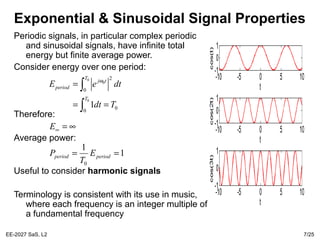
Exponential & Sinusoidal Signal Properties
Periodic signals, in particular complex periodic
and sinusoidal signals, have infinite total
energy but finite average power.
Consider energy over one period:
Therefore:
Average power:
Useful to consider harmonic signals
Terminology is consistent with its use in music,
where each frequency is an integer multiple of
a fundamental frequency
0
0
0
2
0
00
1
T
j t
period
T
E e dt
dt T
ω
=
= =
∫
∫
1
1
0
== periodperiod E
T
P
∞=∞E
EE-2027 SaS, L2 8/25
General Complex Exponential Signals
So far, considered the real and periodic complex exponential
Now consider when C can be complex. Let us express C is polar form
and a in rectangular form:
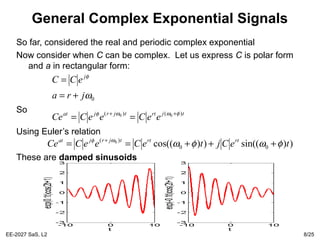
So
Using Euler’s relation
These are damped sinusoids
0ω
φ
jra
eCC j
+=
=
tjrttjrjat
eeCeeCCe )()( 00 φωωφ ++
==
))sin(())cos(( 00
)( 0
teCjteCeeCCe rtrttjrjat
φωφωωφ
+++== +
EE-2027 SaS, L2 9/25
Discrete Unit Impulse and Step Signals
The discrete unit impulse signal is defined:
Useful as a basis for analyzing other signals
The discrete unit step signal is defined:
Note that the unit impulse is the first
difference (derivative) of the step signal
Similarly, the unit step is the running sum
(integral) of the unit impulse.



=
≠
==
01
00
][][
n
n
nnx δ



≥
<
==
01
00
][][
n
n
nunx
]1[][][ −−= nununδ
EE-2027 SaS, L2 10/25
Continuous Unit Impulse and Step Signals
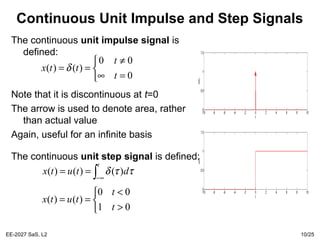
The continuous unit impulse signal is
defined:
Note that it is discontinuous at t=0
The arrow is used to denote area, rather
than actual value
Again, useful for an infinite basis
The continuous unit step signal is defined:



=∞
≠
==
0
00
)()(
t
t
ttx δ
∫ ∞−
==
t
dtutx ττδ )()()(



>
<
==
01
00
)()(
t
t
tutx
EE-2027 SaS, L2 11/25
Written Assignment 1
Q1.3
Q1.4
Q1.5
Q1.6
Q1.13

Lecture2 Signal and Systems

  • 1.
    EE-2027 SaS, L21/25 Lecture 2: Signals Concepts & Properties (1) Systems, signals, mathematical models. Continuous-time and discrete-time signals. Energy and power signals. Causal, Linear and Time Invariant systems. Specific objectives for this lecture include • Energy and power for continuous & discrete-time signals
  • 2.
    EE-2027 SaS, L22/25 Lecture 2: Resources • SaS, O&W, Sections 1.1-1.4 • SaS, H&vV, Sections 1.4-1.9
  • 3.
    EE-2027 SaS, L23/25 Reminder: Continuous & Discrete Signals x(t) t x[n] n Continuous-Time Signals Most signals in the real world are continuous time, as the scale is infinitesimally fine. E.g. voltage, velocity, Denote by x(t), where the time interval may be bounded (finite) or infinite Discrete-Time Signals Some real world and many digital signals are discrete time, as they are sampled E.g. pixels, daily stock price (anything that a digital computer processes) Denote by x[n], where n is an integer value that varies discretely Sampled continuous signal x[n] =x(nk)
  • 4.
    EE-2027 SaS, L24/25 “Electrical” Signal Energy & Power It is often useful to characterise signals by measures such as energy and power For example, the instantaneous power of a resistor is: and the total energy expanded over the interval [t1, t2] is: and the average energy is: How are these concepts defined for any continuous or discrete time signal? )( 1 )()()( 2 tv R titvtp == ∫∫ = 2 1 2 1 )( 1 )( 2 t t t t dttv R dttp ∫∫ − = − 2 1 2 1 )( 11 )( 1 2 1212 t t t t dttv Rtt dttp tt
  • 5.
    EE-2027 SaS, L25/25 Generic Signal Energy and Power Total energy of a continuous signal x(t) over [t1, t2] is: where |.| denote the magnitude of the (complex) number. Similarly for a discrete time signal x[n] over [n1, n2]: By dividing the quantities by (t2-t1) and (n2-n1+1), respectively, gives the average power, P ∫= 2 1 2 )( t t dttxE ∑ = = 2 1 2 ][ n nn nxE
  • 6.
    EE-2027 SaS, L26/25 Energy and Power over Infinite Time For many signals, we’re interested in examining the power and energy over an infinite time interval (-∞, ∞). These quantities are therefore defined by: If the sums or integrals do not converge, the energy of such a signal is infinite Two important (sub)classes of signals 1. Finite total energy (and therefore zero average power) 2. Finite average power (and therefore infinite total energy) Signal analysis over infinite time, all depends on the “tails” (limiting behaviour) ∫∫ ∞ ∞−− ∞→∞ == dttxdttxE T T T 22 )()(lim ∑∑ ∞ −∞=−=∞→∞ == n N NnN nxnxE 22 ][][lim ∫− ∞→∞ = T T T dttx T P 2 )( 2 1 lim ∑ −=∞→∞ + = N NnN nx N P 2 ][ 12 1 lim
  • 7.
    EE-2027 SaS, L27/25 Exponential & Sinusoidal Signal Properties Periodic signals, in particular complex periodic and sinusoidal signals, have infinite total energy but finite average power. Consider energy over one period: Therefore: Average power: Useful to consider harmonic signals Terminology is consistent with its use in music, where each frequency is an integer multiple of a fundamental frequency 0 0 0 2 0 00 1 T j t period T E e dt dt T ω = = = ∫ ∫ 1 1 0 == periodperiod E T P ∞=∞E
  • 8.
    EE-2027 SaS, L28/25 General Complex Exponential Signals So far, considered the real and periodic complex exponential Now consider when C can be complex. Let us express C is polar form and a in rectangular form: So Using Euler’s relation These are damped sinusoids 0ω φ jra eCC j += = tjrttjrjat eeCeeCCe )()( 00 φωωφ ++ == ))sin(())cos(( 00 )( 0 teCjteCeeCCe rtrttjrjat φωφωωφ +++== +
  • 9.
    EE-2027 SaS, L29/25 Discrete Unit Impulse and Step Signals The discrete unit impulse signal is defined: Useful as a basis for analyzing other signals The discrete unit step signal is defined: Note that the unit impulse is the first difference (derivative) of the step signal Similarly, the unit step is the running sum (integral) of the unit impulse.    = ≠ == 01 00 ][][ n n nnx δ    ≥ < == 01 00 ][][ n n nunx ]1[][][ −−= nununδ
  • 10.
    EE-2027 SaS, L210/25 Continuous Unit Impulse and Step Signals The continuous unit impulse signal is defined: Note that it is discontinuous at t=0 The arrow is used to denote area, rather than actual value Again, useful for an infinite basis The continuous unit step signal is defined:    =∞ ≠ == 0 00 )()( t t ttx δ ∫ ∞− == t dtutx ττδ )()()(    > < == 01 00 )()( t t tutx
  • 11.
    EE-2027 SaS, L211/25 Written Assignment 1 Q1.3 Q1.4 Q1.5 Q1.6 Q1.13