KNF1023
                                   Engineering
                                Mathematics II

                                   Second Order ODEs
               Prepared By
              Annie ak Joseph


Prepared By
Annie ak Joseph                          Session 2008/2009
Learning Objectives


      Explain about 2nd Order Linear ODEs


         Discuss about General Solutions of
         Homogeneous ODEs


        Explain about Homogeneous ODEs with
       constants coefficients
Second Order Linear ODEs

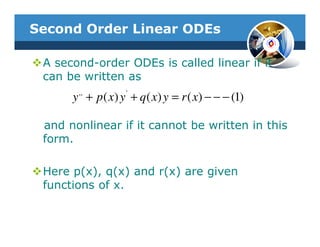
 A second-order ODEs is called linear if it
 can be written as
       ,,          '
      y + p ( x) y + q ( x) y = r ( x) − − − (1)

 and nonlinear if it cannot be written in this
 form.

 Here p(x), q(x) and r(x) are given
 functions of x.
Second Order Linear ODEs

                ,,         '
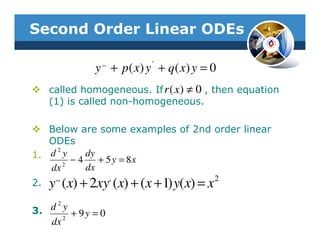
               y + p ( x) y + q ( x) y = 0
     called homogeneous. If r ( x ) ≠ 0 , then equation
     (1) is called non-homogeneous.

   Below are some examples of 2nd order linear
   ODEs
    2
1. d y − 4 dy + 5 y = 8 x
   dx 2    dx
      ,,             ,                    2
2.   y (x) + 2xy (x) + (x + 1) y(x) = x
3. d2y
      2
        + 9y = 0
   dx
General Solutions Of Homogeneous
ODEs

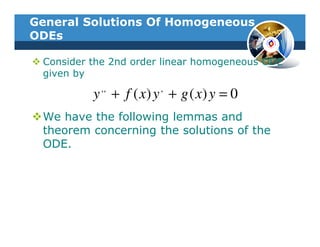
 Consider the 2nd order linear homogeneous ODE
 given by
           ,,          ,
          y + f ( x) y + g ( x) y = 0
 We have the following lemmas and
 theorem concerning the solutions of the
 ODE.
Lemma #1, #2 and Theorem 2

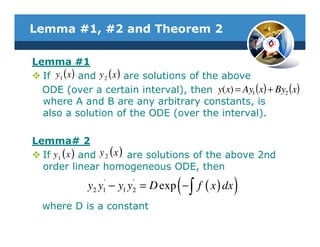
Lemma #1
  If y1 (x ) and y 2 ( x ) are solutions of the above
  ODE (over a certain interval), then y(x) = Ay1 (x) + By2 (x)
  where A and B are any arbitrary constants, is
  also a solution of the ODE (over the interval).

Lemma# 2
  If y 1 ( x ) and y 2 ( x ) are solutions of the above 2nd
  order linear homogeneous ODE, then
                '
              2 1
                       '
                     1 2           (
             y y − y y = D exp − ∫ f ( x ) dx   )
  where D is a constant
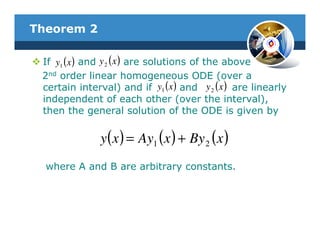
Theorem 2

 If y1 (x ) and y 2 ( x ) are solutions of the above
 2nd order linear homogeneous ODE (over a
 certain interval) and if y1 (x ) and y 2 ( x ) are linearly
 independent of each other (over the interval),
 then the general solution of the ODE is given by

               y( x ) = Ay1 ( x ) + By 2 ( x )
  where A and B are arbitrary constants.
Homogeneous ODEs With Constant
Coefficients

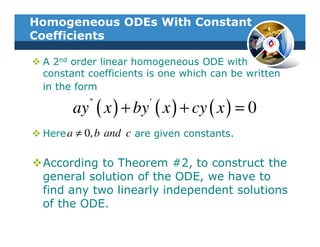
 A 2nd order linear homogeneous ODE with
 constant coefficients is one which can be written
 in the form

       ay ( x ) + by ( x ) + cy ( x ) = 0
          ''           '


 Here a ≠ 0, b and c are given constants.


 According to Theorem #2, to construct the
 general solution of the ODE, we have to
 find any two linearly independent solutions
 of the ODE.
Homogeneous ODEs With Constant
Coefficients

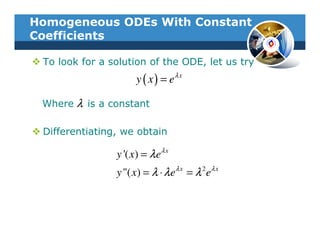
 To look for a solution of the ODE, let us try
                       y ( x ) = eλ x

 Where   λ is a constant

 Differentiating, we obtain

                 y '( x) = λ eλ x
                 y "( x) = λ ⋅ λ eλ x = λ 2 eλ x
Homogeneous ODEs With Constant
Coefficients

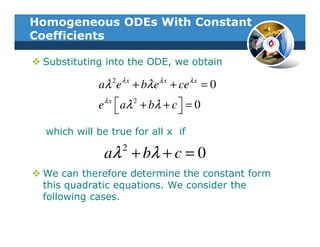
 Substituting into the ODE, we obtain

             aλ 2 eλ x + bλ eλ x + ceλ x = 0
                aλ 2 + bλ + c  = 0
              λx
             e                
  which will be true for all x if
                   2
              aλ + bλ + c = 0
 We can therefore determine the constant form
 this quadratic equations. We consider the
 following cases.
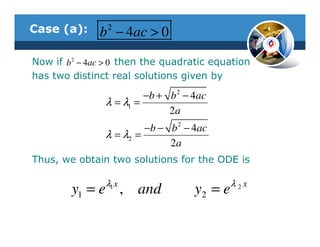
Case (a):       2
              b − 4ac > 0
Now if b 2 − 4ac > 0 then the quadratic equation
has two distinct real solutions given by

                         −b + b 2 − 4ac
                λ = λ1 =
                              2a
                         −b − b 2 − 4ac
                λ = λ2 =
                              2a
Thus, we obtain two solutions for the ODE is

                λ1 x                         λ2x
        y1 = e , and                y2 = e
Continue…

     y1 eλ1 x
       = λ 2 x = e[ 1 2 ] ≠ cons tan t ,since λ1 ≠ λ2 .
                   λ −λ x
 Now
     y2 e
 Hence, the two solutions are linearly
 independent. For this case where b 2 − 4 ac > 0
 from Theorem #2, the general solution of the
 ODE ay "+ by '+ cy = 0 (a≠0, b, and c are constants)
 is given by
                          λ1 x          λ2 x
                 y = Ae          + Be
 where A and B are arbitrary constants and λ1 and λ2
 are the solutions of the quadratic equation
                      2
                 aλ + bλ + c = 0
Example 1

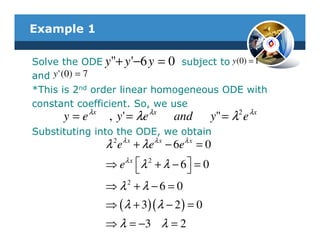
Solve the ODE y"+ y '−6 y = 0 subject to y (0) = 1
and y ' (0) = 7
*This is 2nd order linear homogeneous ODE with
constant coefficient. So, we use
            λx                 λx                    2 λx
      y=e         , y ' = λe         and        y" = λ e
Substituting into the ODE, we obtain
                 λ 2 e λ x + λ e λ x − 6e λ x = 0
                 ⇒e  λ 2 + λ − 6  = 0
                      λx
                                   
                 ⇒ λ2 + λ − 6 = 0
                 ⇒ ( λ + 3)( λ − 2 ) = 0
                 ⇒ λ = −3 λ = 2
Continue…

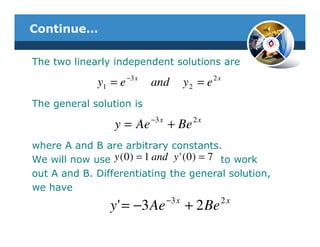
The two linearly independent solutions are
                       −3 x                          2x
              y1 = e          and           y2 = e
The general solution is
                              −3 x            2x
                  y = Ae             + Be
where A and B are arbitrary constants.
We will now use y ( 0 ) = 1 and y ' ( 0 ) = 7 to work
out A and B. Differentiating the general solution,
we have
                                     −3 x             2x
                 y ' = −3 Ae                + 2 Be
Continue…

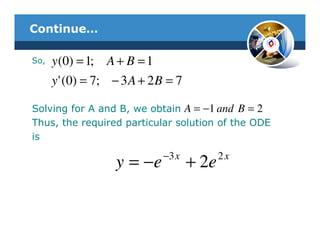
So,   y (0) = 1; A + B = 1
      y ' (0) = 7; − 3 A + 2 B = 7

Solving for A and B, we obtain A = −1 and B = 2
Thus, the required particular solution of the ODE
is
                             −3 x           2x
                   y = −e            + 2e
2
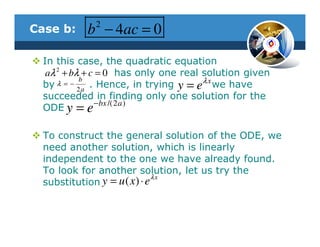
Case b:     b − 4ac = 0
  In this case, the quadratic equation
   aλ 2 + bλ + c = 0 has only one real solution given
            b
  by  λ =−
            2a
               . Hence, in trying y = eλ x we have
  succeeded in finding only one solution for the
                − bx /(2 a )
  ODE y = e

  To construct the general solution of the ODE, we
  need another solution, which is linearly
  independent to the one we have already found.
  To look for another solution, let us try the
                               λx
  substitution y = u ( x ) ⋅ e
Continue…

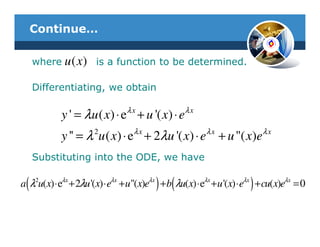
     where u ( x ) is a function to be determined.

     Differentiating, we obtain

                                λx                λx
            y ' = λu ( x) ⋅ e + u '( x) ⋅ e
            y '' = λ 2u ( x) ⋅ eλ x + 2λu '( x) ⋅ eλ x + u "( x)eλ x
     Substituting into the ODE, we have

 (                                       ) (                           )
a λ2u(x) ⋅ eλx + 2λu '(x) ⋅ eλx + u"(x)eλx + b λu(x) ⋅ eλx + u '(x) ⋅ eλx + cu(x)eλx = 0
Continue…

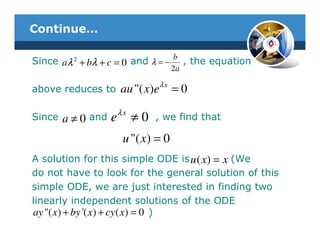
                                         b
Since aλ 2 + bλ + c = 0 and λ = −           , the equation
                                         2a
                                    λx
above reduces to        au "( x)e        =0
                        λx
Since   a≠0   and   e        ≠0   , we find that

                         u "( x ) = 0
A solution for this simple ODE is u ( x ) = x (We
do not have to look for the general solution of this
simple ODE, we are just interested in finding two
linearly independent solutions of the ODE
ay "( x ) + by '( x ) + cy ( x ) = 0 )
Continue…

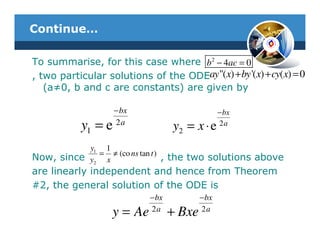
To summarise, for this case where b 2 − 4ac = 0
, two particular solutions of the ODEay "(x) + by '(x) + cy(x) = 0
   (a≠0, b and c are constants) are given by

                    − bx                          − bx
           y1 = e   2a
                                   y2 = x ⋅ e     2a


           y1 1
Now, since y2 = x ≠ (co ns tan t ) , the two solutions above
are linearly independent and hence from Theorem
#2, the general solution of the ODE is
                            − bx           − bx
                   y = Ae   2a
                                   + Bxe   2a
Example 2:

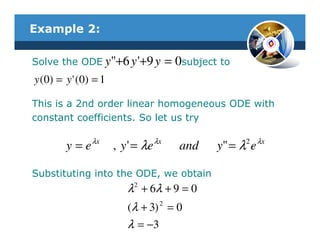
Solve the ODE y"+6 y '+9 y                = 0subject to
y ( 0) = y ' ( 0 ) = 1

This is a 2nd order linear homogeneous ODE with
constant coefficients. So let us try

         y = e λx        , y ' = λ e λx     and     y" = λ2 e λx

Substituting into the ODE, we obtain
                             λ 2 + 6λ + 9 = 0
                             (λ + 3) 2 = 0
                             λ = −3
Continue…

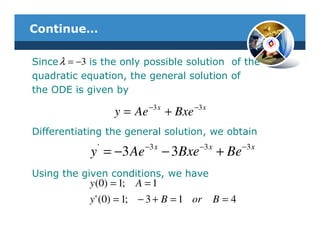
Since λ = −3 is the only possible solution of the
quadratic equation, the general solution of
the ODE is given by
                            −3 x           −3 x
                   y = Ae          + Bxe
Differentiating the general solution, we obtain
              '           −3 x              −3 x          −3 x
            y = −3 Ae              − 3Bxe          + Be
Using the given conditions, we have
            y (0) = 1;   A =1
            y ' (0) = 1; − 3 + B = 1 or            B=4
Continue…

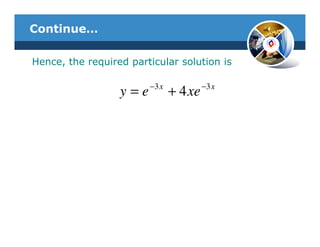
Hence, the required particular solution is

                        −3 x            −3 x
                  y=e          + 4 xe
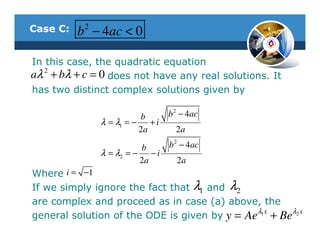
Case C:   b 2 − 4ac < 0

In this case, the quadratic equation
aλ 2 + bλ + c = 0 does not have any real solutions. It
has two distinct complex solutions given by

                         b          b 2 − 4ac
               λ = λ1 = − + i
                         2a           2a

                            b       b 2 − 4ac
               λ = λ2 = −      −i
                            2a        2a
Where i = −1
If we simply ignore the fact that λ1 and λ2
are complex and proceed as in case (a) above, the
                                              λx     λ x
general solution of the ODE is given by y = Ae 1 + Be 2
Continue…

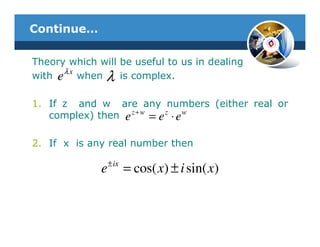
Theory which will be useful to us in dealing
      λx
with e when λ is complex.

1. If z and w are any numbers (either real or
   complex) then e z + w = e z ⋅ e w

2. If x is any real number then

                  ± ix
              e          = cos( x) ± i sin( x)
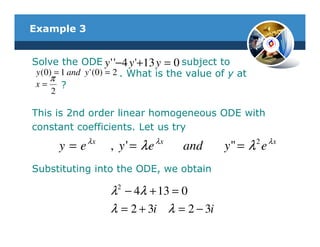
Example 3


Solve the ODE y ' '−4 y '+13 y = 0 subject to
 y (0) = 1 and y ' (0) = 2 . What is the value of y at
     π
 x=      ?
    2

This is 2nd order linear homogeneous ODE with
constant coefficients. Let us try

        y = e λx   , y ' = λ e λx     and       y" = λ 2 e λx
Substituting into the ODE, we obtain

                   λ2 − 4λ + 13 = 0
                   λ = 2 + 3i λ = 2 − 3i
Continue…

Thus, the general solution is given by

                              y = Ae ( 2+3i ) x + Be ( 2−3i ) x
Before we proceed any further, it is useful to
Rewrite the general solution as

           (2 + 3i ) x          (2 −3i ) x
y = Ae                   + Be
      2x           i (3 x )          − i (3 x )
y = e ( Ae                    + Be                )
y = e 2 x ( A [ cos(3 x) + i sin(3 x) ] + B [ cos(3 x) − i sin(3 x) ])
y = e 2 x ([ A + B ] cos(3 x) + i [ A − B ] sin(3 x) )
Continue…

Thus, we can rewrite the general solution as
                y = e 2 x [C cos(3 x) + D sin(3 x) ]
where C=A+B and D=i[A-B] are arbitrary
constants.
Differentiating, we have

y ' = e 2 x [− 3C sin(3x) + 3D cos(3x)] + 2e 2 x [C cos(3x) + D sin(3x)]
Using the given conditions, we find that

             y (0) = 1; C = 1
             y ' (0) = 2; 3D + 2C = 2 or               D=0
Continue…

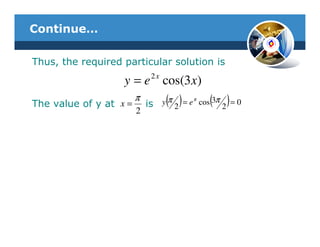
Thus, the required particular solution is
                             2x
                   y = e cos(3 x)
The value of y at x =
                        π
                            is    ( 2) = e
                                  yπ         π
                                                    ( 2) = 0
                                                 cos 3π
                        2
Prepared By
              Annie ak Joseph


Prepared By
Annie ak Joseph                 Session 2007/2008

Week 6 [compatibility mode]

  • 1.
    KNF1023 Engineering Mathematics II Second Order ODEs Prepared By Annie ak Joseph Prepared By Annie ak Joseph Session 2008/2009
  • 2.
    Learning Objectives Explain about 2nd Order Linear ODEs Discuss about General Solutions of Homogeneous ODEs Explain about Homogeneous ODEs with constants coefficients
  • 3.
    Second Order LinearODEs A second-order ODEs is called linear if it can be written as ,, ' y + p ( x) y + q ( x) y = r ( x) − − − (1) and nonlinear if it cannot be written in this form. Here p(x), q(x) and r(x) are given functions of x.
  • 4.
    Second Order LinearODEs ,, ' y + p ( x) y + q ( x) y = 0 called homogeneous. If r ( x ) ≠ 0 , then equation (1) is called non-homogeneous. Below are some examples of 2nd order linear ODEs 2 1. d y − 4 dy + 5 y = 8 x dx 2 dx ,, , 2 2. y (x) + 2xy (x) + (x + 1) y(x) = x 3. d2y 2 + 9y = 0 dx
  • 5.
    General Solutions OfHomogeneous ODEs Consider the 2nd order linear homogeneous ODE given by ,, , y + f ( x) y + g ( x) y = 0 We have the following lemmas and theorem concerning the solutions of the ODE.
  • 6.
    Lemma #1, #2and Theorem 2 Lemma #1 If y1 (x ) and y 2 ( x ) are solutions of the above ODE (over a certain interval), then y(x) = Ay1 (x) + By2 (x) where A and B are any arbitrary constants, is also a solution of the ODE (over the interval). Lemma# 2 If y 1 ( x ) and y 2 ( x ) are solutions of the above 2nd order linear homogeneous ODE, then ' 2 1 ' 1 2 ( y y − y y = D exp − ∫ f ( x ) dx ) where D is a constant
  • 7.
    Theorem 2 Ify1 (x ) and y 2 ( x ) are solutions of the above 2nd order linear homogeneous ODE (over a certain interval) and if y1 (x ) and y 2 ( x ) are linearly independent of each other (over the interval), then the general solution of the ODE is given by y( x ) = Ay1 ( x ) + By 2 ( x ) where A and B are arbitrary constants.
  • 8.
    Homogeneous ODEs WithConstant Coefficients A 2nd order linear homogeneous ODE with constant coefficients is one which can be written in the form ay ( x ) + by ( x ) + cy ( x ) = 0 '' ' Here a ≠ 0, b and c are given constants. According to Theorem #2, to construct the general solution of the ODE, we have to find any two linearly independent solutions of the ODE.
  • 9.
    Homogeneous ODEs WithConstant Coefficients To look for a solution of the ODE, let us try y ( x ) = eλ x Where λ is a constant Differentiating, we obtain y '( x) = λ eλ x y "( x) = λ ⋅ λ eλ x = λ 2 eλ x
  • 10.
    Homogeneous ODEs WithConstant Coefficients Substituting into the ODE, we obtain aλ 2 eλ x + bλ eλ x + ceλ x = 0  aλ 2 + bλ + c  = 0 λx e   which will be true for all x if 2 aλ + bλ + c = 0 We can therefore determine the constant form this quadratic equations. We consider the following cases.
  • 11.
    Case (a): 2 b − 4ac > 0 Now if b 2 − 4ac > 0 then the quadratic equation has two distinct real solutions given by −b + b 2 − 4ac λ = λ1 = 2a −b − b 2 − 4ac λ = λ2 = 2a Thus, we obtain two solutions for the ODE is λ1 x λ2x y1 = e , and y2 = e
  • 12.
    Continue… y1 eλ1 x = λ 2 x = e[ 1 2 ] ≠ cons tan t ,since λ1 ≠ λ2 . λ −λ x Now y2 e Hence, the two solutions are linearly independent. For this case where b 2 − 4 ac > 0 from Theorem #2, the general solution of the ODE ay "+ by '+ cy = 0 (a≠0, b, and c are constants) is given by λ1 x λ2 x y = Ae + Be where A and B are arbitrary constants and λ1 and λ2 are the solutions of the quadratic equation 2 aλ + bλ + c = 0
  • 13.
    Example 1 Solve theODE y"+ y '−6 y = 0 subject to y (0) = 1 and y ' (0) = 7 *This is 2nd order linear homogeneous ODE with constant coefficient. So, we use λx λx 2 λx y=e , y ' = λe and y" = λ e Substituting into the ODE, we obtain λ 2 e λ x + λ e λ x − 6e λ x = 0 ⇒e  λ 2 + λ − 6  = 0 λx  ⇒ λ2 + λ − 6 = 0 ⇒ ( λ + 3)( λ − 2 ) = 0 ⇒ λ = −3 λ = 2
  • 14.
    Continue… The two linearlyindependent solutions are −3 x 2x y1 = e and y2 = e The general solution is −3 x 2x y = Ae + Be where A and B are arbitrary constants. We will now use y ( 0 ) = 1 and y ' ( 0 ) = 7 to work out A and B. Differentiating the general solution, we have −3 x 2x y ' = −3 Ae + 2 Be
  • 15.
    Continue… So, y (0) = 1; A + B = 1 y ' (0) = 7; − 3 A + 2 B = 7 Solving for A and B, we obtain A = −1 and B = 2 Thus, the required particular solution of the ODE is −3 x 2x y = −e + 2e
  • 16.
    2 Case b: b − 4ac = 0 In this case, the quadratic equation aλ 2 + bλ + c = 0 has only one real solution given b by λ =− 2a . Hence, in trying y = eλ x we have succeeded in finding only one solution for the − bx /(2 a ) ODE y = e To construct the general solution of the ODE, we need another solution, which is linearly independent to the one we have already found. To look for another solution, let us try the λx substitution y = u ( x ) ⋅ e
  • 17.
    Continue… where u ( x ) is a function to be determined. Differentiating, we obtain λx λx y ' = λu ( x) ⋅ e + u '( x) ⋅ e y '' = λ 2u ( x) ⋅ eλ x + 2λu '( x) ⋅ eλ x + u "( x)eλ x Substituting into the ODE, we have ( ) ( ) a λ2u(x) ⋅ eλx + 2λu '(x) ⋅ eλx + u"(x)eλx + b λu(x) ⋅ eλx + u '(x) ⋅ eλx + cu(x)eλx = 0
  • 18.
    Continue… b Since aλ 2 + bλ + c = 0 and λ = − , the equation 2a λx above reduces to au "( x)e =0 λx Since a≠0 and e ≠0 , we find that u "( x ) = 0 A solution for this simple ODE is u ( x ) = x (We do not have to look for the general solution of this simple ODE, we are just interested in finding two linearly independent solutions of the ODE ay "( x ) + by '( x ) + cy ( x ) = 0 )
  • 19.
    Continue… To summarise, forthis case where b 2 − 4ac = 0 , two particular solutions of the ODEay "(x) + by '(x) + cy(x) = 0 (a≠0, b and c are constants) are given by − bx − bx y1 = e 2a y2 = x ⋅ e 2a y1 1 Now, since y2 = x ≠ (co ns tan t ) , the two solutions above are linearly independent and hence from Theorem #2, the general solution of the ODE is − bx − bx y = Ae 2a + Bxe 2a
  • 20.
    Example 2: Solve theODE y"+6 y '+9 y = 0subject to y ( 0) = y ' ( 0 ) = 1 This is a 2nd order linear homogeneous ODE with constant coefficients. So let us try y = e λx , y ' = λ e λx and y" = λ2 e λx Substituting into the ODE, we obtain λ 2 + 6λ + 9 = 0 (λ + 3) 2 = 0 λ = −3
  • 21.
    Continue… Since λ =−3 is the only possible solution of the quadratic equation, the general solution of the ODE is given by −3 x −3 x y = Ae + Bxe Differentiating the general solution, we obtain ' −3 x −3 x −3 x y = −3 Ae − 3Bxe + Be Using the given conditions, we have y (0) = 1; A =1 y ' (0) = 1; − 3 + B = 1 or B=4
  • 22.
    Continue… Hence, the requiredparticular solution is −3 x −3 x y=e + 4 xe
  • 23.
    Case C: b 2 − 4ac < 0 In this case, the quadratic equation aλ 2 + bλ + c = 0 does not have any real solutions. It has two distinct complex solutions given by b b 2 − 4ac λ = λ1 = − + i 2a 2a b b 2 − 4ac λ = λ2 = − −i 2a 2a Where i = −1 If we simply ignore the fact that λ1 and λ2 are complex and proceed as in case (a) above, the λx λ x general solution of the ODE is given by y = Ae 1 + Be 2
  • 24.
    Continue… Theory which willbe useful to us in dealing λx with e when λ is complex. 1. If z and w are any numbers (either real or complex) then e z + w = e z ⋅ e w 2. If x is any real number then ± ix e = cos( x) ± i sin( x)
  • 25.
    Example 3 Solve theODE y ' '−4 y '+13 y = 0 subject to y (0) = 1 and y ' (0) = 2 . What is the value of y at π x= ? 2 This is 2nd order linear homogeneous ODE with constant coefficients. Let us try y = e λx , y ' = λ e λx and y" = λ 2 e λx Substituting into the ODE, we obtain λ2 − 4λ + 13 = 0 λ = 2 + 3i λ = 2 − 3i
  • 26.
    Continue… Thus, the generalsolution is given by y = Ae ( 2+3i ) x + Be ( 2−3i ) x Before we proceed any further, it is useful to Rewrite the general solution as (2 + 3i ) x (2 −3i ) x y = Ae + Be 2x i (3 x ) − i (3 x ) y = e ( Ae + Be ) y = e 2 x ( A [ cos(3 x) + i sin(3 x) ] + B [ cos(3 x) − i sin(3 x) ]) y = e 2 x ([ A + B ] cos(3 x) + i [ A − B ] sin(3 x) )
  • 27.
    Continue… Thus, we canrewrite the general solution as y = e 2 x [C cos(3 x) + D sin(3 x) ] where C=A+B and D=i[A-B] are arbitrary constants. Differentiating, we have y ' = e 2 x [− 3C sin(3x) + 3D cos(3x)] + 2e 2 x [C cos(3x) + D sin(3x)] Using the given conditions, we find that y (0) = 1; C = 1 y ' (0) = 2; 3D + 2C = 2 or D=0
  • 28.
    Continue… Thus, the requiredparticular solution is 2x y = e cos(3 x) The value of y at x = π is ( 2) = e yπ π ( 2) = 0 cos 3π 2
  • 29.
    Prepared By Annie ak Joseph Prepared By Annie ak Joseph Session 2007/2008