ENGR 213
     APPLIED ORDINARY DIFFERENTIAL EQUATIONS
               Sample Midterm Examination II

   Please attempt all Problems 1-3. They have equal value.
   Materials allowed: non-programmable calculators.

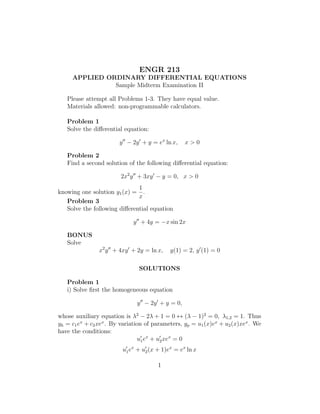
   Problem 1
   Solve the differential equation:

                        y − 2y + y = ex ln x,     x>0

   Problem 2
   Find a second solution of the following differential equation:

                        2x2 y + 3xy − y = 0, x > 0
                              1
knowing one solution y1 (x) = .
                              x
   Problem 3
   Solve the following differential equation

                             y + 4y = −x sin 2x

   BONUS
   Solve
                x2 y + 4xy + 2y = ln x,     y(1) = 2, y (1) = 0

                               SOLUTIONS

   Problem 1
   i) Solve first the homogeneous equation

                               y − 2y + y = 0,

whose auxiliary equation is λ2 − 2λ + 1 = 0 ↔ (λ − 1)2 = 0, λ1,2 = 1. Thus
yh = c1 ex + c2 xex . By variation of parameters, yp = u1 (x)ex + u2 (x)xex . We
have the conditions:
                                u1 ex + u2 xex = 0
                         u1 ex + u2 (x + 1)ex = ex ln x

                                       1
Solving for u1 , u2 , we get
                                             1    1
                      u1 = −       x ln xdx = x2 − x2 ln x
                                             4    2

                            u2 =     ln xdx = x ln x − x
With these, the particular solution becomes
               1 2 1 2                             1            3
    yp (x) =     x − x ln x ex + (x ln x − x) xex = x2 ex ln x − x2 ex
               4    2                              2            4
and the general solution is
                                                  1            3
         y(x) = yh (x) + yp (x) = c1 ex + c2 xex + x2 ex ln x − x2 ex .
                                                  2            4
   Problem 2
   Using reduction of order, we set y2 (x) = u(x)x−1 . Plug back into the
equation y2 = u x−1 − ux−2 , y2 = u x−1 − 2u x−2 + 2ux−3 , we get

                                   2xu − u = 0
                      1                       1            3               1
with solutionln u =   2
                          ln x, giving u = x 2 , u = 2 x 2 and thus y2 = x 2 , and
                                                     3
thus                                             √
                               y(x) = c1 x−1 + c2 x
   Problem 3
   i) Solve the homogeneous equation first

                                    y + 4y = 0

The auxiliary equation gives λ2 + 4 = 0, λ1,2 = ±2i. Then the solution to
the homogeneous equation is yh = c1 cos 2x + c2 sin 2x. Solving the inhomo-
geneous equation by the method of Undetermined Coefficients, set

                  yp = x(Ax + B) cos 2x + x(Cx + D) sin 2x

(Note the multiplication by x since yp is a repeated solution of yh ). We get:

  y = [2Cx2 + 2(D + A)x + B] cos 2x + [−2Ax2 + 2(C − B)x + D] sin 2x


                                          2
and

y = [−4Ax2 +4(2C−B)x+4D+2A] cos 2x+[−4Cx2 −4(D+2A)x−4B+2C] sin 2x

and plugging into the equation y + 4y = −x sin 2x, we identify the coeffi-
cients:
                       x2 cos 2x : − 4A + 4A = 0
                           x2 sin 2x :    − 4C + 4C = 0
                 x cos 2x : 4(2C − B) + 4B = 0 → C = 0
                                                            1
              x sin 2x :      − 4(D + 2A) + 4D = −1 → A =
                                                            8
                                                        1
                    cos 2x : 4D + 2A = 0 → D = −
                                                       16
                    sin 2x :        − 4B + 2C = 0 → B = 0
Thus yp = 1 x2 cos 2x −
          8
                           1 2
                           16
                              x   sin 2x, and

                           1                    1
               y(x) = (c1 + x2 ) cos 2x + (c2 − x2 ) sin 2x
                           8                   16
   BONUS
   i) Find a solution to the homogeneous equation

                               x2 y + 4xy + 2y = 0

which, using the change of variables z = ln x, becomes

                            d2 y          dy
                               2
                                 + (4 − 1) + 2y = 0
                            dz            dz
with auxiliary equation λ2 + 3λ + 2 = 0 ↔ (λ + 1)(λ + 2) = 0. Thus
yh = c1 e−z + c2 e−2z = c1 x−1 + c2 x−2 .
   ii) We can now use either undetermined coefficients for

                            d2 y          dy
                               2
                                 + (4 − 1) + 2y = z,
                            dz            dz
or variation of parameters for the original equation in standard form
                                 4    2   ln x
                              y + y + 2y = 2 .
                                 x   x     x
                                           3
dy      d2 y
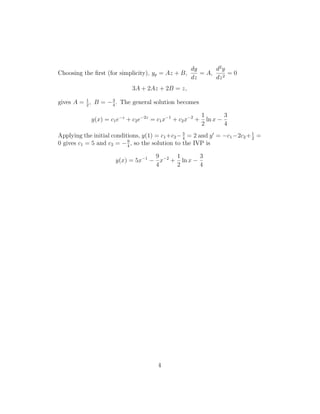
Choosing the first (for simplicity), yp = Az + B,      = A,      =0
                                                   dz      dz 2
                            3A + 2Az + 2B = z,

gives A = 2 , B = − 3 . The general solution becomes
          1
                    4

                                                          1        3
            y(x) = c1 e−z + c2 e−2z = c1 x−1 + c2 x−2 +     ln x −
                                                          2        4
Applying the initial conditions, y(1) = c1 +c2 − 3 = 2 and y = −c1 −2c2 + 2 =
                                                 4
                                                                          1
                           9
0 gives c1 = 5 and c2 = − 4 , so the solution to the IVP is

                                  9     1       3
                     y(x) = 5x−1 − x−2 + ln x −
                                  4     2       4


                                      4

Engr 213 sample midterm 2b sol 2010

  • 1.
    ENGR 213 APPLIED ORDINARY DIFFERENTIAL EQUATIONS Sample Midterm Examination II Please attempt all Problems 1-3. They have equal value. Materials allowed: non-programmable calculators. Problem 1 Solve the differential equation: y − 2y + y = ex ln x, x>0 Problem 2 Find a second solution of the following differential equation: 2x2 y + 3xy − y = 0, x > 0 1 knowing one solution y1 (x) = . x Problem 3 Solve the following differential equation y + 4y = −x sin 2x BONUS Solve x2 y + 4xy + 2y = ln x, y(1) = 2, y (1) = 0 SOLUTIONS Problem 1 i) Solve first the homogeneous equation y − 2y + y = 0, whose auxiliary equation is λ2 − 2λ + 1 = 0 ↔ (λ − 1)2 = 0, λ1,2 = 1. Thus yh = c1 ex + c2 xex . By variation of parameters, yp = u1 (x)ex + u2 (x)xex . We have the conditions: u1 ex + u2 xex = 0 u1 ex + u2 (x + 1)ex = ex ln x 1
  • 2.
    Solving for u1, u2 , we get 1 1 u1 = − x ln xdx = x2 − x2 ln x 4 2 u2 = ln xdx = x ln x − x With these, the particular solution becomes 1 2 1 2 1 3 yp (x) = x − x ln x ex + (x ln x − x) xex = x2 ex ln x − x2 ex 4 2 2 4 and the general solution is 1 3 y(x) = yh (x) + yp (x) = c1 ex + c2 xex + x2 ex ln x − x2 ex . 2 4 Problem 2 Using reduction of order, we set y2 (x) = u(x)x−1 . Plug back into the equation y2 = u x−1 − ux−2 , y2 = u x−1 − 2u x−2 + 2ux−3 , we get 2xu − u = 0 1 1 3 1 with solutionln u = 2 ln x, giving u = x 2 , u = 2 x 2 and thus y2 = x 2 , and 3 thus √ y(x) = c1 x−1 + c2 x Problem 3 i) Solve the homogeneous equation first y + 4y = 0 The auxiliary equation gives λ2 + 4 = 0, λ1,2 = ±2i. Then the solution to the homogeneous equation is yh = c1 cos 2x + c2 sin 2x. Solving the inhomo- geneous equation by the method of Undetermined Coefficients, set yp = x(Ax + B) cos 2x + x(Cx + D) sin 2x (Note the multiplication by x since yp is a repeated solution of yh ). We get: y = [2Cx2 + 2(D + A)x + B] cos 2x + [−2Ax2 + 2(C − B)x + D] sin 2x 2
  • 3.
    and y = [−4Ax2+4(2C−B)x+4D+2A] cos 2x+[−4Cx2 −4(D+2A)x−4B+2C] sin 2x and plugging into the equation y + 4y = −x sin 2x, we identify the coeffi- cients: x2 cos 2x : − 4A + 4A = 0 x2 sin 2x : − 4C + 4C = 0 x cos 2x : 4(2C − B) + 4B = 0 → C = 0 1 x sin 2x : − 4(D + 2A) + 4D = −1 → A = 8 1 cos 2x : 4D + 2A = 0 → D = − 16 sin 2x : − 4B + 2C = 0 → B = 0 Thus yp = 1 x2 cos 2x − 8 1 2 16 x sin 2x, and 1 1 y(x) = (c1 + x2 ) cos 2x + (c2 − x2 ) sin 2x 8 16 BONUS i) Find a solution to the homogeneous equation x2 y + 4xy + 2y = 0 which, using the change of variables z = ln x, becomes d2 y dy 2 + (4 − 1) + 2y = 0 dz dz with auxiliary equation λ2 + 3λ + 2 = 0 ↔ (λ + 1)(λ + 2) = 0. Thus yh = c1 e−z + c2 e−2z = c1 x−1 + c2 x−2 . ii) We can now use either undetermined coefficients for d2 y dy 2 + (4 − 1) + 2y = z, dz dz or variation of parameters for the original equation in standard form 4 2 ln x y + y + 2y = 2 . x x x 3
  • 4.
    dy d2 y Choosing the first (for simplicity), yp = Az + B, = A, =0 dz dz 2 3A + 2Az + 2B = z, gives A = 2 , B = − 3 . The general solution becomes 1 4 1 3 y(x) = c1 e−z + c2 e−2z = c1 x−1 + c2 x−2 + ln x − 2 4 Applying the initial conditions, y(1) = c1 +c2 − 3 = 2 and y = −c1 −2c2 + 2 = 4 1 9 0 gives c1 = 5 and c2 = − 4 , so the solution to the IVP is 9 1 3 y(x) = 5x−1 − x−2 + ln x − 4 2 4 4