


EDUCATIONAL PREPARATION
&
CONTINUING NURSING
EDUCATION
MR. KULTHE VIKRANT RATNAKAR
M. Sc. In Mental Health Nursing
INTRODUCTION
Learning in nursing doesn’t end
with obtaining a certificate. Continuing
nursing education plays an important
role in developing competent nurses.
TERMINOLOGIES
 UNIVERSALISATION - It is a supportive
intervention used by the educator to reassure
and encourage the learner.
 VOCATIONALIZATION - Job based education
 BRAINSTORMING - It is a group creativity
technique designed to generate a large number
of ides for the solution.
CURRENT EDUCATIONAL PATTERNS IN
NURSING
1.NON UNIVERSITY PROGRAMME
 Basic - ANM-GNM
 Training of dais(birth attendant)
 Lady health visitor course
 Post-basic/post certificate short-term courses and
diploma programmed
1. TRAINING OF DAIS(BIRTH ATTENDANT)
 The Dai training became full fledged
during post independence period.
 Duration of training was 30 days.
 This training was done at sub centre and
the equipments provided by UNICEF.
2. AUXILIARY NURSE MIDWIFE
 In 1950 Indian Nursing Council came out with some important
decisions relating to future patterns of nursing training in
India.
 The first course was started at St. Mary’s Hospital Punjab,
1951.
 The period of training was 1.5 year of vocationalized ANM
program and six months of general education.
 The entrance qualification was raised from 7th passed to
matriculation passed.
3. LADY HEALTH VISITOR COURSE
 Training of LHV course continued post
independence.
 The syllabus was prepared and developed by INC
in 1951.
 The entrance qualification was matriculation.
 The duration was two and a half years which was
subsequently reduced to 2 years.
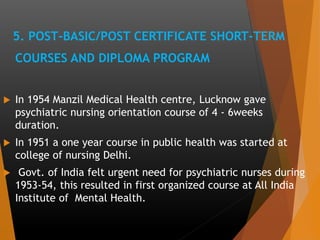
5. POST-BASIC/POST CERTIFICATE SHORT-TERM
COURSES AND DIPLOMA PROGRAM
 In 1954 Manzil Medical Health centre, Lucknow gave
psychiatric nursing orientation course of 4 - 6weeks
duration.
 In 1951 a one year course in public health was started at
college of nursing Delhi.
 Govt. of India felt urgent need for psychiatric nurses during
1953-54, this resulted in first organized course at All India
Institute of Mental Health.
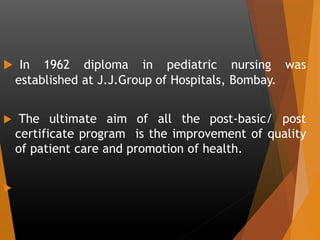
 In 1962 diploma in pediatric nursing was
established at J.J.Group of Hospitals, Bombay.
 The ultimate aim of all the post-basic/ post
certificate program is the improvement of quality
of patient care and promotion of health.

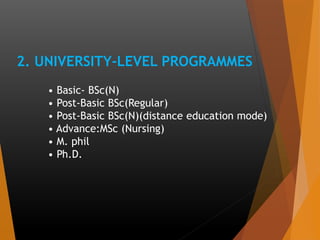
2. UNIVERSITY-LEVEL PROGRAMMES
• Basic- BSc(N)
• Post-Basic BSc(Regular)
• Post-Basic BSc(N)(distance education mode)
• Advance:MSc (Nursing)
• M. phil
• Ph.D.
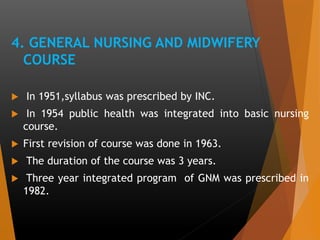
4. GENERAL NURSING AND MIDWIFERY
COURSE
 In 1951,syllabus was prescribed by INC.
 In 1954 public health was integrated into basic nursing
course.
 First revision of course was done in 1963.
 The duration of the course was 3 years.
 Three year integrated program of GNM was prescribed in
1982.
1.BASIC BSc NURSING
The last revision was done in 2007
Duration of BSc Nursing program which is recommended
by the INC is of 4.5 years .
Basic qualification of the course is higher secondary
education.
2. POST BASIC BSC NURSING
 Two years post basic certificate BSc(N) program
was started in December 1962.
 Basic qualification is nurses with diploma in
general and midwifery with minimum of 2 years
experience.
 First started by university of Trivandrum.
 Duration of course is 2 years.
3. POST BASIC NURSING BY DISTANCE EDUCATION
MODE.
 In 1985 Indira Gandhi National open university
was established this pattern.
 In 1992 Post Basic BSc Nursing program was
established.
 3 years duration course, recognized by INC.
4.POST-GRADUATE EDUCATION-MSC
NURSING
 First course of masters of nursing was started at
RAK College of Nursing in 1959 and in 1969 in CMC
Vellore.
 The basic qualification is BSc nursing.
 Duration of course is 2 year.
5. M.PHIL
In 1986 one year full time and two years part
time program was started in RAK College of
nursing Delhi.
6. PH.D IN NURSING
 Indian nurses were sent abroad for Ph. D
programme earlier.
 From 1992 Ph D in nursing is available in India.
MEANING
Continuing nursing education is a
modern imperative, it must be future
oriented, geared to facing of new situations
and to the making of new responses
appropriate for these situations. New
knowledge is emerging rapidly in the
physical, biological, medical and behavioral
sciences which constitute the foundations of
nursing, problems in the nursing must be
solved by rational effort based upon
systematic inquiry.
DEFINITION
 “Continuing nursing education of the
health workers includes the experiences
after initial training which help health
care personnel to maintain and improve
existing, and acquire new competence
relevant to the performance of their
responsibilities. Appropriate continuing
education should reflect community
needs in the health and lead to planned
improvements in the health of the
community’’.
DEFINITION
 ‘’Continuing education is all the
learning activities that occurs after an
individual has completed his basic
education’’
Cooper
DEFINITION
 “That education which builds on
previous education’’
Shannon
FEATURES
 Unified approach.
 Relationship with other systems.
 Comprehensiveness.
 Accessibility for women health workers.
 Integration with the management process.
 Internally coordinated.
 Analysis of needs as a basis for learning.
 Credibility and economic.
NEED
 To ensure safe and effective nursing care
,nurses need to keep abreast with interest,
knowledge and technical advances.
 To meet the needs of population and should
cater to the needs of service.
 Development of nurses will occur by
updating their knowledge and prepare them
for specialization.
 For career improvement.
 Professional roles are changed as society
altered and a new knowledge and
technologies emerge.
 Nursing functions require a high degree of
skill, knowledge, competence and educational
preparation.
 The demand after specialized nursing services
is increasing more rapidly.
 Planned programs are needed to increase
their competence as practitioners.
 Nurses with research aptitudes and
preparation are needed.
 To provide and prepare faculty who seeing
continuing nursing education as a personal
responsibility as well as professional and
university responsibility.
 To provide a variety of continuing nursing
education opportunities of high quality to
nurses in both education and service changes.
FUNCTIONS
 To meet the health needs and public
expectations.
 To develop the practicing abilities of the
nurse.
 Recruitment function.
 Recognize gaps in their knowledge.
 To improve the communication between
the participants, community, faculty and
health sector.
 To test the participants ability to do normal
academic study.
 To ensure the quality of education.
 To maintain academic standards.
 To meet educational requirements.
PHILOSOPHY
 It encompasses various aspect of life and
is not limited to professional education.
Continuing nursing education is
concerned with the development of the
nurses as a person ,a practitioner and as
a citizen.
 Philosophy is based on values social
change. The thoughtful teacher
recognizes that ones philosophy of
education is always emerging one, rather
than a static one.
ELEMENTS
 Learner
 Teacher/Nurse educator.
LEARNER
 As a person as a nurse and as a citizen,thus continuing
nursing education is seen as a totality a sound
philosophy of education recognizes all three aspect of
life long learning.
 Diversity is a part of learning process and contribute to
the development of the individual.
 The learner in his life plays many different
roles.eg:adult, family member, learner, friend etc. for
every aspect of life there are some continuing nursing
elements.
 It aims as a self directed learning.
TEACHER/NURSE EDUCATOR
 He has to accept the concept of
lifelong learning and his responsibility
to encourage nurses to recognize the
values of participating in different type
of educational activities.
 Educator must be aware of souses of
information about related continuing
education activities.eg:self directed
individual study, in service education.
 Teacher should act as a role model.
 The skillful teacher has to aware of difference in
learning, what is already know and encouraging
exploration in those areas yet to be discovered.
 Creative teaching is essential.
 Guide and counselor to the learner.
 Motivator and an encourager for the students.
 Producing instructional materials.
 Select and evaluate materials prepared by others.
 Administrative role like planning, directing,
budgeting and evaluation.
EDUCATIONAL PREPRATION
 Masters degree in his area of nursing expertise or a
doctorate in adult education.
 Credentials with more publications.
 Writing and organizing skills.
 A continuing learner.
 Clinical expertisedness.
 Depth of nursing knowledge and skill in its application.
 Interest in subject in subject enthusiasm in teaching.
 Adequate knowledge about teaching skills and methods of
teaching.
 Broad base knowledge.
COMPETENCIES AND OTHER
CHARECTERISTICS
 Concern for people.
 Flexibility
 Sensitive to group responsibilities.
 Willing to travel.
 Resourcefulness.
 Determination.
 Self confidence.
 A sense of humor.
 An innate curiosity.
 Desire to search the unknown.
 Interest in self development and in others development.
THE FACULTY ADMINISTRATOR
 Teaching is a part of his responsibility.
 He should posses a high degree of
administrative skill.
 He must asses and uses the various abilities
of different faculty members.
 Search for faculty with wide varied
knowledge.
 Help the faculty member to strengthen their
teaching skills.
 Provide conductive enviourment for faculty
members and learner to promote personal
and professional development.
THE FACULTY ADMINISTRATOR
 Encourages supplementary education
and creativity.
 Fosters the expansion of learners
talent.
 The effective administration is
prepared to meet unexpected.
 Supports his faculty and accepts
responsibility, encourages team spirit,
working with other members.
 Recognizes the persons contribution.
MOTIVATION OF THE LEARNER
 To accept the personal responsibility for their
own continued learning, motivation of the
learner is essential.
 Internal motivation ie.the personal needs desire
to learn is more effective than external
incentives like certificates, grades, credits etc.
 The truly motivated person will learn without
external requirements being placed upon him.
 He learns because he has a need for the
knowledge.
 For the motivated learner ,difficulties
encountered in the process are seen as
challenges ,not as obstacles.
INVOLVEMENT IN THE LEARNING
PROCESS
 Learner has to participate in the learning process.
 Learning depends upon the student himself.
 Learning can be done only by the learner.
 It depends upon the effort put forth by the learner .
ORGANIZED LEARNING EXPERIENCES
Learner also involved more directly in program
planning and in the conduct of courses and deciding
which educational experiences and activities are
most suitable to him.
THE NEED OF THE SOCIETY
Quality life and needs of society
influences the learning needs of the
nurses. The critical issue facing the
society can be met by a concerned ,well
informed citizen who are willing to
devote thought time and energy to their
solutions.
 UNIVERSALISATION
Universalisation of continuing
nursing education is necessary.
 THE LESIURE
The individual has to learn how to
use leisure time constructively,
participate in more educational
activities.
INTER PROFESSIONAL
CONTINUING EDUCATION
It is imperative for the future;
educational programs now include course
content open to all these in various
health fields. Nurses have to accept and
participate indiciplinary continuing
education. It requires input from all
professional groups for whom it is
intended.
PLANING
 A successful continuing nursing education
program is the result of careful and detailed
planning.
 Broad planning by institution and agencies
responsible for continuing nursing education is
needed.
 Specific planning by individuals for their own
continuing nursing education.
 Meet the nursing needs.
 Use available resources.
 Avoid duplication and fragmentation of
effort.
 Planning is an ongoing process, the rapid
technologic advances and proliferation of
knowledge demands continuous planning
to meet ever changing learning needs.
ORGANISATION
Programming of professional courses
in nursing is a joint responsibility of a
director of continuing nursing education
and a dean of school of nursing. The
formal channels of communication make
possible the optional use of the nursing
faculty to explore the needs of continuing
nursing education to set priorities, to plan
courses and to teach them.
EVALUVATE THE RESULTS AT
STATED INTERVALS
Evaluation is needed to assess
the effectiveness of the program or
the progress in order to find to find
out what extent pre-set goals have
been achieved evaluations should be
done at different stages of program.
CONCLUSION
Nursing education have expanded
considerably post independence. University
education in nursing brought about changes
in nursing education. The type of nurses
required today is an “all round personality”.
Education brings changes in behavior of the
individual in a desirable manner. It aims at all
round development of an individual to
become mature, self-sufficient, intellectually,
culturalrefined.
Educational preparation and continuing nursing education

Educational preparation and continuing nursing education

  • 1.
    EDUCATIONAL PREPARATION & CONTINUING NURSING EDUCATION MR.KULTHE VIKRANT RATNAKAR M. Sc. In Mental Health Nursing
  • 2.
    INTRODUCTION Learning in nursingdoesn’t end with obtaining a certificate. Continuing nursing education plays an important role in developing competent nurses.
  • 3.
    TERMINOLOGIES  UNIVERSALISATION -It is a supportive intervention used by the educator to reassure and encourage the learner.  VOCATIONALIZATION - Job based education  BRAINSTORMING - It is a group creativity technique designed to generate a large number of ides for the solution.
  • 5.
    CURRENT EDUCATIONAL PATTERNSIN NURSING 1.NON UNIVERSITY PROGRAMME  Basic - ANM-GNM  Training of dais(birth attendant)  Lady health visitor course  Post-basic/post certificate short-term courses and diploma programmed
  • 6.
    1. TRAINING OFDAIS(BIRTH ATTENDANT)  The Dai training became full fledged during post independence period.  Duration of training was 30 days.  This training was done at sub centre and the equipments provided by UNICEF.
  • 7.
    2. AUXILIARY NURSEMIDWIFE  In 1950 Indian Nursing Council came out with some important decisions relating to future patterns of nursing training in India.  The first course was started at St. Mary’s Hospital Punjab, 1951.  The period of training was 1.5 year of vocationalized ANM program and six months of general education.  The entrance qualification was raised from 7th passed to matriculation passed.
  • 8.
    3. LADY HEALTHVISITOR COURSE  Training of LHV course continued post independence.  The syllabus was prepared and developed by INC in 1951.  The entrance qualification was matriculation.  The duration was two and a half years which was subsequently reduced to 2 years.
  • 9.
    5. POST-BASIC/POST CERTIFICATESHORT-TERM COURSES AND DIPLOMA PROGRAM  In 1954 Manzil Medical Health centre, Lucknow gave psychiatric nursing orientation course of 4 - 6weeks duration.  In 1951 a one year course in public health was started at college of nursing Delhi.  Govt. of India felt urgent need for psychiatric nurses during 1953-54, this resulted in first organized course at All India Institute of Mental Health.
  • 10.
     In 1962diploma in pediatric nursing was established at J.J.Group of Hospitals, Bombay.  The ultimate aim of all the post-basic/ post certificate program is the improvement of quality of patient care and promotion of health. 
  • 11.
    2. UNIVERSITY-LEVEL PROGRAMMES •Basic- BSc(N) • Post-Basic BSc(Regular) • Post-Basic BSc(N)(distance education mode) • Advance:MSc (Nursing) • M. phil • Ph.D.
  • 12.
    4. GENERAL NURSINGAND MIDWIFERY COURSE  In 1951,syllabus was prescribed by INC.  In 1954 public health was integrated into basic nursing course.  First revision of course was done in 1963.  The duration of the course was 3 years.  Three year integrated program of GNM was prescribed in 1982.
  • 13.
    1.BASIC BSc NURSING Thelast revision was done in 2007 Duration of BSc Nursing program which is recommended by the INC is of 4.5 years . Basic qualification of the course is higher secondary education.
  • 14.
    2. POST BASICBSC NURSING  Two years post basic certificate BSc(N) program was started in December 1962.  Basic qualification is nurses with diploma in general and midwifery with minimum of 2 years experience.  First started by university of Trivandrum.  Duration of course is 2 years.
  • 15.
    3. POST BASICNURSING BY DISTANCE EDUCATION MODE.  In 1985 Indira Gandhi National open university was established this pattern.  In 1992 Post Basic BSc Nursing program was established.  3 years duration course, recognized by INC.
  • 16.
    4.POST-GRADUATE EDUCATION-MSC NURSING  Firstcourse of masters of nursing was started at RAK College of Nursing in 1959 and in 1969 in CMC Vellore.  The basic qualification is BSc nursing.  Duration of course is 2 year.
  • 17.
    5. M.PHIL In 1986one year full time and two years part time program was started in RAK College of nursing Delhi.
  • 18.
    6. PH.D INNURSING  Indian nurses were sent abroad for Ph. D programme earlier.  From 1992 Ph D in nursing is available in India.
  • 20.
    MEANING Continuing nursing educationis a modern imperative, it must be future oriented, geared to facing of new situations and to the making of new responses appropriate for these situations. New knowledge is emerging rapidly in the physical, biological, medical and behavioral sciences which constitute the foundations of nursing, problems in the nursing must be solved by rational effort based upon systematic inquiry.
  • 21.
    DEFINITION  “Continuing nursingeducation of the health workers includes the experiences after initial training which help health care personnel to maintain and improve existing, and acquire new competence relevant to the performance of their responsibilities. Appropriate continuing education should reflect community needs in the health and lead to planned improvements in the health of the community’’.
  • 22.
    DEFINITION  ‘’Continuing educationis all the learning activities that occurs after an individual has completed his basic education’’ Cooper
  • 23.
    DEFINITION  “That educationwhich builds on previous education’’ Shannon
  • 24.
    FEATURES  Unified approach. Relationship with other systems.  Comprehensiveness.  Accessibility for women health workers.  Integration with the management process.  Internally coordinated.  Analysis of needs as a basis for learning.  Credibility and economic.
  • 25.
    NEED  To ensuresafe and effective nursing care ,nurses need to keep abreast with interest, knowledge and technical advances.  To meet the needs of population and should cater to the needs of service.  Development of nurses will occur by updating their knowledge and prepare them for specialization.  For career improvement.  Professional roles are changed as society altered and a new knowledge and technologies emerge.
  • 26.
     Nursing functionsrequire a high degree of skill, knowledge, competence and educational preparation.  The demand after specialized nursing services is increasing more rapidly.  Planned programs are needed to increase their competence as practitioners.  Nurses with research aptitudes and preparation are needed.  To provide and prepare faculty who seeing continuing nursing education as a personal responsibility as well as professional and university responsibility.  To provide a variety of continuing nursing education opportunities of high quality to nurses in both education and service changes.
  • 27.
    FUNCTIONS  To meetthe health needs and public expectations.  To develop the practicing abilities of the nurse.  Recruitment function.  Recognize gaps in their knowledge.  To improve the communication between the participants, community, faculty and health sector.
  • 28.
     To testthe participants ability to do normal academic study.  To ensure the quality of education.  To maintain academic standards.  To meet educational requirements.
  • 29.
    PHILOSOPHY  It encompassesvarious aspect of life and is not limited to professional education. Continuing nursing education is concerned with the development of the nurses as a person ,a practitioner and as a citizen.  Philosophy is based on values social change. The thoughtful teacher recognizes that ones philosophy of education is always emerging one, rather than a static one.
  • 30.
  • 31.
    LEARNER  As aperson as a nurse and as a citizen,thus continuing nursing education is seen as a totality a sound philosophy of education recognizes all three aspect of life long learning.  Diversity is a part of learning process and contribute to the development of the individual.  The learner in his life plays many different roles.eg:adult, family member, learner, friend etc. for every aspect of life there are some continuing nursing elements.  It aims as a self directed learning.
  • 32.
    TEACHER/NURSE EDUCATOR  Hehas to accept the concept of lifelong learning and his responsibility to encourage nurses to recognize the values of participating in different type of educational activities.  Educator must be aware of souses of information about related continuing education activities.eg:self directed individual study, in service education.  Teacher should act as a role model.
  • 33.
     The skillfulteacher has to aware of difference in learning, what is already know and encouraging exploration in those areas yet to be discovered.  Creative teaching is essential.  Guide and counselor to the learner.  Motivator and an encourager for the students.  Producing instructional materials.  Select and evaluate materials prepared by others.  Administrative role like planning, directing, budgeting and evaluation.
  • 34.
    EDUCATIONAL PREPRATION  Mastersdegree in his area of nursing expertise or a doctorate in adult education.  Credentials with more publications.  Writing and organizing skills.  A continuing learner.  Clinical expertisedness.  Depth of nursing knowledge and skill in its application.  Interest in subject in subject enthusiasm in teaching.  Adequate knowledge about teaching skills and methods of teaching.  Broad base knowledge.
  • 35.
    COMPETENCIES AND OTHER CHARECTERISTICS Concern for people.  Flexibility  Sensitive to group responsibilities.  Willing to travel.  Resourcefulness.  Determination.  Self confidence.  A sense of humor.  An innate curiosity.  Desire to search the unknown.  Interest in self development and in others development.
  • 36.
    THE FACULTY ADMINISTRATOR Teaching is a part of his responsibility.  He should posses a high degree of administrative skill.  He must asses and uses the various abilities of different faculty members.  Search for faculty with wide varied knowledge.  Help the faculty member to strengthen their teaching skills.  Provide conductive enviourment for faculty members and learner to promote personal and professional development.
  • 37.
    THE FACULTY ADMINISTRATOR Encourages supplementary education and creativity.  Fosters the expansion of learners talent.  The effective administration is prepared to meet unexpected.  Supports his faculty and accepts responsibility, encourages team spirit, working with other members.  Recognizes the persons contribution.
  • 38.
    MOTIVATION OF THELEARNER  To accept the personal responsibility for their own continued learning, motivation of the learner is essential.  Internal motivation ie.the personal needs desire to learn is more effective than external incentives like certificates, grades, credits etc.  The truly motivated person will learn without external requirements being placed upon him.  He learns because he has a need for the knowledge.  For the motivated learner ,difficulties encountered in the process are seen as challenges ,not as obstacles.
  • 39.
    INVOLVEMENT IN THELEARNING PROCESS  Learner has to participate in the learning process.  Learning depends upon the student himself.  Learning can be done only by the learner.  It depends upon the effort put forth by the learner . ORGANIZED LEARNING EXPERIENCES Learner also involved more directly in program planning and in the conduct of courses and deciding which educational experiences and activities are most suitable to him.
  • 40.
    THE NEED OFTHE SOCIETY Quality life and needs of society influences the learning needs of the nurses. The critical issue facing the society can be met by a concerned ,well informed citizen who are willing to devote thought time and energy to their solutions.
  • 41.
     UNIVERSALISATION Universalisation ofcontinuing nursing education is necessary.  THE LESIURE The individual has to learn how to use leisure time constructively, participate in more educational activities.
  • 42.
    INTER PROFESSIONAL CONTINUING EDUCATION Itis imperative for the future; educational programs now include course content open to all these in various health fields. Nurses have to accept and participate indiciplinary continuing education. It requires input from all professional groups for whom it is intended.
  • 43.
    PLANING  A successfulcontinuing nursing education program is the result of careful and detailed planning.  Broad planning by institution and agencies responsible for continuing nursing education is needed.  Specific planning by individuals for their own continuing nursing education.
  • 44.
     Meet thenursing needs.  Use available resources.  Avoid duplication and fragmentation of effort.  Planning is an ongoing process, the rapid technologic advances and proliferation of knowledge demands continuous planning to meet ever changing learning needs.
  • 45.
    ORGANISATION Programming of professionalcourses in nursing is a joint responsibility of a director of continuing nursing education and a dean of school of nursing. The formal channels of communication make possible the optional use of the nursing faculty to explore the needs of continuing nursing education to set priorities, to plan courses and to teach them.
  • 46.
    EVALUVATE THE RESULTSAT STATED INTERVALS Evaluation is needed to assess the effectiveness of the program or the progress in order to find to find out what extent pre-set goals have been achieved evaluations should be done at different stages of program.
  • 47.
    CONCLUSION Nursing education haveexpanded considerably post independence. University education in nursing brought about changes in nursing education. The type of nurses required today is an “all round personality”. Education brings changes in behavior of the individual in a desirable manner. It aims at all round development of an individual to become mature, self-sufficient, intellectually, culturalrefined.