SEMINAR
On
CRITICAL PATHWAY
Mr Kulthe Vikrant R
06-03-2019 1
INTRODUCTION
Successful case management relies on critical
pathway to guide care. Critical pathway refers to the
expected outcomes and care strategies developed by
collaborative practice team. Critical pathways and health
care reforms are two separate entities. Critical pathways
are also known as critical paths, clinical pathways, or care
paths, are management plans that display goals for
patients and provide the sequences and timing of actions
necessary to achieve these goals with optimal efficiency.
06-03-2019 2Mr kulthe Vikrant
DEFINITION
 “Critical paths are guides that outline the critical or key events expected to happen each
day of patient’s hospitalization.”
--Cohen & Cesta,2001.
 “A critical pathway are management plans that display goals for patients and provide the
corresponding ideal sequences and timing of staff action to achieve those goals with
optimal efficiency.”
 “A critical pathway is an interdisciplinary plan of care that outlines the optimal
sequencing and timing of interventions for patients with a particular condition, procedure
and symptom’s.”
-- Ignatavicious &hausman, 1995.
 “A critical pathway is the sequence of events in a process that takes the greatest length
of time.”
06-03-2019 3Mr kulthe Vikrant
SYNONYMOUS
 Integrated Care, Pathways Multidisciplinary
pathways of care, Maps Collaborative Care,
Pathways Clinical pathway, Critical
pathway, Care track Care pathway
Anticipated recovery path Managed care
plans.
06-03-2019 4Mr kulthe Vikrant
HISTORY
The concept od critical pathways is borrowed from the
theories of Continuous Quality Improvement (CQI). Critical
pathways are first developed for the use in industry as a tool
to identify and manage the rate limiting steps in production
processes. In health care, critical pathways were first
developed and applied in 1980s to improve hospital
efficiency. Most of the first critical pathway in the hospital
are develop by nurses for nursing care alone. Later on these
have been developed by other disciplines covering all the
aspects.
06-03-2019 5Mr kulthe Vikrant
FEATURES
 Predetermined course of progress,
 Variance analysis,
 Fiscal planning,
 Directing,
 Orientation,
 Identifies outcome.
06-03-2019 6Mr kulthe Vikrant
GOALS OF CRITICAL PATHWAYS
 Selecting a best practice when practice style varies unnecessarily.
 Defining the standards for the expected duration of hospital stay and
for the use of tests and treatment.
 Examining the interrelations among the different steps in the care
process to find ways to co-ordinate or decrease the time in the rate-
limiting step.
 Giving all hospital staff a common game plan from which to view and
understand their various role in the overall care process.
 Providing a framework for the collecting data on the care process so
that providers can learn how often and why patients do not follow
an expected course during their hospitalization.
 Decreasing documentation burden.
 Improving patient satisfaction with care by educating patients and
their families about the plan of care.
06-03-2019 7Mr kulthe Vikrant
PURPOSES
 To monitor quality of patient care.
 To reduce variation in care, decreasing resource utilization and
potentially improve healthcare quality when used as a method.
 To achieved specified patient’s outcomes by a pre-set time
frame.
 To know the predetermine times frames for initiation of
treatment, generalized treatment protocols, and discharged
timelines for specific conditions.
 To shorten the hospital stay, more efficient use of resources,
more communication between discipline, and use of less
expensive method of treatment without compromising quality
of care. 06-03-2019 8Mr kulthe Vikrant
CHARACTERISTICS OF CRITICAL PATHWAYS
 It should be structured multidisciplinary care plan.
 It supports multidisciplinary care and evidence based clinical practice.
 The goal and key elements of care based on evidence and best practice
should be defined and stated.
 It should guide the management for a well-defined group of patients for a
well-defined period of time.
 It sequences the action of multidisciplinary team.
 It facilitates variance managements and allows documenting, monitoring and
evaluating the variance.
 The essential step in care of patients with specific clinical problem is
detailed.
 It should help communication with patient by providing a clearly summary of
care.
06-03-2019 9Mr kulthe Vikrant
BENEFITS OF CRITICAL PATHWAYS
 Improve patients care.
 Increase use of recommended medical acre.
 Decrease use of unnecessary tests.
 Decrease increase lengths of stay of patients.
 Reduce costs.
 Increase participation in clinical research
protocols.
06-03-2019 10Mr kulthe Vikrant
CONTAINS
 Specific medical diagnosis the expected length of stay Patient
identification data
Appropriate time frames (in days, hours, minutes or visits) for intervention
1. Patient outcomes
2. Interventions presented in modality groups (medications, nursing activity
& so on)
3. Nursing diagnosis.
06-03-2019 11Mr kulthe Vikrant
COMPONENTS
1.A timeline
1.The categories of care or activities
and their interventions
1.Intermediate and long-term outcome
criteria and the variance record.
06-03-2019 12Mr kulthe Vikrant
CRITICAL PATHWAY PROFESSIONAL
 Physician
 Nurse manager
 Staff nurse
 Social worker
 Dietician
 Occupational therapist
 pharmacist
06-03-2019 13Mr kulthe Vikrant
DEVELOP CRITICAL PATHWAY
 Retrospective chart review or concurrent chart review
 identify costs associated with the treatment
 Pathway development teams are organized to develop the
tool.
 Patient care expectations and critical events are identified for
incorporation into the path
 Small groups within the development to refine the elements of
the path
 Newly developed tools can be tested on previously admitted
patient
 Implementation with collaboration with other professionals
06-03-2019 14Mr kulthe Vikrant
Methods of Critical Pathway
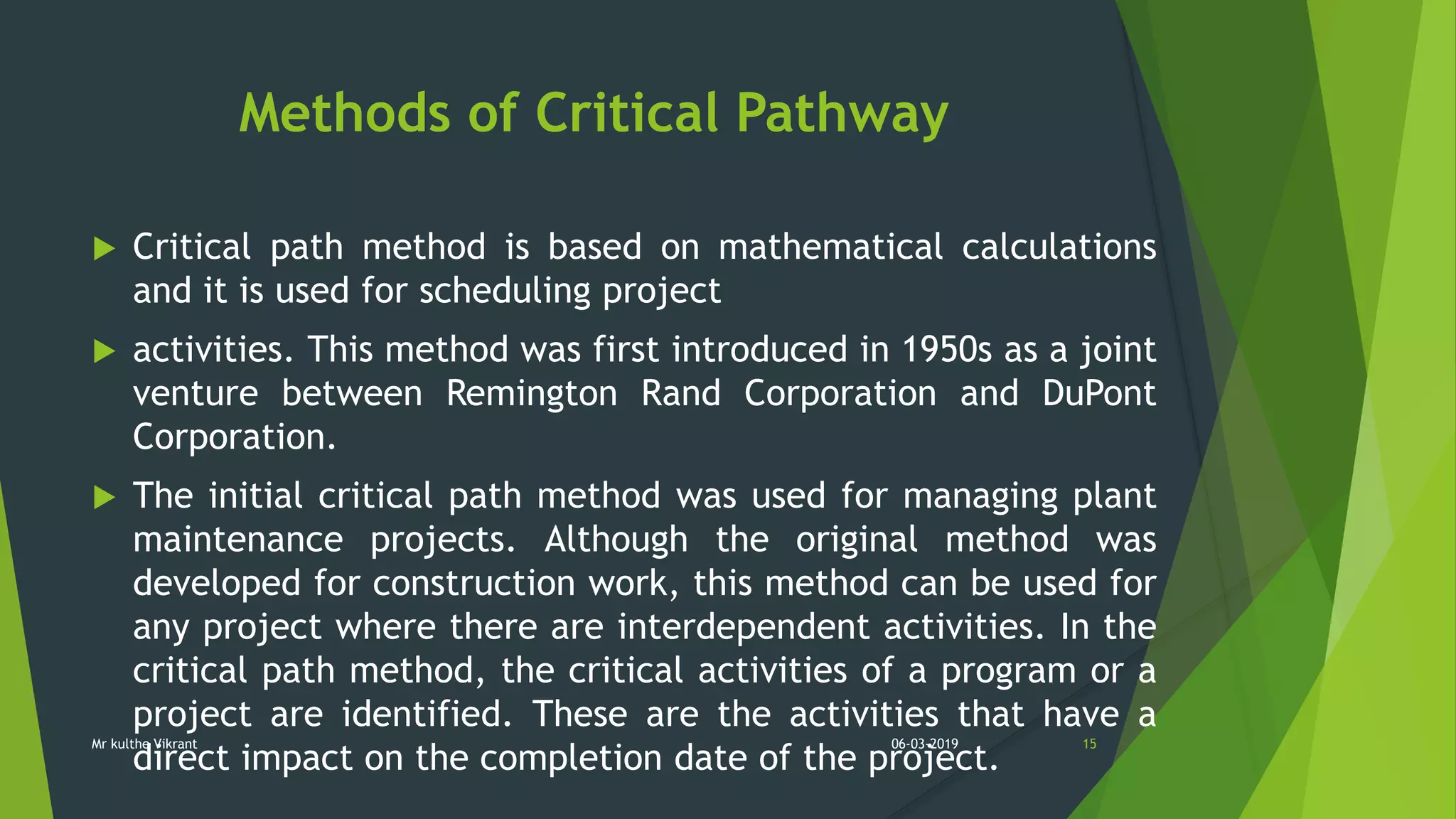
 Critical path method is based on mathematical calculations
and it is used for scheduling project
 activities. This method was first introduced in 1950s as a joint
venture between Remington Rand Corporation and DuPont
Corporation.
 The initial critical path method was used for managing plant
maintenance projects. Although the original method was
developed for construction work, this method can be used for
any project where there are interdependent activities. In the
critical path method, the critical activities of a program or a
project are identified. These are the activities that have a
direct impact on the completion date of the project.
06-03-2019 15Mr kulthe Vikrant
06-03-2019 16Mr kulthe Vikrant
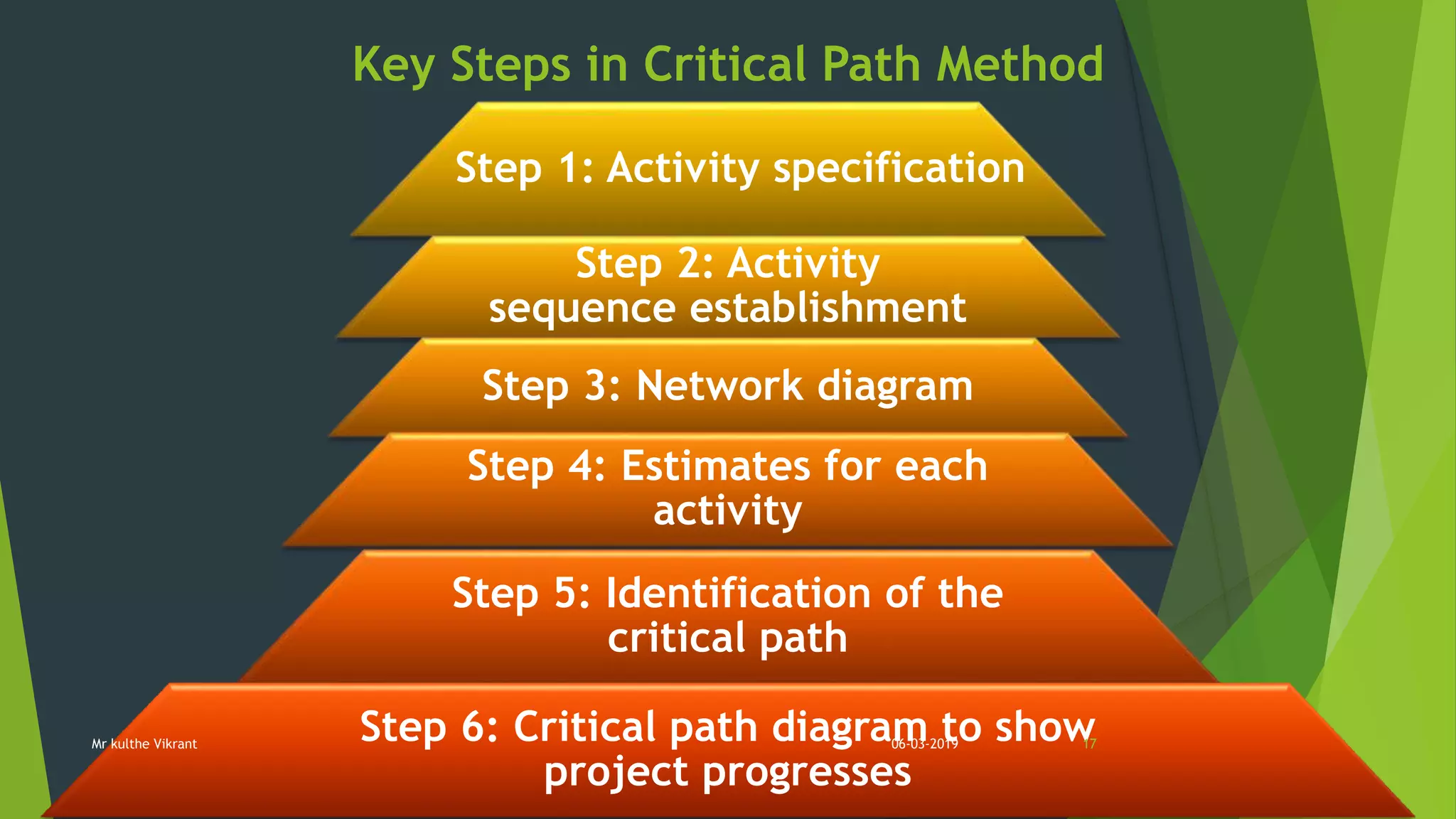
Key Steps in Critical Path Method
Step 1: Activity specification
Step 2: Activity
sequence establishment
Step 3: Network diagram
Step 4: Estimates for each
activity
Step 5: Identification of the
critical path
Step 6: Critical path diagram to show
project progresses
06-03-2019 17Mr kulthe Vikrant
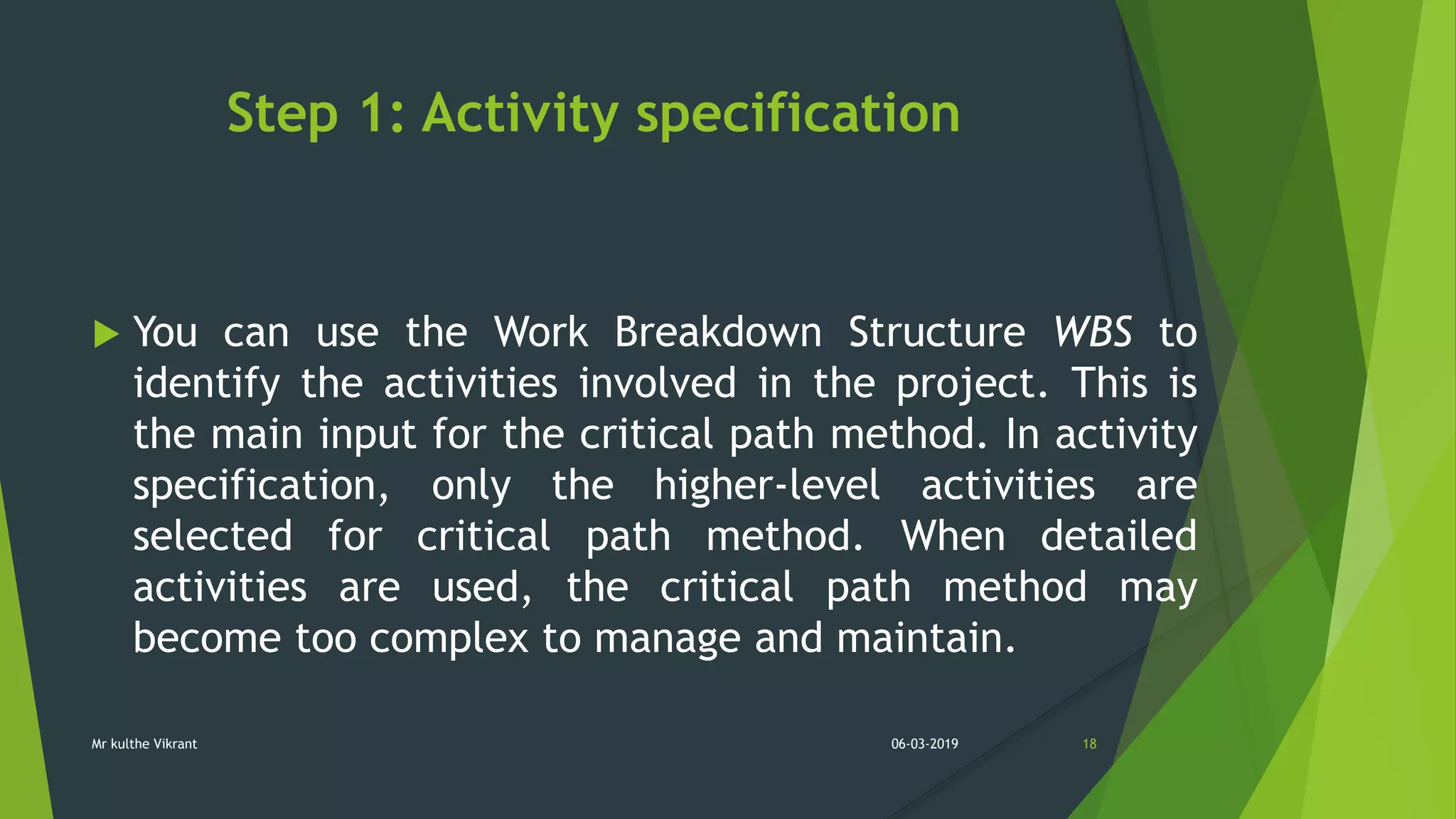
Step 1: Activity specification
 You can use the Work Breakdown Structure WBS to
identify the activities involved in the project. This is
the main input for the critical path method. In activity
specification, only the higher-level activities are
selected for critical path method. When detailed
activities are used, the critical path method may
become too complex to manage and maintain.
06-03-2019 18Mr kulthe Vikrant
Step 2: Activity sequence establishment
 In this step, the correct activity sequence is established.
For that, you need to ask three questions for each task of
your list.
 Which tasks should take place before this task happens?
 Which tasks should be completed at the same time as this
task?
 Which tasks should happen immediately after this task?
06-03-2019 19Mr kulthe Vikrant
Step 3: Network diagram
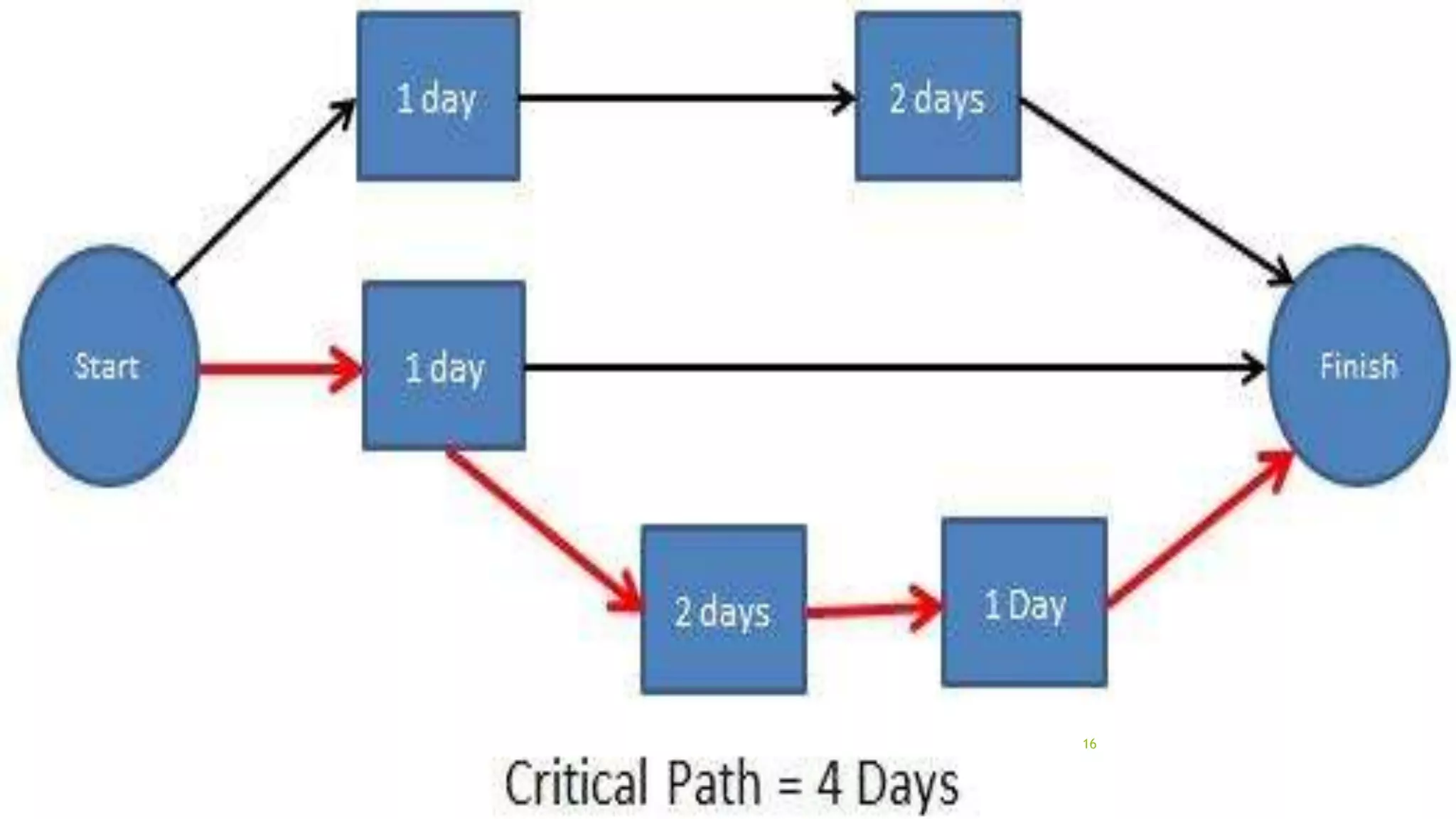
 Once the activity sequence is correctly identified, the
network diagram can be drawn
 Refertothesample diagram above. Although the early
diagrams were drawn on paper, there are a number of
computer softwares, such as Primavera, for this purpose
nowadays.
06-03-2019 20Mr kulthe Vikrant
Step 4: Estimates for each activity
 This could be a direct input from the WBS based
estimation sheet. Most of the companies use 3-
point estimation method or COCOMO based
function points based estimation methods for
tasks estimation. You can use such estimation
information for this step of the process.
06-03-2019 21Mr kulthe Vikrant
STEP 5: IDENTIFICATION OF THE CRITICAL PATH
For this, you need to determine four parameters of each activity of the network.
 Earliest start time ES - The earliest time an activity can start once the previous dependent
 activities are over.
 Earliest finish time EF - ES + activity duration.
 Latest finish time LF - The latest time an activity can finish without delaying the project.
 Latest start time LS - LF = activity duration.
 The float time for an activity is the time between the earliest ES and the latest LS start
time or
 between the earliest EF and latest LF finish times.
 During the float time, an activity can be delayed without delaying the project finish
date.The critical path is the longest path of the network diagram. The activities in the
critical path have an effect on the deadline of the project. If an activity of this path is
delayed, the project will be delayed. In case if the project management needs to
accelerate the project, the times for critical path activities should be reduced.
06-03-2019 22Mr kulthe Vikrant
STEP 6: CRITICAL PATH DIAGRAM TO SHOW
PROJECT PROGRESSES
 Critical path diagram is a live artefact. Therefore, this
diagram should be updated with actual
 values once the task is completed. This gives more
realistic figure for the deadline and the project
management can know whether they are on track
regarding the deliverables.
06-03-2019 23Mr kulthe Vikrant
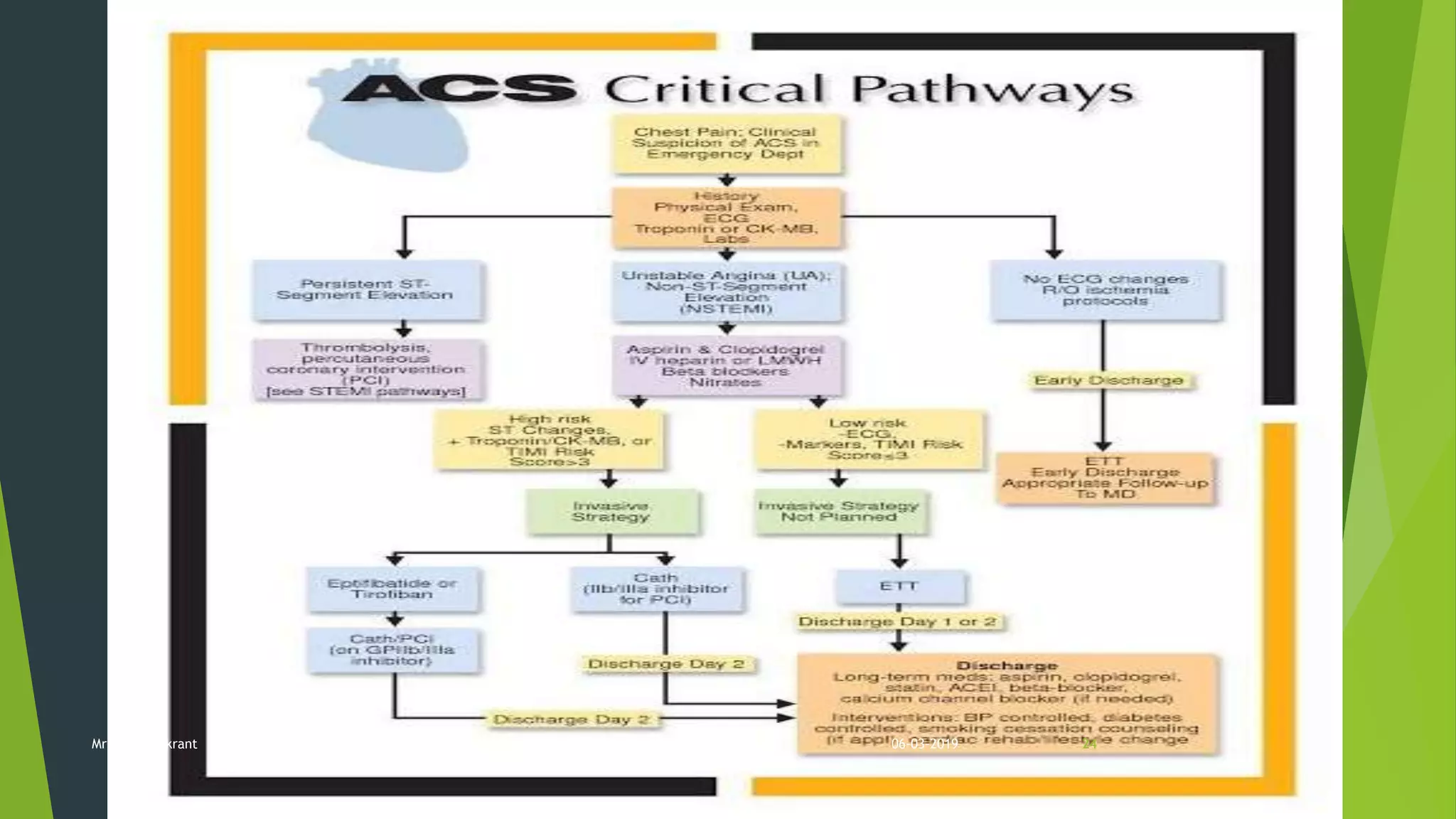
06-03-2019 24Mr kulthe Vikrant
ADVANTAGES OF CRITICAL PATH METHOD
Following are advantages of critical path methods:
 Offers a visual representation of the project activities.
 Presents the time to complete the tasks and the overall
project.
 Tracking of critical activities.
06-03-2019 25Mr kulthe Vikrant
CRITICAL PATHWAY ANALYSIS
 • Analyse the effectiveness
 • Variance analysis Positive variance Negative
variance
 • Consult with other professionals
 • Make change accordingly
06-03-2019 26Mr kulthe Vikrant
ROLE AS NURSE MANAGER:
 Assess quality improvement Effective planning
Evaluate quality Interdepartmental Communication
Educating the staff of other departments about the
pathway role and responsibilities.
 Provides patient care Follow critical pathway Inform
any deviance Collaborate with other professionals
06-03-2019 27Mr kulthe Vikrant
ADVANTAGES
 • Provides standardizing medical care for patients with
similar diagnosis
 • Use resources appropriate to the care needed
 • Reduce cost
 • Reduce length of stay
 • Improve the quality of care
 • Change practice pattern to increase efficiency
06-03-2019 28Mr kulthe Vikrant
DISADVANTAGES
Differences between unique patients One more paper work
Overburdened with administrative cost Problems of
introduction of new technology
• Require commitment from staff and establishment of an
adequate organizational structure
• May take time to be accepted in the workplace
• Need to ensure variance and outcomes are properly
recorded, audited and acted upon.
06-03-2019 29Mr kulthe Vikrant
CONCLUSION
Critical path identification is required for any project-
planning phase. This gives the project management the
correct completion date of the overall project and the
flexibility to float activities. A critical path diagram should
be constantly updated with actual information when the
project progresses in order to refine the activity
length/project duration predictions.
06-03-2019 30Mr kulthe Vikrant
06-03-2019 31Mr kulthe Vikrant

CRITICAL PATHWAY FOR NURSING ADMINISTRATION.

  • 1.
  • 2.
    INTRODUCTION Successful case managementrelies on critical pathway to guide care. Critical pathway refers to the expected outcomes and care strategies developed by collaborative practice team. Critical pathways and health care reforms are two separate entities. Critical pathways are also known as critical paths, clinical pathways, or care paths, are management plans that display goals for patients and provide the sequences and timing of actions necessary to achieve these goals with optimal efficiency. 06-03-2019 2Mr kulthe Vikrant
  • 3.
    DEFINITION  “Critical pathsare guides that outline the critical or key events expected to happen each day of patient’s hospitalization.” --Cohen & Cesta,2001.  “A critical pathway are management plans that display goals for patients and provide the corresponding ideal sequences and timing of staff action to achieve those goals with optimal efficiency.”  “A critical pathway is an interdisciplinary plan of care that outlines the optimal sequencing and timing of interventions for patients with a particular condition, procedure and symptom’s.” -- Ignatavicious &hausman, 1995.  “A critical pathway is the sequence of events in a process that takes the greatest length of time.” 06-03-2019 3Mr kulthe Vikrant
  • 4.
    SYNONYMOUS  Integrated Care,Pathways Multidisciplinary pathways of care, Maps Collaborative Care, Pathways Clinical pathway, Critical pathway, Care track Care pathway Anticipated recovery path Managed care plans. 06-03-2019 4Mr kulthe Vikrant
  • 5.
    HISTORY The concept odcritical pathways is borrowed from the theories of Continuous Quality Improvement (CQI). Critical pathways are first developed for the use in industry as a tool to identify and manage the rate limiting steps in production processes. In health care, critical pathways were first developed and applied in 1980s to improve hospital efficiency. Most of the first critical pathway in the hospital are develop by nurses for nursing care alone. Later on these have been developed by other disciplines covering all the aspects. 06-03-2019 5Mr kulthe Vikrant
  • 6.
    FEATURES  Predetermined courseof progress,  Variance analysis,  Fiscal planning,  Directing,  Orientation,  Identifies outcome. 06-03-2019 6Mr kulthe Vikrant
  • 7.
    GOALS OF CRITICALPATHWAYS  Selecting a best practice when practice style varies unnecessarily.  Defining the standards for the expected duration of hospital stay and for the use of tests and treatment.  Examining the interrelations among the different steps in the care process to find ways to co-ordinate or decrease the time in the rate- limiting step.  Giving all hospital staff a common game plan from which to view and understand their various role in the overall care process.  Providing a framework for the collecting data on the care process so that providers can learn how often and why patients do not follow an expected course during their hospitalization.  Decreasing documentation burden.  Improving patient satisfaction with care by educating patients and their families about the plan of care. 06-03-2019 7Mr kulthe Vikrant
  • 8.
    PURPOSES  To monitorquality of patient care.  To reduce variation in care, decreasing resource utilization and potentially improve healthcare quality when used as a method.  To achieved specified patient’s outcomes by a pre-set time frame.  To know the predetermine times frames for initiation of treatment, generalized treatment protocols, and discharged timelines for specific conditions.  To shorten the hospital stay, more efficient use of resources, more communication between discipline, and use of less expensive method of treatment without compromising quality of care. 06-03-2019 8Mr kulthe Vikrant
  • 9.
    CHARACTERISTICS OF CRITICALPATHWAYS  It should be structured multidisciplinary care plan.  It supports multidisciplinary care and evidence based clinical practice.  The goal and key elements of care based on evidence and best practice should be defined and stated.  It should guide the management for a well-defined group of patients for a well-defined period of time.  It sequences the action of multidisciplinary team.  It facilitates variance managements and allows documenting, monitoring and evaluating the variance.  The essential step in care of patients with specific clinical problem is detailed.  It should help communication with patient by providing a clearly summary of care. 06-03-2019 9Mr kulthe Vikrant
  • 10.
    BENEFITS OF CRITICALPATHWAYS  Improve patients care.  Increase use of recommended medical acre.  Decrease use of unnecessary tests.  Decrease increase lengths of stay of patients.  Reduce costs.  Increase participation in clinical research protocols. 06-03-2019 10Mr kulthe Vikrant
  • 11.
    CONTAINS  Specific medicaldiagnosis the expected length of stay Patient identification data Appropriate time frames (in days, hours, minutes or visits) for intervention 1. Patient outcomes 2. Interventions presented in modality groups (medications, nursing activity & so on) 3. Nursing diagnosis. 06-03-2019 11Mr kulthe Vikrant
  • 12.
    COMPONENTS 1.A timeline 1.The categoriesof care or activities and their interventions 1.Intermediate and long-term outcome criteria and the variance record. 06-03-2019 12Mr kulthe Vikrant
  • 13.
    CRITICAL PATHWAY PROFESSIONAL Physician  Nurse manager  Staff nurse  Social worker  Dietician  Occupational therapist  pharmacist 06-03-2019 13Mr kulthe Vikrant
  • 14.
    DEVELOP CRITICAL PATHWAY Retrospective chart review or concurrent chart review  identify costs associated with the treatment  Pathway development teams are organized to develop the tool.  Patient care expectations and critical events are identified for incorporation into the path  Small groups within the development to refine the elements of the path  Newly developed tools can be tested on previously admitted patient  Implementation with collaboration with other professionals 06-03-2019 14Mr kulthe Vikrant
  • 15.
    Methods of CriticalPathway  Critical path method is based on mathematical calculations and it is used for scheduling project  activities. This method was first introduced in 1950s as a joint venture between Remington Rand Corporation and DuPont Corporation.  The initial critical path method was used for managing plant maintenance projects. Although the original method was developed for construction work, this method can be used for any project where there are interdependent activities. In the critical path method, the critical activities of a program or a project are identified. These are the activities that have a direct impact on the completion date of the project. 06-03-2019 15Mr kulthe Vikrant
  • 16.
  • 17.
    Key Steps inCritical Path Method Step 1: Activity specification Step 2: Activity sequence establishment Step 3: Network diagram Step 4: Estimates for each activity Step 5: Identification of the critical path Step 6: Critical path diagram to show project progresses 06-03-2019 17Mr kulthe Vikrant
  • 18.
    Step 1: Activityspecification  You can use the Work Breakdown Structure WBS to identify the activities involved in the project. This is the main input for the critical path method. In activity specification, only the higher-level activities are selected for critical path method. When detailed activities are used, the critical path method may become too complex to manage and maintain. 06-03-2019 18Mr kulthe Vikrant
  • 19.
    Step 2: Activitysequence establishment  In this step, the correct activity sequence is established. For that, you need to ask three questions for each task of your list.  Which tasks should take place before this task happens?  Which tasks should be completed at the same time as this task?  Which tasks should happen immediately after this task? 06-03-2019 19Mr kulthe Vikrant
  • 20.
    Step 3: Networkdiagram  Once the activity sequence is correctly identified, the network diagram can be drawn  Refertothesample diagram above. Although the early diagrams were drawn on paper, there are a number of computer softwares, such as Primavera, for this purpose nowadays. 06-03-2019 20Mr kulthe Vikrant
  • 21.
    Step 4: Estimatesfor each activity  This could be a direct input from the WBS based estimation sheet. Most of the companies use 3- point estimation method or COCOMO based function points based estimation methods for tasks estimation. You can use such estimation information for this step of the process. 06-03-2019 21Mr kulthe Vikrant
  • 22.
    STEP 5: IDENTIFICATIONOF THE CRITICAL PATH For this, you need to determine four parameters of each activity of the network.  Earliest start time ES - The earliest time an activity can start once the previous dependent  activities are over.  Earliest finish time EF - ES + activity duration.  Latest finish time LF - The latest time an activity can finish without delaying the project.  Latest start time LS - LF = activity duration.  The float time for an activity is the time between the earliest ES and the latest LS start time or  between the earliest EF and latest LF finish times.  During the float time, an activity can be delayed without delaying the project finish date.The critical path is the longest path of the network diagram. The activities in the critical path have an effect on the deadline of the project. If an activity of this path is delayed, the project will be delayed. In case if the project management needs to accelerate the project, the times for critical path activities should be reduced. 06-03-2019 22Mr kulthe Vikrant
  • 23.
    STEP 6: CRITICALPATH DIAGRAM TO SHOW PROJECT PROGRESSES  Critical path diagram is a live artefact. Therefore, this diagram should be updated with actual  values once the task is completed. This gives more realistic figure for the deadline and the project management can know whether they are on track regarding the deliverables. 06-03-2019 23Mr kulthe Vikrant
  • 24.
  • 25.
    ADVANTAGES OF CRITICALPATH METHOD Following are advantages of critical path methods:  Offers a visual representation of the project activities.  Presents the time to complete the tasks and the overall project.  Tracking of critical activities. 06-03-2019 25Mr kulthe Vikrant
  • 26.
    CRITICAL PATHWAY ANALYSIS • Analyse the effectiveness  • Variance analysis Positive variance Negative variance  • Consult with other professionals  • Make change accordingly 06-03-2019 26Mr kulthe Vikrant
  • 27.
    ROLE AS NURSEMANAGER:  Assess quality improvement Effective planning Evaluate quality Interdepartmental Communication Educating the staff of other departments about the pathway role and responsibilities.  Provides patient care Follow critical pathway Inform any deviance Collaborate with other professionals 06-03-2019 27Mr kulthe Vikrant
  • 28.
    ADVANTAGES  • Providesstandardizing medical care for patients with similar diagnosis  • Use resources appropriate to the care needed  • Reduce cost  • Reduce length of stay  • Improve the quality of care  • Change practice pattern to increase efficiency 06-03-2019 28Mr kulthe Vikrant
  • 29.
    DISADVANTAGES Differences between uniquepatients One more paper work Overburdened with administrative cost Problems of introduction of new technology • Require commitment from staff and establishment of an adequate organizational structure • May take time to be accepted in the workplace • Need to ensure variance and outcomes are properly recorded, audited and acted upon. 06-03-2019 29Mr kulthe Vikrant
  • 30.
    CONCLUSION Critical path identificationis required for any project- planning phase. This gives the project management the correct completion date of the overall project and the flexibility to float activities. A critical path diagram should be constantly updated with actual information when the project progresses in order to refine the activity length/project duration predictions. 06-03-2019 30Mr kulthe Vikrant
  • 31.