










LESSON PLANNING
SUMITTED TO SUBMITTED BY
DR. PALLAVI PATHANIA MS. MANISHA KUMARI
ASSOCIATE PROFESSOR M.Sc. (N) 1ST YEAR
SHIMLA NURSING COLLEGE SHIMLA NURSING
COLLEGE
CONTENT
S.NO. TOPIC
1 Lesson planning
a. Introduction
b. Definition of lesson planning
c. Purpose of lesson planning
d. characteristics of lesson planning
e. Principle
f. Importance of lesson planning
g. Steps of lesson planning
h. Guidelines for making good lesson planning
i. Forms of lesson planning
j. Activity
INTRODUCTION
A lesson plan is the instructor’s road map of
what the students need to learn and how it will
be done effectively during the class time then,
you can design appropriate learning activities
and develop strategies to obtain feedback on the
student learning
MEANING OF LESSON PLANNING
LESSON-
1.Things to be learned by pupil.
2.Amount of teaching given at one time within the time assigned.
PLAN-
1. The process of logically organising the teaching activities for a course or
program
2. A guide for teacher which helps to cover topics comprehensively with proper
sequence of points and without missing things
DEFINITION
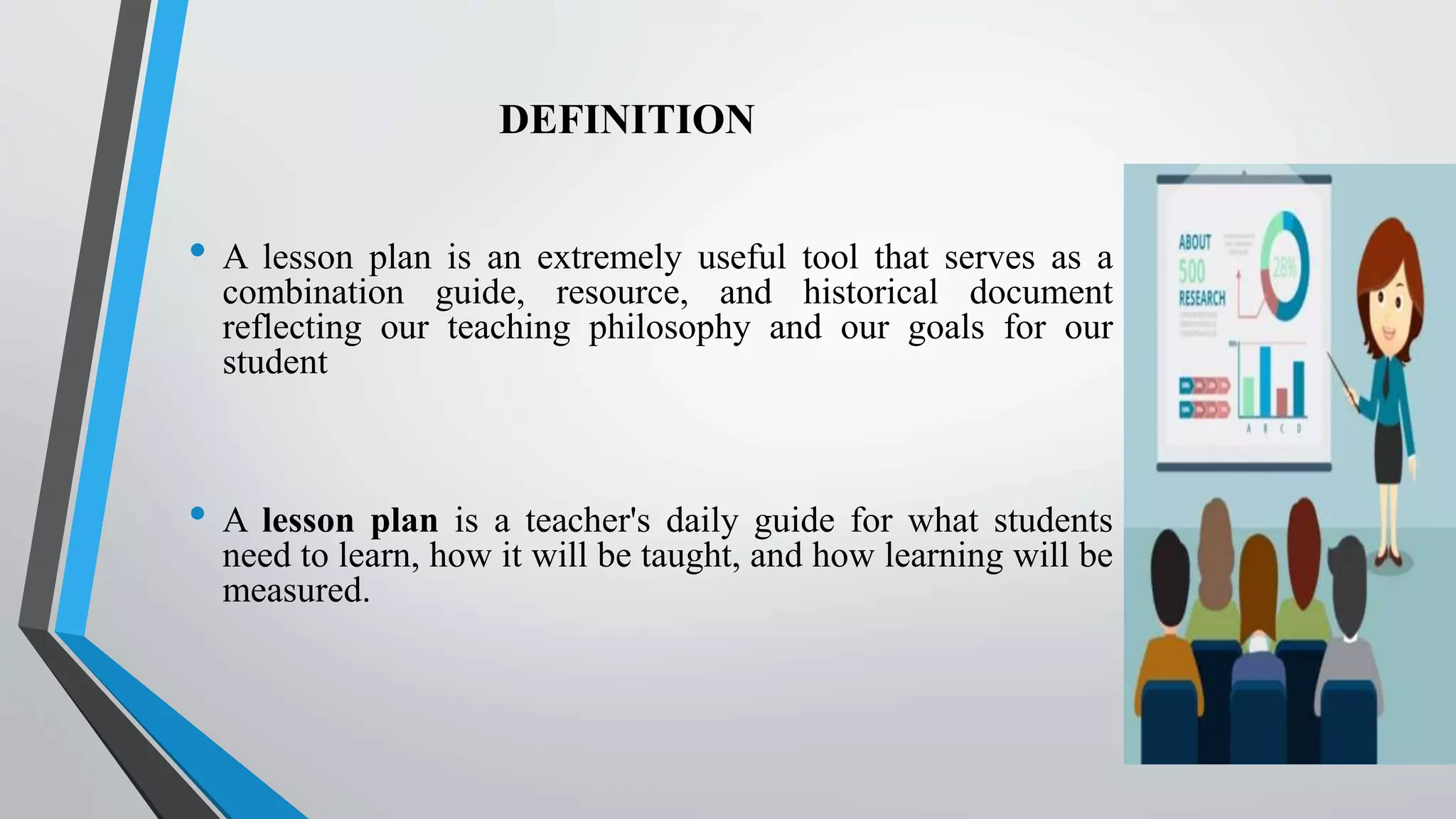
• A lesson plan is an extremely useful tool that serves as a
combination guide, resource, and historical document
reflecting our teaching philosophy and our goals for our
student
• A lesson plan is a teacher's daily guide for what students
need to learn, how it will be taught, and how learning will be
measured.
PURPOSE OF LESSON PLANNING
1. Ensures definite objective for the days work
2. Keeps the teacher on track
3. Ensures selection, presentation and interpretation of
subject matter
4. Helps to choose effective method of teaching
CONTD…
5. Enables to evaluate the teaching sessions
6.Helps to clarify the ideas
7.Gives the teacher greater confidence
8. It stimulates the teacher to think of related material , illustrations and
audio-visual aids
CHARACTERISTICS OF GOOD LESSON PLAN
1. Should have clearly stated objectives
2. To be linked with previous knowledge of
students
3.Should show and specify illustrative aid
4. Should contain suitable organized subject matter
CONT..
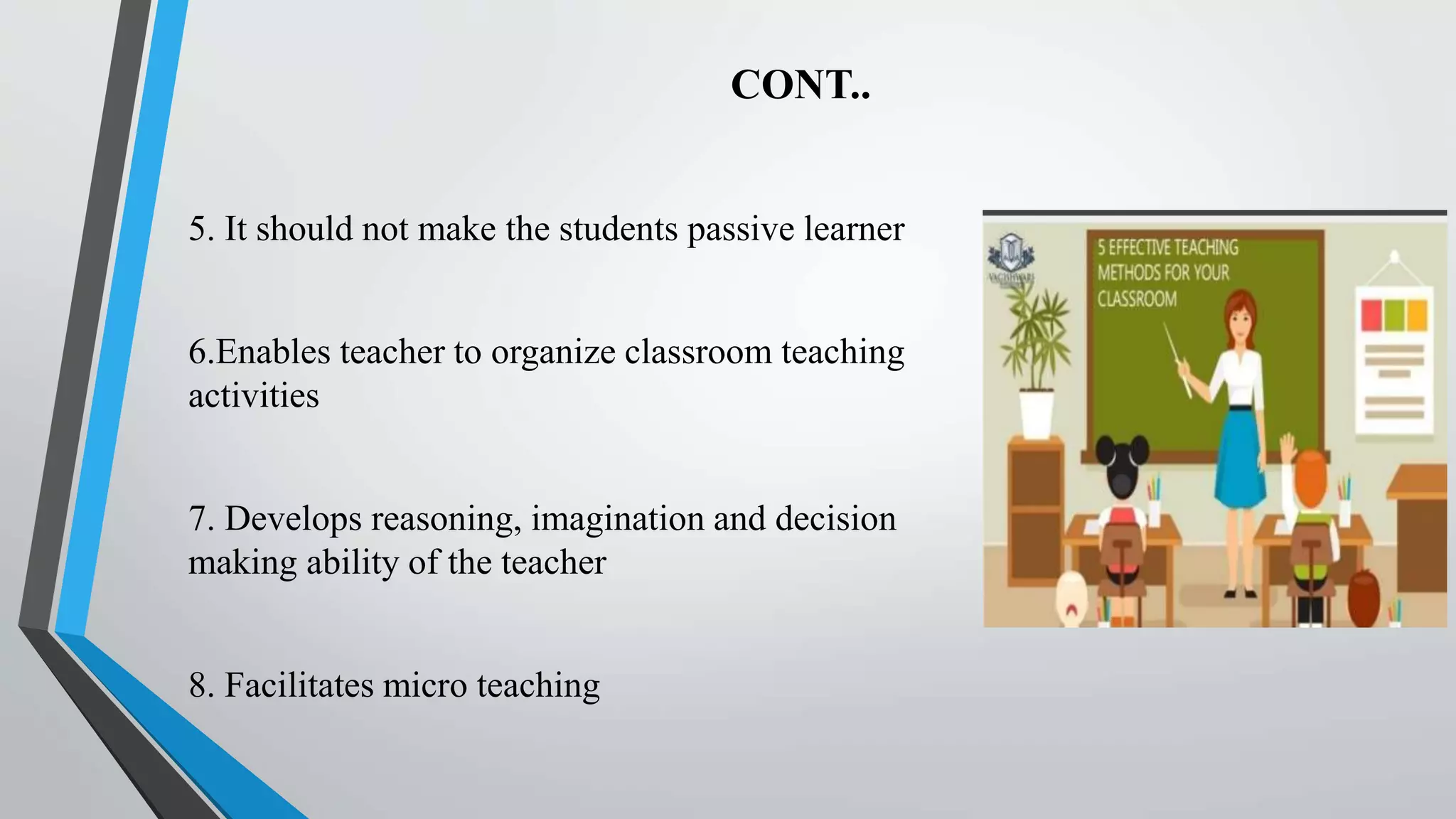
5. It should not make the students passive learner
6.Enables teacher to organize classroom teaching
activities
7. Develops reasoning, imagination and decision
making ability of the teacher
8. Facilitates micro teaching
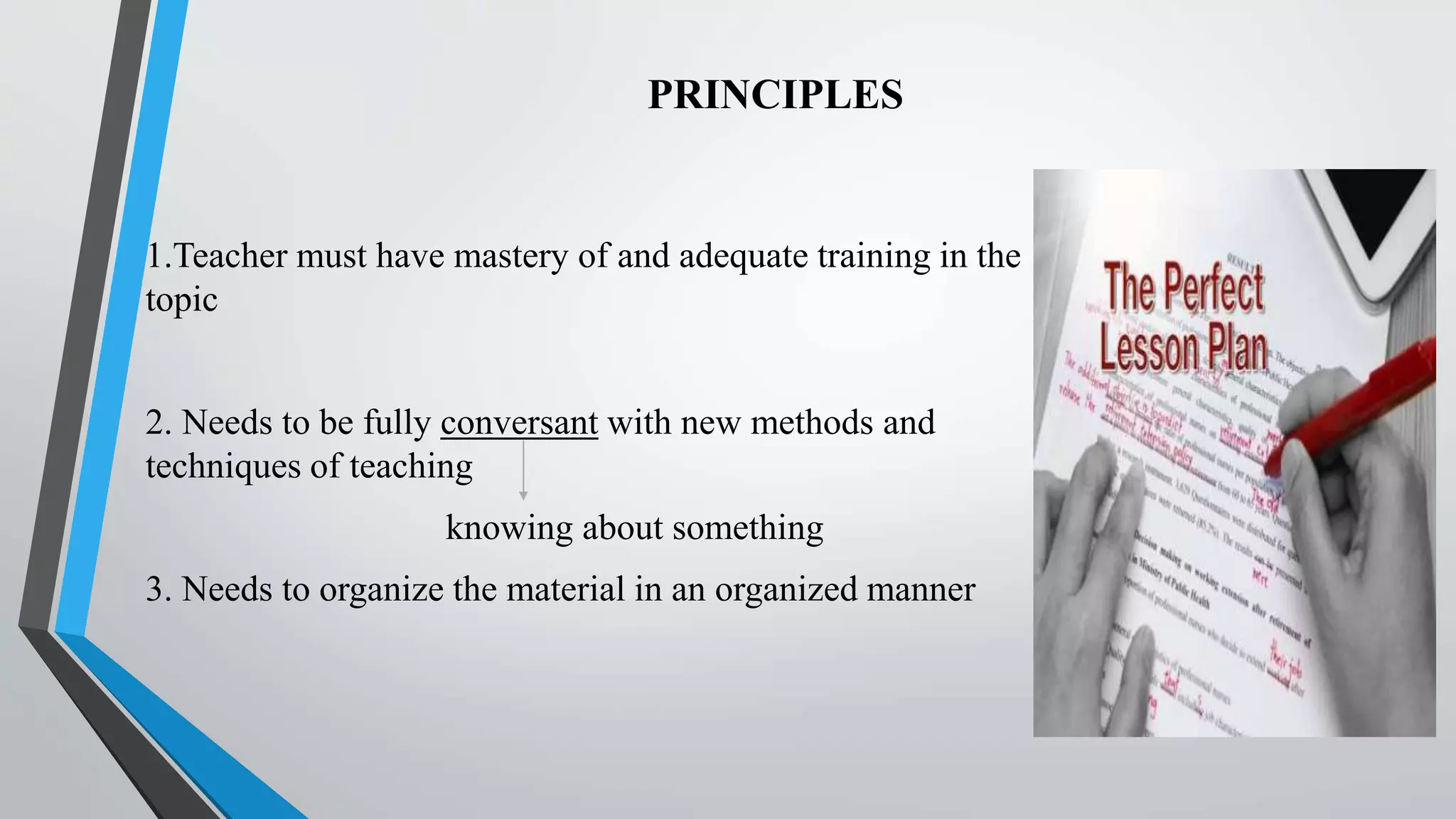
PRINCIPLES
1.Teacher must have mastery of and adequate training in the
topic
2. Needs to be fully conversant with new methods and
techniques of teaching
knowing about something
3. Needs to organize the material in an organized manner
CONTD…
4. Must ensure active student participation
5. Should use different teaching learning methods
IMPORTANCE OF LESSON PLANING
Lesson plan comfortably aligns classroom
instruction with circular goals and objectives
Helps to influence positive attitude of the
students
Lesson plan serves historical document of the
teacher did in class
CONTD….
Lesson plan prevents the over reliance on the text books as a
direct material for teaching
Lesson plan is good for the experience teacher even though
he has excellent, fluent set of class room management skills
Lesson plan serves checklist that guides teacher to be
systematic in the delivery of their lesson plan.
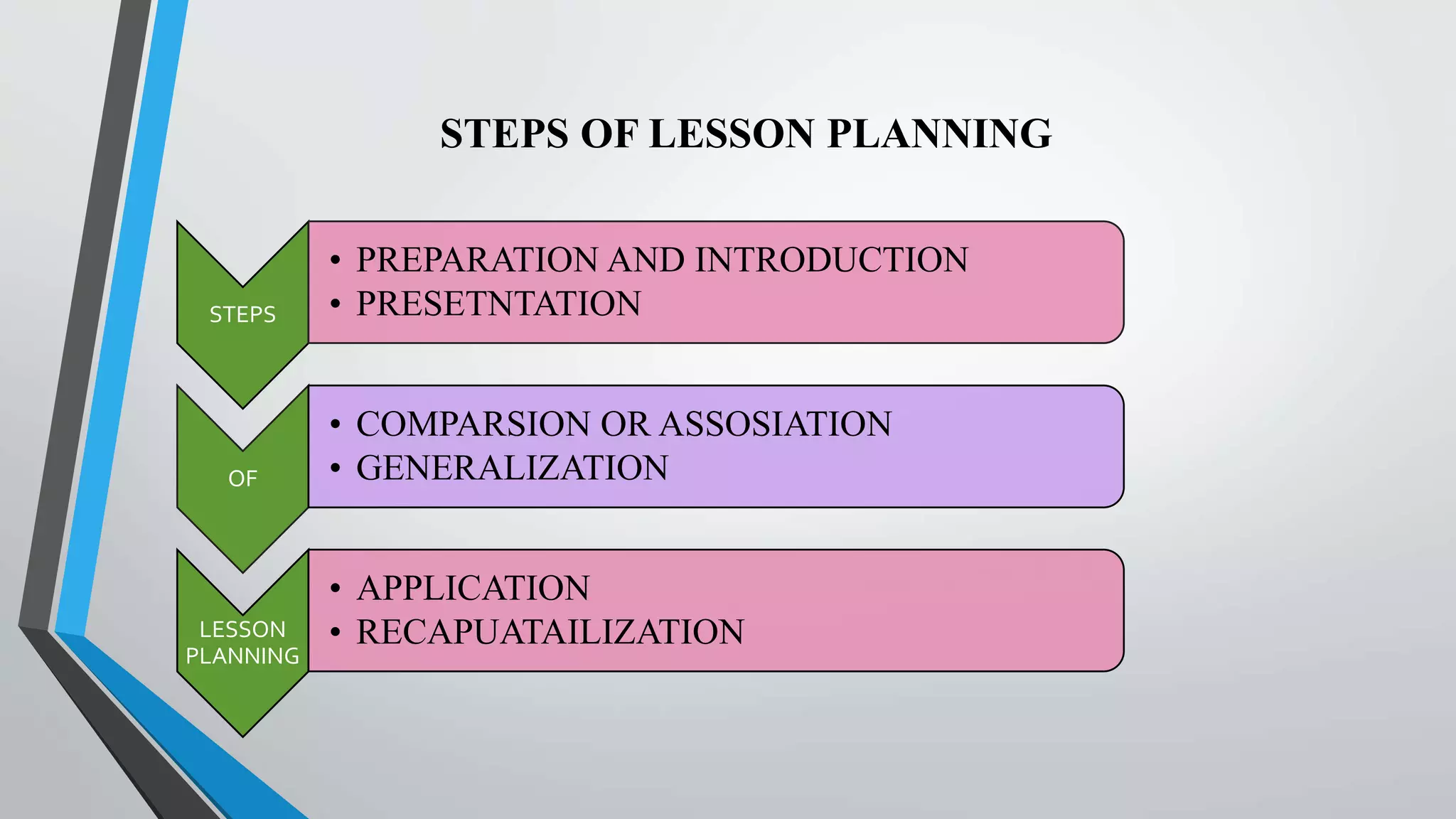
STEPS OF LESSON PLANNING
STEPS
• PREPARATION AND INTRODUCTION
• PRESETNTATION
OF
• COMPARSION OR ASSOSIATION
• GENERALIZATION
LESSON
PLANNING
• APPLICATION
• RECAPUATAILIZATION
1. Preparation or introduction
1.Knowledge which helps to lead them onto lesson.
2. Teacher prepares student to receive knowledge.
3.Testing previous knowledge.
4. It arouses interest and curiosity to learn new matter.
5. Introduction should be brief and to the point.
2.Presentation
1.Aim of the lesson should be clearly stated before the
presentation.
2.In teaching –learning process ,both – actively
participate.
3.The Teacher has to present the topic in enthusiastic
manner
4. learner will be motivated and get interest to learn
3.Comparison or association
1.Quote examples
2. Associate facts with to example
Some examples are given to the students and they are asked to the students and
to observe carefully & compare them with other set of examples and facts
3. So that learner can understand very easily and arrive at generalization on their
own
4.Generalizations
1.It involves reflective thinking.
2. Knowledge presented by the teacher should be thought provoking.
3. Innovating and stimulating to assist the students to generalize the situation.
This step providing the answer to the problem with which it began .
4.Application
1.The student make use of the knowledge acquired
2. What ever they learnt in the theory has to apply in clinical field to make
learning more permanent and worthwhile.
5.Recapitulation
1.Ask suitable stimulating appropriate questions to
student on topic.
2. The answer will give feed back, regarding the
efficacy of the method of teaching clarification
3.Needed or not
Guidelines for making good
lesson plan
The teacher should have--
1. Good knowledge about the student’s interests, traits and
abilities.
2. Mastery over the subject matter and adequate training
on the subject.
3. Principles of teaching and learning.
4. Awareness of individual differences among the
students.
CONT…
5. The knowledge what the students already possess
about the topic
6. Fully conversant with new methods and techniques of
teaching the subject
7. Ensure active pupil participation
CONT…
8. Does not consider the learning structures in organizing teaching activities
9.Teaching activities are less meaningful and practical
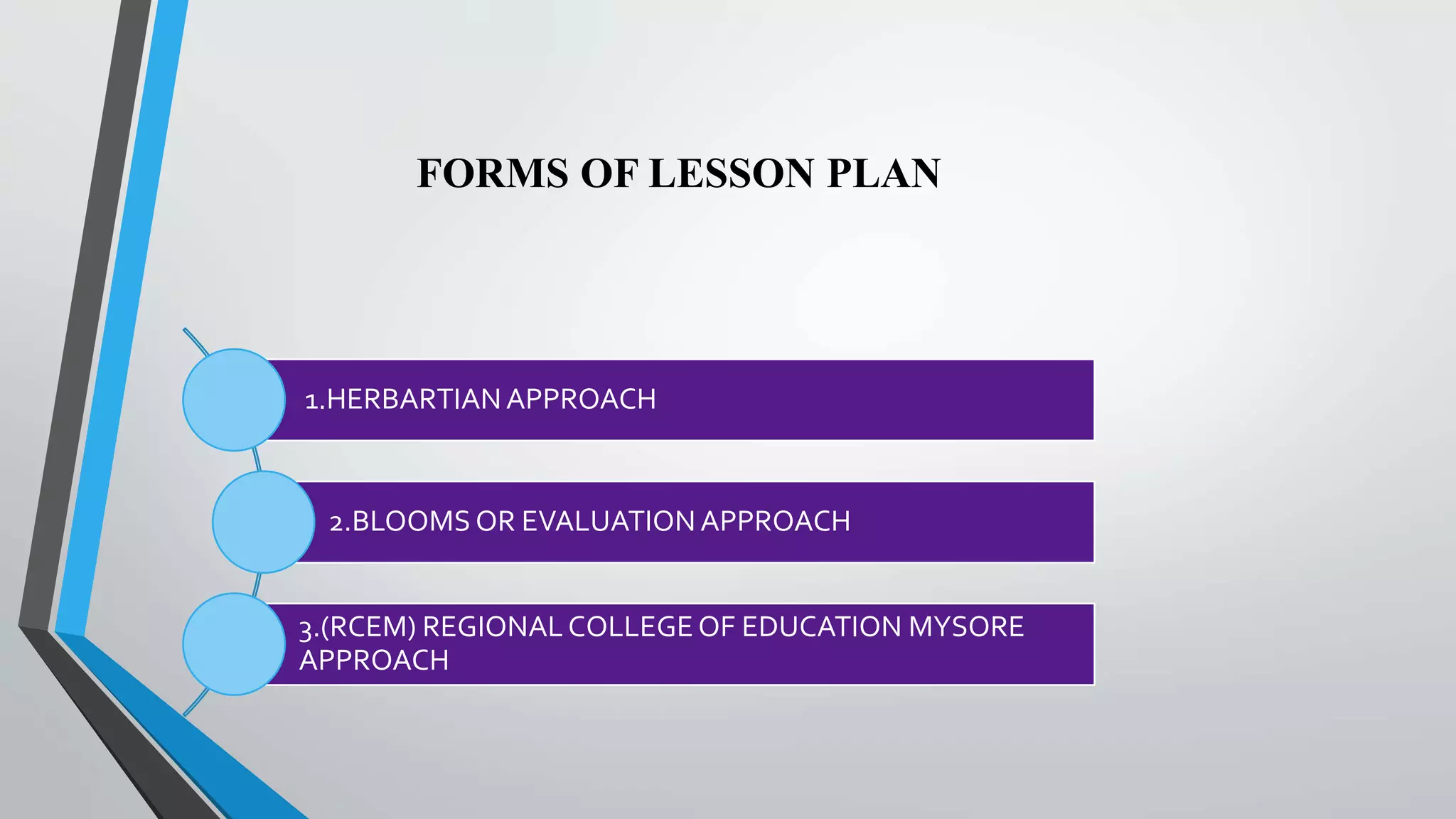
FORMS OF LESSON PLAN
1.HERBARTIANAPPROACH
2.BLOOMS OR EVALUATIONAPPROACH
3.(RCEM) REGIONALCOLLEGEOF EDUCATION MYSORE
APPROACH
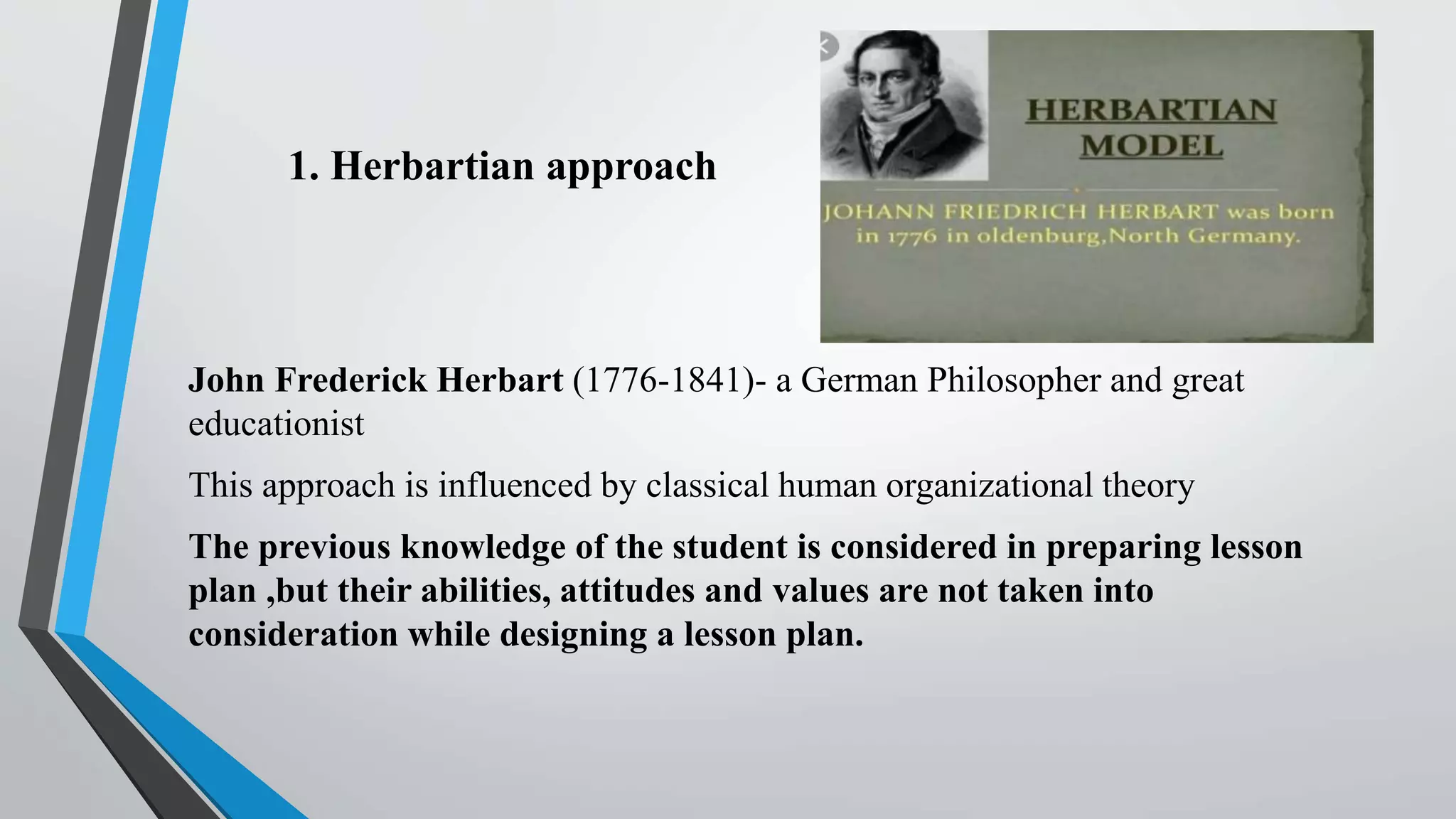
1. Herbartian approach
John Frederick Herbart (1776-1841)- a German Philosopher and great
educationist
This approach is influenced by classical human organizational theory
The previous knowledge of the student is considered in preparing lesson
plan ,but their abilities, attitudes and values are not taken into
consideration while designing a lesson plan.
CONTD…
• Herbart believed in maintaining the integrity of a student's individuality for as
long as possible during the education process as well as an emphasis on moral
training
• The goal of Herbartian was to aid students in their learning process, beginning
from no knowledge to complete knowledge.
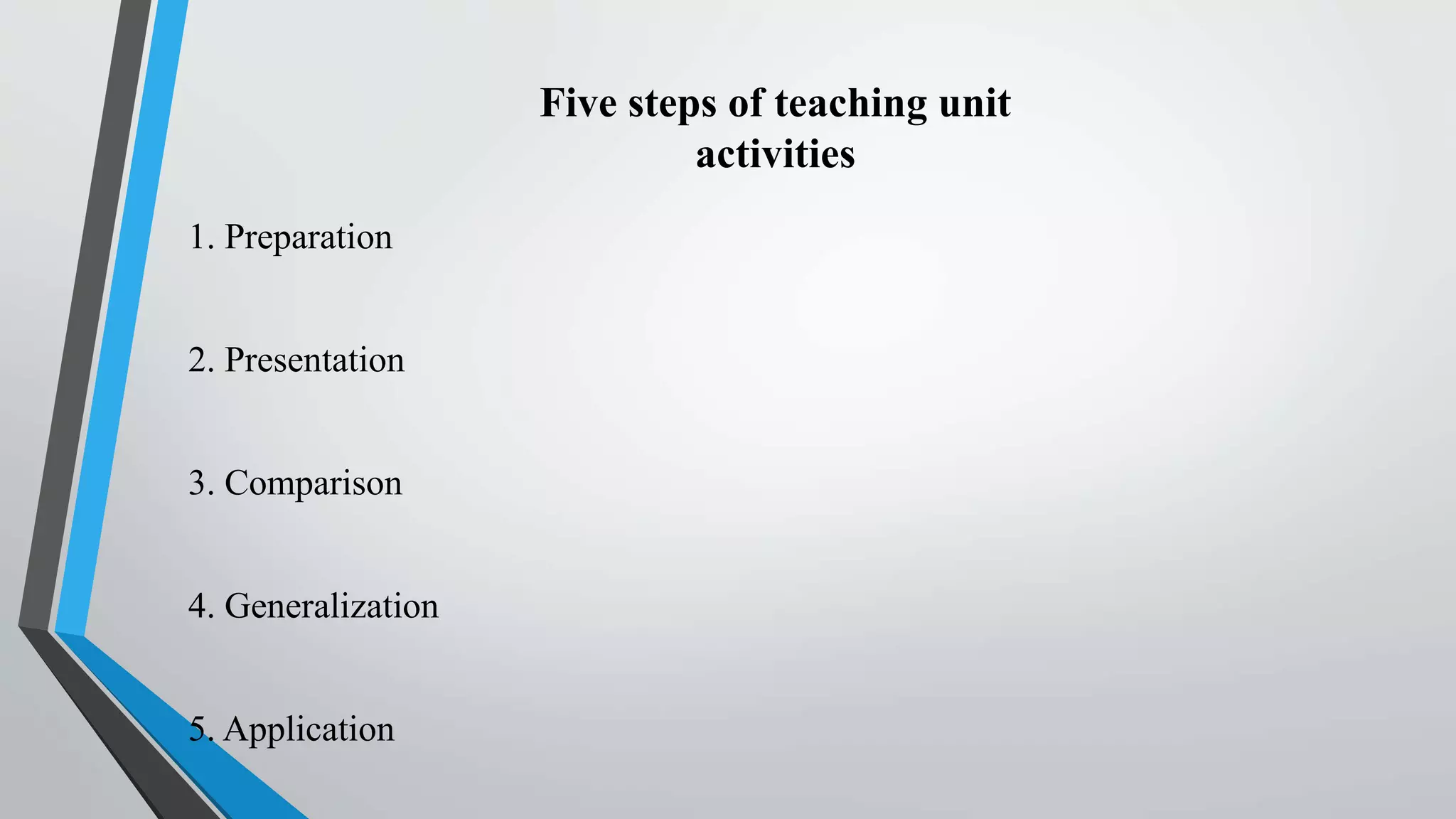
Five steps of teaching unit
activities
1. Preparation
2. Presentation
3. Comparison
4. Generalization
5. Application
Merits of Herbartian lesson
planning
1.It is logical and psychological
2. It assists in making teaching systematic
3. It is employed in the teaching of all school subjects
4.It is used in achieving the cognitive objective of teaching
CONTD…
5. It is simple and easy approach of lesson planning
6. It employs previous knowledge of the students for imparting
new knowledge
7. It provides a useful framework, confidence and self reliance by
following these steps and thus making teaching effective
Demerits of Herbartian approach
1. It is suited for knowledge lesson only
2. It is highly structured and does not provide
opportunities for teacher’s creativity and originality
3. More stress on teaching than in learning
2.Blooms approach
B .S . Bloom (1961)
He has made education as objective centered rather than client centered
His approach of lesson planning is termed as evaluative approach
Blooms Approach
• Bloom’s evaluation approach to lesson plan enables pupils
to learn from basic to complex, promotes critical thinking
and , provides a stage for the Teachers to design different
classroom experiences for students and gives importance
to student centered classroom.
• It focuses on educational objectives, creating learning
experiences and evaluating the change of behaviors.
CONTD..
• This approach is based on psychological and scientific principles, provides
scope for improving the learning experiences, teaching becomes purposeful
and objective oriented.
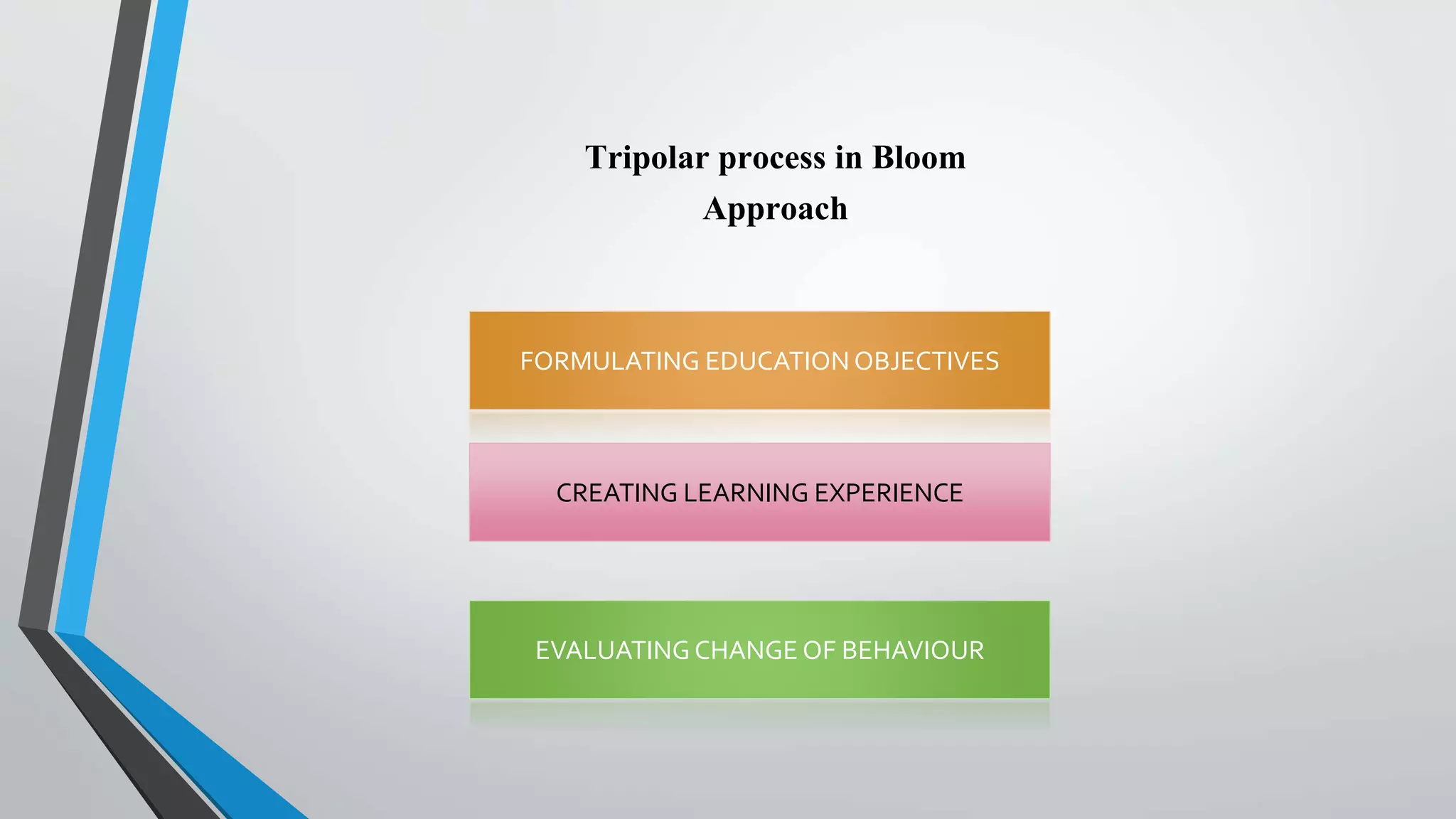
Tripolar process in Bloom
Approach
FORMULATING EDUCATION OBJECTIVES
CREATING LEARNING EXPERIENCE
EVALUATING CHANGE OF BEHAVIOUR
Merits of Blooms lesson planning
The objectives are written in behavioral terms
1. The teaching activities are related to learning structures
2. It makes the teaching purposeful and objective centred
3. It is based on psychological and scientific principles
4. It has greater scope for improving and modifying the
learning experience or teaching activities
Demerits of blooms lesson
planning
1. It is highly structured and mechanized and does not provide opportunity for
creativity and originality
2. It has the greater scope for personal factors of teacher to influence the
planning and organizing teaching activities
3. The mental process and mental abilities are not taken into consideration in
writing objectives in behavioral terms
3. RCEM Approach
• Developed by Indian educationists at Regional college
of Education , Mysore
• Design of lesson planning:-
• input
• process
• output
Contd..
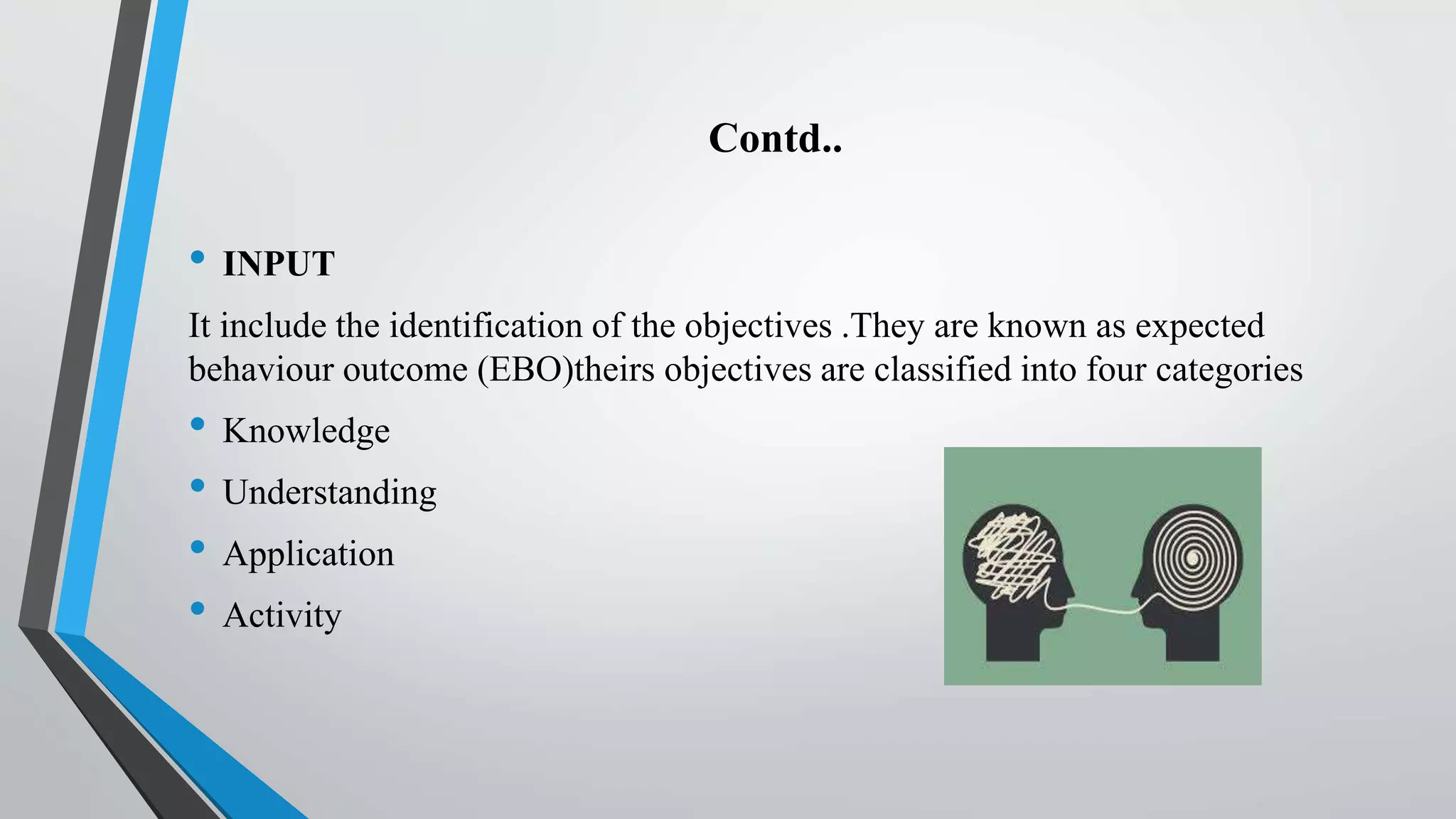
• INPUT
It include the identification of the objectives .They are known as expected
behaviour outcome (EBO)theirs objectives are classified into four categories
• Knowledge
• Understanding
• Application
• Activity
Contd …
PROCESS
• In the process the teaching strategies is selected for achieving the
objectives.in this steps these are includes
1.Communication strategy& A.V. aids
2.Learning situation &providing appropriate
3.Technique of motivation
Contd …
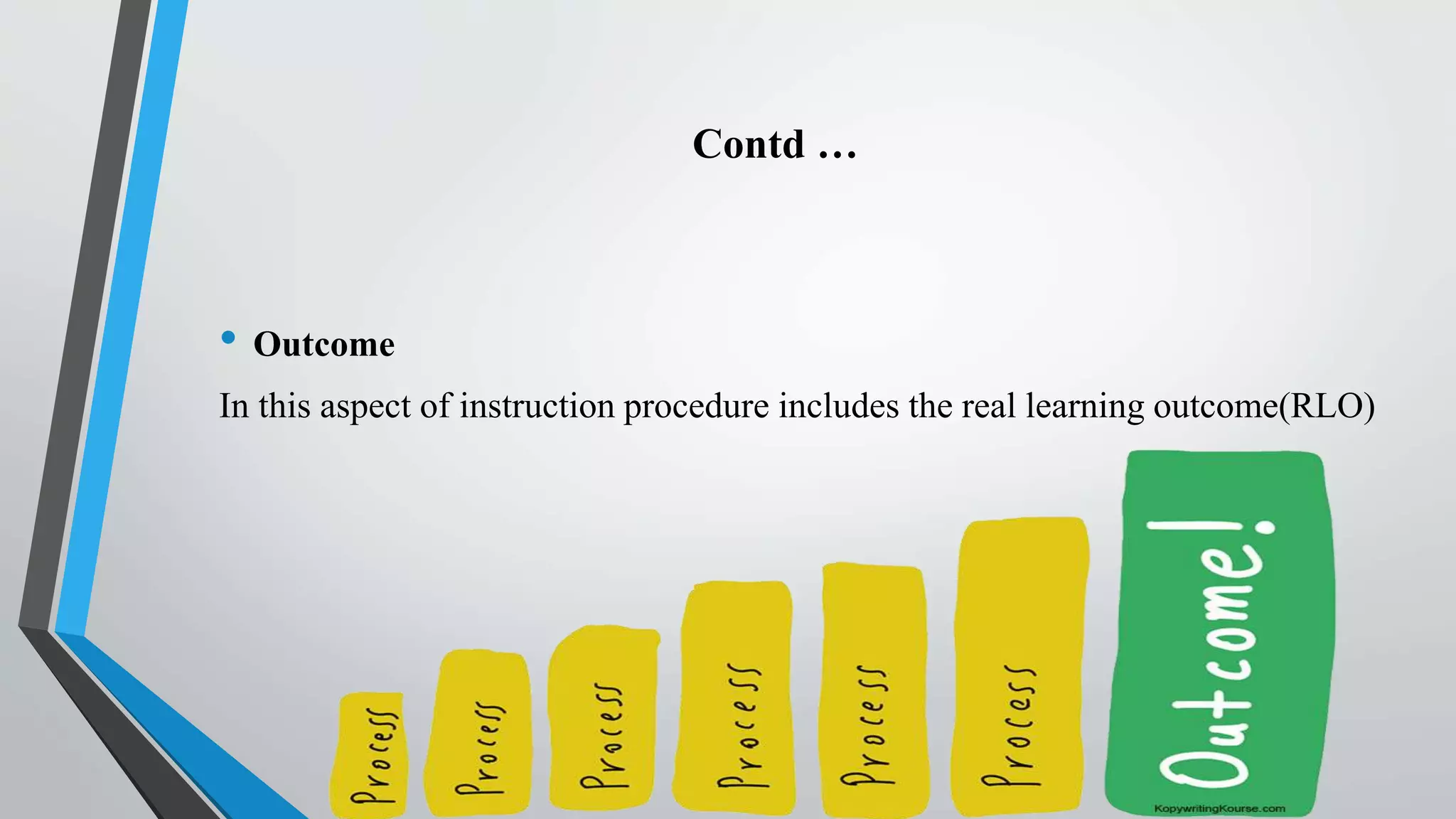
• Outcome
In this aspect of instruction procedure includes the real learning outcome(RLO)
HIGHLY STRUCTURED LESSON PLAN
Name of Teacher
Class:
Subject:
No. Of Students:
Unit:
Date and Time:
Topic of lesson :
Duration:
Previous Knowledge Of students: Venue:
Methods of Teaching:
Resources:
Central objectives:
Specific Objectives:
CONTD…
• Recapitulation:
• Assignments:
• Reference:
TIME SPECIFIC
OBJECTIVES
CONTENT TEACHING
ACTIVITY
STUDENT
ACTIVITY
A.V AIDS EVALUATIO
N
Intro
Aims
Presentation
explanation
Lecture cum
discussion
listen ppt, charts Recapitalisati
on of
questions
Advantages/Disadvantages
Teacher:-
Advantages:-
1. the teacher can plan the presentation in advance, helping in making the
teaching effective
2. Helps in apparent time saving and avoids unnecessary repetition
3. New knowledge can be presented which is not there in the text book
CONT…
Dis Advantage:-
1.The main emphasis is given to presentation
2. It confines the teaching up to memory level only
CONTD..
Students:-
Merit:-
1.A well presented class may increase the student motivation
2.Greater scope for improving and modifying the learning experience
CONTD…
Demerits:-
1.Student attention may want the presentation to suit the level of
understanding of all students
2. Poor planning and lack of direction of teaching may result in
wasting student time
3.Poor lesson plan can make the student more passive learner
Activity
Lesson plan prenatal care and role of nurse
• Name of Teacher: Ms Ankita
• Class: BSc 4th year
• Subject: child health nursing
• No. Of Students: 40
• Date : 25-4-2020
• Topic of lesson : prenatal care and role of nurse
• Duration: 45 min
• Methods of Teaching: lecture cum discussion
• General objectives: at the end of class students are able to explain about prenatal care and role of
nurse
• Specific Objectives: at the end of practice teaching the students will be able to:
• To define prenatal care
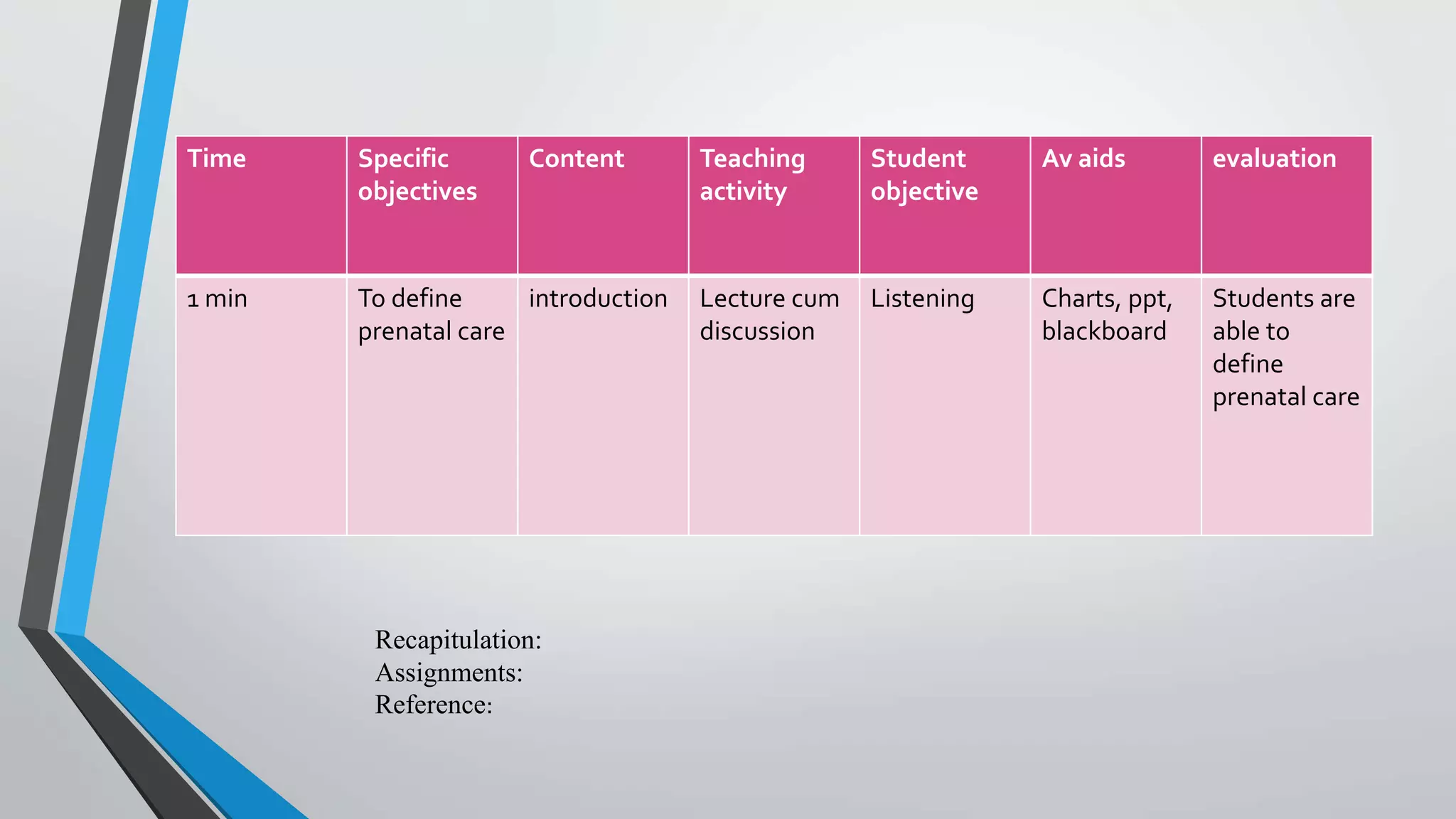
Time Specific
objectives
Content Teaching
activity
Student
objective
Av aids evaluation
1 min To define
prenatal care
introduction Lecture cum
discussion
Listening Charts, ppt,
blackboard
Students are
able to
define
prenatal care
Recapitulation:
Assignments:
Reference:
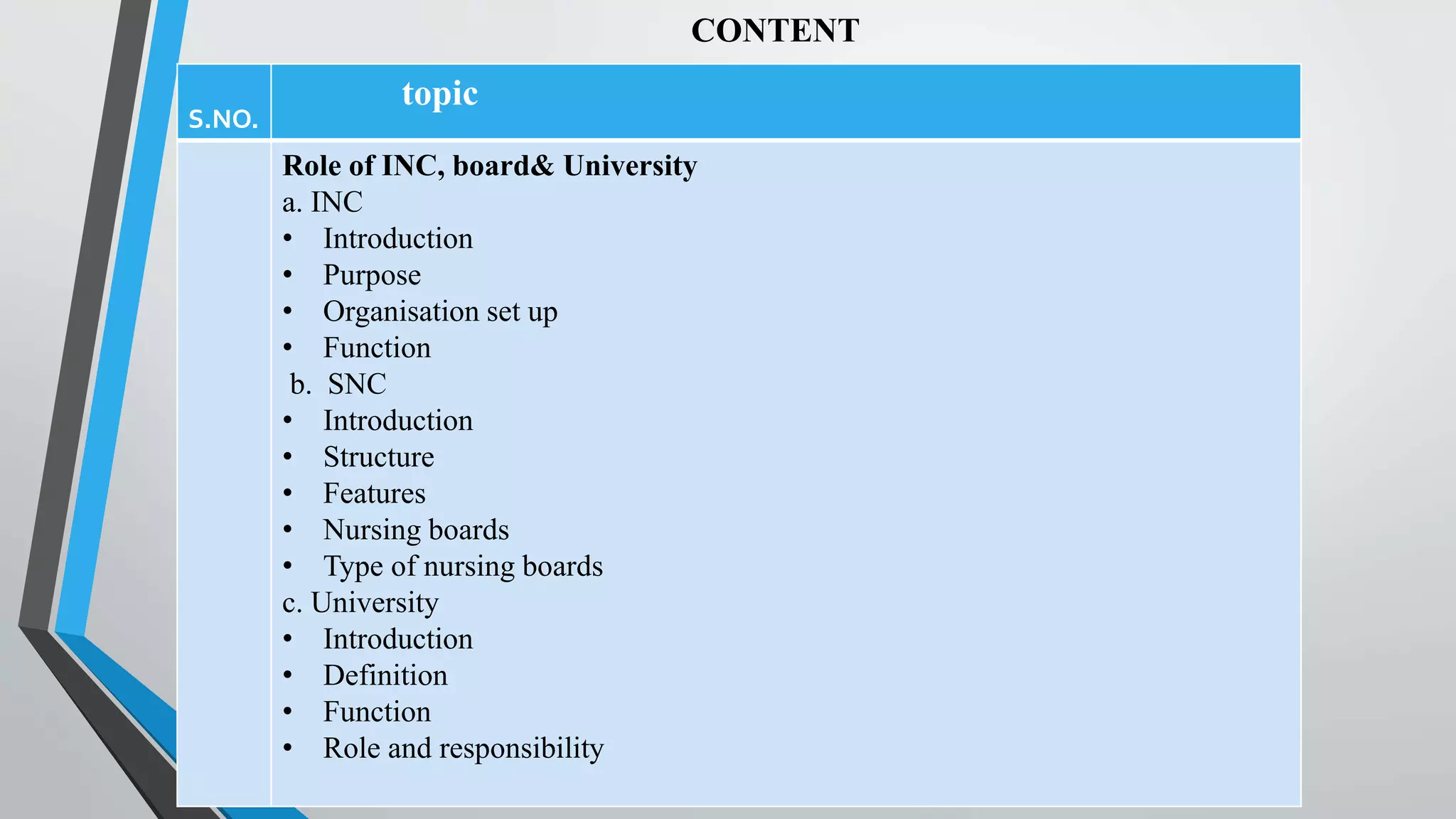
CONTENT
S.NO.
topic
Role of INC, board& University
a. INC
• Introduction
• Purpose
• Organisation set up
• Function
b. SNC
• Introduction
• Structure
• Features
• Nursing boards
• Type of nursing boards
c. University
• Introduction
• Definition
• Function
• Role and responsibility
INC ( INDIAN NURSING COUNCIL)
Introduction
The invading nursing counsel is an Autonomous body under the
ministry of government of India, ministry of the health welfare was
constitute by the central government under section 3(1) of the Indian
nursing council act, 1947 of the parliament in order to establish a
uniform standards of the training for nurses, midwives and health
visitors.
Contd…
Act no. of year: ACT.48 of 1947
Enactments date:{31st December,1947}
Act objectives
• An act to constitute an Indian nursing council
• To establish a uniform standard of the training for nurses, midwives and health
visitors.
• It is enacted with 17 section and each section point out of specific legislative role of
council.
PURPOSE
• The purpose of INC establishment is to formulate a national policy for
training and practice of nursing depending mainly on the culture &
philosophy of the country (India).
President
Vice-president
secretary
Joint secretary
Deputy secretary
Assistance secretary
Office staff y
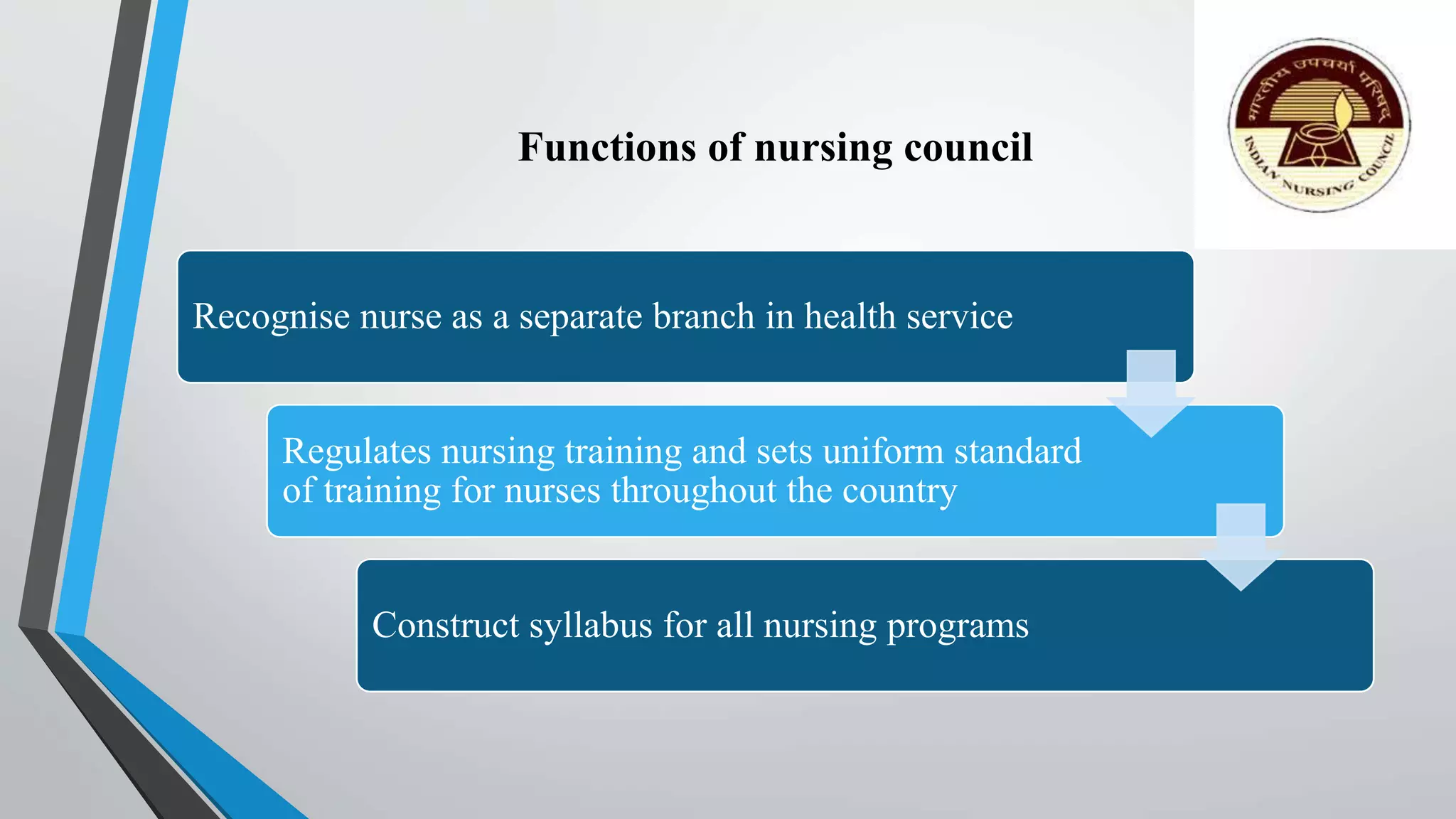
Functions of nursing council
Recognise nurse as a separate branch in health service
Regulates nursing training and sets uniform standard
of training for nurses throughout the country
Construct syllabus for all nursing programs
Contd …
Permits title ,badges, uniforms for registered nurses
Withdrawal of recognition of nursing institution
The regulate nursing practice
Cont..
Power to make regulation
Inspection of school and college of nursing
Maintenance of Indian nurse register
Organising various programmes such as book
exhibition, job fair, seminar , conference inter
colleges competition , sports meets
EDUCATION ROLE AND RESPONSIBILITES
INC initiate, prescribes, guide and supervise the different level of nursing
education.
• It laid down the quantification of the admission, registration and employment.
• It recognizes and approves various institution for conduction different nursing
education programs.
Contd..
• INC sets education activities in different occasions like Nurse Day, breast
feeding week, AIDS Day etc.
• It regulate the course duration
SNC (STATE NURSING COUNCIL)
• Introduction
The State Nurses and Midwives Council was established in
1948 under the provisions of Nurses and Midwives Act with the
purpose of “Better Training of Nurses, Midwives and health
Visitors”
It works as an autonomous body under the Government of
respective states, Department of Health and Family Welfare
STRUCTURE
Each state determines the specific administrative responsibility and oversight of
the council nursing.
• The governor of the state
• The state health directorate
• Nursing directorate
• Another state official or organisation
FEATURES
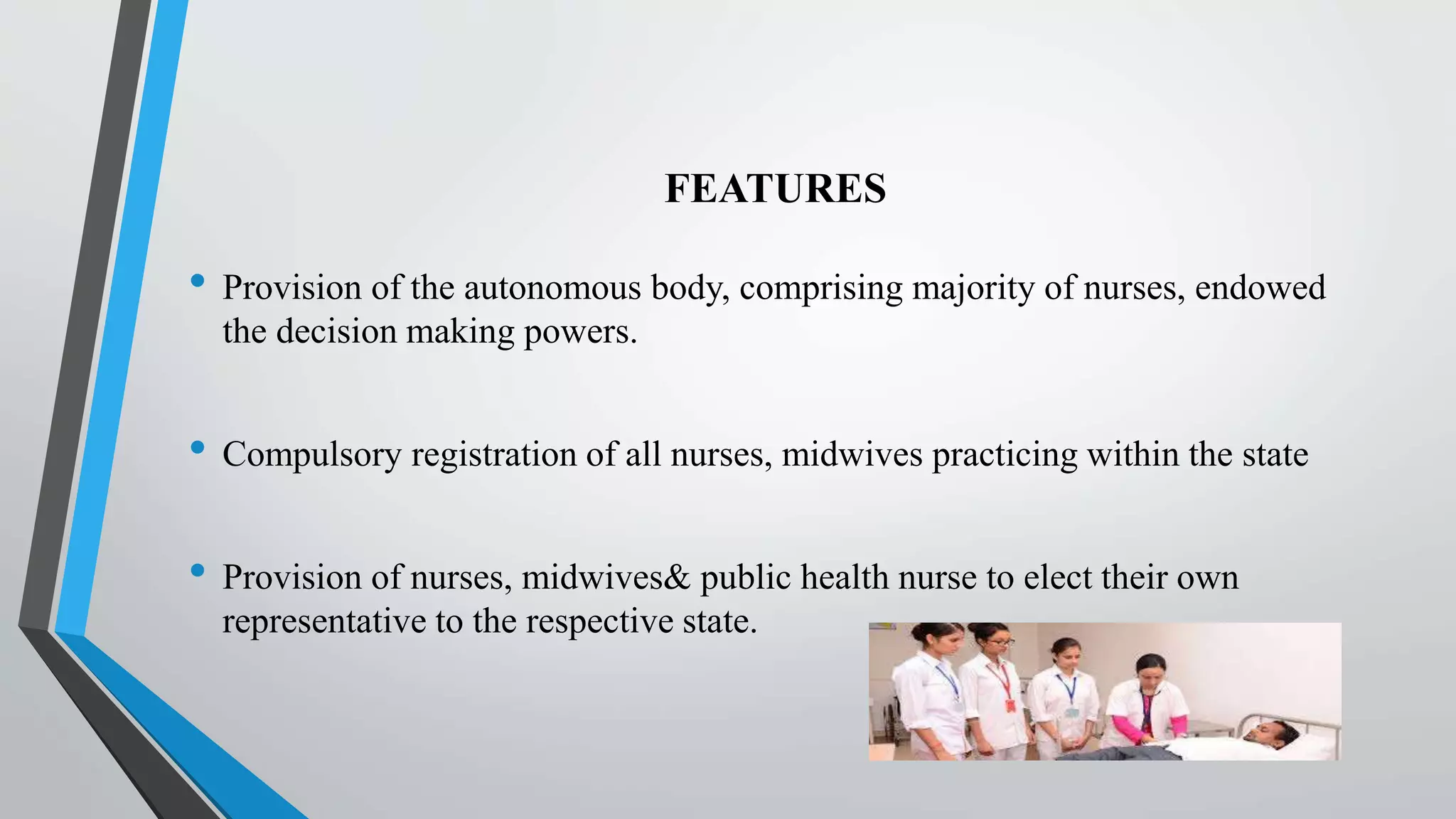
• Provision of the autonomous body, comprising majority of nurses, endowed
the decision making powers.
• Compulsory registration of all nurses, midwives practicing within the state
• Provision of nurses, midwives& public health nurse to elect their own
representative to the respective state.
Contd ..
• Powers to regulate nursing education prescribe curriculum &enunciate
examination policies.
• Provision to have a nurse register to carry out the functions of SNC.
• Provision for the recognition of educational intuitions of nursing &withdrawal
of such recognition, if necessary
NURSING BOARDS
HISTORY
More than 100years ago, state
governments established boards of
nursing to protect the publics health and
welfare by overseeing and ensure the
safe practice of nursing in India
Board of Nursing
are state
governmental
agencies that are
responsible for the
regulation of nursing
practice
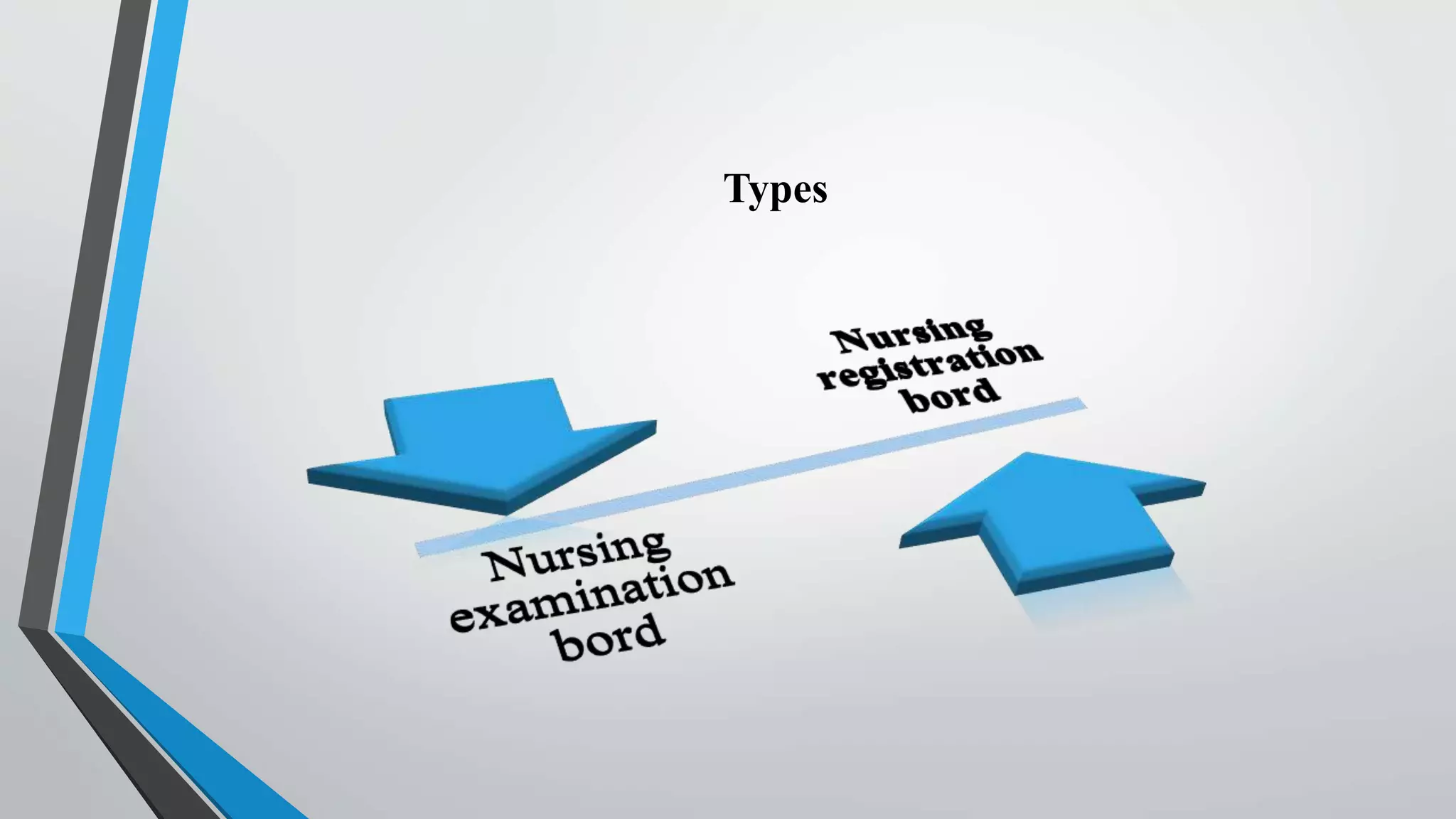
Types
NURSING EXAMINATION BOARD
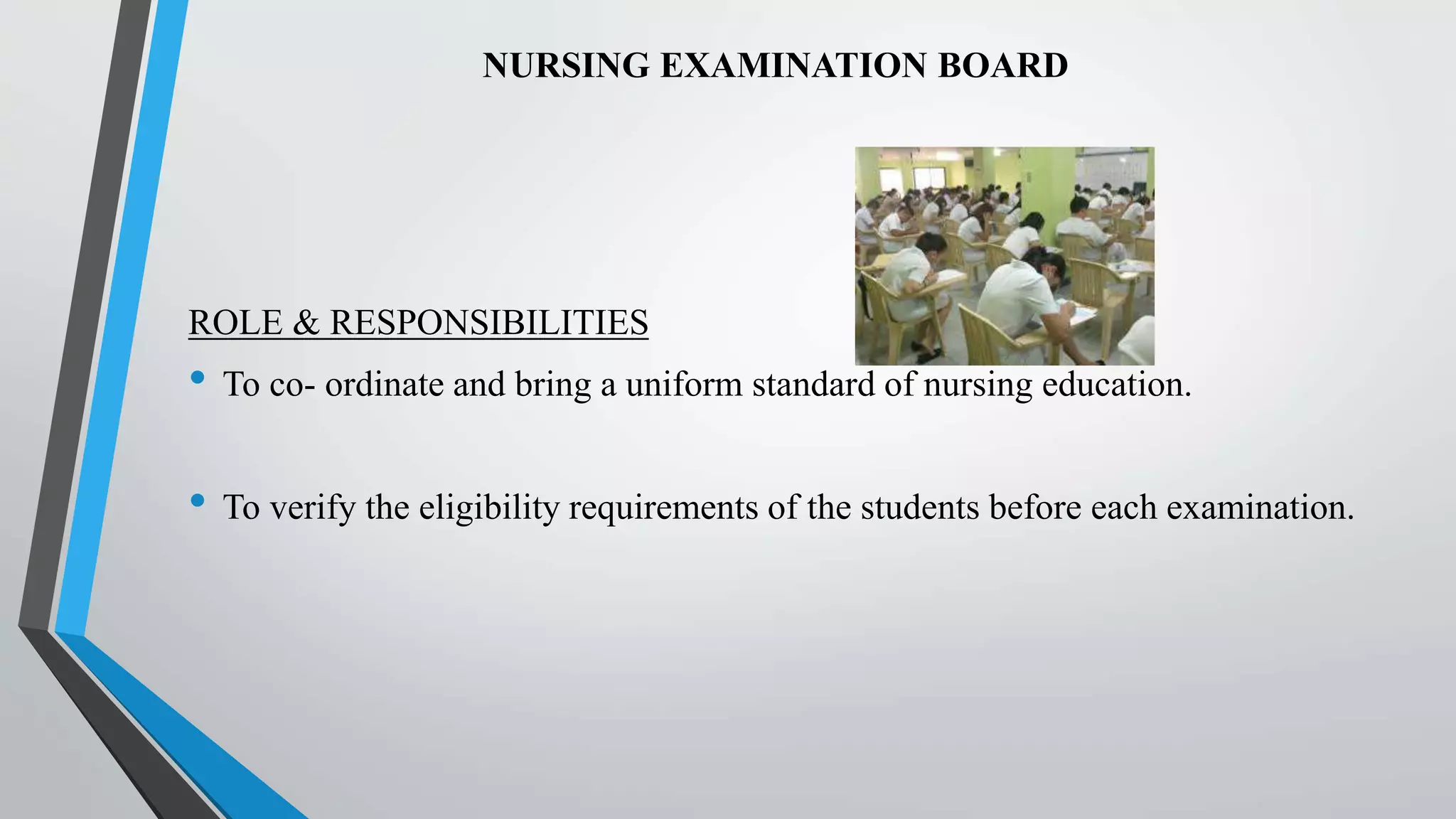
ROLE & RESPONSIBILITIES
• To co- ordinate and bring a uniform standard of nursing education.
• To verify the eligibility requirements of the students before each examination.
Contd …
• To arrange for conducting examination and issuing certificates to successful
candidates.
• To prepare the calendar of events at the beginning of each academic year.
• To appoint the examiners before each examination.
NURSING REGISTRATION BOARD
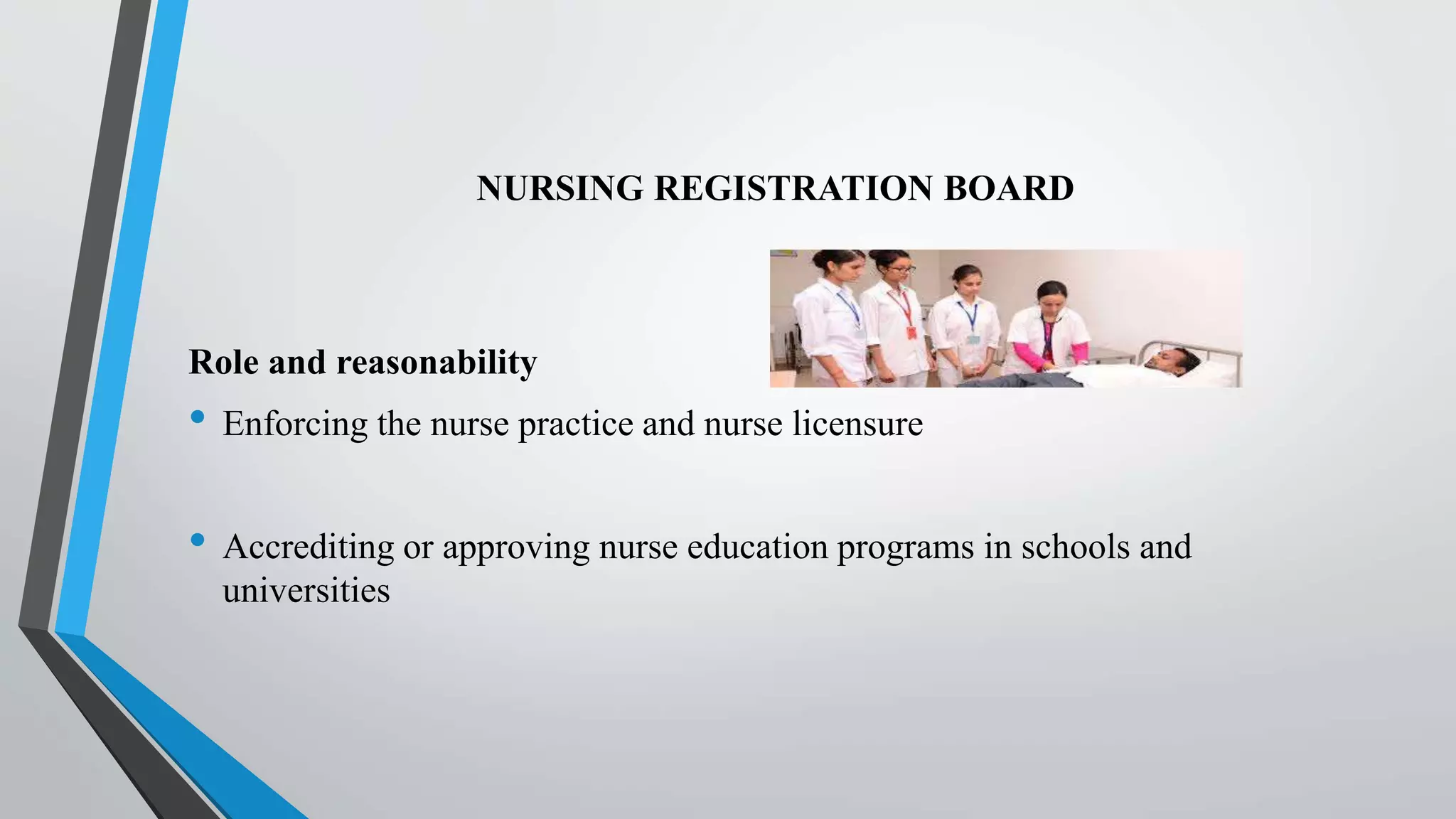
Role and reasonability
• Enforcing the nurse practice and nurse licensure
• Accrediting or approving nurse education programs in schools and
universities
Contd …
• Responsible to maintain the register in prescribed manner for nurses.
Midwives health visitor is called Indian nurses registrar
• Developing policies, practice standards & administrative regulation
Introduction
• A university (Latin: universitas, "a whole") is an
institution of higher (or tertiary) education and
research which awards academic degrees in
various academic disciplines. Universities
typically provide undergraduate education and
postgraduate education.
Definition
• A university is an institution of the higher education
and research which grants academic degrees in a
variety of subjects and provides both undergraduate
education and postgraduation
• an institution of higher learning providing facilities for
teaching and research and authorized to grant academic
degrees
Functions of the University
1. Provide education at university standard
2. Provide facilities for, and encourage, study and research
3. Encourage the advancement and
development of knowledge, and its application
to government, industry, commerce and the
community.
4. Provide courses of study or instruction, at
levels of achievement the Council considers
appropriate, to meet the needs of the
community.
5. confer higher education awards
6. Disseminate knowledge and promote
scholarship
7. Provide facilities and resources for the
wellbeing of the University’s staff, students and
other persons undertaking courses at the
University
8. Perform other functions given to
the University under the Act or
another Act
9.Conduct examination
Roles and responsibility of university
Regulation of its own colleges & affiliation
Conducting inspection and Grandin ting permission
for admission
Conducting examination & announcing the results
Contd …
Conducting the graduation ,post graduation &
doctoral programme
Ensuring faculty welfare and development
Ensuring student welfare and development
Activity
• INC conduct examination in different nursing colleges and university
CONCLUSION
• Teacher must allow themselves flexibility to plan in their own way. Lesson
plan must keep up the students interest and motivation. Evaluate permits
teachers to assess students drawbacks and achievements
• Evaluation and assessment of academic programs and students learning are
shared responsibilities of both academic and non- academic staff and units
• The position of academic planning today is so prominent that it can be
considered the heart of the university system
SUMMURIZATION
REFERANCES
B.T. Basavanthappa , Nursing education 2nd edition (2009). Page no. 581- 588.
https://www.slideshare.com followed on 15/4/2020
http://www.Wikipedia.com followed on 18/4/2020
 Lesson planning

Lesson planning

  • 1.
    LESSON PLANNING SUMITTED TOSUBMITTED BY DR. PALLAVI PATHANIA MS. MANISHA KUMARI ASSOCIATE PROFESSOR M.Sc. (N) 1ST YEAR SHIMLA NURSING COLLEGE SHIMLA NURSING COLLEGE
  • 3.
    CONTENT S.NO. TOPIC 1 Lessonplanning a. Introduction b. Definition of lesson planning c. Purpose of lesson planning d. characteristics of lesson planning e. Principle f. Importance of lesson planning g. Steps of lesson planning h. Guidelines for making good lesson planning i. Forms of lesson planning j. Activity
  • 4.
    INTRODUCTION A lesson planis the instructor’s road map of what the students need to learn and how it will be done effectively during the class time then, you can design appropriate learning activities and develop strategies to obtain feedback on the student learning
  • 5.
    MEANING OF LESSONPLANNING LESSON- 1.Things to be learned by pupil. 2.Amount of teaching given at one time within the time assigned. PLAN- 1. The process of logically organising the teaching activities for a course or program 2. A guide for teacher which helps to cover topics comprehensively with proper sequence of points and without missing things
  • 6.
    DEFINITION • A lessonplan is an extremely useful tool that serves as a combination guide, resource, and historical document reflecting our teaching philosophy and our goals for our student • A lesson plan is a teacher's daily guide for what students need to learn, how it will be taught, and how learning will be measured.
  • 7.
    PURPOSE OF LESSONPLANNING 1. Ensures definite objective for the days work 2. Keeps the teacher on track 3. Ensures selection, presentation and interpretation of subject matter 4. Helps to choose effective method of teaching
  • 8.
    CONTD… 5. Enables toevaluate the teaching sessions 6.Helps to clarify the ideas 7.Gives the teacher greater confidence 8. It stimulates the teacher to think of related material , illustrations and audio-visual aids
  • 9.
    CHARACTERISTICS OF GOODLESSON PLAN 1. Should have clearly stated objectives 2. To be linked with previous knowledge of students 3.Should show and specify illustrative aid 4. Should contain suitable organized subject matter
  • 10.
    CONT.. 5. It shouldnot make the students passive learner 6.Enables teacher to organize classroom teaching activities 7. Develops reasoning, imagination and decision making ability of the teacher 8. Facilitates micro teaching
  • 11.
    PRINCIPLES 1.Teacher must havemastery of and adequate training in the topic 2. Needs to be fully conversant with new methods and techniques of teaching knowing about something 3. Needs to organize the material in an organized manner
  • 12.
    CONTD… 4. Must ensureactive student participation 5. Should use different teaching learning methods
  • 13.
    IMPORTANCE OF LESSONPLANING Lesson plan comfortably aligns classroom instruction with circular goals and objectives Helps to influence positive attitude of the students Lesson plan serves historical document of the teacher did in class
  • 14.
    CONTD…. Lesson plan preventsthe over reliance on the text books as a direct material for teaching Lesson plan is good for the experience teacher even though he has excellent, fluent set of class room management skills Lesson plan serves checklist that guides teacher to be systematic in the delivery of their lesson plan.
  • 15.
    STEPS OF LESSONPLANNING STEPS • PREPARATION AND INTRODUCTION • PRESETNTATION OF • COMPARSION OR ASSOSIATION • GENERALIZATION LESSON PLANNING • APPLICATION • RECAPUATAILIZATION
  • 16.
    1. Preparation orintroduction 1.Knowledge which helps to lead them onto lesson. 2. Teacher prepares student to receive knowledge. 3.Testing previous knowledge. 4. It arouses interest and curiosity to learn new matter. 5. Introduction should be brief and to the point.
  • 17.
    2.Presentation 1.Aim of thelesson should be clearly stated before the presentation. 2.In teaching –learning process ,both – actively participate. 3.The Teacher has to present the topic in enthusiastic manner 4. learner will be motivated and get interest to learn
  • 18.
    3.Comparison or association 1.Quoteexamples 2. Associate facts with to example Some examples are given to the students and they are asked to the students and to observe carefully & compare them with other set of examples and facts 3. So that learner can understand very easily and arrive at generalization on their own
  • 19.
    4.Generalizations 1.It involves reflectivethinking. 2. Knowledge presented by the teacher should be thought provoking. 3. Innovating and stimulating to assist the students to generalize the situation. This step providing the answer to the problem with which it began .
  • 20.
    4.Application 1.The student makeuse of the knowledge acquired 2. What ever they learnt in the theory has to apply in clinical field to make learning more permanent and worthwhile.
  • 21.
    5.Recapitulation 1.Ask suitable stimulatingappropriate questions to student on topic. 2. The answer will give feed back, regarding the efficacy of the method of teaching clarification 3.Needed or not
  • 22.
    Guidelines for makinggood lesson plan The teacher should have-- 1. Good knowledge about the student’s interests, traits and abilities. 2. Mastery over the subject matter and adequate training on the subject. 3. Principles of teaching and learning. 4. Awareness of individual differences among the students.
  • 23.
    CONT… 5. The knowledgewhat the students already possess about the topic 6. Fully conversant with new methods and techniques of teaching the subject 7. Ensure active pupil participation
  • 24.
    CONT… 8. Does notconsider the learning structures in organizing teaching activities 9.Teaching activities are less meaningful and practical
  • 25.
    FORMS OF LESSONPLAN 1.HERBARTIANAPPROACH 2.BLOOMS OR EVALUATIONAPPROACH 3.(RCEM) REGIONALCOLLEGEOF EDUCATION MYSORE APPROACH
  • 26.
    1. Herbartian approach JohnFrederick Herbart (1776-1841)- a German Philosopher and great educationist This approach is influenced by classical human organizational theory The previous knowledge of the student is considered in preparing lesson plan ,but their abilities, attitudes and values are not taken into consideration while designing a lesson plan.
  • 27.
    CONTD… • Herbart believedin maintaining the integrity of a student's individuality for as long as possible during the education process as well as an emphasis on moral training • The goal of Herbartian was to aid students in their learning process, beginning from no knowledge to complete knowledge.
  • 28.
    Five steps ofteaching unit activities 1. Preparation 2. Presentation 3. Comparison 4. Generalization 5. Application
  • 29.
    Merits of Herbartianlesson planning 1.It is logical and psychological 2. It assists in making teaching systematic 3. It is employed in the teaching of all school subjects 4.It is used in achieving the cognitive objective of teaching
  • 30.
    CONTD… 5. It issimple and easy approach of lesson planning 6. It employs previous knowledge of the students for imparting new knowledge 7. It provides a useful framework, confidence and self reliance by following these steps and thus making teaching effective
  • 31.
    Demerits of Herbartianapproach 1. It is suited for knowledge lesson only 2. It is highly structured and does not provide opportunities for teacher’s creativity and originality 3. More stress on teaching than in learning
  • 32.
    2.Blooms approach B .S. Bloom (1961) He has made education as objective centered rather than client centered His approach of lesson planning is termed as evaluative approach
  • 33.
    Blooms Approach • Bloom’sevaluation approach to lesson plan enables pupils to learn from basic to complex, promotes critical thinking and , provides a stage for the Teachers to design different classroom experiences for students and gives importance to student centered classroom. • It focuses on educational objectives, creating learning experiences and evaluating the change of behaviors.
  • 34.
    CONTD.. • This approachis based on psychological and scientific principles, provides scope for improving the learning experiences, teaching becomes purposeful and objective oriented.
  • 35.
    Tripolar process inBloom Approach FORMULATING EDUCATION OBJECTIVES CREATING LEARNING EXPERIENCE EVALUATING CHANGE OF BEHAVIOUR
  • 36.
    Merits of Bloomslesson planning The objectives are written in behavioral terms 1. The teaching activities are related to learning structures 2. It makes the teaching purposeful and objective centred 3. It is based on psychological and scientific principles 4. It has greater scope for improving and modifying the learning experience or teaching activities
  • 37.
    Demerits of bloomslesson planning 1. It is highly structured and mechanized and does not provide opportunity for creativity and originality 2. It has the greater scope for personal factors of teacher to influence the planning and organizing teaching activities 3. The mental process and mental abilities are not taken into consideration in writing objectives in behavioral terms
  • 38.
    3. RCEM Approach •Developed by Indian educationists at Regional college of Education , Mysore • Design of lesson planning:- • input • process • output
  • 39.
    Contd.. • INPUT It includethe identification of the objectives .They are known as expected behaviour outcome (EBO)theirs objectives are classified into four categories • Knowledge • Understanding • Application • Activity
  • 40.
    Contd … PROCESS • Inthe process the teaching strategies is selected for achieving the objectives.in this steps these are includes 1.Communication strategy& A.V. aids 2.Learning situation &providing appropriate 3.Technique of motivation
  • 41.
    Contd … • Outcome Inthis aspect of instruction procedure includes the real learning outcome(RLO)
  • 42.
    HIGHLY STRUCTURED LESSONPLAN Name of Teacher Class: Subject: No. Of Students: Unit: Date and Time: Topic of lesson : Duration: Previous Knowledge Of students: Venue: Methods of Teaching: Resources: Central objectives: Specific Objectives:
  • 43.
    CONTD… • Recapitulation: • Assignments: •Reference: TIME SPECIFIC OBJECTIVES CONTENT TEACHING ACTIVITY STUDENT ACTIVITY A.V AIDS EVALUATIO N Intro Aims Presentation explanation Lecture cum discussion listen ppt, charts Recapitalisati on of questions
  • 44.
    Advantages/Disadvantages Teacher:- Advantages:- 1. the teachercan plan the presentation in advance, helping in making the teaching effective 2. Helps in apparent time saving and avoids unnecessary repetition 3. New knowledge can be presented which is not there in the text book
  • 45.
    CONT… Dis Advantage:- 1.The mainemphasis is given to presentation 2. It confines the teaching up to memory level only
  • 46.
    CONTD.. Students:- Merit:- 1.A well presentedclass may increase the student motivation 2.Greater scope for improving and modifying the learning experience
  • 47.
    CONTD… Demerits:- 1.Student attention maywant the presentation to suit the level of understanding of all students 2. Poor planning and lack of direction of teaching may result in wasting student time 3.Poor lesson plan can make the student more passive learner
  • 48.
    Activity Lesson plan prenatalcare and role of nurse • Name of Teacher: Ms Ankita • Class: BSc 4th year • Subject: child health nursing • No. Of Students: 40 • Date : 25-4-2020 • Topic of lesson : prenatal care and role of nurse • Duration: 45 min • Methods of Teaching: lecture cum discussion • General objectives: at the end of class students are able to explain about prenatal care and role of nurse • Specific Objectives: at the end of practice teaching the students will be able to: • To define prenatal care
  • 49.
    Time Specific objectives Content Teaching activity Student objective Avaids evaluation 1 min To define prenatal care introduction Lecture cum discussion Listening Charts, ppt, blackboard Students are able to define prenatal care Recapitulation: Assignments: Reference:
  • 51.
    CONTENT S.NO. topic Role of INC,board& University a. INC • Introduction • Purpose • Organisation set up • Function b. SNC • Introduction • Structure • Features • Nursing boards • Type of nursing boards c. University • Introduction • Definition • Function • Role and responsibility
  • 52.
    INC ( INDIANNURSING COUNCIL) Introduction The invading nursing counsel is an Autonomous body under the ministry of government of India, ministry of the health welfare was constitute by the central government under section 3(1) of the Indian nursing council act, 1947 of the parliament in order to establish a uniform standards of the training for nurses, midwives and health visitors.
  • 53.
    Contd… Act no. ofyear: ACT.48 of 1947 Enactments date:{31st December,1947} Act objectives • An act to constitute an Indian nursing council • To establish a uniform standard of the training for nurses, midwives and health visitors. • It is enacted with 17 section and each section point out of specific legislative role of council.
  • 54.
    PURPOSE • The purposeof INC establishment is to formulate a national policy for training and practice of nursing depending mainly on the culture & philosophy of the country (India).
  • 56.
  • 57.
    Functions of nursingcouncil Recognise nurse as a separate branch in health service Regulates nursing training and sets uniform standard of training for nurses throughout the country Construct syllabus for all nursing programs
  • 58.
    Contd … Permits title,badges, uniforms for registered nurses Withdrawal of recognition of nursing institution The regulate nursing practice
  • 59.
    Cont.. Power to makeregulation Inspection of school and college of nursing Maintenance of Indian nurse register Organising various programmes such as book exhibition, job fair, seminar , conference inter colleges competition , sports meets
  • 60.
    EDUCATION ROLE ANDRESPONSIBILITES INC initiate, prescribes, guide and supervise the different level of nursing education. • It laid down the quantification of the admission, registration and employment. • It recognizes and approves various institution for conduction different nursing education programs.
  • 61.
    Contd.. • INC setseducation activities in different occasions like Nurse Day, breast feeding week, AIDS Day etc. • It regulate the course duration
  • 62.
    SNC (STATE NURSINGCOUNCIL) • Introduction The State Nurses and Midwives Council was established in 1948 under the provisions of Nurses and Midwives Act with the purpose of “Better Training of Nurses, Midwives and health Visitors” It works as an autonomous body under the Government of respective states, Department of Health and Family Welfare
  • 63.
    STRUCTURE Each state determinesthe specific administrative responsibility and oversight of the council nursing. • The governor of the state • The state health directorate • Nursing directorate • Another state official or organisation
  • 64.
    FEATURES • Provision ofthe autonomous body, comprising majority of nurses, endowed the decision making powers. • Compulsory registration of all nurses, midwives practicing within the state • Provision of nurses, midwives& public health nurse to elect their own representative to the respective state.
  • 65.
    Contd .. • Powersto regulate nursing education prescribe curriculum &enunciate examination policies. • Provision to have a nurse register to carry out the functions of SNC. • Provision for the recognition of educational intuitions of nursing &withdrawal of such recognition, if necessary
  • 66.
    NURSING BOARDS HISTORY More than100years ago, state governments established boards of nursing to protect the publics health and welfare by overseeing and ensure the safe practice of nursing in India Board of Nursing are state governmental agencies that are responsible for the regulation of nursing practice
  • 67.
  • 68.
    NURSING EXAMINATION BOARD ROLE& RESPONSIBILITIES • To co- ordinate and bring a uniform standard of nursing education. • To verify the eligibility requirements of the students before each examination.
  • 69.
    Contd … • Toarrange for conducting examination and issuing certificates to successful candidates. • To prepare the calendar of events at the beginning of each academic year. • To appoint the examiners before each examination.
  • 70.
    NURSING REGISTRATION BOARD Roleand reasonability • Enforcing the nurse practice and nurse licensure • Accrediting or approving nurse education programs in schools and universities
  • 71.
    Contd … • Responsibleto maintain the register in prescribed manner for nurses. Midwives health visitor is called Indian nurses registrar • Developing policies, practice standards & administrative regulation
  • 72.
    Introduction • A university(Latin: universitas, "a whole") is an institution of higher (or tertiary) education and research which awards academic degrees in various academic disciplines. Universities typically provide undergraduate education and postgraduate education.
  • 73.
    Definition • A universityis an institution of the higher education and research which grants academic degrees in a variety of subjects and provides both undergraduate education and postgraduation • an institution of higher learning providing facilities for teaching and research and authorized to grant academic degrees
  • 74.
    Functions of theUniversity 1. Provide education at university standard
  • 75.
    2. Provide facilitiesfor, and encourage, study and research
  • 76.
    3. Encourage theadvancement and development of knowledge, and its application to government, industry, commerce and the community.
  • 77.
    4. Provide coursesof study or instruction, at levels of achievement the Council considers appropriate, to meet the needs of the community.
  • 78.
    5. confer highereducation awards
  • 79.
    6. Disseminate knowledgeand promote scholarship
  • 80.
    7. Provide facilitiesand resources for the wellbeing of the University’s staff, students and other persons undertaking courses at the University
  • 81.
    8. Perform otherfunctions given to the University under the Act or another Act
  • 82.
  • 83.
    Roles and responsibilityof university Regulation of its own colleges & affiliation Conducting inspection and Grandin ting permission for admission Conducting examination & announcing the results
  • 84.
    Contd … Conducting thegraduation ,post graduation & doctoral programme Ensuring faculty welfare and development Ensuring student welfare and development
  • 85.
    Activity • INC conductexamination in different nursing colleges and university
  • 86.
    CONCLUSION • Teacher mustallow themselves flexibility to plan in their own way. Lesson plan must keep up the students interest and motivation. Evaluate permits teachers to assess students drawbacks and achievements • Evaluation and assessment of academic programs and students learning are shared responsibilities of both academic and non- academic staff and units • The position of academic planning today is so prominent that it can be considered the heart of the university system
  • 88.
  • 89.
    REFERANCES B.T. Basavanthappa ,Nursing education 2nd edition (2009). Page no. 581- 588. https://www.slideshare.com followed on 15/4/2020 http://www.Wikipedia.com followed on 18/4/2020