Dr Shamshad
Lecture - 40
Electrical properties of cell membrane- II
(Resting Membrane Potential)
Objectives
1. Describe the method for measurement of membrane
potential.
2. Define resting membrane potential.
3. Discuss the ionic basis of resting membrane potential.
4. Describe the role of sodium-potassium pump in maintenance
of resting membrane potential.
GUYTON & HALL Textbook of Medical Physiology, 12th edition, page: 58-60.
Plasma membrane of most living cells are electrically polarized
as indicated by the presence of transmembrane voltage /
membrane potential.
Resting Membrane Potential / Steady potential /
Transmembrane potential
 Indicates the resting state or the state of polarization of the cell
membrane.
Def:- A constant or steady potential difference between inside &
outside of the cell at Rest observed during the recording with one
electrode inside and other electrode outside the cell.
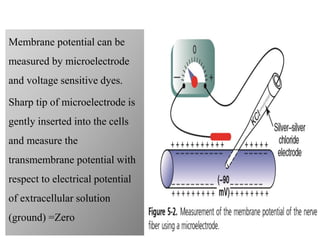
Membrane potential can be
measured by microelectrode
and voltage sensitive dyes.
Sharp tip of microelectrode is
gently inserted into the cells
and measure the
transmembrane potential with
respect to electrical potential
of extracellular solution
(ground) =Zero
Other methods
Spectroscopic technique:-
 It allows the MP of cells with transmembrane potential
 ( Ex: RBCs -200mV) to be measured indirectly
 Labeling of the cell membrane with an appropriate organic dye
molecule and monitoring of the absorption or fluorescence of
the dye.
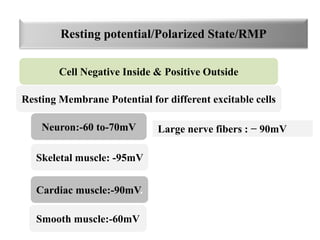
Resting potential/Polarized State/RMP
Cell Negative Inside & Positive Outside
Resting Membrane Potential for different excitable cells
Neuron:-60 to-70mV
Skeletal muscle: -95mV
Smooth muscle:-60mV
Cardiac muscle:-90mV.
Large nerve fibers : − 90mV
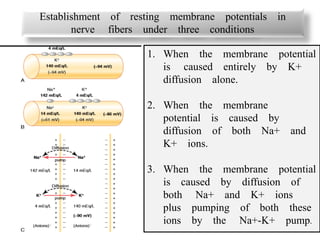
1. When the membrane potential
is caused entirely by K+
diffusion alone.
2. When the membrane
potential is caused by
diffusion of both Na+ and
K+ ions.
3. When the membrane potential
is caused by diffusion of
both Na+ and K+ ions
plus pumping of both these
ions by the Na+-K+ pump.
Establishment of resting membrane potentials in
nerve fibers under three conditions
The RMP, requires different permeabilities for K+ & for Na+, & is
maintained actively by constant Na+/K+ ATPase pump activity.
Leakage of K+ through the
Nerve Cell Membrane shows
potassium [K+] “leak” channel
in the nerve membrane through
which K+ can leak even in a
resting cell.
Channel protein / Tandem pore
domain / Potassium channel/
Potassium [K+] “leak” channel
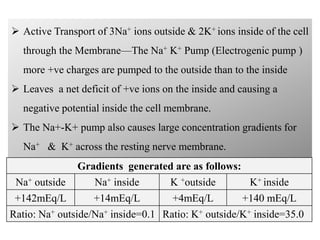
 Active Transport of 3Na+ ions outside & 2K+ ions inside of the cell
through the Membrane—The Na+ K+ Pump (Electrogenic pump )
more +ve charges are pumped to the outside than to the inside
 Leaves a net deficit of +ve ions on the inside and causing a
negative potential inside the cell membrane.
 The Na+-K+ pump also causes large concentration gradients for
Na+ & K+ across the resting nerve membrane.
Gradients generated are as follows:
Na+ outside Na+ inside K +outside K+ inside
+142mEq/L +14mEq/L +4mEq/L +140 mEq/L
Ratio: Na+ outside/Na+ inside=0.1 Ratio: K+ outside/K+ inside=35.0
Why the membrane more permeable to K+ than to Na+
 The cell has many channels open for passive K+ ions than for
passive Na+ ions.
 The resting membrane potential is slightly permeable to Na+ and
the relatively small net diffusion of Na+ inward neutralizes some
of the potential that would be created by K+ alone.
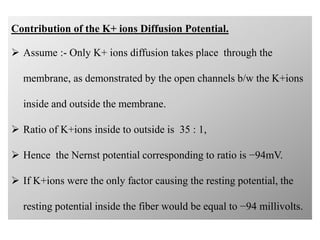
Contribution of the K+ ions Diffusion Potential.
 Assume :- Only K+ ions diffusion takes place through the
membrane, as demonstrated by the open channels b/w the K+ions
inside and outside the membrane.
 Ratio of K+ions inside to outside is 35 : 1,
 Hence the Nernst potential corresponding to ratio is −94mV.
 If K+ions were the only factor causing the resting potential, the
resting potential inside the fiber would be equal to −94 millivolts.
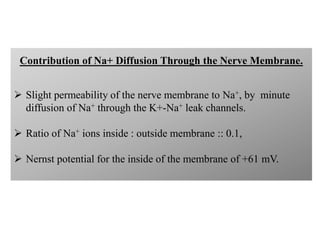
Contribution of Na+ Diffusion Through the Nerve Membrane.
 Slight permeability of the nerve membrane to Na+, by minute
diffusion of Na+ through the K+-Na+ leak channels.
 Ratio of Na+ ions inside : outside membrane :: 0.1,
 Nernst potential for the inside of the membrane of +61 mV.
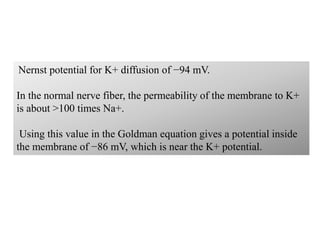
Nernst potential for K+ diffusion of −94 mV.
In the normal nerve fiber, the permeability of the membrane to K+
is about >100 times Na+.
Using this value in the Goldman equation gives a potential inside
the membrane of −86 mV, which is near the K+ potential.
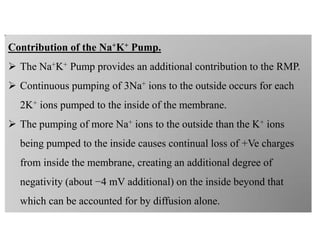
Contribution of the Na+K+ Pump.
 The Na+K+ Pump provides an additional contribution to the RMP.
 Continuous pumping of 3Na+ ions to the outside occurs for each
2K+ ions pumped to the inside of the membrane.
 The pumping of more Na+ ions to the outside than the K+ ions
being pumped to the inside causes continual loss of +Ve charges
from inside the membrane, creating an additional degree of
negativity (about −4 mV additional) on the inside beyond that
which can be accounted for by diffusion alone.
Therefore, the net membrane potential when all these factors are
operative at the same time is about −90 millivolts.
In summary
 The diffusion potentials alone caused by K+ and Na+ diffusion
would give a membrane potential of about −86 millivolts, with
almost all of this being determined by K+ diffusion.
 An additional −4 millivolts is then contributed to the membrane
potential by the continuously acting electrogenic Na+-K+ pump,
giving a net membrane potential of −90 millivolts.
Factors affecting the resting membrane potential
 Depends upon ions present
Permeability & Electrochemical gradients.
Mainly determined by [Na+] and [K+] & their permeabilities.
 The Na+/K+ pump actively transports Na+ out & K+ ions into the cell
Thus keeping high [Na+] in the ECF & high [K+] in the ICF.

Lecture 40 resting membrane potential

  • 1.
    Dr Shamshad Lecture -40 Electrical properties of cell membrane- II (Resting Membrane Potential)
  • 2.
    Objectives 1. Describe themethod for measurement of membrane potential. 2. Define resting membrane potential. 3. Discuss the ionic basis of resting membrane potential. 4. Describe the role of sodium-potassium pump in maintenance of resting membrane potential. GUYTON & HALL Textbook of Medical Physiology, 12th edition, page: 58-60.
  • 3.
    Plasma membrane ofmost living cells are electrically polarized as indicated by the presence of transmembrane voltage / membrane potential. Resting Membrane Potential / Steady potential / Transmembrane potential  Indicates the resting state or the state of polarization of the cell membrane. Def:- A constant or steady potential difference between inside & outside of the cell at Rest observed during the recording with one electrode inside and other electrode outside the cell.
  • 4.
    Membrane potential canbe measured by microelectrode and voltage sensitive dyes. Sharp tip of microelectrode is gently inserted into the cells and measure the transmembrane potential with respect to electrical potential of extracellular solution (ground) =Zero
  • 5.
    Other methods Spectroscopic technique:- It allows the MP of cells with transmembrane potential  ( Ex: RBCs -200mV) to be measured indirectly  Labeling of the cell membrane with an appropriate organic dye molecule and monitoring of the absorption or fluorescence of the dye.
  • 6.
    Resting potential/Polarized State/RMP CellNegative Inside & Positive Outside Resting Membrane Potential for different excitable cells Neuron:-60 to-70mV Skeletal muscle: -95mV Smooth muscle:-60mV Cardiac muscle:-90mV. Large nerve fibers : − 90mV
  • 7.
    1. When themembrane potential is caused entirely by K+ diffusion alone. 2. When the membrane potential is caused by diffusion of both Na+ and K+ ions. 3. When the membrane potential is caused by diffusion of both Na+ and K+ ions plus pumping of both these ions by the Na+-K+ pump. Establishment of resting membrane potentials in nerve fibers under three conditions
  • 8.
    The RMP, requiresdifferent permeabilities for K+ & for Na+, & is maintained actively by constant Na+/K+ ATPase pump activity. Leakage of K+ through the Nerve Cell Membrane shows potassium [K+] “leak” channel in the nerve membrane through which K+ can leak even in a resting cell. Channel protein / Tandem pore domain / Potassium channel/ Potassium [K+] “leak” channel
  • 9.
     Active Transportof 3Na+ ions outside & 2K+ ions inside of the cell through the Membrane—The Na+ K+ Pump (Electrogenic pump ) more +ve charges are pumped to the outside than to the inside  Leaves a net deficit of +ve ions on the inside and causing a negative potential inside the cell membrane.  The Na+-K+ pump also causes large concentration gradients for Na+ & K+ across the resting nerve membrane. Gradients generated are as follows: Na+ outside Na+ inside K +outside K+ inside +142mEq/L +14mEq/L +4mEq/L +140 mEq/L Ratio: Na+ outside/Na+ inside=0.1 Ratio: K+ outside/K+ inside=35.0
  • 10.
    Why the membranemore permeable to K+ than to Na+  The cell has many channels open for passive K+ ions than for passive Na+ ions.  The resting membrane potential is slightly permeable to Na+ and the relatively small net diffusion of Na+ inward neutralizes some of the potential that would be created by K+ alone.
  • 11.
    Contribution of theK+ ions Diffusion Potential.  Assume :- Only K+ ions diffusion takes place through the membrane, as demonstrated by the open channels b/w the K+ions inside and outside the membrane.  Ratio of K+ions inside to outside is 35 : 1,  Hence the Nernst potential corresponding to ratio is −94mV.  If K+ions were the only factor causing the resting potential, the resting potential inside the fiber would be equal to −94 millivolts.
  • 12.
    Contribution of Na+Diffusion Through the Nerve Membrane.  Slight permeability of the nerve membrane to Na+, by minute diffusion of Na+ through the K+-Na+ leak channels.  Ratio of Na+ ions inside : outside membrane :: 0.1,  Nernst potential for the inside of the membrane of +61 mV.
  • 13.
    Nernst potential forK+ diffusion of −94 mV. In the normal nerve fiber, the permeability of the membrane to K+ is about >100 times Na+. Using this value in the Goldman equation gives a potential inside the membrane of −86 mV, which is near the K+ potential.
  • 14.
    Contribution of theNa+K+ Pump.  The Na+K+ Pump provides an additional contribution to the RMP.  Continuous pumping of 3Na+ ions to the outside occurs for each 2K+ ions pumped to the inside of the membrane.  The pumping of more Na+ ions to the outside than the K+ ions being pumped to the inside causes continual loss of +Ve charges from inside the membrane, creating an additional degree of negativity (about −4 mV additional) on the inside beyond that which can be accounted for by diffusion alone.
  • 15.
    Therefore, the netmembrane potential when all these factors are operative at the same time is about −90 millivolts. In summary  The diffusion potentials alone caused by K+ and Na+ diffusion would give a membrane potential of about −86 millivolts, with almost all of this being determined by K+ diffusion.  An additional −4 millivolts is then contributed to the membrane potential by the continuously acting electrogenic Na+-K+ pump, giving a net membrane potential of −90 millivolts.
  • 16.
    Factors affecting theresting membrane potential  Depends upon ions present Permeability & Electrochemical gradients. Mainly determined by [Na+] and [K+] & their permeabilities.  The Na+/K+ pump actively transports Na+ out & K+ ions into the cell Thus keeping high [Na+] in the ECF & high [K+] in the ICF.