EFFECT OF POSTURAL CHANGES
ON BLOOD PRESSURE & HEART
RATE
BY
GURSIMRANJEET SINGH
THEORY
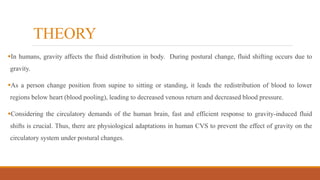
In humans, gravity affects the fluid distribution in body. During postural change, fluid shifting occurs due to
gravity.
As a person change position from supine to sitting or standing, it leads the redistribution of blood to lower
regions below heart (blood pooling), leading to decreased venous return and decreased blood pressure.
Considering the circulatory demands of the human brain, fast and efficient response to gravity-induced fluid
shifts is crucial. Thus, there are physiological adaptations in human CVS to prevent the effect of gravity on the
circulatory system under postural changes.
THEORY CONT…
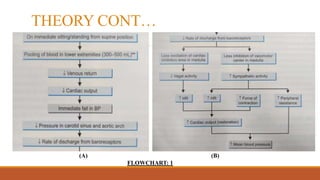
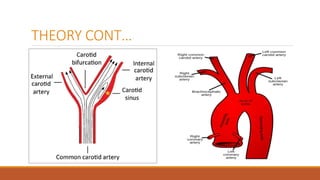
(A) (B)
FLOWCHART: 1
THEORY CONT…
APPARATUS REQUIRED
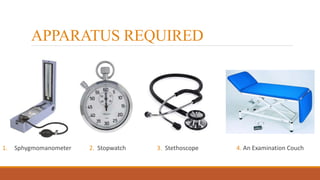
1. Sphygmomanometer 2. Stopwatch 3. Stethoscope 4. An Examination Couch
PROCEDURE
1. First of all allow the subject to relax in supine position for a few minutes.
2. Record the heart rate and blood pressure by palpatory method and then by auscultatory method in supine
position.
3. Then ask the subject to sit up and immediately record the blood pressure and heartrate. Take the readings
again after 1 min, 2 min and 5 minutes.
4. Make the subject to lie down again and let him/her rest for a few minutes. After that again record the blood
pressure and heart rate in supine position.
5. Now ask the subject to suddenly stand up and record the blood pressure and heart rate as soon as possible.
Then repeat the determinations after 1 min, 2 min and 5 minutes.
6. Record all the observations in your workbook.
PROCEDURE (POSITION OF ARM)
 The effect of gravity may be studied in the upper arm by recording the BP with the arm kept at
heart level, then above the head and then hanging it below the heart level.
The pressure in any artery or vein below the level of the heart is increased and that in any vessel
above the heart is decreased by the effect of gravity. The degree of this effect is 0.77 mmHg/cm.
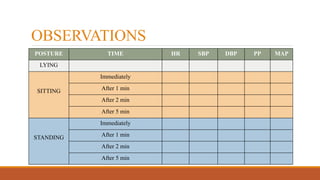
OBSERVATIONS
POSTURE TIME HR SBP DBP PP MAP
LYING
SITTING
Immediately
After 1 min
After 2 min
After 5 min
STANDING
Immediately
After 1 min
After 2 min
After 5 min
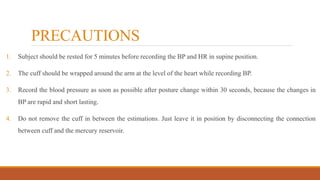
PRECAUTIONS
1. Subject should be rested for 5 minutes before recording the BP and HR in supine position.
2. The cuff should be wrapped around the arm at the level of the heart while recording BP.
3. Record the blood pressure as soon as possible after posture change within 30 seconds, because the changes in
BP are rapid and short lasting.
4. Do not remove the cuff in between the estimations. Just leave it in position by disconnecting the connection
between cuff and the mercury reservoir.
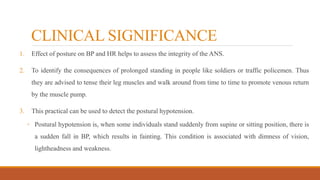
CLINICAL SIGNIFICANCE
1. Effect of posture on BP and HR helps to assess the integrity of the ANS.
2. To identify the consequences of prolonged standing in people like soldiers or traffic policemen. Thus
they are advised to tense their leg muscles and walk around from time to time to promote venous return
by the muscle pump.
3. This practical can be used to detect the postural hypotension.
◦ Postural hypotension is, when some individuals stand suddenly from supine or sitting position, there is
a sudden fall in BP, which results in fainting. This condition is associated with dimness of vision,
lightheadness and weakness.
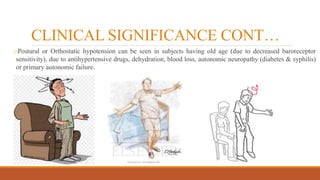
CLINICAL SIGNIFICANCE CONT…
oPostural or Orthostatic hypotension can be seen in subjects having old age (due to decreased baroreceptor
sensitivity), due to antihypertensive drugs, dehydration, blood loss, autonomic neuropathy (diabetes & syphilis)
or primary autonomic failure.
Effect of postural changes on bp and hr

Effect of postural changes on bp and hr

  • 1.
    EFFECT OF POSTURALCHANGES ON BLOOD PRESSURE & HEART RATE BY GURSIMRANJEET SINGH
  • 2.
    THEORY In humans, gravityaffects the fluid distribution in body. During postural change, fluid shifting occurs due to gravity. As a person change position from supine to sitting or standing, it leads the redistribution of blood to lower regions below heart (blood pooling), leading to decreased venous return and decreased blood pressure. Considering the circulatory demands of the human brain, fast and efficient response to gravity-induced fluid shifts is crucial. Thus, there are physiological adaptations in human CVS to prevent the effect of gravity on the circulatory system under postural changes.
  • 3.
  • 4.
  • 5.
    APPARATUS REQUIRED 1. Sphygmomanometer2. Stopwatch 3. Stethoscope 4. An Examination Couch
  • 6.
    PROCEDURE 1. First ofall allow the subject to relax in supine position for a few minutes. 2. Record the heart rate and blood pressure by palpatory method and then by auscultatory method in supine position. 3. Then ask the subject to sit up and immediately record the blood pressure and heartrate. Take the readings again after 1 min, 2 min and 5 minutes. 4. Make the subject to lie down again and let him/her rest for a few minutes. After that again record the blood pressure and heart rate in supine position. 5. Now ask the subject to suddenly stand up and record the blood pressure and heart rate as soon as possible. Then repeat the determinations after 1 min, 2 min and 5 minutes. 6. Record all the observations in your workbook.
  • 7.
    PROCEDURE (POSITION OFARM)  The effect of gravity may be studied in the upper arm by recording the BP with the arm kept at heart level, then above the head and then hanging it below the heart level. The pressure in any artery or vein below the level of the heart is increased and that in any vessel above the heart is decreased by the effect of gravity. The degree of this effect is 0.77 mmHg/cm.
  • 8.
    OBSERVATIONS POSTURE TIME HRSBP DBP PP MAP LYING SITTING Immediately After 1 min After 2 min After 5 min STANDING Immediately After 1 min After 2 min After 5 min
  • 9.
    PRECAUTIONS 1. Subject shouldbe rested for 5 minutes before recording the BP and HR in supine position. 2. The cuff should be wrapped around the arm at the level of the heart while recording BP. 3. Record the blood pressure as soon as possible after posture change within 30 seconds, because the changes in BP are rapid and short lasting. 4. Do not remove the cuff in between the estimations. Just leave it in position by disconnecting the connection between cuff and the mercury reservoir.
  • 10.
    CLINICAL SIGNIFICANCE 1. Effectof posture on BP and HR helps to assess the integrity of the ANS. 2. To identify the consequences of prolonged standing in people like soldiers or traffic policemen. Thus they are advised to tense their leg muscles and walk around from time to time to promote venous return by the muscle pump. 3. This practical can be used to detect the postural hypotension. ◦ Postural hypotension is, when some individuals stand suddenly from supine or sitting position, there is a sudden fall in BP, which results in fainting. This condition is associated with dimness of vision, lightheadness and weakness.
  • 11.
    CLINICAL SIGNIFICANCE CONT… oPosturalor Orthostatic hypotension can be seen in subjects having old age (due to decreased baroreceptor sensitivity), due to antihypertensive drugs, dehydration, blood loss, autonomic neuropathy (diabetes & syphilis) or primary autonomic failure.