EPSP and IPSP
(Sem-5, Paper-2,Unit-4)
Abhijeet Bhattacharya
KSD’s Model College,Dombivali
Definition of EPSP
Increased positivity of the membrane potential of a neuron on the
postsynaptic side of a nerve synapse that is caused by a neurotransmitter
( like Glutamate) which make the membrane selectively permeable to
Sodium ions on the outside but not to chloride ions on the inside and
that tends to depolarize the neuron.
Features of EPSP
➢EPSPs recorded from the cell body are caused by the activation of several
synapses
➢There is a short delay of 0.5–1 msec between stimulating the afferents and the
EPSP. This is called the synaptic delay.
➢EPSPs are small and graded in size, ranging from fractions of 1 mV to about 8
mV,
➢EPSPs generated by glutamate typically last for about 10–20 msec
➢Those due to slow transmission may last for seconds or even minutes.
Effect of EPSP
➢An electrical change (depolarization) in the membrane of a post synaptic
neuron caused by the binding of an excitatory neurotransmitter from a
presynaptic neuron to the post synaptic receptors, make the post synaptic
neuron to generate Action Potential.
➢Example:- Glutamate like neurotransmitters acts on receptors which open
cationic channels like Na+ and K+
➢This changes the Resting potential of -70mV towards 0mV of the post synaptic
potential
Definition of IPSP
Inhibitory Post Synaptic Potential (IPSP)
Increased negativity of the membrane potential of a neuron on the
postsynaptic side of a nerve synapse that is caused by a neurotransmitter
( like GABA) which make the membrane selectively permeable to
potassium and chloride ions on the inside but not to sodium ions on the
outside and that tends to inhibit the neuron.
Features of IPSP are same as EPSP
Effect of IPSP
➢An electrical change (hyperpolarization) in the membrane of a post synaptic neuron
caused by the binding of an inhibitory neurotransmitter from a presynaptic neuron to
the post synaptic receptors, make the post synaptic neuron impossible to generate an
Action Potential.
➢Example:- GABA like neurotransmitters acts on the receptors which open anionic
channels like Cl-
➢This changes the Resting potential of -70mV to be more negative post synaptic
potential, reducing the probability of post synaptic neuron to generate Action
Potential. (If Ecl- is -70mV, will inhibit the Post Synaptic Potential).
Longer duration of EPSP & IPSP
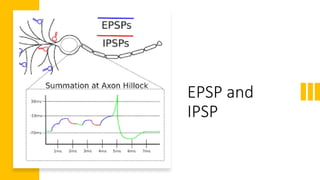
• EPSP and IPSP can last for 5 to 10msec this allows one Post Synaptic Potential
to build upon the next potential. That helps in the ultimate generation of
Action Potential
EPSP and
IPSP
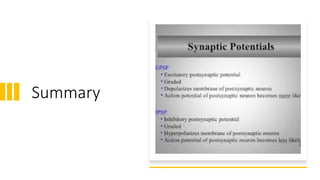
Summary
EPSP and IPSP

EPSP and IPSP

  • 1.
    EPSP and IPSP (Sem-5,Paper-2,Unit-4) Abhijeet Bhattacharya KSD’s Model College,Dombivali
  • 2.
    Definition of EPSP Increasedpositivity of the membrane potential of a neuron on the postsynaptic side of a nerve synapse that is caused by a neurotransmitter ( like Glutamate) which make the membrane selectively permeable to Sodium ions on the outside but not to chloride ions on the inside and that tends to depolarize the neuron.
  • 3.
    Features of EPSP ➢EPSPsrecorded from the cell body are caused by the activation of several synapses ➢There is a short delay of 0.5–1 msec between stimulating the afferents and the EPSP. This is called the synaptic delay. ➢EPSPs are small and graded in size, ranging from fractions of 1 mV to about 8 mV, ➢EPSPs generated by glutamate typically last for about 10–20 msec ➢Those due to slow transmission may last for seconds or even minutes.
  • 4.
    Effect of EPSP ➢Anelectrical change (depolarization) in the membrane of a post synaptic neuron caused by the binding of an excitatory neurotransmitter from a presynaptic neuron to the post synaptic receptors, make the post synaptic neuron to generate Action Potential. ➢Example:- Glutamate like neurotransmitters acts on receptors which open cationic channels like Na+ and K+ ➢This changes the Resting potential of -70mV towards 0mV of the post synaptic potential
  • 5.
    Definition of IPSP InhibitoryPost Synaptic Potential (IPSP) Increased negativity of the membrane potential of a neuron on the postsynaptic side of a nerve synapse that is caused by a neurotransmitter ( like GABA) which make the membrane selectively permeable to potassium and chloride ions on the inside but not to sodium ions on the outside and that tends to inhibit the neuron. Features of IPSP are same as EPSP
  • 6.
    Effect of IPSP ➢Anelectrical change (hyperpolarization) in the membrane of a post synaptic neuron caused by the binding of an inhibitory neurotransmitter from a presynaptic neuron to the post synaptic receptors, make the post synaptic neuron impossible to generate an Action Potential. ➢Example:- GABA like neurotransmitters acts on the receptors which open anionic channels like Cl- ➢This changes the Resting potential of -70mV to be more negative post synaptic potential, reducing the probability of post synaptic neuron to generate Action Potential. (If Ecl- is -70mV, will inhibit the Post Synaptic Potential).
  • 7.
    Longer duration ofEPSP & IPSP • EPSP and IPSP can last for 5 to 10msec this allows one Post Synaptic Potential to build upon the next potential. That helps in the ultimate generation of Action Potential
  • 8.
  • 9.