General Physical Examination
PHD module
Dr Shamshad
Objectives
1. Develop the basic concepts of general physical examination.
2. Perform sequential general physical examination correctly
on a simulated patient using check list.
3. Examine for clubbing of fingers, koilonychia, cyanosis,
pallor, ankle edema, Jugular venous pressure (JVP) &
hydration status.
4. Demonstrate basic ethical and professional practice while
approaching a patient.
Examining a Patient: Diagnostic clues
Diagnostic process has 3 components:
1: History taking: –Symptoms
2:Physical Exam : Signs/Examination findings
3: Investigations : Diagnostic test results
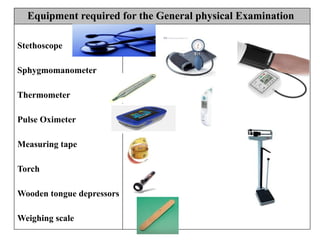
Equipment required for the General physical Examination
Stethoscope
Sphygmomanometer
Thermometer
Pulse Oximeter
Measuring tape
Torch
Wooden tongue depressors
Weighing scale
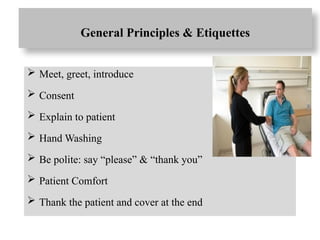
General Principles & Etiquettes
 Meet, greet, introduce
 Consent
 Explain to patient
 Hand Washing
 Be polite: say “please” & “thank you”
 Patient Comfort
 Thank the patient and cover at the end
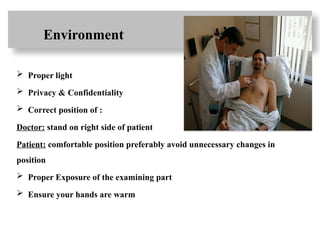
Environment
 Proper light
 Privacy & Confidentiality
 Correct position of :
Doctor: stand on right side of patient
Patient: comfortable position preferably avoid unnecessary changes in
position
 Proper Exposure of the examining part
 Ensure your hands are warm
Cardinal techniques
1. Inspection: Observe the patient without touching
2. Palpation: Feel with palm and fingers
• Ensure your hands are warm
• Superficial and deep palpation
3. Percussion: With the tip of Rt & Lt middle fingers :
 To know consistency of part be observed : Ex lungs, liver etc.
4. Auscultation: With help of stethoscope : heart ,lungs ,bowel
sounds.
Head to Toe approach
 General Appearance : Age & Physique :Height & Weight : BMI
 Posture
 Mental & Emotional State,, Facial expression
 Odor
 Look of Patient: Healthy/ill
 Vital Signs
 Head & Neck
 Hands
 Lymph Nodes
 Feet
ALWAYS
Use a
consistent
technique!
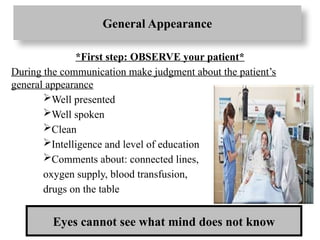
General Appearance
*First step: OBSERVE your patient*
During the communication make judgment about the patient’s
general appearance
Well presented
Well spoken
Clean
Intelligence and level of education
Comments about: connected lines,
oxygen supply, blood transfusion,
drugs on the table
Eyes cannot see what mind does not know
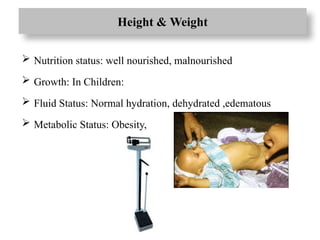
Height & Weight
 Nutrition status: well nourished, malnourished
 Growth: In Children:
 Fluid Status: Normal hydration, dehydrated ,edematous
 Metabolic Status: Obesity,
Vital Signs
1. Pulse: per minute
2. Temperature: Centigrade
3. Respiratory rate:/minute
4. Blood pressure: mmHg
5. Oxygen saturation:%
Head, Eyes, Ears, Nose, Oral cavity, Throat and Neck
[HEENOTN]
 Eyes: Sclera: Jaundice
Conjunctiva: Pallor
Preorbital edema
Ears: Hearing aids, Discharge, abnormality…
 Nose: Deviation, discharge,
Oral Cavity: Pallor, Cyanosis
Jaundice: undersurface of tongue
Oral hygiene. Angular stomatitis, teeth caries
Neck :Pain, Pulsation, Swelling:
Thyroid gland, lymph nodes
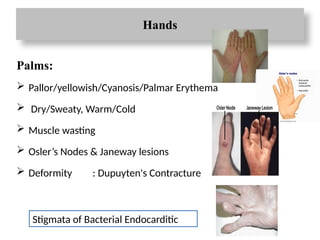
Hands
Palms:
 Pallor/yellowish/Cyanosis/Palmar Erythema
 Dry/Sweaty, Warm/Cold
 Muscle wasting
 Osler’s Nodes & Janeway lesions
 Deformity : Dupuyten's Contracture
Stigmata of Bacterial Endocarditic
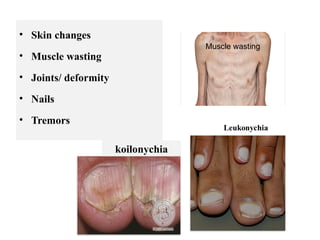
• Skin changes
• Muscle wasting
• Joints/ deformity
• Nails
• Tremors
koilonychia
Muscle wasting
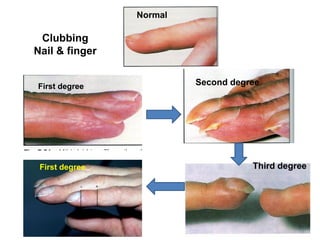
Normal
First degree Second degree
Third degree
First degree
Clubbing
Nail & finger
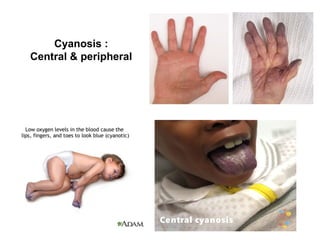
Cyanosis :
Central & peripheral
Pulse
Radial pulse
 Rate: per minute
 Rhythm: regularly regular / regularly irregular/ irregularly
irregular
 Volume: good/low or week thready /high
 Character: Anacrotic/ collapsing/pulses paradoxus
 radio/radial radio/femoral delay
 Vessel wall : soft/tortuous and cord like
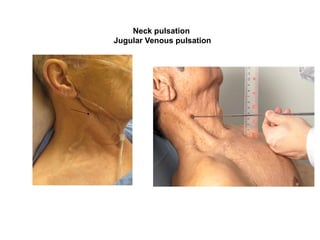
Neck pulsation
Jugular Venous pulsation
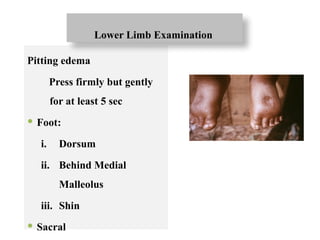
Pitting edema
Press firmly but gently
for at least 5 sec
 Foot:
i. Dorsum
ii. Behind Medial
Malleolus
iii. Shin
 Sacral
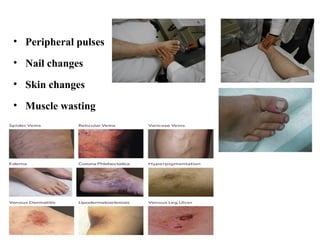
Lower Limb Examination
• Peripheral pulses
• Nail changes
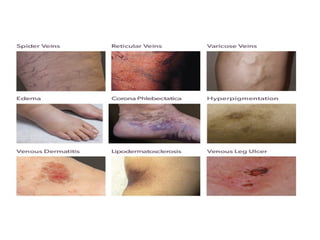
• Skin changes
• Muscle wasting
Lymph Nodes
General Physical Examination
1. Initial Etiquettes
i. Greet and Introduce yourself and examiner
ii. Explain intention to patient and ask for consent
iii. Hand Washing
iv. Be polite: say “please” & “thank you”
v. Patient Comfort
2. General Appearance : Age & Physique :
i. Height & Weight : BMI: Thin/medium/Obese
ii. General Inspection: : Posture, Healthy/ill
ii. Mental & Emotional State : Conscious, alert with time place and person
Respiratory distress ,pain Facial expression ,Odour
Lying supine or propped 45 degree/ sitting
iv. Look for : Connected lines, oxygen supply, blood transfusion, drugs on the table.
3. Head, Eyes, Ears, Nose, Oral cavity, Throat and Neck [HEENOTN]
i. Head: Injury, hygiene
ii. Eyes: Colour: Normal[Pink] Jaundice, Pallor,
Preorbital oedema
i. Ears: Hearing aids, Dishcage, abnormality…
ii. Nose: Deviation, discharge,
iii. Oral cavity and throat: Colour: Pallor, Cyanosis [oral cavity, lips], Jaundice
[under surface of tongue]..
Hygiene: oral cavity, Angular stomatitis, teeth caries …
iv. Neck: Pain, Pulsation, And Swelling: Thyroid gland, lymph nodes..
4. Inspection of Palm of hand
a. Colour: Pale/Pink, Palmar erythema, cyanosis, jaundice…
b. Dry/Sweaty, Warm/Cold
c. Muscle wasting
d. Deformity
5. Inspection of Dorsum of hand
a. Muscle wasting
a. Inspection of fingers and nails Clubbing/Leukonychia/Koilonychia/Splinter
haemorrhage/Nicotine stain
b. Capillary Refill (for adults)
6. Radial Pulse
a. Rate
b. Good/Poor Volume
c. Regular/Irregular Rhythm
7. Forearm
a. Venepuncture marks
b. Tattoo
c. Scars
d. Ecchymosis
8. Blood Pressure: systolic /diastolic mmHg
9. Lower Limb:
i. Deformity, swelling, pulsation, skin…
ii. Pitting edema (press at bony prominence)
a. Medial Malleolus, Mid-leg[Shin],dorsum of feet
10. Thank the patient and cover at the end

General Physical Examination for pptx pptx

  • 1.
  • 2.
    Objectives 1. Develop thebasic concepts of general physical examination. 2. Perform sequential general physical examination correctly on a simulated patient using check list. 3. Examine for clubbing of fingers, koilonychia, cyanosis, pallor, ankle edema, Jugular venous pressure (JVP) & hydration status. 4. Demonstrate basic ethical and professional practice while approaching a patient.
  • 3.
    Examining a Patient:Diagnostic clues Diagnostic process has 3 components: 1: History taking: –Symptoms 2:Physical Exam : Signs/Examination findings 3: Investigations : Diagnostic test results
  • 4.
    Equipment required forthe General physical Examination Stethoscope Sphygmomanometer Thermometer Pulse Oximeter Measuring tape Torch Wooden tongue depressors Weighing scale
  • 5.
    General Principles &Etiquettes  Meet, greet, introduce  Consent  Explain to patient  Hand Washing  Be polite: say “please” & “thank you”  Patient Comfort  Thank the patient and cover at the end
  • 6.
    Environment  Proper light Privacy & Confidentiality  Correct position of : Doctor: stand on right side of patient Patient: comfortable position preferably avoid unnecessary changes in position  Proper Exposure of the examining part  Ensure your hands are warm
  • 7.
    Cardinal techniques 1. Inspection:Observe the patient without touching 2. Palpation: Feel with palm and fingers • Ensure your hands are warm • Superficial and deep palpation 3. Percussion: With the tip of Rt & Lt middle fingers :  To know consistency of part be observed : Ex lungs, liver etc. 4. Auscultation: With help of stethoscope : heart ,lungs ,bowel sounds.
  • 8.
    Head to Toeapproach  General Appearance : Age & Physique :Height & Weight : BMI  Posture  Mental & Emotional State,, Facial expression  Odor  Look of Patient: Healthy/ill  Vital Signs  Head & Neck  Hands  Lymph Nodes  Feet ALWAYS Use a consistent technique!
  • 9.
    General Appearance *First step:OBSERVE your patient* During the communication make judgment about the patient’s general appearance Well presented Well spoken Clean Intelligence and level of education Comments about: connected lines, oxygen supply, blood transfusion, drugs on the table Eyes cannot see what mind does not know
  • 10.
    Height & Weight Nutrition status: well nourished, malnourished  Growth: In Children:  Fluid Status: Normal hydration, dehydrated ,edematous  Metabolic Status: Obesity,
  • 11.
    Vital Signs 1. Pulse:per minute 2. Temperature: Centigrade 3. Respiratory rate:/minute 4. Blood pressure: mmHg 5. Oxygen saturation:%
  • 12.
    Head, Eyes, Ears,Nose, Oral cavity, Throat and Neck [HEENOTN]  Eyes: Sclera: Jaundice Conjunctiva: Pallor Preorbital edema Ears: Hearing aids, Discharge, abnormality…  Nose: Deviation, discharge, Oral Cavity: Pallor, Cyanosis Jaundice: undersurface of tongue Oral hygiene. Angular stomatitis, teeth caries Neck :Pain, Pulsation, Swelling: Thyroid gland, lymph nodes
  • 13.
    Hands Palms:  Pallor/yellowish/Cyanosis/Palmar Erythema Dry/Sweaty, Warm/Cold  Muscle wasting  Osler’s Nodes & Janeway lesions  Deformity : Dupuyten's Contracture Stigmata of Bacterial Endocarditic
  • 14.
    • Skin changes •Muscle wasting • Joints/ deformity • Nails • Tremors koilonychia Muscle wasting
  • 15.
    Normal First degree Seconddegree Third degree First degree Clubbing Nail & finger
  • 16.
  • 17.
    Pulse Radial pulse  Rate:per minute  Rhythm: regularly regular / regularly irregular/ irregularly irregular  Volume: good/low or week thready /high  Character: Anacrotic/ collapsing/pulses paradoxus  radio/radial radio/femoral delay  Vessel wall : soft/tortuous and cord like
  • 18.
  • 19.
    Pitting edema Press firmlybut gently for at least 5 sec  Foot: i. Dorsum ii. Behind Medial Malleolus iii. Shin  Sacral Lower Limb Examination
  • 20.
    • Peripheral pulses •Nail changes • Skin changes • Muscle wasting
  • 22.
  • 23.
  • 24.
    1. Initial Etiquettes i.Greet and Introduce yourself and examiner ii. Explain intention to patient and ask for consent iii. Hand Washing iv. Be polite: say “please” & “thank you” v. Patient Comfort 2. General Appearance : Age & Physique : i. Height & Weight : BMI: Thin/medium/Obese ii. General Inspection: : Posture, Healthy/ill ii. Mental & Emotional State : Conscious, alert with time place and person Respiratory distress ,pain Facial expression ,Odour Lying supine or propped 45 degree/ sitting iv. Look for : Connected lines, oxygen supply, blood transfusion, drugs on the table. 3. Head, Eyes, Ears, Nose, Oral cavity, Throat and Neck [HEENOTN] i. Head: Injury, hygiene ii. Eyes: Colour: Normal[Pink] Jaundice, Pallor, Preorbital oedema i. Ears: Hearing aids, Dishcage, abnormality… ii. Nose: Deviation, discharge, iii. Oral cavity and throat: Colour: Pallor, Cyanosis [oral cavity, lips], Jaundice [under surface of tongue].. Hygiene: oral cavity, Angular stomatitis, teeth caries … iv. Neck: Pain, Pulsation, And Swelling: Thyroid gland, lymph nodes..
  • 25.
    4. Inspection ofPalm of hand a. Colour: Pale/Pink, Palmar erythema, cyanosis, jaundice… b. Dry/Sweaty, Warm/Cold c. Muscle wasting d. Deformity 5. Inspection of Dorsum of hand a. Muscle wasting a. Inspection of fingers and nails Clubbing/Leukonychia/Koilonychia/Splinter haemorrhage/Nicotine stain b. Capillary Refill (for adults) 6. Radial Pulse a. Rate b. Good/Poor Volume c. Regular/Irregular Rhythm 7. Forearm a. Venepuncture marks b. Tattoo c. Scars d. Ecchymosis 8. Blood Pressure: systolic /diastolic mmHg 9. Lower Limb: i. Deformity, swelling, pulsation, skin… ii. Pitting edema (press at bony prominence) a. Medial Malleolus, Mid-leg[Shin],dorsum of feet 10. Thank the patient and cover at the end