Lecture 37:Introduction to Circulation
Dr Shamshad
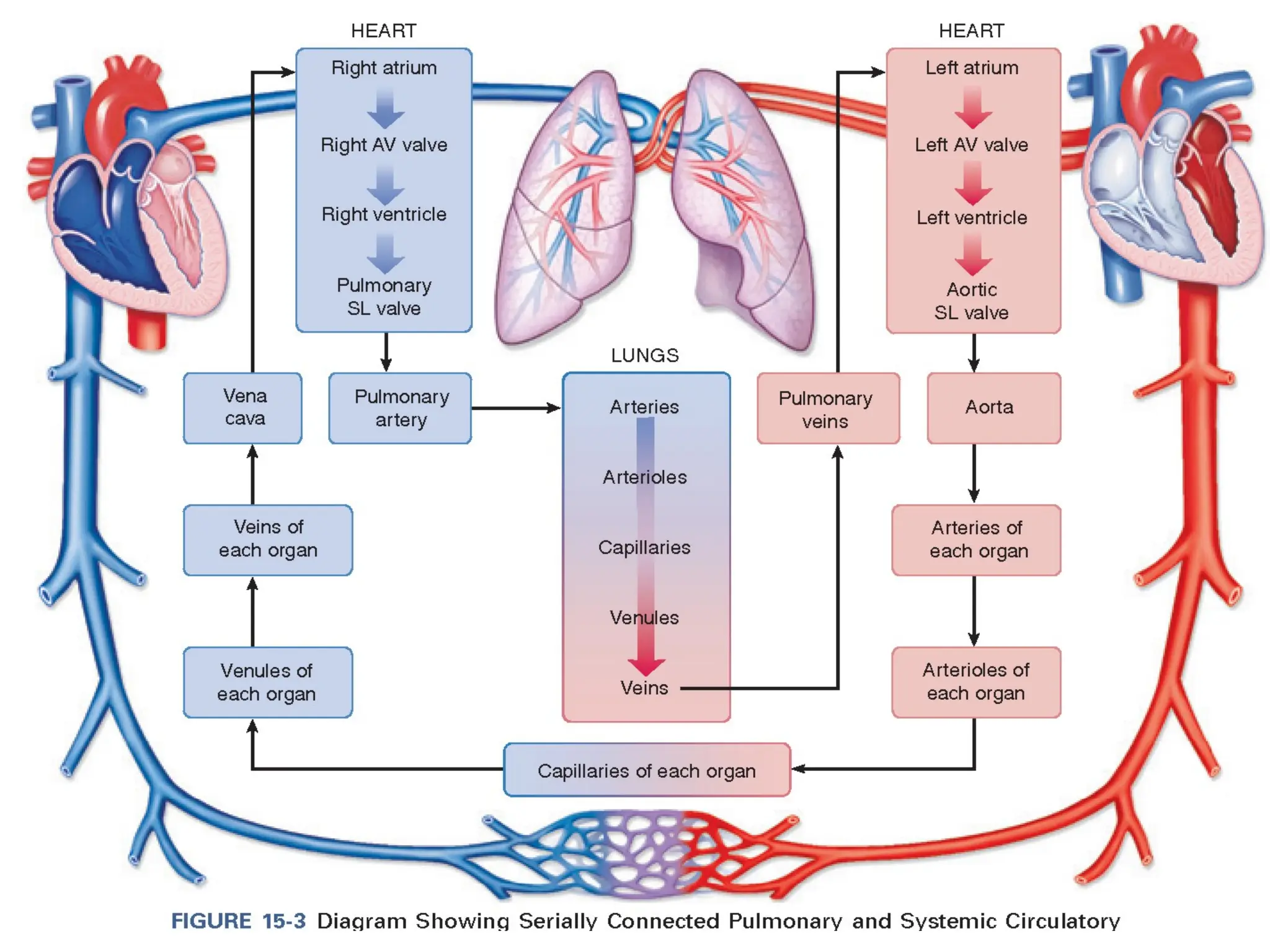
1. Identify the two divisions of circulation and track the pathway of
the blood through both circulations.
2. Outline the various parts of circulation and identify the differences
in structure, function, pressure and velocity of blood in different
vessels.
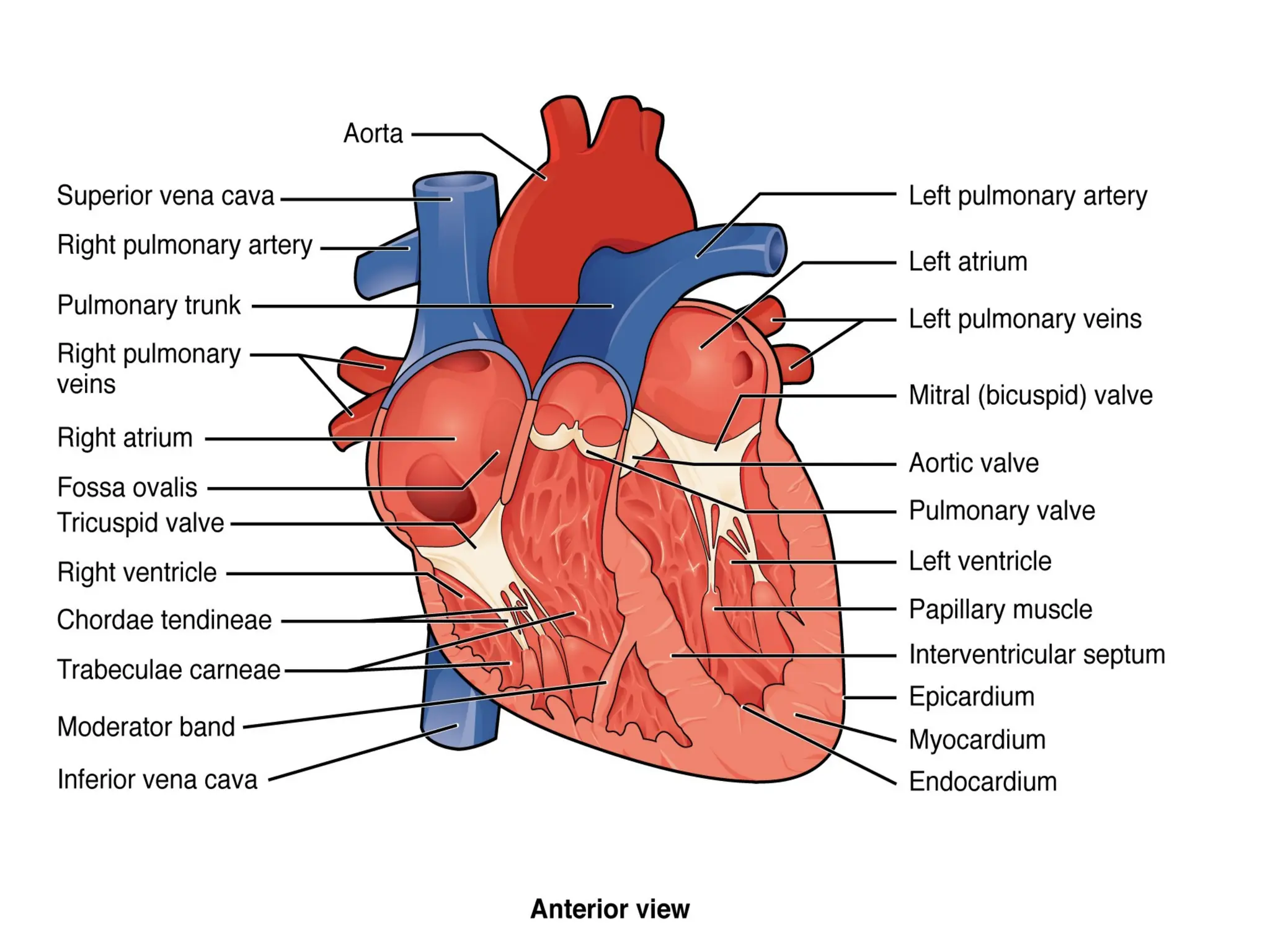
3. Describe the physiological anatomy of the heart and identify its
various specialized functional parts.
OBJECTIVES
Guyton & Hall Textbook of Physiology - 12th ed. P. 157-159 & 101-102
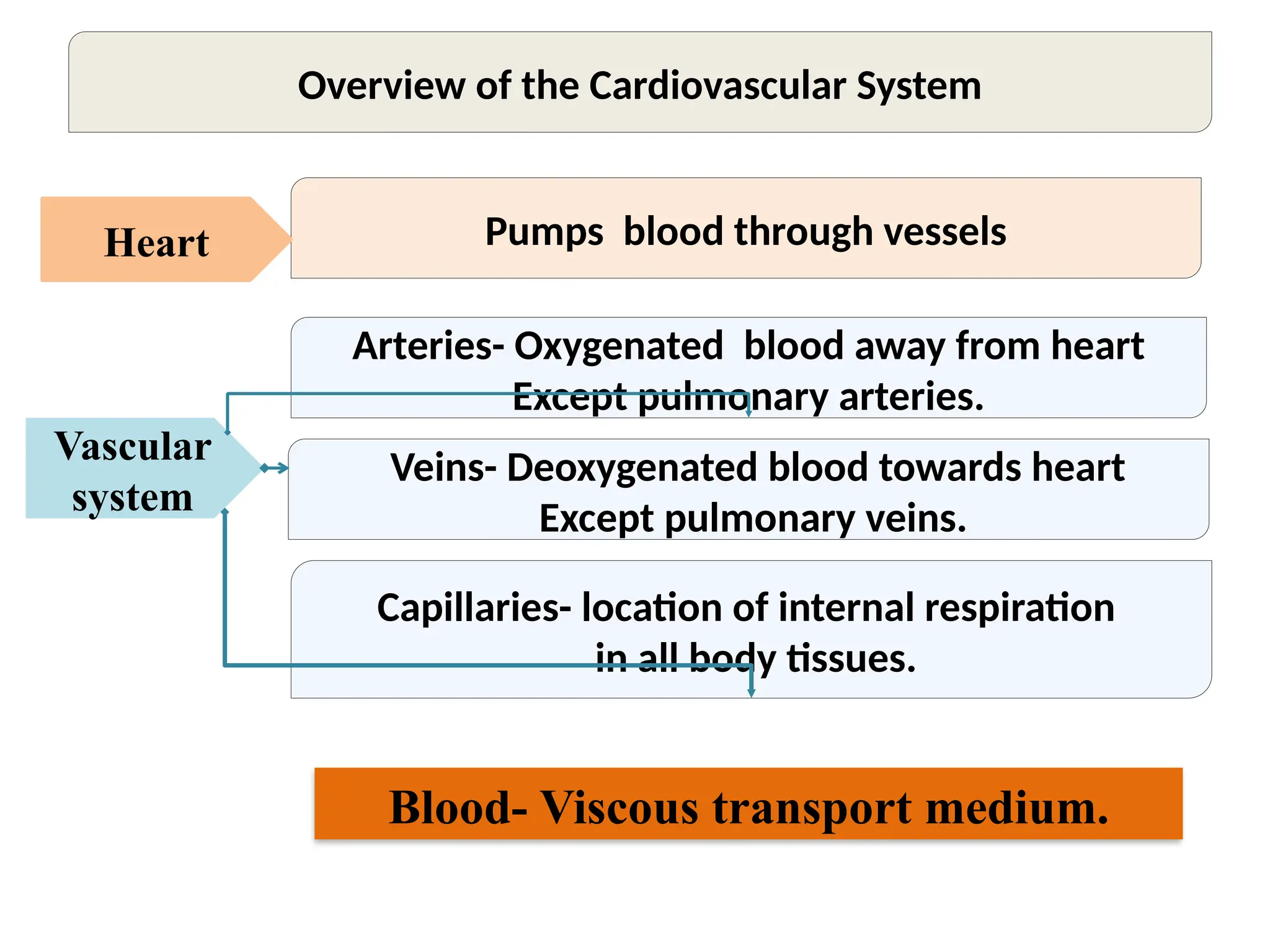
Veins- Deoxygenated blood towards heart
Except pulmonary veins.
Arteries- Oxygenated blood away from heart
Except pulmonary arteries.
Pumps blood through vessels
Capillaries- location of internal respiration
in all body tissues.
Blood- Viscous transport medium.
Heart
Vascular
system
Overview of the Cardiovascular System
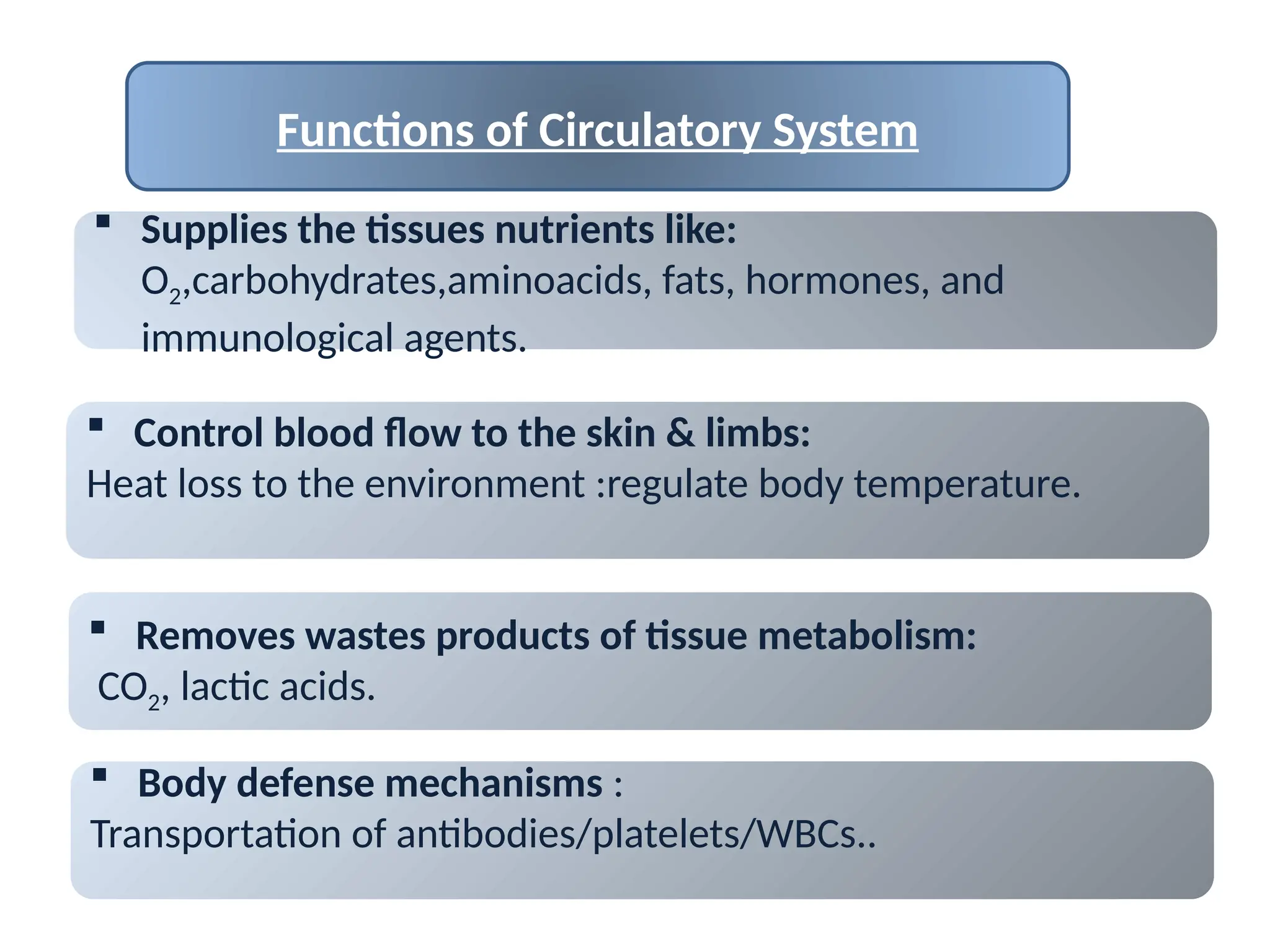
 Supplies the tissues nutrients like:
O2,carbohydrates,aminoacids, fats, hormones, and
immunological agents.
 Removes wastes products of tissue metabolism:
CO2, lactic acids.
 Control blood flow to the skin & limbs:
Heat loss to the environment :regulate body temperature.
 Body defense mechanisms :
Transportation of antibodies/platelets/WBCs..
Functions of Circulatory System
Functions of Heart
 Generating blood pressure.
 Ensuring one-way blood flow: with help of valves
 Routing blood: separates pulmonary and systemic
circulations.
 Regulating blood supply according to the need of the
body [increase in exercise & pregnancy..].
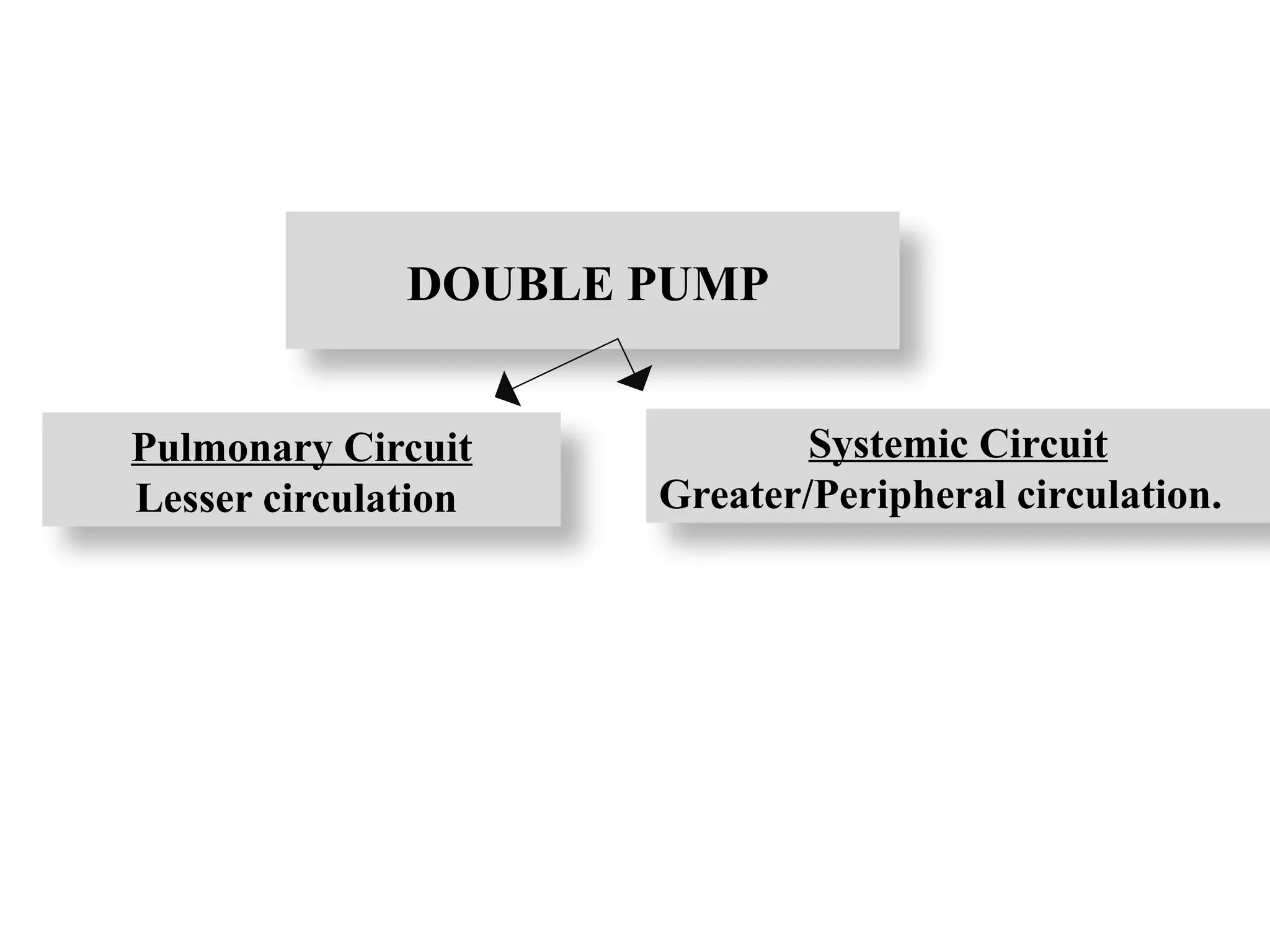
Pulmonary Circuit
Lesser circulation
Systemic Circuit
Greater/Peripheral circulation.
DOUBLE PUMP
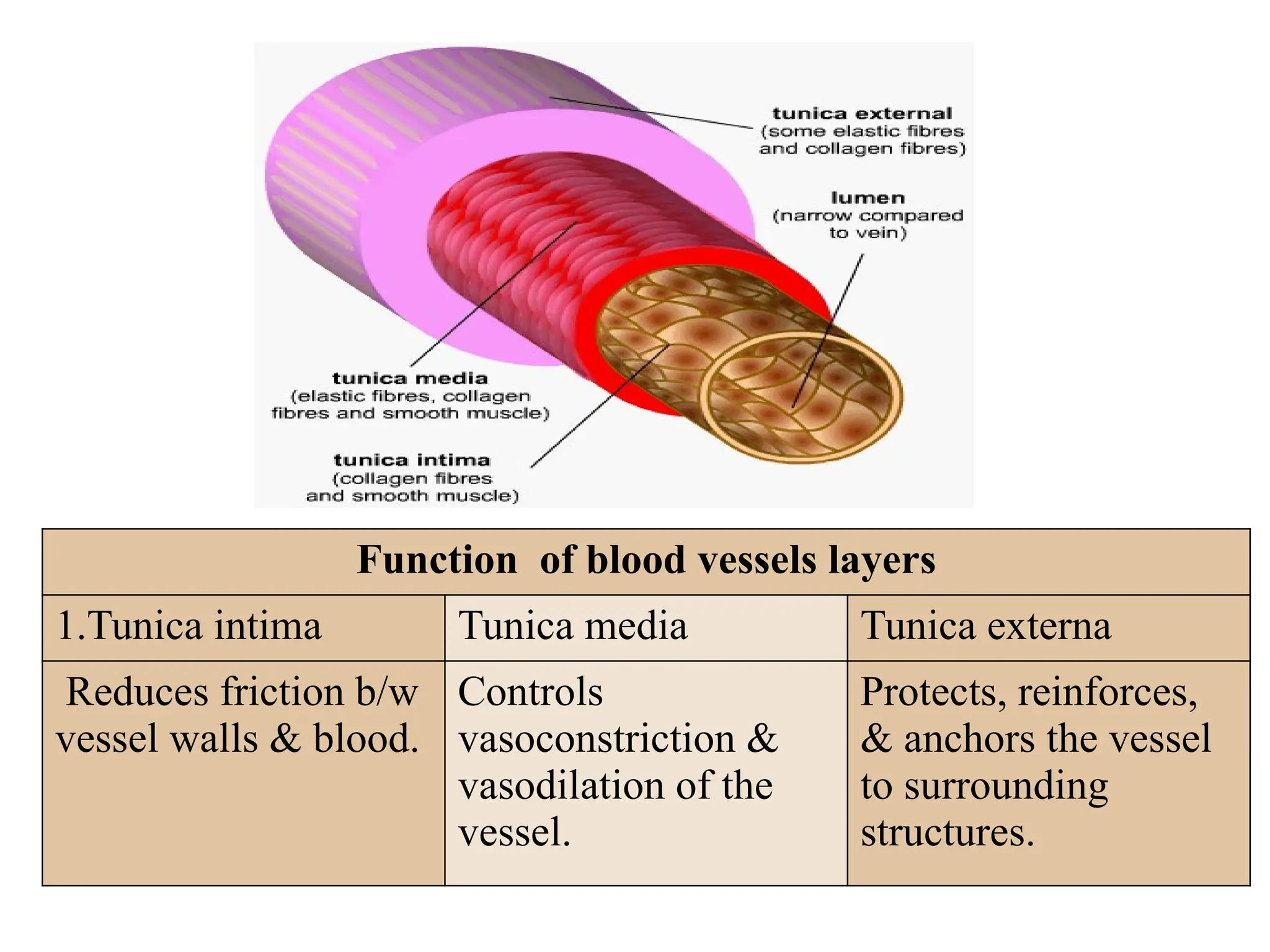
Function of blood vessels layers
1.Tunica intima Tunica media Tunica externa
Reduces friction b/w
vessel walls & blood.
Controls
vasoconstriction &
vasodilation of the
vessel.
Protects, reinforces,
& anchors the vessel
to surrounding
structures.
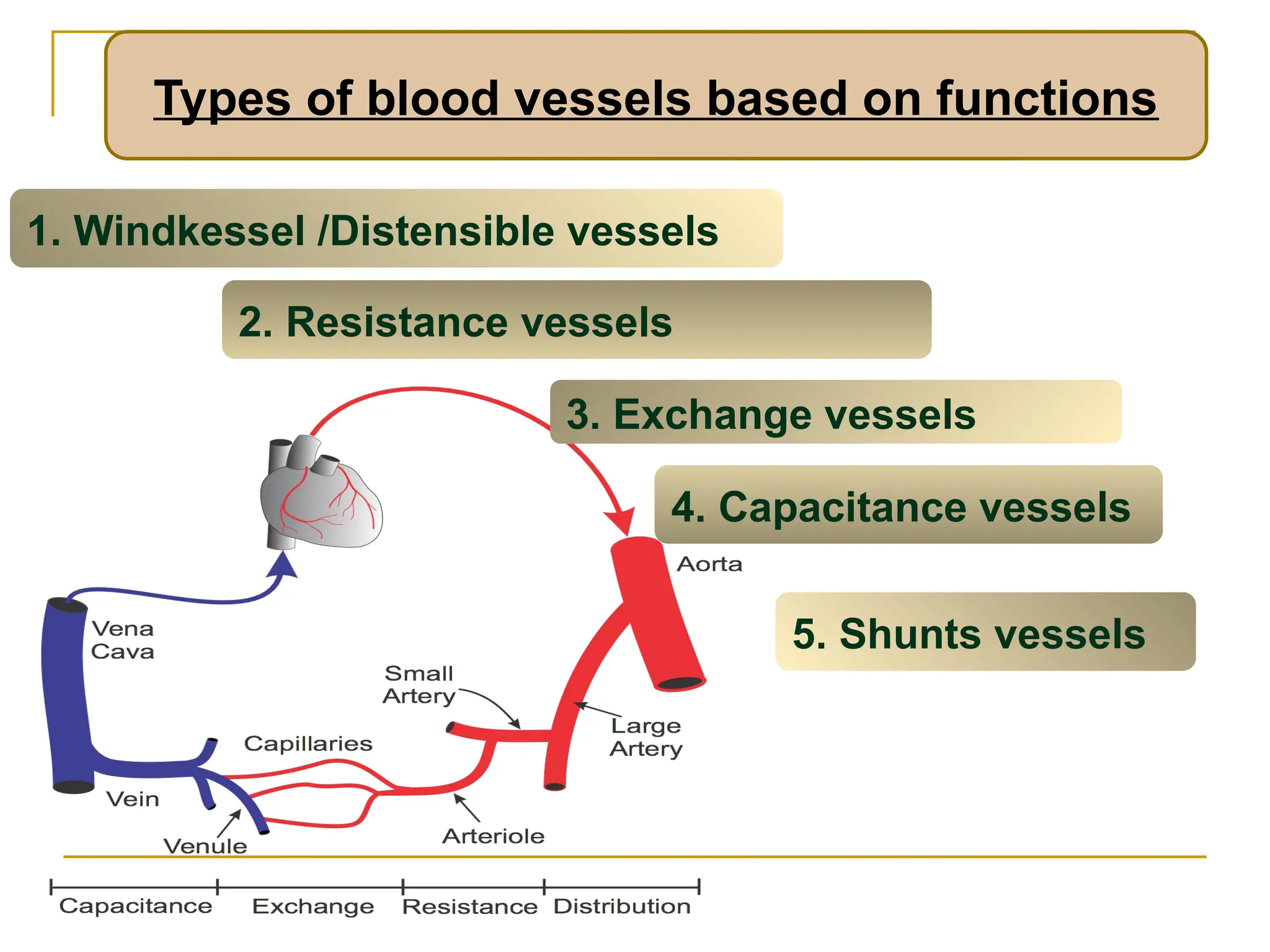
Types of blood vessels based on functions
1. Windkessel /Distensible vessels
3. Exchange vessels
4. Capacitance vessels
2. Resistance vessels
5. Shunts vessels
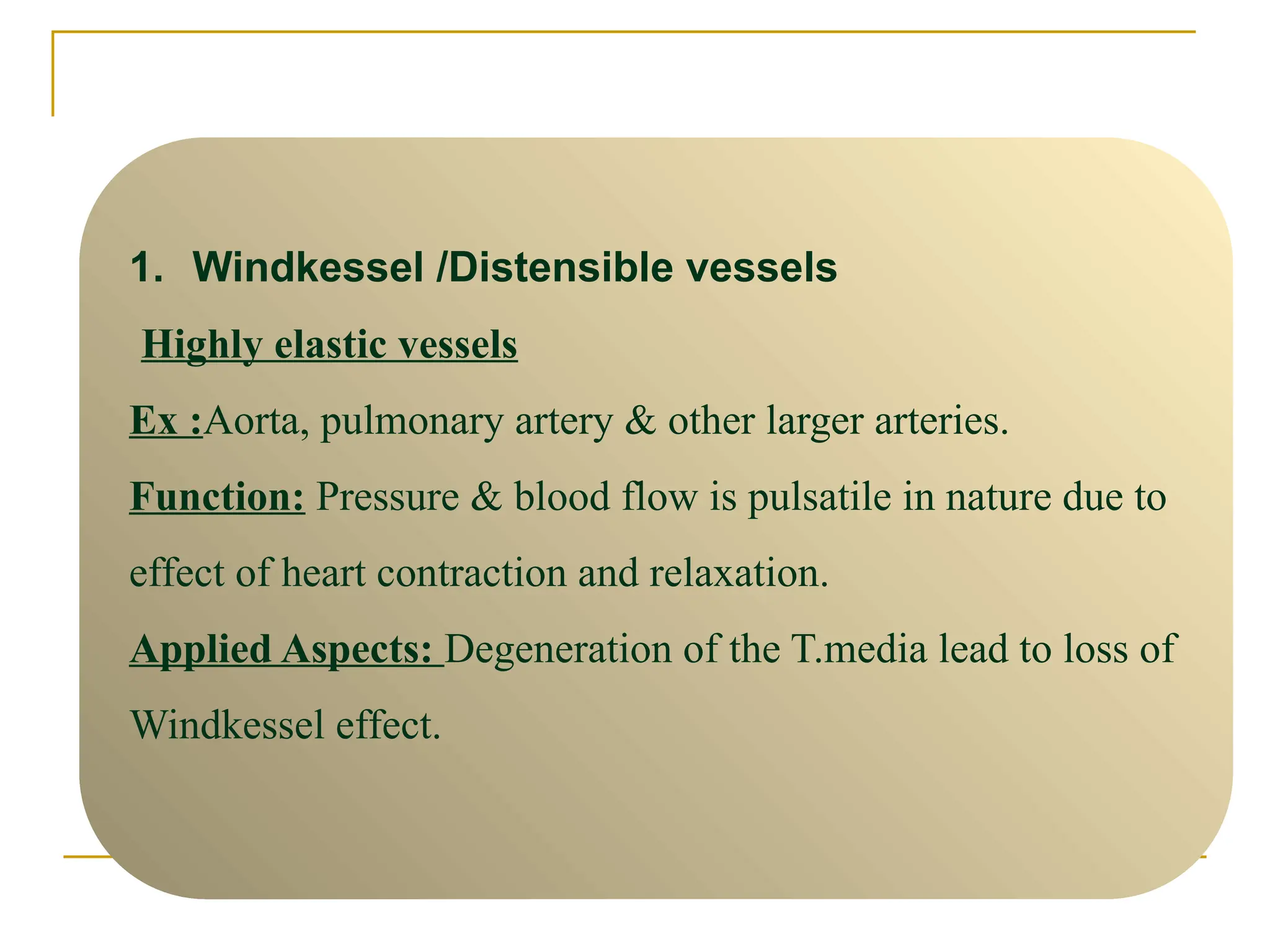
1. Windkessel /Distensible vessels
Highly elastic vessels
Ex :Aorta, pulmonary artery & other larger arteries.
Function: Pressure & blood flow is pulsatile in nature due to
effect of heart contraction and relaxation.
Applied Aspects: Degeneration of the T.media lead to loss of
Windkessel effect.
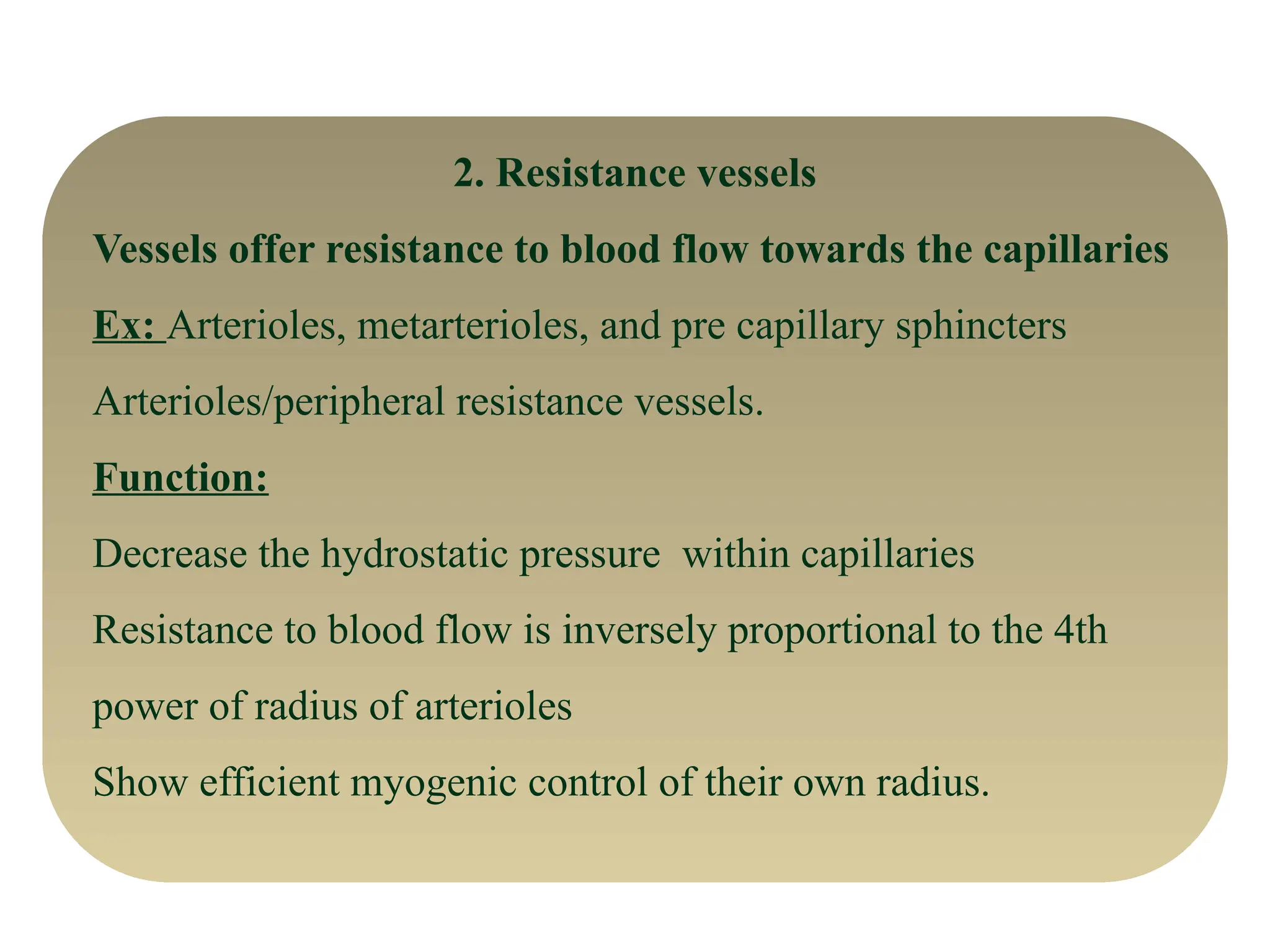
2. Resistance vessels
Vessels offer resistance to blood flow towards the capillaries
Ex: Arterioles, metarterioles, and pre capillary sphincters
Arterioles/peripheral resistance vessels.
Function:
Decrease the hydrostatic pressure within capillaries
Resistance to blood flow is inversely proportional to the 4th
power of radius of arterioles
Show efficient myogenic control of their own radius.
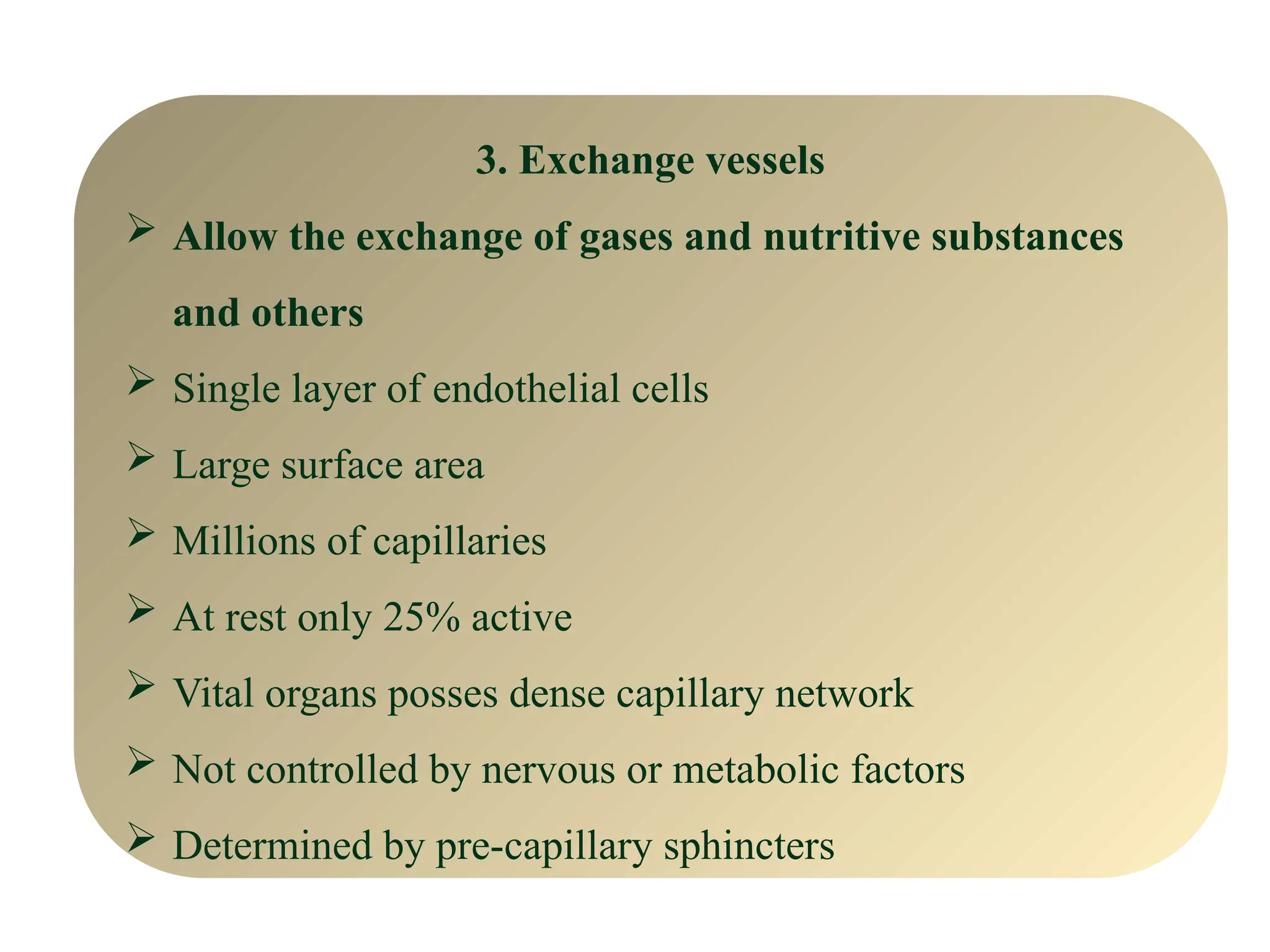
3. Exchange vessels
 Allow the exchange of gases and nutritive substances
and others
 Single layer of endothelial cells
 Large surface area
 Millions of capillaries
 At rest only 25% active
 Vital organs posses dense capillary network
 Not controlled by nervous or metabolic factors
 Determined by pre-capillary sphincters
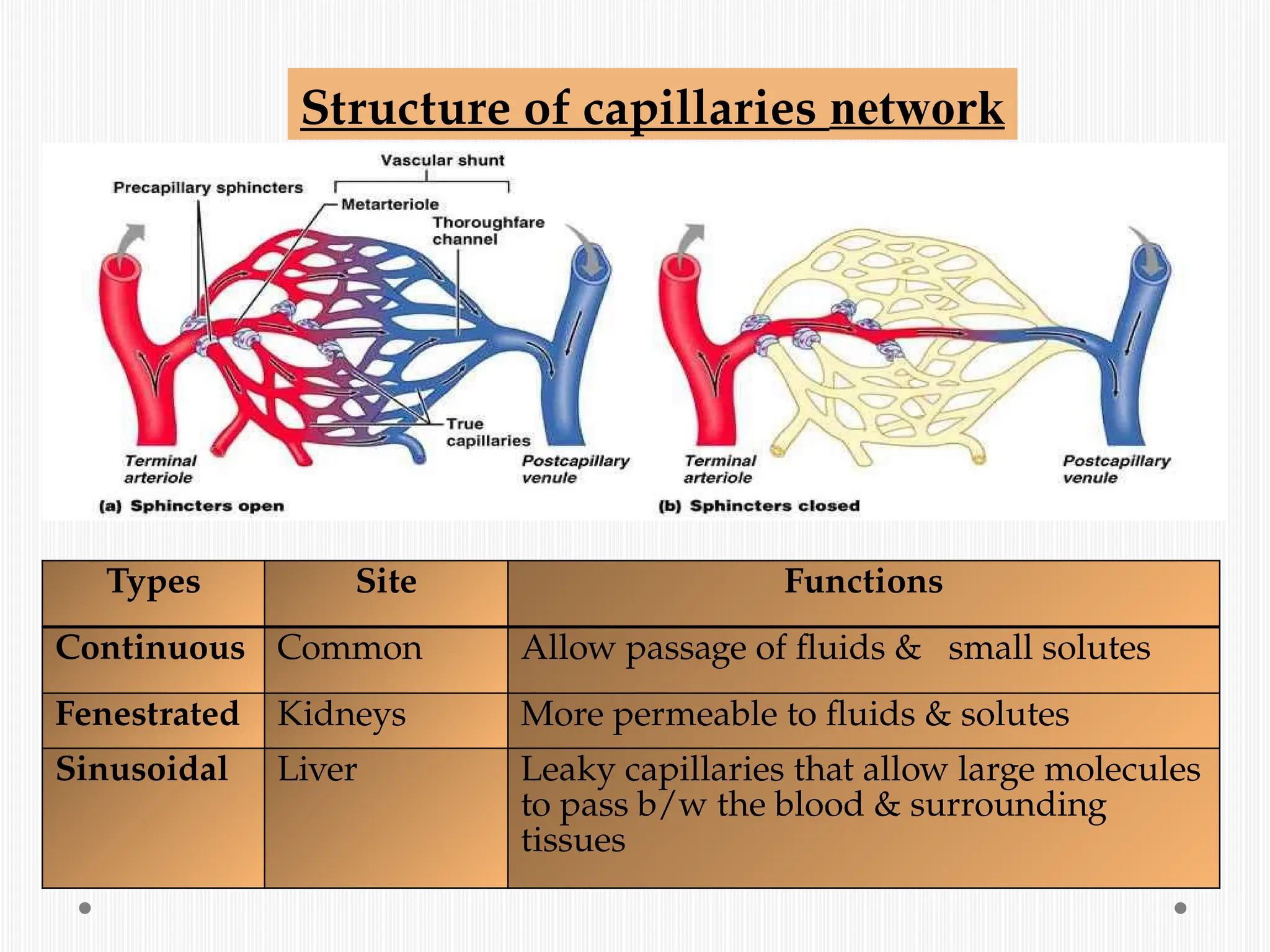
Structure of capillaries network
Types Site Functions
Continuous Common Allow passage of fluids & small solutes
Fenestrated Kidneys More permeable to fluids & solutes
Sinusoidal Liver Leaky capillaries that allow large molecules
to pass b/w the blood & surrounding
tissues
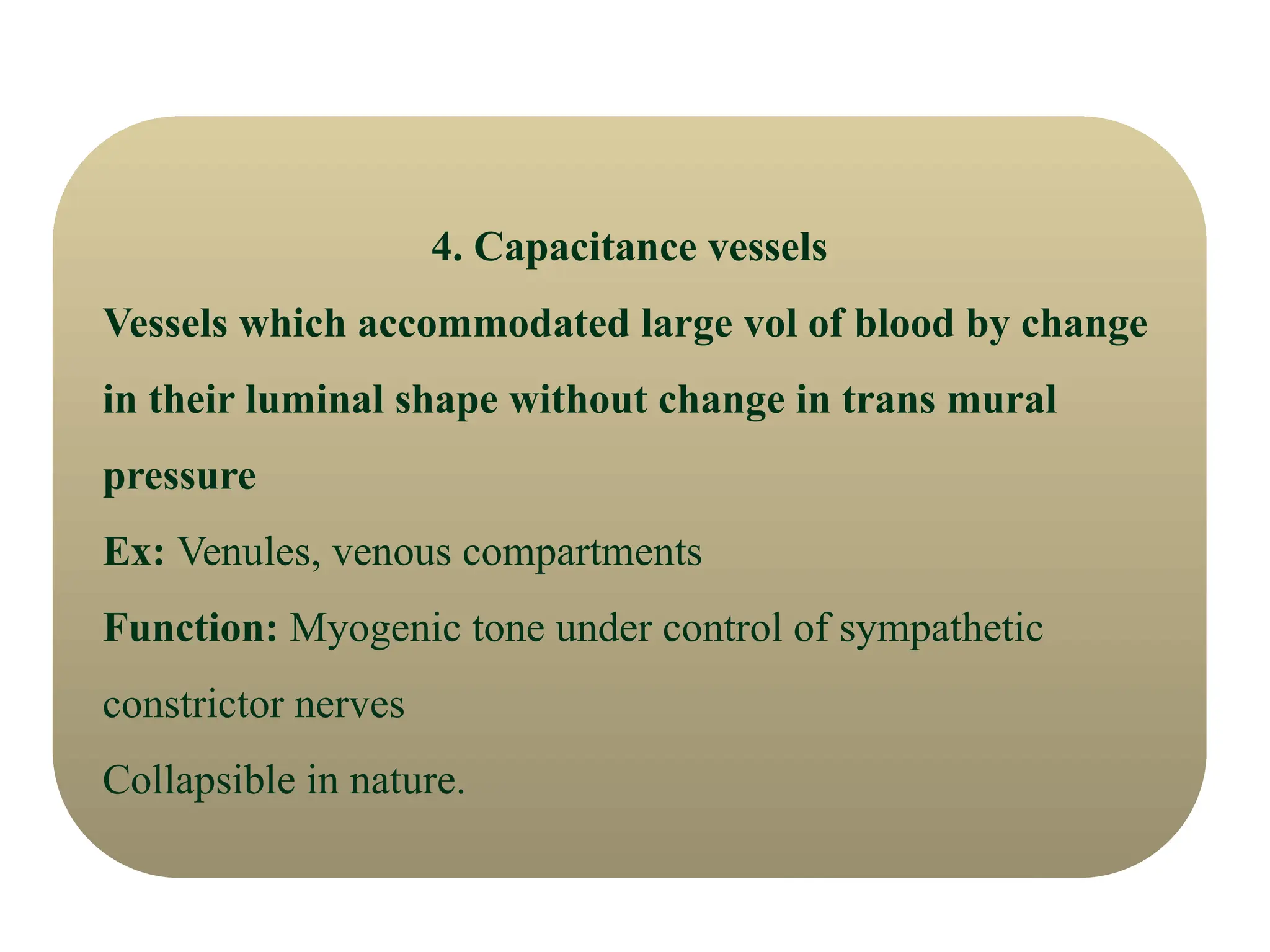
4. Capacitance vessels
Vessels which accommodated large vol of blood by change
in their luminal shape without change in trans mural
pressure
Ex: Venules, venous compartments
Function: Myogenic tone under control of sympathetic
constrictor nerves
Collapsible in nature.
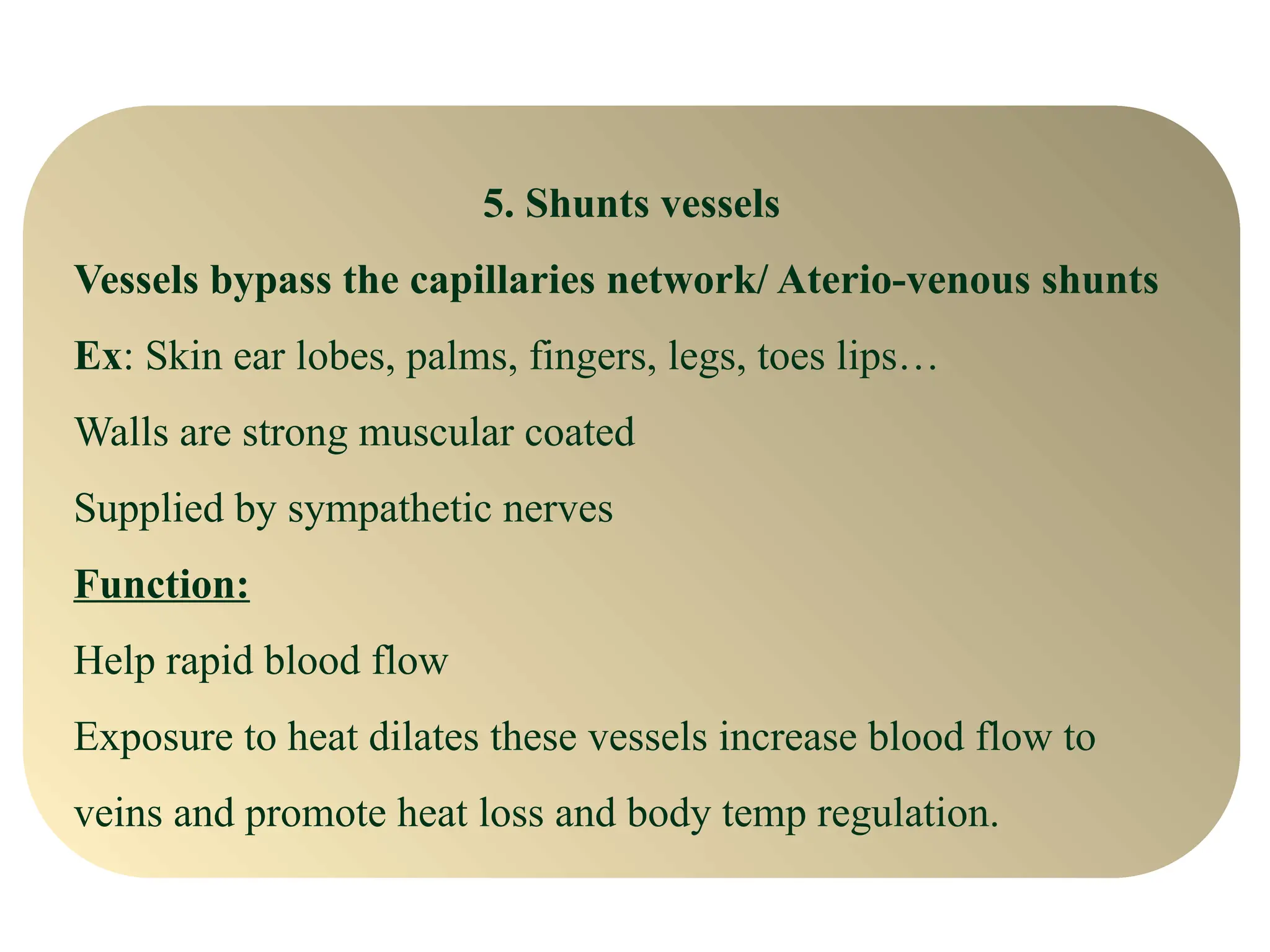
5. Shunts vessels
Vessels bypass the capillaries network/ Aterio-venous shunts
Ex: Skin ear lobes, palms, fingers, legs, toes lips…
Walls are strong muscular coated
Supplied by sympathetic nerves
Function:
Help rapid blood flow
Exposure to heat dilates these vessels increase blood flow to
veins and promote heat loss and body temp regulation.
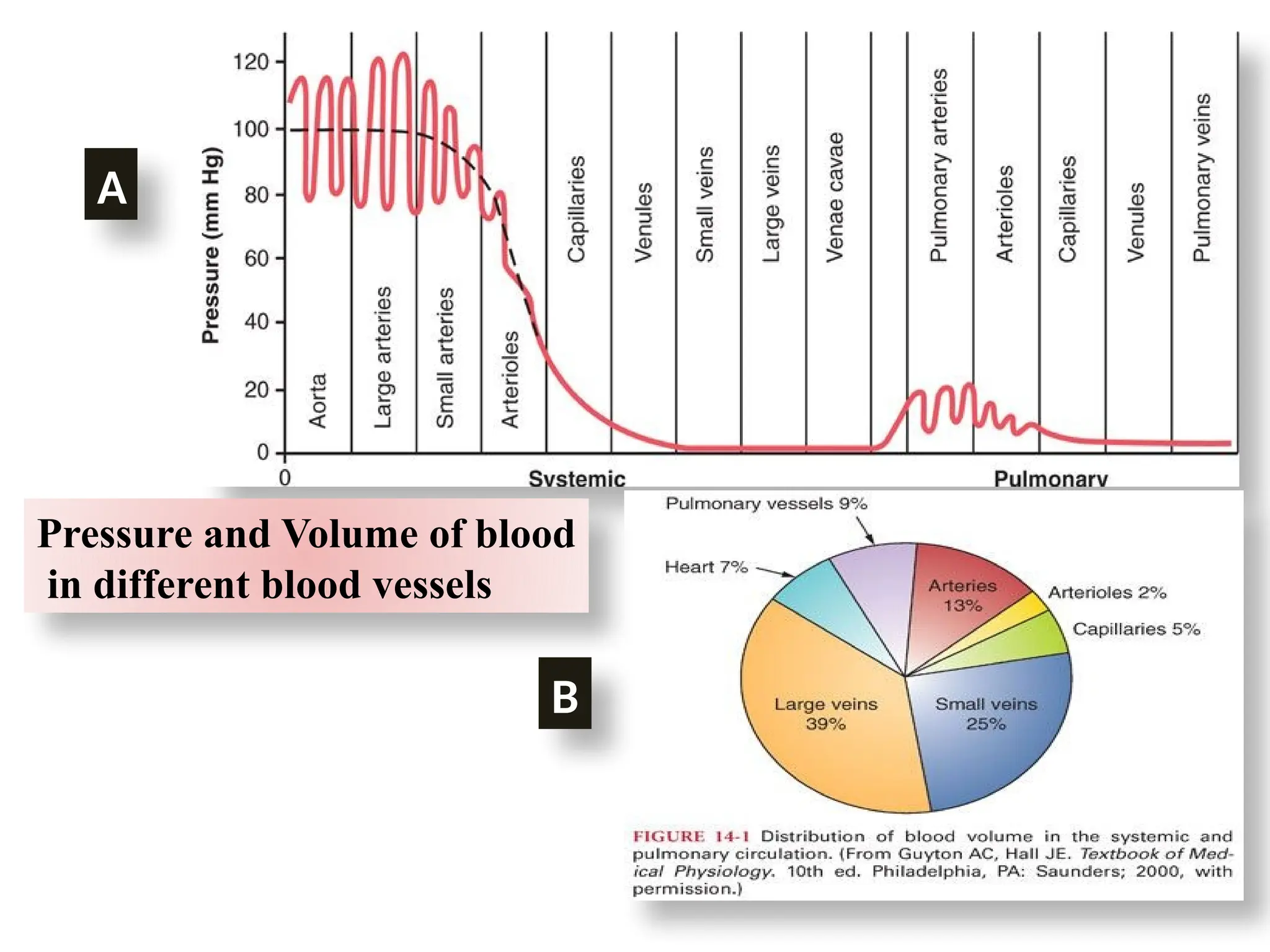
Pressure and Volume of blood
in different blood vessels
A
B
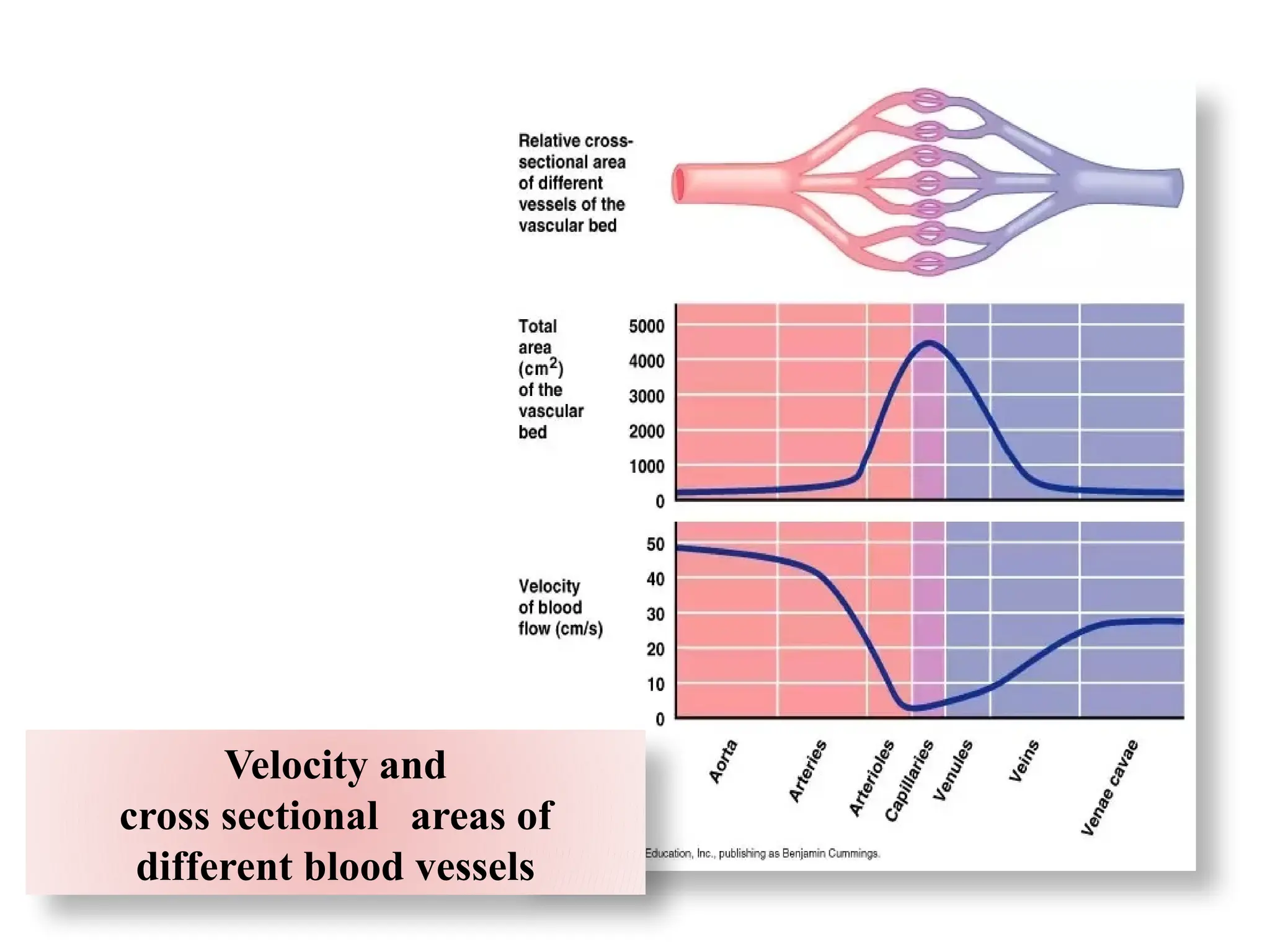
Velocity and
cross sectional areas of
different blood vessels
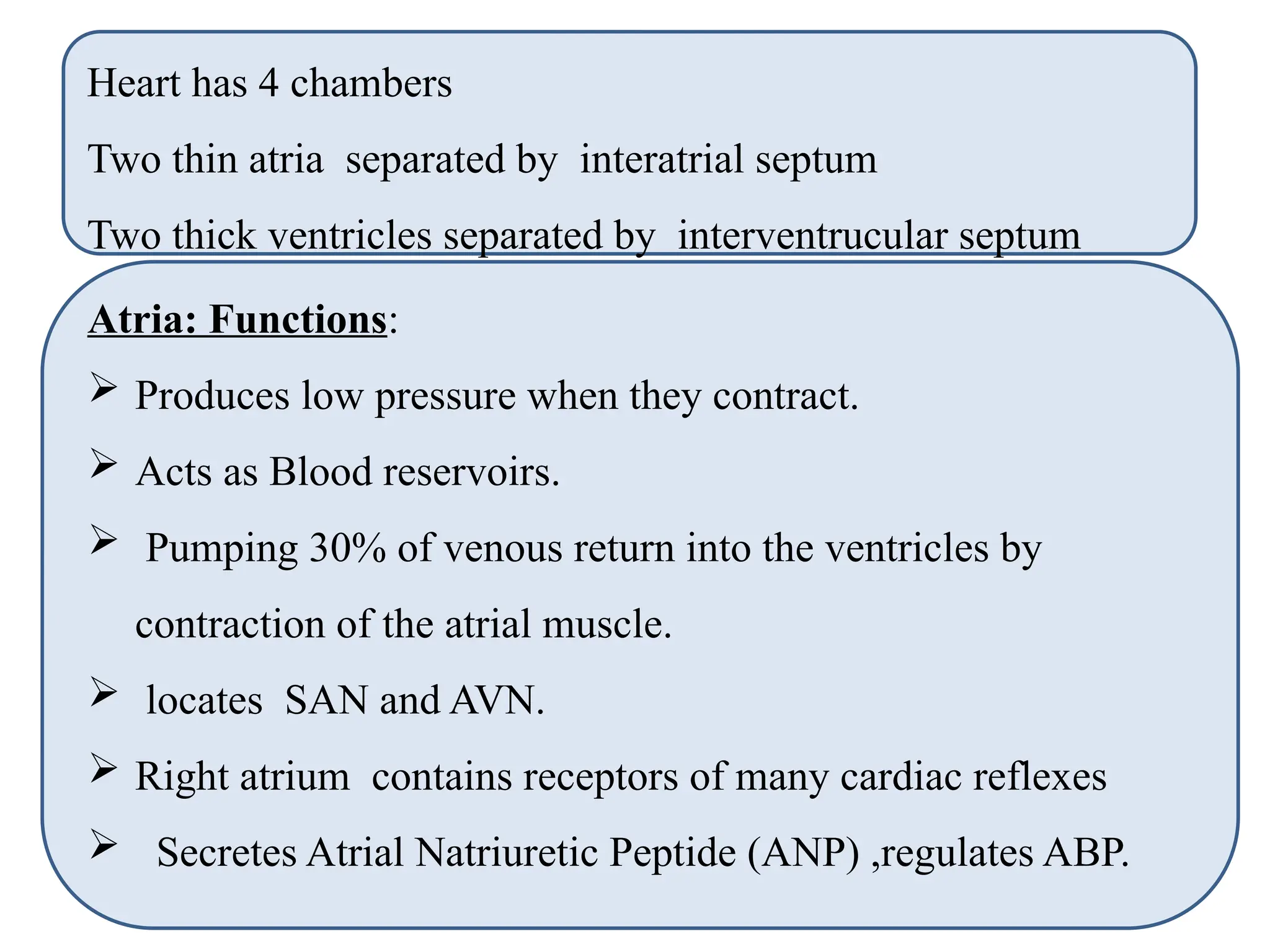
Heart has 4 chambers
Two thin atria separated by interatrial septum
Two thick ventricles separated by interventrucular septum
Atria: Functions:
 Produces low pressure when they contract.
 Acts as Blood reservoirs.
 Pumping 30% of venous return into the ventricles by
contraction of the atrial muscle.
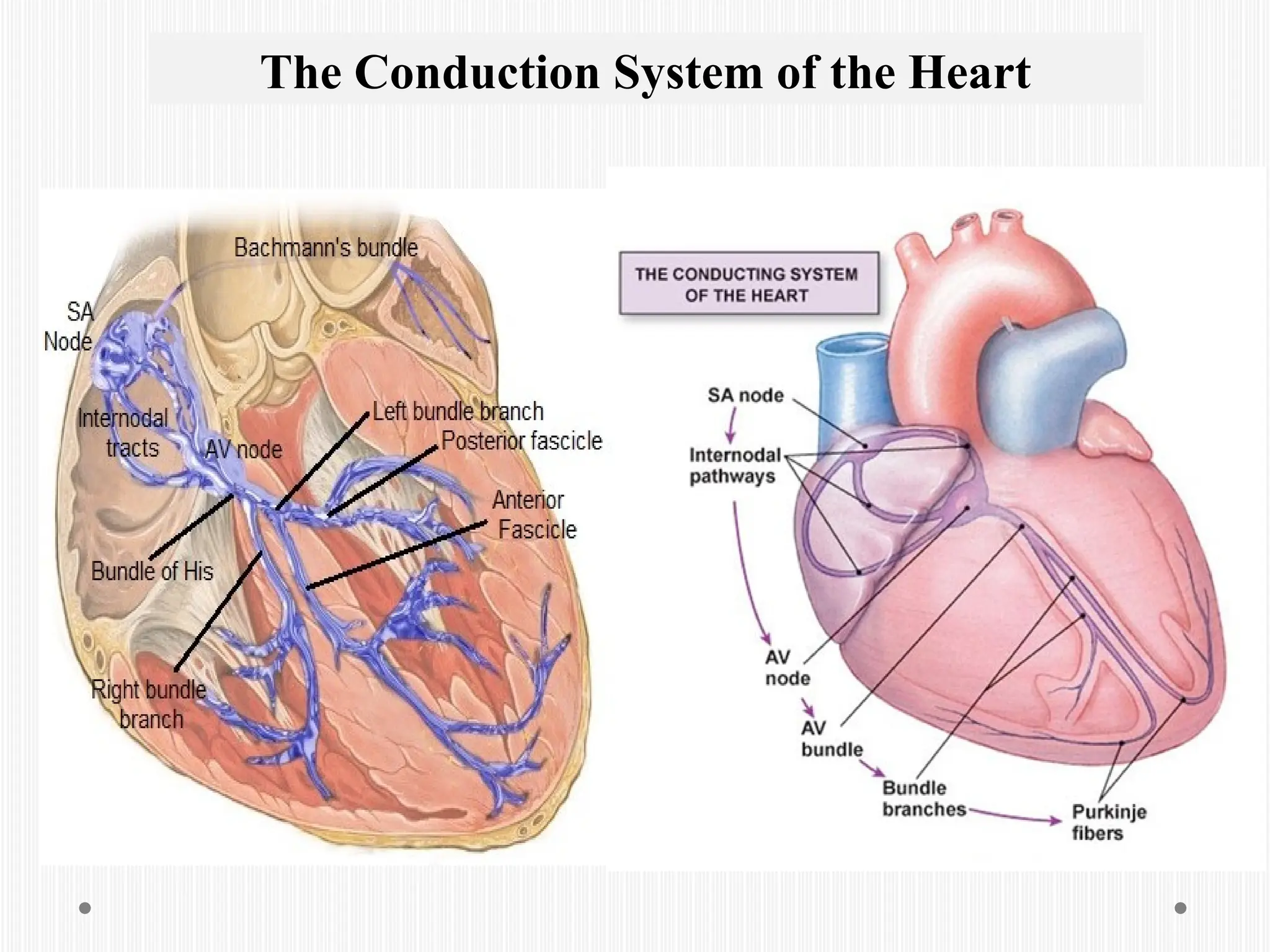
 locates SAN and AVN.
 Right atrium contains receptors of many cardiac reflexes
 Secretes Atrial Natriuretic Peptide (ANP) ,regulates ABP.
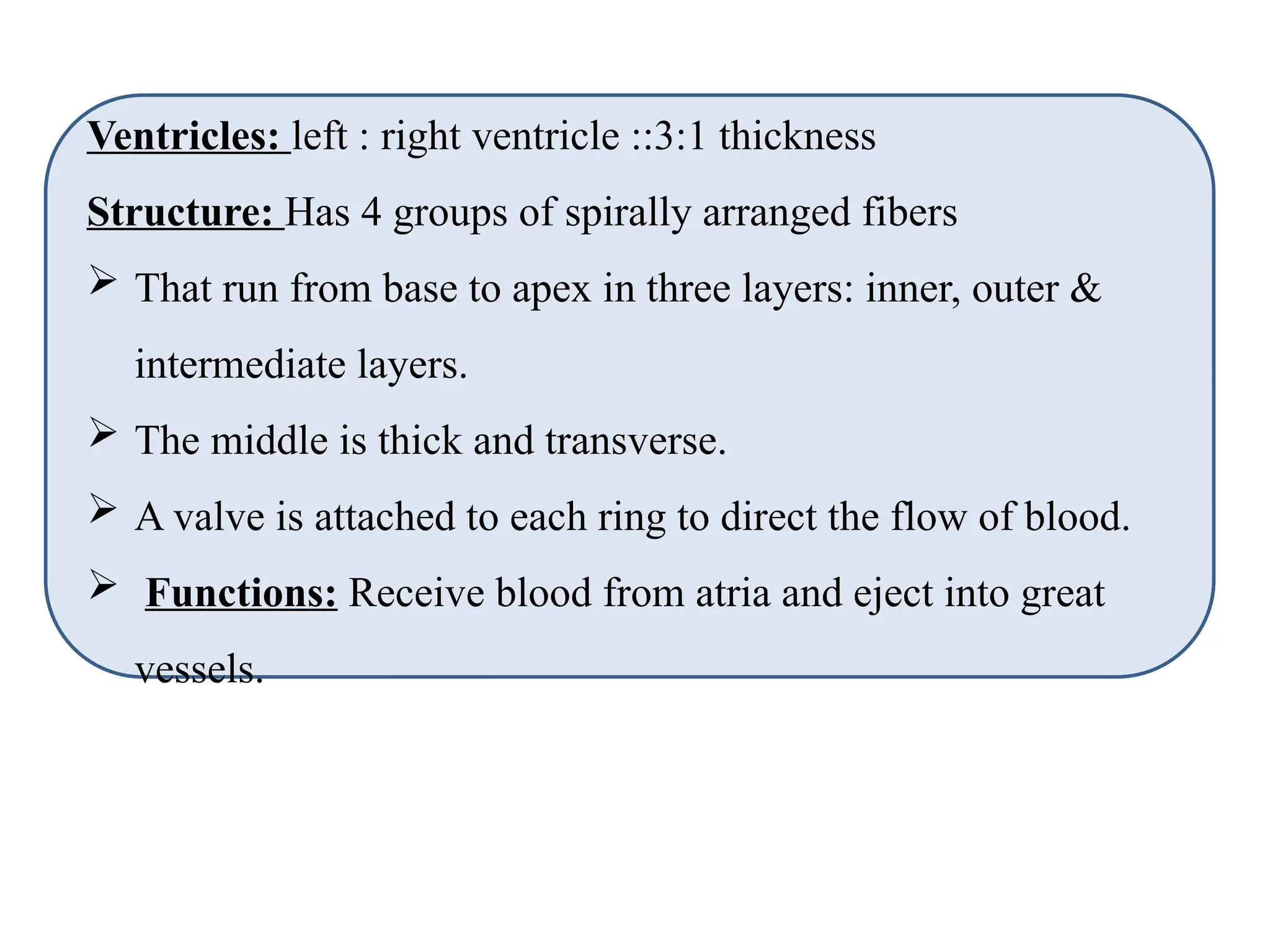
Ventricles: left : right ventricle ::3:1 thickness
Structure: Has 4 groups of spirally arranged fibers
 That run from base to apex in three layers: inner, outer &
intermediate layers.
 The middle is thick and transverse.
 A valve is attached to each ring to direct the flow of blood.
 Functions: Receive blood from atria and eject into great
vessels.
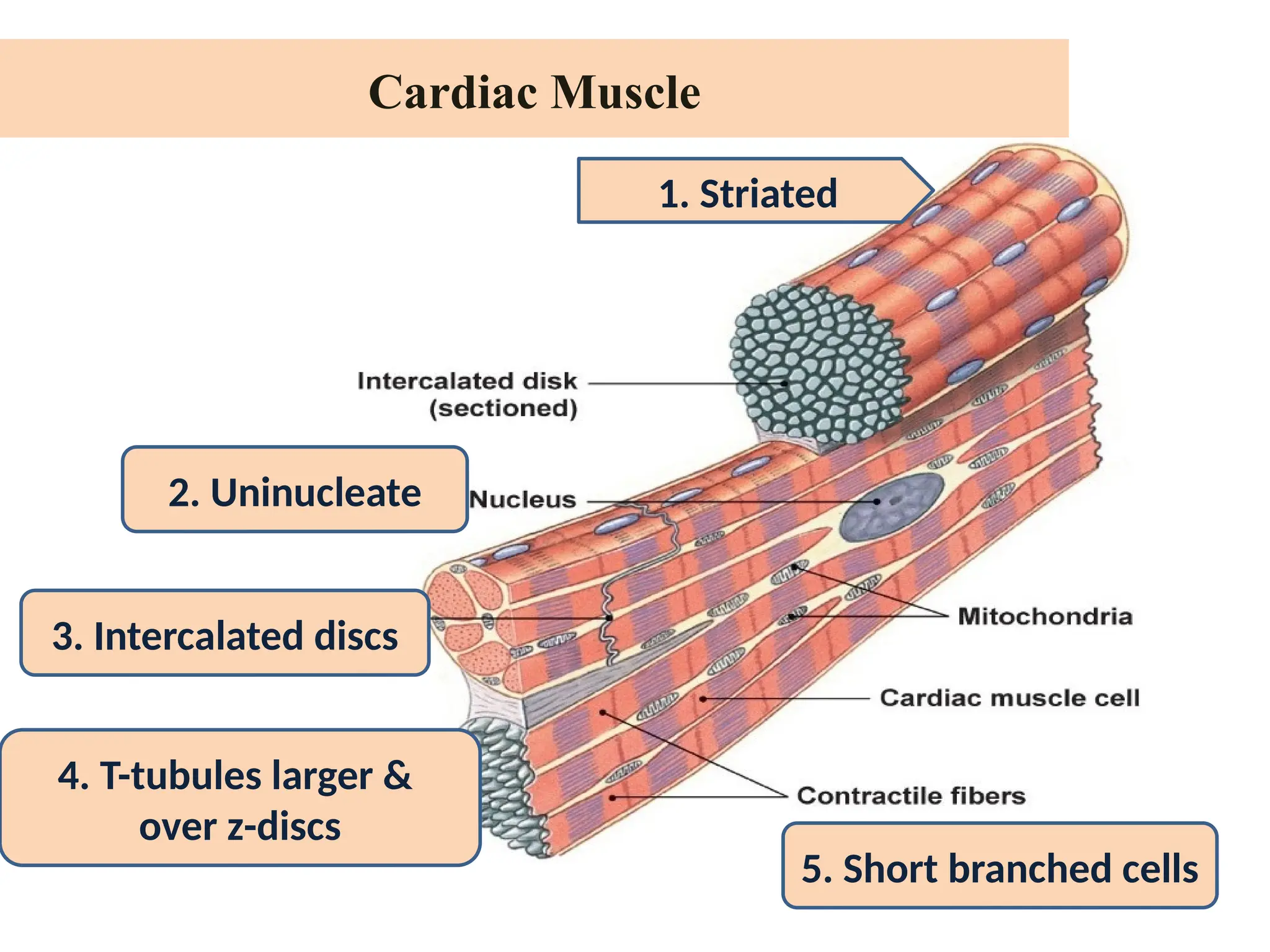
Cardiac Muscle
5. Short branched cells
4. T-tubules larger &
over z-discs
2. Uninucleate
3. Intercalated discs
1. Striated
Intercalated disc: The cell membranes fuse with one another to
form permeable “communicating” junctions (gap junctions).
Function: Allow rapid diffusion of ions.
Cardiac muscle: Syncytium of many heart muscle cells
Function: when one cell gets excited, the action potential rapidly
spreads to all of cardiac cells.
Two syncytiums: Atrial syncytium [the walls of the two atria]
Ventricular syncytium [ two ventricles].
Purpose of syncytiums: Allows the atria to contract a short time
ahead of ventricular contraction, which is important for
effectiveness of heart pumping.
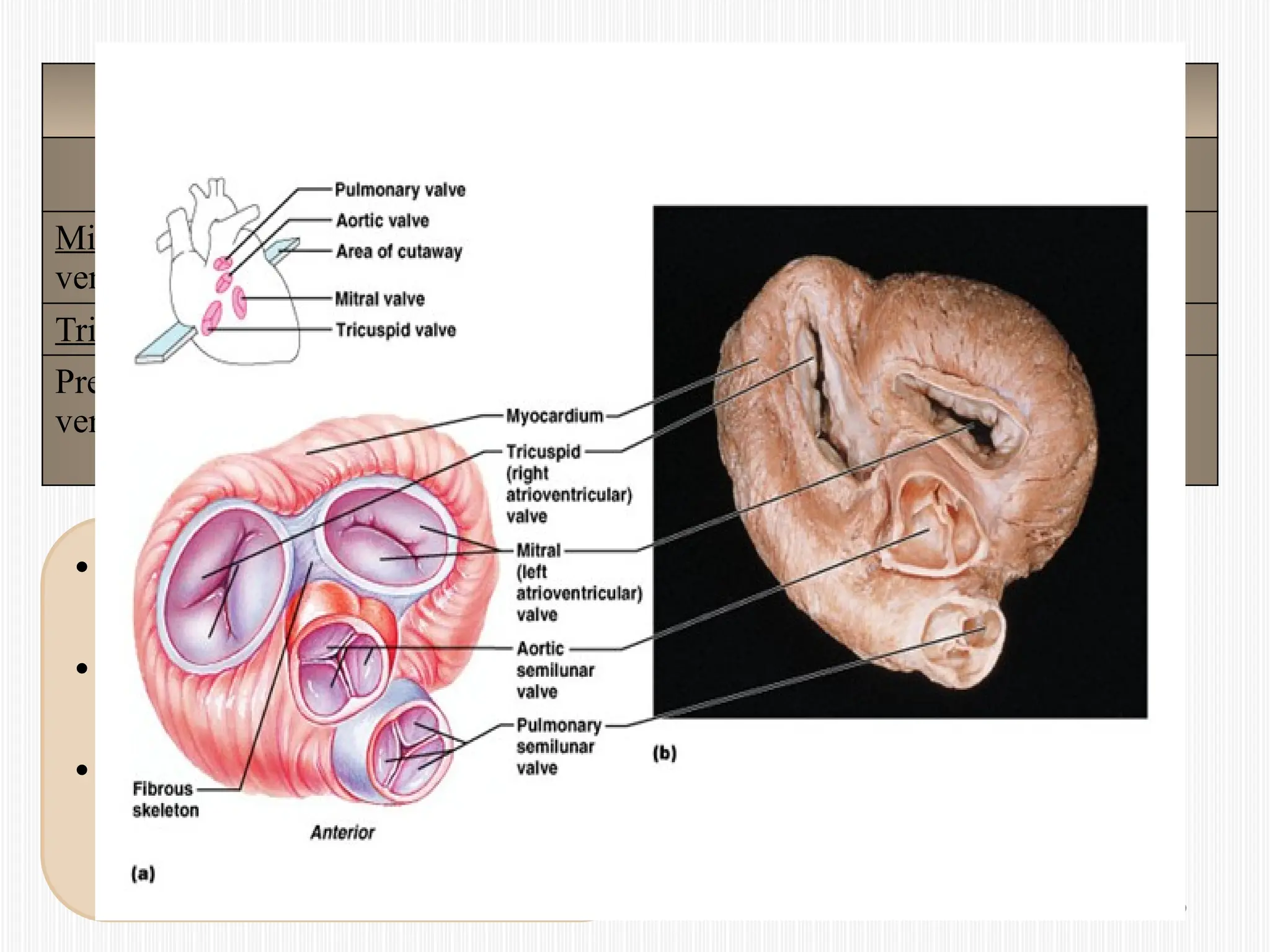
Cardiac Valves
Atrioventricular Valves Semilunar Valves
Mitral/Bicuspid: Left atrium & left
ventricle.
Lt Ventricles & aorta
Tricuspid: Rt atrium & Rt ventricle Rt Ventricles & pulmonary trunk
Prevent backflow to the atria from
ventricles during ventricular systole
Prevent backflow into ventricles from
gr vessels.
Adapted to withstand extra stress.
• Prolapse is prevented by the
chordae tendinae
• Tensioned by the papillary
muscles
• Applied: weakness of
papillary muscle lead to
regurgitation.
The Conduction System of the Heart
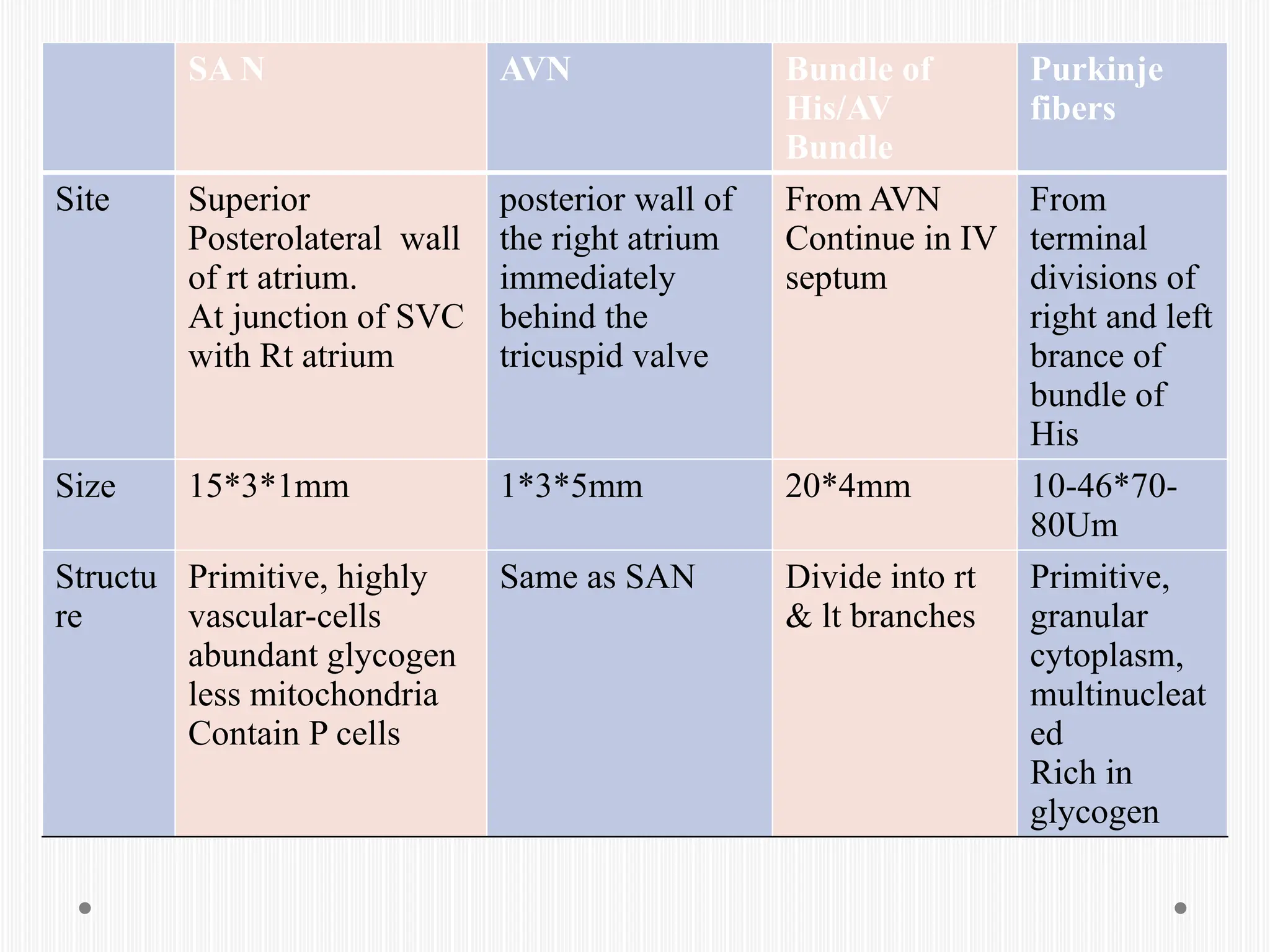
SA N AVN Bundle of
His/AV
Bundle
Purkinje
fibers
Site Superior
Posterolateral wall
of rt atrium.
At junction of SVC
with Rt atrium
posterior wall of
the right atrium
immediately
behind the
tricuspid valve
From AVN
Continue in IV
septum
From
terminal
divisions of
right and left
brance of
bundle of
His
Size 15*3*1mm 1*3*5mm 20*4mm 10-46*70-
80Um
Structu
re
Primitive, highly
vascular-cells
abundant glycogen
less mitochondria
Contain P cells
Same as SAN Divide into rt
& lt branches
Primitive,
granular
cytoplasm,
multinucleat
ed
Rich in
glycogen
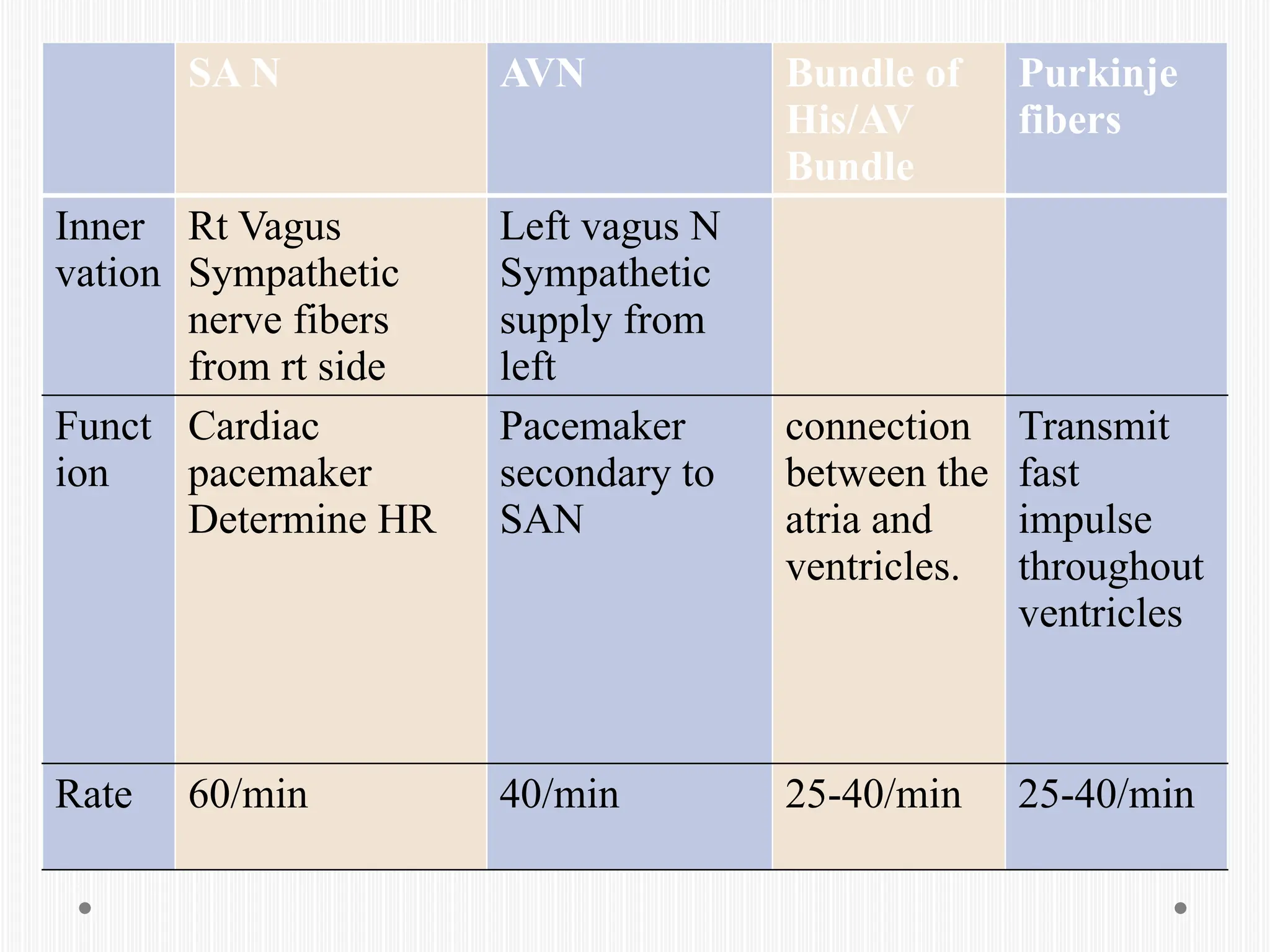
SA N AVN Bundle of
His/AV
Bundle
Purkinje
fibers
Inner
vation
Rt Vagus
Sympathetic
nerve fibers
from rt side
Left vagus N
Sympathetic
supply from
left
Funct
ion
Cardiac
pacemaker
Determine HR
Pacemaker
secondary to
SAN
connection
between the
atria and
ventricles.
Transmit
fast
impulse
throughout
ventricles
Rate 60/min 40/min 25-40/min 25-40/min

Lecture: Introduction of cardiovascular system

  • 1.
    Lecture 37:Introduction toCirculation Dr Shamshad
  • 2.
    1. Identify thetwo divisions of circulation and track the pathway of the blood through both circulations. 2. Outline the various parts of circulation and identify the differences in structure, function, pressure and velocity of blood in different vessels. 3. Describe the physiological anatomy of the heart and identify its various specialized functional parts. OBJECTIVES Guyton & Hall Textbook of Physiology - 12th ed. P. 157-159 & 101-102
  • 3.
    Veins- Deoxygenated bloodtowards heart Except pulmonary veins. Arteries- Oxygenated blood away from heart Except pulmonary arteries. Pumps blood through vessels Capillaries- location of internal respiration in all body tissues. Blood- Viscous transport medium. Heart Vascular system Overview of the Cardiovascular System
  • 4.
     Supplies thetissues nutrients like: O2,carbohydrates,aminoacids, fats, hormones, and immunological agents.  Removes wastes products of tissue metabolism: CO2, lactic acids.  Control blood flow to the skin & limbs: Heat loss to the environment :regulate body temperature.  Body defense mechanisms : Transportation of antibodies/platelets/WBCs.. Functions of Circulatory System
  • 5.
    Functions of Heart Generating blood pressure.  Ensuring one-way blood flow: with help of valves  Routing blood: separates pulmonary and systemic circulations.  Regulating blood supply according to the need of the body [increase in exercise & pregnancy..].
  • 6.
    Pulmonary Circuit Lesser circulation SystemicCircuit Greater/Peripheral circulation. DOUBLE PUMP
  • 8.
    Function of bloodvessels layers 1.Tunica intima Tunica media Tunica externa Reduces friction b/w vessel walls & blood. Controls vasoconstriction & vasodilation of the vessel. Protects, reinforces, & anchors the vessel to surrounding structures.
  • 9.
    Types of bloodvessels based on functions 1. Windkessel /Distensible vessels 3. Exchange vessels 4. Capacitance vessels 2. Resistance vessels 5. Shunts vessels
  • 10.
    1. Windkessel /Distensiblevessels Highly elastic vessels Ex :Aorta, pulmonary artery & other larger arteries. Function: Pressure & blood flow is pulsatile in nature due to effect of heart contraction and relaxation. Applied Aspects: Degeneration of the T.media lead to loss of Windkessel effect.
  • 11.
    2. Resistance vessels Vesselsoffer resistance to blood flow towards the capillaries Ex: Arterioles, metarterioles, and pre capillary sphincters Arterioles/peripheral resistance vessels. Function: Decrease the hydrostatic pressure within capillaries Resistance to blood flow is inversely proportional to the 4th power of radius of arterioles Show efficient myogenic control of their own radius.
  • 12.
    3. Exchange vessels Allow the exchange of gases and nutritive substances and others  Single layer of endothelial cells  Large surface area  Millions of capillaries  At rest only 25% active  Vital organs posses dense capillary network  Not controlled by nervous or metabolic factors  Determined by pre-capillary sphincters
  • 13.
    Structure of capillariesnetwork Types Site Functions Continuous Common Allow passage of fluids & small solutes Fenestrated Kidneys More permeable to fluids & solutes Sinusoidal Liver Leaky capillaries that allow large molecules to pass b/w the blood & surrounding tissues
  • 14.
    4. Capacitance vessels Vesselswhich accommodated large vol of blood by change in their luminal shape without change in trans mural pressure Ex: Venules, venous compartments Function: Myogenic tone under control of sympathetic constrictor nerves Collapsible in nature.
  • 15.
    5. Shunts vessels Vesselsbypass the capillaries network/ Aterio-venous shunts Ex: Skin ear lobes, palms, fingers, legs, toes lips… Walls are strong muscular coated Supplied by sympathetic nerves Function: Help rapid blood flow Exposure to heat dilates these vessels increase blood flow to veins and promote heat loss and body temp regulation.
  • 16.
    Pressure and Volumeof blood in different blood vessels A B
  • 17.
    Velocity and cross sectionalareas of different blood vessels
  • 19.
    Heart has 4chambers Two thin atria separated by interatrial septum Two thick ventricles separated by interventrucular septum Atria: Functions:  Produces low pressure when they contract.  Acts as Blood reservoirs.  Pumping 30% of venous return into the ventricles by contraction of the atrial muscle.  locates SAN and AVN.  Right atrium contains receptors of many cardiac reflexes  Secretes Atrial Natriuretic Peptide (ANP) ,regulates ABP.
  • 20.
    Ventricles: left :right ventricle ::3:1 thickness Structure: Has 4 groups of spirally arranged fibers  That run from base to apex in three layers: inner, outer & intermediate layers.  The middle is thick and transverse.  A valve is attached to each ring to direct the flow of blood.  Functions: Receive blood from atria and eject into great vessels.
  • 21.
    Cardiac Muscle 5. Shortbranched cells 4. T-tubules larger & over z-discs 2. Uninucleate 3. Intercalated discs 1. Striated
  • 22.
    Intercalated disc: Thecell membranes fuse with one another to form permeable “communicating” junctions (gap junctions). Function: Allow rapid diffusion of ions. Cardiac muscle: Syncytium of many heart muscle cells Function: when one cell gets excited, the action potential rapidly spreads to all of cardiac cells. Two syncytiums: Atrial syncytium [the walls of the two atria] Ventricular syncytium [ two ventricles]. Purpose of syncytiums: Allows the atria to contract a short time ahead of ventricular contraction, which is important for effectiveness of heart pumping.
  • 23.
    Cardiac Valves Atrioventricular ValvesSemilunar Valves Mitral/Bicuspid: Left atrium & left ventricle. Lt Ventricles & aorta Tricuspid: Rt atrium & Rt ventricle Rt Ventricles & pulmonary trunk Prevent backflow to the atria from ventricles during ventricular systole Prevent backflow into ventricles from gr vessels. Adapted to withstand extra stress. • Prolapse is prevented by the chordae tendinae • Tensioned by the papillary muscles • Applied: weakness of papillary muscle lead to regurgitation.
  • 24.
  • 25.
    SA N AVNBundle of His/AV Bundle Purkinje fibers Site Superior Posterolateral wall of rt atrium. At junction of SVC with Rt atrium posterior wall of the right atrium immediately behind the tricuspid valve From AVN Continue in IV septum From terminal divisions of right and left brance of bundle of His Size 15*3*1mm 1*3*5mm 20*4mm 10-46*70- 80Um Structu re Primitive, highly vascular-cells abundant glycogen less mitochondria Contain P cells Same as SAN Divide into rt & lt branches Primitive, granular cytoplasm, multinucleat ed Rich in glycogen
  • 26.
    SA N AVNBundle of His/AV Bundle Purkinje fibers Inner vation Rt Vagus Sympathetic nerve fibers from rt side Left vagus N Sympathetic supply from left Funct ion Cardiac pacemaker Determine HR Pacemaker secondary to SAN connection between the atria and ventricles. Transmit fast impulse throughout ventricles Rate 60/min 40/min 25-40/min 25-40/min

Editor's Notes

  • #13 A cuff of smooth muscle, called a precapillary sphincter, surrounds each capillary at the metarteriole and acts as a valve to regulate blood flow into the capillary