Resting Membrane
Potential
Dr Phiri S B
Electricity Review
A) Law of conservation of charge: the net amount of electric charge produced in a
system is zero. ie. for every +ve charge on an ion, there is an electron on
another ion. Overall, the body is electrically neutral.
B) Opposite charges attract and like charges repel.
C) Energy is needed to separate charge.
D) If separated charges could move towards one another, the material through
which they are moving is called a conductor.
E) If the material prevents the movement of separate charges, the material is
called an insulator. The cell membrane is a good insulator.
F) Static electricity arises from the separation of electric charge.
RESTING AND ACTION POTENTIALS
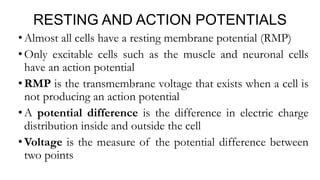
• Almost all cells have a resting membrane potential (RMP)
• Only excitable cells such as the muscle and neuronal cells
have an action potential
• RMP is the transmembrane voltage that exists when a cell is
not producing an action potential
• A potential difference is the difference in electric charge
distribution inside and outside the cell
• Voltage is the measure of the potential difference between
two points
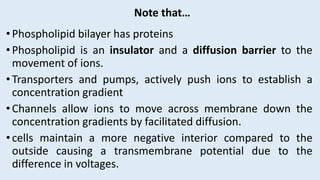
•Phospholipid bilayer has proteins
•Phospholipid is an insulator and a diffusion barrier to the
movement of ions.
•Transporters and pumps, actively push ions to establish a
concentration gradient
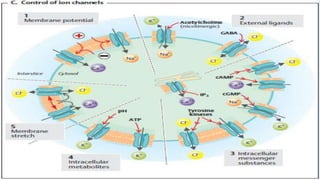
•Channels allow ions to move across membrane down the
concentration gradients by facilitated diffusion.
•cells maintain a more negative interior compared to the
outside causing a transmembrane potential due to the
difference in voltages.
Note that…
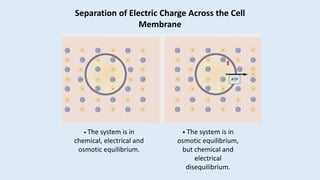
Separation of Electric Charge Across the Cell
Membrane
• The system is in
chemical, electrical and
osmotic equilibrium.
• The system is in
osmotic equilibrium,
but chemical and
electrical
disequilibrium.
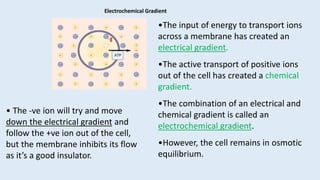
•The input of energy to transport ions
across a membrane has created an
electrical gradient.
•The active transport of positive ions
out of the cell has created a chemical
gradient.
•The combination of an electrical and
chemical gradient is called an
electrochemical gradient.
•However, the cell remains in osmotic
equilibrium.
• The -ve ion will try and move
down the electrical gradient and
follow the +ve ion out of the cell,
but the membrane inhibits its flow
as it’s a good insulator.
Electrochemical Gradient
Membrane potential
• Due to separation of positive and negative
charges across the cell membrane, because of;
• unequal distribution of ions of one or more
species across the membrane (ie, a
concentration gradient).
• Membrane permeable to one or more of
these ion species.
• The resting membrane potential represents an
equilibrium situation.
• concentration gradients equal and opposite to
electrical gradients.
RESTING MEMBRANE POTENTIAL
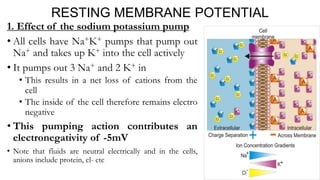
1. Effect of the sodium potassium pump
• All cells have Na+K+ pumps that pump out
Na+ and takes up K+ into the cell actively
• It pumps out 3 Na+ and 2 K+ in
• This results in a net loss of cations from the
cell
• The inside of the cell therefore remains electro
negative
• This pumping action contributes an
electronegativity of -5mV
• Note that fluids are neutral electrically and in the cells,
anions include protein, cl- etc
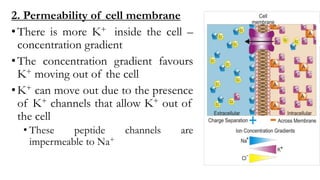
2. Permeability of cell membrane
•There is more K+ inside the cell –
concentration gradient
•The concentration gradient favours
K+ moving out of the cell
•K+ can move out due to the presence
of K+ channels that allow K+ out of
the cell
• These peptide channels are
impermeable to Na+
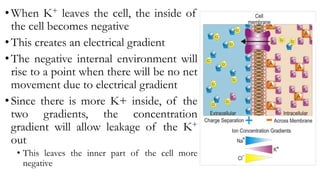
• When K+ leaves the cell, the inside of
the cell becomes negative
• This creates an electrical gradient
• The negative internal environment will
rise to a point when there will be no net
movement due to electrical gradient
• Since there is more K+ inside, of the
two gradients, the concentration
gradient will allow leakage of the K+
out
• This leaves the inner part of the cell more
negative
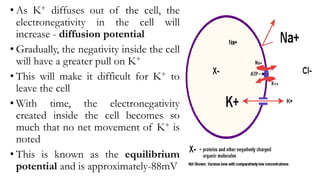
• As K+ diffuses out of the cell, the
electronegativity in the cell will
increase - diffusion potential
• Gradually, the negativity inside the cell
will have a greater pull on K+
• This will make it difficult for K+ to
leave the cell
• With time, the electronegativity
created inside the cell becomes so
much that no net movement of K+ is
noted
• This is known as the equilibrium
potential and is approximately-88mV
Nernst Equation
ECl = equilibrium potential for Cl–
R = gas constant
T = absolute temperature
F = the faraday (number of coulombs per mole of
charge)
ZCl = valence of Cl– (–1)
[Clo
–] = Cl– concentration outside the cell
[Cli
–] = Cl– concentration inside the cell
So what is RMP?
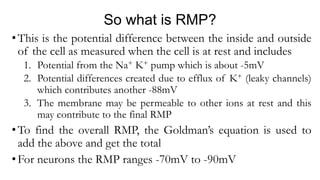
•This is the potential difference between the inside and outside
of the cell as measured when the cell is at rest and includes
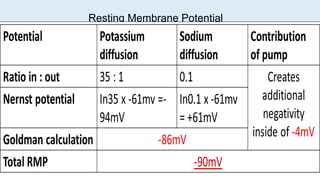
1. Potential from the Na+ K+ pump which is about -5mV
2. Potential differences created due to efflux of K+ (leaky channels)
which contributes another -88mV
3. The membrane may be permeable to other ions at rest and this
may contribute to the final RMP
•To find the overall RMP, the Goldman’s equation is used to
add the above and get the total
•For neurons the RMP ranges -70mV to -90mV
14
OUTSIDE
INSIDE
K+ = Potassium; Na+ = Sodium; Cl- = Chloride; Pr- = proteins
K+
K+
Force of Diffusion
Electrostatic Force
+ + + + + + + + + + + + + + + + + + + + + + + + + + + + + + + + + + + + + + + + + + +
- - - - - - - - - - - - - - - - - - - - - - - - - - - - - - - - - - - - - - - - - - - - - - - - - - - - -- - - - - - -
Cl-
Force of Diffusion
Cl-
Electrostatic Force
Pr-
Leaks
for Na+
open
channel
open
channel
no
channel
Resting Membrane Potential
- 94 mV
Na
+
Na+
+61 mV
3Na/2K
pump
-4 mV
THANKS FOR YOUR ATTENTION
The End
DR S B PHIRI

1. Resting Membrane Potential.pptx

  • 1.
  • 2.
    Electricity Review A) Lawof conservation of charge: the net amount of electric charge produced in a system is zero. ie. for every +ve charge on an ion, there is an electron on another ion. Overall, the body is electrically neutral. B) Opposite charges attract and like charges repel. C) Energy is needed to separate charge. D) If separated charges could move towards one another, the material through which they are moving is called a conductor. E) If the material prevents the movement of separate charges, the material is called an insulator. The cell membrane is a good insulator. F) Static electricity arises from the separation of electric charge.
  • 3.
    RESTING AND ACTIONPOTENTIALS • Almost all cells have a resting membrane potential (RMP) • Only excitable cells such as the muscle and neuronal cells have an action potential • RMP is the transmembrane voltage that exists when a cell is not producing an action potential • A potential difference is the difference in electric charge distribution inside and outside the cell • Voltage is the measure of the potential difference between two points
  • 4.
    •Phospholipid bilayer hasproteins •Phospholipid is an insulator and a diffusion barrier to the movement of ions. •Transporters and pumps, actively push ions to establish a concentration gradient •Channels allow ions to move across membrane down the concentration gradients by facilitated diffusion. •cells maintain a more negative interior compared to the outside causing a transmembrane potential due to the difference in voltages. Note that…
  • 5.
    Separation of ElectricCharge Across the Cell Membrane • The system is in chemical, electrical and osmotic equilibrium. • The system is in osmotic equilibrium, but chemical and electrical disequilibrium.
  • 6.
    •The input ofenergy to transport ions across a membrane has created an electrical gradient. •The active transport of positive ions out of the cell has created a chemical gradient. •The combination of an electrical and chemical gradient is called an electrochemical gradient. •However, the cell remains in osmotic equilibrium. • The -ve ion will try and move down the electrical gradient and follow the +ve ion out of the cell, but the membrane inhibits its flow as it’s a good insulator. Electrochemical Gradient
  • 7.
    Membrane potential • Dueto separation of positive and negative charges across the cell membrane, because of; • unequal distribution of ions of one or more species across the membrane (ie, a concentration gradient). • Membrane permeable to one or more of these ion species. • The resting membrane potential represents an equilibrium situation. • concentration gradients equal and opposite to electrical gradients.
  • 8.
    RESTING MEMBRANE POTENTIAL 1.Effect of the sodium potassium pump • All cells have Na+K+ pumps that pump out Na+ and takes up K+ into the cell actively • It pumps out 3 Na+ and 2 K+ in • This results in a net loss of cations from the cell • The inside of the cell therefore remains electro negative • This pumping action contributes an electronegativity of -5mV • Note that fluids are neutral electrically and in the cells, anions include protein, cl- etc
  • 9.
    2. Permeability ofcell membrane •There is more K+ inside the cell – concentration gradient •The concentration gradient favours K+ moving out of the cell •K+ can move out due to the presence of K+ channels that allow K+ out of the cell • These peptide channels are impermeable to Na+
  • 10.
    • When K+leaves the cell, the inside of the cell becomes negative • This creates an electrical gradient • The negative internal environment will rise to a point when there will be no net movement due to electrical gradient • Since there is more K+ inside, of the two gradients, the concentration gradient will allow leakage of the K+ out • This leaves the inner part of the cell more negative
  • 11.
    • As K+diffuses out of the cell, the electronegativity in the cell will increase - diffusion potential • Gradually, the negativity inside the cell will have a greater pull on K+ • This will make it difficult for K+ to leave the cell • With time, the electronegativity created inside the cell becomes so much that no net movement of K+ is noted • This is known as the equilibrium potential and is approximately-88mV
  • 12.
    Nernst Equation ECl =equilibrium potential for Cl– R = gas constant T = absolute temperature F = the faraday (number of coulombs per mole of charge) ZCl = valence of Cl– (–1) [Clo –] = Cl– concentration outside the cell [Cli –] = Cl– concentration inside the cell
  • 13.
    So what isRMP? •This is the potential difference between the inside and outside of the cell as measured when the cell is at rest and includes 1. Potential from the Na+ K+ pump which is about -5mV 2. Potential differences created due to efflux of K+ (leaky channels) which contributes another -88mV 3. The membrane may be permeable to other ions at rest and this may contribute to the final RMP •To find the overall RMP, the Goldman’s equation is used to add the above and get the total •For neurons the RMP ranges -70mV to -90mV
  • 14.
    14 OUTSIDE INSIDE K+ = Potassium;Na+ = Sodium; Cl- = Chloride; Pr- = proteins K+ K+ Force of Diffusion Electrostatic Force + + + + + + + + + + + + + + + + + + + + + + + + + + + + + + + + + + + + + + + + + + + - - - - - - - - - - - - - - - - - - - - - - - - - - - - - - - - - - - - - - - - - - - - - - - - - - - - -- - - - - - - Cl- Force of Diffusion Cl- Electrostatic Force Pr- Leaks for Na+ open channel open channel no channel Resting Membrane Potential - 94 mV Na + Na+ +61 mV 3Na/2K pump -4 mV
  • 15.
    THANKS FOR YOURATTENTION The End DR S B PHIRI