1
College of Medicine Majamaah University, KSA
Check list for the students: Lymph Node Examination and BMI
Competencies
1:Initial steps
A. Greet the patient & introduce yourself
B. Confirm the name & ID of patient.
C. Examine from the right side of patient
D. Explain the procedure and reassure: Take verbal consent
E. Hand hygiene with alcohol gel
F. Uncover the part to be examined
G. Position the patient siting , standing or lying down
H. Check the instrument and equipments required.
2: Brief history
History of present illness
Fever, Bleeding, Enlarged nodes, Swelling in extremities, Medication
Past and medical history
Infection: TB, HIV, Surgery, Transfusion ,Malignancy
Family history
Chronic illness, Malignancy, TB,…
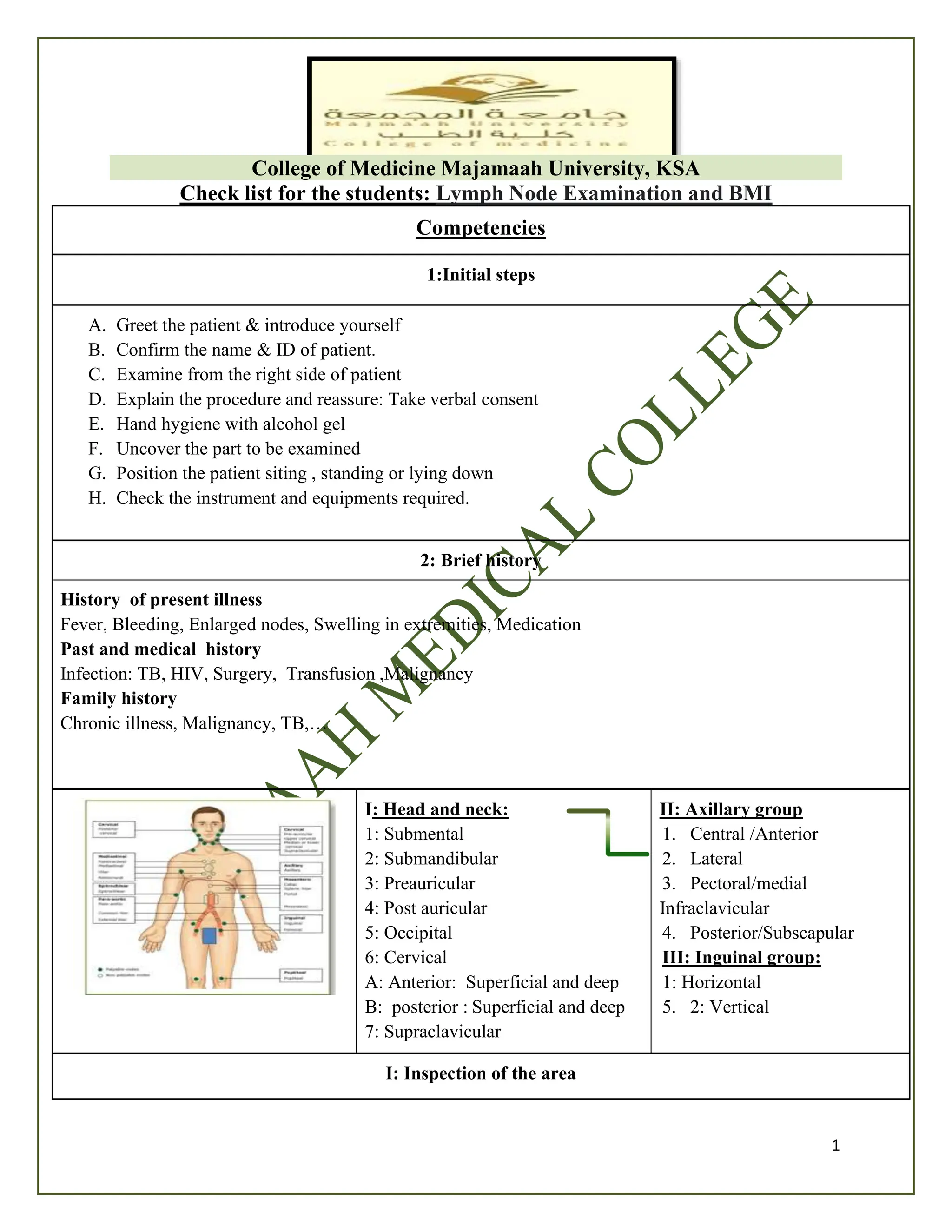
I: Head and neck:
1: Submental
2: Submandibular
3: Preauricular
4: Post auricular
5: Occipital
6: Cervical
A: Anterior: Superficial and deep
B: posterior : Superficial and deep
7: Supraclavicular
II: Axillary group
1. Central /Anterior
2. Lateral
3. Pectoral/medial
Infraclavicular
4. Posterior/Subscapular
III: Inguinal group:
1: Horizontal
5. 2: Vertical
I: Inspection of the area
2
Asymmetry or erythema
Swelling
Discharge
Ulceration, Scars, Pulsation…..
II: Palpation
1: Site: Assess the lymph node’s location in relation to other anatomical structures
2:Temperature: Of the site
3:Number AND Tenderness: Number of swelling and If tender on palpation.
4: Size: Assess the size of the lymph node.
5: Shape: Assess borders of Lymph node
Determine if they feel regular or irregular.
6: Consistency: Determine if lymph node feels soft/hard/ rubbery.
7: Mobility: Assess if the lymph node feels mobile / tethered to other local structures.
8: Fluctuant: Determine if fluid filled (is it trans-illuminable);
9: Pulsatility
10: Relation to underlying/overlying tissue : (tethered/ mobile)
Interpretation of lymph node findings
1: Normal: Lymph nodes are smooth and relatively soft.
2: Benign lymph nodes: typically less than 1cm, smooth, rounded, non-tender and mobile.
3: Reactive lymph nodes: typically smooth, rounded, tender, mobile & associated with infective symptoms
(e.g. fever).
4: Lymphadenopathy associated with hematological malignancy: widespread enlarged rubbery lymph
nodes.
5: Lymphadenopathy associated with metastatic cancer: regional groups draining the affected organ.
Lymph nodes typically feel hard, firm, and irregular and are often tethered to local structures.
5: Final steps: Professional & Ethical Attitude
Thank & cover the patient.
Polite, considerate towards the Simulator & Well organized presentation.
3
Body Mass Index (BMI) / Quetelet Index
Height: in meter
Weight : kgs
Quetelet formula: BMI = kg/m2
Weight in Kgs divided by the Height in meters squared.
Interference
Category Normal range
Severe thinness <16
Moderate thinness 16-17
Mild thinness 17-18.5
Normal 18.5-25
Overweight 25-30
Obese I 30-35
Obese II 35-40
Obese III >40

Check list for lymph node examination and BMI.pdf

  • 1.
    1 College of MedicineMajamaah University, KSA Check list for the students: Lymph Node Examination and BMI Competencies 1:Initial steps A. Greet the patient & introduce yourself B. Confirm the name & ID of patient. C. Examine from the right side of patient D. Explain the procedure and reassure: Take verbal consent E. Hand hygiene with alcohol gel F. Uncover the part to be examined G. Position the patient siting , standing or lying down H. Check the instrument and equipments required. 2: Brief history History of present illness Fever, Bleeding, Enlarged nodes, Swelling in extremities, Medication Past and medical history Infection: TB, HIV, Surgery, Transfusion ,Malignancy Family history Chronic illness, Malignancy, TB,… I: Head and neck: 1: Submental 2: Submandibular 3: Preauricular 4: Post auricular 5: Occipital 6: Cervical A: Anterior: Superficial and deep B: posterior : Superficial and deep 7: Supraclavicular II: Axillary group 1. Central /Anterior 2. Lateral 3. Pectoral/medial Infraclavicular 4. Posterior/Subscapular III: Inguinal group: 1: Horizontal 5. 2: Vertical I: Inspection of the area
  • 2.
    2 Asymmetry or erythema Swelling Discharge Ulceration,Scars, Pulsation….. II: Palpation 1: Site: Assess the lymph node’s location in relation to other anatomical structures 2:Temperature: Of the site 3:Number AND Tenderness: Number of swelling and If tender on palpation. 4: Size: Assess the size of the lymph node. 5: Shape: Assess borders of Lymph node Determine if they feel regular or irregular. 6: Consistency: Determine if lymph node feels soft/hard/ rubbery. 7: Mobility: Assess if the lymph node feels mobile / tethered to other local structures. 8: Fluctuant: Determine if fluid filled (is it trans-illuminable); 9: Pulsatility 10: Relation to underlying/overlying tissue : (tethered/ mobile) Interpretation of lymph node findings 1: Normal: Lymph nodes are smooth and relatively soft. 2: Benign lymph nodes: typically less than 1cm, smooth, rounded, non-tender and mobile. 3: Reactive lymph nodes: typically smooth, rounded, tender, mobile & associated with infective symptoms (e.g. fever). 4: Lymphadenopathy associated with hematological malignancy: widespread enlarged rubbery lymph nodes. 5: Lymphadenopathy associated with metastatic cancer: regional groups draining the affected organ. Lymph nodes typically feel hard, firm, and irregular and are often tethered to local structures. 5: Final steps: Professional & Ethical Attitude Thank & cover the patient. Polite, considerate towards the Simulator & Well organized presentation.
  • 3.
    3 Body Mass Index(BMI) / Quetelet Index Height: in meter Weight : kgs Quetelet formula: BMI = kg/m2 Weight in Kgs divided by the Height in meters squared. Interference Category Normal range Severe thinness <16 Moderate thinness 16-17 Mild thinness 17-18.5 Normal 18.5-25 Overweight 25-30 Obese I 30-35 Obese II 35-40 Obese III >40