Factors affecting GRF
Dr Shamshad
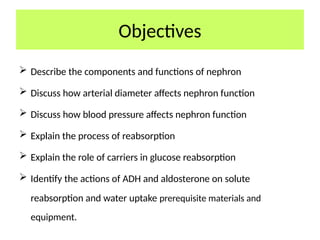
Objectives
 Describe the components and functions of nephron
 Discuss how arterial diameter affects nephron function
 Discuss how blood pressure affects nephron function
 Explain the process of reabsorption
 Explain the role of carriers in glucose reabsorption
 Identify the actions of ADH and aldosterone on solute
reabsorption and water uptake prerequisite materials and
equipment.
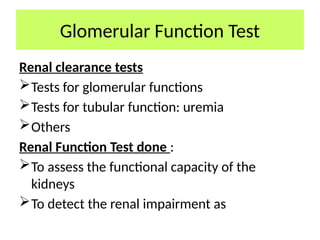
Glomerular Function Test
Renal clearance tests
Tests for glomerular functions
Tests for tubular function: uremia
Others
Renal Function Test done :
To assess the functional capacity of the
kidneys
To detect the renal impairment as
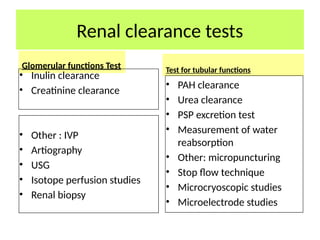
Renal clearance tests
Glomerular functions Test
• Inulin clearance
• Creatinine clearance
• Other : IVP
• Artiography
• USG
• Isotope perfusion studies
• Renal biopsy
Test for tubular functions
• PAH clearance
• Urea clearance
• PSP excretion test
• Measurement of water
reabsorption
• Other: micropuncturing
• Stop flow technique
• Microcryoscopic studies
• Microelectrode studies
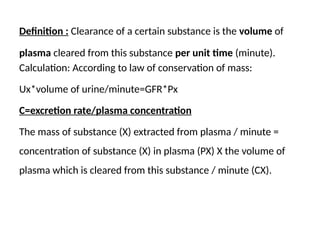
Definition : Clearance of a certain substance is the volume of
plasma cleared from this substance per unit time (minute).
Calculation: According to law of conservation of mass:
Ux*volume of urine/minute=GFR*Px
C=excretion rate/plasma concentration
The mass of substance (X) extracted from plasma / minute =
concentration of substance (X) in plasma (PX) X the volume of
plasma which is cleared from this substance / minute (CX).
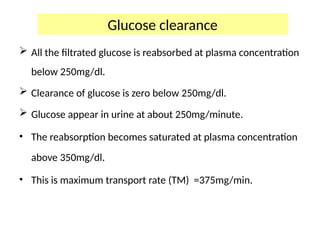
Glucose clearance
 All the filtrated glucose is reabsorbed at plasma concentration
below 250mg/dl.
 Clearance of glucose is zero below 250mg/dl.
 Glucose appear in urine at about 250mg/minute.
• The reabsorption becomes saturated at plasma concentration
above 350mg/dl.
• This is maximum transport rate (TM) =375mg/min.
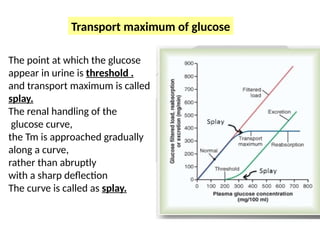
The point at which the glucose
appear in urine is threshold .
and transport maximum is called
splay.
The renal handling of the
glucose curve,
the Tm is approached gradually
along a curve,
rather than abruptly
with a sharp deflection
The curve is called as splay.
Transport maximum of glucose
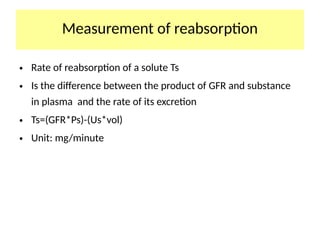
Measurement of reabsorption
• Rate of reabsorption of a solute Ts
• Is the difference between the product of GFR and substance
in plasma and the rate of its excretion
• Ts=(GFR*Ps)-(Us*vol)
• Unit: mg/minute
Measurement of Secretion
The rate of secretion of a solutes Ts, is the difference between
the rate of excretion Us*V, and the rate of filtration, GFR*PS
Ts=(Us*V)-(GFR*Ps)m/minute.
According to substance selected; clearance may be used
for:
1- Measurement of glomerular filtration rate (GFR):
Clearance of inulin or creatinine.
2- Measurement of renal plasma flow (RPF):
Clearance of PAH.
3- Measurement of reabsorptive capacity of renal
tubules:
Transport maximum of glucose (TMG).
4- Measurement of secretory capacity of renal tubules:
Transport maximum of PAH (TMPAH).
5-
5- Mode of handling of substance by the kidney:
Clearance ratio and fraction excretion.
6- Assessment of diluting capacity of the kidney:
Free water clearance.
7- Assessment of concentrating capacity of the kidney:
Free water reabsorption
Measurement of GFR
Substance used to measure GFR should apply
the following conditions:
1- Non-toxic.
2- Does not affect GFR or RPF.
3- Not metabolized by the body or the kidney.
4- Freely filtered: of small molecular weight
and not bound to plasma proteins
5- Neither reabsorbed nor secreted.
6- Accurately measured in plasma and urine.
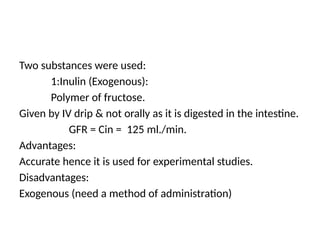
Two substances were used:
1:Inulin (Exogenous):
Polymer of fructose.
Given by IV drip & not orally as it is digested in the intestine.
GFR = Cin = 125 ml./min.
Advantages:
Accurate hence it is used for experimental studies.
Disadvantages:
Exogenous (need a method of administration)
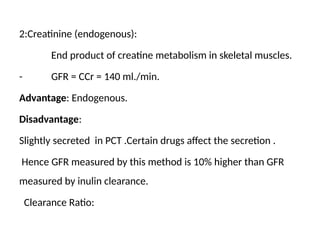
2:Creatinine (endogenous):
End product of creatine metabolism in skeletal muscles.
- GFR = CCr = 140 ml./min.
Advantage: Endogenous.
Disadvantage:
Slightly secreted in PCT .Certain drugs affect the secretion .
Hence GFR measured by this method is 10% higher than GFR
measured by inulin clearance.
Clearance Ratio:
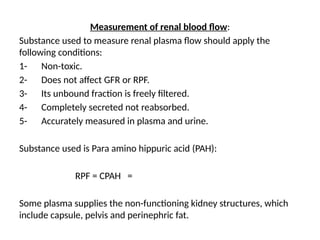
Measurement of renal blood flow:
Substance used to measure renal plasma flow should apply the
following conditions:
1- Non-toxic.
2- Does not affect GFR or RPF.
3- Its unbound fraction is freely filtered.
4- Completely secreted not reabsorbed.
5- Accurately measured in plasma and urine.
Substance used is Para amino hippuric acid (PAH):
RPF = CPAH =
Some plasma supplies the non-functioning kidney structures, which
include capsule, pelvis and perinephric fat.
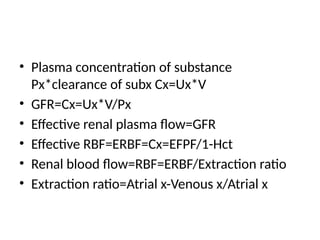
• Plasma concentration of substance
Px*clearance of subx Cx=Ux*V
• GFR=Cx=Ux*V/Px
• Effective renal plasma flow=GFR
• Effective RBF=ERBF=Cx=EFPF/1-Hct
• Renal blood flow=RBF=ERBF/Extraction ratio
• Extraction ratio=Atrial x-Venous x/Atrial x
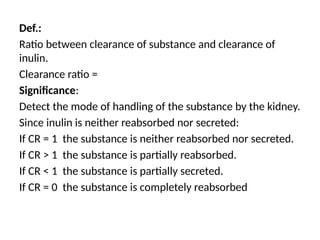
Def.:
Ratio between clearance of substance and clearance of
inulin.
Clearance ratio =
Significance:
Detect the mode of handling of the substance by the kidney.
Since inulin is neither reabsorbed nor secreted:
If CR = 1 the substance is neither reabsorbed nor secreted.
If CR > 1 the substance is partially reabsorbed.
If CR < 1 the substance is partially secreted.
If CR = 0 the substance is completely reabsorbed

factors affecting glomerular filtration rate .pptx

  • 1.
  • 2.
    Objectives  Describe thecomponents and functions of nephron  Discuss how arterial diameter affects nephron function  Discuss how blood pressure affects nephron function  Explain the process of reabsorption  Explain the role of carriers in glucose reabsorption  Identify the actions of ADH and aldosterone on solute reabsorption and water uptake prerequisite materials and equipment.
  • 3.
    Glomerular Function Test Renalclearance tests Tests for glomerular functions Tests for tubular function: uremia Others Renal Function Test done : To assess the functional capacity of the kidneys To detect the renal impairment as
  • 4.
    Renal clearance tests Glomerularfunctions Test • Inulin clearance • Creatinine clearance • Other : IVP • Artiography • USG • Isotope perfusion studies • Renal biopsy Test for tubular functions • PAH clearance • Urea clearance • PSP excretion test • Measurement of water reabsorption • Other: micropuncturing • Stop flow technique • Microcryoscopic studies • Microelectrode studies
  • 5.
    Definition : Clearanceof a certain substance is the volume of plasma cleared from this substance per unit time (minute). Calculation: According to law of conservation of mass: Ux*volume of urine/minute=GFR*Px C=excretion rate/plasma concentration The mass of substance (X) extracted from plasma / minute = concentration of substance (X) in plasma (PX) X the volume of plasma which is cleared from this substance / minute (CX).
  • 6.
    Glucose clearance  Allthe filtrated glucose is reabsorbed at plasma concentration below 250mg/dl.  Clearance of glucose is zero below 250mg/dl.  Glucose appear in urine at about 250mg/minute. • The reabsorption becomes saturated at plasma concentration above 350mg/dl. • This is maximum transport rate (TM) =375mg/min.
  • 7.
    The point atwhich the glucose appear in urine is threshold . and transport maximum is called splay. The renal handling of the glucose curve, the Tm is approached gradually along a curve, rather than abruptly with a sharp deflection The curve is called as splay. Transport maximum of glucose
  • 8.
    Measurement of reabsorption •Rate of reabsorption of a solute Ts • Is the difference between the product of GFR and substance in plasma and the rate of its excretion • Ts=(GFR*Ps)-(Us*vol) • Unit: mg/minute
  • 9.
    Measurement of Secretion Therate of secretion of a solutes Ts, is the difference between the rate of excretion Us*V, and the rate of filtration, GFR*PS Ts=(Us*V)-(GFR*Ps)m/minute.
  • 10.
    According to substanceselected; clearance may be used for: 1- Measurement of glomerular filtration rate (GFR): Clearance of inulin or creatinine. 2- Measurement of renal plasma flow (RPF): Clearance of PAH. 3- Measurement of reabsorptive capacity of renal tubules: Transport maximum of glucose (TMG). 4- Measurement of secretory capacity of renal tubules: Transport maximum of PAH (TMPAH). 5-
  • 11.
    5- Mode ofhandling of substance by the kidney: Clearance ratio and fraction excretion. 6- Assessment of diluting capacity of the kidney: Free water clearance. 7- Assessment of concentrating capacity of the kidney: Free water reabsorption
  • 12.
    Measurement of GFR Substanceused to measure GFR should apply the following conditions: 1- Non-toxic. 2- Does not affect GFR or RPF. 3- Not metabolized by the body or the kidney. 4- Freely filtered: of small molecular weight and not bound to plasma proteins 5- Neither reabsorbed nor secreted. 6- Accurately measured in plasma and urine.
  • 13.
    Two substances wereused: 1:Inulin (Exogenous): Polymer of fructose. Given by IV drip & not orally as it is digested in the intestine. GFR = Cin = 125 ml./min. Advantages: Accurate hence it is used for experimental studies. Disadvantages: Exogenous (need a method of administration)
  • 14.
    2:Creatinine (endogenous): End productof creatine metabolism in skeletal muscles. - GFR = CCr = 140 ml./min. Advantage: Endogenous. Disadvantage: Slightly secreted in PCT .Certain drugs affect the secretion . Hence GFR measured by this method is 10% higher than GFR measured by inulin clearance. Clearance Ratio:
  • 15.
    Measurement of renalblood flow: Substance used to measure renal plasma flow should apply the following conditions: 1- Non-toxic. 2- Does not affect GFR or RPF. 3- Its unbound fraction is freely filtered. 4- Completely secreted not reabsorbed. 5- Accurately measured in plasma and urine. Substance used is Para amino hippuric acid (PAH): RPF = CPAH = Some plasma supplies the non-functioning kidney structures, which include capsule, pelvis and perinephric fat.
  • 16.
    • Plasma concentrationof substance Px*clearance of subx Cx=Ux*V • GFR=Cx=Ux*V/Px • Effective renal plasma flow=GFR • Effective RBF=ERBF=Cx=EFPF/1-Hct • Renal blood flow=RBF=ERBF/Extraction ratio • Extraction ratio=Atrial x-Venous x/Atrial x
  • 17.
    Def.: Ratio between clearanceof substance and clearance of inulin. Clearance ratio = Significance: Detect the mode of handling of the substance by the kidney. Since inulin is neither reabsorbed nor secreted: If CR = 1 the substance is neither reabsorbed nor secreted. If CR > 1 the substance is partially reabsorbed. If CR < 1 the substance is partially secreted. If CR = 0 the substance is completely reabsorbed