BIOPHYSICS –
ELECTROPHYSIOLOGY
Membrane Potential & Action Potential
Department of Physiotherapy
M.L.B Paramedical Training College
Jhansi
Dr Gaurav Saxena
Senior Teaching Faculty ( Assoc. Prof. )
& Head of Department
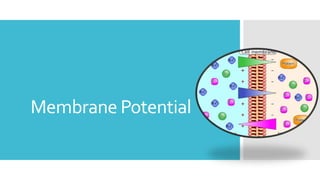
Membrane Potential
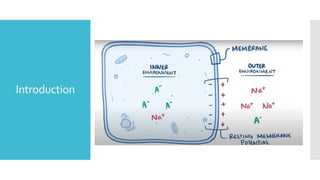
Introduction
Introduction
 Any biological cell consist of various ions
 These ions are located either inside or outside the cell
membrane
 Intra cellular matrix – Inside the cell
 Extra cellular Matrix- Out side the cell
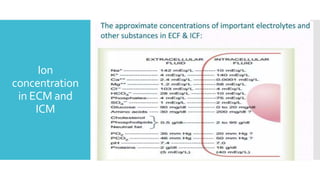
 This concentration of ions in ECM or ICM is not equal, this
difference in concentration of ion and charge generate a
electrical potential known as Membrane potential
 Also known as – Transmembrane potential
 Membrane potential which is resulted from equilibrium in
diffusion of all ions is known as Resting membrane potential
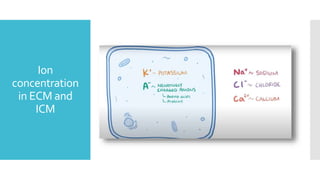
Ion
concentration
in ECM and
ICM
Ion
concentration
in ECM and
ICM
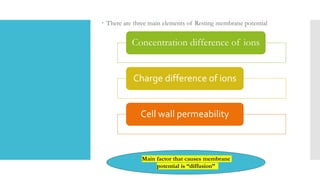
 There are three main elements of Resting membrane potential
Concentration difference of ions
Charge difference of ions
Cell wall permeability
Main factor that causes membrane
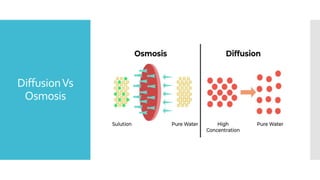
potential is “diffusion”
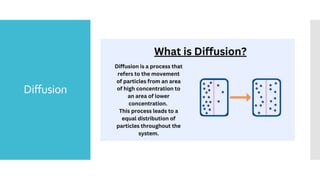
Diffusion
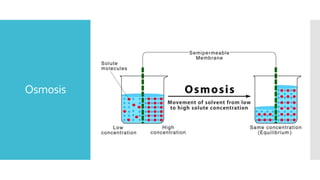
Osmosis
DiffusionVs
Osmosis
Sodium
potassium
pump
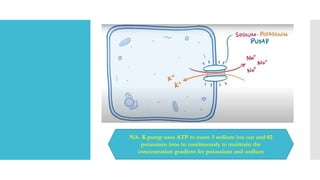
 NA-K pump is a protein that has been
identified in many cells that maintains
 the internal concentration
of potassium ions [K+] higher than that in
the surrounding medium (blood, body
fluid, water)
&
 Maintains the internal concentration
of sodium ions [Na+] lower than that of
the surrounding medium.
 It is an enzyme that uses metabolic energy
to transport (pump) Na+ outward and
K+ inward.
 The Resting membrane potential of cells
and related bioelectric phenomena such as
the action potential depend on the steady
state difference in concentrations of
Na+ and K+ maintained by the pump.
NA- K pump uses ATP to move 3 sodium ion out and 02
potassium ions in continuously to maintain the
concentration gradient for potassium and sodium
Movement of
a ion
Ex. Potassium
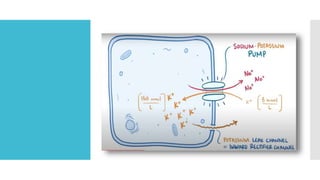
 K+ has a concentration of 150mm/l inside the cell and 5 mm/l
outside the cell
 Due to high difference between ICM and ECM concentration of K +,
a concentration gradient is created, which pushes K+ outside the
cell
 However NA-K pump can efflux only limited K+ hence significant
amount of K + moves out of cell through potassium leak channels
or inward rectifier channels
 Using these channels concentration gradient pushes significant K+ out
of the cell
 This lead to negative charge inside the cell and positive charge outside
the cell , this process continues until there is a significant difference
between inside and outside of the cell polarity
 This significant difference in polarity creates electrostatic gradient
Movement of
Potassium
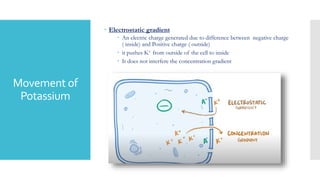
 Electrostatic gradient
 An electric charge generated due to difference between negative charge
( inside) and Positive charge ( outside)
 it pushes K+ from outside of the cell to inside
 It does not interfere the concentration gradient

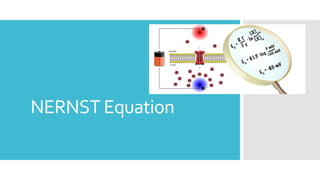
NERNST Equation
Introduction
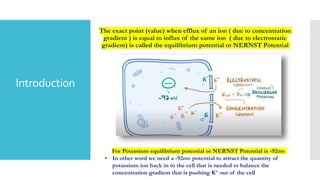
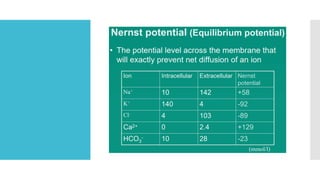
The exact point (value) when efflux of an ion ( due to concentration
gradient ) is equal to influx of the same ion ( due to electrostatic
gradient) is called the equilibrium potential or NERNST Potential
For Potassium equilibrium potential or NERNST Potential is -92mv
• In other word we need a -92mv potential to attract the quantity of
potassium ion back in to the cell that is needed to balance the
concentration gradient that is pushing K+ out of the cell
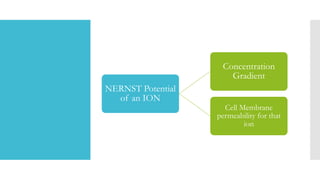
NERNST Potential
of an ION
Concentration
Gradient
Cell Membrane
permeability for that
ion
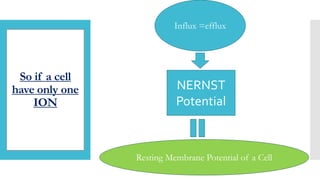
So if a cell
have only one
ION
NERNST
Potential
Influx =efflux
Resting Membrane Potential of a Cell
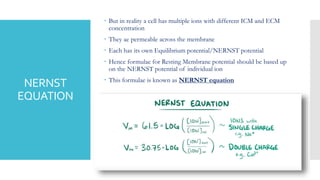
NERNST
EQUATION
 But in reality a cell has multiple ions with different ICM and ECM
concentration
 They ae permeable across the membrane
 Each has its own Equilibrium potential/NERNST potential
 Hence formulae for Resting Membrane potential should be based up
on the NERNST potential of individual ion
 This formulae is known as NERNST equation
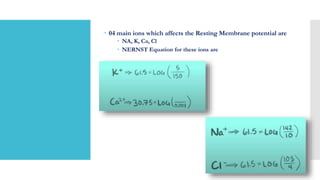
 04 main ions which affects the Resting Membrane potential are
 NA, K, Ca, Cl
 NERNST Equation for these ions are
Calculation of
Resting
Membrane
Potential
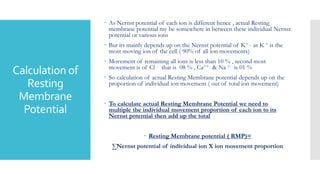
 As Nernst potential of each ion is different hence , actual Resting
membrane potential my be somewhere in between these individual Nernst
potential or various ions
 But its mainly depends up on the Nernst potential of K+ , as K + is the
most moving ion of the cell ( 90% of all ion movements)
 Movement of remaining all ions is less than 10 % , second most
movement is of Cl - that is 08 % , Ca++ & Na + is 01 %
 So calculation of actual Resting Membrane potential depends up on the
proportion of individual ion movement ( out of total ion movement)
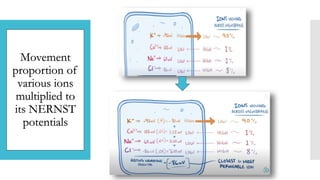
 To calculate actual Resting Membrane Potential we need to
multiple the individual movement proportion of each ion to its
Nernst potential then add up the total
 Resting Membrane potential ( RMP)=
∑Nernst potential of individual ion X ion movement proportion
Movement
proportion of
various ions
multiplied to
its NERNST
potentials
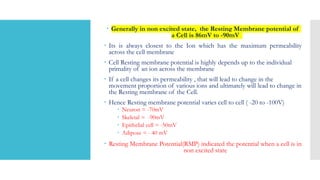
 Generally in non excited state, the Resting Membrane potential of
a Cell is 86mV to -90mV
 Its is always closest to the Ion which has the maximum permeability
across the cell membrane
 Cell Resting membrane potential is highly depends up to the individual
primality of an ion across the membrane
 If a cell changes its permeability , that will lead to change in the
movement proportion of various ions and ultimately will lead to change in
the Resting membrane of the Cell.
 Hence Resting membrane potential varies cell to cell ( -20 to -100V)
 Neuron = -70mV
 Skeletal = -90mV
 Epithelial cell = -50mV
 Adipose = - 40 mV
 Resting Membrane Potential(RMP) indicated the potential when a cell is in
non excited state
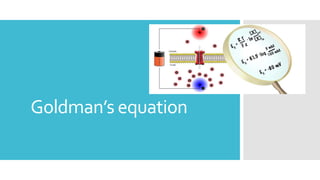
Goldman’s equation
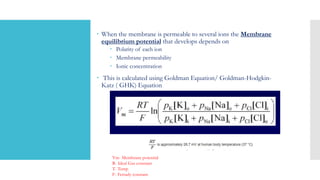
 When the membrane is permeable to several ions the Membrane
equilibrium potential that develops depends on
 Polarity of each ion
 Membrane permeability
 Ionic concentration
 This is calculated using Goldman Equation/ Goldman-Hodgkin-
Katz ( GHK) Equation
Vm- Membrane potential
R- Ideal Gas constant
T- Temp
F- Ferrady constant
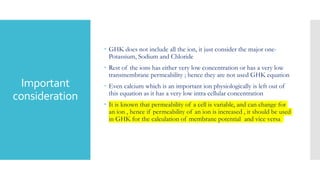
Important
consideration
 GHK does not include all the ion, it just consider the major one-
Potassium, Sodium and Chloride
 Rest of the ions has either very low concentration or has a very low
transmembrane permeability ; hence they are not used GHK equation
 Even calcium which is an important ion physiologically is left out of
this equation as it has a very low intra cellular concentration
 It is known that permeability of a cell is variable, and can change for
an ion , hence if permeability of an ion is increased , it should be used
in GHK for the calculation of membrane potential and vice versa
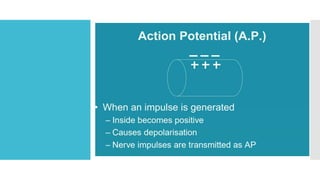
Action Potential
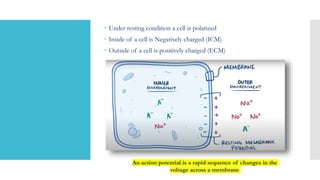
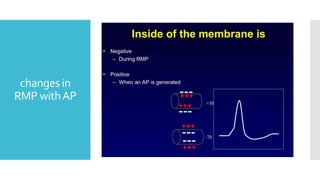
 Under resting condition a cell is polarized
 Inside of a cell is Negatively charged (ICM)
 Outside of a cell is positively charged (ECM)
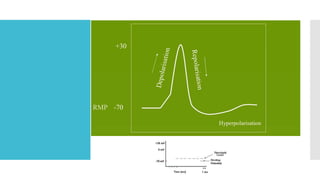
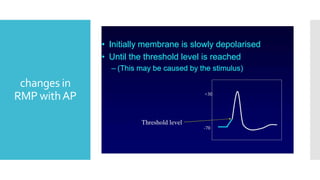
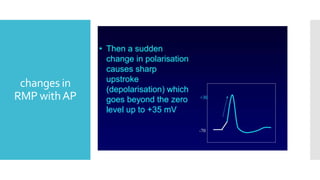
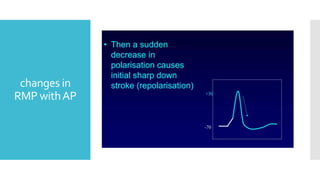
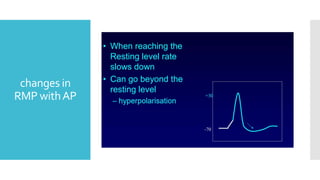
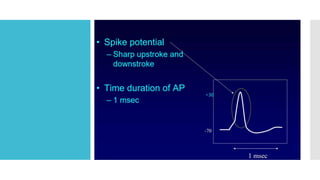
An action potential is a rapid sequence of changes in the
voltage across a membrane
changes in
RMP withAP
changes in
RMP withAP
changes in
RMP withAP
changes in
RMP withAP
changes in
RMP withAP
All or None
Law ofAP
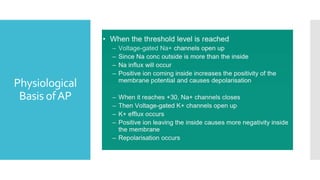
Physiological
Basis ofAP
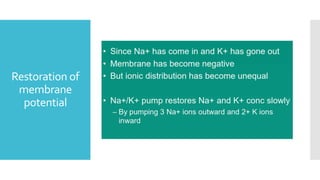
Restoration of
membrane
potential
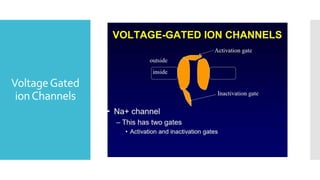
VoltageGated
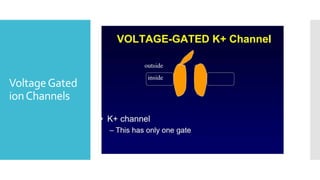
ionChannels
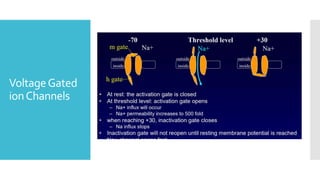
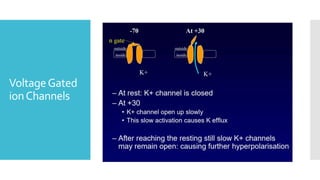
VoltageGated
ionChannels
VoltageGated
ionChannels
VoltageGated
ionChannels

2. BIOPHYSICS – Membrane Potentials and Action Potential.pptx

  • 1.
    BIOPHYSICS – ELECTROPHYSIOLOGY Membrane Potential& Action Potential Department of Physiotherapy M.L.B Paramedical Training College Jhansi Dr Gaurav Saxena Senior Teaching Faculty ( Assoc. Prof. ) & Head of Department
  • 2.
  • 3.
  • 4.
    Introduction  Any biologicalcell consist of various ions  These ions are located either inside or outside the cell membrane  Intra cellular matrix – Inside the cell  Extra cellular Matrix- Out side the cell  This concentration of ions in ECM or ICM is not equal, this difference in concentration of ion and charge generate a electrical potential known as Membrane potential  Also known as – Transmembrane potential  Membrane potential which is resulted from equilibrium in diffusion of all ions is known as Resting membrane potential
  • 5.
  • 6.
  • 7.
     There arethree main elements of Resting membrane potential Concentration difference of ions Charge difference of ions Cell wall permeability Main factor that causes membrane potential is “diffusion”
  • 8.
  • 9.
  • 10.
  • 11.
    Sodium potassium pump  NA-K pumpis a protein that has been identified in many cells that maintains  the internal concentration of potassium ions [K+] higher than that in the surrounding medium (blood, body fluid, water) &  Maintains the internal concentration of sodium ions [Na+] lower than that of the surrounding medium.  It is an enzyme that uses metabolic energy to transport (pump) Na+ outward and K+ inward.  The Resting membrane potential of cells and related bioelectric phenomena such as the action potential depend on the steady state difference in concentrations of Na+ and K+ maintained by the pump.
  • 12.
    NA- K pumpuses ATP to move 3 sodium ion out and 02 potassium ions in continuously to maintain the concentration gradient for potassium and sodium
  • 13.
    Movement of a ion Ex.Potassium  K+ has a concentration of 150mm/l inside the cell and 5 mm/l outside the cell  Due to high difference between ICM and ECM concentration of K +, a concentration gradient is created, which pushes K+ outside the cell  However NA-K pump can efflux only limited K+ hence significant amount of K + moves out of cell through potassium leak channels or inward rectifier channels  Using these channels concentration gradient pushes significant K+ out of the cell  This lead to negative charge inside the cell and positive charge outside the cell , this process continues until there is a significant difference between inside and outside of the cell polarity  This significant difference in polarity creates electrostatic gradient
  • 15.
    Movement of Potassium  Electrostaticgradient  An electric charge generated due to difference between negative charge ( inside) and Positive charge ( outside)  it pushes K+ from outside of the cell to inside  It does not interfere the concentration gradient 
  • 16.
  • 17.
    Introduction The exact point(value) when efflux of an ion ( due to concentration gradient ) is equal to influx of the same ion ( due to electrostatic gradient) is called the equilibrium potential or NERNST Potential For Potassium equilibrium potential or NERNST Potential is -92mv • In other word we need a -92mv potential to attract the quantity of potassium ion back in to the cell that is needed to balance the concentration gradient that is pushing K+ out of the cell
  • 18.
    NERNST Potential of anION Concentration Gradient Cell Membrane permeability for that ion
  • 19.
    So if acell have only one ION NERNST Potential Influx =efflux Resting Membrane Potential of a Cell
  • 20.
    NERNST EQUATION  But inreality a cell has multiple ions with different ICM and ECM concentration  They ae permeable across the membrane  Each has its own Equilibrium potential/NERNST potential  Hence formulae for Resting Membrane potential should be based up on the NERNST potential of individual ion  This formulae is known as NERNST equation
  • 21.
     04 mainions which affects the Resting Membrane potential are  NA, K, Ca, Cl  NERNST Equation for these ions are
  • 23.
    Calculation of Resting Membrane Potential  AsNernst potential of each ion is different hence , actual Resting membrane potential my be somewhere in between these individual Nernst potential or various ions  But its mainly depends up on the Nernst potential of K+ , as K + is the most moving ion of the cell ( 90% of all ion movements)  Movement of remaining all ions is less than 10 % , second most movement is of Cl - that is 08 % , Ca++ & Na + is 01 %  So calculation of actual Resting Membrane potential depends up on the proportion of individual ion movement ( out of total ion movement)  To calculate actual Resting Membrane Potential we need to multiple the individual movement proportion of each ion to its Nernst potential then add up the total  Resting Membrane potential ( RMP)= ∑Nernst potential of individual ion X ion movement proportion
  • 24.
  • 25.
     Generally innon excited state, the Resting Membrane potential of a Cell is 86mV to -90mV  Its is always closest to the Ion which has the maximum permeability across the cell membrane  Cell Resting membrane potential is highly depends up to the individual primality of an ion across the membrane  If a cell changes its permeability , that will lead to change in the movement proportion of various ions and ultimately will lead to change in the Resting membrane of the Cell.  Hence Resting membrane potential varies cell to cell ( -20 to -100V)  Neuron = -70mV  Skeletal = -90mV  Epithelial cell = -50mV  Adipose = - 40 mV  Resting Membrane Potential(RMP) indicated the potential when a cell is in non excited state
  • 26.
  • 27.
     When themembrane is permeable to several ions the Membrane equilibrium potential that develops depends on  Polarity of each ion  Membrane permeability  Ionic concentration  This is calculated using Goldman Equation/ Goldman-Hodgkin- Katz ( GHK) Equation Vm- Membrane potential R- Ideal Gas constant T- Temp F- Ferrady constant
  • 28.
    Important consideration  GHK doesnot include all the ion, it just consider the major one- Potassium, Sodium and Chloride  Rest of the ions has either very low concentration or has a very low transmembrane permeability ; hence they are not used GHK equation  Even calcium which is an important ion physiologically is left out of this equation as it has a very low intra cellular concentration  It is known that permeability of a cell is variable, and can change for an ion , hence if permeability of an ion is increased , it should be used in GHK for the calculation of membrane potential and vice versa
  • 29.
  • 30.
     Under restingcondition a cell is polarized  Inside of a cell is Negatively charged (ICM)  Outside of a cell is positively charged (ECM) An action potential is a rapid sequence of changes in the voltage across a membrane
  • 33.
  • 34.
  • 35.
  • 36.
  • 37.
  • 39.
  • 41.
  • 42.
  • 43.
  • 44.
  • 45.
  • 46.