Denaturation,Renaturation of DNA
Replication of DNA
MOLECULAR BIOLOGY & GENETICS
Qurat-ul-Ain, B. Pharm., M. Phil., Ph.D.,
Visiting Assistant Professor
Department of Physical Therapy, Faculty of Health& Medical Sciences,
Hamdard University, Karachi, Pakistan
Assistant Professor
Department of Pharmaceutical Chemistry, Faculty of Pharmacy, Hamdard
University, Karachi, Pakistan.
Qurat-ul-Ain, B. Pharm., M. Phil., Ph.D., qurat.fophu@yahoo.com
1. Denaturation
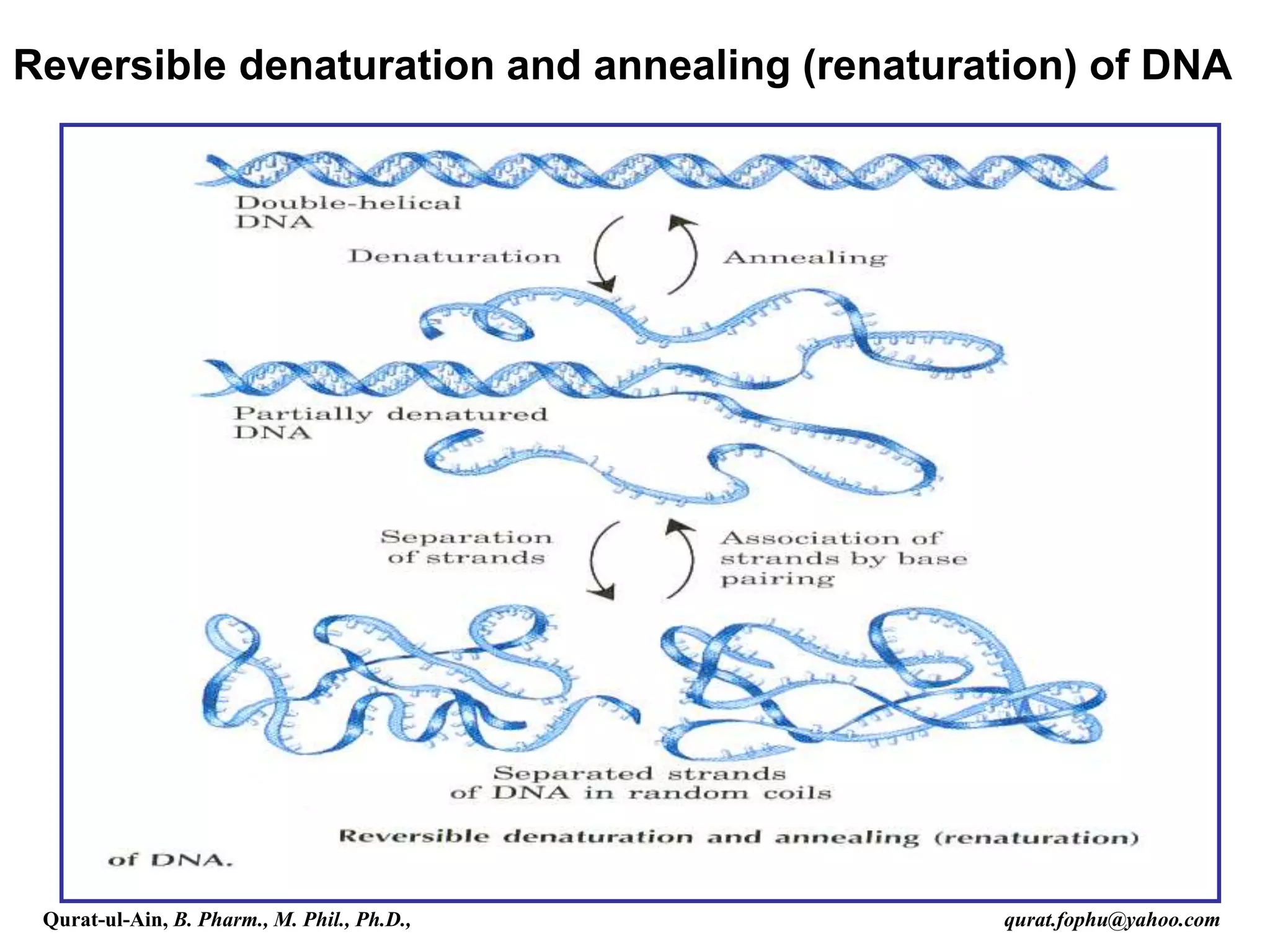
- the double helix can be denatured in different ways:
heat, pH (acid & alkali),
-chemicals such as urea (poorly), formamide,
dimethylsulfoxide, etc., and by proteins (single-strand
DNA or RNA binding proteins)
- dissociation by heating is also named melting
- progress of denaturation can be monitored by UV
absorption spectroscopy
- hyperchromicity effect : disruption of the stacking
=> 30 to 40 % increase of UV (260 nm) absorption
Qurat-ul-Ain, B. Pharm., M. Phil., Ph.D., qurat.fophu@yahoo.com
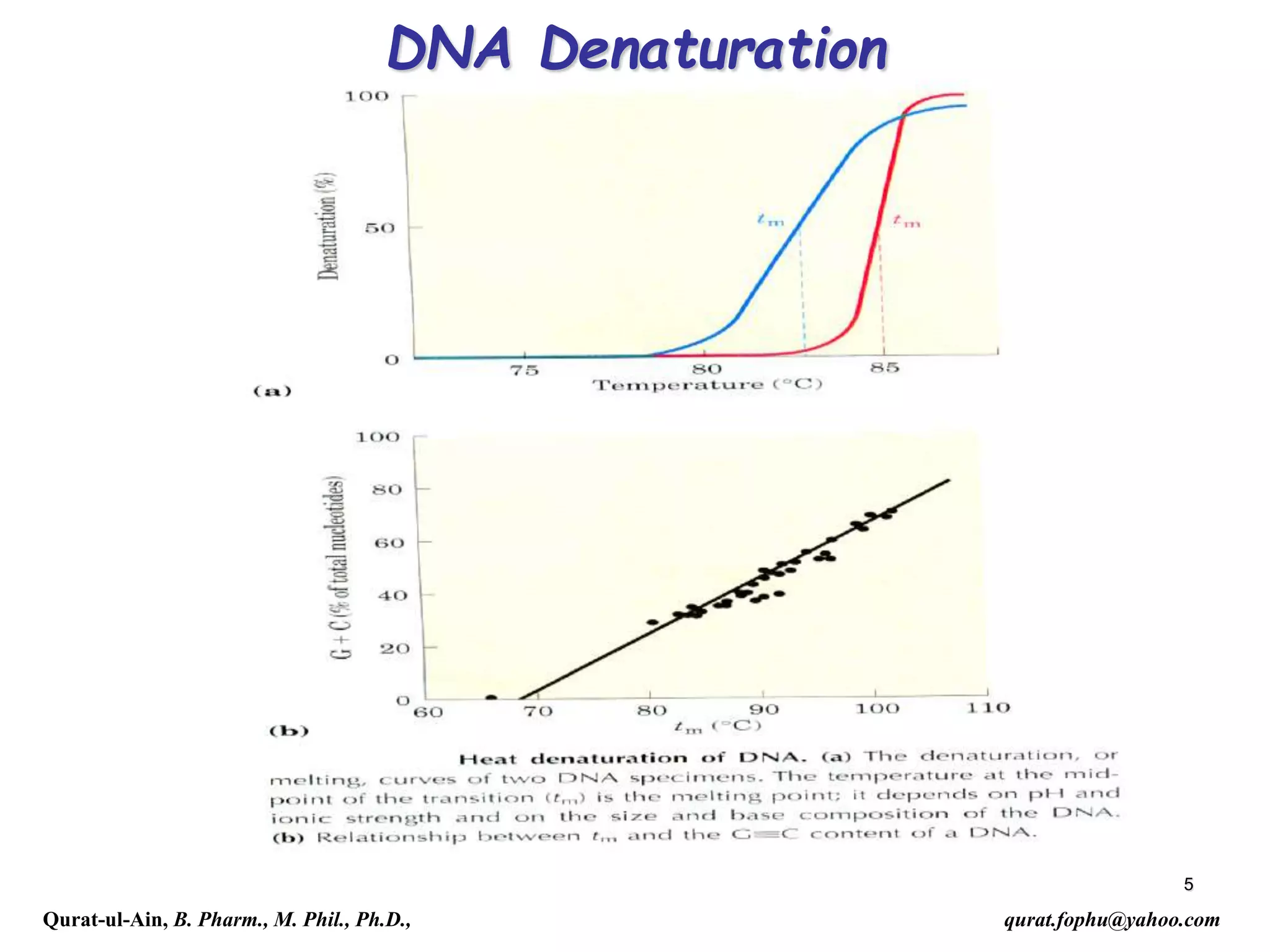
- Tm : melting temperature
- position in melting profile where 50% is single-stranded
- pseudo-monomolecular reaction: strands are not physically
separated (but A-T rich zones 'melt' first) (dynamic equilibrium)
=> ' denaturation is concentration-independent'
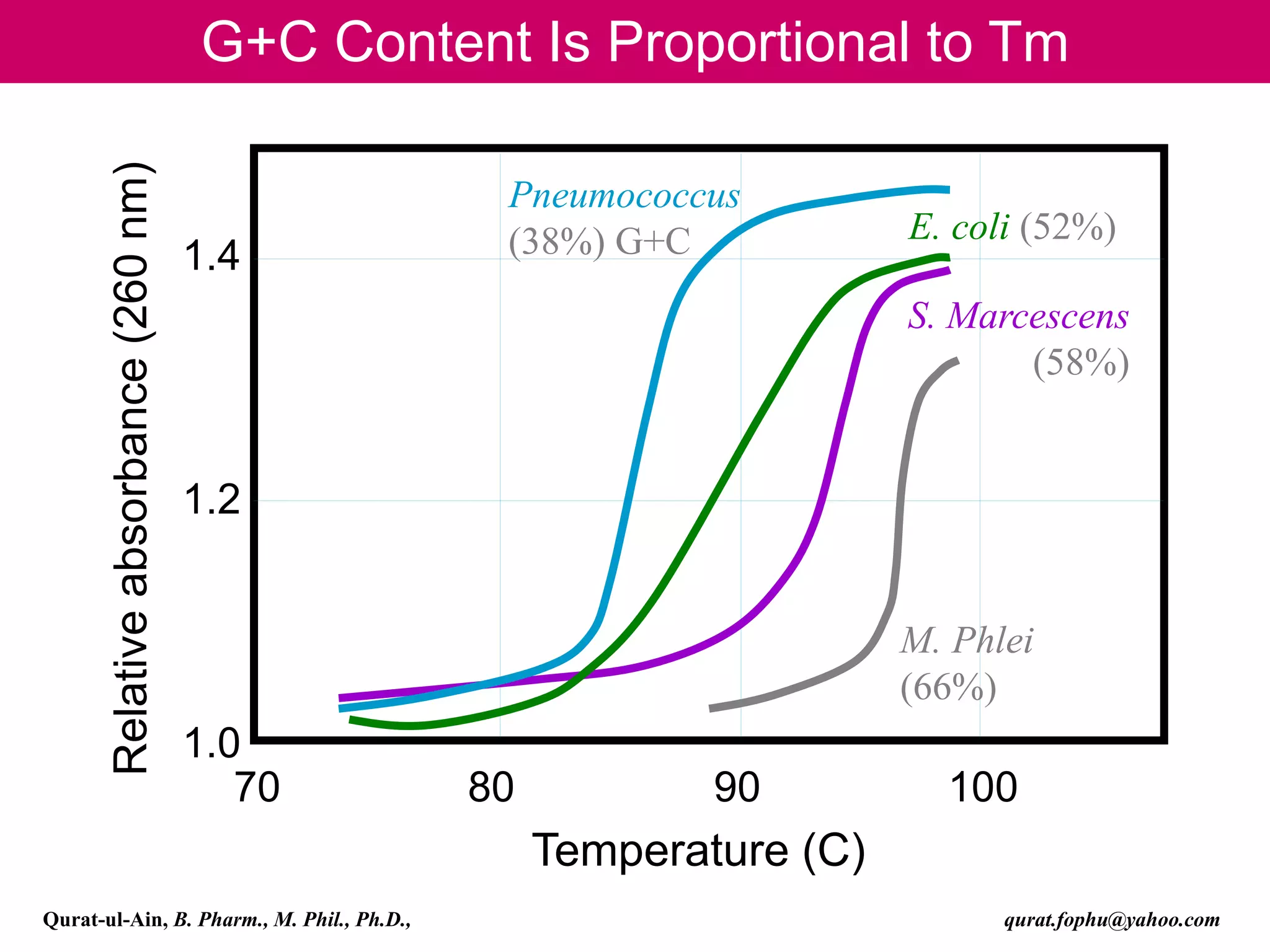
- linear relationship between Tm and %G+C of a duplex
- physical separation requires temperatures far above Tm
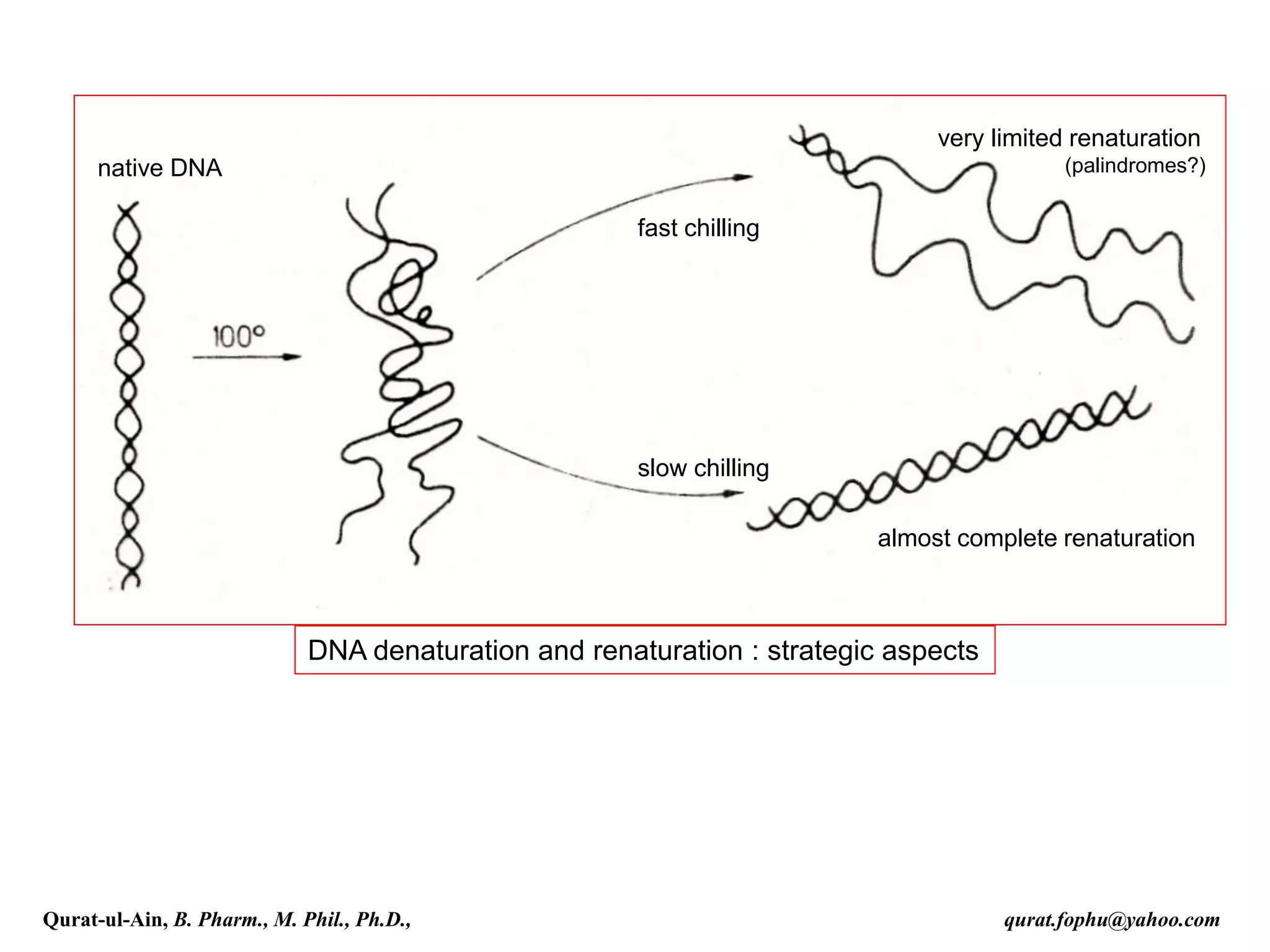
- upon fast chilling (e.g. placing the tube in ice-water!) : nucleic
acid remains single-stranded
- slow cooling is necessary to enable the base-pairs (and
stacking) to rebuild
=> 'renaturation requires energy ! '
Qurat-ul-Ain, B. Pharm., M. Phil., Ph.D., qurat.fophu@yahoo.com
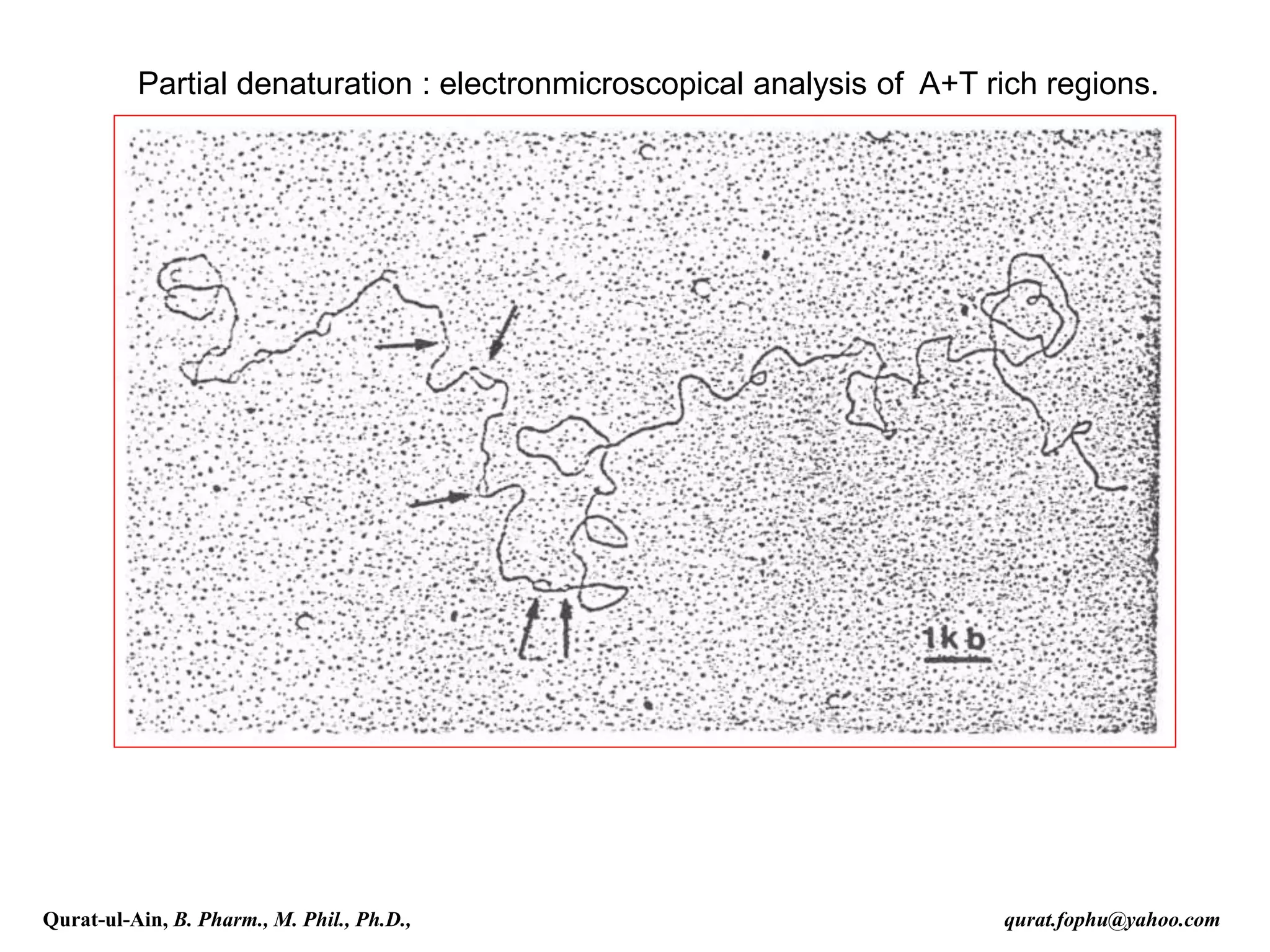
Partial denaturation : electronmicroscopical analysis of A+T rich regions.
Qurat-ul-Ain, B. Pharm., M. Phil., Ph.D., qurat.fophu@yahoo.com
5
DNA Denaturation
Qurat-ul-Ain, B. Pharm., M. Phil., Ph.D., qurat.fophu@yahoo.com
G+C Content Is Proportional to Tm
70 80 90 100
1.4
1.2
1.0
Relative
absorbance
(260
nm)
Temperature (C)
Pneumococcus
(38%) G+C E. coli (52%)
S. Marcescens
(58%)
M. Phlei
(66%)
Qurat-ul-Ain, B. Pharm., M. Phil., Ph.D., qurat.fophu@yahoo.com
Renaturation
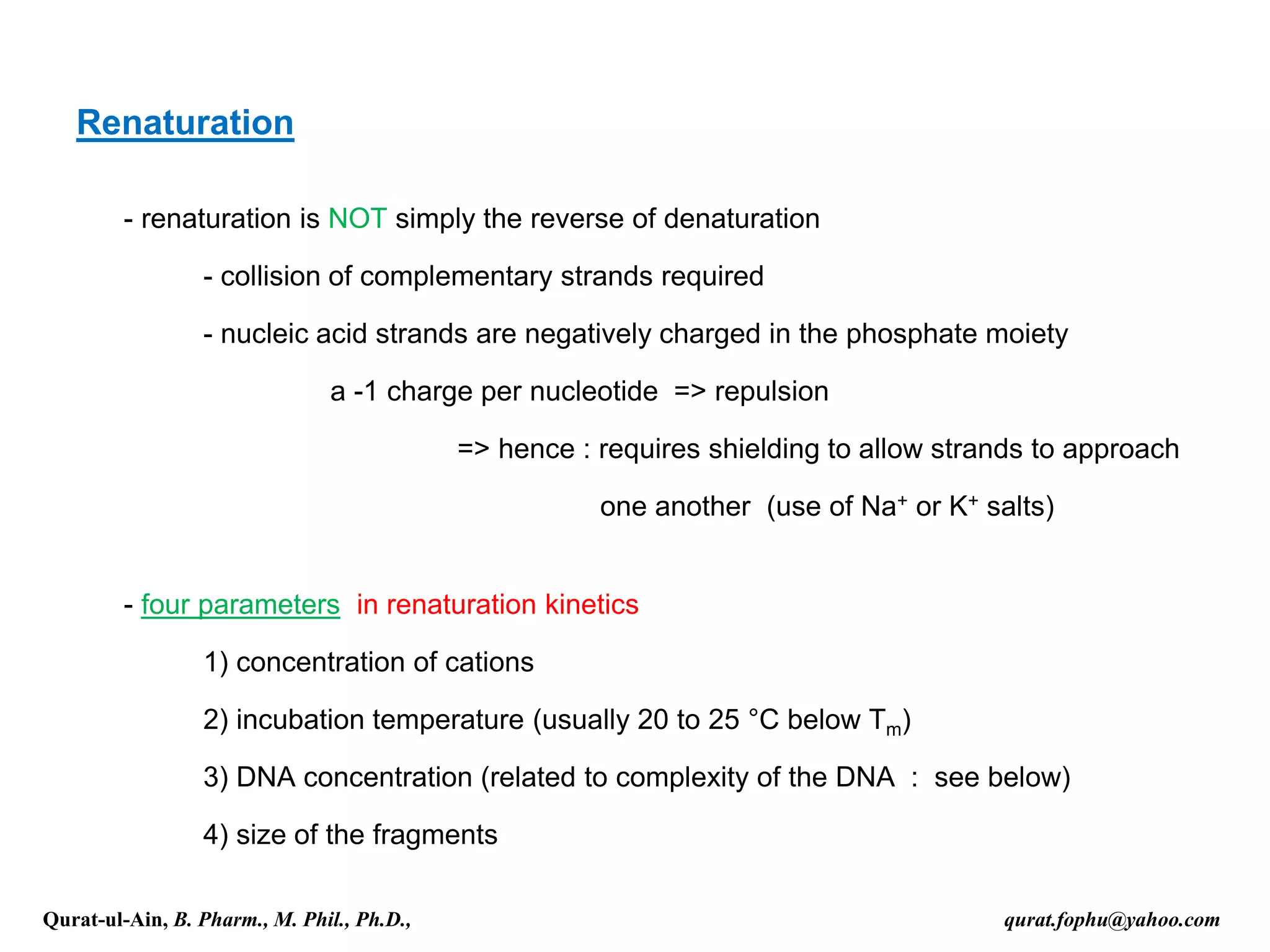
- renaturation is NOT simply the reverse of denaturation
- collision of complementary strands required
- nucleic acid strands are negatively charged in the phosphate moiety
a -1 charge per nucleotide => repulsion
=> hence : requires shielding to allow strands to approach
one another (use of Na+ or K+ salts)
- four parameters in renaturation kinetics
1) concentration of cations
2) incubation temperature (usually 20 to 25 °C below Tm)
3) DNA concentration (related to complexity of the DNA : see below)
4) size of the fragments
Qurat-ul-Ain, B. Pharm., M. Phil., Ph.D., qurat.fophu@yahoo.com
DNA denaturation and renaturation : strategic aspects
native DNA
fast chilling
slow chilling
very limited renaturation
(palindromes?)
almost complete renaturation
Qurat-ul-Ain, B. Pharm., M. Phil., Ph.D., qurat.fophu@yahoo.com
9
Reversible denaturation and annealing (renaturation) of DNA
Qurat-ul-Ain, B. Pharm., M. Phil., Ph.D., qurat.fophu@yahoo.com
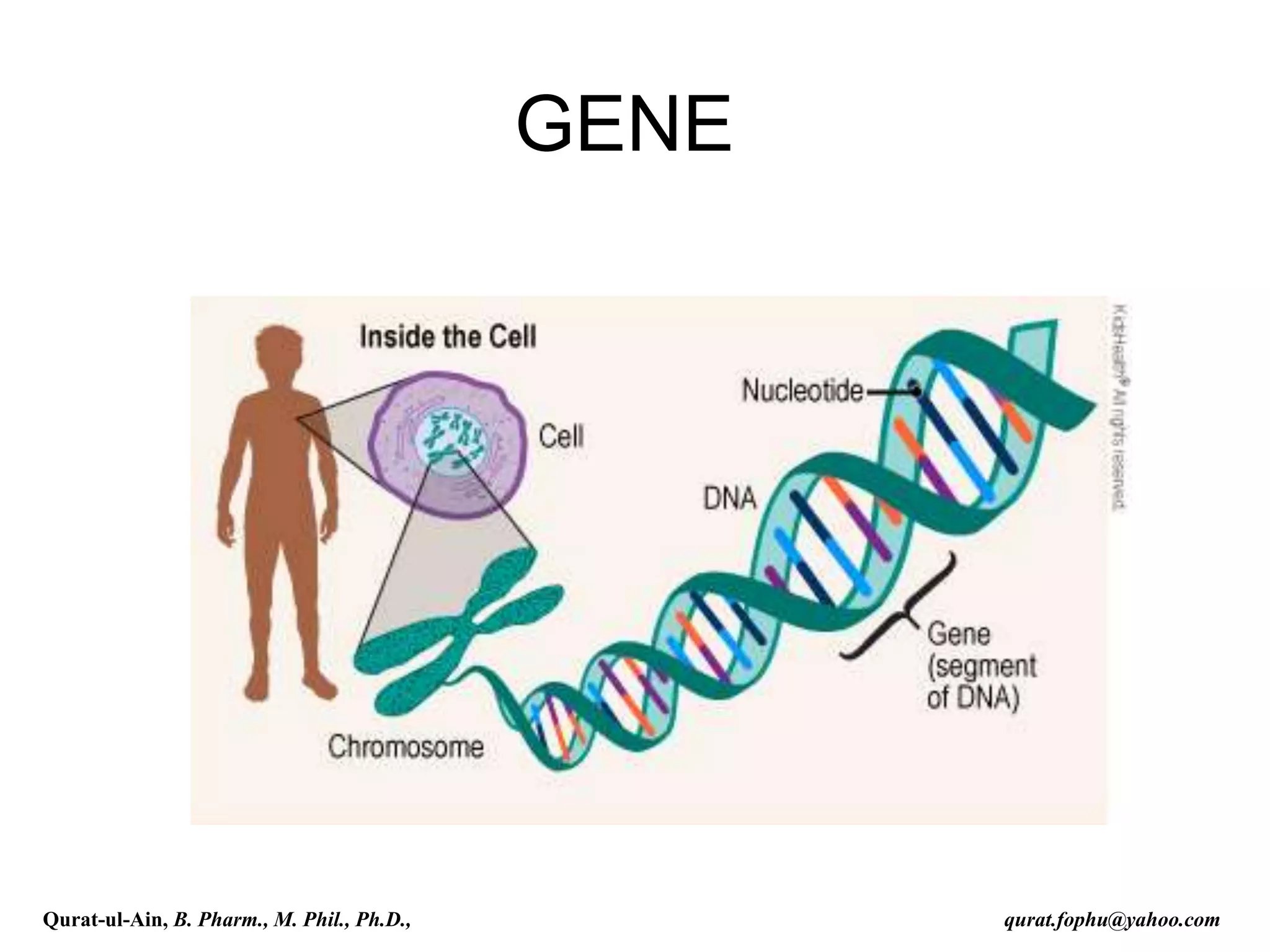
GENE
Qurat-ul-Ain, B. Pharm., M. Phil., Ph.D., qurat.fophu@yahoo.com
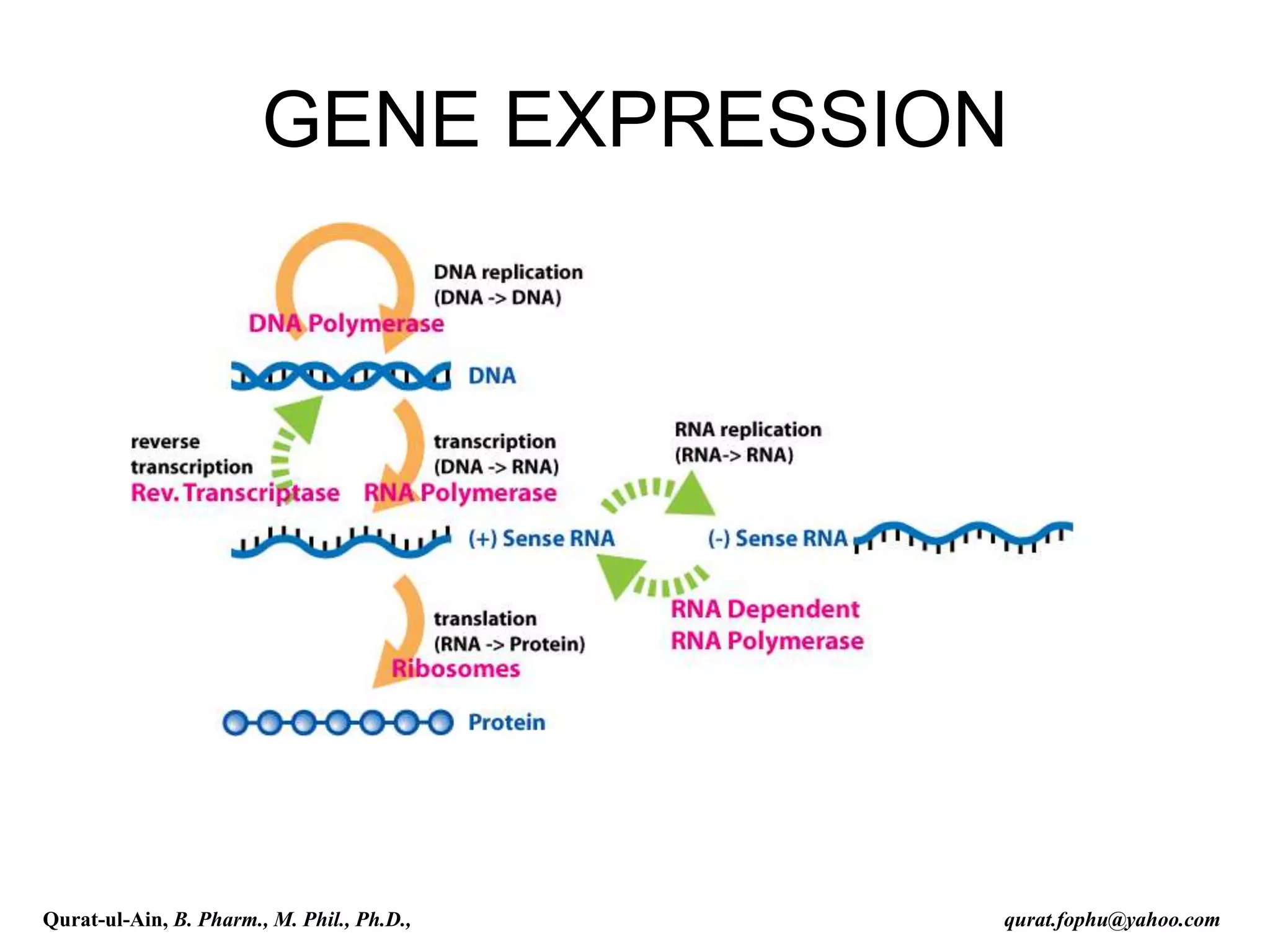
GENE EXPRESSION
Qurat-ul-Ain, B. Pharm., M. Phil., Ph.D., qurat.fophu@yahoo.com
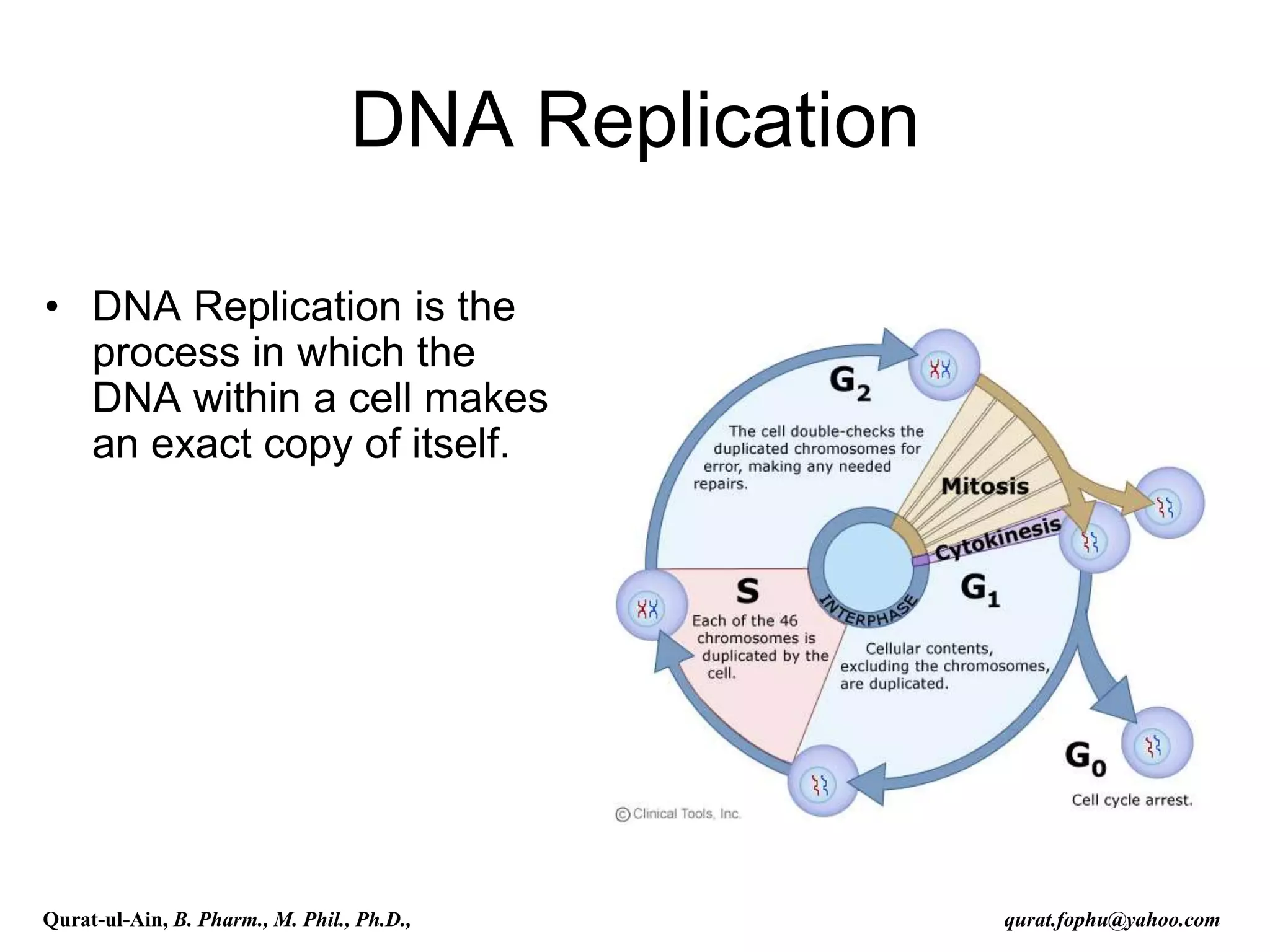
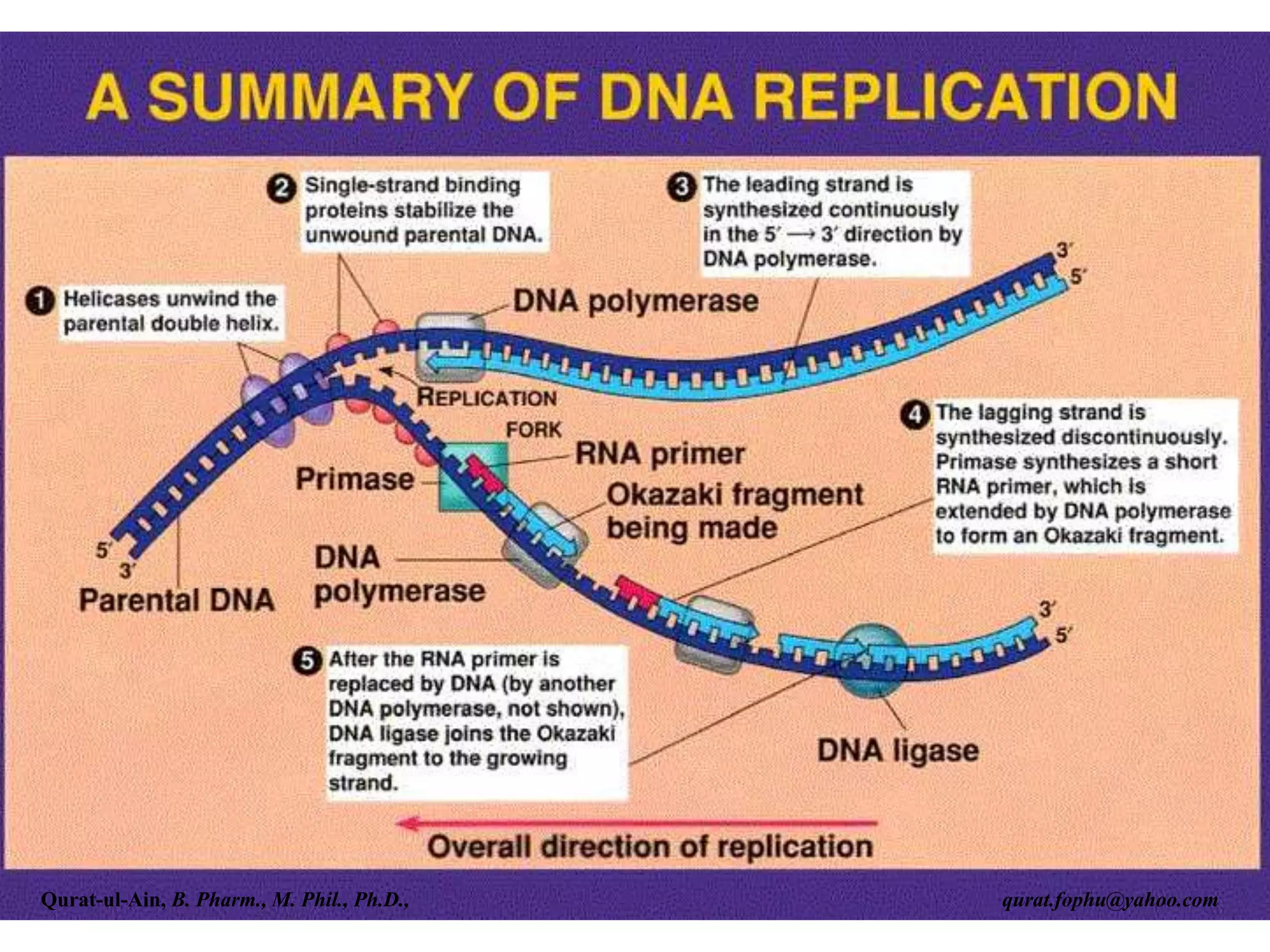
DNA Replication
• DNA Replication is the
process in which the
DNA within a cell makes
an exact copy of itself.
Qurat-ul-Ain, B. Pharm., M. Phil., Ph.D., qurat.fophu@yahoo.com
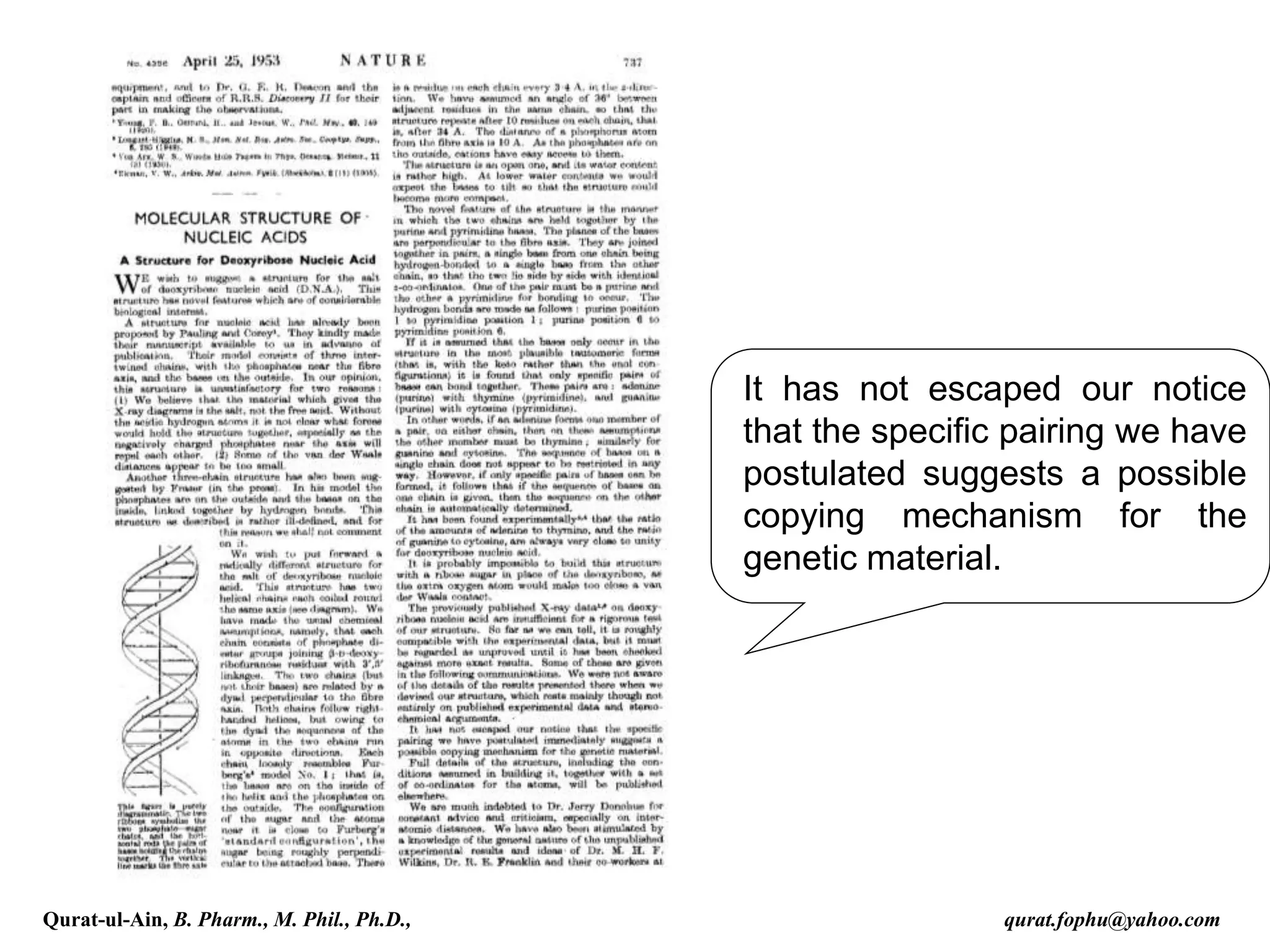
It has not escaped our notice
that the specific pairing we have
postulated suggests a possible
copying mechanism for the
genetic material.
Qurat-ul-Ain, B. Pharm., M. Phil., Ph.D., qurat.fophu@yahoo.com
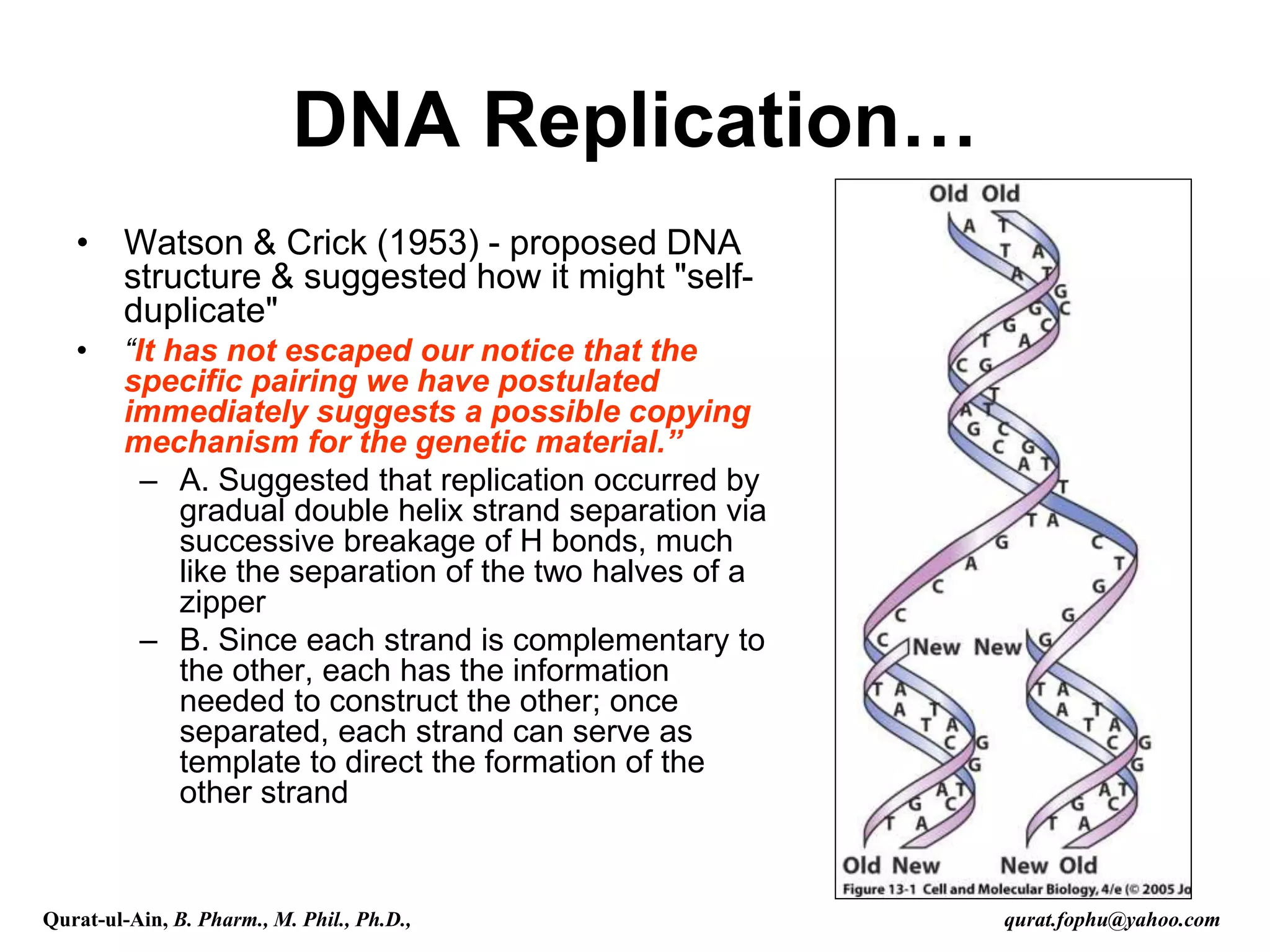
• Watson & Crick (1953) - proposed DNA
structure & suggested how it might "self-
duplicate"
• “It has not escaped our notice that the
specific pairing we have postulated
immediately suggests a possible copying
mechanism for the genetic material.”
– A. Suggested that replication occurred by
gradual double helix strand separation via
successive breakage of H bonds, much
like the separation of the two halves of a
zipper
– B. Since each strand is complementary to
the other, each has the information
needed to construct the other; once
separated, each strand can serve as
template to direct the formation of the
other strand
DNA Replication…
Qurat-ul-Ain, B. Pharm., M. Phil., Ph.D., qurat.fophu@yahoo.com
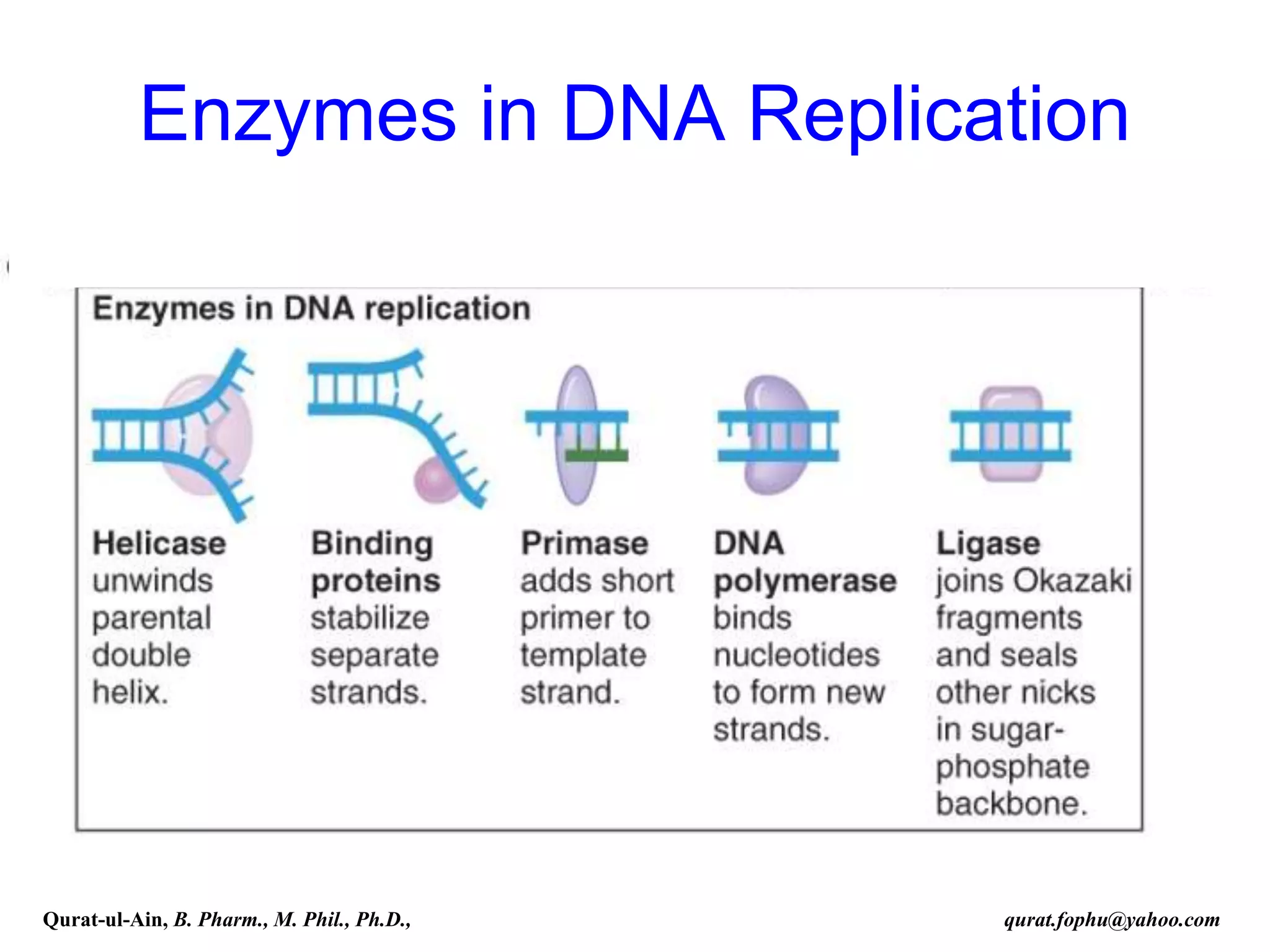
Enzymes in DNA Replication
Qurat-ul-Ain, B. Pharm., M. Phil., Ph.D., qurat.fophu@yahoo.com
Elongation
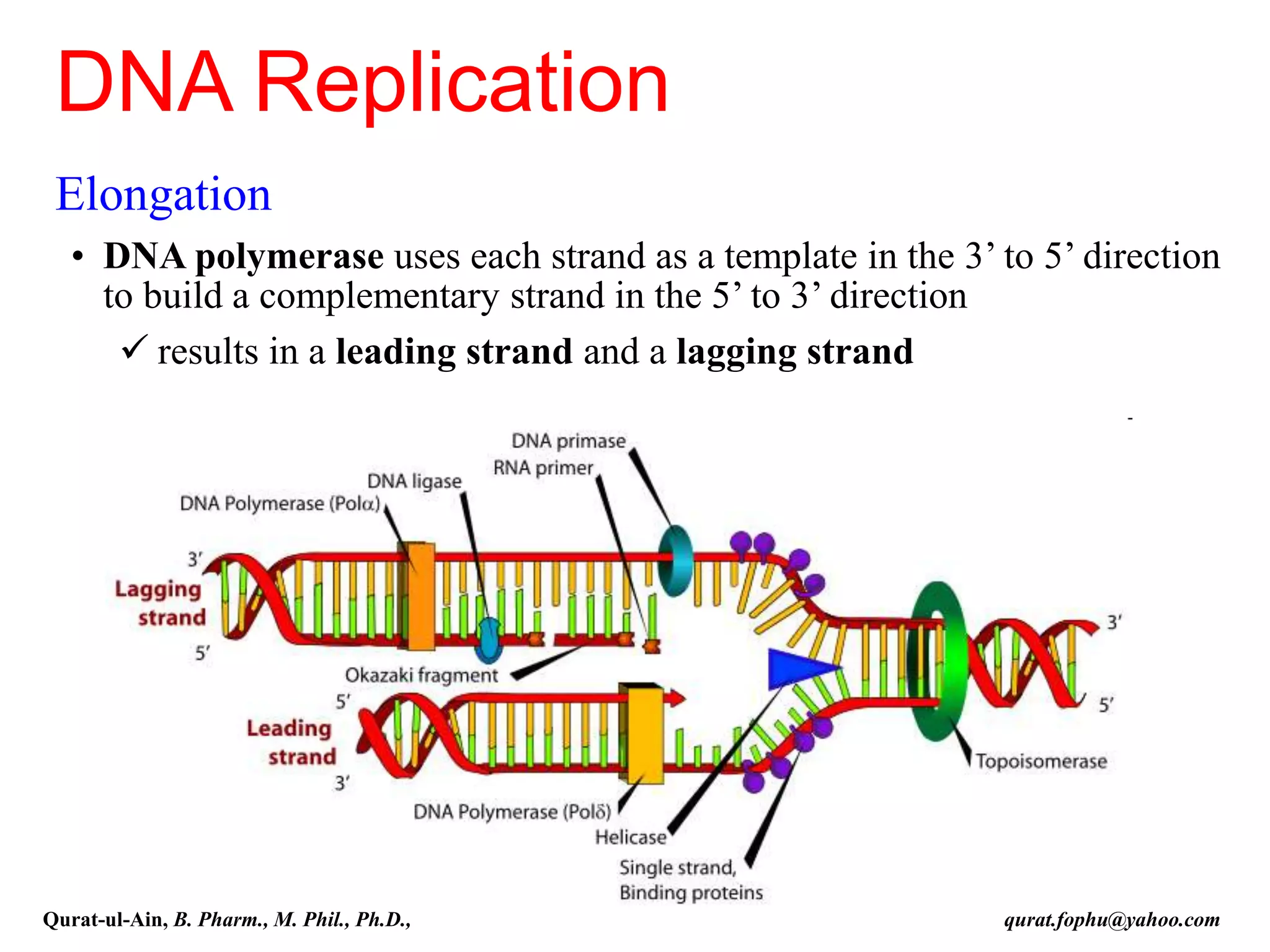
• DNA polymerase uses each strand as a template in the 3’ to 5’ direction
to build a complementary strand in the 5’ to 3’ direction
 results in a leading strand and a lagging strand
DNA Replication
Qurat-ul-Ain, B. Pharm., M. Phil., Ph.D., qurat.fophu@yahoo.com
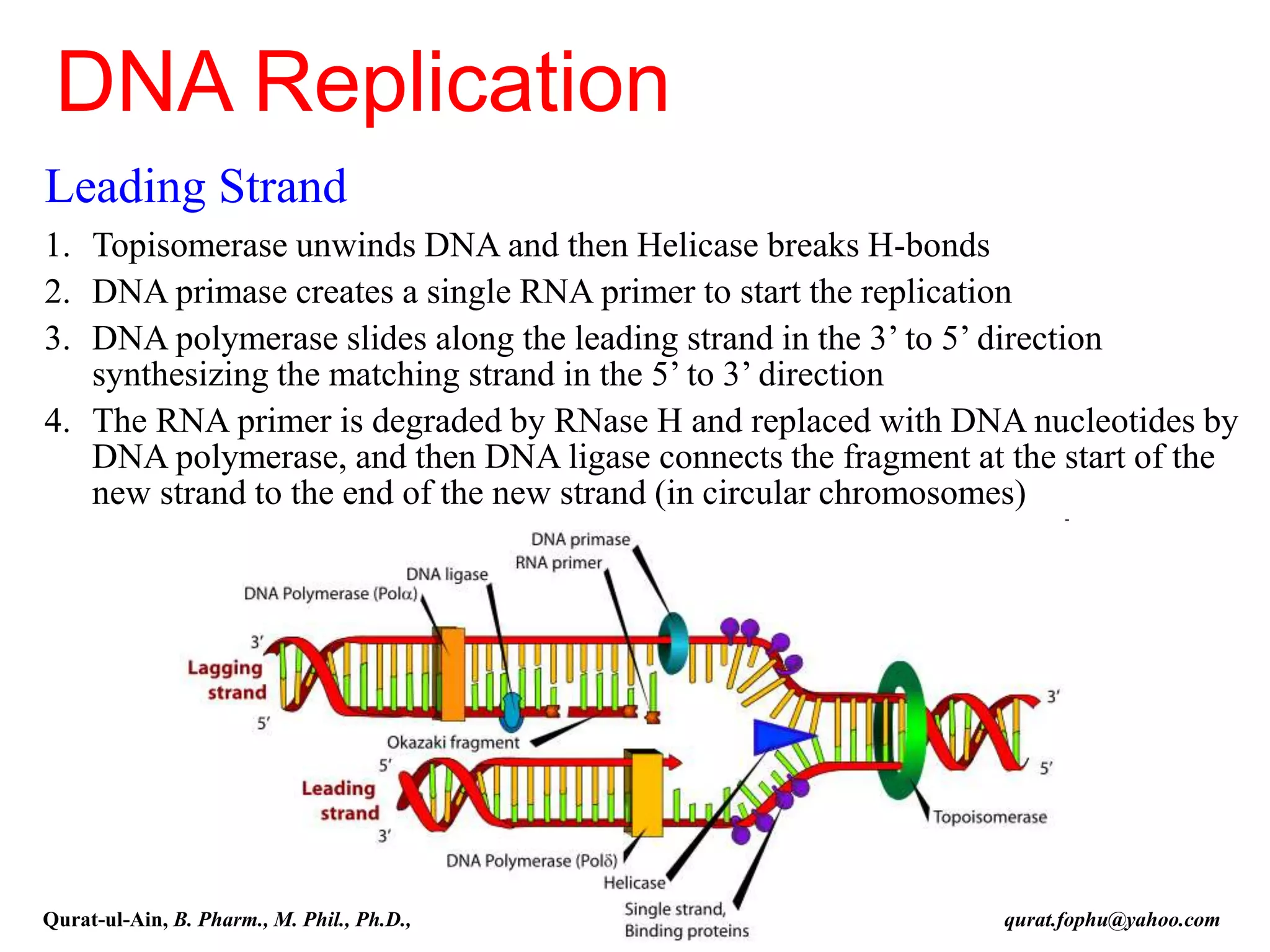
Leading Strand
1. Topisomerase unwinds DNA and then Helicase breaks H-bonds
2. DNA primase creates a single RNA primer to start the replication
3. DNA polymerase slides along the leading strand in the 3’ to 5’ direction
synthesizing the matching strand in the 5’ to 3’ direction
4. The RNA primer is degraded by RNase H and replaced with DNA nucleotides by
DNA polymerase, and then DNA ligase connects the fragment at the start of the
new strand to the end of the new strand (in circular chromosomes)
DNA Replication
Qurat-ul-Ain, B. Pharm., M. Phil., Ph.D., qurat.fophu@yahoo.com
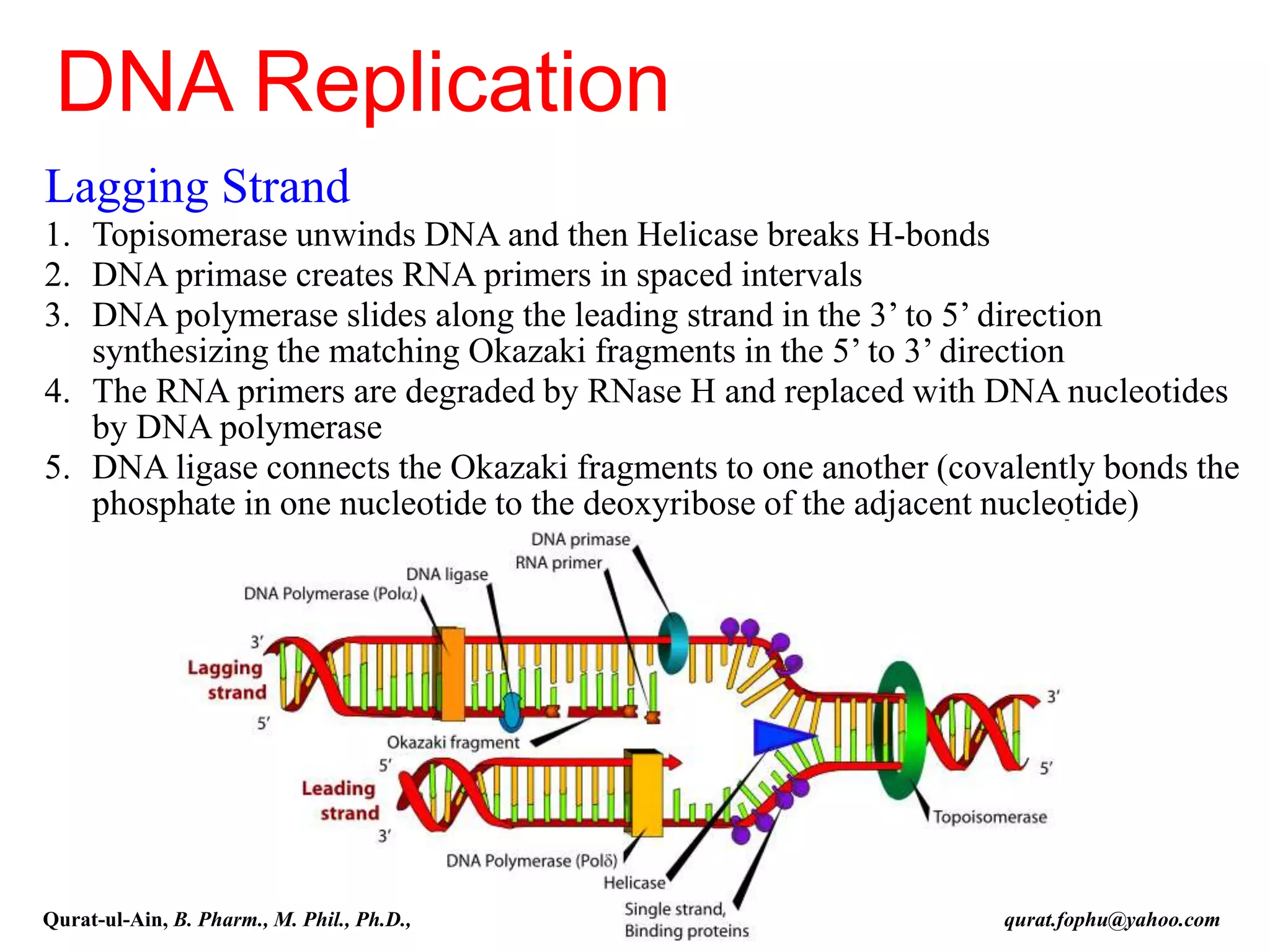
Lagging Strand
1. Topisomerase unwinds DNA and then Helicase breaks H-bonds
2. DNA primase creates RNA primers in spaced intervals
3. DNA polymerase slides along the leading strand in the 3’ to 5’ direction
synthesizing the matching Okazaki fragments in the 5’ to 3’ direction
4. The RNA primers are degraded by RNase H and replaced with DNA nucleotides
by DNA polymerase
5. DNA ligase connects the Okazaki fragments to one another (covalently bonds the
phosphate in one nucleotide to the deoxyribose of the adjacent nucleotide)
DNA Replication
Qurat-ul-Ain, B. Pharm., M. Phil., Ph.D., qurat.fophu@yahoo.com
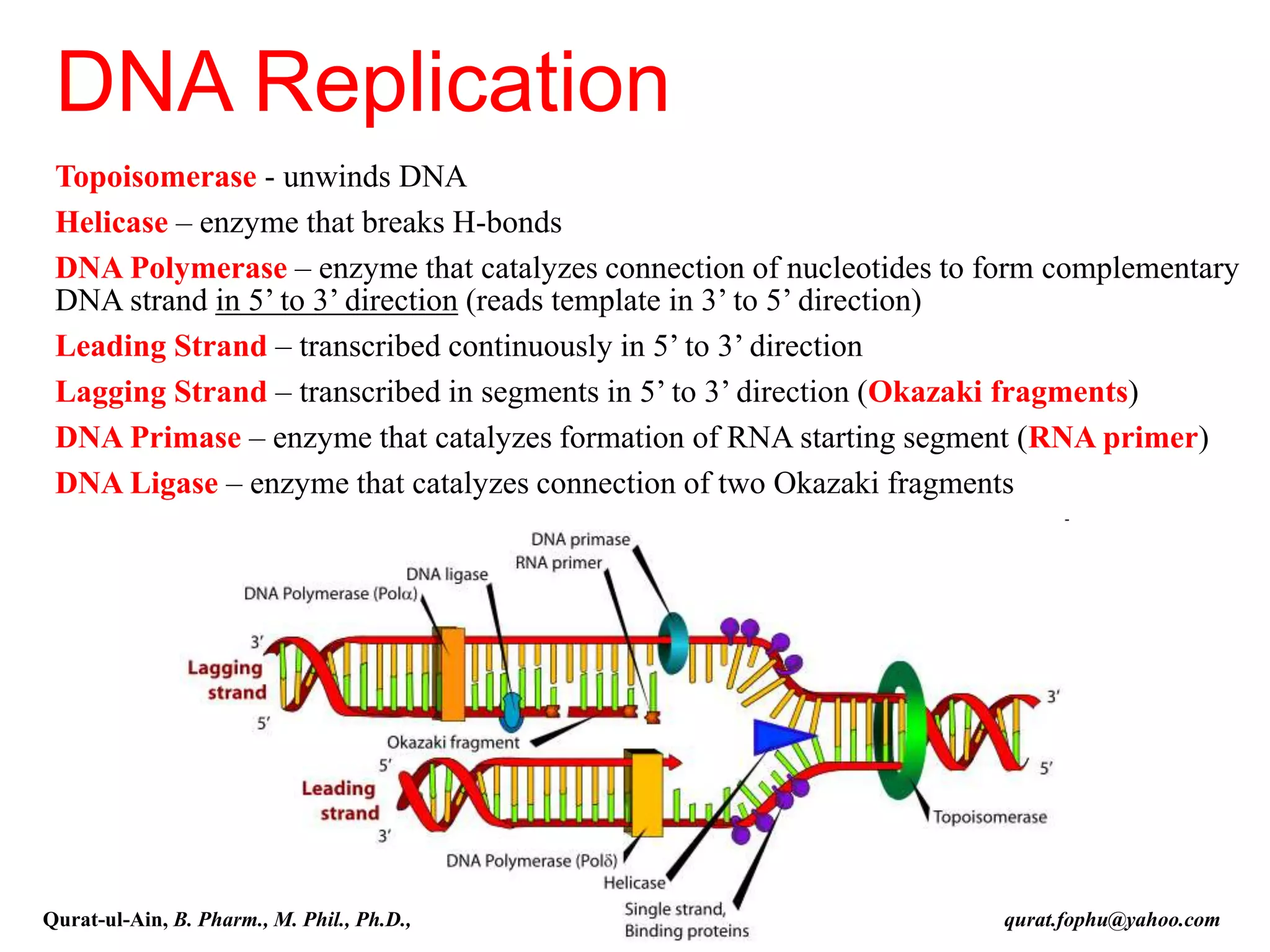
Topoisomerase - unwinds DNA
Helicase – enzyme that breaks H-bonds
DNA Polymerase – enzyme that catalyzes connection of nucleotides to form complementary
DNA strand in 5’ to 3’ direction (reads template in 3’ to 5’ direction)
Leading Strand – transcribed continuously in 5’ to 3’ direction
Lagging Strand – transcribed in segments in 5’ to 3’ direction (Okazaki fragments)
DNA Primase – enzyme that catalyzes formation of RNA starting segment (RNA primer)
DNA Ligase – enzyme that catalyzes connection of two Okazaki fragments
DNA Replication
Qurat-ul-Ain, B. Pharm., M. Phil., Ph.D., qurat.fophu@yahoo.com
Figure 2.3
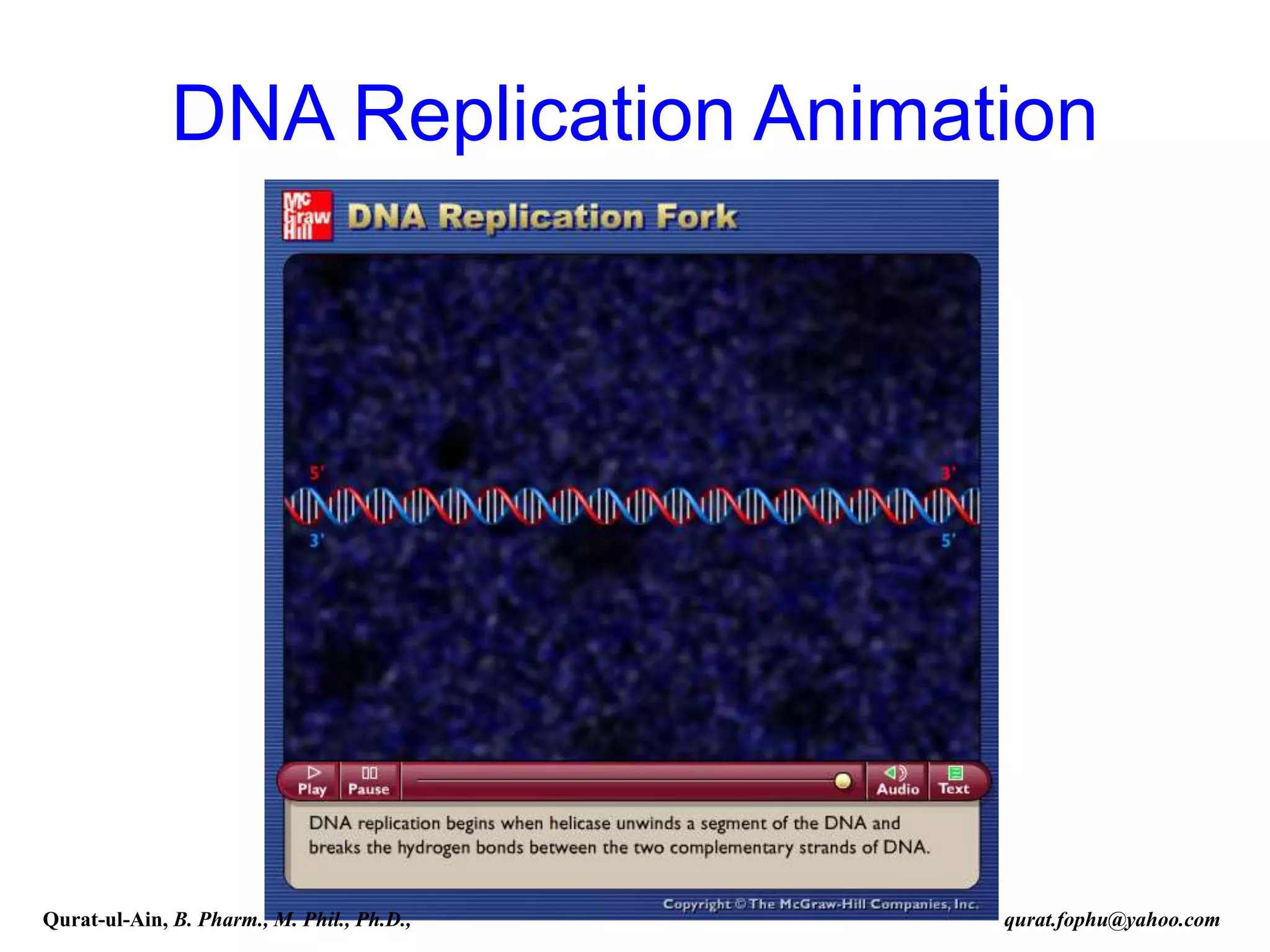
DNA Replication Animation
Please note that due to differing
operating systems, some animations
will not appear until the presentation is
viewed in Presentation Mode (Slide
Show view). You may see blank slides
in the “Normal” or “Slide Sorter” views.
All animations will appear after viewing
in Presentation Mode and playing each
animation. Most animations will require
the latest version of the Flash Player,
which is available at
http://get.adobe.com/flashplayer.
Qurat-ul-Ain, B. Pharm., M. Phil., Ph.D., qurat.fophu@yahoo.com
DNA Replication
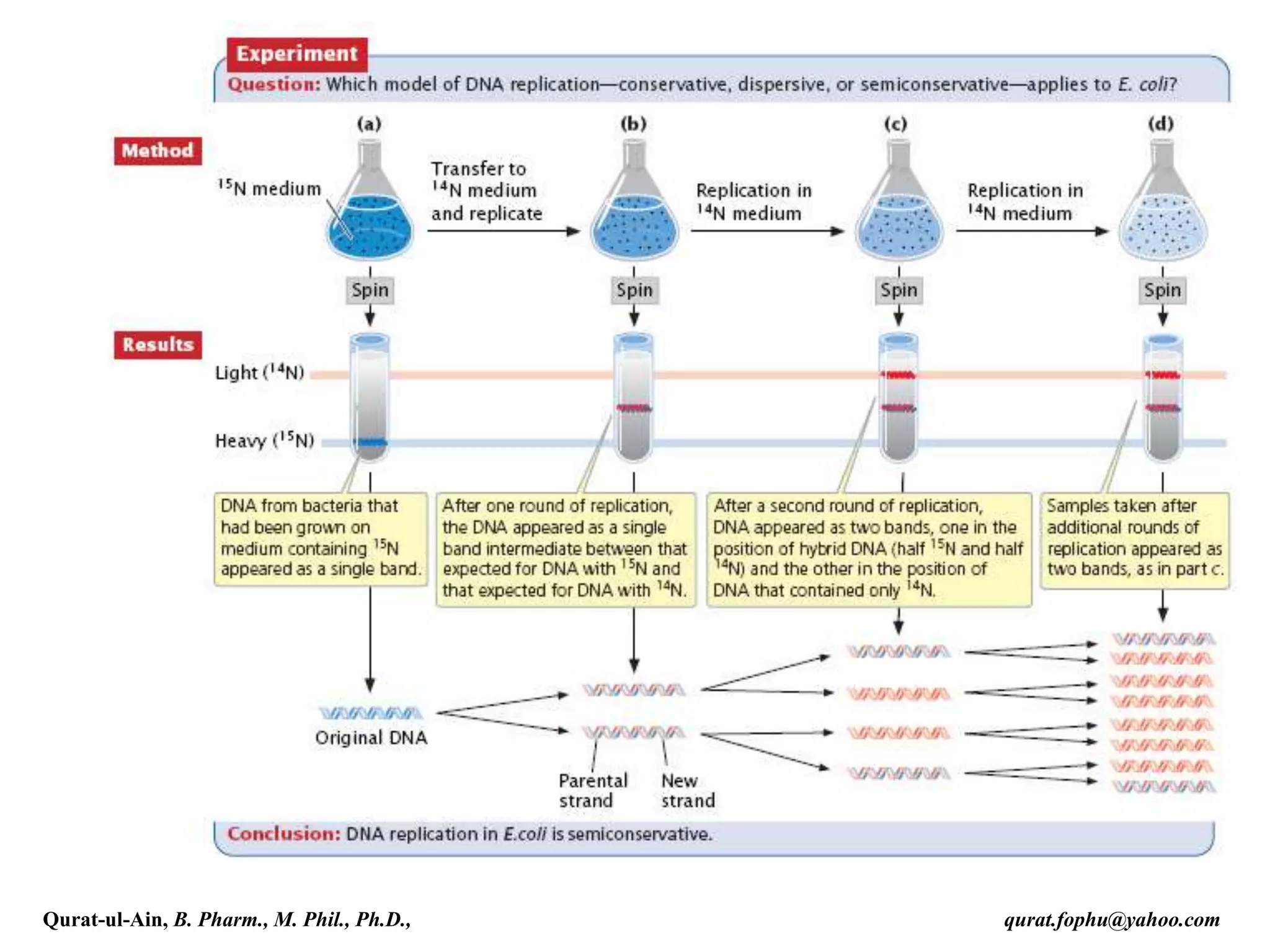
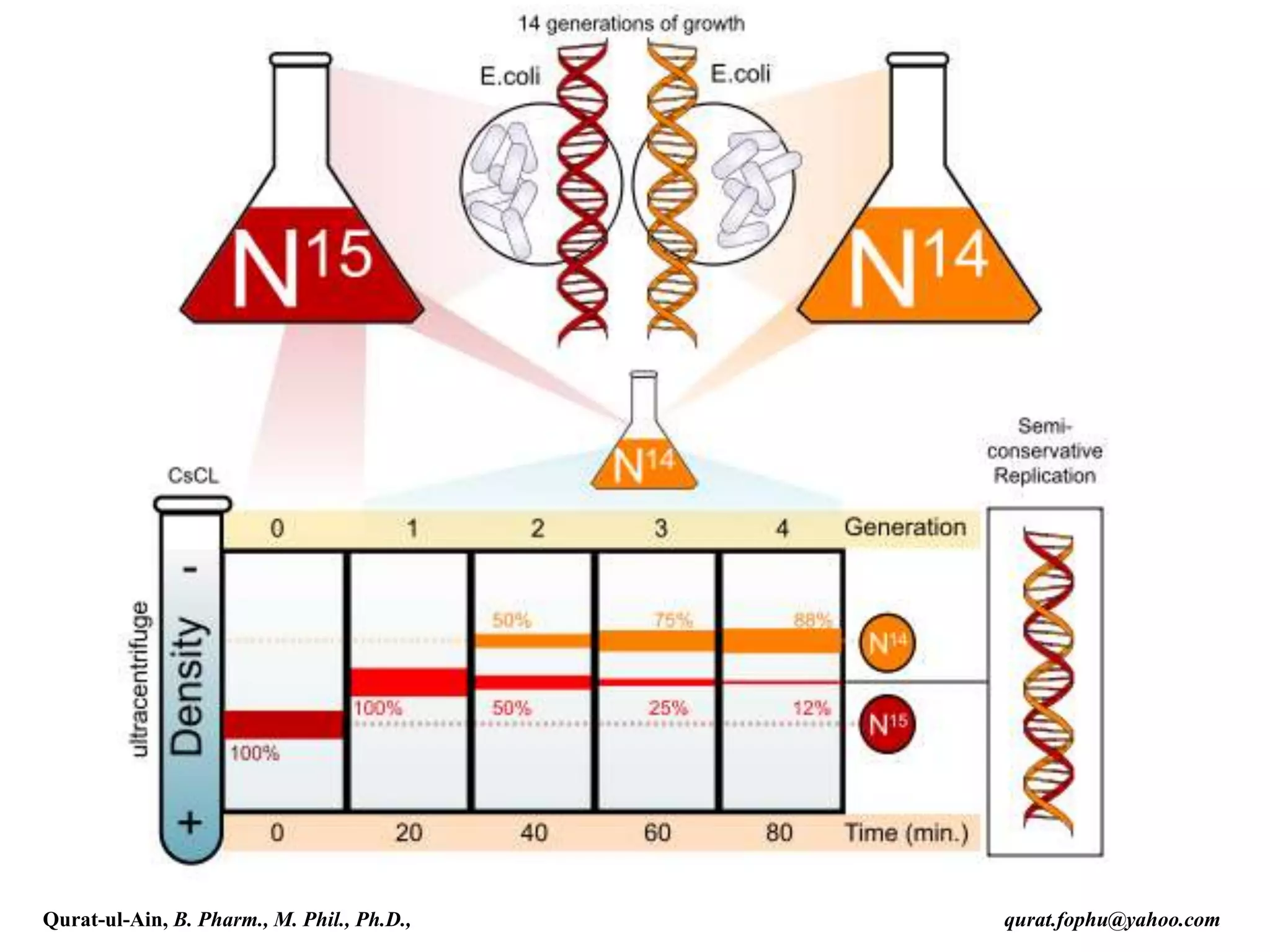
Matthew Meselson & Franklin Stahl, 1958
investigated the process of DNA replication
considered 3 possible mechanisms:
– conservative model
– semiconservative model
– dispersive model
Qurat-ul-Ain, B. Pharm., M. Phil., Ph.D., qurat.fophu@yahoo.com
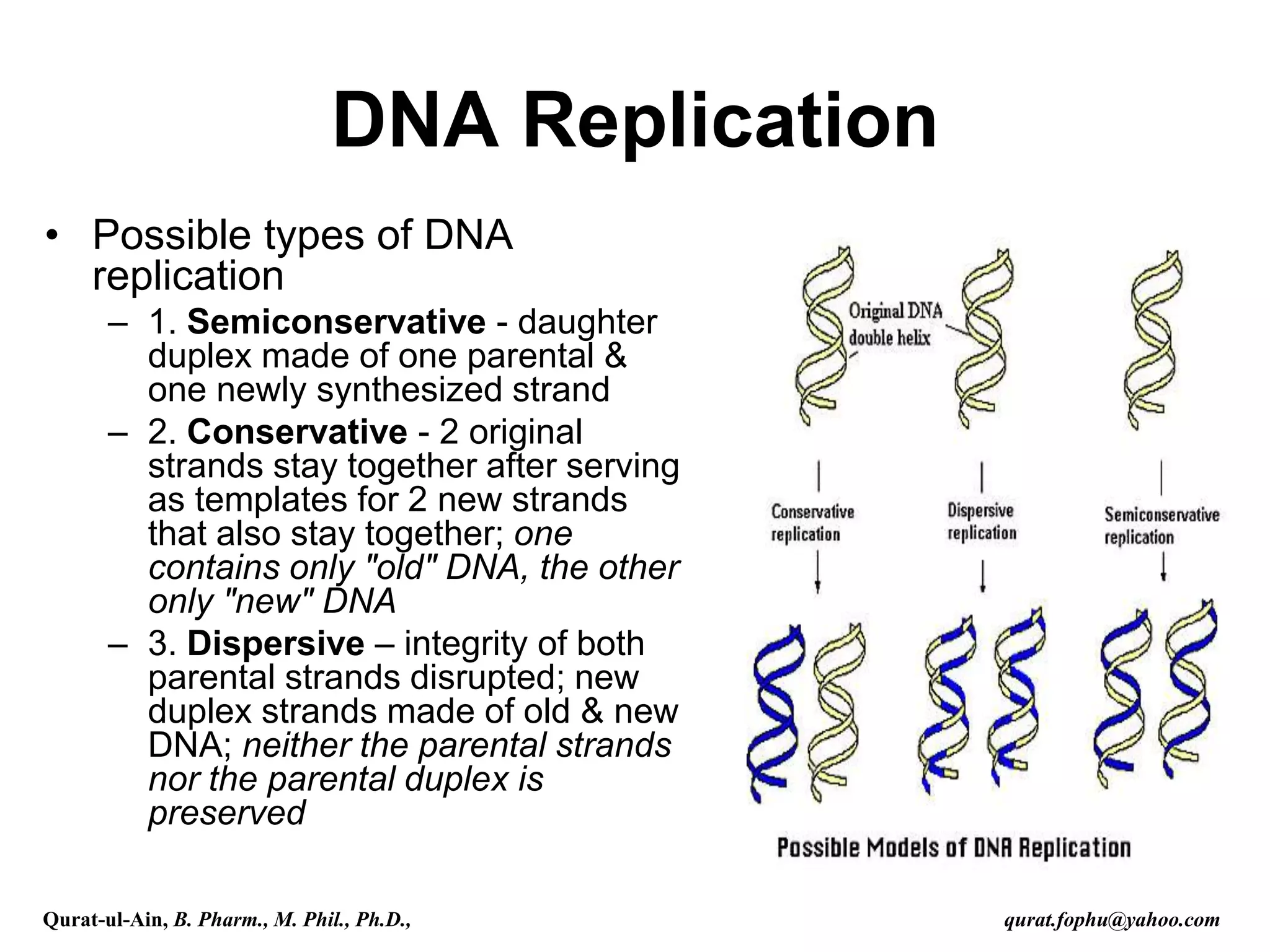
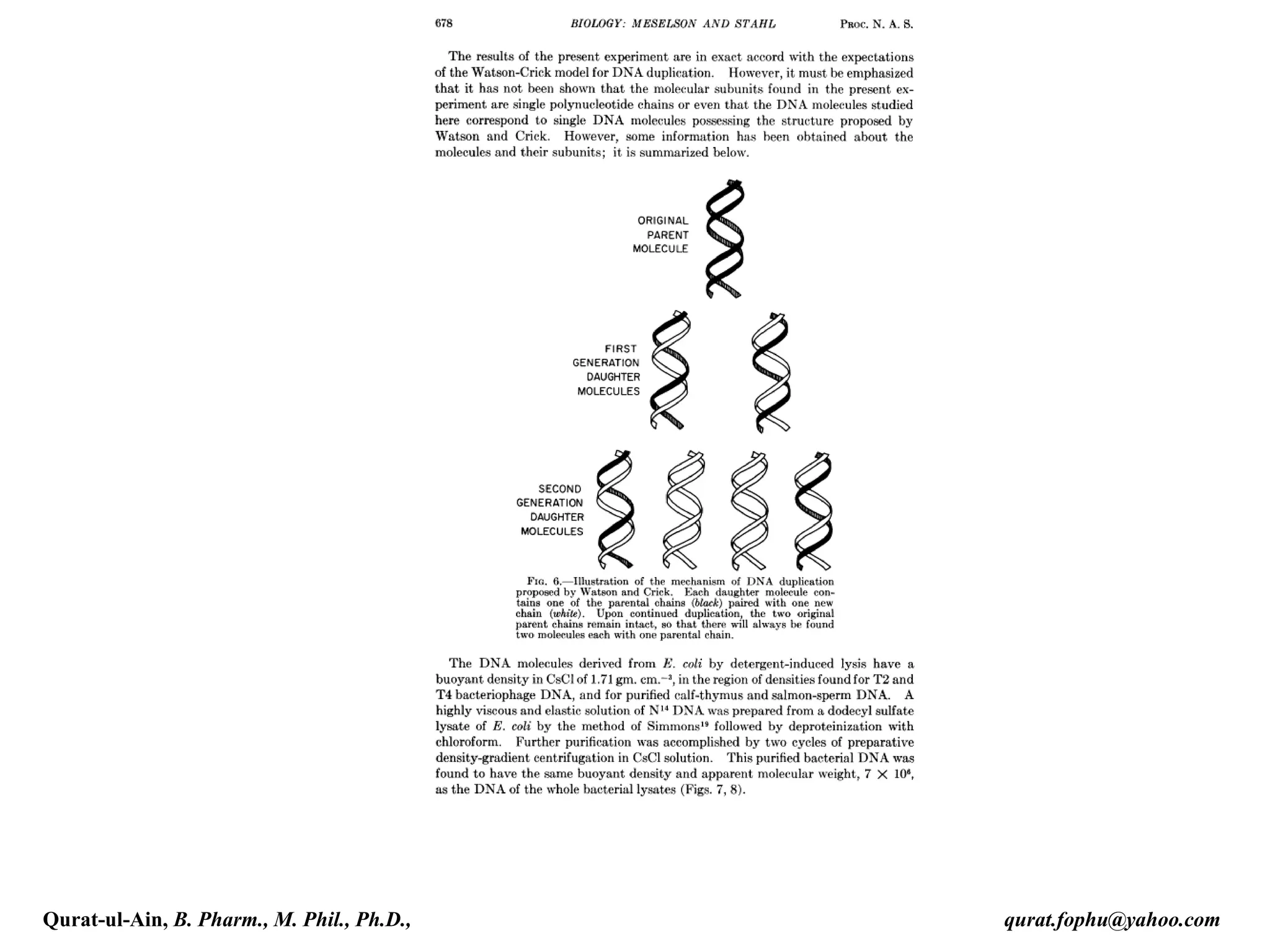
• Possible types of DNA
replication
– 1. Semiconservative - daughter
duplex made of one parental &
one newly synthesized strand
– 2. Conservative - 2 original
strands stay together after serving
as templates for 2 new strands
that also stay together; one
contains only "old" DNA, the other
only "new" DNA
– 3. Dispersive – integrity of both
parental strands disrupted; new
duplex strands made of old & new
DNA; neither the parental strands
nor the parental duplex is
preserved
DNA Replication
Qurat-ul-Ain, B. Pharm., M. Phil., Ph.D., qurat.fophu@yahoo.com
Figure 2.3
Experiment Animation
Please note that due to differing
operating systems, some animations
will not appear until the presentation is
viewed in Presentation Mode (Slide
Show view). You may see blank slides
in the “Normal” or “Slide Sorter” views.
All animations will appear after viewing
in Presentation Mode and playing each
animation. Most animations will require
the latest version of the Flash Player,
which is available at
http://get.adobe.com/flashplayer.
Qurat-ul-Ain, B. Pharm., M. Phil., Ph.D., qurat.fophu@yahoo.com
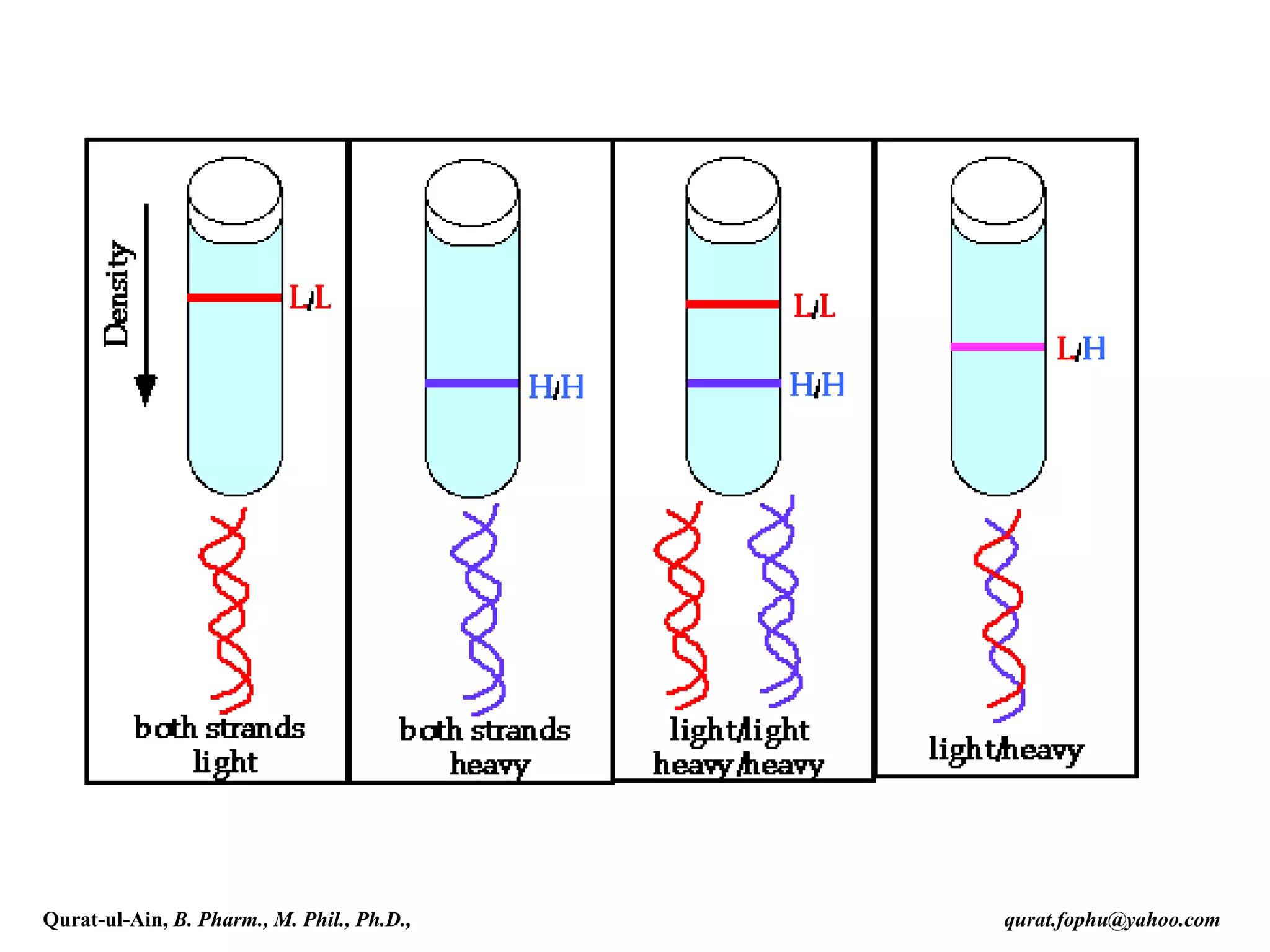
• The result
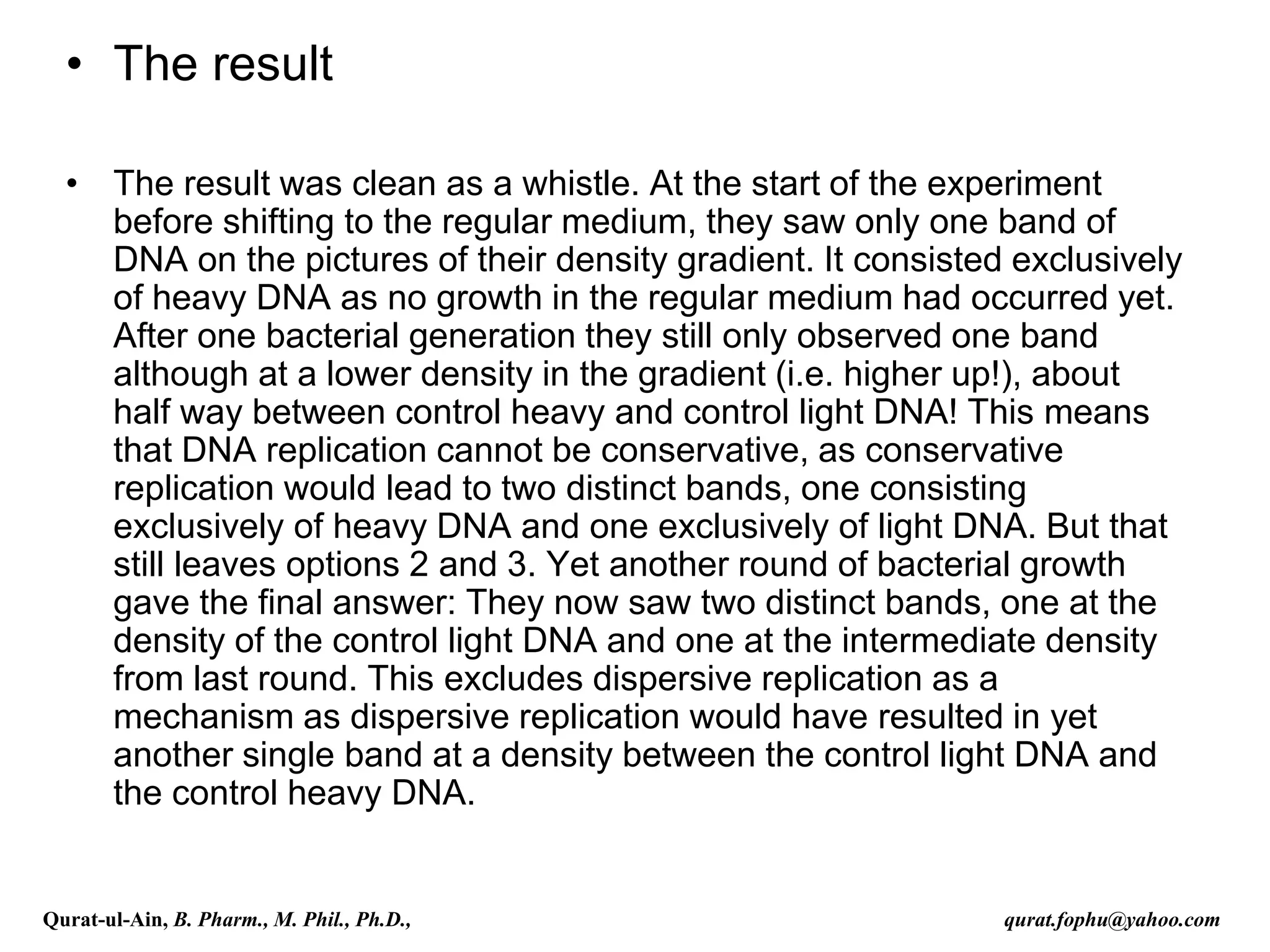
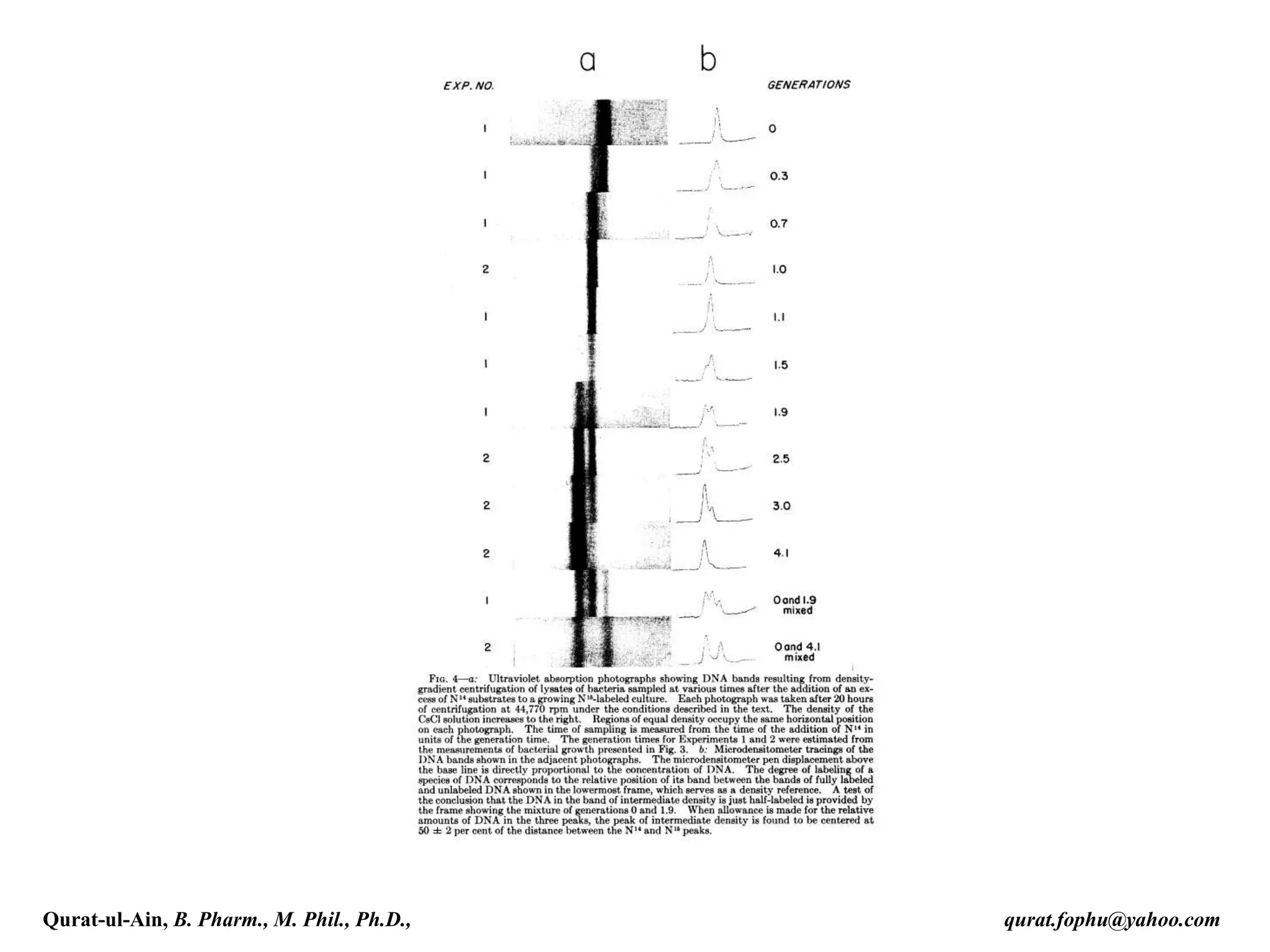
• The result was clean as a whistle. At the start of the experiment
before shifting to the regular medium, they saw only one band of
DNA on the pictures of their density gradient. It consisted exclusively
of heavy DNA as no growth in the regular medium had occurred yet.
After one bacterial generation they still only observed one band
although at a lower density in the gradient (i.e. higher up!), about
half way between control heavy and control light DNA! This means
that DNA replication cannot be conservative, as conservative
replication would lead to two distinct bands, one consisting
exclusively of heavy DNA and one exclusively of light DNA. But that
still leaves options 2 and 3. Yet another round of bacterial growth
gave the final answer: They now saw two distinct bands, one at the
density of the control light DNA and one at the intermediate density
from last round. This excludes dispersive replication as a
mechanism as dispersive replication would have resulted in yet
another single band at a density between the control light DNA and
the control heavy DNA.
Qurat-ul-Ain, B. Pharm., M. Phil., Ph.D., qurat.fophu@yahoo.com
DNA Replication
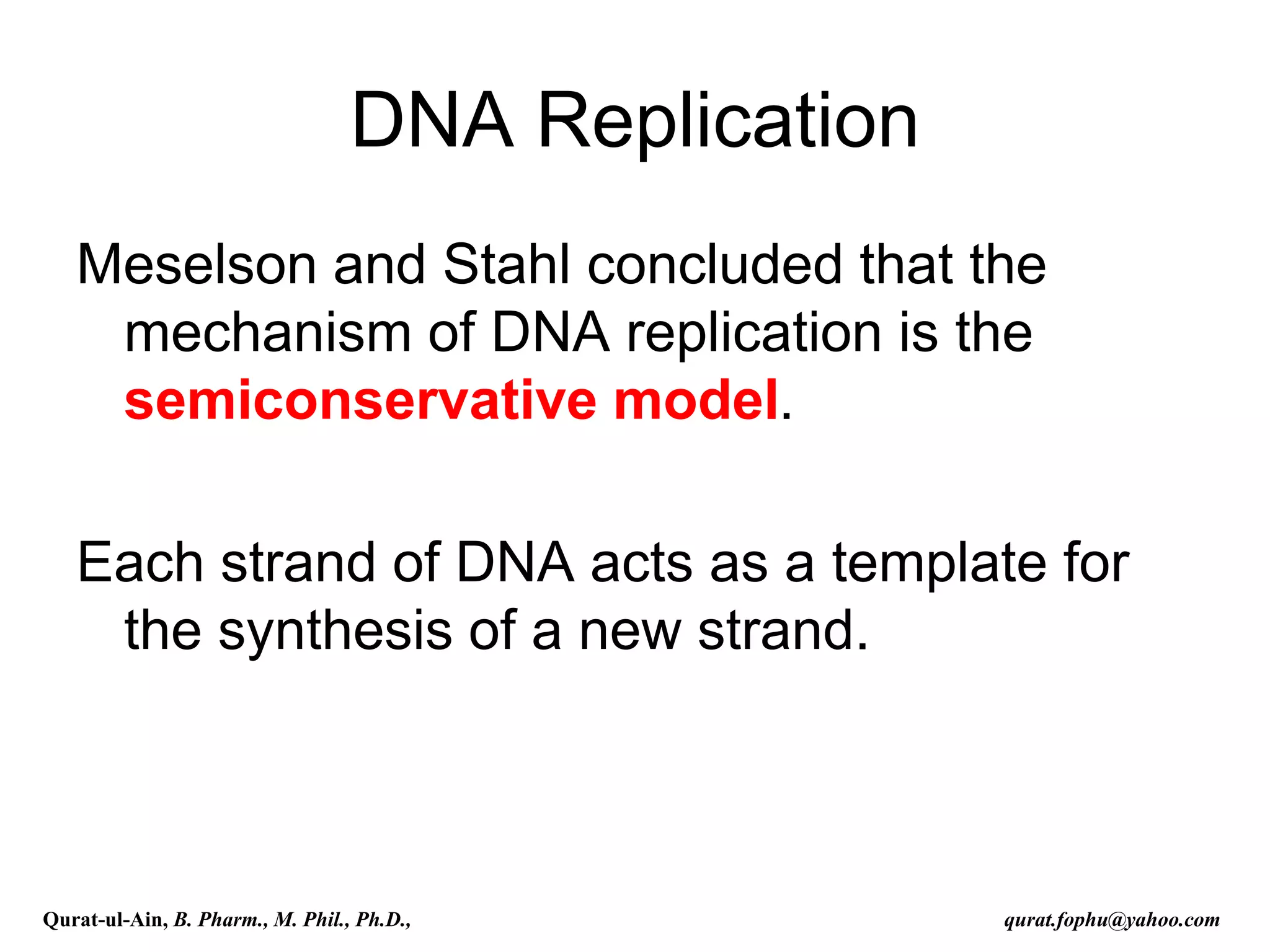
Meselson and Stahl concluded that the
mechanism of DNA replication is the
semiconservative model.
Each strand of DNA acts as a template for
the synthesis of a new strand.
Qurat-ul-Ain, B. Pharm., M. Phil., Ph.D., qurat.fophu@yahoo.com
DNA Replication…
• Reproduction is fundamental to all living systems
• Regardless of the reproductive mechanism
(asexual or sexual) a method must exist to
transfer genetic material from one generation to
the next.
• DNA must be copied (replicated) in a manner
that minimizes mistakes.
• Damage to DNA must be repaired to prevent
that damage from being transferred to the next
generation.
Qurat-ul-Ain, B. Pharm., M. Phil., Ph.D., qurat.fophu@yahoo.com

Lecture 3.part.1Denaturation,Renaturation of DNA Replication of DNA

  • 1.
    Denaturation,Renaturation of DNA Replicationof DNA MOLECULAR BIOLOGY & GENETICS Qurat-ul-Ain, B. Pharm., M. Phil., Ph.D., Visiting Assistant Professor Department of Physical Therapy, Faculty of Health& Medical Sciences, Hamdard University, Karachi, Pakistan Assistant Professor Department of Pharmaceutical Chemistry, Faculty of Pharmacy, Hamdard University, Karachi, Pakistan. Qurat-ul-Ain, B. Pharm., M. Phil., Ph.D., qurat.fophu@yahoo.com
  • 2.
    1. Denaturation - thedouble helix can be denatured in different ways: heat, pH (acid & alkali), -chemicals such as urea (poorly), formamide, dimethylsulfoxide, etc., and by proteins (single-strand DNA or RNA binding proteins) - dissociation by heating is also named melting - progress of denaturation can be monitored by UV absorption spectroscopy - hyperchromicity effect : disruption of the stacking => 30 to 40 % increase of UV (260 nm) absorption Qurat-ul-Ain, B. Pharm., M. Phil., Ph.D., qurat.fophu@yahoo.com
  • 3.
    - Tm :melting temperature - position in melting profile where 50% is single-stranded - pseudo-monomolecular reaction: strands are not physically separated (but A-T rich zones 'melt' first) (dynamic equilibrium) => ' denaturation is concentration-independent' - linear relationship between Tm and %G+C of a duplex - physical separation requires temperatures far above Tm - upon fast chilling (e.g. placing the tube in ice-water!) : nucleic acid remains single-stranded - slow cooling is necessary to enable the base-pairs (and stacking) to rebuild => 'renaturation requires energy ! ' Qurat-ul-Ain, B. Pharm., M. Phil., Ph.D., qurat.fophu@yahoo.com
  • 4.
    Partial denaturation :electronmicroscopical analysis of A+T rich regions. Qurat-ul-Ain, B. Pharm., M. Phil., Ph.D., qurat.fophu@yahoo.com
  • 5.
    5 DNA Denaturation Qurat-ul-Ain, B.Pharm., M. Phil., Ph.D., qurat.fophu@yahoo.com
  • 6.
    G+C Content IsProportional to Tm 70 80 90 100 1.4 1.2 1.0 Relative absorbance (260 nm) Temperature (C) Pneumococcus (38%) G+C E. coli (52%) S. Marcescens (58%) M. Phlei (66%) Qurat-ul-Ain, B. Pharm., M. Phil., Ph.D., qurat.fophu@yahoo.com
  • 7.
    Renaturation - renaturation isNOT simply the reverse of denaturation - collision of complementary strands required - nucleic acid strands are negatively charged in the phosphate moiety a -1 charge per nucleotide => repulsion => hence : requires shielding to allow strands to approach one another (use of Na+ or K+ salts) - four parameters in renaturation kinetics 1) concentration of cations 2) incubation temperature (usually 20 to 25 °C below Tm) 3) DNA concentration (related to complexity of the DNA : see below) 4) size of the fragments Qurat-ul-Ain, B. Pharm., M. Phil., Ph.D., qurat.fophu@yahoo.com
  • 8.
    DNA denaturation andrenaturation : strategic aspects native DNA fast chilling slow chilling very limited renaturation (palindromes?) almost complete renaturation Qurat-ul-Ain, B. Pharm., M. Phil., Ph.D., qurat.fophu@yahoo.com
  • 9.
    9 Reversible denaturation andannealing (renaturation) of DNA Qurat-ul-Ain, B. Pharm., M. Phil., Ph.D., qurat.fophu@yahoo.com
  • 10.
    GENE Qurat-ul-Ain, B. Pharm.,M. Phil., Ph.D., qurat.fophu@yahoo.com
  • 11.
    GENE EXPRESSION Qurat-ul-Ain, B.Pharm., M. Phil., Ph.D., qurat.fophu@yahoo.com
  • 12.
    DNA Replication • DNAReplication is the process in which the DNA within a cell makes an exact copy of itself. Qurat-ul-Ain, B. Pharm., M. Phil., Ph.D., qurat.fophu@yahoo.com
  • 13.
    It has notescaped our notice that the specific pairing we have postulated suggests a possible copying mechanism for the genetic material. Qurat-ul-Ain, B. Pharm., M. Phil., Ph.D., qurat.fophu@yahoo.com
  • 14.
    • Watson &Crick (1953) - proposed DNA structure & suggested how it might "self- duplicate" • “It has not escaped our notice that the specific pairing we have postulated immediately suggests a possible copying mechanism for the genetic material.” – A. Suggested that replication occurred by gradual double helix strand separation via successive breakage of H bonds, much like the separation of the two halves of a zipper – B. Since each strand is complementary to the other, each has the information needed to construct the other; once separated, each strand can serve as template to direct the formation of the other strand DNA Replication… Qurat-ul-Ain, B. Pharm., M. Phil., Ph.D., qurat.fophu@yahoo.com
  • 15.
    Enzymes in DNAReplication Qurat-ul-Ain, B. Pharm., M. Phil., Ph.D., qurat.fophu@yahoo.com
  • 16.
    Elongation • DNA polymeraseuses each strand as a template in the 3’ to 5’ direction to build a complementary strand in the 5’ to 3’ direction  results in a leading strand and a lagging strand DNA Replication Qurat-ul-Ain, B. Pharm., M. Phil., Ph.D., qurat.fophu@yahoo.com
  • 17.
    Leading Strand 1. Topisomeraseunwinds DNA and then Helicase breaks H-bonds 2. DNA primase creates a single RNA primer to start the replication 3. DNA polymerase slides along the leading strand in the 3’ to 5’ direction synthesizing the matching strand in the 5’ to 3’ direction 4. The RNA primer is degraded by RNase H and replaced with DNA nucleotides by DNA polymerase, and then DNA ligase connects the fragment at the start of the new strand to the end of the new strand (in circular chromosomes) DNA Replication Qurat-ul-Ain, B. Pharm., M. Phil., Ph.D., qurat.fophu@yahoo.com
  • 18.
    Lagging Strand 1. Topisomeraseunwinds DNA and then Helicase breaks H-bonds 2. DNA primase creates RNA primers in spaced intervals 3. DNA polymerase slides along the leading strand in the 3’ to 5’ direction synthesizing the matching Okazaki fragments in the 5’ to 3’ direction 4. The RNA primers are degraded by RNase H and replaced with DNA nucleotides by DNA polymerase 5. DNA ligase connects the Okazaki fragments to one another (covalently bonds the phosphate in one nucleotide to the deoxyribose of the adjacent nucleotide) DNA Replication Qurat-ul-Ain, B. Pharm., M. Phil., Ph.D., qurat.fophu@yahoo.com
  • 19.
    Topoisomerase - unwindsDNA Helicase – enzyme that breaks H-bonds DNA Polymerase – enzyme that catalyzes connection of nucleotides to form complementary DNA strand in 5’ to 3’ direction (reads template in 3’ to 5’ direction) Leading Strand – transcribed continuously in 5’ to 3’ direction Lagging Strand – transcribed in segments in 5’ to 3’ direction (Okazaki fragments) DNA Primase – enzyme that catalyzes formation of RNA starting segment (RNA primer) DNA Ligase – enzyme that catalyzes connection of two Okazaki fragments DNA Replication Qurat-ul-Ain, B. Pharm., M. Phil., Ph.D., qurat.fophu@yahoo.com
  • 20.
    Qurat-ul-Ain, B. Pharm.,M. Phil., Ph.D., qurat.fophu@yahoo.com
  • 21.
    Figure 2.3 DNA ReplicationAnimation Please note that due to differing operating systems, some animations will not appear until the presentation is viewed in Presentation Mode (Slide Show view). You may see blank slides in the “Normal” or “Slide Sorter” views. All animations will appear after viewing in Presentation Mode and playing each animation. Most animations will require the latest version of the Flash Player, which is available at http://get.adobe.com/flashplayer. Qurat-ul-Ain, B. Pharm., M. Phil., Ph.D., qurat.fophu@yahoo.com
  • 22.
    Qurat-ul-Ain, B. Pharm.,M. Phil., Ph.D., qurat.fophu@yahoo.com
  • 23.
    DNA Replication Matthew Meselson& Franklin Stahl, 1958 investigated the process of DNA replication considered 3 possible mechanisms: – conservative model – semiconservative model – dispersive model Qurat-ul-Ain, B. Pharm., M. Phil., Ph.D., qurat.fophu@yahoo.com
  • 24.
    • Possible typesof DNA replication – 1. Semiconservative - daughter duplex made of one parental & one newly synthesized strand – 2. Conservative - 2 original strands stay together after serving as templates for 2 new strands that also stay together; one contains only "old" DNA, the other only "new" DNA – 3. Dispersive – integrity of both parental strands disrupted; new duplex strands made of old & new DNA; neither the parental strands nor the parental duplex is preserved DNA Replication Qurat-ul-Ain, B. Pharm., M. Phil., Ph.D., qurat.fophu@yahoo.com
  • 25.
    Qurat-ul-Ain, B. Pharm.,M. Phil., Ph.D., qurat.fophu@yahoo.com
  • 26.
    Qurat-ul-Ain, B. Pharm.,M. Phil., Ph.D., qurat.fophu@yahoo.com
  • 27.
    Figure 2.3 Experiment Animation Pleasenote that due to differing operating systems, some animations will not appear until the presentation is viewed in Presentation Mode (Slide Show view). You may see blank slides in the “Normal” or “Slide Sorter” views. All animations will appear after viewing in Presentation Mode and playing each animation. Most animations will require the latest version of the Flash Player, which is available at http://get.adobe.com/flashplayer. Qurat-ul-Ain, B. Pharm., M. Phil., Ph.D., qurat.fophu@yahoo.com
  • 28.
    Qurat-ul-Ain, B. Pharm.,M. Phil., Ph.D., qurat.fophu@yahoo.com
  • 29.
    Qurat-ul-Ain, B. Pharm.,M. Phil., Ph.D., qurat.fophu@yahoo.com
  • 30.
    • The result •The result was clean as a whistle. At the start of the experiment before shifting to the regular medium, they saw only one band of DNA on the pictures of their density gradient. It consisted exclusively of heavy DNA as no growth in the regular medium had occurred yet. After one bacterial generation they still only observed one band although at a lower density in the gradient (i.e. higher up!), about half way between control heavy and control light DNA! This means that DNA replication cannot be conservative, as conservative replication would lead to two distinct bands, one consisting exclusively of heavy DNA and one exclusively of light DNA. But that still leaves options 2 and 3. Yet another round of bacterial growth gave the final answer: They now saw two distinct bands, one at the density of the control light DNA and one at the intermediate density from last round. This excludes dispersive replication as a mechanism as dispersive replication would have resulted in yet another single band at a density between the control light DNA and the control heavy DNA. Qurat-ul-Ain, B. Pharm., M. Phil., Ph.D., qurat.fophu@yahoo.com
  • 31.
    Qurat-ul-Ain, B. Pharm.,M. Phil., Ph.D., qurat.fophu@yahoo.com
  • 32.
    DNA Replication Meselson andStahl concluded that the mechanism of DNA replication is the semiconservative model. Each strand of DNA acts as a template for the synthesis of a new strand. Qurat-ul-Ain, B. Pharm., M. Phil., Ph.D., qurat.fophu@yahoo.com
  • 33.
    DNA Replication… • Reproductionis fundamental to all living systems • Regardless of the reproductive mechanism (asexual or sexual) a method must exist to transfer genetic material from one generation to the next. • DNA must be copied (replicated) in a manner that minimizes mistakes. • Damage to DNA must be repaired to prevent that damage from being transferred to the next generation. Qurat-ul-Ain, B. Pharm., M. Phil., Ph.D., qurat.fophu@yahoo.com
  • 34.
    Qurat-ul-Ain, B. Pharm.,M. Phil., Ph.D., qurat.fophu@yahoo.com