MOLECULAR BIOLOGY & GENETICS
Basic Processes of Molecular Biology
DNA repair
4rd Lecture, Part.2
Qurat-ul-Ain, B. Pharm., M. Phil., Ph.D.,
Visiting Assistant Professor
Department of Physical Therapy, Faculty of Health& Medical Sciences,
Hamdard University, Karachi, Pakistan
Assistant Professor
Department of Pharmaceutical Chemistry, Faculty of Pharmacy, Hamdard
University, Karachi, Pakistan.
Qurat-ul-Ain, B. Pharm., M. Phil., Ph.D., qurat.fophu@yahoo.com
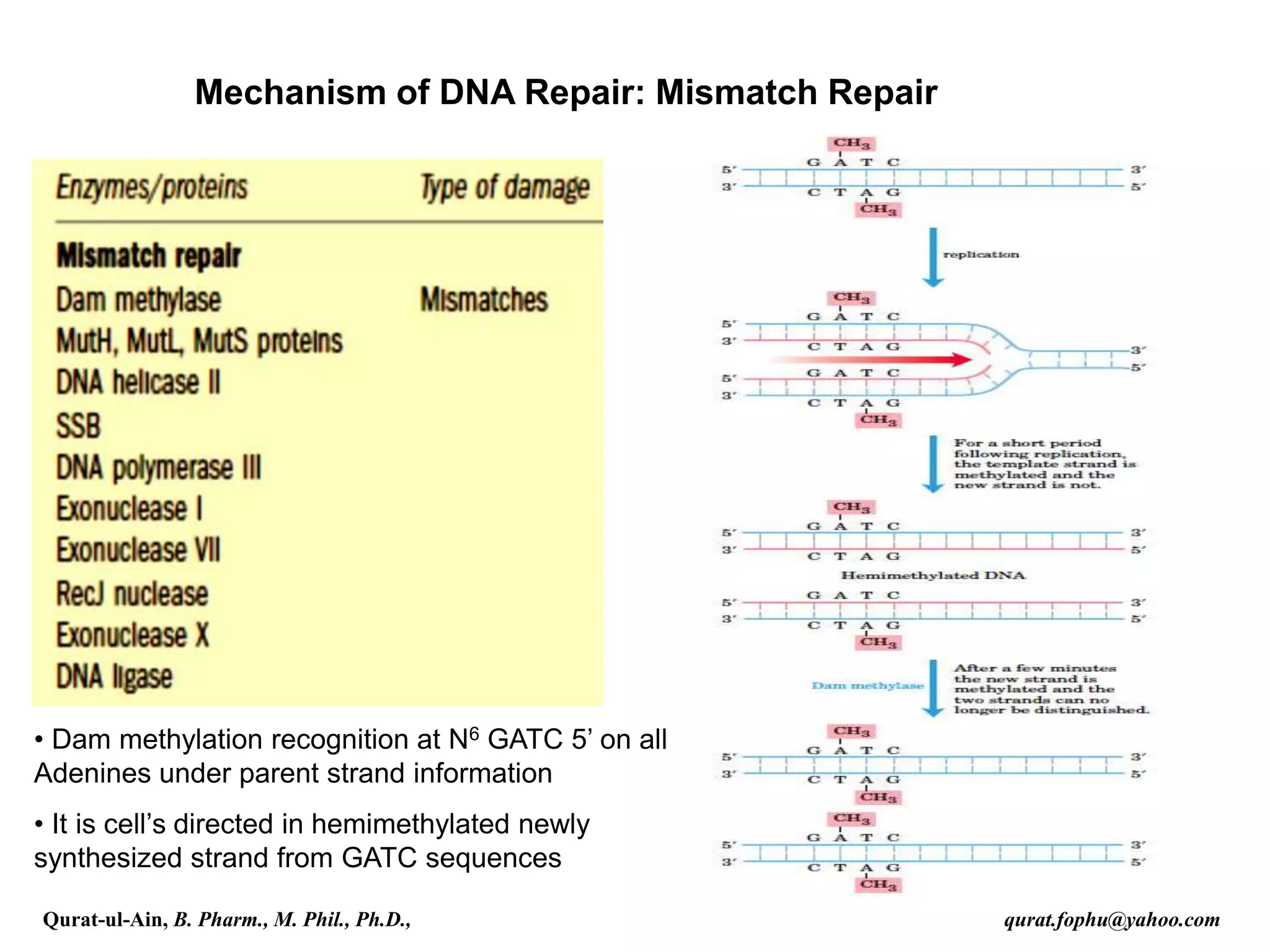
Mechanism of DNA Repair: Mismatch Repair
• Dam methylation recognition at N6 GATC 5’ on all
Adenines under parent strand information
• It is cell’s directed in hemimethylated newly
synthesized strand from GATC sequences
Qurat-ul-Ain, B. Pharm., M. Phil., Ph.D., qurat.fophu@yahoo.com
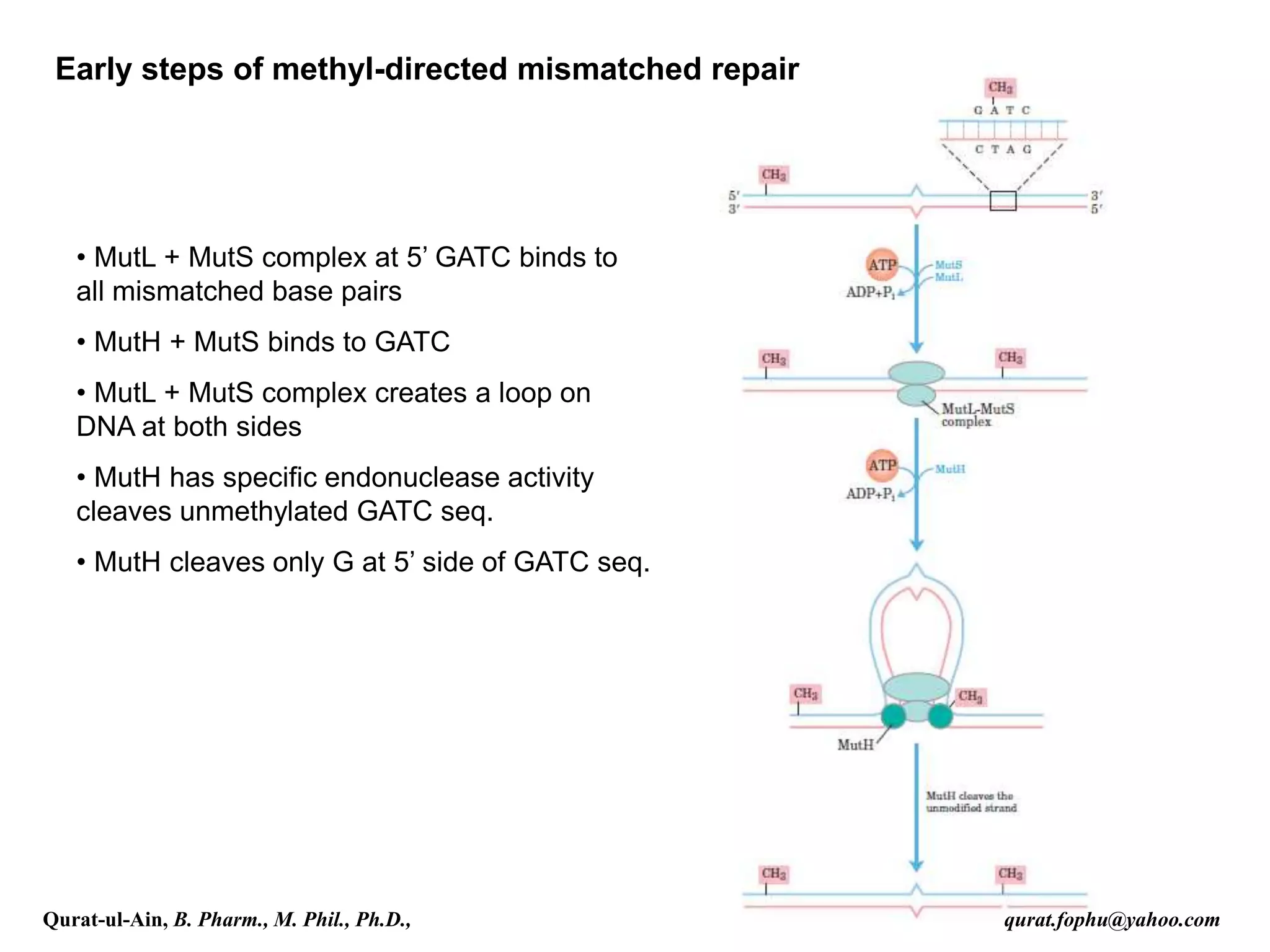
Early steps of methyl-directed mismatched repair
• MutL + MutS complex at 5’ GATC binds to
all mismatched base pairs
• MutH + MutS binds to GATC
• MutL + MutS complex creates a loop on
DNA at both sides
• MutH has specific endonuclease activity
cleaves unmethylated GATC seq.
• MutH cleaves only G at 5’ side of GATC seq.
Qurat-ul-Ain, B. Pharm., M. Phil., Ph.D., qurat.fophu@yahoo.com
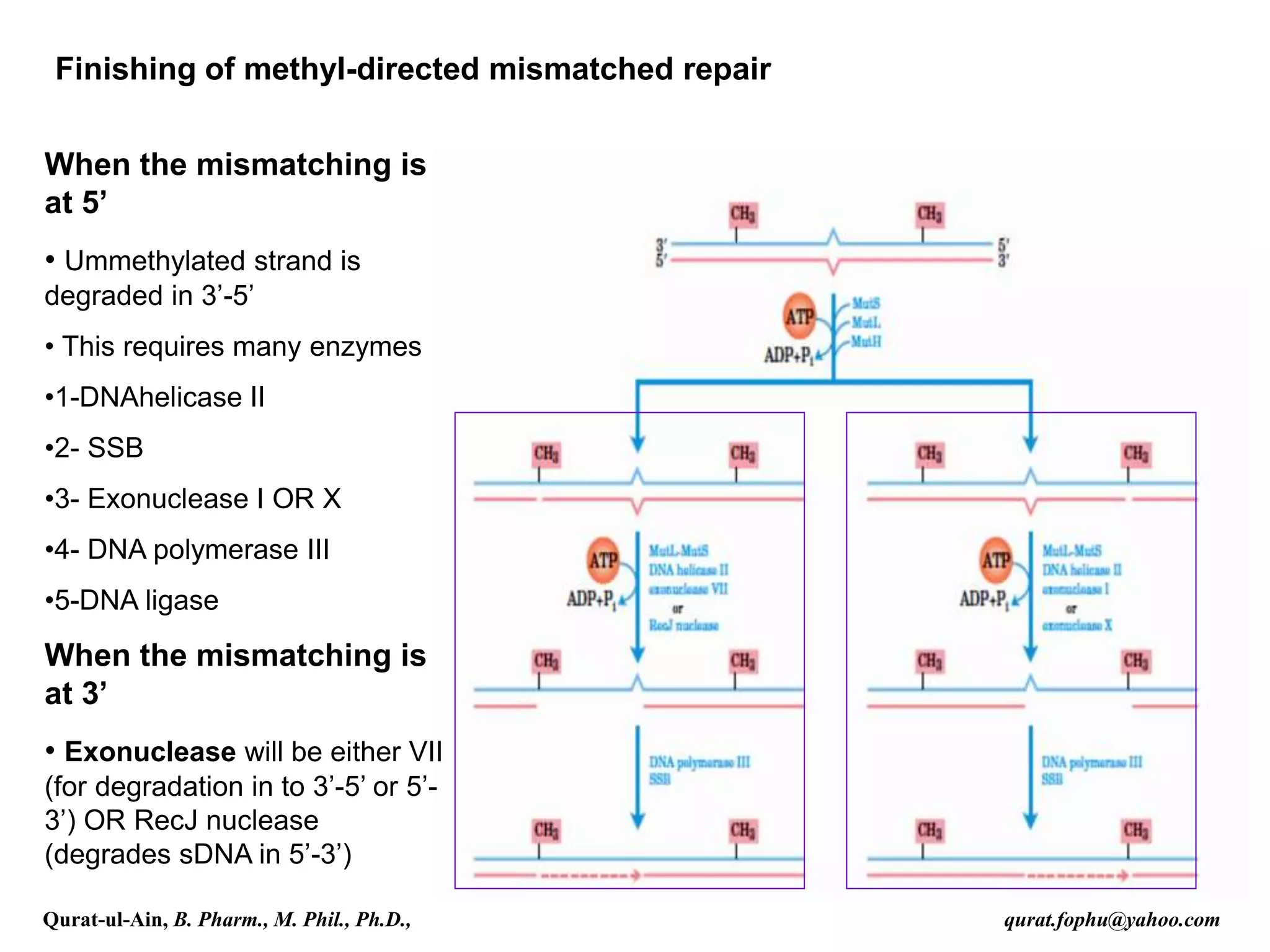
Finishing of methyl-directed mismatched repair
When the mismatching is
at 5’
• Ummethylated strand is
degraded in 3’-5’
• This requires many enzymes
•1-DNAhelicase II
•2- SSB
•3- Exonuclease I OR X
•4- DNA polymerase III
•5-DNA ligase
When the mismatching is
at 3’
• Exonuclease will be either VII
(for degradation in to 3’-5’ or 5’-
3’) OR RecJ nuclease
(degrades sDNA in 5’-3’)
Qurat-ul-Ain, B. Pharm., M. Phil., Ph.D., qurat.fophu@yahoo.com
Mechanism of DNA Repair: Base Excision Repair
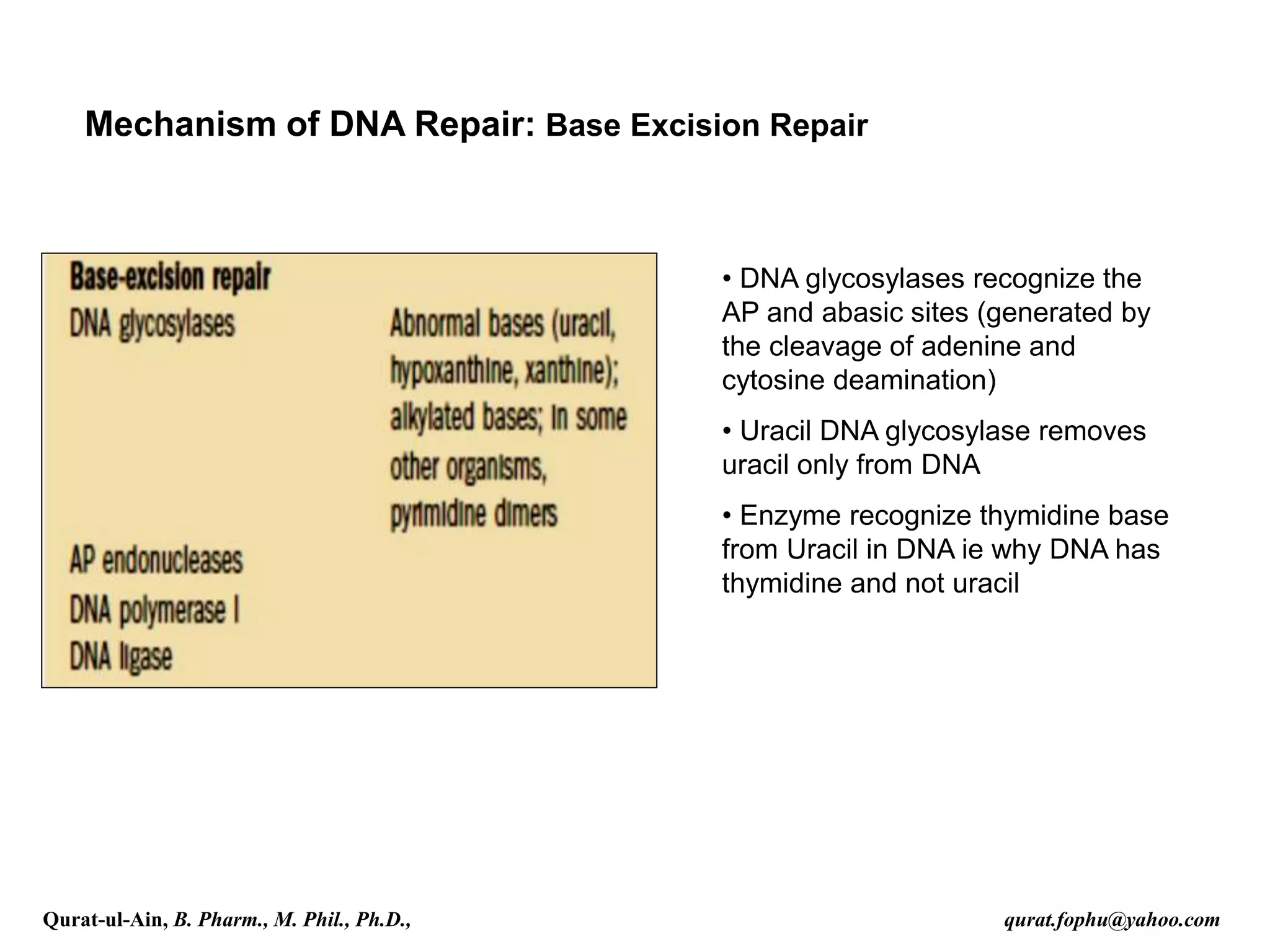
• DNA glycosylases recognize the
AP and abasic sites (generated by
the cleavage of adenine and
cytosine deamination)
• Uracil DNA glycosylase removes
uracil only from DNA
• Enzyme recognize thymidine base
from Uracil in DNA ie why DNA has
thymidine and not uracil
Qurat-ul-Ain, B. Pharm., M. Phil., Ph.D., qurat.fophu@yahoo.com
Base-excision repair pathway
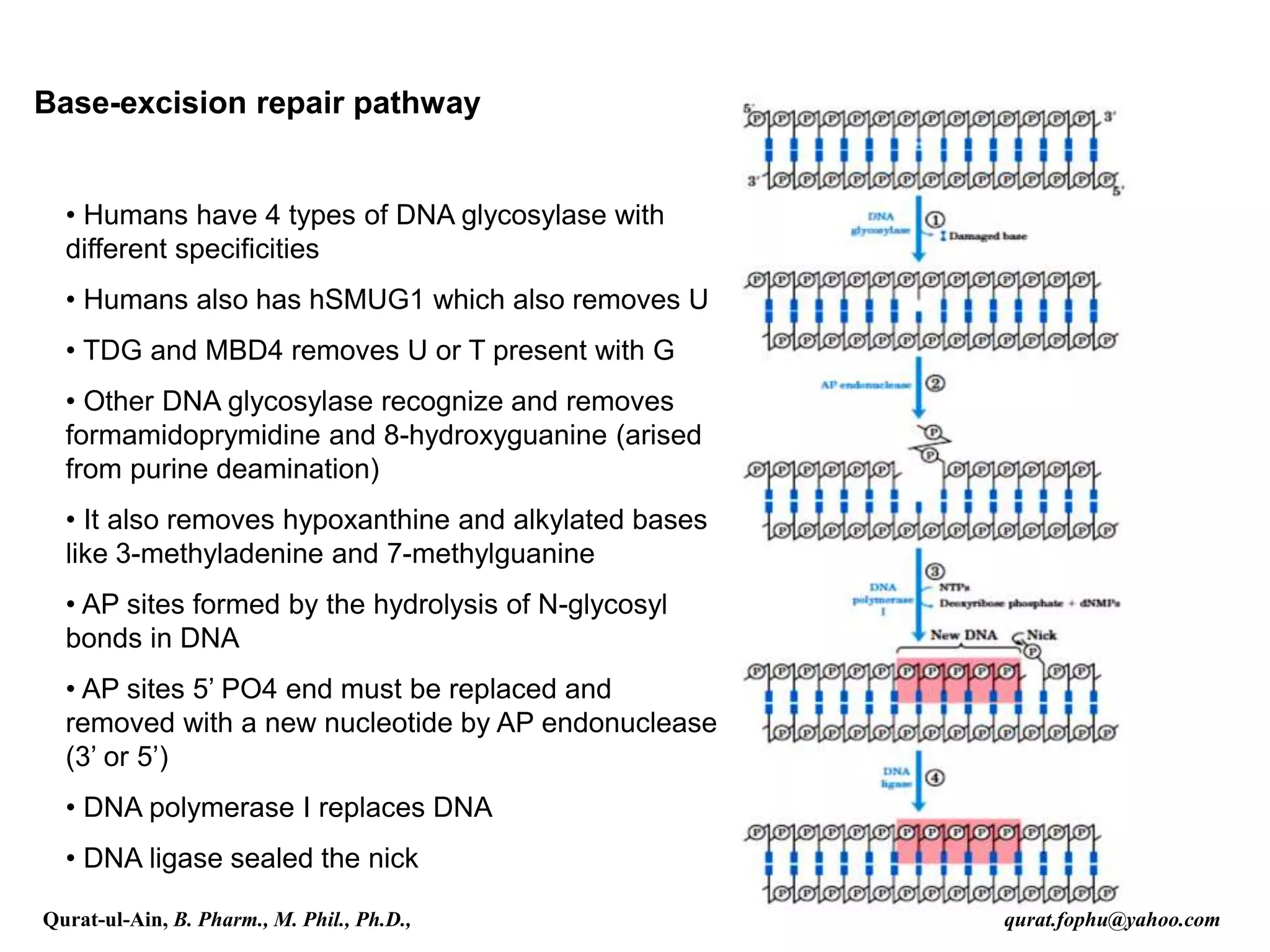
• Humans have 4 types of DNA glycosylase with
different specificities
• Humans also has hSMUG1 which also removes U
• TDG and MBD4 removes U or T present with G
• Other DNA glycosylase recognize and removes
formamidoprymidine and 8-hydroxyguanine (arised
from purine deamination)
• It also removes hypoxanthine and alkylated bases
like 3-methyladenine and 7-methylguanine
• AP sites formed by the hydrolysis of N-glycosyl
bonds in DNA
• AP sites 5’ PO4 end must be replaced and
removed with a new nucleotide by AP endonuclease
(3’ or 5’)
• DNA polymerase I replaces DNA
• DNA ligase sealed the nick
Qurat-ul-Ain, B. Pharm., M. Phil., Ph.D., qurat.fophu@yahoo.com
Mechanism of DNA Repair: Nucleotide-Excision Repair
• This repair type is imp for cell survival
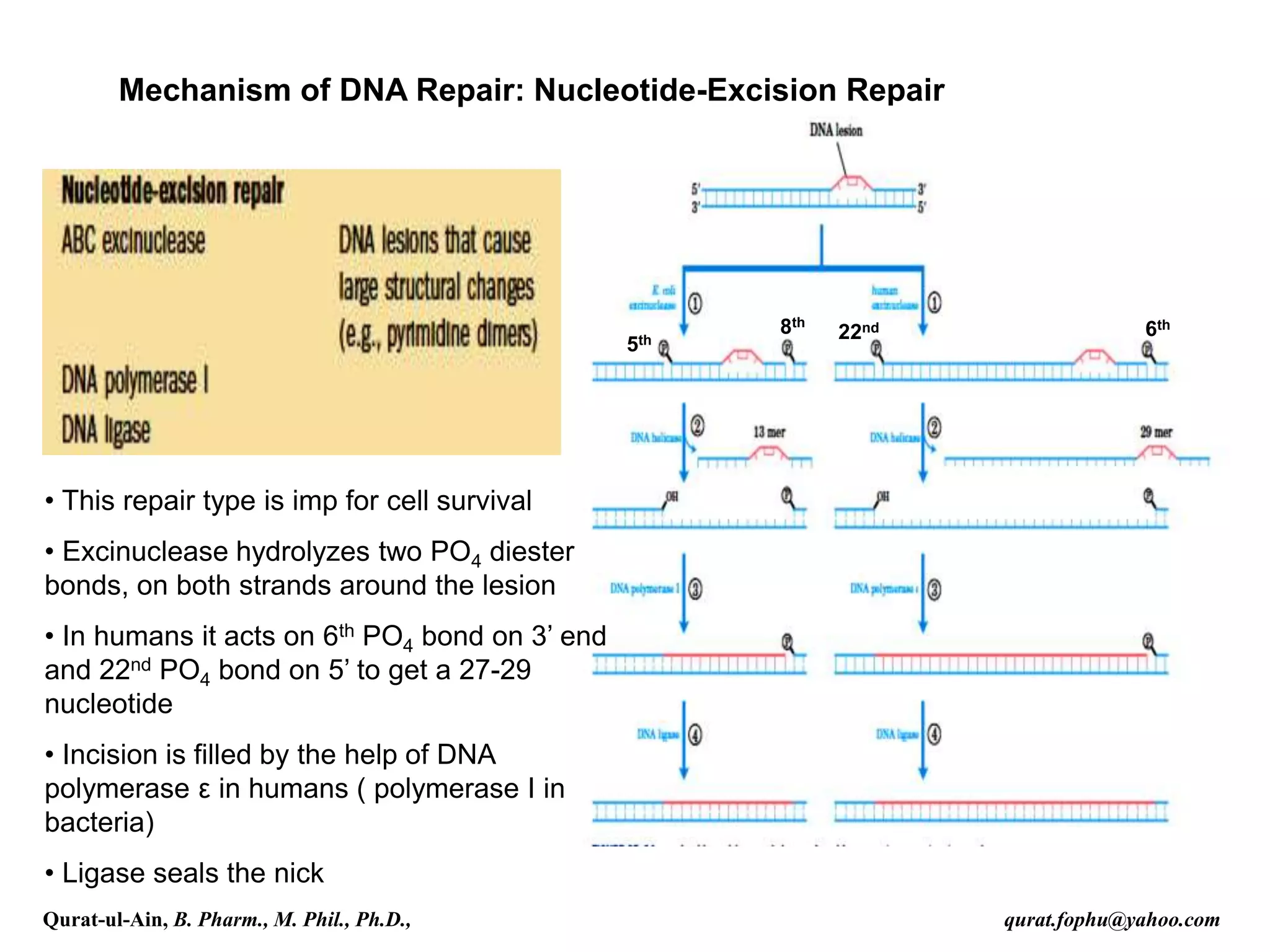
• Excinuclease hydrolyzes two PO4 diester
bonds, on both strands around the lesion
• In humans it acts on 6th PO4 bond on 3’ end
and 22nd PO4 bond on 5’ to get a 27-29
nucleotide
• Incision is filled by the help of DNA
polymerase ε in humans ( polymerase I in
bacteria)
• Ligase seals the nick
6th
22nd
8th
5th
Qurat-ul-Ain, B. Pharm., M. Phil., Ph.D., qurat.fophu@yahoo.com
Excinucleases DNA repair in E. Coli
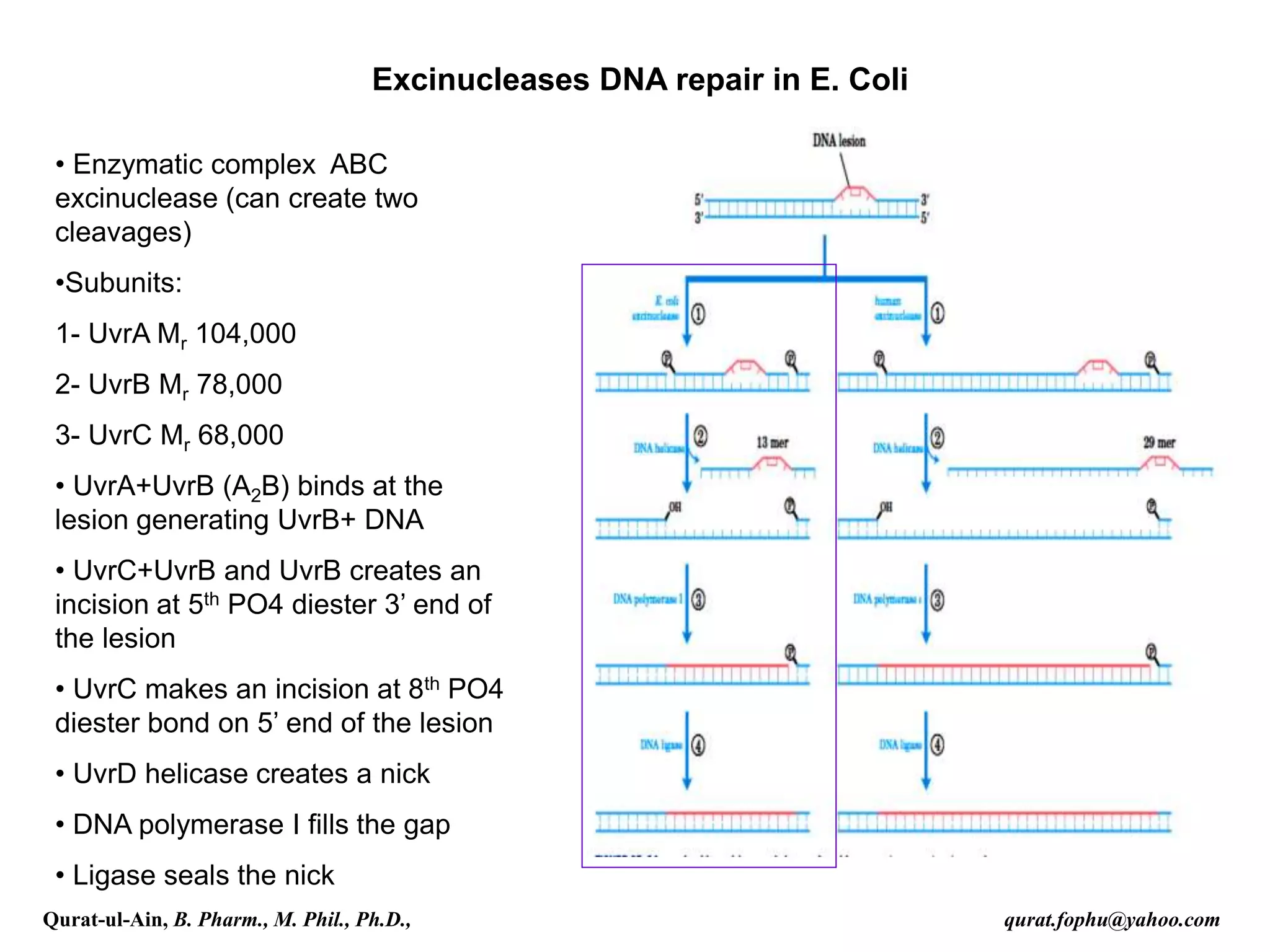
• Enzymatic complex ABC
excinuclease (can create two
cleavages)
•Subunits:
1- UvrA Mr 104,000
2- UvrB Mr 78,000
3- UvrC Mr 68,000
• UvrA+UvrB (A2B) binds at the
lesion generating UvrB+ DNA
• UvrC+UvrB and UvrB creates an
incision at 5th PO4 diester 3’ end of
the lesion
• UvrC makes an incision at 8th PO4
diester bond on 5’ end of the lesion
• UvrD helicase creates a nick
• DNA polymerase I fills the gap
• Ligase seals the nick
Qurat-ul-Ain, B. Pharm., M. Phil., Ph.D., qurat.fophu@yahoo.com
• Repair mechanism like nucleotide-
excision repair and base-excision repair
is tied to transcription in eukaryotes
• Deficiencies in any of the repair
enzymes leads to many serious illness
• This pathway helps to repair DNA from
various carcinogens like benzo[ά]
pyrene-guanine, cyclobutane pyrimidine
dimers and 6-4 photoproducts
Eukaryotic excinucleases DNA repair system : DNA damages caused by
cigarette smoke can be repair by this repair mechanism
Qurat-ul-Ain, B. Pharm., M. Phil., Ph.D., qurat.fophu@yahoo.com
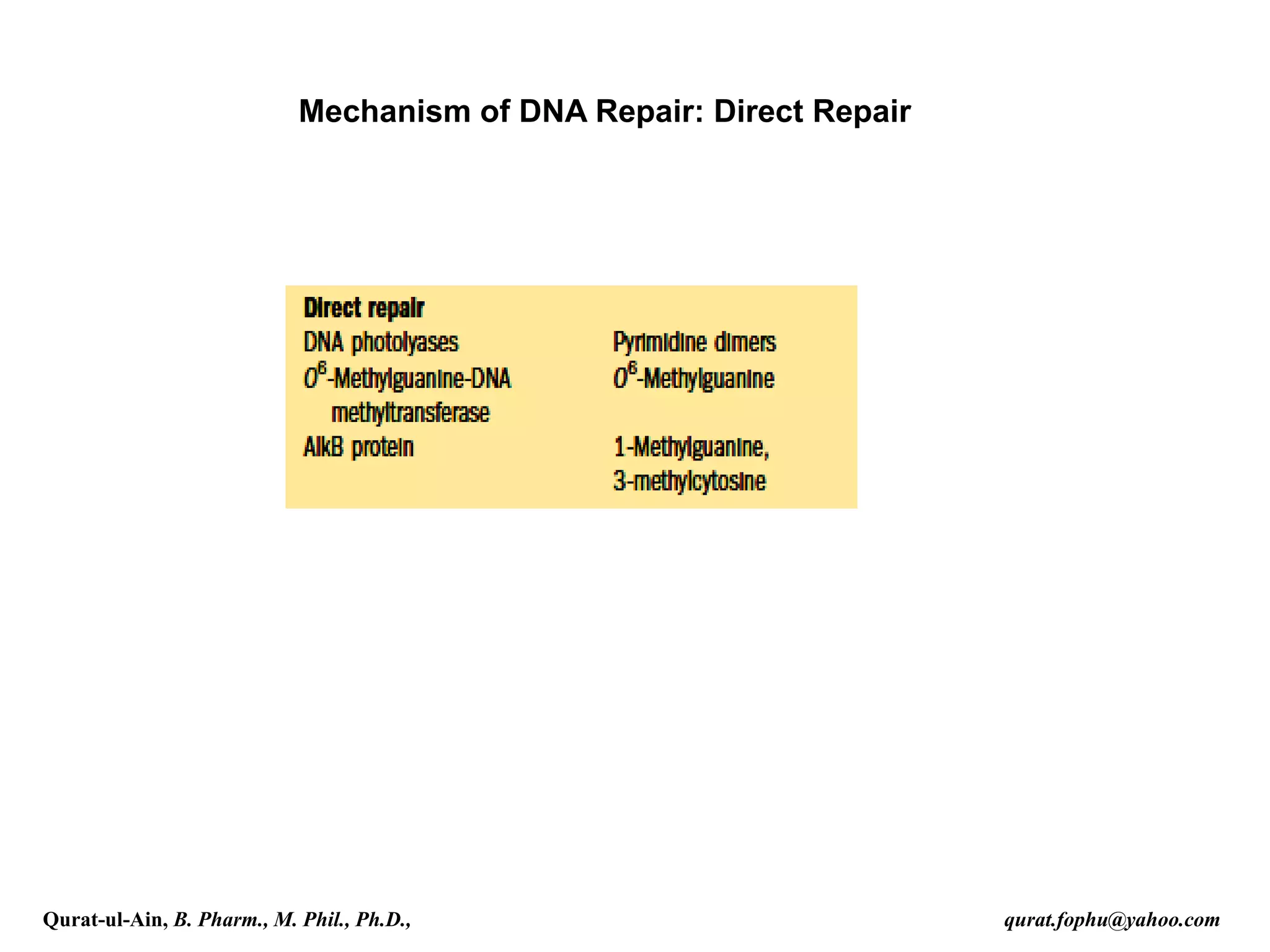
Mechanism of DNA Repair: Direct Repair
Qurat-ul-Ain, B. Pharm., M. Phil., Ph.D., qurat.fophu@yahoo.com
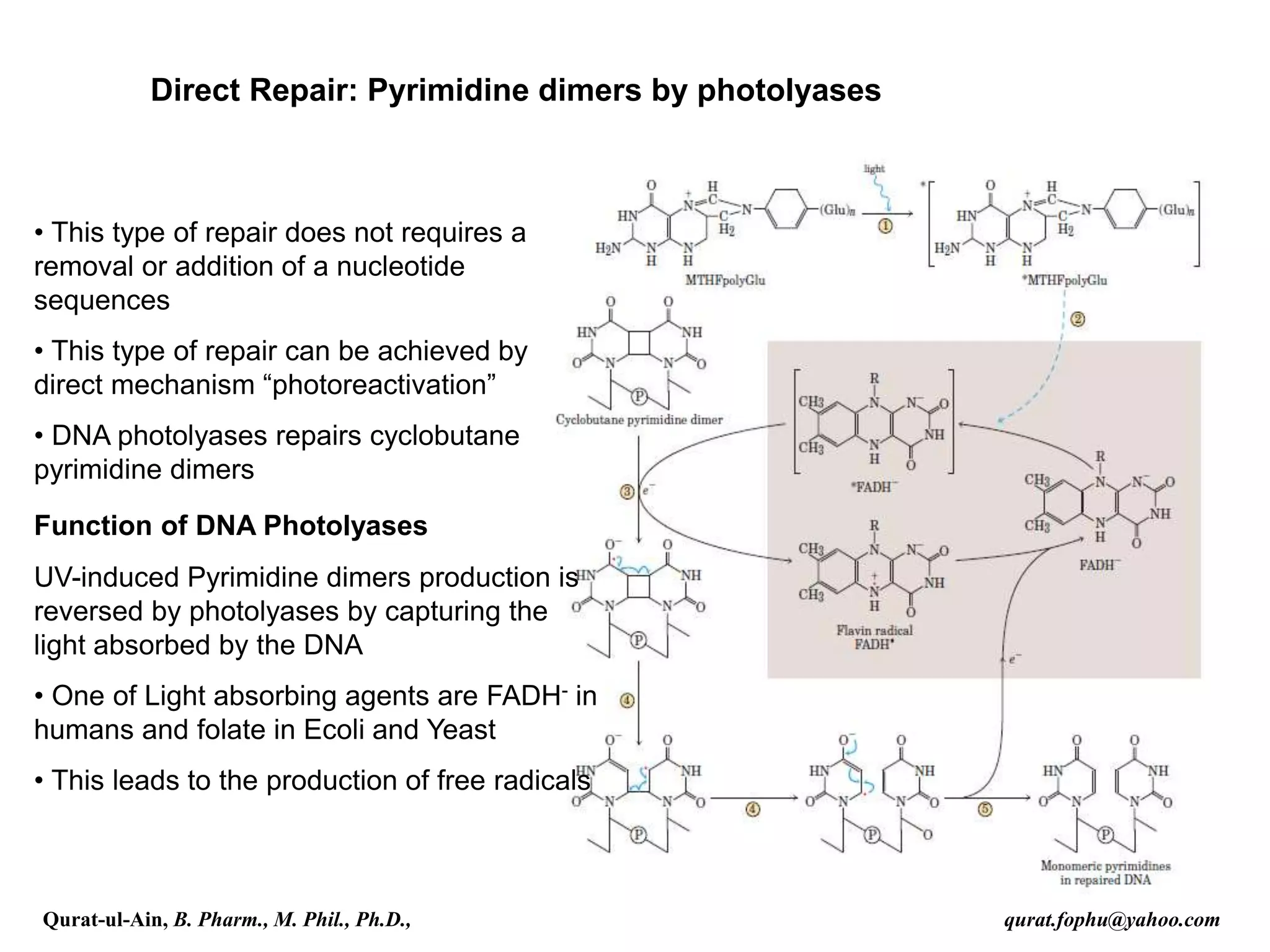
Direct Repair: Pyrimidine dimers by photolyases
• This type of repair does not requires a
removal or addition of a nucleotide
sequences
• This type of repair can be achieved by
direct mechanism “photoreactivation”
• DNA photolyases repairs cyclobutane
pyrimidine dimers
Function of DNA Photolyases
UV-induced Pyrimidine dimers production is
reversed by photolyases by capturing the
light absorbed by the DNA
• One of Light absorbing agents are FADH- in
humans and folate in Ecoli and Yeast
• This leads to the production of free radicals
Qurat-ul-Ain, B. Pharm., M. Phil., Ph.D., qurat.fophu@yahoo.com
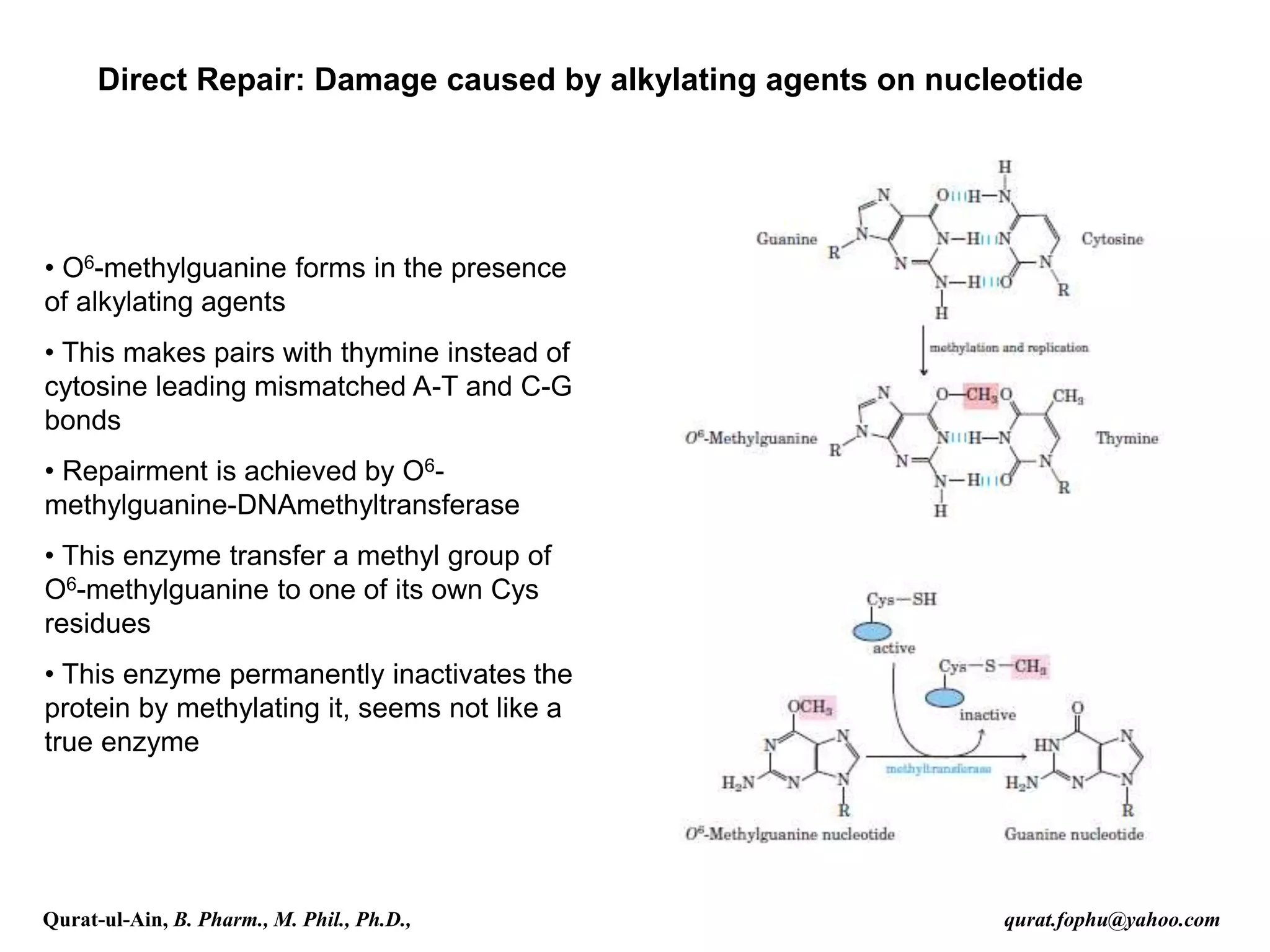
• O6-methylguanine forms in the presence
of alkylating agents
• This makes pairs with thymine instead of
cytosine leading mismatched A-T and C-G
bonds
• Repairment is achieved by O6-
methylguanine-DNAmethyltransferase
• This enzyme transfer a methyl group of
O6-methylguanine to one of its own Cys
residues
• This enzyme permanently inactivates the
protein by methylating it, seems not like a
true enzyme
Direct Repair: Damage caused by alkylating agents on nucleotide
Qurat-ul-Ain, B. Pharm., M. Phil., Ph.D., qurat.fophu@yahoo.com
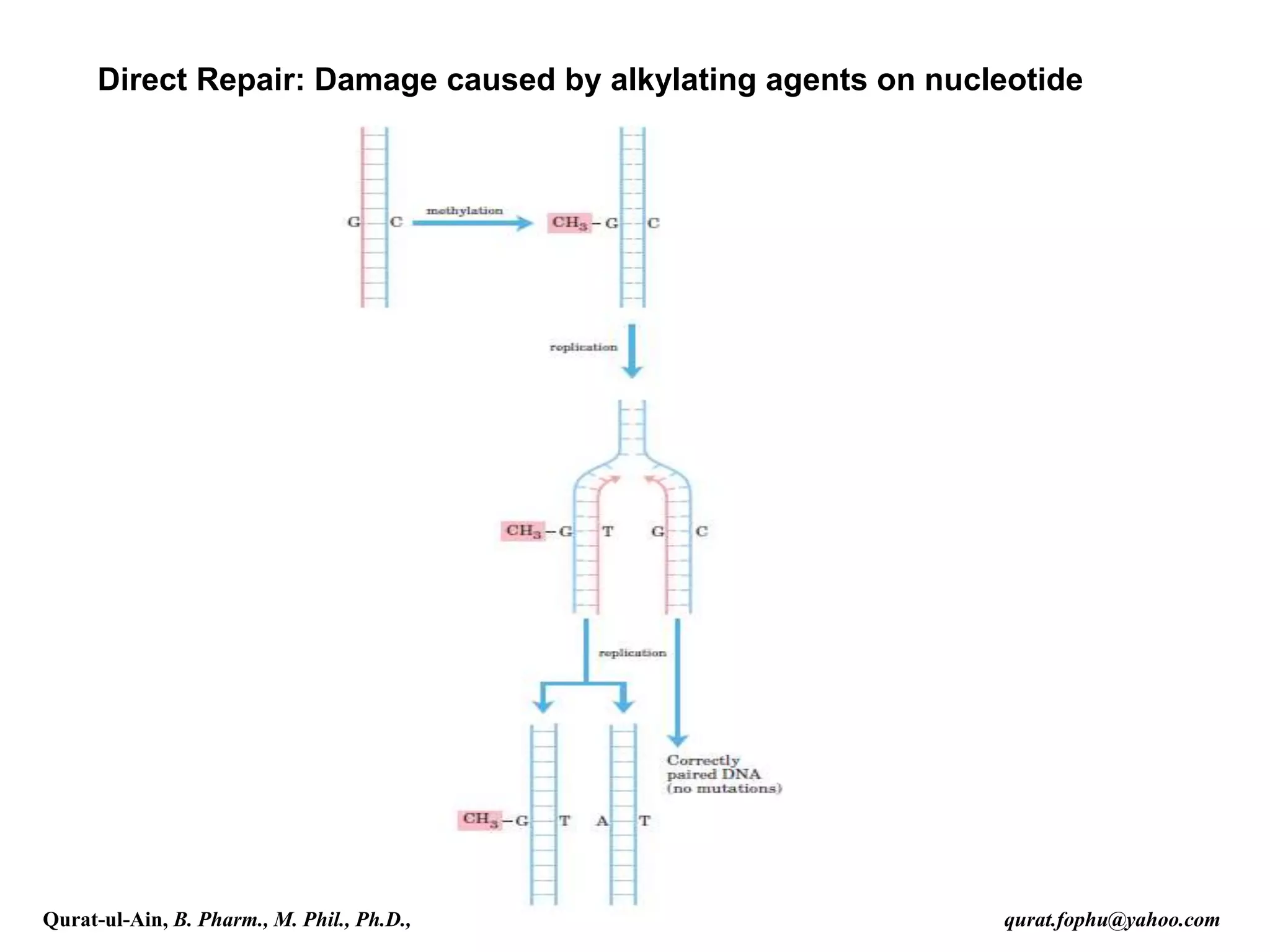
Direct Repair: Damage caused by alkylating agents on nucleotide
Qurat-ul-Ain, B. Pharm., M. Phil., Ph.D., qurat.fophu@yahoo.com
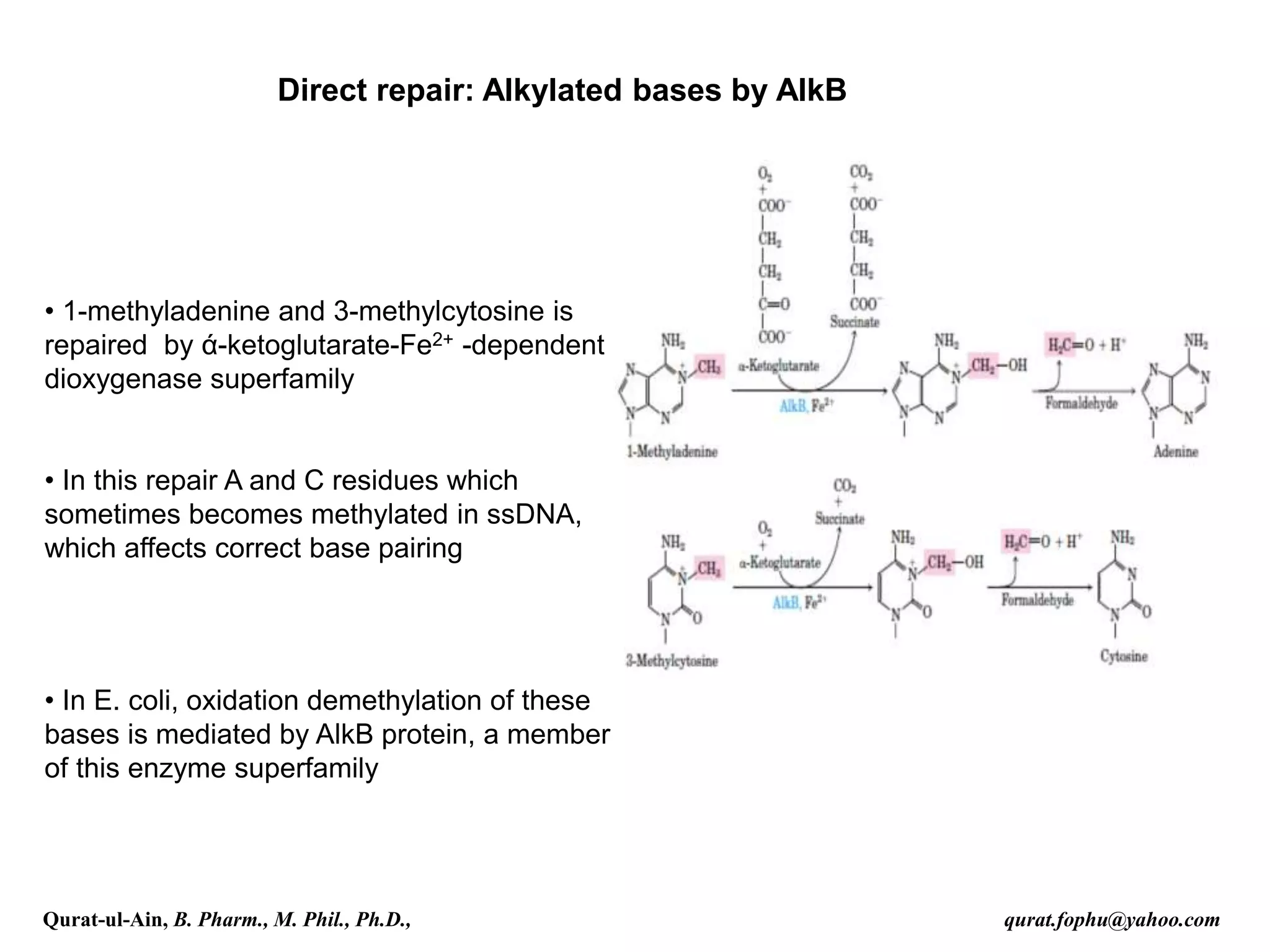
Direct repair: Alkylated bases by AlkB
• 1-methyladenine and 3-methylcytosine is
repaired by ά-ketoglutarate-Fe2+ -dependent
dioxygenase superfamily
• In this repair A and C residues which
sometimes becomes methylated in ssDNA,
which affects correct base pairing
• In E. coli, oxidation demethylation of these
bases is mediated by AlkB protein, a member
of this enzyme superfamily
Qurat-ul-Ain, B. Pharm., M. Phil., Ph.D., qurat.fophu@yahoo.com
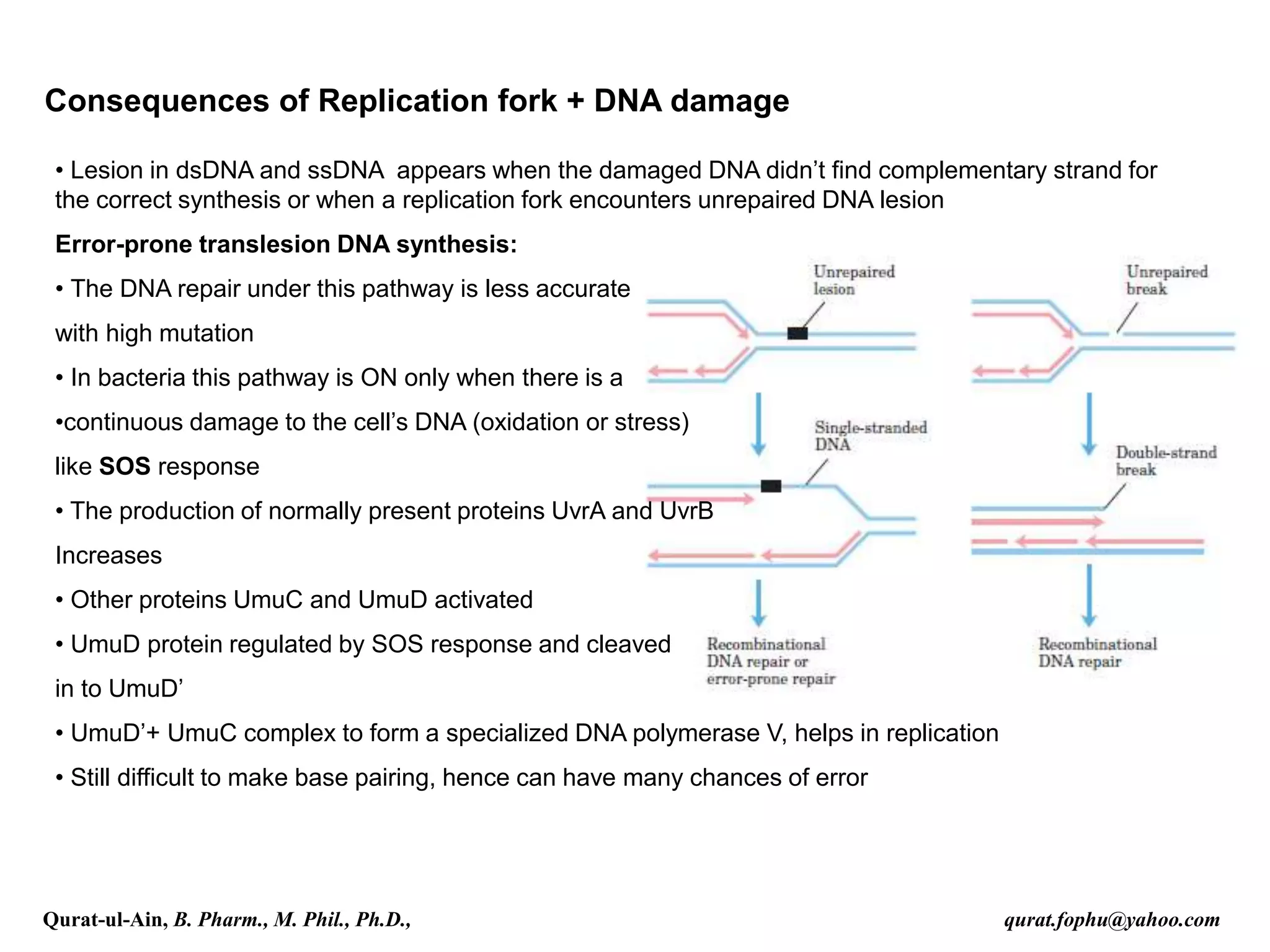
Consequences of Replication fork + DNA damage
• Lesion in dsDNA and ssDNA appears when the damaged DNA didn’t find complementary strand for
the correct synthesis or when a replication fork encounters unrepaired DNA lesion
Error-prone translesion DNA synthesis:
• The DNA repair under this pathway is less accurate
with high mutation
• In bacteria this pathway is ON only when there is a
•continuous damage to the cell’s DNA (oxidation or stress)
like SOS response
• The production of normally present proteins UvrA and UvrB
Increases
• Other proteins UmuC and UmuD activated
• UmuD protein regulated by SOS response and cleaved
in to UmuD’
• UmuD’+ UmuC complex to form a specialized DNA polymerase V, helps in replication
• Still difficult to make base pairing, hence can have many chances of error
Qurat-ul-Ain, B. Pharm., M. Phil., Ph.D., qurat.fophu@yahoo.com
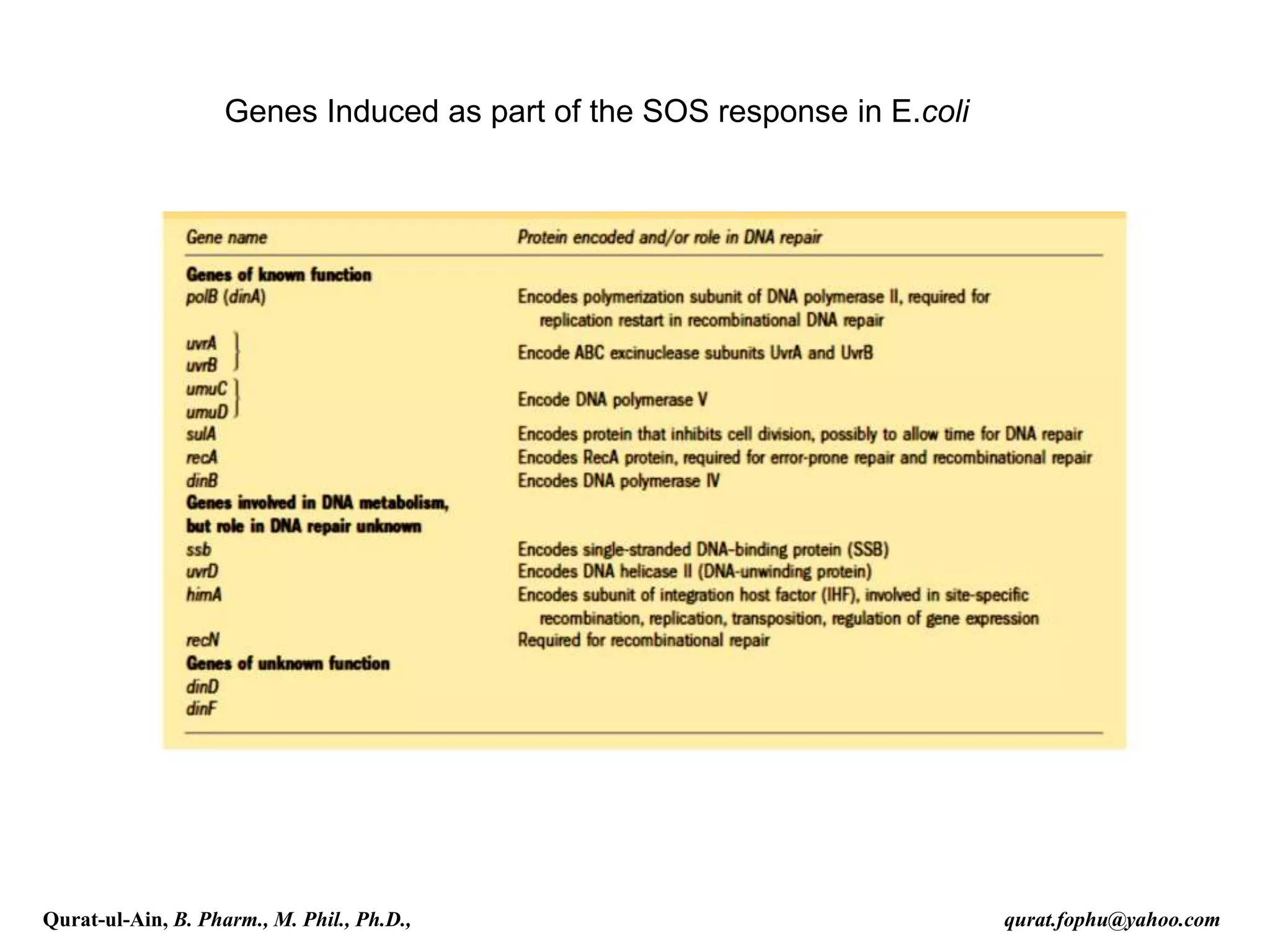
Genes Induced as part of the SOS response in E.coli
Qurat-ul-Ain, B. Pharm., M. Phil., Ph.D., qurat.fophu@yahoo.com
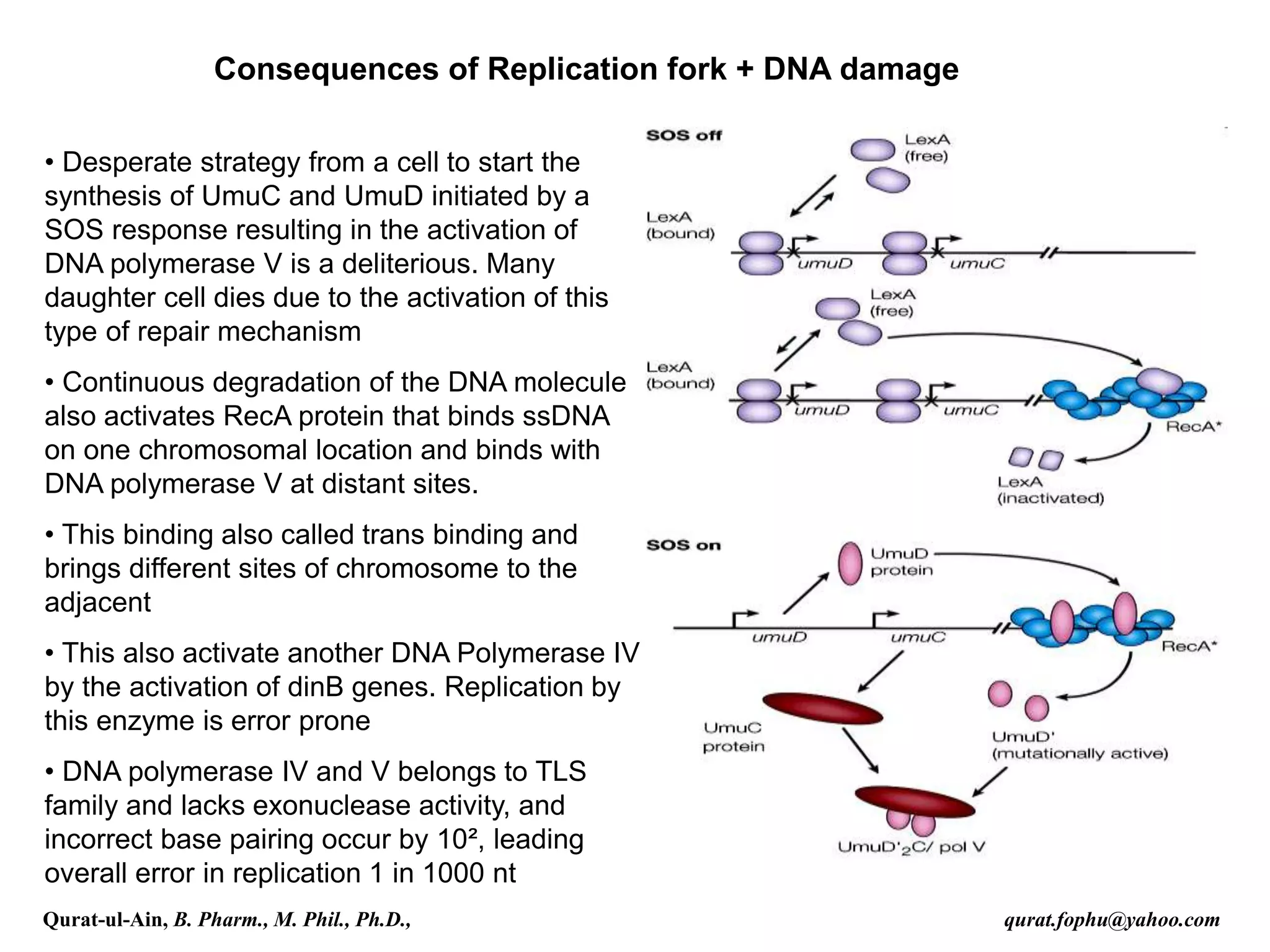
Consequences of Replication fork + DNA damage
• Desperate strategy from a cell to start the
synthesis of UmuC and UmuD initiated by a
SOS response resulting in the activation of
DNA polymerase V is a deliterious. Many
daughter cell dies due to the activation of this
type of repair mechanism
• Continuous degradation of the DNA molecule
also activates RecA protein that binds ssDNA
on one chromosomal location and binds with
DNA polymerase V at distant sites.
• This binding also called trans binding and
brings different sites of chromosome to the
adjacent
• This also activate another DNA Polymerase IV
by the activation of dinB genes. Replication by
this enzyme is error prone
• DNA polymerase IV and V belongs to TLS
family and lacks exonuclease activity, and
incorrect base pairing occur by 10², leading
overall error in replication 1 in 1000 nt
Qurat-ul-Ain, B. Pharm., M. Phil., Ph.D., qurat.fophu@yahoo.com
• DNA polymerase η (eta) found in all eukaryotes and initiates TLS
primary β, iota and λ have specialized role in base- excision repair
• These enzymes also have 5’-deoxyribose PO4 lyase activity
• After the removal of base by glycosylase and PO4 group by AP
endonuclease, Polymerase removes the abasic site (5’ PO4) and fill
in the short gap
• This leads to the reduction in DNA polymerase η activity due to the
short length of DNA
Consequences of Replication fork + DNA damage
Qurat-ul-Ain, B. Pharm., M. Phil., Ph.D., qurat.fophu@yahoo.com
You tube Links- DNA Repair
http://www.youtube.com/watch?v=kp0esidDr-c&feature=related
http://www.youtube.com/watch?v=nPS2jBq1k48&feature=related
http://www.youtube.com/watch?v=y16w-CGAa0Y&feature=related
http://www.youtube.com/watch?v=nUzyrBC0tTY
http://www.youtube.com/watch?v=idbGJsDXDFo&NR=1
Qurat-ul-Ain, B. Pharm., M. Phil., Ph.D., qurat.fophu@yahoo.com
Thank You…………..

Lecture.4, part.2 DNA Repair

  • 1.
    MOLECULAR BIOLOGY &GENETICS Basic Processes of Molecular Biology DNA repair 4rd Lecture, Part.2 Qurat-ul-Ain, B. Pharm., M. Phil., Ph.D., Visiting Assistant Professor Department of Physical Therapy, Faculty of Health& Medical Sciences, Hamdard University, Karachi, Pakistan Assistant Professor Department of Pharmaceutical Chemistry, Faculty of Pharmacy, Hamdard University, Karachi, Pakistan. Qurat-ul-Ain, B. Pharm., M. Phil., Ph.D., qurat.fophu@yahoo.com
  • 2.
    Mechanism of DNARepair: Mismatch Repair • Dam methylation recognition at N6 GATC 5’ on all Adenines under parent strand information • It is cell’s directed in hemimethylated newly synthesized strand from GATC sequences Qurat-ul-Ain, B. Pharm., M. Phil., Ph.D., qurat.fophu@yahoo.com
  • 3.
    Early steps ofmethyl-directed mismatched repair • MutL + MutS complex at 5’ GATC binds to all mismatched base pairs • MutH + MutS binds to GATC • MutL + MutS complex creates a loop on DNA at both sides • MutH has specific endonuclease activity cleaves unmethylated GATC seq. • MutH cleaves only G at 5’ side of GATC seq. Qurat-ul-Ain, B. Pharm., M. Phil., Ph.D., qurat.fophu@yahoo.com
  • 4.
    Finishing of methyl-directedmismatched repair When the mismatching is at 5’ • Ummethylated strand is degraded in 3’-5’ • This requires many enzymes •1-DNAhelicase II •2- SSB •3- Exonuclease I OR X •4- DNA polymerase III •5-DNA ligase When the mismatching is at 3’ • Exonuclease will be either VII (for degradation in to 3’-5’ or 5’- 3’) OR RecJ nuclease (degrades sDNA in 5’-3’) Qurat-ul-Ain, B. Pharm., M. Phil., Ph.D., qurat.fophu@yahoo.com
  • 5.
    Mechanism of DNARepair: Base Excision Repair • DNA glycosylases recognize the AP and abasic sites (generated by the cleavage of adenine and cytosine deamination) • Uracil DNA glycosylase removes uracil only from DNA • Enzyme recognize thymidine base from Uracil in DNA ie why DNA has thymidine and not uracil Qurat-ul-Ain, B. Pharm., M. Phil., Ph.D., qurat.fophu@yahoo.com
  • 6.
    Base-excision repair pathway •Humans have 4 types of DNA glycosylase with different specificities • Humans also has hSMUG1 which also removes U • TDG and MBD4 removes U or T present with G • Other DNA glycosylase recognize and removes formamidoprymidine and 8-hydroxyguanine (arised from purine deamination) • It also removes hypoxanthine and alkylated bases like 3-methyladenine and 7-methylguanine • AP sites formed by the hydrolysis of N-glycosyl bonds in DNA • AP sites 5’ PO4 end must be replaced and removed with a new nucleotide by AP endonuclease (3’ or 5’) • DNA polymerase I replaces DNA • DNA ligase sealed the nick Qurat-ul-Ain, B. Pharm., M. Phil., Ph.D., qurat.fophu@yahoo.com
  • 7.
    Mechanism of DNARepair: Nucleotide-Excision Repair • This repair type is imp for cell survival • Excinuclease hydrolyzes two PO4 diester bonds, on both strands around the lesion • In humans it acts on 6th PO4 bond on 3’ end and 22nd PO4 bond on 5’ to get a 27-29 nucleotide • Incision is filled by the help of DNA polymerase ε in humans ( polymerase I in bacteria) • Ligase seals the nick 6th 22nd 8th 5th Qurat-ul-Ain, B. Pharm., M. Phil., Ph.D., qurat.fophu@yahoo.com
  • 8.
    Excinucleases DNA repairin E. Coli • Enzymatic complex ABC excinuclease (can create two cleavages) •Subunits: 1- UvrA Mr 104,000 2- UvrB Mr 78,000 3- UvrC Mr 68,000 • UvrA+UvrB (A2B) binds at the lesion generating UvrB+ DNA • UvrC+UvrB and UvrB creates an incision at 5th PO4 diester 3’ end of the lesion • UvrC makes an incision at 8th PO4 diester bond on 5’ end of the lesion • UvrD helicase creates a nick • DNA polymerase I fills the gap • Ligase seals the nick Qurat-ul-Ain, B. Pharm., M. Phil., Ph.D., qurat.fophu@yahoo.com
  • 9.
    • Repair mechanismlike nucleotide- excision repair and base-excision repair is tied to transcription in eukaryotes • Deficiencies in any of the repair enzymes leads to many serious illness • This pathway helps to repair DNA from various carcinogens like benzo[ά] pyrene-guanine, cyclobutane pyrimidine dimers and 6-4 photoproducts Eukaryotic excinucleases DNA repair system : DNA damages caused by cigarette smoke can be repair by this repair mechanism Qurat-ul-Ain, B. Pharm., M. Phil., Ph.D., qurat.fophu@yahoo.com
  • 10.
    Mechanism of DNARepair: Direct Repair Qurat-ul-Ain, B. Pharm., M. Phil., Ph.D., qurat.fophu@yahoo.com
  • 11.
    Direct Repair: Pyrimidinedimers by photolyases • This type of repair does not requires a removal or addition of a nucleotide sequences • This type of repair can be achieved by direct mechanism “photoreactivation” • DNA photolyases repairs cyclobutane pyrimidine dimers Function of DNA Photolyases UV-induced Pyrimidine dimers production is reversed by photolyases by capturing the light absorbed by the DNA • One of Light absorbing agents are FADH- in humans and folate in Ecoli and Yeast • This leads to the production of free radicals Qurat-ul-Ain, B. Pharm., M. Phil., Ph.D., qurat.fophu@yahoo.com
  • 12.
    • O6-methylguanine formsin the presence of alkylating agents • This makes pairs with thymine instead of cytosine leading mismatched A-T and C-G bonds • Repairment is achieved by O6- methylguanine-DNAmethyltransferase • This enzyme transfer a methyl group of O6-methylguanine to one of its own Cys residues • This enzyme permanently inactivates the protein by methylating it, seems not like a true enzyme Direct Repair: Damage caused by alkylating agents on nucleotide Qurat-ul-Ain, B. Pharm., M. Phil., Ph.D., qurat.fophu@yahoo.com
  • 13.
    Direct Repair: Damagecaused by alkylating agents on nucleotide Qurat-ul-Ain, B. Pharm., M. Phil., Ph.D., qurat.fophu@yahoo.com
  • 14.
    Direct repair: Alkylatedbases by AlkB • 1-methyladenine and 3-methylcytosine is repaired by ά-ketoglutarate-Fe2+ -dependent dioxygenase superfamily • In this repair A and C residues which sometimes becomes methylated in ssDNA, which affects correct base pairing • In E. coli, oxidation demethylation of these bases is mediated by AlkB protein, a member of this enzyme superfamily Qurat-ul-Ain, B. Pharm., M. Phil., Ph.D., qurat.fophu@yahoo.com
  • 15.
    Consequences of Replicationfork + DNA damage • Lesion in dsDNA and ssDNA appears when the damaged DNA didn’t find complementary strand for the correct synthesis or when a replication fork encounters unrepaired DNA lesion Error-prone translesion DNA synthesis: • The DNA repair under this pathway is less accurate with high mutation • In bacteria this pathway is ON only when there is a •continuous damage to the cell’s DNA (oxidation or stress) like SOS response • The production of normally present proteins UvrA and UvrB Increases • Other proteins UmuC and UmuD activated • UmuD protein regulated by SOS response and cleaved in to UmuD’ • UmuD’+ UmuC complex to form a specialized DNA polymerase V, helps in replication • Still difficult to make base pairing, hence can have many chances of error Qurat-ul-Ain, B. Pharm., M. Phil., Ph.D., qurat.fophu@yahoo.com
  • 16.
    Genes Induced aspart of the SOS response in E.coli Qurat-ul-Ain, B. Pharm., M. Phil., Ph.D., qurat.fophu@yahoo.com
  • 17.
    Consequences of Replicationfork + DNA damage • Desperate strategy from a cell to start the synthesis of UmuC and UmuD initiated by a SOS response resulting in the activation of DNA polymerase V is a deliterious. Many daughter cell dies due to the activation of this type of repair mechanism • Continuous degradation of the DNA molecule also activates RecA protein that binds ssDNA on one chromosomal location and binds with DNA polymerase V at distant sites. • This binding also called trans binding and brings different sites of chromosome to the adjacent • This also activate another DNA Polymerase IV by the activation of dinB genes. Replication by this enzyme is error prone • DNA polymerase IV and V belongs to TLS family and lacks exonuclease activity, and incorrect base pairing occur by 10², leading overall error in replication 1 in 1000 nt Qurat-ul-Ain, B. Pharm., M. Phil., Ph.D., qurat.fophu@yahoo.com
  • 18.
    • DNA polymeraseη (eta) found in all eukaryotes and initiates TLS primary β, iota and λ have specialized role in base- excision repair • These enzymes also have 5’-deoxyribose PO4 lyase activity • After the removal of base by glycosylase and PO4 group by AP endonuclease, Polymerase removes the abasic site (5’ PO4) and fill in the short gap • This leads to the reduction in DNA polymerase η activity due to the short length of DNA Consequences of Replication fork + DNA damage Qurat-ul-Ain, B. Pharm., M. Phil., Ph.D., qurat.fophu@yahoo.com
  • 19.
    You tube Links-DNA Repair http://www.youtube.com/watch?v=kp0esidDr-c&feature=related http://www.youtube.com/watch?v=nPS2jBq1k48&feature=related http://www.youtube.com/watch?v=nPS2jBq1k48&feature=related http://www.youtube.com/watch?v=y16w-CGAa0Y&feature=related http://www.youtube.com/watch?v=y16w-CGAa0Y&feature=related http://www.youtube.com/watch?v=nUzyrBC0tTY http://www.youtube.com/watch?v=idbGJsDXDFo&NR=1 Qurat-ul-Ain, B. Pharm., M. Phil., Ph.D., qurat.fophu@yahoo.com
  • 20.