MOLECULAR BIOLOGY & GENETICS
Basic Processes of Molecular Biology
DNA replication
3rd Lecture, Part.2
Qurat-ul-Ain, B. Pharm., M. Phil., Ph.D.,
Visiting Assistant Professor
Department of Physical Therapy, Faculty of Health& Medical Sciences,
Hamdard University, Karachi, Pakistan
Assistant Professor
Department of Pharmaceutical Chemistry, Faculty of Pharmacy, Hamdard
University, Karachi, Pakistan.
Qurat-ul-Ain, B. Pharm., M. Phil., Ph.D., qurat.fophu@yahoo.com
Meselson-Stahl experiment
DNA replication is Semiconservative
Qurat-ul-Ain, B. Pharm., M. Phil., Ph.D., qurat.fophu@yahoo.com
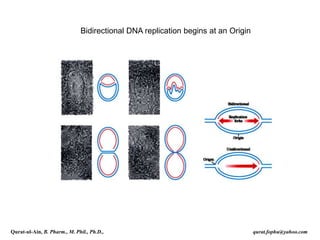
Bidirectional DNA replication begins at an Origin
Qurat-ul-Ain, B. Pharm., M. Phil., Ph.D., qurat.fophu@yahoo.com
DNA Replication and
Recombination
Synthesis of DNA molecule: in 3 steps
1- Initiation
2- Elongation
3-Termination
These processes required many different types of enzymes
1- DNA replicase system or replisome
2- Helicases
3- Topoisomerases
4- Primase
5- DNA ligases
Qurat-ul-Ain, B. Pharm., M. Phil., Ph.D., qurat.fophu@yahoo.com
Initiation
E.Coli DNA replication origin called OriC containing 246 bp.
For replication specific sequencing are present which is recognized by the enzymes
involved in the initiation:
1- 9 bp sequences on which DnaA protein binds
• DnaA-binding sites (I sites), IHF (Integration host factor) and FIS (factor for inversion
stimulation).
2- 13 bp rich A=T sequences on which DNA unwinding element (DUE)
IHF FIS
Qurat-ul-Ain, B. Pharm., M. Phil., Ph.D., qurat.fophu@yahoo.com
Initiation
• DnaA protein is a member of the AAA+
ATPase protein family
Function: formation of oligomers and
hydrolyze ATP (do things slowly)
• 8 DnaA protein molecules in
ATP bound form makes a
helical complex
emcompassing the R and I
sites in oriC.
• It has high affinity towards R
sites than I
• It binds to R sites in ATP or
ADP-bound form whereas It
binds to I sites in only ATP-
bound form
Qurat-ul-Ain, B. Pharm., M. Phil., Ph.D., qurat.fophu@yahoo.com
Initiation
• The tight right directional helical emcompassing of the
initiation DnaA proteins creates a positive but effective
supercoiling of the DNA
• This supercoil creates a stress in the DNA molecule
• This triggers the denaturation in A=T rich DUE region
• Replication starts at oriC region in the presence of IHF,
HU and FIS that helps in bending the DNA molecule.
• At this step AAA-ATPase protein DnaC protein helps
DnaB protein to bind on the newly denatured DNA strands
How DnaC docks DnaB protein?
• Hexamer of each DnaC subunit bound with ATP binds
with hexameric ring-shaped DnaB helicase.
• This interaction of DnaB-DnaC opens DnaB ring, further
interaction required DnaA
• 2 out of 6 hexamer of DnaB are loaded on DUE on to
each strand.
• DnaC+ATP hydrolyzed, releasing DnaC and DnaB bound
to the DNA.
Qurat-ul-Ain, B. Pharm., M. Phil., Ph.D., qurat.fophu@yahoo.com
Key step in replication: DnaB helicase
docking on the DNA
DnaB unwinds the DNA from 5’→ 3’ of
single stranded DNA, both strands moves
in opposite direction.
• This DNA with DnaB helicase has two
replication forks
• DNA polymerase III holoenzyme is linked
via epsilon subunits
• Many other single stranded DNA-binding
protein (SSB) are involved that binds on
each of the DNA strand at the fork
• Simultaneously DNA gyrase or DNA
topoisomerase II relieves the tension in
the DNA molecule at the fork
• Initiation is regulated and occur once in
every cell cycle
• DNA polymerase III and its β subunit
when loaded on to the DNA, Hda proteins
interact with β subunit and binds with
DnaA
Qurat-ul-Ain, B. Pharm., M. Phil., Ph.D., qurat.fophu@yahoo.com
• This interaction stimulates the hydrolysis of its bound ATP
• Hydrolysis of ATP leads of disassembly of the DNA complex at the fork
• ATP converts in to ADP this cycles the protein between its inactive and active
forms on a time scale of 20 to 40 mins.
The oriC DNA is methylated by Dam methylase at N6 of adenine 5’ GATC
region (palindromic sequence)
Qurat-ul-Ain, B. Pharm., M. Phil., Ph.D., qurat.fophu@yahoo.com
• Completion of DNA replication the oriC region of DNA is methylated but the
newly strand is not
• The hemimethylated oriC sequences are now ready to interact with the plasma
membrane with the help of a protein called SeqA
• OriC is released from the plasma membrane and SeqA is dissociates and DNA
is fully methylated by Dam methylase
Qurat-ul-Ain, B. Pharm., M. Phil., Ph.D., qurat.fophu@yahoo.com
Elongation of the DNA: Leading and Lagging strand synthesis
Leading strand synthesis:
• It begins with the synthesis by primase RNA
primer (DnaG,10-60 nucleotide) at the fork
• DnaG + DnaB helicase, primer synthesis takes
place opposite in the direction of helicase
movement
• DnaB helicase moves along the DNA strand, the
lagging strand
• dNTs keep adding to the DNA strand by DNA
polymerases III + DnaB complex moving on the
opposite strand
Lagging strand: Okazaki fragments
• On the other hand, Lagging strand synthesis
starts by the formation of okazaki fragments
replication direction is always from 5’- 3’
• Primase synthesize RNA primer and DNA
polymerase III + DnaB adds dNTs to the lagging
strand like in leading strand
Qurat-ul-Ain, B. Pharm., M. Phil., Ph.D., qurat.fophu@yahoo.com
Clamp loading complex of DNA polymerase III
• It contains two subunits along with the subunits
along with the ….. Subunits + AAA + ATPase
• This whole complex binds to ATP and the new β
sliding clamp
• This creates a stretch on the dimeric clamp,
opening up the ring at one subunit interface
• Lagging strand slipped into the ring via breaking
• Clamp loader hydrolyzes ATP, releasing the β
sliding clamp
• This allows it to close around the DNA
• Replisome promote fast DNA synthesis adding ~
1000 nucleotides/ to lagging and leading strand.
• Once okazaki fragment is completed the RNA
primer is removed and replace it with DNA
polymerase I
• The nick is sealed by Ligase
Qurat-ul-Ain, B. Pharm., M. Phil., Ph.D., qurat.fophu@yahoo.com
Okazaki fragments:
Qurat-ul-Ain, B. Pharm., M. Phil., Ph.D., qurat.fophu@yahoo.com
Okazaki fragments synthesis complexity:
• DNA polymerase III forms a dimer around both the
strands bringing the strand close together
• DnaB + DnaG complex forms at the replication fork
called Replisome
• DNA polymerase III has two sets of core subunits
one synthesize the leading strand while the other
synthesize the Okazaki fragments on the lagging
strand
• It is noted that at the Primosome there is β sliding
clamp complex is present which is prepared by DNA
polymerase III
• At the completion of the Okazaki fragments the
replication halts, core subunits of the DNA
polymerase III dissociates from β sliding clamp and
reassociates with the new β sliding clamp
• This initiates the synthesis of new Okazaki
fragments
Qurat-ul-Ain, B. Pharm., M. Phil., Ph.D., qurat.fophu@yahoo.com
DNA ligation by Ligases
Qurat-ul-Ain, B. Pharm., M. Phil., Ph.D., qurat.fophu@yahoo.com
DNA Ligases
• Ligase enzyme catalyzes the formation of a phosphodiester bond between a 3’
hydroxyl at the end of one DNA strand and a 5’ phosphate at the end of another
strand
• Via adenylation the phosphate can be activated
Properties of DNA ligase
• It is isolated from viruses and eukaryotes use ATP however, DNA ligases from
bacteria are different
a) Many DNA ligase use NAD+ a cofactor that normally functions in hydride transfer
reactions, a source of the AMP activating group
b) DNA ligase can also be very useful in DNA recombination experiments
Qurat-ul-Ain, B. Pharm., M. Phil., Ph.D., qurat.fophu@yahoo.com
Replication in Eukaryotes
Qurat-ul-Ain, B. Pharm., M. Phil., Ph.D., qurat.fophu@yahoo.com
Cell –Cycle control System and Activated Protein Kinases
• Cyclin dependent kinases (cdks) a protein kinases which actually regulates
major events of cell cycle such as DNA replication, mitosis and cytokinesis
• In crease cdks levels during and at the beginning of mitosis leads to the
increase phosphorylation of proteins that controls chromosome condensation,
nuclear envelop breakdown and spindle assembly
• However cdks activity is control by many complexes and proteins such as
cyclins, cyclin activating kinases (CAK), cdk inhibitor protein (CKI), SCF, and
Anaphase-promoting complex (APC), cdk25 and wee1
Qurat-ul-Ain, B. Pharm., M. Phil., Ph.D., qurat.fophu@yahoo.com
Cyclins-cdks complex
• cdks require cyclins for their activation
• Cyclins are synthesized and degraded in each cell cycle
• cdks level remain normal through out the cell cycle, however changes in
the levels of cyclins causes the assembly of cyclin-cdk complexes- leads to
the activation and triggering of the cell-cycle events
• There are four classes of cyclins G1/S-cyclins, S-cyclins, M-cyclins and
G1 cyclins
• Mode of activation is each complex phosphorylate the target substrate
proteins and can change the activity of activation according the levels of
substrate that changes during or after the cell cycle
• CAK activates the cyclin-cdk complex by phosphorylating an a.a near the
cdk active site—which eventually activates the target protein and induce sp
cell-cycle activity
Qurat-ul-Ain, B. Pharm., M. Phil., Ph.D., qurat.fophu@yahoo.com
Regulation of cyclin-cdk complex
• The activity of the complex can be inhibited by phosphorylation via Wee1, a
protein kinase and activation can be done by a phosphatases which
dephosphorylate the complex via cdc25
• The activity of the complex can be regulated by another kinases cdk
inhibitor proteins (CKIs), which controls mainly S and G 1 phases . Upon
binding conformational changes takes place and makes it inactive
Qurat-ul-Ain, B. Pharm., M. Phil., Ph.D., qurat.fophu@yahoo.com
Cyclical proteolysis and cell-cycle control system
• The rate limiting step in cyclin destruction is the final ubiquitin-transfer
reaction performed by 2 ubiquitin ligases, APC complex and SCF
• SCF in S and G1 phase ubiquitinate the complex G1/S-cyclins and
certain CKI that are involve in S phase initiation
• However M phase is controlled by APC complex, it proteolyzed and
ubiquitinites cyclins and other proteins involve in M phase
• SCF activity is constant throughout the cell cycle, however APC levels
changes with cell-cycle stages
Qurat-ul-Ain, B. Pharm., M. Phil., Ph.D., qurat.fophu@yahoo.com
Cell –Cycle control and Transcriptional Regulation
• In more complex cell cycle, cyclins are controlled not only by there levels but
by controlling at the gene transcription level and its synthesis.
Qurat-ul-Ain, B. Pharm., M. Phil., Ph.D., qurat.fophu@yahoo.com
Intracellular control of cell cycle events
• A cell must go only one time for replication and whole genome must be
copied only once and with full accuracy
• The maintenance of each phase of cell-cycle that is G phase fusing with
S phase fusing with G1 phase fusing with M phase and then G phase
again, requires highly skilled and accuracy and constant adding of
activating substrates to maintain the smooth overlap of the phases at
different stages of cell-cycle
• Origin of replication (ORC) binds to the replication site and serves as
platform for all the other regulatory proteins and complexes necessary for
the replication
• For eg cdc6 a regulator protein, its level increases only in G1 phase
where it is required to bind with a complex with closely related proteins,
minichromosomal maintenance proteins (Mcm) , resulting in the formation
of a large pre-replicative complex or pre-RC complex
Qurat-ul-Ain, B. Pharm., M. Phil., Ph.D., qurat.fophu@yahoo.com
Intracellular control of cell cycle events
• The activation of the S-cdk in late G1 initiates DNA replication, another
kinases phosphorylate the Pre-Rc complex
• S-Cdk helps cdc6 protein to dissociate from ORC after an origin is fired--- this
leads to the disassembly of pre-RC which prevents replication from occurring
again at the same origin
• Secondly It prevents cdc6 and Mcm proteins from reassembling at any origin
• It phosphorylates the cdc6, and triggers the ubiquitinylation by the SCF
protein
• S-Cdk also phoshorylates certain Mcm proteins which triggers their export
from the nulceus, further proving that Mcm complex cannot bind to the
replication origin
• At the end all Cdk levels becomes zero, this dephosphorylate the cdc6 and
Mcm proteins allow pre-Rc complex assembly to occur once again
Qurat-ul-Ain, B. Pharm., M. Phil., Ph.D., qurat.fophu@yahoo.com
Replication in Eukaryotes Cells
Cyclin dependent kinases (CDKs) regulation control over DNA replication
• The cyclins destruction by Ubiquiton-dependent proteolysis at the end of M phase
• In the absence of CDKs the pre-replicative complexes (pre-RCs) can be formed on
replication sites
• In fast growing cells, this pre-RCs complex forms at the end M phase. Pre-RCs are called
licensing
• In eukaryotes the replication started by the formation of a mini chromosome maintenance
(MCM) proteins
• Many diff. types of MCM proteins exits like MCM2-MCM7 helicase also resembles like
DnaB helicase, loads on ORC along CDC6 (cell division cycle) and CDT1 (Cell division
transcript 1)
• Replication requires the S phase, cyclin-cyclin dependent kinase complexes and CDC7-
DBF4
• For replication both complexes must be together and the phosphorylating proteins on the
pre-RCs complex
Qurat-ul-Ain, B. Pharm., M. Phil., Ph.D., qurat.fophu@yahoo.com
Control of replication achieved by inhibiting the synthesis of more complexes
by CDK2 and other cyclins
Qurat-ul-Ain, B. Pharm., M. Phil., Ph.D., qurat.fophu@yahoo.com
Termination
• Two replication forks of a circular E. coli
chromosome meet at the terminus having many
copies of 20 bp copies called Ter
• Ter sequence trap the replication fork
• Ter is for protein Tus (terminus utilization
substance) binding
• Ter-Tus complex works per replication cycle
upon collision of either fork
• Ter prevent over replication by replication fork
and halts upon collision of other fork
• The sequences that comes in between Ter-Tus
will be replicated only , making catenane circular
chromosomes
• DNA synthesis by this is called catenanes
• To separate catanades of circular E. coli requires
topoisomerase IV
• This separates chromosomes and cells divide in
to daughter cells
• Other type of circular chromosome termination
phase of replication like viruses- infects
eukaroytes cells are the same
Qurat-ul-Ain, B. Pharm., M. Phil., Ph.D., qurat.fophu@yahoo.com
To ensure that no replication origin fires more than once, the assembly of the replication
apparatus at origins is tightly regulated by the cell-cycle machinery. The first step in the
replication reaction (licensing) involves the loading of the replicative helicase Mcm2-7 at
origins. This requires the concerted action of the six subunit Origin Recognition Complex
(ORC), Cdc6 and Cdt1. Together this complex bound to origins is called the pre-
replicative complex or pre-RC (Figure 2). This complex can only form in G1 phase of the
cell cycle when the APC/C is active and CDK activity is low. This is because CDKs and
other APC/C targets such as Geminin are potent inhibitors of pre-RC formation. Once
cells enter S-phase, the APC/C is inactivated, CDK activity (and also Geminin) rises and
any further pre-RC formation is blocked.
In addition to its role as an inhibitor of pre-RC formation, CDK, together with a second
kinase - DDK (Cdc7/Dbf4), are essential positive regulators of replication initiation. CDK
phosphorylates the two essential initiation factors Sld2 and Sld3, which in turn allows
binding to another essential initiation factor called Dpb11 (Figure 2). How CDK
phosphorylation of these targets facilitates replication initiation is not known, but the
transient association of these factors at origins has been termed the pre-initiation
complex (pre-IC) and it is likely to be a transient intermediate in the establishment of
bidirectional replication forks (Figure 2). DDK targets the MCM helicase and is likely to be
responsible for activating this enzyme, which is loaded in G1 phase in an inactive state.
Since CDK activity both inhibits pre-RC formation and is essential to initiate replication,
this produces a switch that only allows replication initiation in S-phase.
Our research is focused on the pre-initiation complex step in the replication reaction. This
step is the key CDK regulatory step, but the function of this intermediate is not known.
Furthermore, the pre-IC may also integrate information from other kinases, such as the
DNA damage checkpoint and may be responsible for regulating how efficiently and when
an origin fires during S-phase. Much of our understanding of the pre-IC in eukaryotes
comes from studies in budding yeast, but how replication initiation is regulated in other
eukaryotes is largely unknown. CDK activity and replication initiation factors are
frequently deregulated in cancer and understanding this step in DNA replication is
important for appreciating the causes and furthering the diagnosis and treatment of this
disease.
Qurat-ul-Ain, B. Pharm., M. Phil., Ph.D., qurat.fophu@yahoo.com
Thank You…………………

Lecture 3.part 2 DNA Replication

  • 1.
    MOLECULAR BIOLOGY &GENETICS Basic Processes of Molecular Biology DNA replication 3rd Lecture, Part.2 Qurat-ul-Ain, B. Pharm., M. Phil., Ph.D., Visiting Assistant Professor Department of Physical Therapy, Faculty of Health& Medical Sciences, Hamdard University, Karachi, Pakistan Assistant Professor Department of Pharmaceutical Chemistry, Faculty of Pharmacy, Hamdard University, Karachi, Pakistan. Qurat-ul-Ain, B. Pharm., M. Phil., Ph.D., qurat.fophu@yahoo.com
  • 2.
    Meselson-Stahl experiment DNA replicationis Semiconservative Qurat-ul-Ain, B. Pharm., M. Phil., Ph.D., qurat.fophu@yahoo.com
  • 3.
    Bidirectional DNA replicationbegins at an Origin Qurat-ul-Ain, B. Pharm., M. Phil., Ph.D., qurat.fophu@yahoo.com
  • 4.
    DNA Replication and Recombination Synthesisof DNA molecule: in 3 steps 1- Initiation 2- Elongation 3-Termination These processes required many different types of enzymes 1- DNA replicase system or replisome 2- Helicases 3- Topoisomerases 4- Primase 5- DNA ligases Qurat-ul-Ain, B. Pharm., M. Phil., Ph.D., qurat.fophu@yahoo.com
  • 5.
    Initiation E.Coli DNA replicationorigin called OriC containing 246 bp. For replication specific sequencing are present which is recognized by the enzymes involved in the initiation: 1- 9 bp sequences on which DnaA protein binds • DnaA-binding sites (I sites), IHF (Integration host factor) and FIS (factor for inversion stimulation). 2- 13 bp rich A=T sequences on which DNA unwinding element (DUE) IHF FIS Qurat-ul-Ain, B. Pharm., M. Phil., Ph.D., qurat.fophu@yahoo.com
  • 6.
    Initiation • DnaA proteinis a member of the AAA+ ATPase protein family Function: formation of oligomers and hydrolyze ATP (do things slowly) • 8 DnaA protein molecules in ATP bound form makes a helical complex emcompassing the R and I sites in oriC. • It has high affinity towards R sites than I • It binds to R sites in ATP or ADP-bound form whereas It binds to I sites in only ATP- bound form Qurat-ul-Ain, B. Pharm., M. Phil., Ph.D., qurat.fophu@yahoo.com
  • 7.
    Initiation • The tightright directional helical emcompassing of the initiation DnaA proteins creates a positive but effective supercoiling of the DNA • This supercoil creates a stress in the DNA molecule • This triggers the denaturation in A=T rich DUE region • Replication starts at oriC region in the presence of IHF, HU and FIS that helps in bending the DNA molecule. • At this step AAA-ATPase protein DnaC protein helps DnaB protein to bind on the newly denatured DNA strands How DnaC docks DnaB protein? • Hexamer of each DnaC subunit bound with ATP binds with hexameric ring-shaped DnaB helicase. • This interaction of DnaB-DnaC opens DnaB ring, further interaction required DnaA • 2 out of 6 hexamer of DnaB are loaded on DUE on to each strand. • DnaC+ATP hydrolyzed, releasing DnaC and DnaB bound to the DNA. Qurat-ul-Ain, B. Pharm., M. Phil., Ph.D., qurat.fophu@yahoo.com
  • 8.
    Key step inreplication: DnaB helicase docking on the DNA DnaB unwinds the DNA from 5’→ 3’ of single stranded DNA, both strands moves in opposite direction. • This DNA with DnaB helicase has two replication forks • DNA polymerase III holoenzyme is linked via epsilon subunits • Many other single stranded DNA-binding protein (SSB) are involved that binds on each of the DNA strand at the fork • Simultaneously DNA gyrase or DNA topoisomerase II relieves the tension in the DNA molecule at the fork • Initiation is regulated and occur once in every cell cycle • DNA polymerase III and its β subunit when loaded on to the DNA, Hda proteins interact with β subunit and binds with DnaA Qurat-ul-Ain, B. Pharm., M. Phil., Ph.D., qurat.fophu@yahoo.com
  • 9.
    • This interactionstimulates the hydrolysis of its bound ATP • Hydrolysis of ATP leads of disassembly of the DNA complex at the fork • ATP converts in to ADP this cycles the protein between its inactive and active forms on a time scale of 20 to 40 mins. The oriC DNA is methylated by Dam methylase at N6 of adenine 5’ GATC region (palindromic sequence) Qurat-ul-Ain, B. Pharm., M. Phil., Ph.D., qurat.fophu@yahoo.com
  • 10.
    • Completion ofDNA replication the oriC region of DNA is methylated but the newly strand is not • The hemimethylated oriC sequences are now ready to interact with the plasma membrane with the help of a protein called SeqA • OriC is released from the plasma membrane and SeqA is dissociates and DNA is fully methylated by Dam methylase Qurat-ul-Ain, B. Pharm., M. Phil., Ph.D., qurat.fophu@yahoo.com
  • 11.
    Elongation of theDNA: Leading and Lagging strand synthesis Leading strand synthesis: • It begins with the synthesis by primase RNA primer (DnaG,10-60 nucleotide) at the fork • DnaG + DnaB helicase, primer synthesis takes place opposite in the direction of helicase movement • DnaB helicase moves along the DNA strand, the lagging strand • dNTs keep adding to the DNA strand by DNA polymerases III + DnaB complex moving on the opposite strand Lagging strand: Okazaki fragments • On the other hand, Lagging strand synthesis starts by the formation of okazaki fragments replication direction is always from 5’- 3’ • Primase synthesize RNA primer and DNA polymerase III + DnaB adds dNTs to the lagging strand like in leading strand Qurat-ul-Ain, B. Pharm., M. Phil., Ph.D., qurat.fophu@yahoo.com
  • 12.
    Clamp loading complexof DNA polymerase III • It contains two subunits along with the subunits along with the ….. Subunits + AAA + ATPase • This whole complex binds to ATP and the new β sliding clamp • This creates a stretch on the dimeric clamp, opening up the ring at one subunit interface • Lagging strand slipped into the ring via breaking • Clamp loader hydrolyzes ATP, releasing the β sliding clamp • This allows it to close around the DNA • Replisome promote fast DNA synthesis adding ~ 1000 nucleotides/ to lagging and leading strand. • Once okazaki fragment is completed the RNA primer is removed and replace it with DNA polymerase I • The nick is sealed by Ligase Qurat-ul-Ain, B. Pharm., M. Phil., Ph.D., qurat.fophu@yahoo.com
  • 13.
    Okazaki fragments: Qurat-ul-Ain, B.Pharm., M. Phil., Ph.D., qurat.fophu@yahoo.com
  • 14.
    Okazaki fragments synthesiscomplexity: • DNA polymerase III forms a dimer around both the strands bringing the strand close together • DnaB + DnaG complex forms at the replication fork called Replisome • DNA polymerase III has two sets of core subunits one synthesize the leading strand while the other synthesize the Okazaki fragments on the lagging strand • It is noted that at the Primosome there is β sliding clamp complex is present which is prepared by DNA polymerase III • At the completion of the Okazaki fragments the replication halts, core subunits of the DNA polymerase III dissociates from β sliding clamp and reassociates with the new β sliding clamp • This initiates the synthesis of new Okazaki fragments Qurat-ul-Ain, B. Pharm., M. Phil., Ph.D., qurat.fophu@yahoo.com
  • 15.
    Qurat-ul-Ain, B. Pharm.,M. Phil., Ph.D., qurat.fophu@yahoo.com
  • 16.
    DNA ligation byLigases Qurat-ul-Ain, B. Pharm., M. Phil., Ph.D., qurat.fophu@yahoo.com
  • 17.
    DNA Ligases • Ligaseenzyme catalyzes the formation of a phosphodiester bond between a 3’ hydroxyl at the end of one DNA strand and a 5’ phosphate at the end of another strand • Via adenylation the phosphate can be activated Properties of DNA ligase • It is isolated from viruses and eukaryotes use ATP however, DNA ligases from bacteria are different a) Many DNA ligase use NAD+ a cofactor that normally functions in hydride transfer reactions, a source of the AMP activating group b) DNA ligase can also be very useful in DNA recombination experiments Qurat-ul-Ain, B. Pharm., M. Phil., Ph.D., qurat.fophu@yahoo.com
  • 18.
    Replication in Eukaryotes Qurat-ul-Ain,B. Pharm., M. Phil., Ph.D., qurat.fophu@yahoo.com
  • 19.
    Cell –Cycle controlSystem and Activated Protein Kinases • Cyclin dependent kinases (cdks) a protein kinases which actually regulates major events of cell cycle such as DNA replication, mitosis and cytokinesis • In crease cdks levels during and at the beginning of mitosis leads to the increase phosphorylation of proteins that controls chromosome condensation, nuclear envelop breakdown and spindle assembly • However cdks activity is control by many complexes and proteins such as cyclins, cyclin activating kinases (CAK), cdk inhibitor protein (CKI), SCF, and Anaphase-promoting complex (APC), cdk25 and wee1 Qurat-ul-Ain, B. Pharm., M. Phil., Ph.D., qurat.fophu@yahoo.com
  • 20.
    Cyclins-cdks complex • cdksrequire cyclins for their activation • Cyclins are synthesized and degraded in each cell cycle • cdks level remain normal through out the cell cycle, however changes in the levels of cyclins causes the assembly of cyclin-cdk complexes- leads to the activation and triggering of the cell-cycle events • There are four classes of cyclins G1/S-cyclins, S-cyclins, M-cyclins and G1 cyclins • Mode of activation is each complex phosphorylate the target substrate proteins and can change the activity of activation according the levels of substrate that changes during or after the cell cycle • CAK activates the cyclin-cdk complex by phosphorylating an a.a near the cdk active site—which eventually activates the target protein and induce sp cell-cycle activity Qurat-ul-Ain, B. Pharm., M. Phil., Ph.D., qurat.fophu@yahoo.com
  • 21.
    Regulation of cyclin-cdkcomplex • The activity of the complex can be inhibited by phosphorylation via Wee1, a protein kinase and activation can be done by a phosphatases which dephosphorylate the complex via cdc25 • The activity of the complex can be regulated by another kinases cdk inhibitor proteins (CKIs), which controls mainly S and G 1 phases . Upon binding conformational changes takes place and makes it inactive Qurat-ul-Ain, B. Pharm., M. Phil., Ph.D., qurat.fophu@yahoo.com
  • 22.
    Cyclical proteolysis andcell-cycle control system • The rate limiting step in cyclin destruction is the final ubiquitin-transfer reaction performed by 2 ubiquitin ligases, APC complex and SCF • SCF in S and G1 phase ubiquitinate the complex G1/S-cyclins and certain CKI that are involve in S phase initiation • However M phase is controlled by APC complex, it proteolyzed and ubiquitinites cyclins and other proteins involve in M phase • SCF activity is constant throughout the cell cycle, however APC levels changes with cell-cycle stages Qurat-ul-Ain, B. Pharm., M. Phil., Ph.D., qurat.fophu@yahoo.com
  • 23.
    Cell –Cycle controland Transcriptional Regulation • In more complex cell cycle, cyclins are controlled not only by there levels but by controlling at the gene transcription level and its synthesis. Qurat-ul-Ain, B. Pharm., M. Phil., Ph.D., qurat.fophu@yahoo.com
  • 24.
    Intracellular control ofcell cycle events • A cell must go only one time for replication and whole genome must be copied only once and with full accuracy • The maintenance of each phase of cell-cycle that is G phase fusing with S phase fusing with G1 phase fusing with M phase and then G phase again, requires highly skilled and accuracy and constant adding of activating substrates to maintain the smooth overlap of the phases at different stages of cell-cycle • Origin of replication (ORC) binds to the replication site and serves as platform for all the other regulatory proteins and complexes necessary for the replication • For eg cdc6 a regulator protein, its level increases only in G1 phase where it is required to bind with a complex with closely related proteins, minichromosomal maintenance proteins (Mcm) , resulting in the formation of a large pre-replicative complex or pre-RC complex Qurat-ul-Ain, B. Pharm., M. Phil., Ph.D., qurat.fophu@yahoo.com
  • 25.
    Intracellular control ofcell cycle events • The activation of the S-cdk in late G1 initiates DNA replication, another kinases phosphorylate the Pre-Rc complex • S-Cdk helps cdc6 protein to dissociate from ORC after an origin is fired--- this leads to the disassembly of pre-RC which prevents replication from occurring again at the same origin • Secondly It prevents cdc6 and Mcm proteins from reassembling at any origin • It phosphorylates the cdc6, and triggers the ubiquitinylation by the SCF protein • S-Cdk also phoshorylates certain Mcm proteins which triggers their export from the nulceus, further proving that Mcm complex cannot bind to the replication origin • At the end all Cdk levels becomes zero, this dephosphorylate the cdc6 and Mcm proteins allow pre-Rc complex assembly to occur once again Qurat-ul-Ain, B. Pharm., M. Phil., Ph.D., qurat.fophu@yahoo.com
  • 26.
    Replication in EukaryotesCells Cyclin dependent kinases (CDKs) regulation control over DNA replication • The cyclins destruction by Ubiquiton-dependent proteolysis at the end of M phase • In the absence of CDKs the pre-replicative complexes (pre-RCs) can be formed on replication sites • In fast growing cells, this pre-RCs complex forms at the end M phase. Pre-RCs are called licensing • In eukaryotes the replication started by the formation of a mini chromosome maintenance (MCM) proteins • Many diff. types of MCM proteins exits like MCM2-MCM7 helicase also resembles like DnaB helicase, loads on ORC along CDC6 (cell division cycle) and CDT1 (Cell division transcript 1) • Replication requires the S phase, cyclin-cyclin dependent kinase complexes and CDC7- DBF4 • For replication both complexes must be together and the phosphorylating proteins on the pre-RCs complex Qurat-ul-Ain, B. Pharm., M. Phil., Ph.D., qurat.fophu@yahoo.com
  • 27.
    Control of replicationachieved by inhibiting the synthesis of more complexes by CDK2 and other cyclins Qurat-ul-Ain, B. Pharm., M. Phil., Ph.D., qurat.fophu@yahoo.com
  • 28.
    Termination • Two replicationforks of a circular E. coli chromosome meet at the terminus having many copies of 20 bp copies called Ter • Ter sequence trap the replication fork • Ter is for protein Tus (terminus utilization substance) binding • Ter-Tus complex works per replication cycle upon collision of either fork • Ter prevent over replication by replication fork and halts upon collision of other fork • The sequences that comes in between Ter-Tus will be replicated only , making catenane circular chromosomes • DNA synthesis by this is called catenanes • To separate catanades of circular E. coli requires topoisomerase IV • This separates chromosomes and cells divide in to daughter cells • Other type of circular chromosome termination phase of replication like viruses- infects eukaroytes cells are the same Qurat-ul-Ain, B. Pharm., M. Phil., Ph.D., qurat.fophu@yahoo.com
  • 29.
    To ensure thatno replication origin fires more than once, the assembly of the replication apparatus at origins is tightly regulated by the cell-cycle machinery. The first step in the replication reaction (licensing) involves the loading of the replicative helicase Mcm2-7 at origins. This requires the concerted action of the six subunit Origin Recognition Complex (ORC), Cdc6 and Cdt1. Together this complex bound to origins is called the pre- replicative complex or pre-RC (Figure 2). This complex can only form in G1 phase of the cell cycle when the APC/C is active and CDK activity is low. This is because CDKs and other APC/C targets such as Geminin are potent inhibitors of pre-RC formation. Once cells enter S-phase, the APC/C is inactivated, CDK activity (and also Geminin) rises and any further pre-RC formation is blocked. In addition to its role as an inhibitor of pre-RC formation, CDK, together with a second kinase - DDK (Cdc7/Dbf4), are essential positive regulators of replication initiation. CDK phosphorylates the two essential initiation factors Sld2 and Sld3, which in turn allows binding to another essential initiation factor called Dpb11 (Figure 2). How CDK phosphorylation of these targets facilitates replication initiation is not known, but the transient association of these factors at origins has been termed the pre-initiation complex (pre-IC) and it is likely to be a transient intermediate in the establishment of bidirectional replication forks (Figure 2). DDK targets the MCM helicase and is likely to be responsible for activating this enzyme, which is loaded in G1 phase in an inactive state. Since CDK activity both inhibits pre-RC formation and is essential to initiate replication, this produces a switch that only allows replication initiation in S-phase. Our research is focused on the pre-initiation complex step in the replication reaction. This step is the key CDK regulatory step, but the function of this intermediate is not known. Furthermore, the pre-IC may also integrate information from other kinases, such as the DNA damage checkpoint and may be responsible for regulating how efficiently and when an origin fires during S-phase. Much of our understanding of the pre-IC in eukaryotes comes from studies in budding yeast, but how replication initiation is regulated in other eukaryotes is largely unknown. CDK activity and replication initiation factors are frequently deregulated in cancer and understanding this step in DNA replication is important for appreciating the causes and furthering the diagnosis and treatment of this disease. Qurat-ul-Ain, B. Pharm., M. Phil., Ph.D., qurat.fophu@yahoo.com
  • 30.