VECTOR SPACE
PRESENTED BY :-MECHANICAL
ENGINEERING
DIVISION-B SEM-2
YEAR-2016-17
Real Vector Spaces
Sub Spaces
Linear combination
Span Of Set Of Vectors
Basis
Dimension
Row Space, Column Space, Null Space
Rank And Nullity
Coordinate and change of basis
CONTENTS
NAME ENROLLMENT NO.
PATEL JAIMIN A 150280119080
PATEL KAUSHAL K 150280119081
PATEL KRUNAL S 150280119082
PATEL MEET B 150280119083
PATEL MILAN V 150280119084
PATEL MILIND B 150280119085
PATEL PRANAV P 150280119086
PATEL RAVI K 150280119087
PATEL RAVI S 150280119088
PATEL UJJWAL G 150280119089
PATIL KRUNAL R 150280119090
PRESENTED BY:-
VECTOR SPACE
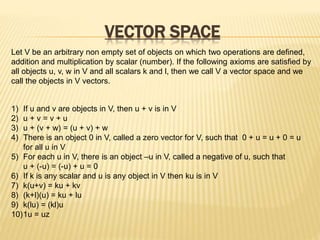
Let V be an arbitrary non empty set of objects on which two operations are defined,
addition and multiplication by scalar (number). If the following axioms are satisfied by
all objects u, v, w in V and all scalars k and l, then we call V a vector space and we
call the objects in V vectors.
1) If u and v are objects in V, then u + v is in V
2) u + v = v + u
3) u + (v + w) = (u + v) + w
4) There is an object 0 in V, called a zero vector for V, such that 0 + u = u + 0 = u
for all u in V
5) For each u in V, there is an object –u in V, called a negative of u, such that
u + (-u) = (-u) + u = 0
6) If k is any scalar and u is any object in V then ku is in V
7) k(u+v) = ku + kv
8) (k+l)(u) = ku + lu
9) k(lu) = (kl)u
10)1u = uz
EXAMPLE OF VECTOR SPACE
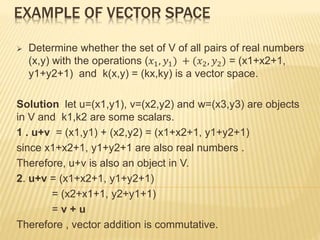
 Determine whether the set of V of all pairs of real numbers
(x,y) with the operations (𝑥1, 𝑦1) + (𝑥2, 𝑦2) = (x1+x2+1,
y1+y2+1) and k(x,y) = (kx,ky) is a vector space.
Solution let u=(x1,y1), v=(x2,y2) and w=(x3,y3) are objects
in V and k1,k2 are some scalars.
1 . u+v = (x1,y1) + (x2,y2) = (x1+x2+1, y1+y2+1)
since x1+x2+1, y1+y2+1 are also real numbers .
Therefore, u+v is also an object in V.
2. u+v = (x1+x2+1, y1+y2+1)
= (x2+x1+1, y2+y1+1)
= v + u
Therefore , vector addition is commutative.
3. u+(v+w) = (x1,y1)+[(x2,y2) +(x3,y3)]
= (x1,y1)+(x2+x3+1, y2+y3+1)
= [x1+ (x2+x3+1)+1 , y1+(y2+y1+1)+1)
= [(x1+ x2+1)+x3+1 , (y1+y2+1)+y3+1)]
= (x1+x2+1, y1+y2+1)+(x3+y3)
= (u+v)+w
Hence, vector addition is associative.
4. Let (a,b) be in object in V such that (a,b)+u=u
(a,b) +(x1,y1)=(x1,y1)
(a+x1+1,b1+y1+1) = (x1,y1)
a= -1 , b=-1
Hence, (-1,-1) is zero vector in V.
5. Let (a,b) be in object in V such that (a,b)+u=(-1,-1)
(a,b)+(x1,y1)=(-1,-1)
(x1+a+1,y1+b+1)=(1,-1)
a= -x1-2 , b = -y1-2
Hence, (-x1-2,y1-2) is the negative of u in V
6. k1u = k1(x1,y1)
=(k1x1,k1y1)
Since k1x1, k1y1 are real numbers.
Therefore, V is closed under scalar multiplication.
7. K1(u+v)= k1(x1+ x2+1, y1+y2+1)
=(k1x1 + k1x2 + k1, k1y1 + k1y2 + k1)
≠ k1u + k1v
V is not distributive under scalar multiplication.
Hence, V is not a vector space
SUBSPACES
If W is a set of one or more vectors in a vector space V,
then W is a sub space of V if and only if the following
condition hold;
a)If u,v are vectors in a W then u+v is in a W.
b)If k is any scalar and u is any vector In a W then ku is in
W.
originhethrough tLines(2)
9
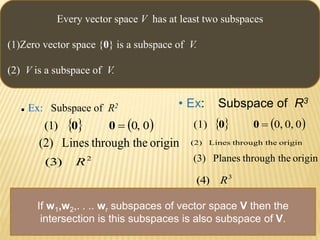
Every vector space V has at least two subspaces
(1)Zero vector space {0} is a subspace of V.
(2) V is a subspace of V.
 Ex: Subspace of R2
   00,(1) 00
originhethrough tLines(2)
2
(3) R
• Ex: Subspace of R3
originhethrough tPlanes(3)
3
(4) R
   00,0,(1) 00
If w1,w2,. . .. wr subspaces of vector space V then the
intersection is this subspaces is also subspace of V.
Let W be the set of all 2×2 symmetric matrices. Show that W
is a subspace of the vector space M2×2, with the standard
operations of matrix addition and scalar multiplication.
10
sapcesvector:2222  MMW
Sol:
)(Let 221121 AA,AAWA,A TT

)( 21212121 AAAAAAWAW,A TTT

)( kAkAkAWA,Rk TT

22ofsubspaceais  MW
)( 21 WAA 
)( WkA
Ex : (A subspace of M2×2)
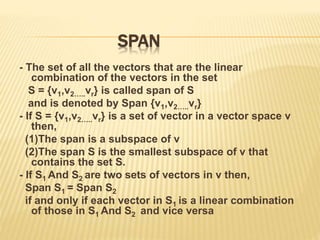
SPAN
- The set of all the vectors that are the linear
combination of the vectors in the set
S = {v1,v2…..vr} is called span of S
and is denoted by Span {v1,v2…..vr}
- If S = {v1,v2…..vr} is a set of vector in a vector space v
then,
(1)The span is a subspace of v
(2)The span S is the smallest subspace of v that
contains the set S.
- If S1 And S2 are two sets of vectors in v then,
Span S1 = Span S2
if and only if each vector in S1 is a linear combination
of those in S1 And S2 and vice versa
METHOD TO CHECK SPAN OF V
1.choose an arbitary vector b in v.
2. express b as alinear combination of v1,v2,…..,vr
b=k1v1+k2v2+…..+krvr
3. if the system of the equation in above equation is
consistent for all choice of b then vectors
v1,v2,…..,vr span v.if it is inconsistent for some
choice of b, vectors do not span v.
kkccc uuuv  2211
formin thewrittenbecanifinvectorsthe
ofncombinatiolinearacalledisspacevectorainA vector
21 vuuu
v
V,,,
V
k
Definition
scalars:21 k,c,,cc 
Linear combination
If S = (w1,w2,w3, . . . . , wr) is a nonempty set of vectors in a vector
space V, then:
(a) The set W of all possible linear combinations of the vectors in S
is a subspace of V.
(b) The set W in part (a) is the “smallest” subspace of V that
contains all of the vectors in S in the sense that any other subspace
that contains those vectors contains W.
 Example:
Every vector v = (a, b, c) in R3 is expressible as a linear
combination of the standard basis vectors i = (1,0,0), j =
(0,1,0), k=(0,0,1) since
v = (a,b,c) = a(1,0,0) + b(0,1,0) + c(0,0,1)
= ai + bj + ck
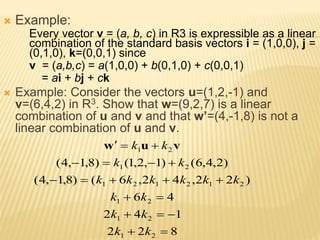
 Example: Consider the vectors u=(1,2,-1) and
v=(6,4,2) in R3. Show that w=(9,2,7) is a linear
combination of u and v and that w’=(4,-1,8) is not a
linear combination of u and v.
822
142
46
)22,42,6()8,1,4(
)2,4,6()1,2,1()8,1,4(
21
21
21
212121
21
21






kk
kk
kk
kkkkkk
kk
kk vuw













2123
2012
1101
   nEliminatioJordanGuass












7000
4210
1101
)70(solutionnohassystemthis  
332211 vvvw ccc 
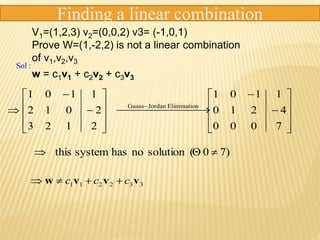
V1=(1,2,3) v2=(0,0,2) v3= (-1,0,1)
Prove W=(1,-2,2) is not a linear combination
of v1,v2,v3
w = c1v1 + c2v2 + c3v3
Finding a linear combination
Sol :
Basis
• Definition:
V:a vector space
Generating
Sets
Bases
Linearly
Independent
Sets
 S is called a basis for V
S ={v1, v2, …,
vn}V
• S spans V (i.e., span(S) =
V )
• S is linearly independent
(1) Ø is a basis for {0}
(2) the standard basis for R3:
{i, j, k} i = (1, 0, 0), j = (0, 1, 0), k = (0, 0, 1)

Notes:
(3) the standard basis for R
n
:
{e1, e2, …, en} e1=(1,0,…,0), e2=(0,1,…,0), en=(0,0,…,1)
Ex: R4 {(1,0,0,0), (0,1,0,0), (0,0,1,0), (0,0,0,1)}
Ex: matrix
space:






























10
00
,
01
00
,
00
10
,
00
01
22
(4) the standard basis for mn matrix space:
{ Eij | 1im , 1jn }
(5) the standard basis for Pn(x):
{1, x, x2, …, xn}
Ex: P3(x) {1, x, x2, x3}
Example
Let V = P3 and let S = {1, t, t2, t3}. Show that S is a
basis for V.
Solution
We must show both linear independence and span.
Linear Independence:
Let
c1(1) + c2(t) + c3(t2) + c4(t3) = 0
Then since a polynomial is zero if and only if its
coefficients are all zero we have
c1 = c2 = c3 = c4 = 0
Hence S is a linearly independent set of vectors in V.
Span
A general vector in P3 is given by
a + bt + ct2 + dt3
We need to find constants c1, c2, c3, c4 such that
c1(1) + c2(t) + c3(t2) + c4(t3) = a + bt + ct2 + dt3
We just let
c1 = a, c2 = b, c3 = c, c4 = d
Hence S spans V.
We can conclude that S is a basis for V.
In general the basis {1, t, t2, ... , tn} is called the STANDARD
BASIS for Pn.
Change of basis problem
You were given the coordinates of a vector relative to one
basis B and were asked to find the coordinates relative to
another basis B'.
Transition matrix from B' to B:
V
BB nn
spacevectorafor
basestwobe}...,,{nda},...,,{etL 2121 uuuuuu 
BB P  ][][hent vv         BBnBB
v,...,,  1 uuu 2
      BnBB
P uuu 2
 ...,,,1
where
is called the transition matrix from B' to B
If [v]B is the coordinate matrix of v relative to B
[v]B‘ is the coordinate matrix of v relative to B'
If P is the transition matrix from a basis B' to a basis B in Rn,
then
(1) P is invertible
(2) The transition matrix from B to B' is P
–1
THEOREM 1 The inverse of a transition matrix
THEOREM 2
Let B={v1, v2, … , vn} and B' ={u1, u2, … , un} be two bases
for R
n
. Then the transition matrix P–1 from B to B' can be
found by using Gauss-Jordan elimination on the n×2n
matrix as follows.
Transition matrix from B to B'
 BB   1
PIn 
B={(–3, 2), (4,–2)} and B' ={(–1, 2), (2,–2)} are two
bases for R
2
(a) Find the transition matrix from B' to B.
(b)
(c) Find the transition matrix from B to B' .
BB ][find,
2
1
][Let ' vv 






Ex : (Finding a transition matrix)
Sol:










22
21
22
43










12
23
10
01

G.J.E.
B B' I P









12
23
P (the transition matrix from B' to B)
(a)
Sol:










22
21
22
43

 G.J.E.
B B'
(a)


























 
0
1
2
1
12
23
][][
2
1
][ BBB
P vvv
(b)










22
43
22
21










32
21
10
01


G.J.E.
B' B I P
-1
(the transition matrix from B to B')







 
32
211
P
 Check: 2
1
10
01
32
21
12
23
IPP 






















)2,3()2,4)(0()2,3)(1(
0
1
][
)2,3()2,2)(2()2,1)(1(
2
1
][
:Check














vv
vv
B
B
(c)
25
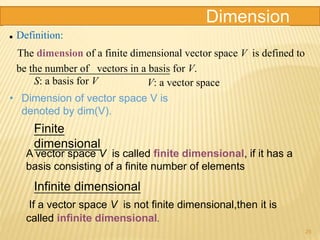
Dimension
 Definition:
The dimension of a finite dimensional vector space V is defined to
be the number of vectors in a basis for V.
V: a vector spaceS: a basis for V
Finite
dimensional
A vector space V is called finite dimensional, if it has a
basis consisting of a finite number of elements
Infinite dimensional
If a vector space V is not finite dimensional,then it is
called infinite dimensional.
• Dimension of vector space V is
denoted by dim(V).
26
Theorems for dimention
THEOREM 1
All bases for a finite-dimensional vector space have
the same number of vectors.
THEOREM 2
Let V be a finite-dimensional vector space, and let be any
basis.
(a) If a set has more than n vectors, then it is linearly
dependent.
(b) If a set has fewer than n vectors, then it does not span
V.
27
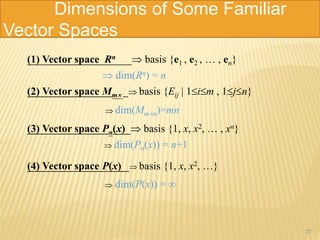
Dimensions of Some Familiar
Vector Spaces
(1) Vector space Rn  basis {e1 , e2 ,  , en}
(2) Vector space Mm  basis {Eij | 1im , 1jn}
(3) Vector space Pn(x)  basis {1, x, x2,  , xn}
(4) Vector space P(x)  basis {1, x, x2, }
 dim(Rn) = n
 dim(Mmn)=mn
 dim(Pn(x)) = n+1
 dim(P(x)) = 
Coordinates
• Coordinate representation relative to a basis Let B = {v1,
v2, …, vn} be an ordered basis for a vector space V and let x
be a vector in V such that .2211 nnccc vvvx  
The scalars c1, c2, …, cn are called the coordinates of x relative to
the basis B. The coordinate matrix (or coordinate vector) of x
relative to B is the column matrix in Rn whose components are the
coordinates of x.
 













n
B
c
c
c

2
1
x
Find the coordinate matrix of x=(1, 2, –1) in R3 relative to
the (nonstandard) basis
B ' = {u1, u2, u3}={(1, 0, 1), (0, – 1, 2), (2, 3, – 5)}
Sol:
2100
8010
5001
1521
2310
1201
E.G.J.
























)5,3,2()2,1,0()1,0,1()1,2,1( 321332211
 cccccc uuux






































1
2
1
521
310
201
i.e.
152
23
12
3
2
1
321
32
31
c
c
c
ccc
cc
cc











 
2
8
5
][ B
x
Finding a coordinate matrix relative to a
nonstandard basis
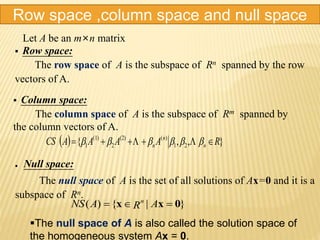
 Row space:
The row space of A is the subspace of Rn spanned by the row
vectors of A.
 Column space:
The column space of A is the subspace of Rm spanned by
the column vectors of A.
  },,{ 21
)((2)
2
(1)
1 RAAAACS n
n
n   
}|{)( 0xx  ARANS n
 Null space:
The null space of A is the set of all solutions of Ax=0 and it is a
subspace of Rn.
Let A be an m×n matrix
Row space ,column space and null space
The null space of A is also called the solution space of
the homogeneous system Ax = 0.
Find a basis of row space of A =



















2402
1243
1603
0110
3131
Sol:



















2402
1243
1603
0110
3131
A=
















0000
0000
1000
0110
3131
3
2
1
w
w
w
B = .E.G
bbbbaaaa 43214321
Finding a basis for a row space
EXAMPLE
A basis for RS(A) = {the nonzero row vectors of B} (Thm 3)
= {w1, w2, w3} = {(1, 3, 1, 3), (0, 1, 1, 0), (0, 0, 0, 1)}
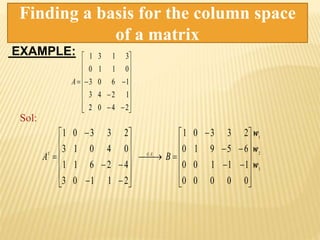
Finding a basis for the column space
of a matrix



















2402
1243
1603
0110
3131
A
Sol:
3
2
1
..
00000
11100
65910
23301
21103
42611
04013
23301
w
w
w































 BA EGT
EXAMPLE:
CS(A)=RS(AT)
(A basis for the column space of A)
A Basis For CS(A) = a basis for RS(AT)
= {the nonzero vectors
of B}
= {w1, w2, w3}





































































1
1
1
0
0
,
6
5
9
1
0
,
2
3
3
0
1
Rank and Nullity
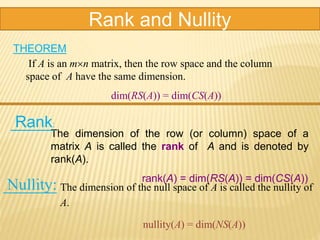
If A is an mn matrix, then the row space and the column
space of A have the same dimension.
dim(RS(A)) = dim(CS(A))
THEOREM
The dimension of the row (or column) space of a
matrix A is called the rank of A and is denoted by
rank(A).
rank(A) = dim(RS(A)) = dim(CS(A))
Rank:
Nullity: The dimension of the null space of A is called the nullity of
A.
nullity(A) = dim(NS(A))
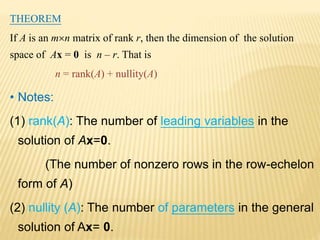
THEOREM
If A is an mn matrix of rank r, then the dimension of the solution
space of Ax = 0 is n – r. That is
n = rank(A) + nullity(A)
• Notes:
(1) rank(A): The number of leading variables in the
solution of Ax=0.
(The number of nonzero rows in the row-echelon
form of A)
(2) nullity (A): The number of parameters in the general
solution of Ax= 0.
36
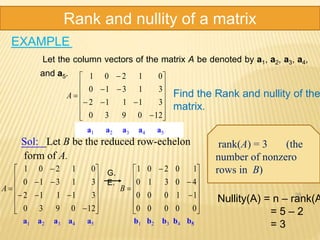
Rank and nullity of a matrix
Let the column vectors of the matrix A be denoted by a1, a2, a3, a4,
and a5.

















120930
31112
31310
01201
A
a1 a2 a3 a4 a5
EXAMPLE
Find the Rank and nullity of the
matrix.
Sol: Let B be the reduced row-echelon
form of A.

































00000
11000
40310
10201
120930
31112
31310
01201
BA
a1 a2 a3 a4 a5 b1 b2 b3 b4 b5
G.
E.
rank(A) = 3 (the
number of nonzero
rows in B)
Nullity(A) = n – rank(A
= 5 – 2
= 3
THANK YOU
GUIDED BY:-
MR. JAYDEV PATEL

Vector space

  • 1.
    VECTOR SPACE PRESENTED BY:-MECHANICAL ENGINEERING DIVISION-B SEM-2 YEAR-2016-17
  • 2.
    Real Vector Spaces SubSpaces Linear combination Span Of Set Of Vectors Basis Dimension Row Space, Column Space, Null Space Rank And Nullity Coordinate and change of basis CONTENTS
  • 3.
    NAME ENROLLMENT NO. PATELJAIMIN A 150280119080 PATEL KAUSHAL K 150280119081 PATEL KRUNAL S 150280119082 PATEL MEET B 150280119083 PATEL MILAN V 150280119084 PATEL MILIND B 150280119085 PATEL PRANAV P 150280119086 PATEL RAVI K 150280119087 PATEL RAVI S 150280119088 PATEL UJJWAL G 150280119089 PATIL KRUNAL R 150280119090 PRESENTED BY:-
  • 4.
    VECTOR SPACE Let Vbe an arbitrary non empty set of objects on which two operations are defined, addition and multiplication by scalar (number). If the following axioms are satisfied by all objects u, v, w in V and all scalars k and l, then we call V a vector space and we call the objects in V vectors. 1) If u and v are objects in V, then u + v is in V 2) u + v = v + u 3) u + (v + w) = (u + v) + w 4) There is an object 0 in V, called a zero vector for V, such that 0 + u = u + 0 = u for all u in V 5) For each u in V, there is an object –u in V, called a negative of u, such that u + (-u) = (-u) + u = 0 6) If k is any scalar and u is any object in V then ku is in V 7) k(u+v) = ku + kv 8) (k+l)(u) = ku + lu 9) k(lu) = (kl)u 10)1u = uz
  • 5.
    EXAMPLE OF VECTORSPACE  Determine whether the set of V of all pairs of real numbers (x,y) with the operations (𝑥1, 𝑦1) + (𝑥2, 𝑦2) = (x1+x2+1, y1+y2+1) and k(x,y) = (kx,ky) is a vector space. Solution let u=(x1,y1), v=(x2,y2) and w=(x3,y3) are objects in V and k1,k2 are some scalars. 1 . u+v = (x1,y1) + (x2,y2) = (x1+x2+1, y1+y2+1) since x1+x2+1, y1+y2+1 are also real numbers . Therefore, u+v is also an object in V. 2. u+v = (x1+x2+1, y1+y2+1) = (x2+x1+1, y2+y1+1) = v + u Therefore , vector addition is commutative.
  • 6.
    3. u+(v+w) =(x1,y1)+[(x2,y2) +(x3,y3)] = (x1,y1)+(x2+x3+1, y2+y3+1) = [x1+ (x2+x3+1)+1 , y1+(y2+y1+1)+1) = [(x1+ x2+1)+x3+1 , (y1+y2+1)+y3+1)] = (x1+x2+1, y1+y2+1)+(x3+y3) = (u+v)+w Hence, vector addition is associative. 4. Let (a,b) be in object in V such that (a,b)+u=u (a,b) +(x1,y1)=(x1,y1) (a+x1+1,b1+y1+1) = (x1,y1) a= -1 , b=-1 Hence, (-1,-1) is zero vector in V. 5. Let (a,b) be in object in V such that (a,b)+u=(-1,-1) (a,b)+(x1,y1)=(-1,-1) (x1+a+1,y1+b+1)=(1,-1) a= -x1-2 , b = -y1-2 Hence, (-x1-2,y1-2) is the negative of u in V
  • 7.
    6. k1u =k1(x1,y1) =(k1x1,k1y1) Since k1x1, k1y1 are real numbers. Therefore, V is closed under scalar multiplication. 7. K1(u+v)= k1(x1+ x2+1, y1+y2+1) =(k1x1 + k1x2 + k1, k1y1 + k1y2 + k1) ≠ k1u + k1v V is not distributive under scalar multiplication. Hence, V is not a vector space
  • 8.
    SUBSPACES If W isa set of one or more vectors in a vector space V, then W is a sub space of V if and only if the following condition hold; a)If u,v are vectors in a W then u+v is in a W. b)If k is any scalar and u is any vector In a W then ku is in W.
  • 9.
    originhethrough tLines(2) 9 Every vectorspace V has at least two subspaces (1)Zero vector space {0} is a subspace of V. (2) V is a subspace of V.  Ex: Subspace of R2    00,(1) 00 originhethrough tLines(2) 2 (3) R • Ex: Subspace of R3 originhethrough tPlanes(3) 3 (4) R    00,0,(1) 00 If w1,w2,. . .. wr subspaces of vector space V then the intersection is this subspaces is also subspace of V.
  • 10.
    Let W bethe set of all 2×2 symmetric matrices. Show that W is a subspace of the vector space M2×2, with the standard operations of matrix addition and scalar multiplication. 10 sapcesvector:2222  MMW Sol: )(Let 221121 AA,AAWA,A TT  )( 21212121 AAAAAAWAW,A TTT  )( kAkAkAWA,Rk TT  22ofsubspaceais  MW )( 21 WAA  )( WkA Ex : (A subspace of M2×2)
  • 11.
    SPAN - The setof all the vectors that are the linear combination of the vectors in the set S = {v1,v2…..vr} is called span of S and is denoted by Span {v1,v2…..vr} - If S = {v1,v2…..vr} is a set of vector in a vector space v then, (1)The span is a subspace of v (2)The span S is the smallest subspace of v that contains the set S. - If S1 And S2 are two sets of vectors in v then, Span S1 = Span S2 if and only if each vector in S1 is a linear combination of those in S1 And S2 and vice versa
  • 12.
    METHOD TO CHECKSPAN OF V 1.choose an arbitary vector b in v. 2. express b as alinear combination of v1,v2,…..,vr b=k1v1+k2v2+…..+krvr 3. if the system of the equation in above equation is consistent for all choice of b then vectors v1,v2,…..,vr span v.if it is inconsistent for some choice of b, vectors do not span v.
  • 14.
    kkccc uuuv 2211 formin thewrittenbecanifinvectorsthe ofncombinatiolinearacalledisspacevectorainA vector 21 vuuu v V,,, V k Definition scalars:21 k,c,,cc  Linear combination If S = (w1,w2,w3, . . . . , wr) is a nonempty set of vectors in a vector space V, then: (a) The set W of all possible linear combinations of the vectors in S is a subspace of V. (b) The set W in part (a) is the “smallest” subspace of V that contains all of the vectors in S in the sense that any other subspace that contains those vectors contains W.
  • 15.
     Example: Every vectorv = (a, b, c) in R3 is expressible as a linear combination of the standard basis vectors i = (1,0,0), j = (0,1,0), k=(0,0,1) since v = (a,b,c) = a(1,0,0) + b(0,1,0) + c(0,0,1) = ai + bj + ck  Example: Consider the vectors u=(1,2,-1) and v=(6,4,2) in R3. Show that w=(9,2,7) is a linear combination of u and v and that w’=(4,-1,8) is not a linear combination of u and v. 822 142 46 )22,42,6()8,1,4( )2,4,6()1,2,1()8,1,4( 21 21 21 212121 21 21       kk kk kk kkkkkk kk kk vuw
  • 16.
                 2123 2012 1101   nEliminatioJordanGuass             7000 4210 1101 )70(solutionnohassystemthis   332211 vvvw ccc  V1=(1,2,3) v2=(0,0,2) v3= (-1,0,1) Prove W=(1,-2,2) is not a linear combination of v1,v2,v3 w = c1v1 + c2v2 + c3v3 Finding a linear combination Sol :
  • 17.
    Basis • Definition: V:a vectorspace Generating Sets Bases Linearly Independent Sets  S is called a basis for V S ={v1, v2, …, vn}V • S spans V (i.e., span(S) = V ) • S is linearly independent (1) Ø is a basis for {0} (2) the standard basis for R3: {i, j, k} i = (1, 0, 0), j = (0, 1, 0), k = (0, 0, 1)  Notes:
  • 18.
    (3) the standardbasis for R n : {e1, e2, …, en} e1=(1,0,…,0), e2=(0,1,…,0), en=(0,0,…,1) Ex: R4 {(1,0,0,0), (0,1,0,0), (0,0,1,0), (0,0,0,1)} Ex: matrix space:                               10 00 , 01 00 , 00 10 , 00 01 22 (4) the standard basis for mn matrix space: { Eij | 1im , 1jn } (5) the standard basis for Pn(x): {1, x, x2, …, xn} Ex: P3(x) {1, x, x2, x3}
  • 19.
    Example Let V =P3 and let S = {1, t, t2, t3}. Show that S is a basis for V. Solution We must show both linear independence and span. Linear Independence: Let c1(1) + c2(t) + c3(t2) + c4(t3) = 0 Then since a polynomial is zero if and only if its coefficients are all zero we have c1 = c2 = c3 = c4 = 0 Hence S is a linearly independent set of vectors in V.
  • 20.
    Span A general vectorin P3 is given by a + bt + ct2 + dt3 We need to find constants c1, c2, c3, c4 such that c1(1) + c2(t) + c3(t2) + c4(t3) = a + bt + ct2 + dt3 We just let c1 = a, c2 = b, c3 = c, c4 = d Hence S spans V. We can conclude that S is a basis for V. In general the basis {1, t, t2, ... , tn} is called the STANDARD BASIS for Pn.
  • 21.
    Change of basisproblem You were given the coordinates of a vector relative to one basis B and were asked to find the coordinates relative to another basis B'. Transition matrix from B' to B: V BB nn spacevectorafor basestwobe}...,,{nda},...,,{etL 2121 uuuuuu  BB P  ][][hent vv         BBnBB v,...,,  1 uuu 2       BnBB P uuu 2  ...,,,1 where is called the transition matrix from B' to B If [v]B is the coordinate matrix of v relative to B [v]B‘ is the coordinate matrix of v relative to B'
  • 22.
    If P isthe transition matrix from a basis B' to a basis B in Rn, then (1) P is invertible (2) The transition matrix from B to B' is P –1 THEOREM 1 The inverse of a transition matrix THEOREM 2 Let B={v1, v2, … , vn} and B' ={u1, u2, … , un} be two bases for R n . Then the transition matrix P–1 from B to B' can be found by using Gauss-Jordan elimination on the n×2n matrix as follows. Transition matrix from B to B'  BB   1 PIn 
  • 23.
    B={(–3, 2), (4,–2)}and B' ={(–1, 2), (2,–2)} are two bases for R 2 (a) Find the transition matrix from B' to B. (b) (c) Find the transition matrix from B to B' . BB ][find, 2 1 ][Let ' vv        Ex : (Finding a transition matrix) Sol:           22 21 22 43           12 23 10 01  G.J.E. B B' I P          12 23 P (the transition matrix from B' to B) (a) Sol:           22 21 22 43   G.J.E. B B' (a)
  • 24.
                                0 1 2 1 12 23 ][][ 2 1 ][ BBB Pvvv (b)           22 43 22 21           32 21 10 01   G.J.E. B' B I P -1 (the transition matrix from B to B')          32 211 P  Check: 2 1 10 01 32 21 12 23 IPP                        )2,3()2,4)(0()2,3)(1( 0 1 ][ )2,3()2,2)(2()2,1)(1( 2 1 ][ :Check               vv vv B B (c)
  • 25.
    25 Dimension  Definition: The dimensionof a finite dimensional vector space V is defined to be the number of vectors in a basis for V. V: a vector spaceS: a basis for V Finite dimensional A vector space V is called finite dimensional, if it has a basis consisting of a finite number of elements Infinite dimensional If a vector space V is not finite dimensional,then it is called infinite dimensional. • Dimension of vector space V is denoted by dim(V).
  • 26.
    26 Theorems for dimention THEOREM1 All bases for a finite-dimensional vector space have the same number of vectors. THEOREM 2 Let V be a finite-dimensional vector space, and let be any basis. (a) If a set has more than n vectors, then it is linearly dependent. (b) If a set has fewer than n vectors, then it does not span V.
  • 27.
    27 Dimensions of SomeFamiliar Vector Spaces (1) Vector space Rn  basis {e1 , e2 ,  , en} (2) Vector space Mm  basis {Eij | 1im , 1jn} (3) Vector space Pn(x)  basis {1, x, x2,  , xn} (4) Vector space P(x)  basis {1, x, x2, }  dim(Rn) = n  dim(Mmn)=mn  dim(Pn(x)) = n+1  dim(P(x)) = 
  • 28.
    Coordinates • Coordinate representationrelative to a basis Let B = {v1, v2, …, vn} be an ordered basis for a vector space V and let x be a vector in V such that .2211 nnccc vvvx   The scalars c1, c2, …, cn are called the coordinates of x relative to the basis B. The coordinate matrix (or coordinate vector) of x relative to B is the column matrix in Rn whose components are the coordinates of x.                n B c c c  2 1 x
  • 29.
    Find the coordinatematrix of x=(1, 2, –1) in R3 relative to the (nonstandard) basis B ' = {u1, u2, u3}={(1, 0, 1), (0, – 1, 2), (2, 3, – 5)} Sol: 2100 8010 5001 1521 2310 1201 E.G.J.                         )5,3,2()2,1,0()1,0,1()1,2,1( 321332211  cccccc uuux                                       1 2 1 521 310 201 i.e. 152 23 12 3 2 1 321 32 31 c c c ccc cc cc              2 8 5 ][ B x Finding a coordinate matrix relative to a nonstandard basis
  • 30.
     Row space: Therow space of A is the subspace of Rn spanned by the row vectors of A.  Column space: The column space of A is the subspace of Rm spanned by the column vectors of A.   },,{ 21 )((2) 2 (1) 1 RAAAACS n n n    }|{)( 0xx  ARANS n  Null space: The null space of A is the set of all solutions of Ax=0 and it is a subspace of Rn. Let A be an m×n matrix Row space ,column space and null space The null space of A is also called the solution space of the homogeneous system Ax = 0.
  • 31.
    Find a basisof row space of A =                    2402 1243 1603 0110 3131 Sol:                    2402 1243 1603 0110 3131 A=                 0000 0000 1000 0110 3131 3 2 1 w w w B = .E.G bbbbaaaa 43214321 Finding a basis for a row space EXAMPLE A basis for RS(A) = {the nonzero row vectors of B} (Thm 3) = {w1, w2, w3} = {(1, 3, 1, 3), (0, 1, 1, 0), (0, 0, 0, 1)}
  • 32.
    Finding a basisfor the column space of a matrix                    2402 1243 1603 0110 3131 A Sol: 3 2 1 .. 00000 11100 65910 23301 21103 42611 04013 23301 w w w                                 BA EGT EXAMPLE:
  • 33.
    CS(A)=RS(AT) (A basis forthe column space of A) A Basis For CS(A) = a basis for RS(AT) = {the nonzero vectors of B} = {w1, w2, w3}                                                                      1 1 1 0 0 , 6 5 9 1 0 , 2 3 3 0 1
  • 34.
    Rank and Nullity IfA is an mn matrix, then the row space and the column space of A have the same dimension. dim(RS(A)) = dim(CS(A)) THEOREM The dimension of the row (or column) space of a matrix A is called the rank of A and is denoted by rank(A). rank(A) = dim(RS(A)) = dim(CS(A)) Rank: Nullity: The dimension of the null space of A is called the nullity of A. nullity(A) = dim(NS(A))
  • 35.
    THEOREM If A isan mn matrix of rank r, then the dimension of the solution space of Ax = 0 is n – r. That is n = rank(A) + nullity(A) • Notes: (1) rank(A): The number of leading variables in the solution of Ax=0. (The number of nonzero rows in the row-echelon form of A) (2) nullity (A): The number of parameters in the general solution of Ax= 0.
  • 36.
    36 Rank and nullityof a matrix Let the column vectors of the matrix A be denoted by a1, a2, a3, a4, and a5.                  120930 31112 31310 01201 A a1 a2 a3 a4 a5 EXAMPLE Find the Rank and nullity of the matrix. Sol: Let B be the reduced row-echelon form of A.                                  00000 11000 40310 10201 120930 31112 31310 01201 BA a1 a2 a3 a4 a5 b1 b2 b3 b4 b5 G. E. rank(A) = 3 (the number of nonzero rows in B) Nullity(A) = n – rank(A = 5 – 2 = 3
  • 37.