4.8 Antiderivatives
2 
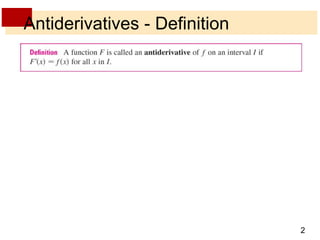
Antiderivatives - Definition
3 
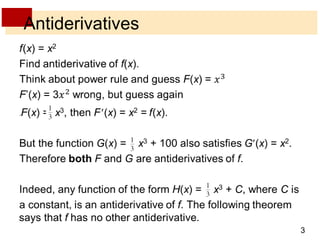
Antiderivatives
4 
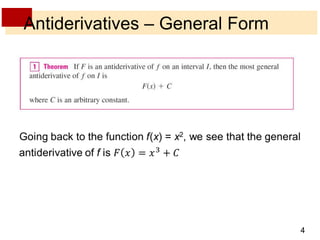
Antiderivatives – General Form
5 
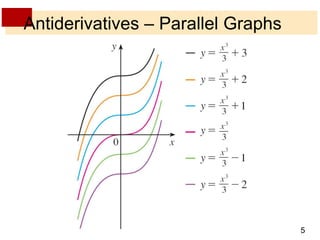
Antiderivatives – Parallel Graphs
6 
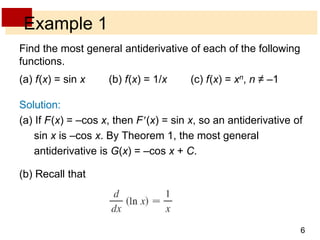
Example 1 
Find the most general antiderivative of each of the following 
functions. 
(a) f(x) = sin x (b) f(x) = 1/x (c) f(x) = xn, n ≠ –1 
Solution: 
(a) If F(x) = –cos x, then F(x) = sin x, so an antiderivative of 
sin x is –cos x. By Theorem 1, the most general 
antiderivative is G(x) = –cos x + C. 
(b) Recall that
cont’d 
7 
Example 1 – Solution 
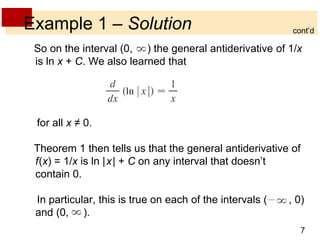
So on the interval (0, ) the general antiderivative of 1/x 
is ln x + C. We also learned that 
for all x ≠ 0. 
Theorem 1 then tells us that the general antiderivative of 
f(x) = 1/x is ln |x| + C on any interval that doesn’t 
contain 0. 
In particular, this is true on each of the intervals ( , 0) 
and (0, ).
8 
Example 1 – Solution 
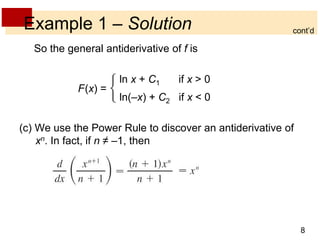
So the general antiderivative of f is 
ln x + C1 if x > 0 
ln(–x) + C2 if x < 0 
(c) We use the Power Rule to discover an antiderivative of 
xn. In fact, if n ≠ –1, then 
cont’d 
F(x) =
cont’d 
9 
Example 1 – Power Rule 
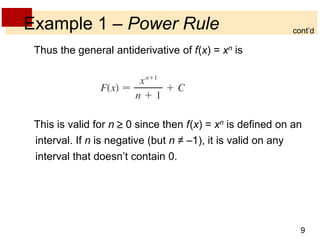
Thus the general antiderivative of f(x) = xn is 
This is valid for n  0 since then f(x) = xn is defined on an 
interval. If n is negative (but n ≠ –1), it is valid on any 
interval that doesn’t contain 0.
10 
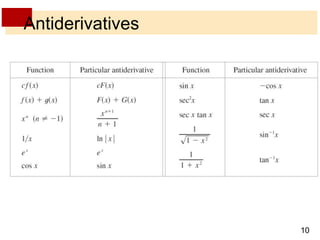
Antiderivatives
11 
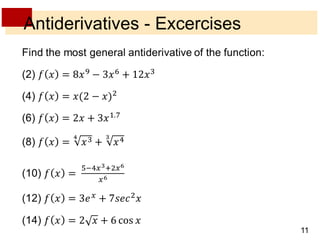
Antiderivatives - Excercises
12 
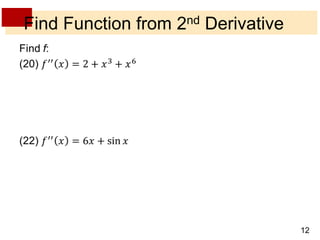
Find Function from 2nd Derivative
13 
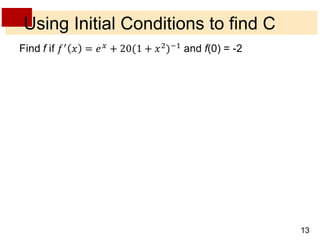
Using Initial Conditions to find C
14 
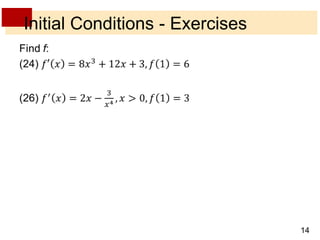
Initial Conditions - Exercises

Lecture 18 antiderivatives - section 4.8

  • 1.
  • 2.
  • 3.
  • 4.
  • 5.
    5 Antiderivatives –Parallel Graphs
  • 6.
    6 Example 1 Find the most general antiderivative of each of the following functions. (a) f(x) = sin x (b) f(x) = 1/x (c) f(x) = xn, n ≠ –1 Solution: (a) If F(x) = –cos x, then F(x) = sin x, so an antiderivative of sin x is –cos x. By Theorem 1, the most general antiderivative is G(x) = –cos x + C. (b) Recall that
  • 7.
    cont’d 7 Example1 – Solution So on the interval (0, ) the general antiderivative of 1/x is ln x + C. We also learned that for all x ≠ 0. Theorem 1 then tells us that the general antiderivative of f(x) = 1/x is ln |x| + C on any interval that doesn’t contain 0. In particular, this is true on each of the intervals ( , 0) and (0, ).
  • 8.
    8 Example 1– Solution So the general antiderivative of f is ln x + C1 if x > 0 ln(–x) + C2 if x < 0 (c) We use the Power Rule to discover an antiderivative of xn. In fact, if n ≠ –1, then cont’d F(x) =
  • 9.
    cont’d 9 Example1 – Power Rule Thus the general antiderivative of f(x) = xn is This is valid for n  0 since then f(x) = xn is defined on an interval. If n is negative (but n ≠ –1), it is valid on any interval that doesn’t contain 0.
  • 10.
  • 11.
  • 12.
    12 Find Functionfrom 2nd Derivative
  • 13.
    13 Using InitialConditions to find C
  • 14.