Seminar Series on
Linear Algebra for Machine Learning
Part 2: Basis and Dimension
Dr. Ceni Babaoglu
Ryerson University
cenibabaoglu.com
Dr. Ceni Babaoglu cenibabaoglu.com
Linear Algebra for Machine Learning: Basis and Dimension
Overview
1 The span of a set of vectors
2 Linear dependence and independence
3 Basis and Dimension
4 Change of Basis
5 Changing Coordinates
6 Orthogonal and Orthonormal Bases
7 References
Dr. Ceni Babaoglu cenibabaoglu.com
Linear Algebra for Machine Learning: Basis and Dimension
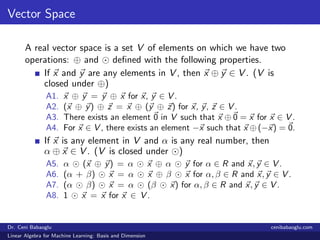
Vector Space
A real vector space is a set V of elements on which we have two
operations: ⊕ and defined with the following properties.
If x and y are any elements in V , then x ⊕ y ∈ V . (V is
closed under ⊕)
A1. x ⊕ y = y ⊕ x for x, y ∈ V .
A2. (x ⊕ y) ⊕ z = x ⊕ (y ⊕ z) for x, y, z ∈ V .
A3. There exists an element 0 in V such that x ⊕ 0 = x for x ∈ V .
A4. For x ∈ V , there exists an element −x such that x ⊕ (−x) = 0.
If x is any element in V and α is any real number, then
α ⊕ x ∈ V . (V is closed under )
A5. α (x ⊕ y) = α x ⊕ α y for α ∈ R and x, y ∈ V .
A6. (α + β) x = α x ⊕ β x for α, β ∈ R and x, y ∈ V .
A7. (α β) x = α (β x) for α, β ∈ R and x, y ∈ V .
A8. 1 x = x for x ∈ V .
Dr. Ceni Babaoglu cenibabaoglu.com
Linear Algebra for Machine Learning: Basis and Dimension
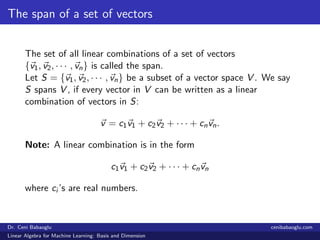
The span of a set of vectors
The set of all linear combinations of a set of vectors
{v1, v2, · · · , vn} is called the span.
Let S = {v1, v2, · · · , vn} be a subset of a vector space V . We say
S spans V , if every vector in V can be written as a linear
combination of vectors in S:
v = c1v1 + c2v2 + · · · + cnvn.
Note: A linear combination is in the form
c1v1 + c2v2 + · · · + cnvn
where ci ’s are real numbers.
Dr. Ceni Babaoglu cenibabaoglu.com
Linear Algebra for Machine Learning: Basis and Dimension
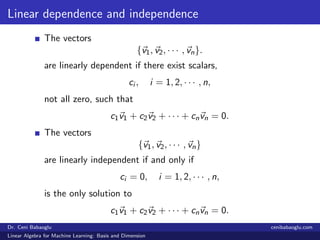
Linear dependence and independence
The vectors
{v1, v2, · · · , vn}.
are linearly dependent if there exist scalars,
ci , i = 1, 2, · · · , n,
not all zero, such that
c1v1 + c2v2 + · · · + cnvn = 0.
The vectors
{v1, v2, · · · , vn}
are linearly independent if and only if
ci = 0, i = 1, 2, · · · , n,
is the only solution to
c1v1 + c2v2 + · · · + cnvn = 0.
Dr. Ceni Babaoglu cenibabaoglu.com
Linear Algebra for Machine Learning: Basis and Dimension
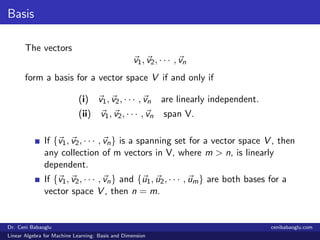
Basis
The vectors
v1, v2, · · · , vn
form a basis for a vector space V if and only if
(i) v1, v2, · · · , vn are linearly independent.
(ii) v1, v2, · · · , vn span V.
If {v1, v2, · · · , vn} is a spanning set for a vector space V , then
any collection of m vectors in V, where m > n, is linearly
dependent.
If {v1, v2, · · · , vn} and {u1, u2, · · · , um} are both bases for a
vector space V , then n = m.
Dr. Ceni Babaoglu cenibabaoglu.com
Linear Algebra for Machine Learning: Basis and Dimension
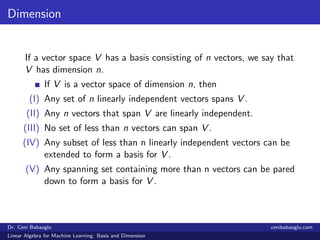
Dimension
If a vector space V has a basis consisting of n vectors, we say that
V has dimension n.
If V is a vector space of dimension n, then
(I) Any set of n linearly independent vectors spans V .
(II) Any n vectors that span V are linearly independent.
(III) No set of less than n vectors can span V .
(IV) Any subset of less than n linearly independent vectors can be
extended to form a basis for V .
(V) Any spanning set containing more than n vectors can be pared
down to form a basis for V .
Dr. Ceni Babaoglu cenibabaoglu.com
Linear Algebra for Machine Learning: Basis and Dimension
Example
Rn is n-dimensional. Let x = [x1 x2 x3 · · · xn]T ∈ Rn. Then





x1
x2
...
xn





= x1







1
0
0
...
0







+ x2







0
1
0
...
0







+ · · · + xn







0
0
0
...
1







≡ x1i1 + x2i2 + · · · + xnin.
Therefore span{i1, i2, · · · , in} = Rn.
i1, i2, · · · , in are linearly independent.
They form a basis and this implies the dimension of R is n.
Dr. Ceni Babaoglu cenibabaoglu.com
Linear Algebra for Machine Learning: Basis and Dimension
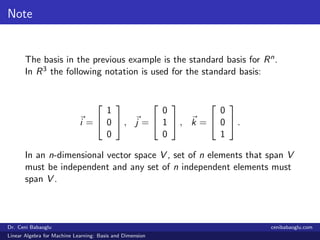
Note
The basis in the previous example is the standard basis for Rn.
In R3 the following notation is used for the standard basis:
i =


1
0
0

 , j =


0
1
0

 , k =


0
0
1

 .
In an n-dimensional vector space V , set of n elements that span V
must be independent and any set of n independent elements must
span V .
Dr. Ceni Babaoglu cenibabaoglu.com
Linear Algebra for Machine Learning: Basis and Dimension
Change of Basis
The standard basis for R2 is {e1, e2}. Any vector x ∈ R2 can be
expressed as a linear combination
x = x1e1 + x2e2.
The scalars x1 and x2 can be thought of as the coordinates of x
with respect to the standard basis.
For any basis {y, z} for R2, a given vector x can be represented
uniquely as a linear combination,
x = αy + βz.
[y, z]: ordered basis
(α, β)T : the coordinate vector of x with respect to [y, z]
If we reverse the order of the basis vectors and take [z, y], then
we must also reorder the coordinate vector and take (β, α)T .
Dr. Ceni Babaoglu cenibabaoglu.com
Linear Algebra for Machine Learning: Basis and Dimension
Example
y = (2, 1)T and z = (1, 4)T are linearly independent and form a
basis for R2.
x = (7, 7)T can be written as a linear combination:
x = 3y + z
The coordinate vector of x with respect to [y, z] is (3, 1)T .
Geometrically, the coordinate vector specifies how to get from the
origin O(0, 0) to the point P(7, 7), moving first in the direction of
y and then in the direction of z .
Dr. Ceni Babaoglu cenibabaoglu.com
Linear Algebra for Machine Learning: Basis and Dimension
Changing Coordinates
Suppose, for example, instead of using [e1, e2] for R2, we wish to
use a different basis, say
u1 =
3
2
, u2 =
1
1
.
I. Given a vector c1u1 + c2u2, let’s find its coordinates with
respect to e1 and e2.
II. Given a vector x = (x1, x2)T , let’s find its coordinates with
respect to u1 and u2.
Dr. Ceni Babaoglu cenibabaoglu.com
Linear Algebra for Machine Learning: Basis and Dimension
Changing Coordinates
I. Given a vector c1u1 + c2u2, let’s find its coordinates with
respect to e1 and e2.
u1 = 3e1 + 2e2, u2 = e1 + e2
c1u1 + c2u2 = (3c1e1 + 2c1e2) + (c2e1 + c2e2)
= (3c1 + c2)e1 + (2c1 + c2)e2
x =
3c1 + c2
2c1 + c2
=
3 1
2 1
c1
c2
U = (u1, u2) =
3 1
2 1
U: the transition matrix from [u1, u2] to [e1, e2]
Given any coordinate c with respect to [u1, u2], the corresponding
coordinate vector x with respect to [e1, e2] by
x = Uc
Dr. Ceni Babaoglu cenibabaoglu.com
Linear Algebra for Machine Learning: Basis and Dimension
Changing Coordinates
II. Given a vector x = (x1, x2)T , let’s find its coordinates with
respect to u1 and u2.
We have to find the transition matrix from [e1, e2] to [u1, u2].
The matrix U is nonsingular, since its column vectors u1 and u2
are linearly independent.
c = U−1
x
Given vector x,
x = (x1, x2)T
= x1e1 + x2e2
We need to multiply by U−1 to find its coordinate vector with
respect to [u1, u2].
U−1: the transition matrix from [e1, e2] to [u1, u2]
Dr. Ceni Babaoglu cenibabaoglu.com
Linear Algebra for Machine Learning: Basis and Dimension
Example
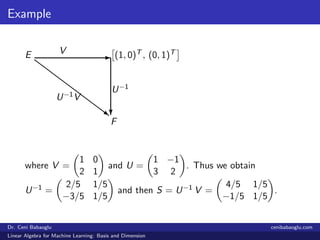
Let E = (1, 2)T , (0, 1)T and F = (1, 3)T , (−1, 2)T be ordered
basis for R2.
(i) Find the transition matrix S from the basis E to the basis F.
(ii) If the vector x ∈ R2 has the coordinate vector [x]E = (5, 0)T
with respect to the ordered basis E, determine the coordinate
vector [x]F with respect to the ordered basis F.
Dr. Ceni Babaoglu cenibabaoglu.com
Linear Algebra for Machine Learning: Basis and Dimension
Example
(i) We should find the matrix S =
a c
b d
such that
[x]F = S [x]E for x ∈ R2. We solve the following system:
1
2
= a
1
3
+ b
−1
2
0
1
= c
1
3
+ d
−1
2
⇒ 1 = a − b 2 = 3a + 2b
0 = c − d 1 = 3c + 2d
⇒ a = 4/5 b = −1/5 c = d = 1/5
⇒ S =
4/5 1/5
−1/5 1/5
Dr. Ceni Babaoglu cenibabaoglu.com
Linear Algebra for Machine Learning: Basis and Dimension
Example
E -V (1, 0)T , (0, 1)T
?
U−1
Z
Z
Z
Z
Z
Z
Z
ZZ~
U−1V
F
where V =
1 0
2 1
and U =
1 −1
3 2
. Thus we obtain
U−1 =
2/5 1/5
−3/5 1/5
and then S = U−1 V =
4/5 1/5
−1/5 1/5
.
Dr. Ceni Babaoglu cenibabaoglu.com
Linear Algebra for Machine Learning: Basis and Dimension
Example
(ii) Since [x]E = (5, 0)T ,
[x]F = S [x]E =
4/5 1/5
−1/5 1/5
5
0
=
4
−1
Dr. Ceni Babaoglu cenibabaoglu.com
Linear Algebra for Machine Learning: Basis and Dimension
Orthogonal and Orthonormal Bases
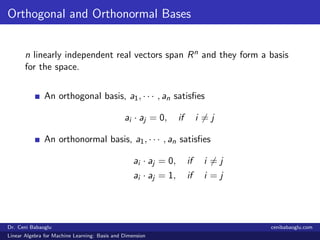
n linearly independent real vectors span Rn and they form a basis
for the space.
An orthogonal basis, a1, · · · , an satisfies
ai · aj = 0, if i = j
An orthonormal basis, a1, · · · , an satisfies
ai · aj = 0, if i = j
ai · aj = 1, if i = j
Dr. Ceni Babaoglu cenibabaoglu.com
Linear Algebra for Machine Learning: Basis and Dimension
References
Linear Algebra With Applications, 7th Edition
by Steven J. Leon.
Elementary Linear Algebra with Applications, 9th Edition
by Bernard Kolman and David Hill.
Dr. Ceni Babaoglu cenibabaoglu.com
Linear Algebra for Machine Learning: Basis and Dimension

2. Linear Algebra for Machine Learning: Basis and Dimension

  • 1.
    Seminar Series on LinearAlgebra for Machine Learning Part 2: Basis and Dimension Dr. Ceni Babaoglu Ryerson University cenibabaoglu.com Dr. Ceni Babaoglu cenibabaoglu.com Linear Algebra for Machine Learning: Basis and Dimension
  • 2.
    Overview 1 The spanof a set of vectors 2 Linear dependence and independence 3 Basis and Dimension 4 Change of Basis 5 Changing Coordinates 6 Orthogonal and Orthonormal Bases 7 References Dr. Ceni Babaoglu cenibabaoglu.com Linear Algebra for Machine Learning: Basis and Dimension
  • 3.
    Vector Space A realvector space is a set V of elements on which we have two operations: ⊕ and defined with the following properties. If x and y are any elements in V , then x ⊕ y ∈ V . (V is closed under ⊕) A1. x ⊕ y = y ⊕ x for x, y ∈ V . A2. (x ⊕ y) ⊕ z = x ⊕ (y ⊕ z) for x, y, z ∈ V . A3. There exists an element 0 in V such that x ⊕ 0 = x for x ∈ V . A4. For x ∈ V , there exists an element −x such that x ⊕ (−x) = 0. If x is any element in V and α is any real number, then α ⊕ x ∈ V . (V is closed under ) A5. α (x ⊕ y) = α x ⊕ α y for α ∈ R and x, y ∈ V . A6. (α + β) x = α x ⊕ β x for α, β ∈ R and x, y ∈ V . A7. (α β) x = α (β x) for α, β ∈ R and x, y ∈ V . A8. 1 x = x for x ∈ V . Dr. Ceni Babaoglu cenibabaoglu.com Linear Algebra for Machine Learning: Basis and Dimension
  • 4.
    The span ofa set of vectors The set of all linear combinations of a set of vectors {v1, v2, · · · , vn} is called the span. Let S = {v1, v2, · · · , vn} be a subset of a vector space V . We say S spans V , if every vector in V can be written as a linear combination of vectors in S: v = c1v1 + c2v2 + · · · + cnvn. Note: A linear combination is in the form c1v1 + c2v2 + · · · + cnvn where ci ’s are real numbers. Dr. Ceni Babaoglu cenibabaoglu.com Linear Algebra for Machine Learning: Basis and Dimension
  • 5.
    Linear dependence andindependence The vectors {v1, v2, · · · , vn}. are linearly dependent if there exist scalars, ci , i = 1, 2, · · · , n, not all zero, such that c1v1 + c2v2 + · · · + cnvn = 0. The vectors {v1, v2, · · · , vn} are linearly independent if and only if ci = 0, i = 1, 2, · · · , n, is the only solution to c1v1 + c2v2 + · · · + cnvn = 0. Dr. Ceni Babaoglu cenibabaoglu.com Linear Algebra for Machine Learning: Basis and Dimension
  • 6.
    Basis The vectors v1, v2,· · · , vn form a basis for a vector space V if and only if (i) v1, v2, · · · , vn are linearly independent. (ii) v1, v2, · · · , vn span V. If {v1, v2, · · · , vn} is a spanning set for a vector space V , then any collection of m vectors in V, where m > n, is linearly dependent. If {v1, v2, · · · , vn} and {u1, u2, · · · , um} are both bases for a vector space V , then n = m. Dr. Ceni Babaoglu cenibabaoglu.com Linear Algebra for Machine Learning: Basis and Dimension
  • 7.
    Dimension If a vectorspace V has a basis consisting of n vectors, we say that V has dimension n. If V is a vector space of dimension n, then (I) Any set of n linearly independent vectors spans V . (II) Any n vectors that span V are linearly independent. (III) No set of less than n vectors can span V . (IV) Any subset of less than n linearly independent vectors can be extended to form a basis for V . (V) Any spanning set containing more than n vectors can be pared down to form a basis for V . Dr. Ceni Babaoglu cenibabaoglu.com Linear Algebra for Machine Learning: Basis and Dimension
  • 8.
    Example Rn is n-dimensional.Let x = [x1 x2 x3 · · · xn]T ∈ Rn. Then      x1 x2 ... xn      = x1        1 0 0 ... 0        + x2        0 1 0 ... 0        + · · · + xn        0 0 0 ... 1        ≡ x1i1 + x2i2 + · · · + xnin. Therefore span{i1, i2, · · · , in} = Rn. i1, i2, · · · , in are linearly independent. They form a basis and this implies the dimension of R is n. Dr. Ceni Babaoglu cenibabaoglu.com Linear Algebra for Machine Learning: Basis and Dimension
  • 9.
    Note The basis inthe previous example is the standard basis for Rn. In R3 the following notation is used for the standard basis: i =   1 0 0   , j =   0 1 0   , k =   0 0 1   . In an n-dimensional vector space V , set of n elements that span V must be independent and any set of n independent elements must span V . Dr. Ceni Babaoglu cenibabaoglu.com Linear Algebra for Machine Learning: Basis and Dimension
  • 10.
    Change of Basis Thestandard basis for R2 is {e1, e2}. Any vector x ∈ R2 can be expressed as a linear combination x = x1e1 + x2e2. The scalars x1 and x2 can be thought of as the coordinates of x with respect to the standard basis. For any basis {y, z} for R2, a given vector x can be represented uniquely as a linear combination, x = αy + βz. [y, z]: ordered basis (α, β)T : the coordinate vector of x with respect to [y, z] If we reverse the order of the basis vectors and take [z, y], then we must also reorder the coordinate vector and take (β, α)T . Dr. Ceni Babaoglu cenibabaoglu.com Linear Algebra for Machine Learning: Basis and Dimension
  • 11.
    Example y = (2,1)T and z = (1, 4)T are linearly independent and form a basis for R2. x = (7, 7)T can be written as a linear combination: x = 3y + z The coordinate vector of x with respect to [y, z] is (3, 1)T . Geometrically, the coordinate vector specifies how to get from the origin O(0, 0) to the point P(7, 7), moving first in the direction of y and then in the direction of z . Dr. Ceni Babaoglu cenibabaoglu.com Linear Algebra for Machine Learning: Basis and Dimension
  • 12.
    Changing Coordinates Suppose, forexample, instead of using [e1, e2] for R2, we wish to use a different basis, say u1 = 3 2 , u2 = 1 1 . I. Given a vector c1u1 + c2u2, let’s find its coordinates with respect to e1 and e2. II. Given a vector x = (x1, x2)T , let’s find its coordinates with respect to u1 and u2. Dr. Ceni Babaoglu cenibabaoglu.com Linear Algebra for Machine Learning: Basis and Dimension
  • 13.
    Changing Coordinates I. Givena vector c1u1 + c2u2, let’s find its coordinates with respect to e1 and e2. u1 = 3e1 + 2e2, u2 = e1 + e2 c1u1 + c2u2 = (3c1e1 + 2c1e2) + (c2e1 + c2e2) = (3c1 + c2)e1 + (2c1 + c2)e2 x = 3c1 + c2 2c1 + c2 = 3 1 2 1 c1 c2 U = (u1, u2) = 3 1 2 1 U: the transition matrix from [u1, u2] to [e1, e2] Given any coordinate c with respect to [u1, u2], the corresponding coordinate vector x with respect to [e1, e2] by x = Uc Dr. Ceni Babaoglu cenibabaoglu.com Linear Algebra for Machine Learning: Basis and Dimension
  • 14.
    Changing Coordinates II. Givena vector x = (x1, x2)T , let’s find its coordinates with respect to u1 and u2. We have to find the transition matrix from [e1, e2] to [u1, u2]. The matrix U is nonsingular, since its column vectors u1 and u2 are linearly independent. c = U−1 x Given vector x, x = (x1, x2)T = x1e1 + x2e2 We need to multiply by U−1 to find its coordinate vector with respect to [u1, u2]. U−1: the transition matrix from [e1, e2] to [u1, u2] Dr. Ceni Babaoglu cenibabaoglu.com Linear Algebra for Machine Learning: Basis and Dimension
  • 15.
    Example Let E =(1, 2)T , (0, 1)T and F = (1, 3)T , (−1, 2)T be ordered basis for R2. (i) Find the transition matrix S from the basis E to the basis F. (ii) If the vector x ∈ R2 has the coordinate vector [x]E = (5, 0)T with respect to the ordered basis E, determine the coordinate vector [x]F with respect to the ordered basis F. Dr. Ceni Babaoglu cenibabaoglu.com Linear Algebra for Machine Learning: Basis and Dimension
  • 16.
    Example (i) We shouldfind the matrix S = a c b d such that [x]F = S [x]E for x ∈ R2. We solve the following system: 1 2 = a 1 3 + b −1 2 0 1 = c 1 3 + d −1 2 ⇒ 1 = a − b 2 = 3a + 2b 0 = c − d 1 = 3c + 2d ⇒ a = 4/5 b = −1/5 c = d = 1/5 ⇒ S = 4/5 1/5 −1/5 1/5 Dr. Ceni Babaoglu cenibabaoglu.com Linear Algebra for Machine Learning: Basis and Dimension
  • 17.
    Example E -V (1,0)T , (0, 1)T ? U−1 Z Z Z Z Z Z Z ZZ~ U−1V F where V = 1 0 2 1 and U = 1 −1 3 2 . Thus we obtain U−1 = 2/5 1/5 −3/5 1/5 and then S = U−1 V = 4/5 1/5 −1/5 1/5 . Dr. Ceni Babaoglu cenibabaoglu.com Linear Algebra for Machine Learning: Basis and Dimension
  • 18.
    Example (ii) Since [x]E= (5, 0)T , [x]F = S [x]E = 4/5 1/5 −1/5 1/5 5 0 = 4 −1 Dr. Ceni Babaoglu cenibabaoglu.com Linear Algebra for Machine Learning: Basis and Dimension
  • 19.
    Orthogonal and OrthonormalBases n linearly independent real vectors span Rn and they form a basis for the space. An orthogonal basis, a1, · · · , an satisfies ai · aj = 0, if i = j An orthonormal basis, a1, · · · , an satisfies ai · aj = 0, if i = j ai · aj = 1, if i = j Dr. Ceni Babaoglu cenibabaoglu.com Linear Algebra for Machine Learning: Basis and Dimension
  • 20.
    References Linear Algebra WithApplications, 7th Edition by Steven J. Leon. Elementary Linear Algebra with Applications, 9th Edition by Bernard Kolman and David Hill. Dr. Ceni Babaoglu cenibabaoglu.com Linear Algebra for Machine Learning: Basis and Dimension