Mathematics for Deep Learning
Ryoungwoo Jang, M.D.
University of Ulsan, Asan Medical Center
This pdf file is compiled in LATEX.
Every picture was drawn by Python.
Outline 3
Recommendation
Introduction
Linear Algebra
Manifold
Universal Approximation Theorem
Recommendation
Recommendation 5
Easy to start, easy to finish :
Calculus : James Stewart, Calculus
Linear algebra : Gilbert Strang, Introduction to Linear
Algebra
Mathematical Statistics : Hogg, Introduction to
Mathematical Statistics
Warning! - easy to start, hard to finish :
Calculus : 김홍종, 미적분학
Linear Algebra : 이인석 - 선형대수와 군
Mathematical Statistics : 김우철 - 수리통계학
Introduction
Introduction 7
Today’s Goal :
Linear Algebra, Manifold, Manifold Hypothesis,
Manifold Conjecture, Universal Approximation Theorem
Linear Algebra
Vector, Vector space 9
In high school, vector was
something that has size and direction
Vector, Vector space 10
In modern mathematics, · · ·
Vector, Vector space 11
Vector is element of Vector space.
Then, what is vector space?
Vector, Vector space 12
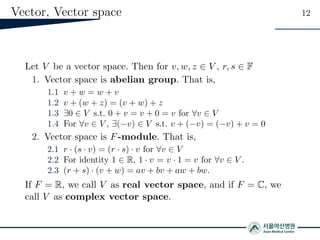
Let V be a vector space. Then for v, w, z ∈ V , r, s ∈ F
1. Vector space is abelian group. That is,
1.1 v + w = w + v
1.2 v + (w + z) = (v + w) + z
1.3 ∃0 ∈ V s.t. 0 + v = v + 0 = v for ∀v ∈ V
1.4 For ∀v ∈ V , ∃(−v) ∈ V s.t. v + (−v) = (−v) + v = 0
2. Vector space is F-module. That is,
2.1 r · (s · v) = (r · s) · v for ∀v ∈ V
2.2 For identity 1 ∈ R, 1 · v = v · 1 = v for ∀v ∈ V .
2.3 (r + s) · (v + w) = av + bv + aw + bw.
If F = R, we call V as real vector space, and if F = C, we
call V as complex vector space.
Vector, Vector space 13
What the · · · ?
Vector, Vector space 14
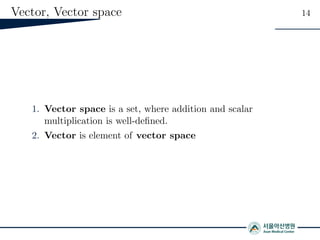
1. Vector space is a set, where addition and scalar
multiplication is well-defined.
2. Vector is element of vector space
Linear combination 15
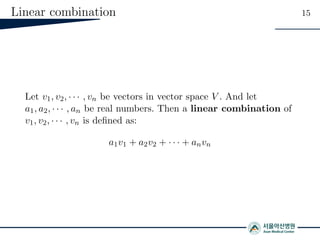
Let v1, v2, · · · , vn be vectors in vector space V . And let
a1, a2, · · · , an be real numbers. Then a linear combination of
v1, v2, · · · , vn is defined as:
a1v1 + a2v2 + · · · + anvn
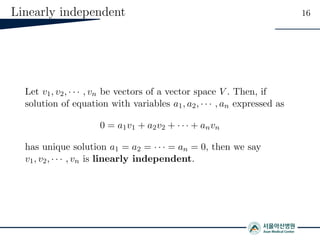
Linearly independent 16
Let v1, v2, · · · , vn be vectors of a vector space V . Then, if
solution of equation with variables a1, a2, · · · , an expressed as
0 = a1v1 + a2v2 + · · · + anvn
has unique solution a1 = a2 = · · · = an = 0, then we say
v1, v2, · · · , vn is linearly independent.
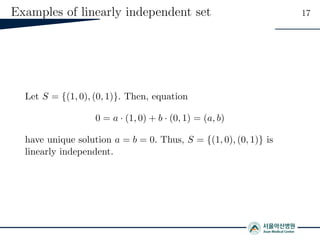
Examples of linearly independent set 17
Let S = {(1, 0), (0, 1)}. Then, equation
0 = a · (1, 0) + b · (0, 1) = (a, b)
have unique solution a = b = 0. Thus, S = {(1, 0), (0, 1)} is
linearly independent.
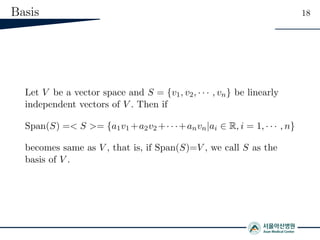
Basis 18
Let V be a vector space and S = {v1, v2, · · · , vn} be linearly
independent vectors of V . Then if
Span(S) =< S >= {a1v1 +a2v2 +· · ·+anvn|ai ∈ R, i = 1, · · · , n}
becomes same as V , that is, if Span(S)=V , we call S as the
basis of V .
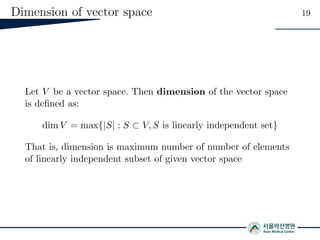
Dimension of vector space 19
Let V be a vector space. Then dimension of the vector space
is defined as:
dim V = max{|S| : S ⊂ V, S is linearly independent set}
That is, dimension is maximum number of number of elements
of linearly independent subset of given vector space
Linear map 20
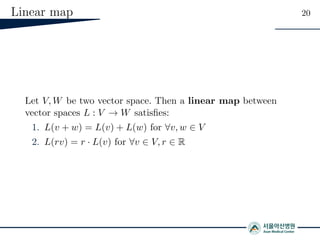
Let V, W be two vector space. Then a linear map between
vector spaces L : V → W satisfies:
1. L(v + w) = L(v) + L(w) for ∀v, w ∈ V
2. L(rv) = r · L(v) for ∀v ∈ V, r ∈ R
Fundamental Theorem of Linear Algebra 21
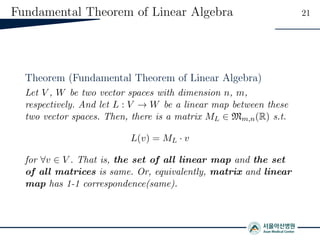
Theorem (Fundamental Theorem of Linear Algebra)
Let V , W be two vector spaces with dimension n, m,
respectively. And let L : V → W be a linear map between these
two vector spaces. Then, there is a matrix ML ∈ Mm,n(R) s.t.
L(v) = ML · v
for ∀v ∈ V . That is, the set of all linear map and the set
of all matrices is same. Or, equivalently, matrix and linear
map has 1-1 correspondence(same).
Linear map with Neural Network 22
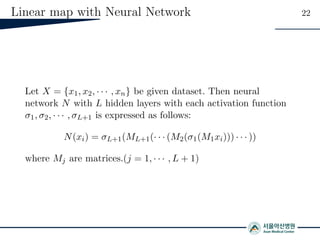
Let X = {x1, x2, · · · , xn} be given dataset. Then neural
network N with L hidden layers with each activation function
σ1, σ2, · · · , σL+1 is expressed as follows:
N(xi) = σL+1(ML+1(· · · (M2(σ1(M1xi))) · · · ))
where Mj are matrices.(j = 1, · · · , L + 1)
Norm of Vector 23
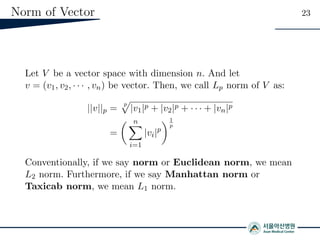
Let V be a vector space with dimension n. And let
v = (v1, v2, · · · , vn) be vector. Then, we call Lp norm of V as:
||v||p =
p
|v1|p + |v2|p + · · · + |vn|p
=
n
i=1
|vi|p
1
p
Conventionally, if we say norm or Euclidean norm, we mean
L2 norm. Furthermore, if we say Manhattan norm or
Taxicab norm, we mean L1 norm.
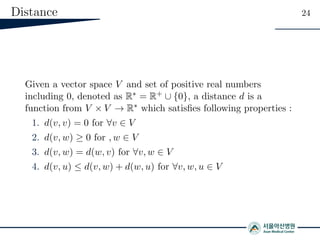
Distance 24
Given a vector space V and set of positive real numbers
including 0, denoted as R∗ = R+ ∪ {0}, a distance d is a
function from V × V → R∗ which satisfies following properties :
1. d(v, v) = 0 for ∀v ∈ V
2. d(v, w) ≥ 0 for , w ∈ V
3. d(v, w) = d(w, v) for ∀v, w ∈ V
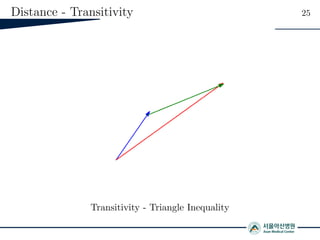
4. d(v, u) ≤ d(v, w) + d(w, u) for ∀v, w, u ∈ V
Distance - Transitivity 25
Transitivity - Triangle Inequality
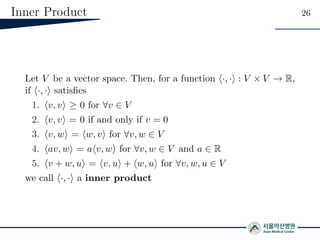
Inner Product 26
Let V be a vector space. Then, for a function ·, · : V × V → R,
if ·, · satisfies
1. v, v ≥ 0 for ∀v ∈ V
2. v, v = 0 if and only if v = 0
3. v, w = w, v for ∀v, w ∈ V
4. av, w = a v, w for ∀v, w ∈ V and a ∈ R
5. v + w, u = v, u + w, u for ∀v, w, u ∈ V
we call ·, · a inner product
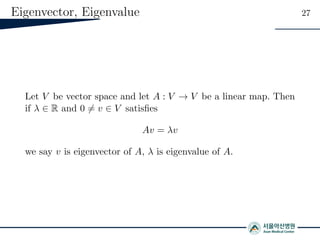
Eigenvector, Eigenvalue 27
Let V be vector space and let A : V → V be a linear map. Then
if λ ∈ R and 0 = v ∈ V satisfies
Av = λv
we say v is eigenvector of A, λ is eigenvalue of A.
Eigenvector, Eigenvalue 28
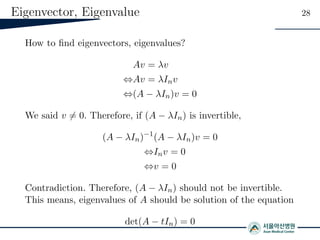
How to find eigenvectors, eigenvalues?
Av = λv
⇔Av = λInv
⇔(A − λIn)v = 0
We said v = 0. Therefore, if (A − λIn) is invertible,
(A − λIn)−1
(A − λIn)v = 0
⇔Inv = 0
⇔v = 0
Contradiction. Therefore, (A − λIn) should not be invertible.
This means, eigenvalues of A should be solution of the equation
det(A − tIn) = 0
Eigenvector, Eigenvalue 29
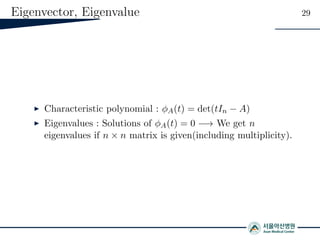
Characteristic polynomial : φA(t) = det(tIn − A)
Eigenvalues : Solutions of φA(t) = 0 −→ We get n
eigenvalues if n × n matrix is given(including multiplicity).
Manifold
Topology, Topological space 31
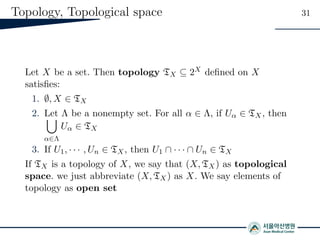
Let X be a set. Then topology TX ⊆ 2X defined on X
satisfies:
1. ∅, X ∈ TX
2. Let Λ be a nonempty set. For all α ∈ Λ, if Uα ∈ TX, then
α∈Λ
Uα ∈ TX
3. If U1, · · · , Un ∈ TX, then U1 ∩ · · · ∩ Un ∈ TX
If TX is a topology of X, we say that (X, TX) as topological
space. we just abbreviate (X, TX) as X. We say elements of
topology as open set
Homeomorphism 32
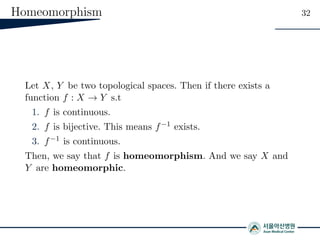
Let X, Y be two topological spaces. Then if there exists a
function f : X → Y s.t
1. f is continuous.
2. f is bijective. This means f−1 exists.
3. f−1 is continuous.
Then, we say that f is homeomorphism. And we say X and
Y are homeomorphic.
Examples of homeomorphic objects 33
Cup with one handle and donut(torus)1.
Two dimensional triangle and rectangle, and circle.
R ∪ {∞} and circle.
1
https://en.wikipedia.org/wiki/Homeomorphism
Topological manifold 34
Let M be a topological space. Then, if M satisfies:
1. For each p ∈ M, there exists an open set Up ∈ TX s.t.
p ∈ Up is homeomorphic to Rn.
2. M is Hausdorff space.
3. M is second countable.
Examples of topological manifolds 35
Euclidean space, Rn
Sphere(Earth), Sn−1
Dimension of manifold 36
Let M be a manifold. Then, for every p ∈ M, there exists an
open set Up ∈ TX s.t. Up is homeomorphic to RN . Then, we say
this n as dimension of manifold.
Embedding of manifold in euclidean space 37
Let M be a manifold. Then, there exists a euclidean space RN
s.t. M is embdded in RN . We say this N as dimension of
embedding space.
Manifold Hypothesis 38
Let X = {x1, · · · , xn} be a set of n data points. Then, Manifold
hypothesis is:
X consists a manifold that is embedded in high dimension,
which is in fact low dimensional manifold.
Manifold conjecture 39
Let X = {x1, · · · , xn} be a set of n data points. Then, Manifold
conjecture is:
What is the exact expression of manifold hypothesis?
How does the manifold look like?
Universal Approximation Theorem
Universal Approximation Theorem - prerequisite 41
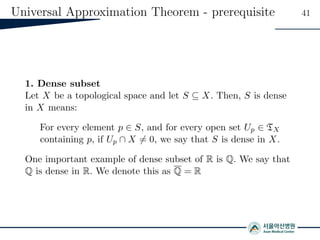
1. Dense subset
Let X be a topological space and let S ⊆ X. Then, S is dense
in X means:
For every element p ∈ S, and for every open set Up ∈ TX
containing p, if Up ∩ X = 0, we say that S is dense in X.
One important example of dense subset of R is Q. We say that
Q is dense in R. We denote this as Q = R
Universal Approximation Theorem - prerequisite 42
2. Sigmoidal function
A sigmoidal function is a monotonically increasing continuous
function σ : R → [0, 1] s.t.
σ(x) =
1 x → +∞
0 x → −∞
Universal Approximation Theorem - prerequisite 43
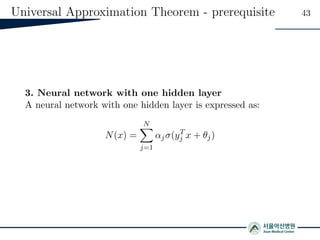
3. Neural network with one hidden layer
A neural network with one hidden layer is expressed as:
N(x) =
N
j=1
αjσ(yT
j x + θj)
Universal Approximation Theorem 44
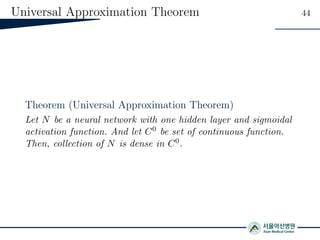
Theorem (Universal Approximation Theorem)
Let N be a neural network with one hidden layer and sigmoidal
activation function. And let C0 be set of continuous function.
Then, collection of N is dense in C0.

Mathematics for Deep Learning (1)

  • 1.
    Mathematics for DeepLearning Ryoungwoo Jang, M.D. University of Ulsan, Asan Medical Center
  • 2.
    This pdf fileis compiled in LATEX. Every picture was drawn by Python.
  • 3.
  • 4.
  • 5.
    Recommendation 5 Easy tostart, easy to finish : Calculus : James Stewart, Calculus Linear algebra : Gilbert Strang, Introduction to Linear Algebra Mathematical Statistics : Hogg, Introduction to Mathematical Statistics Warning! - easy to start, hard to finish : Calculus : 김홍종, 미적분학 Linear Algebra : 이인석 - 선형대수와 군 Mathematical Statistics : 김우철 - 수리통계학
  • 6.
  • 7.
    Introduction 7 Today’s Goal: Linear Algebra, Manifold, Manifold Hypothesis, Manifold Conjecture, Universal Approximation Theorem
  • 8.
  • 9.
    Vector, Vector space9 In high school, vector was something that has size and direction
  • 10.
    Vector, Vector space10 In modern mathematics, · · ·
  • 11.
    Vector, Vector space11 Vector is element of Vector space. Then, what is vector space?
  • 12.
    Vector, Vector space12 Let V be a vector space. Then for v, w, z ∈ V , r, s ∈ F 1. Vector space is abelian group. That is, 1.1 v + w = w + v 1.2 v + (w + z) = (v + w) + z 1.3 ∃0 ∈ V s.t. 0 + v = v + 0 = v for ∀v ∈ V 1.4 For ∀v ∈ V , ∃(−v) ∈ V s.t. v + (−v) = (−v) + v = 0 2. Vector space is F-module. That is, 2.1 r · (s · v) = (r · s) · v for ∀v ∈ V 2.2 For identity 1 ∈ R, 1 · v = v · 1 = v for ∀v ∈ V . 2.3 (r + s) · (v + w) = av + bv + aw + bw. If F = R, we call V as real vector space, and if F = C, we call V as complex vector space.
  • 13.
    Vector, Vector space13 What the · · · ?
  • 14.
    Vector, Vector space14 1. Vector space is a set, where addition and scalar multiplication is well-defined. 2. Vector is element of vector space
  • 15.
    Linear combination 15 Letv1, v2, · · · , vn be vectors in vector space V . And let a1, a2, · · · , an be real numbers. Then a linear combination of v1, v2, · · · , vn is defined as: a1v1 + a2v2 + · · · + anvn
  • 16.
    Linearly independent 16 Letv1, v2, · · · , vn be vectors of a vector space V . Then, if solution of equation with variables a1, a2, · · · , an expressed as 0 = a1v1 + a2v2 + · · · + anvn has unique solution a1 = a2 = · · · = an = 0, then we say v1, v2, · · · , vn is linearly independent.
  • 17.
    Examples of linearlyindependent set 17 Let S = {(1, 0), (0, 1)}. Then, equation 0 = a · (1, 0) + b · (0, 1) = (a, b) have unique solution a = b = 0. Thus, S = {(1, 0), (0, 1)} is linearly independent.
  • 18.
    Basis 18 Let Vbe a vector space and S = {v1, v2, · · · , vn} be linearly independent vectors of V . Then if Span(S) =< S >= {a1v1 +a2v2 +· · ·+anvn|ai ∈ R, i = 1, · · · , n} becomes same as V , that is, if Span(S)=V , we call S as the basis of V .
  • 19.
    Dimension of vectorspace 19 Let V be a vector space. Then dimension of the vector space is defined as: dim V = max{|S| : S ⊂ V, S is linearly independent set} That is, dimension is maximum number of number of elements of linearly independent subset of given vector space
  • 20.
    Linear map 20 LetV, W be two vector space. Then a linear map between vector spaces L : V → W satisfies: 1. L(v + w) = L(v) + L(w) for ∀v, w ∈ V 2. L(rv) = r · L(v) for ∀v ∈ V, r ∈ R
  • 21.
    Fundamental Theorem ofLinear Algebra 21 Theorem (Fundamental Theorem of Linear Algebra) Let V , W be two vector spaces with dimension n, m, respectively. And let L : V → W be a linear map between these two vector spaces. Then, there is a matrix ML ∈ Mm,n(R) s.t. L(v) = ML · v for ∀v ∈ V . That is, the set of all linear map and the set of all matrices is same. Or, equivalently, matrix and linear map has 1-1 correspondence(same).
  • 22.
    Linear map withNeural Network 22 Let X = {x1, x2, · · · , xn} be given dataset. Then neural network N with L hidden layers with each activation function σ1, σ2, · · · , σL+1 is expressed as follows: N(xi) = σL+1(ML+1(· · · (M2(σ1(M1xi))) · · · )) where Mj are matrices.(j = 1, · · · , L + 1)
  • 23.
    Norm of Vector23 Let V be a vector space with dimension n. And let v = (v1, v2, · · · , vn) be vector. Then, we call Lp norm of V as: ||v||p = p |v1|p + |v2|p + · · · + |vn|p = n i=1 |vi|p 1 p Conventionally, if we say norm or Euclidean norm, we mean L2 norm. Furthermore, if we say Manhattan norm or Taxicab norm, we mean L1 norm.
  • 24.
    Distance 24 Given avector space V and set of positive real numbers including 0, denoted as R∗ = R+ ∪ {0}, a distance d is a function from V × V → R∗ which satisfies following properties : 1. d(v, v) = 0 for ∀v ∈ V 2. d(v, w) ≥ 0 for , w ∈ V 3. d(v, w) = d(w, v) for ∀v, w ∈ V 4. d(v, u) ≤ d(v, w) + d(w, u) for ∀v, w, u ∈ V
  • 25.
    Distance - Transitivity25 Transitivity - Triangle Inequality
  • 26.
    Inner Product 26 LetV be a vector space. Then, for a function ·, · : V × V → R, if ·, · satisfies 1. v, v ≥ 0 for ∀v ∈ V 2. v, v = 0 if and only if v = 0 3. v, w = w, v for ∀v, w ∈ V 4. av, w = a v, w for ∀v, w ∈ V and a ∈ R 5. v + w, u = v, u + w, u for ∀v, w, u ∈ V we call ·, · a inner product
  • 27.
    Eigenvector, Eigenvalue 27 LetV be vector space and let A : V → V be a linear map. Then if λ ∈ R and 0 = v ∈ V satisfies Av = λv we say v is eigenvector of A, λ is eigenvalue of A.
  • 28.
    Eigenvector, Eigenvalue 28 Howto find eigenvectors, eigenvalues? Av = λv ⇔Av = λInv ⇔(A − λIn)v = 0 We said v = 0. Therefore, if (A − λIn) is invertible, (A − λIn)−1 (A − λIn)v = 0 ⇔Inv = 0 ⇔v = 0 Contradiction. Therefore, (A − λIn) should not be invertible. This means, eigenvalues of A should be solution of the equation det(A − tIn) = 0
  • 29.
    Eigenvector, Eigenvalue 29 Characteristicpolynomial : φA(t) = det(tIn − A) Eigenvalues : Solutions of φA(t) = 0 −→ We get n eigenvalues if n × n matrix is given(including multiplicity).
  • 30.
  • 31.
    Topology, Topological space31 Let X be a set. Then topology TX ⊆ 2X defined on X satisfies: 1. ∅, X ∈ TX 2. Let Λ be a nonempty set. For all α ∈ Λ, if Uα ∈ TX, then α∈Λ Uα ∈ TX 3. If U1, · · · , Un ∈ TX, then U1 ∩ · · · ∩ Un ∈ TX If TX is a topology of X, we say that (X, TX) as topological space. we just abbreviate (X, TX) as X. We say elements of topology as open set
  • 32.
    Homeomorphism 32 Let X,Y be two topological spaces. Then if there exists a function f : X → Y s.t 1. f is continuous. 2. f is bijective. This means f−1 exists. 3. f−1 is continuous. Then, we say that f is homeomorphism. And we say X and Y are homeomorphic.
  • 33.
    Examples of homeomorphicobjects 33 Cup with one handle and donut(torus)1. Two dimensional triangle and rectangle, and circle. R ∪ {∞} and circle. 1 https://en.wikipedia.org/wiki/Homeomorphism
  • 34.
    Topological manifold 34 LetM be a topological space. Then, if M satisfies: 1. For each p ∈ M, there exists an open set Up ∈ TX s.t. p ∈ Up is homeomorphic to Rn. 2. M is Hausdorff space. 3. M is second countable.
  • 35.
    Examples of topologicalmanifolds 35 Euclidean space, Rn Sphere(Earth), Sn−1
  • 36.
    Dimension of manifold36 Let M be a manifold. Then, for every p ∈ M, there exists an open set Up ∈ TX s.t. Up is homeomorphic to RN . Then, we say this n as dimension of manifold.
  • 37.
    Embedding of manifoldin euclidean space 37 Let M be a manifold. Then, there exists a euclidean space RN s.t. M is embdded in RN . We say this N as dimension of embedding space.
  • 38.
    Manifold Hypothesis 38 LetX = {x1, · · · , xn} be a set of n data points. Then, Manifold hypothesis is: X consists a manifold that is embedded in high dimension, which is in fact low dimensional manifold.
  • 39.
    Manifold conjecture 39 LetX = {x1, · · · , xn} be a set of n data points. Then, Manifold conjecture is: What is the exact expression of manifold hypothesis? How does the manifold look like?
  • 40.
  • 41.
    Universal Approximation Theorem- prerequisite 41 1. Dense subset Let X be a topological space and let S ⊆ X. Then, S is dense in X means: For every element p ∈ S, and for every open set Up ∈ TX containing p, if Up ∩ X = 0, we say that S is dense in X. One important example of dense subset of R is Q. We say that Q is dense in R. We denote this as Q = R
  • 42.
    Universal Approximation Theorem- prerequisite 42 2. Sigmoidal function A sigmoidal function is a monotonically increasing continuous function σ : R → [0, 1] s.t. σ(x) = 1 x → +∞ 0 x → −∞
  • 43.
    Universal Approximation Theorem- prerequisite 43 3. Neural network with one hidden layer A neural network with one hidden layer is expressed as: N(x) = N j=1 αjσ(yT j x + θj)
  • 44.
    Universal Approximation Theorem44 Theorem (Universal Approximation Theorem) Let N be a neural network with one hidden layer and sigmoidal activation function. And let C0 be set of continuous function. Then, collection of N is dense in C0.