1
Sequences and Series
K.Anitha M.Sc.,M.Phil.,
A.SujathaM.Sc.,M.Phil.,PGDCA.,
Department of Mathematics
2
Sequences
3
Sequences
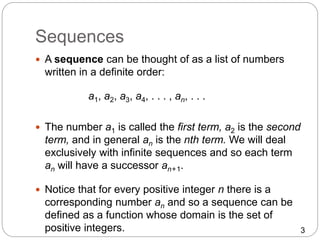
 A sequence can be thought of as a list of numbers
written in a definite order:
a1, a2, a3, a4, . . . , an, . . .
 The number a1 is called the first term, a2 is the second
term, and in general an is the nth term. We will deal
exclusively with infinite sequences and so each term
an will have a successor an+1.
 Notice that for every positive integer n there is a
corresponding number an and so a sequence can be
defined as a function whose domain is the set of
positive integers.
4
Sequences
 But we usually write an instead of the function
notation f(n)
 for the value of the function at the number n.
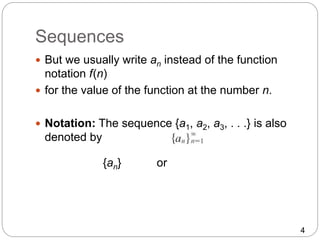
 Notation: The sequence {a1, a2, a3, . . .} is also
denoted by
{an} or
5
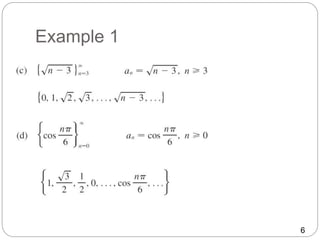
Example 1
 Ways to define a sequence:
1.Use the sequence brace notation
2.Define the nth term using a formula
3.Write the terms explicitly (with ellipses)
 Note: the sequence start index doen’t have to be
1.
n=1
∞
6
Example 1
7
Sequence visualization
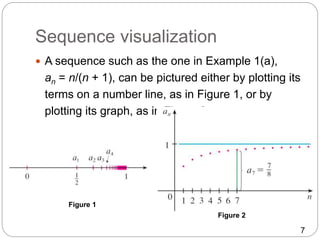
 A sequence such as the one in Example 1(a),
an = n/(n + 1), can be pictured either by plotting its
terms on a number line, as in Figure 1, or by
plotting its graph, as in Figure 2.
Figure 2
Figure 1
8
Sequence limit, introduction
 Note that, since a sequence is a function whose
domain is the set of positive integers, its graph
consists of isolated points with coordinates
(1, a1) (2, a2) (3, a3) . . . (n, an) . . .
 From Figure 1 or Figure 2 it appears that the terms of
the sequence an = n/(n + 1) are approaching 1 as n
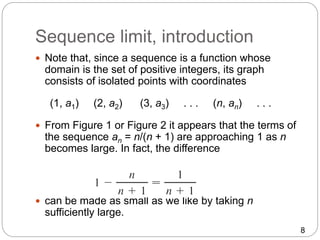
becomes large. In fact, the difference
 can be made as small as we like by taking n
sufficiently large.
9
Sequence limit, introduction
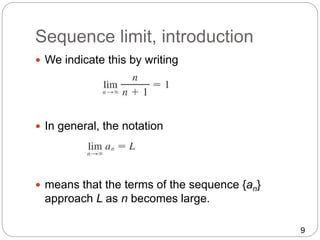
 We indicate this by writing
 In general, the notation
 means that the terms of the sequence {an}
approach L as n becomes large.
10
Sequence limit, informal
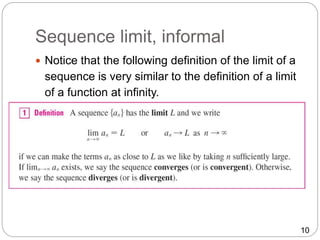
 Notice that the following definition of the limit of a
sequence is very similar to the definition of a limit
of a function at infinity.
11
Sequence limit, informal
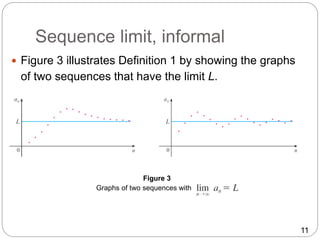
 Figure 3 illustrates Definition 1 by showing the graphs
of two sequences that have the limit L.
Graphs of two sequences with
Figure 3
12
Sequence limit, formal
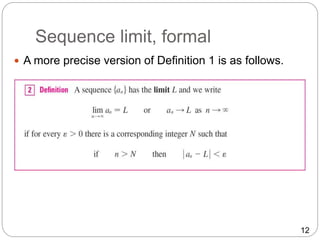
 A more precise version of Definition 1 is as follows.
13
Sequence limit, formal
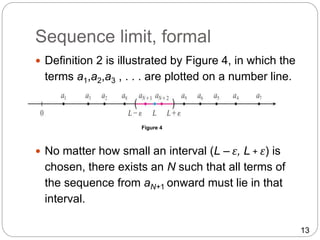
 Definition 2 is illustrated by Figure 4, in which the
terms a1,a2,a3 , . . . are plotted on a number line.
 No matter how small an interval (L – ε, L + ε) is
chosen, there exists an N such that all terms of
the sequence from aN+1 onward must lie in that
interval.
Figure 4
14
Sequence limit, formal
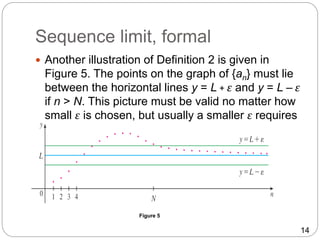
 Another illustration of Definition 2 is given in
Figure 5. The points on the graph of {an} must lie
between the horizontal lines y = L + ε and y = L – ε
if n > N. This picture must be valid no matter how
small ε is chosen, but usually a smaller ε requires
a larger N.
Figure 5
15
Sequence limit from function limit
 You will see that the only difference between limn an
= L and limx f(x)= L is that n is required to be an
integer. Thus we have the following theorem, which is
illustrated by Figure 6.
Figure 6
16
Sequence limit from function limit
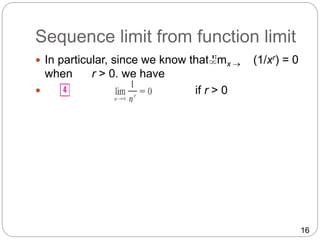
 In particular, since we know that limx  (1/xr) = 0
when r > 0, we have
 if r > 0
17
Sequences diverging to infinity
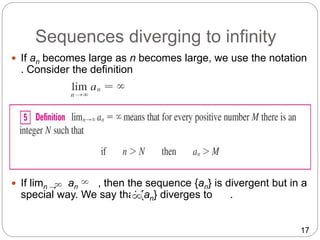
 If an becomes large as n becomes large, we use the notation
. Consider the definition
 If limn  an = , then the sequence {an} is divergent but in a
special way. We say that {an} diverges to .
18
Sequence limit laws
19
Sequence limit theorems
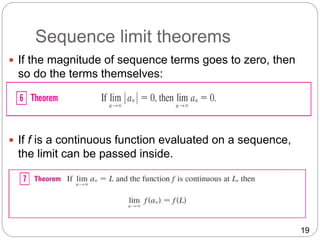
 If the magnitude of sequence terms goes to zero, then
so do the terms themselves:
 If f is a continuous function evaluated on a sequence,
the limit can be passed inside.
20
Example 11
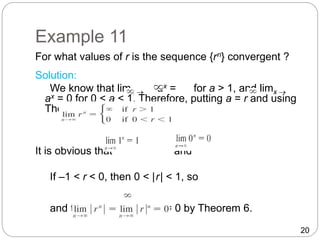
For what values of r is the sequence {rn} convergent ?
Solution:
We know that limx  ax = for a > 1, and limx 
ax = 0 for 0 < a < 1. Therefore, putting a = r and using
Theorem 3, we have
It is obvious that and
If –1 < r < 0, then 0 < |r| < 1, so
and therefore limn  rn = 0 by Theorem 6.
21
Example 11 – Solution
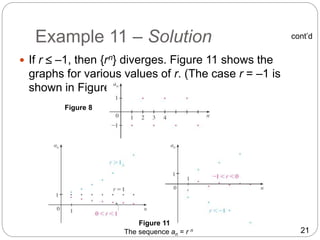
 If r  –1, then {rn} diverges. Figure 11 shows the
graphs for various values of r. (The case r = –1 is
shown in Figure 8.)
cont’d
Figure 11
The sequence an = r n
Figure 8
22
Example 11: Summary
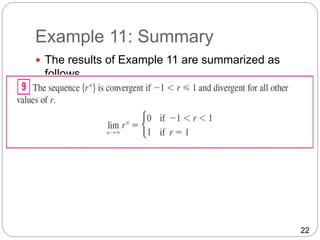
 The results of Example 11 are summarized as
follows.
23
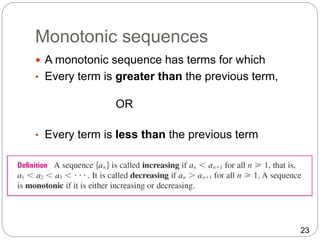
Monotonic sequences
 A monotonic sequence has terms for which
• Every term is greater than the previous term,
OR
• Every term is less than the previous term
24
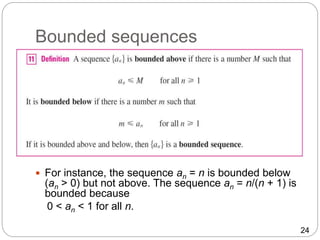
Bounded sequences
 For instance, the sequence an = n is bounded below
(an > 0) but not above. The sequence an = n/(n + 1) is
bounded because
0 < an < 1 for all n.
25
Bounded monotonic sequences
 We know that not every bounded sequence is
convergent [for instance, the sequence an = (–1)n
satisfies –1  an  1 but is divergent,] and not
every monotonic sequence is convergent (an = n
 ).
 But if a sequence is both bounded and
monotonic, then it must be convergent.
26
Bounded monotonic sequences
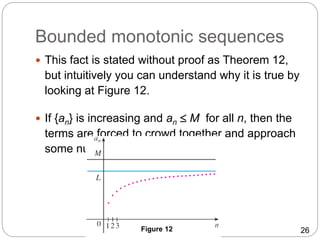
 This fact is stated without proof as Theorem 12,
but intuitively you can understand why it is true by
looking at Figure 12.
 If {an} is increasing and an  M for all n, then the
terms are forced to crowd together and approach
some number L.
Figure 12
27
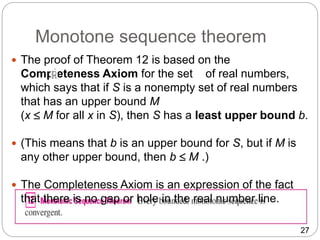
Monotone sequence theorem
 The proof of Theorem 12 is based on the
Completeness Axiom for the set of real numbers,
which says that if S is a nonempty set of real numbers
that has an upper bound M
(x  M for all x in S), then S has a least upper bound b.
 (This means that b is an upper bound for S, but if M is
any other upper bound, then b  M .)
 The Completeness Axiom is an expression of the fact
that there is no gap or hole in the real number line.

Sequences and series

  • 1.
    1 Sequences and Series K.AnithaM.Sc.,M.Phil., A.SujathaM.Sc.,M.Phil.,PGDCA., Department of Mathematics
  • 2.
  • 3.
    3 Sequences  A sequencecan be thought of as a list of numbers written in a definite order: a1, a2, a3, a4, . . . , an, . . .  The number a1 is called the first term, a2 is the second term, and in general an is the nth term. We will deal exclusively with infinite sequences and so each term an will have a successor an+1.  Notice that for every positive integer n there is a corresponding number an and so a sequence can be defined as a function whose domain is the set of positive integers.
  • 4.
    4 Sequences  But weusually write an instead of the function notation f(n)  for the value of the function at the number n.  Notation: The sequence {a1, a2, a3, . . .} is also denoted by {an} or
  • 5.
    5 Example 1  Waysto define a sequence: 1.Use the sequence brace notation 2.Define the nth term using a formula 3.Write the terms explicitly (with ellipses)  Note: the sequence start index doen’t have to be 1. n=1 ∞
  • 6.
  • 7.
    7 Sequence visualization  Asequence such as the one in Example 1(a), an = n/(n + 1), can be pictured either by plotting its terms on a number line, as in Figure 1, or by plotting its graph, as in Figure 2. Figure 2 Figure 1
  • 8.
    8 Sequence limit, introduction Note that, since a sequence is a function whose domain is the set of positive integers, its graph consists of isolated points with coordinates (1, a1) (2, a2) (3, a3) . . . (n, an) . . .  From Figure 1 or Figure 2 it appears that the terms of the sequence an = n/(n + 1) are approaching 1 as n becomes large. In fact, the difference  can be made as small as we like by taking n sufficiently large.
  • 9.
    9 Sequence limit, introduction We indicate this by writing  In general, the notation  means that the terms of the sequence {an} approach L as n becomes large.
  • 10.
    10 Sequence limit, informal Notice that the following definition of the limit of a sequence is very similar to the definition of a limit of a function at infinity.
  • 11.
    11 Sequence limit, informal Figure 3 illustrates Definition 1 by showing the graphs of two sequences that have the limit L. Graphs of two sequences with Figure 3
  • 12.
    12 Sequence limit, formal A more precise version of Definition 1 is as follows.
  • 13.
    13 Sequence limit, formal Definition 2 is illustrated by Figure 4, in which the terms a1,a2,a3 , . . . are plotted on a number line.  No matter how small an interval (L – ε, L + ε) is chosen, there exists an N such that all terms of the sequence from aN+1 onward must lie in that interval. Figure 4
  • 14.
    14 Sequence limit, formal Another illustration of Definition 2 is given in Figure 5. The points on the graph of {an} must lie between the horizontal lines y = L + ε and y = L – ε if n > N. This picture must be valid no matter how small ε is chosen, but usually a smaller ε requires a larger N. Figure 5
  • 15.
    15 Sequence limit fromfunction limit  You will see that the only difference between limn an = L and limx f(x)= L is that n is required to be an integer. Thus we have the following theorem, which is illustrated by Figure 6. Figure 6
  • 16.
    16 Sequence limit fromfunction limit  In particular, since we know that limx  (1/xr) = 0 when r > 0, we have  if r > 0
  • 17.
    17 Sequences diverging toinfinity  If an becomes large as n becomes large, we use the notation . Consider the definition  If limn  an = , then the sequence {an} is divergent but in a special way. We say that {an} diverges to .
  • 18.
  • 19.
    19 Sequence limit theorems If the magnitude of sequence terms goes to zero, then so do the terms themselves:  If f is a continuous function evaluated on a sequence, the limit can be passed inside.
  • 20.
    20 Example 11 For whatvalues of r is the sequence {rn} convergent ? Solution: We know that limx  ax = for a > 1, and limx  ax = 0 for 0 < a < 1. Therefore, putting a = r and using Theorem 3, we have It is obvious that and If –1 < r < 0, then 0 < |r| < 1, so and therefore limn  rn = 0 by Theorem 6.
  • 21.
    21 Example 11 –Solution  If r  –1, then {rn} diverges. Figure 11 shows the graphs for various values of r. (The case r = –1 is shown in Figure 8.) cont’d Figure 11 The sequence an = r n Figure 8
  • 22.
    22 Example 11: Summary The results of Example 11 are summarized as follows.
  • 23.
    23 Monotonic sequences  Amonotonic sequence has terms for which • Every term is greater than the previous term, OR • Every term is less than the previous term
  • 24.
    24 Bounded sequences  Forinstance, the sequence an = n is bounded below (an > 0) but not above. The sequence an = n/(n + 1) is bounded because 0 < an < 1 for all n.
  • 25.
    25 Bounded monotonic sequences We know that not every bounded sequence is convergent [for instance, the sequence an = (–1)n satisfies –1  an  1 but is divergent,] and not every monotonic sequence is convergent (an = n  ).  But if a sequence is both bounded and monotonic, then it must be convergent.
  • 26.
    26 Bounded monotonic sequences This fact is stated without proof as Theorem 12, but intuitively you can understand why it is true by looking at Figure 12.  If {an} is increasing and an  M for all n, then the terms are forced to crowd together and approach some number L. Figure 12
  • 27.
    27 Monotone sequence theorem The proof of Theorem 12 is based on the Completeness Axiom for the set of real numbers, which says that if S is a nonempty set of real numbers that has an upper bound M (x  M for all x in S), then S has a least upper bound b.  (This means that b is an upper bound for S, but if M is any other upper bound, then b  M .)  The Completeness Axiom is an expression of the fact that there is no gap or hole in the real number line.