Counseling and Psychotherapy 
Cesar Chester O. RReelllleevvee,, EEdd DD,, RRGGCC
Course Description 
This course provides the idea and 
knowledge of counseling and 
psychotherapy. It is concerned with the 
understanding of the individual and the 
principles, techniques, methods and 
strategies of counseling and 
psychotherapy. To assist the individuals 
in making intelligent choices and 
adjustment to his/her environment and 
society is also a major concern of the 
course
Course Objective 
It is expected at the end of the course, the 
students should be able to have a clear 
concept of counseling and psychotherapy. 
Likewise students should have the 
understanding of the working principles, 
techniques, methods and strategies 
behind counseling and psychotherapy. It 
is also expected that students gain rich 
experience on psychological counseling 
and psychotherapy through actual actual 
application or simulation
Philosophical Foundation of Theories 
Theoretical models for counseling have 
their origins in the values and beliefs of 
person who in turn, have converted these 
into a philosophy and a theoretical model 
for counseling. These values and beliefs 
form a rationale for what one does, how 
one does it, and under what 
circumstance. It predicts probable 
outcomes for different sets of conditions.
Philosophical… 
Theory summarizes the information base 
on philosophy and draws conclusion. 
…theories provide guidelines that have 
been tested by experienced counselors. 
They explain behaviors. They may 
predict desirable or undesirable 
outcomes in given 
circumstances(Gibson & Mitchell, 2003).
Philosophical… 
Philosophy has asked significant 
questions that led to the understanding 
of what a human being is and how 
he/she must be handled. This is why 
Philosophy is a very important 
foundation of Guidance Counseling 
…Materialism believed that humans 
were entirely physical. 
Determinist asserted that all human choices 
were determined by the laws of nature.
Philosophical… 
Rationalism emphazised that reasons, 
innate ideas, and deductions guide 
knowledge. 
Empiricism underscored that experience 
was the source of knowledge. 
Positivism concentrated on natural phenoma 
or facts that were objectively observable. 
Existentialism focused on the uniqueness of 
human beings and highlighted this as the 
only reality.
Philosophical… 
Every counseling practitioner should have a 
philosophy of human beings and how their 
problems evolve in order to establish a 
philosophy of helping. The goals that 
should be pursued, the role that the 
counselors should play, the techniques 
that could be employed, and the steps that 
must be taken must be based on such a 
philosophy and must then be a part of 
one’s Counseling Philosophy (Villar, 2009)
CCoouunnsseelliinngg vveerrssuuss PPssyycchhootthheerraappyy 
RA 9258, Article I Sec. 3 (a): 
Guidance and Counseling 
-is a profession that involves the use of an 
integrated approach to the development of a 
well-functioning individual primarily by helping 
him/her to utilize his/her potentials to the fullest 
and plan his/her future in accordance with 
his/her abilities, interests and needs.It includes 
functions such as counseling subjects, 
particularly subjects given in the licensure 
examinations, and other human development 
services.
CCoouunnsseelliinngg vveerrssuuss PPssyycchhootthheerraappyy 
REPUBLIC ACT No. 10029, Article III (b): 
Practice of Psychology 
- consists of the delivery of psychological services 
that involve application of psychological 
principles and procedures for the purpose of 
describing, understanding, predicting and 
influencing the behavior of individuals or groups, 
in order to assist in the attainment of optimal 
human growth and functioning. The delivery of 
psychological services includes, but is not 
limited to:
CCoouunnsseelliinngg vveerrssuuss PPssyycchhootthheerraappyy 
REPUBLIC ACT No. 10029, Article III (b): 
Practice of Psychology 
(1) psychological interventions: psychological 
counseling, psychotherapy, psychosocial 
support, coaching, psychological debriefing, 
group processes and all other psychological 
interventions that involve the application of 
psychological principles to improve 
psychological functioning of individuals, families, 
groups and organizations;
CCoouunnsseelliinngg vveerrssuuss 
PPssyycchhootthheerraappyy 
Psychotherapy 
(American Psychological Association) 
- is a collaborative treatment based on the 
relationship between an individual and a 
psychologist. Grounded in dialogue, it 
provides a supportive environment that 
allows you to talk openly with someone 
who’s objective, neutral and 
nonjudgmental.
CCoouunnsseelliinngg vveerrssuuss 
PPssyycchhootthheerraappyy 
Psychotherapy 
(Engler and Goleman, 1992) 
- Is the general name for a variety of 
psychological interventions designed 
to help people resolve, emotional, 
behavioral, or interpersonal problems 
of various kinds and improve the 
quality of their lives.
CCoouunnsseelliinngg vveerrssuuss 
PPssyycchhootthheerraappyy 
Guidance, Counseling,and Psychotherapy: Variations on 
the same Theme? (Neukrug, 2012) 
Counseling is a professional relationships 
that empowers diverse individuals, 
families, and group to accomplish 
mental health, wellness, education, and 
career goals. (ACA, 2010)
…counseling vs psychotherapy 
Over the years there have plethora of definitions of 
counseling that suggest it could be anything from 
a problem-solving, directive, and rational 
approach to helping normal people 
– an approach that is distinguishable from 
psychotherapy (Williamson, 1950, 1958); 
- to a process that is similar to but less intensive 
than psychotherapy (Nugent & Jones, 2005); 
- to an approach that suggests that there is no 
essential difference between the two (Neukrug: 
Patterson, 1986).
…counseling vs psychotherapy 
The word Guidance appeared around 1600 and 
was defined as “the process of guiding an 
individual”. Early Guidance work involved 
individuals giving moralistic and direct advice. 
This definition continued until the twentieth 
century, when the vocational guidance 
counselors used the word to describe the act of 
“guiding” an individual into a profession and 
offering suggestion for life skills. 
With the development of psychoanalysis near the 
end of the nineteenth century came the word 
psychotherapy. Meaning “caring for the soul”, 
the world derived from the Greek words psyche
…counseling vs psychotherapy 
meaning spirit or soul, and therapeutikos, 
meaning caring for another (Kleinke, 1994) 
During the early part of 20th century, vocational 
guidance counselors became increasingly 
dissatisfied with the word guidance and its heavy 
emphasis on advice giving and morality. 
Consequently, the word counseling was adopted 
to indicate that vocational counselors, like the 
psychoanalysts who practiced psychotherapy, 
dealt with social and emotional issues.
…counseling vs psychotherapy 
As mental health workers became more prevalent 
during the mid-1900, they too adopted the word 
counseling, rather used the word guidance with 
its moralistic implications, or psychotherapy, 
which was associated with psychoanalysis. 
In the training of counselors today, the word 
guidance has tended to take a back seat to the 
word counseling, while the worlds counseling 
and psychotherapy are generally used 
interchangeably in textbooks (e.i. Theory and 
Practice of Counseling and Psychotherpy, Corey)
…counseling vs psychotherapy 
Despite the lack of distinction made in most texts, a 
differentiation between counseling and 
psychotherapy is likely to be made by the 
average person, perhaps by many counseling 
students, and even by professors of counseling. 
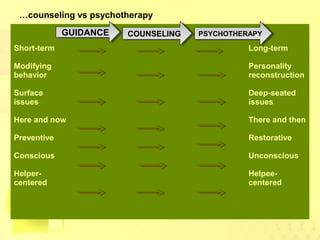
Acknowledging this common usage, one model of 
understanding these terms would place guidance 
and psychotherapy on opposite extremes, with 
counseling falling somewhere midway on the 
continuum.
…counseling vs psychotherapy 
GGUUIDIDAANNCCEE CCOOUUNNSSEELLININGG PPSSYYCCHHOOTTHHEERRAAPPYY 
Short-term 
Modifying 
behavior 
Surface 
issues 
Here and now 
Preventive 
Conscious 
Helper-centered 
Long-term 
Personality 
reconstruction 
Deep-seated 
issues 
There and then 
Restorative 
Unconscious 
Helpee-centered
…counseling vs psychotherapy 
Comparison of Mental Health Professionals 
(Neukrug, 2012) 
Whether we call it guidance, counseling, or 
psychoterapy, in todays world we find a number 
of professionals practicing it. In fact, although 
difference in the training of mental health 
professionals exist, over the years their 
professional duties have begun to overlap (Todd 
& Bohart, 2006).
Six Stages 
Stage One: Relationship building 
Stage Two: Assessment and diagnosis 
Stage Three: Formulation of counseling 
goals 
Stage Four: Intervention and problem 
solving 
Stage Five: Termination and Follow Up 
Stage Six: Research and evaluation
5 General Categories of Counseling and 
Psychotherapy Approaches 
(Corey, 2009) 
1. Psychodynamic Approaches 
2. Experiential and Relationship- 
Oriented Approaches 
3. Action-Oriented Therapies 
4. Systems-Oriented Approaches 
5. Postmodern Approaches
Psychodynamic Approaches 
a. Psychoanalytic therapy – is based largely on 
insight, unconscious motivation, and 
reconstruction of personality 
b. Adlerian therapy – differs from psychoanalytic 
theory in many respects but it can broadly be 
considered an analytic perspective. It focus on 
meaning, goals, purposeful behavior, conscious 
action, belonging and social interest.
Experiential and Relationship Oriented-Approaches 
a. Existential approach – stress the concern for what it 
means to be fully human. It suggests certain themes 
that are part of the human condition such as freedom 
and responsibility, anxiety, guilt, awareness of being 
finite, creating meaning in the world and shaping one’s 
future by making active choices. 
b. Person-centered approach – which is rooted in 
humanistic philosophy, places emphasis on the basic 
attitudes of the therapist. It maintains the quality of the 
client-therapist relationship. 
c. Gestalt therapy – which offers range of experiment to 
help clients gain awareness of what they are 
experiencing in the here and now – that, is the present.
Action-Oriented Therapies 
a. Reality Therapy – focuses on clients’ current 
behavior and stresses developing clear plans 
for new behavior. 
b. Behavior Therapy – puts a premium on doing 
and taking steps to make concrete changes 
c. Rational Emotive Behavior therapy and 
Cognitive therapy – highlight the necessity of 
learning how to challenge dysfunctional beliefs 
and automatic thoughts that lead to behavioral 
problems.
Systems Perspective 
The system orientation stresses the 
importance of understanding 
individuals in the context of the 
surroundings that influence their 
development. 
a. Feminist Therapy 
b. Family Therapy
Post Modern Approaches 
Challenges the basic assumptions of 
most of the traditional approaches by 
assuming that there is no single truth 
and reality is socially constructed 
through human interaction. 
a. social constructionism 
b. solution-focused brief therapy 
c. narrative therapy
Note: Discussant of Counseling 
Theories/Therapy/Psychotherapy 
Framework of discussions: 
• Proponent/s 
• View of Human/Theory of Personality 
• Sources/Nature of Difficulty/Maladjustment 
• Goal of Counseling 
• Role of Counselor 
• Counseling Strategies 
• Steps in Counseling 
• Contributions/Limitations
References: 
Corey, Gerald (2009). Theory and Practice of 
Counseling and Psychotheraphy. Brooks/Cole 
Cengage Learning 
De Jesus, Evangeline M. (2006) Counseling 
Psychology. Educational Publishing House 
Engler, Jack and Goleman, Daniel (1992). The 
Consumer’s Guide to Psychotherapy. Simon & 
Schuster/Fireside 
Gibson, Robert L and Mitchell, Mariannne H. 
(2003). Introduction to Counseling and 
Guidance. Pearson Education Inc.
References: 
Neukrug, Ed (2012) An Introduction to Counseling 
Profession. The World of the Counselor. 
Brooks/Cole Cengage Learning 
Nytsul, Michael S. (2010) Introduction to 
Counseling An Art and Science Perspective. 
Pearson Higher Ed USA 
Villar, Imelda Virginia G. (2007) Implementing 
Comprehensive Guidance Counseling Program 
in the Philippines. Aligned Transformatioon 
Publication.
References: 
http://www.apa.org/helpcenter/understanding-psychotherapy. 
aspx 
http://www.lawphil.net/statutes/repacts/ra2010/ra_ 
10029_2010.html

Counseling and psychotherapy

  • 1.
    Counseling and Psychotherapy Cesar Chester O. RReelllleevvee,, EEdd DD,, RRGGCC
  • 2.
    Course Description Thiscourse provides the idea and knowledge of counseling and psychotherapy. It is concerned with the understanding of the individual and the principles, techniques, methods and strategies of counseling and psychotherapy. To assist the individuals in making intelligent choices and adjustment to his/her environment and society is also a major concern of the course
  • 3.
    Course Objective Itis expected at the end of the course, the students should be able to have a clear concept of counseling and psychotherapy. Likewise students should have the understanding of the working principles, techniques, methods and strategies behind counseling and psychotherapy. It is also expected that students gain rich experience on psychological counseling and psychotherapy through actual actual application or simulation
  • 4.
    Philosophical Foundation ofTheories Theoretical models for counseling have their origins in the values and beliefs of person who in turn, have converted these into a philosophy and a theoretical model for counseling. These values and beliefs form a rationale for what one does, how one does it, and under what circumstance. It predicts probable outcomes for different sets of conditions.
  • 5.
    Philosophical… Theory summarizesthe information base on philosophy and draws conclusion. …theories provide guidelines that have been tested by experienced counselors. They explain behaviors. They may predict desirable or undesirable outcomes in given circumstances(Gibson & Mitchell, 2003).
  • 6.
    Philosophical… Philosophy hasasked significant questions that led to the understanding of what a human being is and how he/she must be handled. This is why Philosophy is a very important foundation of Guidance Counseling …Materialism believed that humans were entirely physical. Determinist asserted that all human choices were determined by the laws of nature.
  • 7.
    Philosophical… Rationalism emphazisedthat reasons, innate ideas, and deductions guide knowledge. Empiricism underscored that experience was the source of knowledge. Positivism concentrated on natural phenoma or facts that were objectively observable. Existentialism focused on the uniqueness of human beings and highlighted this as the only reality.
  • 8.
    Philosophical… Every counselingpractitioner should have a philosophy of human beings and how their problems evolve in order to establish a philosophy of helping. The goals that should be pursued, the role that the counselors should play, the techniques that could be employed, and the steps that must be taken must be based on such a philosophy and must then be a part of one’s Counseling Philosophy (Villar, 2009)
  • 9.
    CCoouunnsseelliinngg vveerrssuuss PPssyycchhootthheerraappyy RA 9258, Article I Sec. 3 (a): Guidance and Counseling -is a profession that involves the use of an integrated approach to the development of a well-functioning individual primarily by helping him/her to utilize his/her potentials to the fullest and plan his/her future in accordance with his/her abilities, interests and needs.It includes functions such as counseling subjects, particularly subjects given in the licensure examinations, and other human development services.
  • 10.
    CCoouunnsseelliinngg vveerrssuuss PPssyycchhootthheerraappyy REPUBLIC ACT No. 10029, Article III (b): Practice of Psychology - consists of the delivery of psychological services that involve application of psychological principles and procedures for the purpose of describing, understanding, predicting and influencing the behavior of individuals or groups, in order to assist in the attainment of optimal human growth and functioning. The delivery of psychological services includes, but is not limited to:
  • 11.
    CCoouunnsseelliinngg vveerrssuuss PPssyycchhootthheerraappyy REPUBLIC ACT No. 10029, Article III (b): Practice of Psychology (1) psychological interventions: psychological counseling, psychotherapy, psychosocial support, coaching, psychological debriefing, group processes and all other psychological interventions that involve the application of psychological principles to improve psychological functioning of individuals, families, groups and organizations;
  • 12.
    CCoouunnsseelliinngg vveerrssuuss PPssyycchhootthheerraappyy Psychotherapy (American Psychological Association) - is a collaborative treatment based on the relationship between an individual and a psychologist. Grounded in dialogue, it provides a supportive environment that allows you to talk openly with someone who’s objective, neutral and nonjudgmental.
  • 13.
    CCoouunnsseelliinngg vveerrssuuss PPssyycchhootthheerraappyy Psychotherapy (Engler and Goleman, 1992) - Is the general name for a variety of psychological interventions designed to help people resolve, emotional, behavioral, or interpersonal problems of various kinds and improve the quality of their lives.
  • 14.
    CCoouunnsseelliinngg vveerrssuuss PPssyycchhootthheerraappyy Guidance, Counseling,and Psychotherapy: Variations on the same Theme? (Neukrug, 2012) Counseling is a professional relationships that empowers diverse individuals, families, and group to accomplish mental health, wellness, education, and career goals. (ACA, 2010)
  • 15.
    …counseling vs psychotherapy Over the years there have plethora of definitions of counseling that suggest it could be anything from a problem-solving, directive, and rational approach to helping normal people – an approach that is distinguishable from psychotherapy (Williamson, 1950, 1958); - to a process that is similar to but less intensive than psychotherapy (Nugent & Jones, 2005); - to an approach that suggests that there is no essential difference between the two (Neukrug: Patterson, 1986).
  • 16.
    …counseling vs psychotherapy The word Guidance appeared around 1600 and was defined as “the process of guiding an individual”. Early Guidance work involved individuals giving moralistic and direct advice. This definition continued until the twentieth century, when the vocational guidance counselors used the word to describe the act of “guiding” an individual into a profession and offering suggestion for life skills. With the development of psychoanalysis near the end of the nineteenth century came the word psychotherapy. Meaning “caring for the soul”, the world derived from the Greek words psyche
  • 17.
    …counseling vs psychotherapy meaning spirit or soul, and therapeutikos, meaning caring for another (Kleinke, 1994) During the early part of 20th century, vocational guidance counselors became increasingly dissatisfied with the word guidance and its heavy emphasis on advice giving and morality. Consequently, the word counseling was adopted to indicate that vocational counselors, like the psychoanalysts who practiced psychotherapy, dealt with social and emotional issues.
  • 18.
    …counseling vs psychotherapy As mental health workers became more prevalent during the mid-1900, they too adopted the word counseling, rather used the word guidance with its moralistic implications, or psychotherapy, which was associated with psychoanalysis. In the training of counselors today, the word guidance has tended to take a back seat to the word counseling, while the worlds counseling and psychotherapy are generally used interchangeably in textbooks (e.i. Theory and Practice of Counseling and Psychotherpy, Corey)
  • 19.
    …counseling vs psychotherapy Despite the lack of distinction made in most texts, a differentiation between counseling and psychotherapy is likely to be made by the average person, perhaps by many counseling students, and even by professors of counseling. Acknowledging this common usage, one model of understanding these terms would place guidance and psychotherapy on opposite extremes, with counseling falling somewhere midway on the continuum.
  • 20.
    …counseling vs psychotherapy GGUUIDIDAANNCCEE CCOOUUNNSSEELLININGG PPSSYYCCHHOOTTHHEERRAAPPYY Short-term Modifying behavior Surface issues Here and now Preventive Conscious Helper-centered Long-term Personality reconstruction Deep-seated issues There and then Restorative Unconscious Helpee-centered
  • 21.
    …counseling vs psychotherapy Comparison of Mental Health Professionals (Neukrug, 2012) Whether we call it guidance, counseling, or psychoterapy, in todays world we find a number of professionals practicing it. In fact, although difference in the training of mental health professionals exist, over the years their professional duties have begun to overlap (Todd & Bohart, 2006).
  • 22.
    Six Stages StageOne: Relationship building Stage Two: Assessment and diagnosis Stage Three: Formulation of counseling goals Stage Four: Intervention and problem solving Stage Five: Termination and Follow Up Stage Six: Research and evaluation
  • 23.
    5 General Categoriesof Counseling and Psychotherapy Approaches (Corey, 2009) 1. Psychodynamic Approaches 2. Experiential and Relationship- Oriented Approaches 3. Action-Oriented Therapies 4. Systems-Oriented Approaches 5. Postmodern Approaches
  • 24.
    Psychodynamic Approaches a.Psychoanalytic therapy – is based largely on insight, unconscious motivation, and reconstruction of personality b. Adlerian therapy – differs from psychoanalytic theory in many respects but it can broadly be considered an analytic perspective. It focus on meaning, goals, purposeful behavior, conscious action, belonging and social interest.
  • 25.
    Experiential and RelationshipOriented-Approaches a. Existential approach – stress the concern for what it means to be fully human. It suggests certain themes that are part of the human condition such as freedom and responsibility, anxiety, guilt, awareness of being finite, creating meaning in the world and shaping one’s future by making active choices. b. Person-centered approach – which is rooted in humanistic philosophy, places emphasis on the basic attitudes of the therapist. It maintains the quality of the client-therapist relationship. c. Gestalt therapy – which offers range of experiment to help clients gain awareness of what they are experiencing in the here and now – that, is the present.
  • 26.
    Action-Oriented Therapies a.Reality Therapy – focuses on clients’ current behavior and stresses developing clear plans for new behavior. b. Behavior Therapy – puts a premium on doing and taking steps to make concrete changes c. Rational Emotive Behavior therapy and Cognitive therapy – highlight the necessity of learning how to challenge dysfunctional beliefs and automatic thoughts that lead to behavioral problems.
  • 27.
    Systems Perspective Thesystem orientation stresses the importance of understanding individuals in the context of the surroundings that influence their development. a. Feminist Therapy b. Family Therapy
  • 28.
    Post Modern Approaches Challenges the basic assumptions of most of the traditional approaches by assuming that there is no single truth and reality is socially constructed through human interaction. a. social constructionism b. solution-focused brief therapy c. narrative therapy
  • 29.
    Note: Discussant ofCounseling Theories/Therapy/Psychotherapy Framework of discussions: • Proponent/s • View of Human/Theory of Personality • Sources/Nature of Difficulty/Maladjustment • Goal of Counseling • Role of Counselor • Counseling Strategies • Steps in Counseling • Contributions/Limitations
  • 30.
    References: Corey, Gerald(2009). Theory and Practice of Counseling and Psychotheraphy. Brooks/Cole Cengage Learning De Jesus, Evangeline M. (2006) Counseling Psychology. Educational Publishing House Engler, Jack and Goleman, Daniel (1992). The Consumer’s Guide to Psychotherapy. Simon & Schuster/Fireside Gibson, Robert L and Mitchell, Mariannne H. (2003). Introduction to Counseling and Guidance. Pearson Education Inc.
  • 31.
    References: Neukrug, Ed(2012) An Introduction to Counseling Profession. The World of the Counselor. Brooks/Cole Cengage Learning Nytsul, Michael S. (2010) Introduction to Counseling An Art and Science Perspective. Pearson Higher Ed USA Villar, Imelda Virginia G. (2007) Implementing Comprehensive Guidance Counseling Program in the Philippines. Aligned Transformatioon Publication.
  • 32.
    References: http://www.apa.org/helpcenter/understanding-psychotherapy. aspx http://www.lawphil.net/statutes/repacts/ra2010/ra_ 10029_2010.html

Editor's Notes

  • #23 Rick wondering about questions we might ask here…e.g. Stage 1: where are the places where legal and ethical issues would arise Stage 2: What assessment would you consider – from an initial look at case info, does it seem to meet criteria for depression? How specifically? What legal/ethical issues here? Stage 3: Important things to know about the setting of goals. What factors that the client brings are going to have an impact here. What goals would you set with her? Stage Four: Here is the intervention stage – consider your developing treatment plan – sketch out an advance idea of your plan to accomplish your goals, think of early, middle and late stages of counseling Stage Five: What is important to consider as you think about termination? Legal/ethical issues? How would you go about it? Stage Six: Research and Evaluation – here the question is how will you know if your work helped this client – how will your experience with him/her inform your future practice?