Psychodynamic Perspective
Dr Neeta Gupta
Practitioner Of CBT,REBT & EFT
Associate Professor
D.A.V (P.G) College
Dehradun
Psychodynamic perspective tries to help clients understand long-standing
conflicts from the past which helps the client become more self-aware
and bring what is unconscious into consciousness. It focuses on the fact
that many of the personal troubles in life are the result of mental
processes that are hidden from us.
Psychodynamic therapy involves
the interpretation of mental and
emotional processes rather than
focusing on behavior (Strupp,
Butler, & Rosser, 1988). Psychodynamic
therapists attemptto help clients find
patterns in their emotions, thoughts,
and beliefs in order to gain insight into
their current self.
CORE PRINCIPLES OF PSYCHODYNAMIC PERSPECTIVE
In psychodynamic perspective the psychologist help
people gain insight into their lives and present-day
problems. They also evaluate patterns people develop over
time. To do this, the psychologist review certain life
factors with a person in therapy:
•Emotions
•Thoughts
•Early-life experiences
•Beliefs
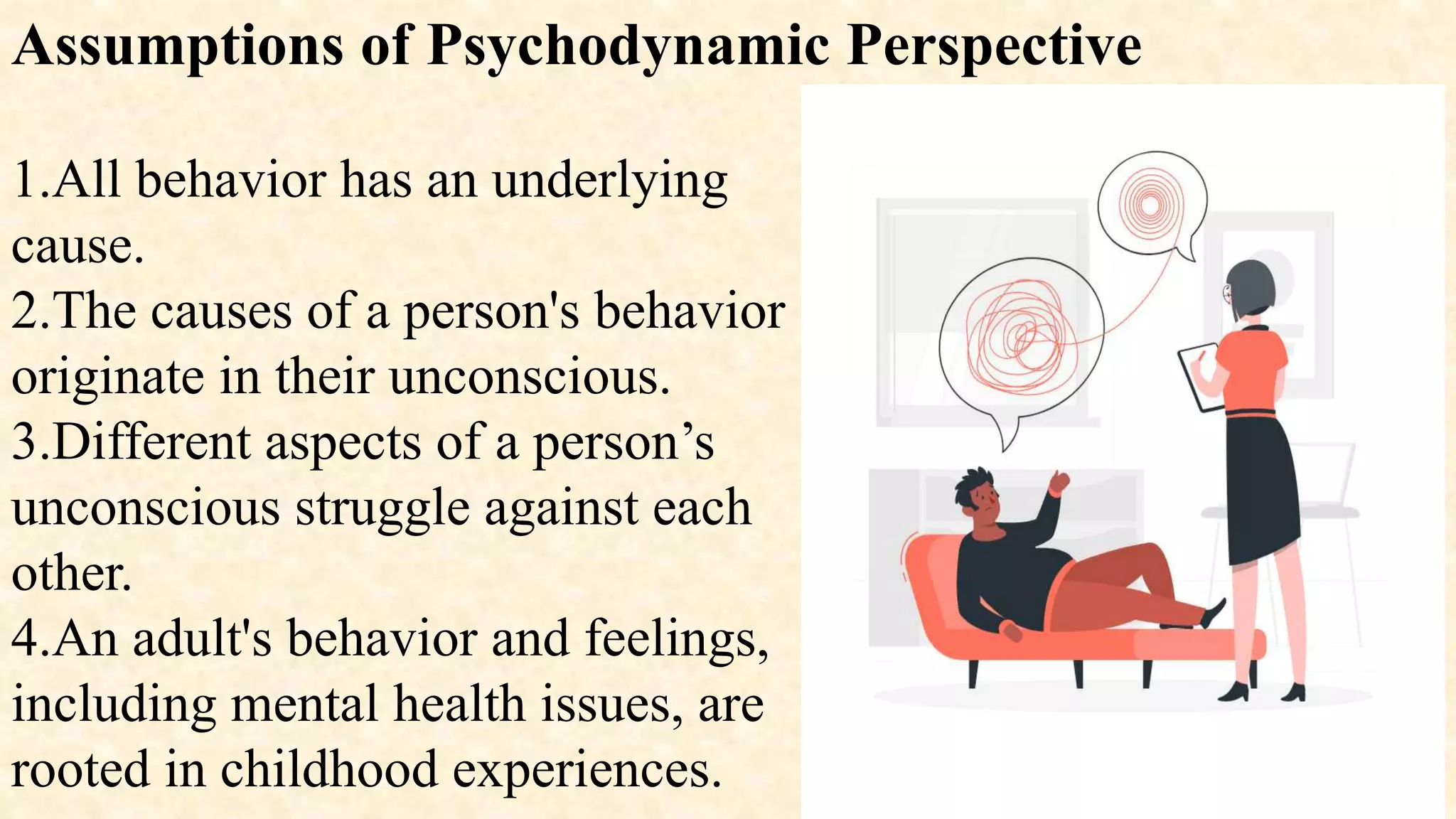
Assumptions of Psychodynamic Perspective
1.All behavior has an underlying
cause.
2.The causes of a person's behavior
originate in their unconscious.
3.Different aspects of a person’s
unconscious struggle against each
other.
4.An adult's behavior and feelings,
including mental health issues, are
rooted in childhood experiences.
Psychodynamic theory has a holistic focus on the perspective of the
client.
The alternative, “problem-based” therapies, such as cognitive behavioral
therapy, aim to reduce or eliminate symptoms instead of exploring the
client’s deep-seated needs, urges, and desires. Psychodynamic
perspective involves the interpretation of mental and emotional
processes rather than focusing on behavior Psychodynamic therapists
attempt to help clients find patterns in their emotions, thoughts, and
beliefs in order to gain insight into their current self. These patterns are
often found to begin in the person’s childhood since psychodynamic
theory holds that early life experiences are extremely influential in the
psychological development and functioning of an adult (Matthews &
Chu, 1997).
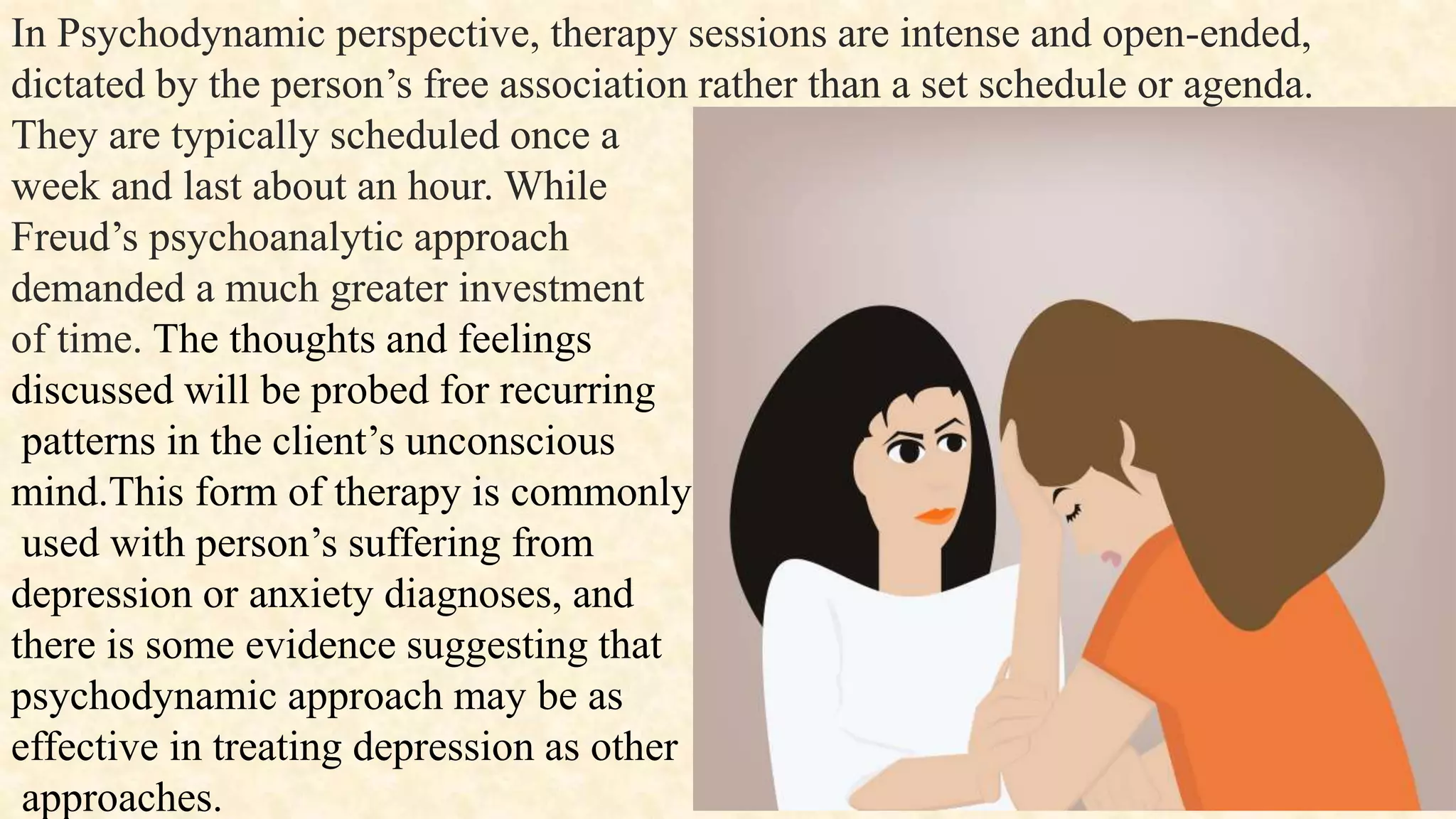
In Psychodynamic perspective, therapy sessions are intense and open-ended,
dictated by the person’s free association rather than a set schedule or agenda.
They are typically scheduled once a
week and last about an hour. While
Freud’s psychoanalytic approach
demanded a much greater investment
of time. The thoughts and feelings
discussed will be probed for recurring
patterns in the client’s unconscious
mind.This form of therapy is commonly
used with person’s suffering from
depression or anxiety diagnoses, and
there is some evidence suggesting that
psychodynamic approach may be as
effective in treating depression as other
approaches.
The main goals of psychodynamic therapy are to (1) enhance the client’s
self-awareness and (2) foster understanding of the client’s thoughts,
feelings, and beliefs in relation to their past experiences, especially his or
her experiences as a child. The assumption
In psychodynamic therapy is that chronic
problems are rooted in the unconscious
mind and must be brought to light for
catharsis to occur. Thus, the client must
have the self-awareness to discover these
unconscious patterns of thought and an
understanding of how these patterns
came to be in order to deal with them.
Freud held that which truly drives human behaviour is buried deep within the human
mind, in what he termed the unconscious mind. proposed that the human mind is
composed of three parts:
1.The id, which consists of instinct and forms the basis of the unconscious mind;
2.The superego, or moral component that houses our beliefs of right and wrong;
3.The ego, the mediator between the animal instinct of the id and the enlightened moral
thought of the superego (Haggerty, 2016).
Freud hypothesized that these components grew out of
certain stages in childhood development. He believed
humans are born with the id, develop the ego as a
toddler,and add the superego around the age of five.
Freud’s hypothesis led him to the logical
Conclusion (based on his theory) that one’s
personality is firmly rooted in their childhood
experiences.
Freud theorized three levels of the mind:
1.The Unconscious: this level is where our
instincts, deeply held beliefs, and many patterns
of thought and behavior reside; we are not
consciously aware of anything at this level,
but Freud believed the contents of the
unconscious mind make up the vast majority of
who we are, what we want, and how we behave
in order to get what we want.
2.The Subconscious or Preconscious: this
level can be called up to consciousness with a
purposeful ffort from the individual; the contents
of this level are just below the surface of
consciousness.
3.The Conscious: this is the level at which we are fully
ware;
According to Freud:
The unconscious mind is one of the most
powerful drivers of human behavior and emotion;
•No behavior is without cause—all behavior is
determined;
•Childhood experiences exert a significant
influence on thoughts, emotions, and behavior as
an adult;
•Important conflicts during childhood
development shape our overall personality as
adults (Freud, 1899).
Today, the role of the therapist in psychodynamic therapy is to
work with the client to discover the bases for their symptoms.
The therapist plays this role by
encouraging the client to talk about the emotions they are feeling
and
helping the client to identify recurring patterns in their thoughts,
emotions, and behaviors.
In general, the therapist’s role is to
aid the client in connecting the
dots between their past experiences
and their current problems, and
leverage their internal resources to
address these problems.
Types of Psychodynamic Therapy
1. Brief Psychodynamic Therapy
The aspect of brief psychodynamic therapy that sets it apart from other
types of psychodynamic therapies is right in the name: brief.
This type of therapy is generally conducted over the course of only a few
sessions, or even just one session in some cases. Sometimes an
individual struggling with a specific problem only needs to make a few
important connections to overcome that problem.
Brief psychodynamic therapy has been applied to situations like:
Rape;
Accident (traffic, physical injury, etc.);
Act of terrorism;
Acute psychological disturbances (like anxiety or depression);
Traumatic family event (discovery of a secret, divorce, etc.).
2. Psychodynamic Family Therapy:
Like other psychodynamic therapies, this form focuses on unconscious processes and
unresolved conflicts but views them in the context of family relationships. The therapist
will lead the family members through an exploration of family history, especially
any traumatic family events.
3. Psychodynamic Art / Music Therapy
Clients can actually create art or music in the session. It doesn’t have to be “good” art or
music, it only needs to convey the thoughts or feelings of the clients in a way that makes
sense to them.
Through art and/or music, the therapist and client can
build an understanding and form an important bond.
They may find that art and music are better methods
of deep communication than talking.
This type of therapy may be particularly well suited for
those who are shy or otherwise find it difficult to talk,
as well as clients who are experiencing crippling
anxiety or fear which music or art can help to soothe.
The five tools and techniques below are common practice for many types of
psychodynamic therapy.
1. Psychodynamic Diagnostic Manual (PDM)
The Diagnostic and Statistical Manual, or DSM, is often referred to as the clinical
psychologist’s Bible. The DSM serves as a framework for understanding and evaluating
behavior within a therapeutic context.
2. Rorschach Inkblots
3. Freudian Slip
This may be the least formal (and perhaps least applied)
technique in psychodynamic therapy, but it is certainly
not a dead concept yet.
A “Freudian slip” is also known as a slip of the tongue
or, more formally, parapraxes. These slips refer to
instances when we mean to say one thing
but accidentally let “slip” another, specifically when
deeper meaning can be attributed to this slip.
4. Free Association
Free association may be the single most important and most used
tool for psychodynamic therapists. This technique is simple and
often effective.
The more formal technique involves
the therapist reading a list of words
and the client responding
immediately with the first word that
comes to mind. This exercise can
shed light on some of the
associations and connections the
client has hidden deep below the
surface.
5. Dream Analysis
Dream analysis is undertaken by discussing the client’s dreams in detail.
The therapist will guide the client through this discussion, asking questions
and prodding the client to remember and describe the dream in as much
detail as possible. While the client talks about
their dream, the therapist attempts to aid the
client in sorting the “manifest” content from
“latent” content.
The manifest content is what
the client remembers about their dream—what
happened, who was there, how it felt, the
physical and temporal environment of the
dream, etc. The latent content is what is beneath
the surface of the dream, and this is where the
meaning of the dream lies
Strengths
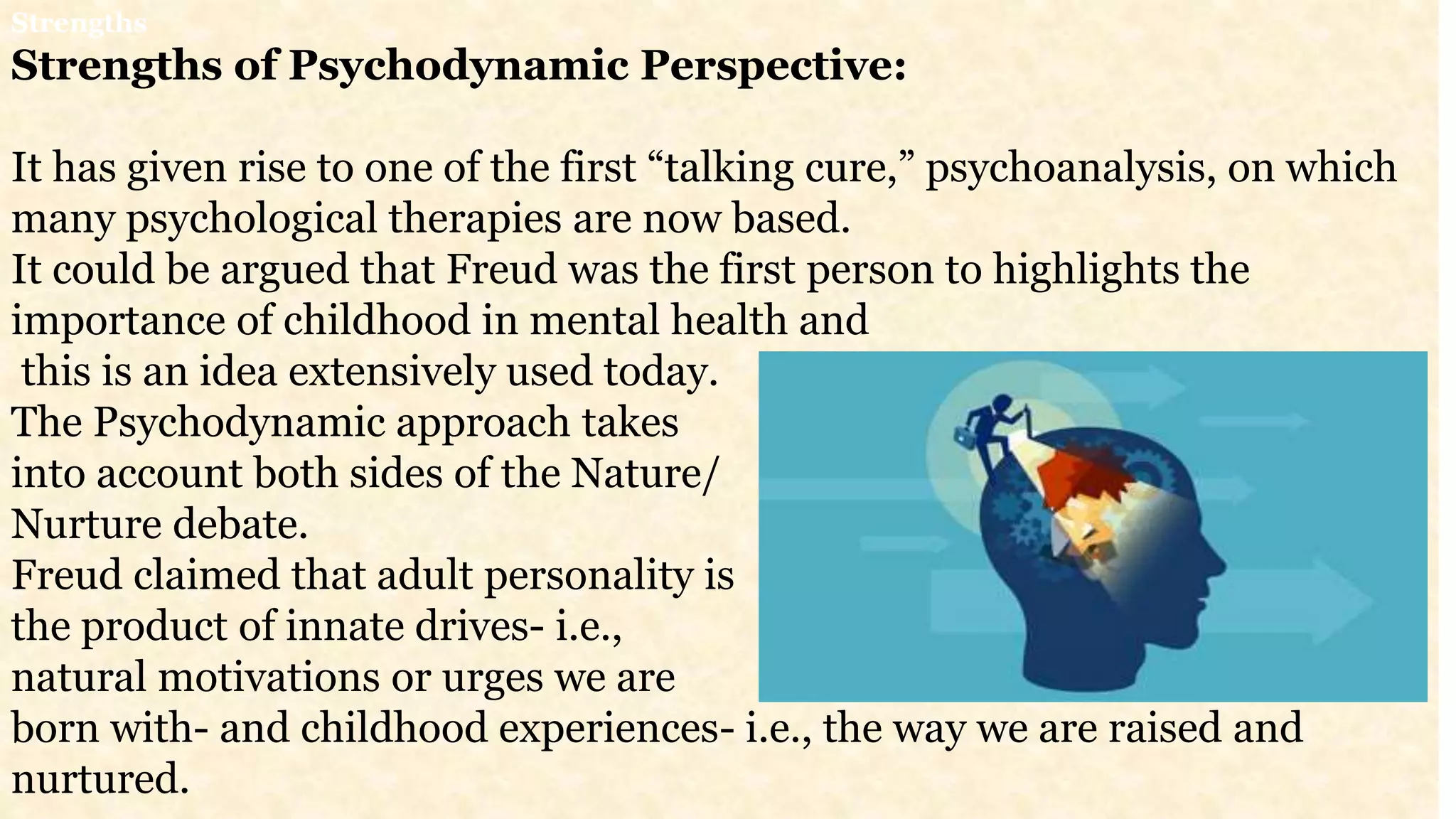
Strengths of Psychodynamic Perspective:
It has given rise to one of the first “talking cure,” psychoanalysis, on which
many psychological therapies are now based.
It could be argued that Freud was the first person to highlights the
importance of childhood in mental health and
this is an idea extensively used today.
The Psychodynamic approach takes
into account both sides of the Nature/
Nurture debate.
Freud claimed that adult personality is
the product of innate drives- i.e.,
natural motivations or urges we are
born with- and childhood experiences- i.e., the way we are raised and
nurtured.
Limitations
Ignores mediational processes (e.g., thinking)
The psychodynamic approach places too much emphasis on the
psychological factors, without considering the biological/genetic
factors that influence and contribute to mental health problems.
It is too deterministic (little free-will)
Unfalsifiable (difficult to prove wrong)
Case Studies - Subjective / Cannot generalize results
.
REFERENCES
https://elexisalford.files.wordpress.com/2015/05/35572-id-ego-superego255b1255d.gif
http://webspace.ship.edu/cgboer/freudsmind.gif
https://positivepsychology.com/psychodynamic-therapy/
https://www.goodtherapy.org/learn-about-therapy/types/psychodynamic
https://www.simplypsychology.org/psychodynamic.html
https://i.gifer.com/muY.gif
https://thumbs.gfycat.com/GiganticSlushyLemming-size_restricted.gif
https://64.media.tumblr.com/5ccc936af72d7c544ed1d87c774b966f/tumblr_mkwchuI0ry1qf62ks
o1_r1_500.gifv
https://drkimmyramotar.com/wp-content/uploads/2020/11/Psychologist-3.gif
https://i.pinimg.com/originals/44/d2/2b/44d22be362ac6b2c427d1be85fe91512.gif
https://tenscores.com/blog/wp-content/uploads/2015/07/Sigmund-Freud-Winking.gif
https://www.frontiersin.org/files/Articles/507186/fpsyg-11-00366-HTML-r1/image_m/fpsyg-11-
00366-g003.jpg
https://assets.ltkcontent.com/images/98947/psychodynamic-perspective_0066f46bde.jpg

Psychodynamic Perspective

  • 1.
    Psychodynamic Perspective Dr NeetaGupta Practitioner Of CBT,REBT & EFT Associate Professor D.A.V (P.G) College Dehradun
  • 2.
    Psychodynamic perspective triesto help clients understand long-standing conflicts from the past which helps the client become more self-aware and bring what is unconscious into consciousness. It focuses on the fact that many of the personal troubles in life are the result of mental processes that are hidden from us. Psychodynamic therapy involves the interpretation of mental and emotional processes rather than focusing on behavior (Strupp, Butler, & Rosser, 1988). Psychodynamic therapists attemptto help clients find patterns in their emotions, thoughts, and beliefs in order to gain insight into their current self.
  • 3.
    CORE PRINCIPLES OFPSYCHODYNAMIC PERSPECTIVE In psychodynamic perspective the psychologist help people gain insight into their lives and present-day problems. They also evaluate patterns people develop over time. To do this, the psychologist review certain life factors with a person in therapy: •Emotions •Thoughts •Early-life experiences •Beliefs
  • 4.
    Assumptions of PsychodynamicPerspective 1.All behavior has an underlying cause. 2.The causes of a person's behavior originate in their unconscious. 3.Different aspects of a person’s unconscious struggle against each other. 4.An adult's behavior and feelings, including mental health issues, are rooted in childhood experiences.
  • 5.
    Psychodynamic theory hasa holistic focus on the perspective of the client. The alternative, “problem-based” therapies, such as cognitive behavioral therapy, aim to reduce or eliminate symptoms instead of exploring the client’s deep-seated needs, urges, and desires. Psychodynamic perspective involves the interpretation of mental and emotional processes rather than focusing on behavior Psychodynamic therapists attempt to help clients find patterns in their emotions, thoughts, and beliefs in order to gain insight into their current self. These patterns are often found to begin in the person’s childhood since psychodynamic theory holds that early life experiences are extremely influential in the psychological development and functioning of an adult (Matthews & Chu, 1997).
  • 6.
    In Psychodynamic perspective,therapy sessions are intense and open-ended, dictated by the person’s free association rather than a set schedule or agenda. They are typically scheduled once a week and last about an hour. While Freud’s psychoanalytic approach demanded a much greater investment of time. The thoughts and feelings discussed will be probed for recurring patterns in the client’s unconscious mind.This form of therapy is commonly used with person’s suffering from depression or anxiety diagnoses, and there is some evidence suggesting that psychodynamic approach may be as effective in treating depression as other approaches.
  • 7.
    The main goalsof psychodynamic therapy are to (1) enhance the client’s self-awareness and (2) foster understanding of the client’s thoughts, feelings, and beliefs in relation to their past experiences, especially his or her experiences as a child. The assumption In psychodynamic therapy is that chronic problems are rooted in the unconscious mind and must be brought to light for catharsis to occur. Thus, the client must have the self-awareness to discover these unconscious patterns of thought and an understanding of how these patterns came to be in order to deal with them.
  • 8.
    Freud held thatwhich truly drives human behaviour is buried deep within the human mind, in what he termed the unconscious mind. proposed that the human mind is composed of three parts: 1.The id, which consists of instinct and forms the basis of the unconscious mind; 2.The superego, or moral component that houses our beliefs of right and wrong; 3.The ego, the mediator between the animal instinct of the id and the enlightened moral thought of the superego (Haggerty, 2016). Freud hypothesized that these components grew out of certain stages in childhood development. He believed humans are born with the id, develop the ego as a toddler,and add the superego around the age of five. Freud’s hypothesis led him to the logical Conclusion (based on his theory) that one’s personality is firmly rooted in their childhood experiences.
  • 9.
    Freud theorized threelevels of the mind: 1.The Unconscious: this level is where our instincts, deeply held beliefs, and many patterns of thought and behavior reside; we are not consciously aware of anything at this level, but Freud believed the contents of the unconscious mind make up the vast majority of who we are, what we want, and how we behave in order to get what we want. 2.The Subconscious or Preconscious: this level can be called up to consciousness with a purposeful ffort from the individual; the contents of this level are just below the surface of consciousness. 3.The Conscious: this is the level at which we are fully ware;
  • 10.
    According to Freud: Theunconscious mind is one of the most powerful drivers of human behavior and emotion; •No behavior is without cause—all behavior is determined; •Childhood experiences exert a significant influence on thoughts, emotions, and behavior as an adult; •Important conflicts during childhood development shape our overall personality as adults (Freud, 1899).
  • 11.
    Today, the roleof the therapist in psychodynamic therapy is to work with the client to discover the bases for their symptoms. The therapist plays this role by encouraging the client to talk about the emotions they are feeling and helping the client to identify recurring patterns in their thoughts, emotions, and behaviors. In general, the therapist’s role is to aid the client in connecting the dots between their past experiences and their current problems, and leverage their internal resources to address these problems.
  • 12.
    Types of PsychodynamicTherapy 1. Brief Psychodynamic Therapy The aspect of brief psychodynamic therapy that sets it apart from other types of psychodynamic therapies is right in the name: brief. This type of therapy is generally conducted over the course of only a few sessions, or even just one session in some cases. Sometimes an individual struggling with a specific problem only needs to make a few important connections to overcome that problem. Brief psychodynamic therapy has been applied to situations like: Rape; Accident (traffic, physical injury, etc.); Act of terrorism; Acute psychological disturbances (like anxiety or depression); Traumatic family event (discovery of a secret, divorce, etc.).
  • 13.
    2. Psychodynamic FamilyTherapy: Like other psychodynamic therapies, this form focuses on unconscious processes and unresolved conflicts but views them in the context of family relationships. The therapist will lead the family members through an exploration of family history, especially any traumatic family events. 3. Psychodynamic Art / Music Therapy Clients can actually create art or music in the session. It doesn’t have to be “good” art or music, it only needs to convey the thoughts or feelings of the clients in a way that makes sense to them. Through art and/or music, the therapist and client can build an understanding and form an important bond. They may find that art and music are better methods of deep communication than talking. This type of therapy may be particularly well suited for those who are shy or otherwise find it difficult to talk, as well as clients who are experiencing crippling anxiety or fear which music or art can help to soothe.
  • 14.
    The five toolsand techniques below are common practice for many types of psychodynamic therapy. 1. Psychodynamic Diagnostic Manual (PDM) The Diagnostic and Statistical Manual, or DSM, is often referred to as the clinical psychologist’s Bible. The DSM serves as a framework for understanding and evaluating behavior within a therapeutic context. 2. Rorschach Inkblots 3. Freudian Slip This may be the least formal (and perhaps least applied) technique in psychodynamic therapy, but it is certainly not a dead concept yet. A “Freudian slip” is also known as a slip of the tongue or, more formally, parapraxes. These slips refer to instances when we mean to say one thing but accidentally let “slip” another, specifically when deeper meaning can be attributed to this slip.
  • 15.
    4. Free Association Freeassociation may be the single most important and most used tool for psychodynamic therapists. This technique is simple and often effective. The more formal technique involves the therapist reading a list of words and the client responding immediately with the first word that comes to mind. This exercise can shed light on some of the associations and connections the client has hidden deep below the surface.
  • 16.
    5. Dream Analysis Dreamanalysis is undertaken by discussing the client’s dreams in detail. The therapist will guide the client through this discussion, asking questions and prodding the client to remember and describe the dream in as much detail as possible. While the client talks about their dream, the therapist attempts to aid the client in sorting the “manifest” content from “latent” content. The manifest content is what the client remembers about their dream—what happened, who was there, how it felt, the physical and temporal environment of the dream, etc. The latent content is what is beneath the surface of the dream, and this is where the meaning of the dream lies
  • 17.
    Strengths Strengths of PsychodynamicPerspective: It has given rise to one of the first “talking cure,” psychoanalysis, on which many psychological therapies are now based. It could be argued that Freud was the first person to highlights the importance of childhood in mental health and this is an idea extensively used today. The Psychodynamic approach takes into account both sides of the Nature/ Nurture debate. Freud claimed that adult personality is the product of innate drives- i.e., natural motivations or urges we are born with- and childhood experiences- i.e., the way we are raised and nurtured.
  • 18.
    Limitations Ignores mediational processes(e.g., thinking) The psychodynamic approach places too much emphasis on the psychological factors, without considering the biological/genetic factors that influence and contribute to mental health problems. It is too deterministic (little free-will) Unfalsifiable (difficult to prove wrong) Case Studies - Subjective / Cannot generalize results .
  • 19.
    REFERENCES https://elexisalford.files.wordpress.com/2015/05/35572-id-ego-superego255b1255d.gif http://webspace.ship.edu/cgboer/freudsmind.gif https://positivepsychology.com/psychodynamic-therapy/ https://www.goodtherapy.org/learn-about-therapy/types/psychodynamic https://www.simplypsychology.org/psychodynamic.html https://i.gifer.com/muY.gif https://thumbs.gfycat.com/GiganticSlushyLemming-size_restricted.gif https://64.media.tumblr.com/5ccc936af72d7c544ed1d87c774b966f/tumblr_mkwchuI0ry1qf62ks o1_r1_500.gifv https://drkimmyramotar.com/wp-content/uploads/2020/11/Psychologist-3.gif https://i.pinimg.com/originals/44/d2/2b/44d22be362ac6b2c427d1be85fe91512.gif https://tenscores.com/blog/wp-content/uploads/2015/07/Sigmund-Freud-Winking.gif https://www.frontiersin.org/files/Articles/507186/fpsyg-11-00366-HTML-r1/image_m/fpsyg-11- 00366-g003.jpg https://assets.ltkcontent.com/images/98947/psychodynamic-perspective_0066f46bde.jpg