Cognitive Therapy
Cognitive Therapy
• Cognitive therapy attempts to change problem feelings and
behaviors by changing the way a client thinks about significant
life experiences
Changing false beliefs
• Faulty thinking
Unreasonable attitudes (“Being perfect is the most important
trait for a student to have”)
False premises (“If I do everything they want me to, then I’ll
be popular”)
Rigid rules that put behavior on automatic pilot so that prior
patterns are repeated even when they have not worked (“I
must obey authorities”)
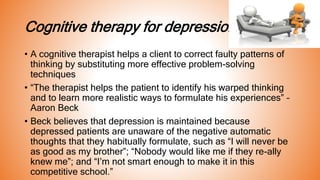
Cognitive therapy for depression
• A cognitive therapist helps a client to correct faulty patterns of
thinking by substituting more effective problem-solving
techniques
• “The therapist helps the patient to identify his warped thinking
and to learn more realistic ways to formulate his experiences” –
Aaron Beck
• Beck believes that depression is maintained because
depressed patients are unaware of the negative automatic
thoughts that they habitually formulate, such as “I will never be
as good as my brother”; “Nobody would like me if they re-ally
knew me”; and “I’m not smart enough to make it in this
competitive school.”
• A therapist uses four tactics to change the cognitive
foundation that supports the clients’ depression
Challenging the client’s basic assumptions about his or
her functioning.
Evaluating the evidence the client has for and against the
accuracy of automatic thoughts.
Reattributing blame to situational factors rather than to
the patient’s incompetence.
Discussing alternative solutions to complex tasks that
could lead to failure experiences
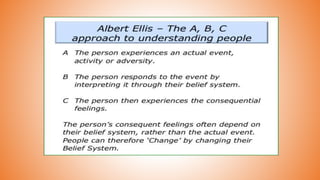
Rational Emotive therapy
• One of the earliest forms of cognitive therapy developed
by Albert Ellis
• RET is a comprehensive system of personality change
based on the transformation of irrational beliefs that
cause undesirable, highly charged emotional reactions,
such as severe anxiety
• Rational-emotive therapists teach clients how to
recognize the “shoulds,” “oughts,” and “musts” that are
controlling their actions and preventing them from
choosing the lives they want
• They attempt to break through a client’s closed-
mindedness by showing that an emotional reaction
that follows some event is really the effect of
unrecognized beliefs about the event
• Rational-emotive therapy aims to increase an
individual’s sense of self-worth and the potential to
be self-actualized by getting rid of the system of
faulty beliefs that block personal growth
Cognitive Behavioral Therapy
• You are what you tell yourself you can be, and you are
guided by what you believe you ought to do
• This therapeutic approach combines the cognitive
emphasis on changing false beliefs with the behavioral
focus on reinforcement contingencies in the modification
of performance
• A critical part of this therapeutic approach is the
discovery by therapist and client of the way the client
thinks about and expresses the problem for which
therapy is sought
• Once both therapist and client understand the kind of
thinking that is leading to unproductive or dysfunctional
behaviors, they develop new self-statements that are
constructive and minimize the use of self-defeating ones
that elicit anxiety or reduce self-esteem
• Through setting attainable goals, developing realistic
strategies for attaining them, and evaluating feedback
realistically, you develop a sense of mastery and self-
efficacy
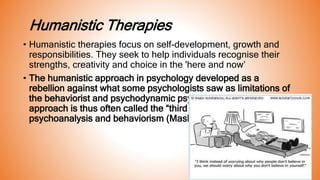
Humanistic Therapies
• Humanistic therapies focus on self-development, growth and
responsibilities. They seek to help individuals recognise their
strengths, creativity and choice in the 'here and now’
• The humanistic approach in psychology developed as a
rebellion against what some psychologists saw as limitations of
the behaviorist and psychodynamic psychology. The humanistic
approach is thus often called the “third force” in psychology after
psychoanalysis and behaviorism (Maslow, 1968).
Features of Humanistic Theories
• For Carl Rogers (1902–1987), the self is a central
concept for personality
• self signals a key feature of all humanistic theories,
which is an emphasis on the drive toward self-
actualization
• Self-actualization is a constant striving to realize one’s
inherent potential
• The striving toward self-fulfillment is a constructive,
guiding force that moves each person toward generally
positive behaviors and enhancement of the self.
• The drive for self-actualization at times comes
into conflict with the need for approval from
the self and others eg: when a child
misbehaves, parents should emphasize that it
is the behavior they disapprove of, not the
child
• As an adult, you need to give to and receive
unconditional positive regard from those to
whom you are close. Most important, you
need to feel unconditional positive self-regard,
or acceptance of yourself, in spite of the
weaknesses you might be trying to change
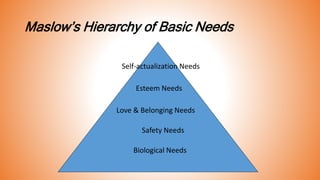
Maslow’s Hierarchy of Basic Needs
Self-actualization Needs
Esteem Needs
Love & Belonging Needs
Safety Needs
Biological Needs
• In addition, humanistic theories have been
described as being holistic, dispositional and
phenomenological
• Holistic :-Humanistic theories are holistic
because they explain people’s separate acts in
terms of their entire personalities; people are not
seen as the sum of discrete traits that each
influence behavior in different ways
• Dispositional :-Humanistic theories are
dispositional because they focus on the innate
qualities within a person that exert a major
influence over the direction behavior will take
• Phenomenological :-Humanistic theories are
phenomenological because they emphasize an
individual’s frame of reference and subjective
view of reality—not the objective perspective
of an observer or of a therapist
Unconditional positive regard
• We need this to accept all parts of our personality.
• With this we know we are loved & valued for being who we
are.
• Parents can do this, by it clear that their love is not contingent
on the child’s behavior (even when such behavior is abhored).
•Humanistic theorists emphasized each
individual’s drive toward self-
actualization.This group recognized,
however, that people’s progress toward
this goal is determined, in part, by
realities of their environments.We turn
now to theories that directly examine
how individuals’ behaviors are shaped by
their environments.
Goal of Humanistic Therapy
• the goal of a humanistic therapy was to help the
individual achieve the joy of self-realization and
promote the inherent constructive forces in
human nature that support a striving for self-
fulfillment
• Believe in Free Will
• Humanist do not believe that human being are pushed
and pulled by mechanical forces, either of stimuli and
reinforcements (behaviorism) or of unconscious
instinctual impulses (psychoanalysis).
• Emphasize the uniqueness of each individual
• Believe that humans strive for an upper level of
capabilities.
Group Therapy
• group therapy is a form of psychotherapy in
which one or more therapists treat a small
group of clients together as a group.
• It may include supporting groups such as
anger
management, mindfulness, relaxation
training or social skills training
• Other, more specialized forms of group
therapy would include non-
verbal expressive therapies such as art
therapy, dance therapy, or music therapy.
• There are several reasons why group therapy
has flourished. Some advantages are
• therapy is less expensive to participants and
allows small numbers of mental health
personnel to help more clients
• It is a less threatening situation for people who
have problems
• It allows group processes to be used to
influence individual maladaptive behavior;
• It provides people with opportunities to
observe and practice interpersonal skills within
the therapy session;
• It provides an analogue of the primary family
group, which enables corrective emotional
experiences to take place.
Problems in Group Therapy
• some groups establish a culture in which little progress can be
made
• members create a norm of passivity and limited self-disclosure
• effectiveness of groups can change dramatically when
members leave or join the groups
Family group therapy and Family
therapist
• In family therapy, the client is a whole nuclear family, and each
family member is treated as a member of a system of
relationships
• Family therapy can focus on both the child’s problem and the
parent’s behaviors that may maintain that problem.
• The job of the family therapist is to understand the structure of
the family and the many forces acting on it. Then he or she
works with the family members to dissolve “dysfunctional”
structural elements while creating and maintaining new, more
effective structures
Self Help Groups
• Self-help groups appear to serve a number of
functions for their members: For example, they
provide people with a sense of hope and control
over their problems, they engage social support
for people’s suffering, and they provide a forum
for dispensing and acquiring information about
disorders and treatments (Groh et al., 2008).
Researchers have begun to demonstrate that
self-help groups may help bring relief alongside
other forms of therapy. For example, participation
in self-help groups has the potential to reduce
symptoms of depression

Cognitive therapy

  • 1.
  • 2.
    Cognitive Therapy • Cognitivetherapy attempts to change problem feelings and behaviors by changing the way a client thinks about significant life experiences
  • 3.
    Changing false beliefs •Faulty thinking Unreasonable attitudes (“Being perfect is the most important trait for a student to have”) False premises (“If I do everything they want me to, then I’ll be popular”) Rigid rules that put behavior on automatic pilot so that prior patterns are repeated even when they have not worked (“I must obey authorities”)
  • 4.
    Cognitive therapy fordepression • A cognitive therapist helps a client to correct faulty patterns of thinking by substituting more effective problem-solving techniques • “The therapist helps the patient to identify his warped thinking and to learn more realistic ways to formulate his experiences” – Aaron Beck • Beck believes that depression is maintained because depressed patients are unaware of the negative automatic thoughts that they habitually formulate, such as “I will never be as good as my brother”; “Nobody would like me if they re-ally knew me”; and “I’m not smart enough to make it in this competitive school.”
  • 5.
    • A therapistuses four tactics to change the cognitive foundation that supports the clients’ depression Challenging the client’s basic assumptions about his or her functioning. Evaluating the evidence the client has for and against the accuracy of automatic thoughts. Reattributing blame to situational factors rather than to the patient’s incompetence. Discussing alternative solutions to complex tasks that could lead to failure experiences
  • 6.
    Rational Emotive therapy •One of the earliest forms of cognitive therapy developed by Albert Ellis • RET is a comprehensive system of personality change based on the transformation of irrational beliefs that cause undesirable, highly charged emotional reactions, such as severe anxiety • Rational-emotive therapists teach clients how to recognize the “shoulds,” “oughts,” and “musts” that are controlling their actions and preventing them from choosing the lives they want
  • 8.
    • They attemptto break through a client’s closed- mindedness by showing that an emotional reaction that follows some event is really the effect of unrecognized beliefs about the event • Rational-emotive therapy aims to increase an individual’s sense of self-worth and the potential to be self-actualized by getting rid of the system of faulty beliefs that block personal growth
  • 9.
    Cognitive Behavioral Therapy •You are what you tell yourself you can be, and you are guided by what you believe you ought to do • This therapeutic approach combines the cognitive emphasis on changing false beliefs with the behavioral focus on reinforcement contingencies in the modification of performance • A critical part of this therapeutic approach is the discovery by therapist and client of the way the client thinks about and expresses the problem for which therapy is sought
  • 10.
    • Once boththerapist and client understand the kind of thinking that is leading to unproductive or dysfunctional behaviors, they develop new self-statements that are constructive and minimize the use of self-defeating ones that elicit anxiety or reduce self-esteem • Through setting attainable goals, developing realistic strategies for attaining them, and evaluating feedback realistically, you develop a sense of mastery and self- efficacy
  • 11.
    Humanistic Therapies • Humanistictherapies focus on self-development, growth and responsibilities. They seek to help individuals recognise their strengths, creativity and choice in the 'here and now’ • The humanistic approach in psychology developed as a rebellion against what some psychologists saw as limitations of the behaviorist and psychodynamic psychology. The humanistic approach is thus often called the “third force” in psychology after psychoanalysis and behaviorism (Maslow, 1968).
  • 12.
    Features of HumanisticTheories • For Carl Rogers (1902–1987), the self is a central concept for personality • self signals a key feature of all humanistic theories, which is an emphasis on the drive toward self- actualization • Self-actualization is a constant striving to realize one’s inherent potential • The striving toward self-fulfillment is a constructive, guiding force that moves each person toward generally positive behaviors and enhancement of the self.
  • 13.
    • The drivefor self-actualization at times comes into conflict with the need for approval from the self and others eg: when a child misbehaves, parents should emphasize that it is the behavior they disapprove of, not the child • As an adult, you need to give to and receive unconditional positive regard from those to whom you are close. Most important, you need to feel unconditional positive self-regard, or acceptance of yourself, in spite of the weaknesses you might be trying to change
  • 14.
    Maslow’s Hierarchy ofBasic Needs Self-actualization Needs Esteem Needs Love & Belonging Needs Safety Needs Biological Needs
  • 15.
    • In addition,humanistic theories have been described as being holistic, dispositional and phenomenological • Holistic :-Humanistic theories are holistic because they explain people’s separate acts in terms of their entire personalities; people are not seen as the sum of discrete traits that each influence behavior in different ways • Dispositional :-Humanistic theories are dispositional because they focus on the innate qualities within a person that exert a major influence over the direction behavior will take
  • 16.
    • Phenomenological :-Humanistictheories are phenomenological because they emphasize an individual’s frame of reference and subjective view of reality—not the objective perspective of an observer or of a therapist
  • 17.
    Unconditional positive regard •We need this to accept all parts of our personality. • With this we know we are loved & valued for being who we are. • Parents can do this, by it clear that their love is not contingent on the child’s behavior (even when such behavior is abhored).
  • 18.
    •Humanistic theorists emphasizedeach individual’s drive toward self- actualization.This group recognized, however, that people’s progress toward this goal is determined, in part, by realities of their environments.We turn now to theories that directly examine how individuals’ behaviors are shaped by their environments.
  • 19.
    Goal of HumanisticTherapy • the goal of a humanistic therapy was to help the individual achieve the joy of self-realization and promote the inherent constructive forces in human nature that support a striving for self- fulfillment • Believe in Free Will • Humanist do not believe that human being are pushed and pulled by mechanical forces, either of stimuli and reinforcements (behaviorism) or of unconscious instinctual impulses (psychoanalysis). • Emphasize the uniqueness of each individual • Believe that humans strive for an upper level of capabilities.
  • 20.
    Group Therapy • grouptherapy is a form of psychotherapy in which one or more therapists treat a small group of clients together as a group. • It may include supporting groups such as anger management, mindfulness, relaxation training or social skills training • Other, more specialized forms of group therapy would include non- verbal expressive therapies such as art therapy, dance therapy, or music therapy.
  • 21.
    • There areseveral reasons why group therapy has flourished. Some advantages are • therapy is less expensive to participants and allows small numbers of mental health personnel to help more clients
  • 22.
    • It isa less threatening situation for people who have problems • It allows group processes to be used to influence individual maladaptive behavior; • It provides people with opportunities to observe and practice interpersonal skills within the therapy session; • It provides an analogue of the primary family group, which enables corrective emotional experiences to take place.
  • 23.
    Problems in GroupTherapy • some groups establish a culture in which little progress can be made • members create a norm of passivity and limited self-disclosure • effectiveness of groups can change dramatically when members leave or join the groups
  • 24.
    Family group therapyand Family therapist • In family therapy, the client is a whole nuclear family, and each family member is treated as a member of a system of relationships • Family therapy can focus on both the child’s problem and the parent’s behaviors that may maintain that problem. • The job of the family therapist is to understand the structure of the family and the many forces acting on it. Then he or she works with the family members to dissolve “dysfunctional” structural elements while creating and maintaining new, more effective structures
  • 25.
    Self Help Groups •Self-help groups appear to serve a number of functions for their members: For example, they provide people with a sense of hope and control over their problems, they engage social support for people’s suffering, and they provide a forum for dispensing and acquiring information about disorders and treatments (Groh et al., 2008). Researchers have begun to demonstrate that self-help groups may help bring relief alongside other forms of therapy. For example, participation in self-help groups has the potential to reduce symptoms of depression