Person-Centered
Therapy
Dr.V.Veera Balaji Kumar PhD
Psychologist
Person-Centered Therapy
 A reaction against the directive and psychoanalytic
approaches
 Challenges:
 The assumption that “the counselor knows best”
 The validity of advice, suggestion, persuasion,
teaching, diagnosis, and interpretation
 The belief that clients cannot understand and
resolve their own problems without direct help
 The focus on problems over persons
Basic Philosophy
 Human beings are inherently trustworthy
 Have potential for understanding
themselves and resolving their problems
 A therapeutic relationship can facilitate their
growth and maturity
Person-Centered Therapy
Emphasizes:
 Therapy as a journey shared by two fallible people
 The person’s innate striving for self-actualization
 The personal characteristics of the therapist and
the quality of the therapeutic relationship
 The counselor’s creation of a permissive, “growth
promoting” climate
 People are capable of self-directed growth if
involved in a therapeutic relationship
The Person-Centered Approach
 A humanistic theory—each of us has a
natural potential that we can actualize and
through which we can find meaning
 Shares with existentialism a focus on
respect and trust for the client
Humanism vs. Existentialism…
Humanism and Existentialism BOTH:
 Respect for client’s experience and
 Uniqueness of each individual
 Trust in clients ability to change
 Believe in freedom, choice, values,
personal responsibility, autonomy, meaning
 Place less value on techniques and more
on genuine encounter
Humanism vs. Existentialism…
Existentialism
 Clients come into
counseling because
they are facing
anxiety in trying to
construct an identity
in a world without
intrinsic meaning
Humanism
 Clients do not suffer
from anxiety in
creating an identity
 Clients need to
believe that they have
the natural potential
to actualize
Person-Centered
Theory of Personality
 Carl Rogers was concerned about the way
people treated each other and how they cared
for or didn't care for each other.
 He believed that children would develop a
good sense of their own self-worth or self-
regard if others (parents, teachers, or friends)
treated them as valuable and worthy.
Carl Rogers:
The Humanistic Approach
Two Basic Human Needs
Self Actualization: the need to fulfill all of one’s
potential.
Positive Regard: the need to receive
acceptance, respect, and affection from others.
Positive regard often comes with conditions attached (“Conditions of
Worth”): We must meet others’ expectations to get it. This is called
Conditional Positive Regard.
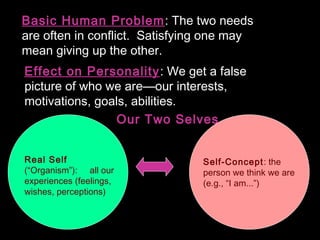
Basic Human Problem: The two needs
are often in conflict. Satisfying one may
mean giving up the other.
Effect on Personality: We get a false
picture of who we are—our interests,
motivations, goals, abilities.
Our Two Selves
Real Self
(“Organism”): all our
experiences (feelings,
wishes, perceptions)
Self-Concept: the
person we think we are
(e.g., “I am...”)
Self-Concept
 The organized set of characteristics that an
individual perceives as peculiar to himself /
herself.
 It is largely based on the social evaluations
he/she has experienced.
 When significant others provide positive
conditional regard for certain behaviour the
person interjects the associated values,
making them their own and acquires
“conditions of worth”.
Person-Centered Theory of
Personality
 When individuals were treated by others in a
way that was sometimes harsh, manipulative,
or self-serving, then the person was treated
conditionally.
 Conditions of worth (conditionality) develop
from conditional positive regard from others.
 Such conditions can make it difficult for a
person to become a fully functioning person.
Conditionality or Conditions of Worth
The process of evaluating one's own experience based on values
or beliefs that others hold.
 Conditional positive regard
 Receiving praise, attention, or approval from
others as a result of behaving in accordance with
the expectations of others.
 Fully functioning person
 A person who meets his or her own need for positive
regard rather than relying on the expectations of others.
Such individuals are open to new experiences and not
defensive.
Losing Touch with the Real Self
 We have a need for positive self-regard (to like and
respect ourselves).
 Conditional positive regard from others becomes
conditional positive self-regard.
 This means we will like and accept only those parts
of ourselves that other people like and accept.
 The self-concept pulls away from the real self; we
get a false picture of who we really are.
 This mismatch is called Incongruence.
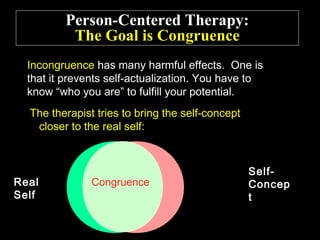
Person-Centered Therapy:
The Goal is Congruence
Incongruence has many harmful effects. One is
that it prevents self-actualization. You have to
know “who you are” to fulfill your potential.
The therapist tries to bring the self-concept
closer to the real self:
Real
Self
Self-
Concep
t
Congruence
Organismic Valuing Process
• Individuals selecting goals based on inner
nature, internal rationality, and individual
decision making.
• It is a means for an individuals to fulfil their
actualizing tendency which is a desire and
need to develop and evolve as a person.
• This process uses organismic variables to
develop goals and make decisions.
• Organismic variables are the internal forces
and influences an organism’s behaviour.
• People who experienced a caring, supportive, and
loving environment during childhood were more able
and likely to trust themselves and their internal feelings
in regards to decision making and goal achievement.
• The organismic valuing process includes many
variables such as
• authenticity (being yourself),
• autonomy (making your own decisions and not
basing it on other people's desires),
• an internal locus of evaluation (not seeking the
approval of others), and
• unconditional positive self-regard.
Organismic Valuing Process
Fully functioning person
• One of Roger’s proposition was that
“Psychological adjustment exists when the concept
of the self is such that all the sensory and visceral
experiences of the organism are, or may be,
assimilated on a symbolic level into a consistent
relationship with the concept of self.”
• He describes this as the good life, where the
organism continually aims to fulfil its full potential.
Fully functioning person
The characteristics of a fully functioning
person:
1. A growing openness to experience –
2. they move away from defensiveness and
3. have no need for ‘subception’
(subception = subliminal perception = a perceptual
defence that involves unconsciously applying
strategies to prevent a troubling stimulus from
entering consciousness).
Fully functioning person
2. An increasingly existential lifestyle –
living each moment fully –
not distorting the moment to fit personality
or self-concept but allowing personality
and self-concept to emanate from the
experience.
This results in excitement, daring,
adaptability, tolerance, spontaneity, and a
lack of rigidity and suggests a foundation
of trust.
3. Increasing organismic trust – they trust their own
judgment and their ability to choose appropriate
behavior. They do not rely on existing codes and social
norms but trust their own sense of right and wrong.
4. Freedom of choice – not being shackled by the
restrictions that influence an incongruent individual, they
are able to make a wider range of choices more fluently.
They feel responsible for their own behavior.
5. Creativity – it follows that they will feel more free to
be creative. They adapt to their own circumstances
without feeling a need to conform.
Fully functioning person
Reliability and constructiveness – they can be trusted to act
constructively. An individual who is open to all their needs will
be able to maintain a balance between them. Even aggressive
needs will be matched and balanced by intrinsic goodness in
congruent individuals.
A rich full life – he describes the life of the fully functioning
individual as rich, full and exciting and suggests that they
experience joy and pain, love and heartbreak, fear and courage
more intensely. Rogers' description of the good life:This process
of the good life is not, I am convinced, a life for the faint-
hearted. It involves the stretching and growing of becoming
more and more of one's potentialities. It involves the courage to
be. It means launching oneself fully into the stream of life.
(Rogers 1961)[21]
Fully functioning person
A Growth-Promoting Climate
 Congruence - genuineness or realness
 Unconditional positive regard- acceptance
and caring, but not approval of all behavior
 Accurate empathic understanding – an
ability to deeply grasp the client’s subjective
world
 Helper attitudes are more important than
knowledge
Person-Centered Therapy
3 ATTITUDES THERAPIST MUST CONVEY
 Genuineness: open, real, honest
 Unconditional positive regard and
acceptance: value and accept client as they
are
 Empathetic understanding
Six Conditions (necessary and sufficient for
personality changes to occur)
 Two persons are in psychological contact – A DYAD
 The first, the client, is experiencing incongruency – i.e.
VULNERABLE AND ANXIOUS
 The second person, the therapist, is congruent or
integrated in the relationship – authentic not pretending.
 The therapist experiences unconditional positive
regard or real caring for the client
 The therapist experiences empathy for the client’s
internal frame of reference and endeavors to
communicate this to the client
 The communication to the client is, to a minimal degree,
achieved- Client recognizes the acceptance & empathy
that the therapist feels for them
Necessary and Sufficient
Conditions for Change
1. Psychological contact
A relationship must exist so that two people
may have impact on each other.
Necessary and Sufficient Conditions
for Change
2. Incongruence in the client
 For change to take place, a client must be in a
state of psychological vulnerability.
 There is a discrepancy between individuals'
views of themselves and their actual
experience.
 Included would be depression, anxiety, or a
wide variety of problems.
 Although individuals may not be aware at first of
their incongruence or vulnerability, they will be
so if therapy continues.
Necessary and Sufficient Conditions
for Change
3. Congruence and genuineness
 Therapists are aware of themselves.
 They are aware of their feelings, their
experiences as they relate to the client,
and their general reactions to the client.
 Therapists are open to understanding their
own experiences as well as those of the
client.
Necessary and Sufficient Conditions
for Change
4. Unconditional positive regard or acceptance
 The therapist does not judge the client but
accepts the client for who he or she is.
 Accepting the client does not mean that the
counselor agrees with the client.
 With acceptance often comes caring and
warmth.
Necessary and Sufficient Conditions
for Change
5. Empathy
 The therapist enters the world of the client,
leaving behind, as much as possible, his or her
own values.
 Since it is not possible to be "value free," the
therapist monitors his or her own values and
feelings.
 The therapist tries to understand the experience
of the client, what it is to be the client.
 Caring and warmth are expressed often in
statements of empathy.
Conveying Empathy
 Active listening to client’s narrative
 Eye contact, body language etc.
 Reflection - Paraphrasing or summarizing
what the client has just said or
communicated so far.
 Give clients permission to be themselves
without being judged
Necessary and Sufficient Conditions
for Change
 6. Perception of empathy and acceptance
 Not only must the therapist unconditionally accept
and understand the client, the client must perceive
that he or she is being understood and accepted.
 Therapists' voice tone and physical expression
contribute to the communication of empathy and
acceptance.
 They are a part of the client's perception of
empathy.
Process of Therapy
Stage 1
Minimal self-awareness
Not likely to voluntarily present for therapy
Stage 2
Little sense of responsibility for difficulties
Stage 3**
Able to discuss self-experiences and feelings
Stage 4
Begins to accept responsibility for difficulties
Process of Therapy
Stage 5
Able to experience and express feelings in the
present
Stage 6
Realization of previously being stuck
Stage 7
Conditions of worth are replaced by internally
generated values
The Therapist
 Focuses on the quality of the therapeutic
relationship
 Serves as a model of a human being struggling
toward greater realness
 Is genuine, integrated, and authentic, without a
false front
 Can openly express feelings and attitudes that
are present in the relationship with the client
The Client’s Experience in Therapy
 1. Experiencing responsibility.
 2. Experiencing the therapist.
 3. Experiencing the process of exploration.
 4. Experiencing the self.
 5. Experiencing change.
Person-Centered Therapy
OUTCOMES OF THERAPY
 Increased Self-esteem
 Greater openness to experiences
 Better congruence between actual self
and idealized self
 Decreased defensiveness, guilt / shame
and Insecurity
 Positive and comfortable relationships
 Increased capacity to experience and
express their feelings at the moment they
occur
Person-Centered Goals in Therapy
 Become more self-directed.
 Increase positive self-regard.
 The client chooses the goals.
Assessment
 The Q Sort technique - used by Rogers to assess
change with therapy. Clients sort about 100 adjective
cards twice before and twice after therapy.
 Client rates adjectives in terms of how descriptive the
words are of their “current self” and of their “ideal
self.” The two sets of scores should correlate more
highly after than before therapy.
 Assessment occurs as therapists empathically
understand clients.
Person-Centered Therapy
STRENGTHS
 Empathy
 Phenomenological approach
 Reflection
 Increase self-understanding
 Genuine
 Unconditional positive regard and
acceptance
Person-Centered Therapy
WEAKNESSES
 Not much research on theory and practice
 Theory has not evolved since the 1960’s
Rogers’ Contributions
 Emphasized that the
therapeutic
relationship is the
primary agent of
growth
 Created a style of
therapy that can be
used by various
helping professionals

Person centered therapy dr veera_balaji

  • 1.
  • 2.
    Person-Centered Therapy  Areaction against the directive and psychoanalytic approaches  Challenges:  The assumption that “the counselor knows best”  The validity of advice, suggestion, persuasion, teaching, diagnosis, and interpretation  The belief that clients cannot understand and resolve their own problems without direct help  The focus on problems over persons
  • 3.
    Basic Philosophy  Humanbeings are inherently trustworthy  Have potential for understanding themselves and resolving their problems  A therapeutic relationship can facilitate their growth and maturity
  • 4.
    Person-Centered Therapy Emphasizes:  Therapyas a journey shared by two fallible people  The person’s innate striving for self-actualization  The personal characteristics of the therapist and the quality of the therapeutic relationship  The counselor’s creation of a permissive, “growth promoting” climate  People are capable of self-directed growth if involved in a therapeutic relationship
  • 5.
    The Person-Centered Approach A humanistic theory—each of us has a natural potential that we can actualize and through which we can find meaning  Shares with existentialism a focus on respect and trust for the client
  • 6.
    Humanism vs. Existentialism… Humanismand Existentialism BOTH:  Respect for client’s experience and  Uniqueness of each individual  Trust in clients ability to change  Believe in freedom, choice, values, personal responsibility, autonomy, meaning  Place less value on techniques and more on genuine encounter
  • 7.
    Humanism vs. Existentialism… Existentialism Clients come into counseling because they are facing anxiety in trying to construct an identity in a world without intrinsic meaning Humanism  Clients do not suffer from anxiety in creating an identity  Clients need to believe that they have the natural potential to actualize
  • 8.
    Person-Centered Theory of Personality Carl Rogers was concerned about the way people treated each other and how they cared for or didn't care for each other.  He believed that children would develop a good sense of their own self-worth or self- regard if others (parents, teachers, or friends) treated them as valuable and worthy.
  • 9.
    Carl Rogers: The HumanisticApproach Two Basic Human Needs Self Actualization: the need to fulfill all of one’s potential. Positive Regard: the need to receive acceptance, respect, and affection from others. Positive regard often comes with conditions attached (“Conditions of Worth”): We must meet others’ expectations to get it. This is called Conditional Positive Regard.
  • 10.
    Basic Human Problem:The two needs are often in conflict. Satisfying one may mean giving up the other. Effect on Personality: We get a false picture of who we are—our interests, motivations, goals, abilities. Our Two Selves Real Self (“Organism”): all our experiences (feelings, wishes, perceptions) Self-Concept: the person we think we are (e.g., “I am...”)
  • 11.
    Self-Concept  The organizedset of characteristics that an individual perceives as peculiar to himself / herself.  It is largely based on the social evaluations he/she has experienced.  When significant others provide positive conditional regard for certain behaviour the person interjects the associated values, making them their own and acquires “conditions of worth”.
  • 12.
    Person-Centered Theory of Personality When individuals were treated by others in a way that was sometimes harsh, manipulative, or self-serving, then the person was treated conditionally.  Conditions of worth (conditionality) develop from conditional positive regard from others.  Such conditions can make it difficult for a person to become a fully functioning person.
  • 13.
    Conditionality or Conditionsof Worth The process of evaluating one's own experience based on values or beliefs that others hold.  Conditional positive regard  Receiving praise, attention, or approval from others as a result of behaving in accordance with the expectations of others.  Fully functioning person  A person who meets his or her own need for positive regard rather than relying on the expectations of others. Such individuals are open to new experiences and not defensive.
  • 14.
    Losing Touch withthe Real Self  We have a need for positive self-regard (to like and respect ourselves).  Conditional positive regard from others becomes conditional positive self-regard.  This means we will like and accept only those parts of ourselves that other people like and accept.  The self-concept pulls away from the real self; we get a false picture of who we really are.  This mismatch is called Incongruence.
  • 15.
    Person-Centered Therapy: The Goalis Congruence Incongruence has many harmful effects. One is that it prevents self-actualization. You have to know “who you are” to fulfill your potential. The therapist tries to bring the self-concept closer to the real self: Real Self Self- Concep t Congruence
  • 16.
    Organismic Valuing Process •Individuals selecting goals based on inner nature, internal rationality, and individual decision making. • It is a means for an individuals to fulfil their actualizing tendency which is a desire and need to develop and evolve as a person. • This process uses organismic variables to develop goals and make decisions. • Organismic variables are the internal forces and influences an organism’s behaviour.
  • 17.
    • People whoexperienced a caring, supportive, and loving environment during childhood were more able and likely to trust themselves and their internal feelings in regards to decision making and goal achievement. • The organismic valuing process includes many variables such as • authenticity (being yourself), • autonomy (making your own decisions and not basing it on other people's desires), • an internal locus of evaluation (not seeking the approval of others), and • unconditional positive self-regard. Organismic Valuing Process
  • 18.
    Fully functioning person •One of Roger’s proposition was that “Psychological adjustment exists when the concept of the self is such that all the sensory and visceral experiences of the organism are, or may be, assimilated on a symbolic level into a consistent relationship with the concept of self.” • He describes this as the good life, where the organism continually aims to fulfil its full potential.
  • 19.
    Fully functioning person Thecharacteristics of a fully functioning person: 1. A growing openness to experience – 2. they move away from defensiveness and 3. have no need for ‘subception’ (subception = subliminal perception = a perceptual defence that involves unconsciously applying strategies to prevent a troubling stimulus from entering consciousness).
  • 20.
    Fully functioning person 2.An increasingly existential lifestyle – living each moment fully – not distorting the moment to fit personality or self-concept but allowing personality and self-concept to emanate from the experience. This results in excitement, daring, adaptability, tolerance, spontaneity, and a lack of rigidity and suggests a foundation of trust.
  • 21.
    3. Increasing organismictrust – they trust their own judgment and their ability to choose appropriate behavior. They do not rely on existing codes and social norms but trust their own sense of right and wrong. 4. Freedom of choice – not being shackled by the restrictions that influence an incongruent individual, they are able to make a wider range of choices more fluently. They feel responsible for their own behavior. 5. Creativity – it follows that they will feel more free to be creative. They adapt to their own circumstances without feeling a need to conform. Fully functioning person
  • 22.
    Reliability and constructiveness– they can be trusted to act constructively. An individual who is open to all their needs will be able to maintain a balance between them. Even aggressive needs will be matched and balanced by intrinsic goodness in congruent individuals. A rich full life – he describes the life of the fully functioning individual as rich, full and exciting and suggests that they experience joy and pain, love and heartbreak, fear and courage more intensely. Rogers' description of the good life:This process of the good life is not, I am convinced, a life for the faint- hearted. It involves the stretching and growing of becoming more and more of one's potentialities. It involves the courage to be. It means launching oneself fully into the stream of life. (Rogers 1961)[21] Fully functioning person
  • 23.
    A Growth-Promoting Climate Congruence - genuineness or realness  Unconditional positive regard- acceptance and caring, but not approval of all behavior  Accurate empathic understanding – an ability to deeply grasp the client’s subjective world  Helper attitudes are more important than knowledge
  • 24.
    Person-Centered Therapy 3 ATTITUDESTHERAPIST MUST CONVEY  Genuineness: open, real, honest  Unconditional positive regard and acceptance: value and accept client as they are  Empathetic understanding
  • 25.
    Six Conditions (necessaryand sufficient for personality changes to occur)  Two persons are in psychological contact – A DYAD  The first, the client, is experiencing incongruency – i.e. VULNERABLE AND ANXIOUS  The second person, the therapist, is congruent or integrated in the relationship – authentic not pretending.  The therapist experiences unconditional positive regard or real caring for the client  The therapist experiences empathy for the client’s internal frame of reference and endeavors to communicate this to the client  The communication to the client is, to a minimal degree, achieved- Client recognizes the acceptance & empathy that the therapist feels for them
  • 26.
    Necessary and Sufficient Conditionsfor Change 1. Psychological contact A relationship must exist so that two people may have impact on each other.
  • 27.
    Necessary and SufficientConditions for Change 2. Incongruence in the client  For change to take place, a client must be in a state of psychological vulnerability.  There is a discrepancy between individuals' views of themselves and their actual experience.  Included would be depression, anxiety, or a wide variety of problems.  Although individuals may not be aware at first of their incongruence or vulnerability, they will be so if therapy continues.
  • 28.
    Necessary and SufficientConditions for Change 3. Congruence and genuineness  Therapists are aware of themselves.  They are aware of their feelings, their experiences as they relate to the client, and their general reactions to the client.  Therapists are open to understanding their own experiences as well as those of the client.
  • 29.
    Necessary and SufficientConditions for Change 4. Unconditional positive regard or acceptance  The therapist does not judge the client but accepts the client for who he or she is.  Accepting the client does not mean that the counselor agrees with the client.  With acceptance often comes caring and warmth.
  • 30.
    Necessary and SufficientConditions for Change 5. Empathy  The therapist enters the world of the client, leaving behind, as much as possible, his or her own values.  Since it is not possible to be "value free," the therapist monitors his or her own values and feelings.  The therapist tries to understand the experience of the client, what it is to be the client.  Caring and warmth are expressed often in statements of empathy.
  • 31.
    Conveying Empathy  Activelistening to client’s narrative  Eye contact, body language etc.  Reflection - Paraphrasing or summarizing what the client has just said or communicated so far.  Give clients permission to be themselves without being judged
  • 32.
    Necessary and SufficientConditions for Change  6. Perception of empathy and acceptance  Not only must the therapist unconditionally accept and understand the client, the client must perceive that he or she is being understood and accepted.  Therapists' voice tone and physical expression contribute to the communication of empathy and acceptance.  They are a part of the client's perception of empathy.
  • 33.
    Process of Therapy Stage1 Minimal self-awareness Not likely to voluntarily present for therapy Stage 2 Little sense of responsibility for difficulties Stage 3** Able to discuss self-experiences and feelings Stage 4 Begins to accept responsibility for difficulties
  • 34.
    Process of Therapy Stage5 Able to experience and express feelings in the present Stage 6 Realization of previously being stuck Stage 7 Conditions of worth are replaced by internally generated values
  • 35.
    The Therapist  Focuseson the quality of the therapeutic relationship  Serves as a model of a human being struggling toward greater realness  Is genuine, integrated, and authentic, without a false front  Can openly express feelings and attitudes that are present in the relationship with the client
  • 36.
    The Client’s Experiencein Therapy  1. Experiencing responsibility.  2. Experiencing the therapist.  3. Experiencing the process of exploration.  4. Experiencing the self.  5. Experiencing change.
  • 37.
    Person-Centered Therapy OUTCOMES OFTHERAPY  Increased Self-esteem  Greater openness to experiences  Better congruence between actual self and idealized self  Decreased defensiveness, guilt / shame and Insecurity  Positive and comfortable relationships  Increased capacity to experience and express their feelings at the moment they occur
  • 38.
    Person-Centered Goals inTherapy  Become more self-directed.  Increase positive self-regard.  The client chooses the goals.
  • 39.
    Assessment  The QSort technique - used by Rogers to assess change with therapy. Clients sort about 100 adjective cards twice before and twice after therapy.  Client rates adjectives in terms of how descriptive the words are of their “current self” and of their “ideal self.” The two sets of scores should correlate more highly after than before therapy.  Assessment occurs as therapists empathically understand clients.
  • 40.
    Person-Centered Therapy STRENGTHS  Empathy Phenomenological approach  Reflection  Increase self-understanding  Genuine  Unconditional positive regard and acceptance
  • 41.
    Person-Centered Therapy WEAKNESSES  Notmuch research on theory and practice  Theory has not evolved since the 1960’s
  • 42.
    Rogers’ Contributions  Emphasizedthat the therapeutic relationship is the primary agent of growth  Created a style of therapy that can be used by various helping professionals

Editor's Notes

  • #17 Organismic Variables Organismic Variables are the internal forces and influences that influence an organism’s behavior. These are the types of variables that cause animals to engage in behavior appropriate to their species; horses eat grass, ducks like to swim, birds fly, etc.
  • #19 "To open one's spirit to what is going on now, and discover in that present process whatever structure it appears to have" (Rogers 1961)[21]
  • #20 "To open one's spirit to what is going on now, and discover in that present process whatever structure it appears to have" (Rogers 1961)[21]
  • #21 "To open one's spirit to what is going on now, and discover in that present process whatever structure it appears to have" (Rogers 1961)[21]
  • #34 **Note: Most clients come to counseling at Stage 2 and end at Stage 4. Stage 1 a.       Client is not likely to voluntarily present for counseling. b.      Change is not on the agenda, because the client is not aware of a problem. c.       The client is afraid of intimate relationships. d.      The client tends to talk about things other than him or herself.   2. Stage 2 a.       The client does come to counseling but can be quite challenging b.      The client talks about things that are not related to self. c.       The client has no sense of responsibility for problems.   3. Stage 3 a.       Common stage for clients who come to counseling voluntarily. b.      The client discusses self experiences and feelings. c.       The client keeps experiences and feelings at a distance and objectified. d.      Feelings are perceived by the client as something bad. e.       The client is able to see contradictions in experience.   4. Stage 4 a.       The client begins to express more intense feelings that are from past rather than present experience. b.      The client gains awareness of the incongruence between the self and experience. c.       The client begins to take responsibility for his difficulties. d.      The client may experience feelings related to the present, however will likely have difficulty accepting them.  
  • #35 5. Stage 5 a.       The client is able to experience and express feelings in the present. b.      There is some fear regarding the experience and expression of feelings. c.       The client begins to use the organismic valuing process to evaluate experience.   6. Stage 6 a.       “Very distinctive and dramatic” as the client realizes that he was previously “stuck”. b.      The client realizes incongruence between the self and experience. c.       The client becomes the aspect of the self that was denied because of conditions of worth. d.      Once this process is experienced, it is irreversible.   7. Stage 7 a.       The client learns to trust himself and relies on the organismic valuing process for evaluating experiences. b.      Conditions of worth are replaced by values that are generated from within.   F. Resistance to the Therapeutic Process 1. A natural reluctance within the client to avoid the painful experience of disclosing to one’s self and to the counselor his or her feelings that have been denied. 2. A result of the counselor engaging in techniques such as “offering interpretations, making diagnoses and other judgments” (Rogers, 1987) rather than creating a safe relationship through providing the core conditions.