Chapter 21
The Urinary System

Copyright 2010, John Wiley & Sons, Inc.
End of Chapter 21


Copyright 2010 John Wiley & Sons, Inc.
All rights reserved. Reproduction or translation of
this work beyond that permitted in section 117 of the
1976 United States Copyright Act without express
permission of the copyright owner is unlawful.
Request for further information should be addressed
to the Permission Department, John Wiley & Sons,
Inc. The purchaser may make back-up copies for
his/her own use only and not for distribution or
resale. The Publishers assumes no responsibility
for errors, omissions, or damages caused by the
use of theses programs or from the use of the
information herein.
Copyright 2010, John Wiley & Sons, Inc.
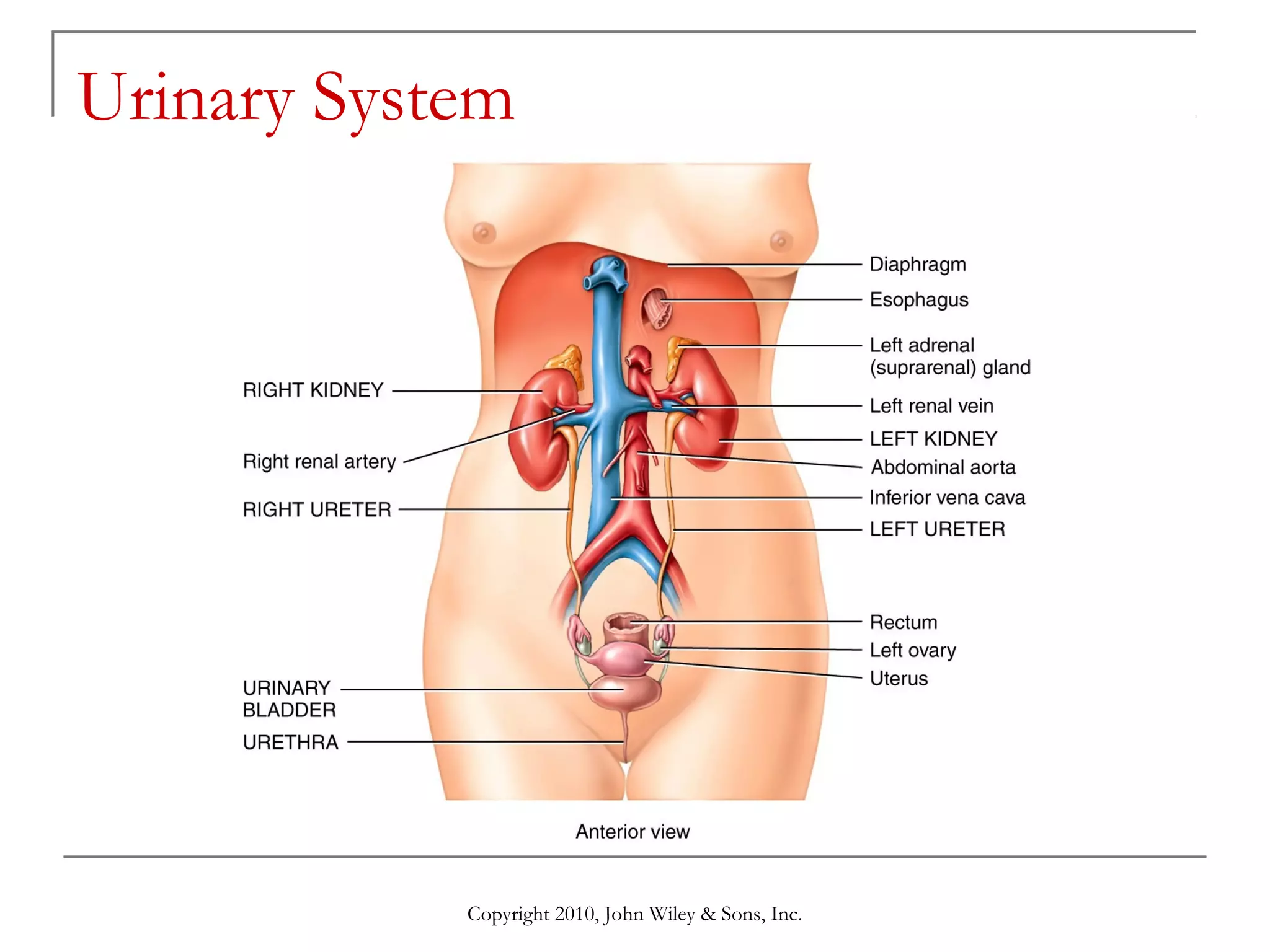
Urinary System




Two kidneys and two ureters
Urinary bladder & urethra
Effector organ for
1.
2.
3.
4.
5.

Regulation of Plasma ion composition
Regulation of Body water Volume (BP)
Regulation of blood pH (with lung)
Production of Hormones
Excretion of waste

Copyright 2010, John Wiley & Sons, Inc.
Urinary System

Copyright 2010, John Wiley & Sons, Inc.
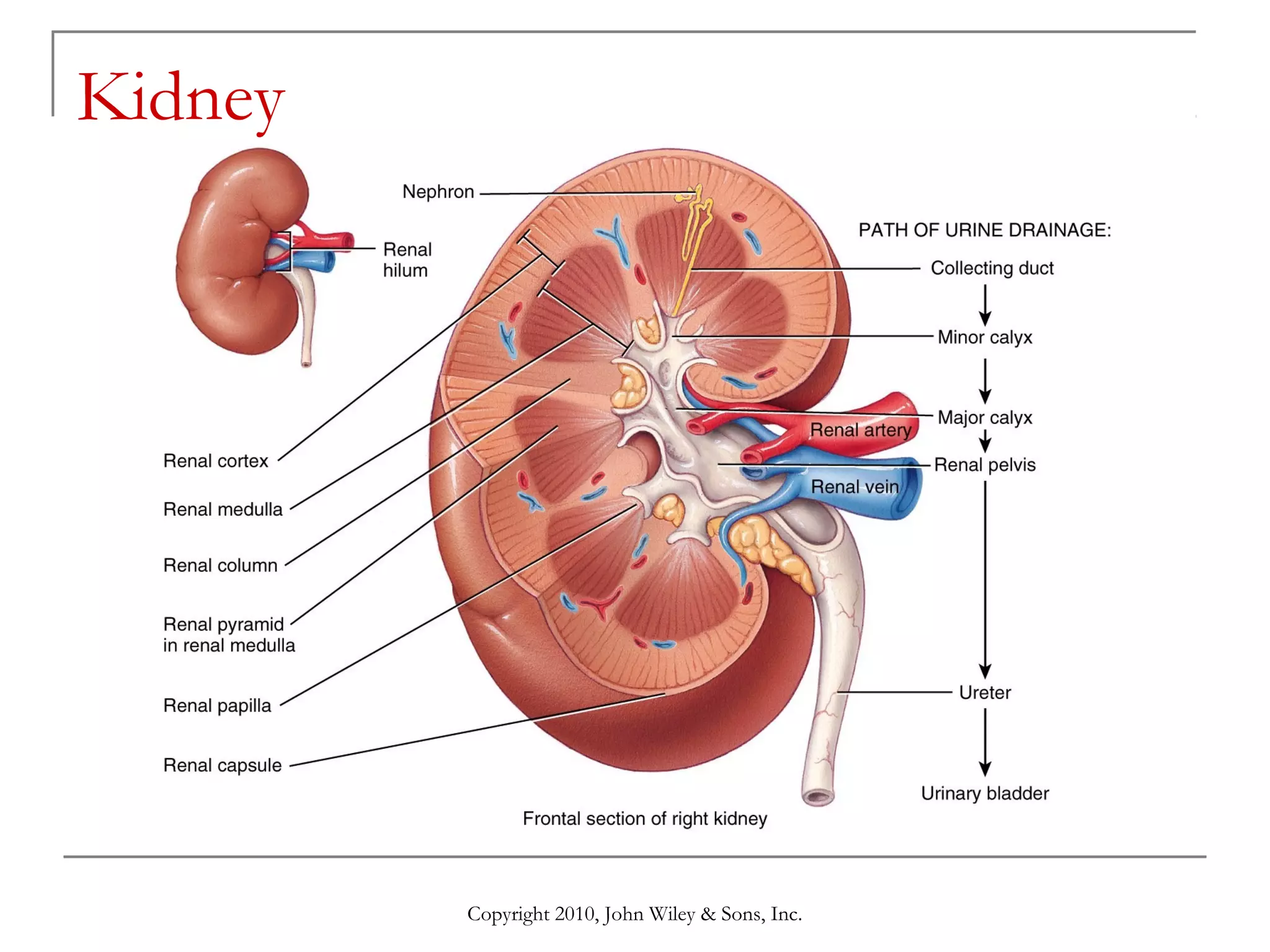
Kidney



Divided into cortex –outer portion
Medulla- inner portion




Urine goes into renal pelvis




Contain renal pyramids & renal columns
Edges are made of major & minor calyces

Then out ureter

Copyright 2010, John Wiley & Sons, Inc.
Kidney

Copyright 2010, John Wiley & Sons, Inc.
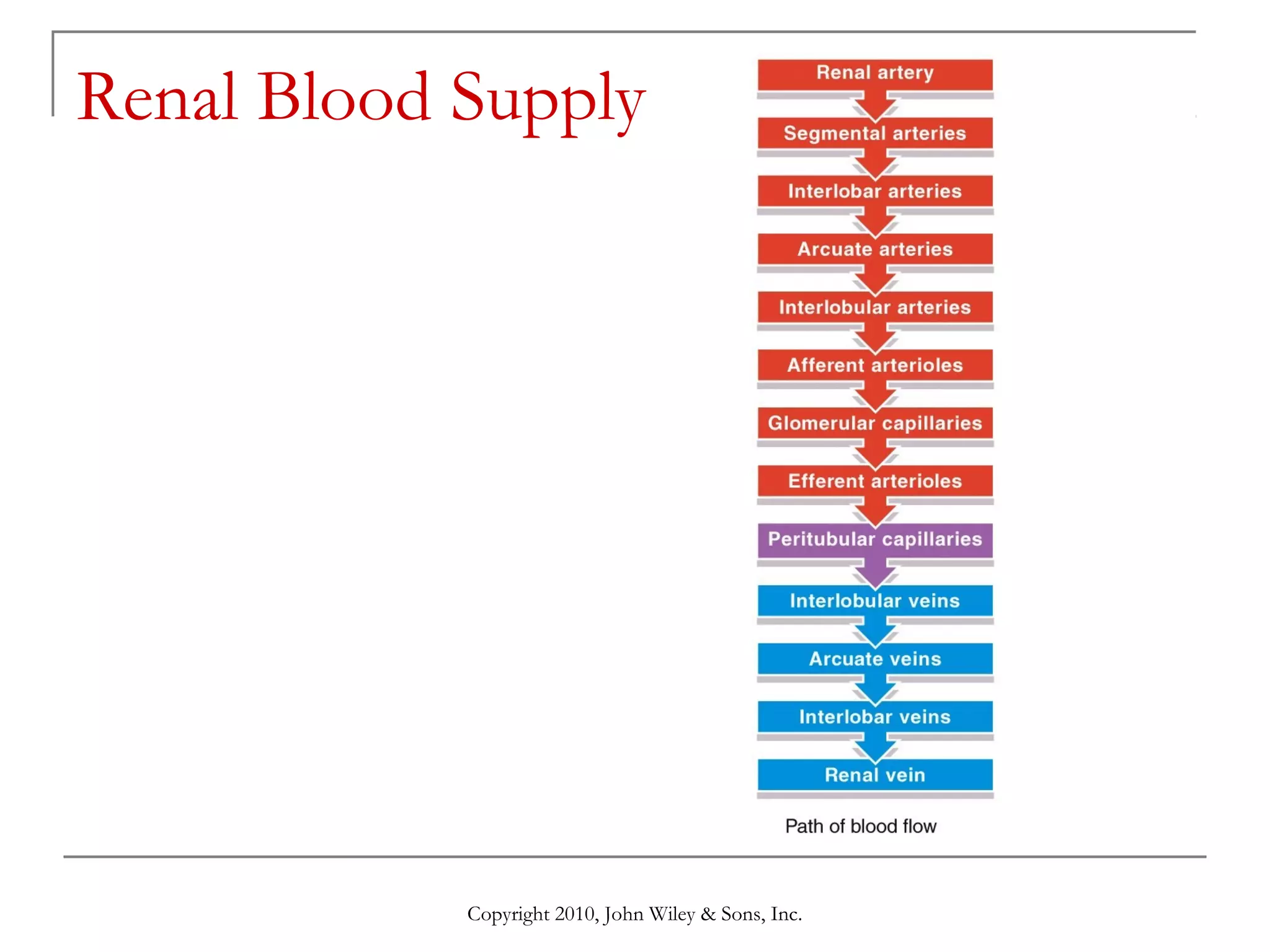
Renal Blood Supply



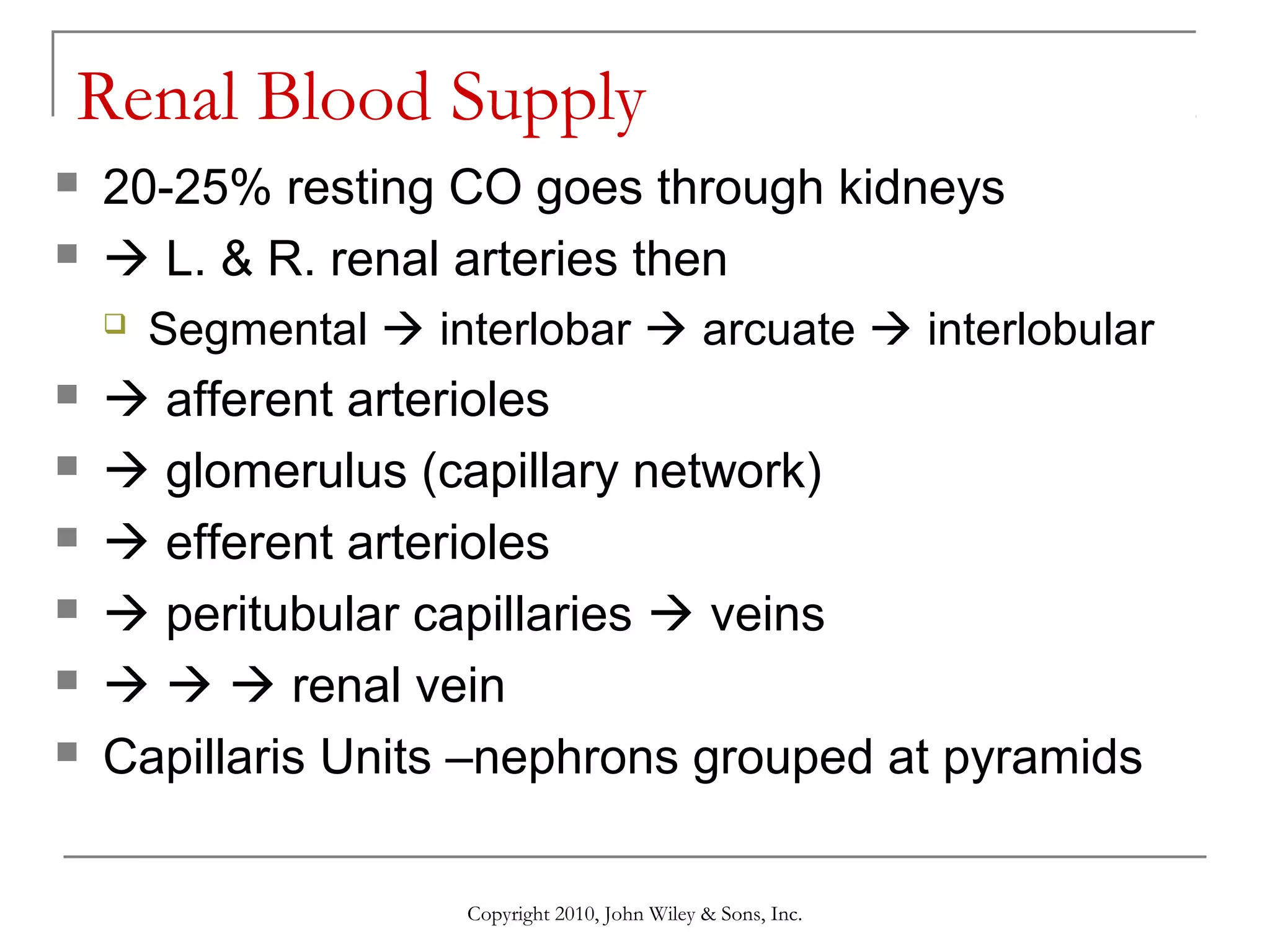
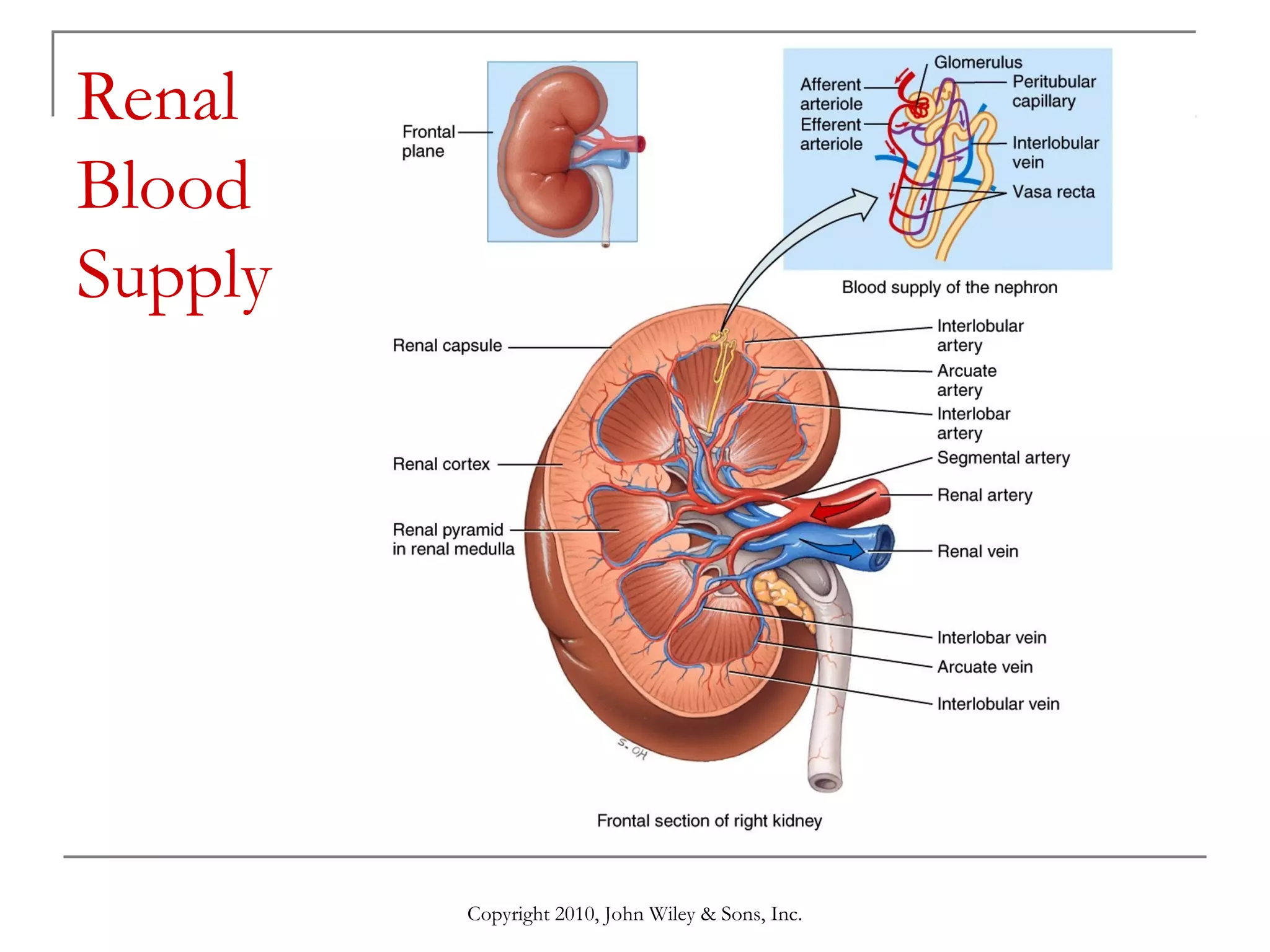
20-25% resting CO goes through kidneys
 L. & R. renal arteries then









Segmental  interlobar  arcuate  interlobular

 afferent arterioles
 glomerulus (capillary network)
 efferent arterioles
 peritubular capillaries  veins
   renal vein
Capillaris Units –nephrons grouped at pyramids
Copyright 2010, John Wiley & Sons, Inc.
Renal
Blood
Supply

Copyright 2010, John Wiley & Sons, Inc.
Renal Blood Supply

Copyright 2010, John Wiley & Sons, Inc.
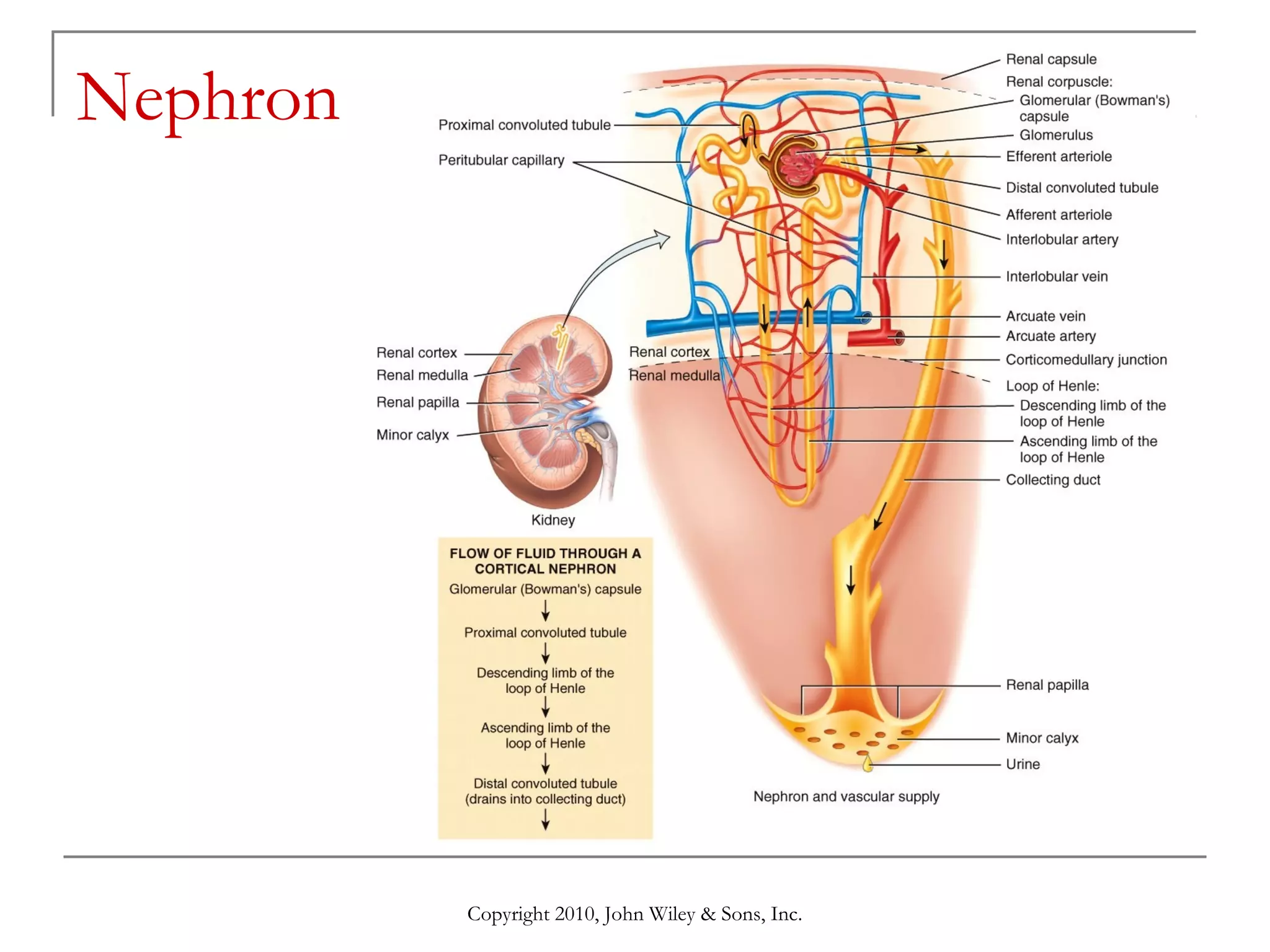
Nephron









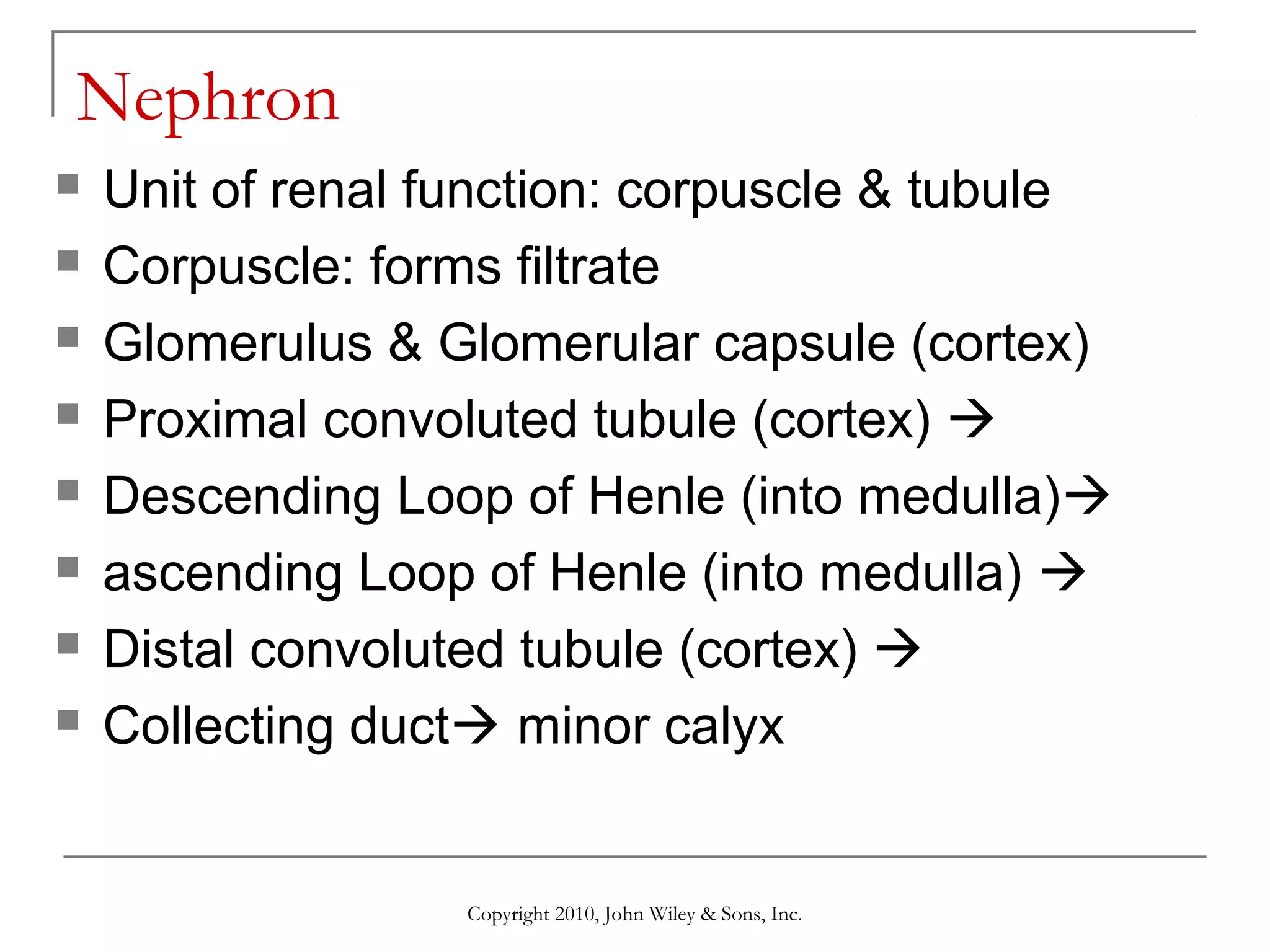
Unit of renal function: corpuscle & tubule
Corpuscle: forms filtrate
Glomerulus & Glomerular capsule (cortex)
Proximal convoluted tubule (cortex) 
Descending Loop of Henle (into medulla)
ascending Loop of Henle (into medulla) 
Distal convoluted tubule (cortex) 
Collecting duct minor calyx

Copyright 2010, John Wiley & Sons, Inc.
Nephron

Copyright 2010, John Wiley & Sons, Inc.
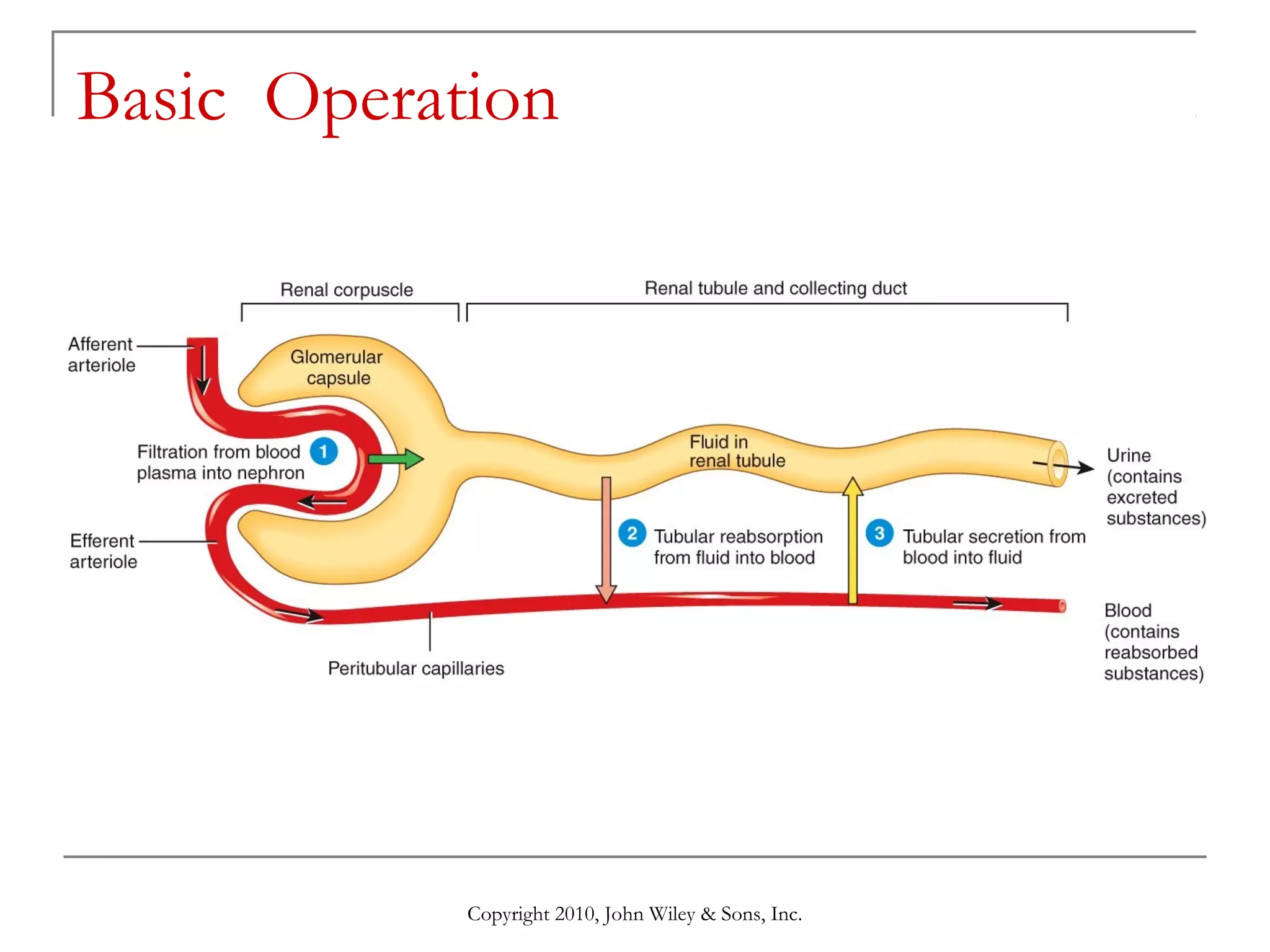
Basic Operation



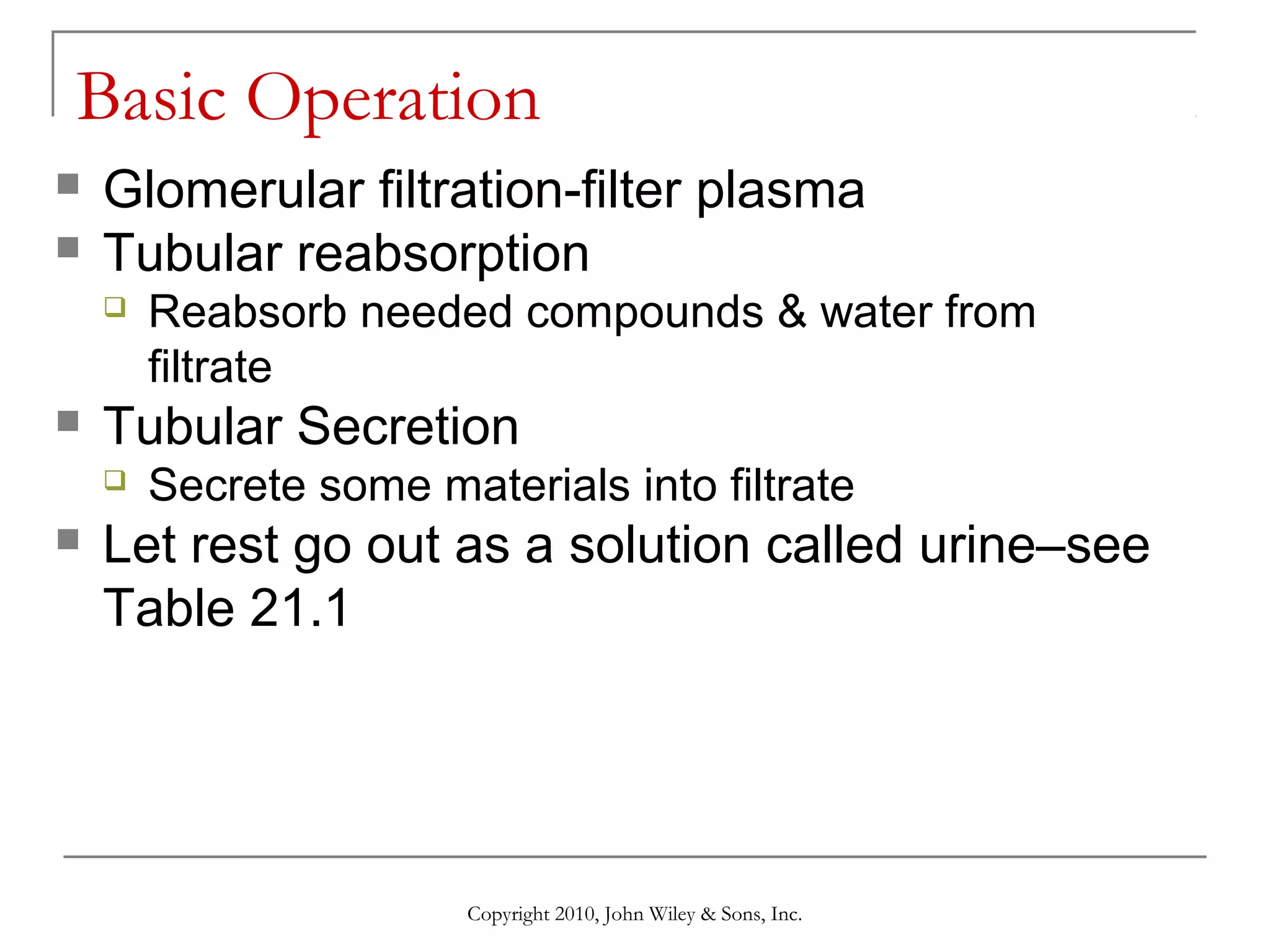
Glomerular filtration-filter plasma
Tubular reabsorption




Tubular Secretion




Reabsorb needed compounds & water from
filtrate
Secrete some materials into filtrate

Let rest go out as a solution called urine–see
Table 21.1

Copyright 2010, John Wiley & Sons, Inc.
Basic Operation

Copyright 2010, John Wiley & Sons, Inc.
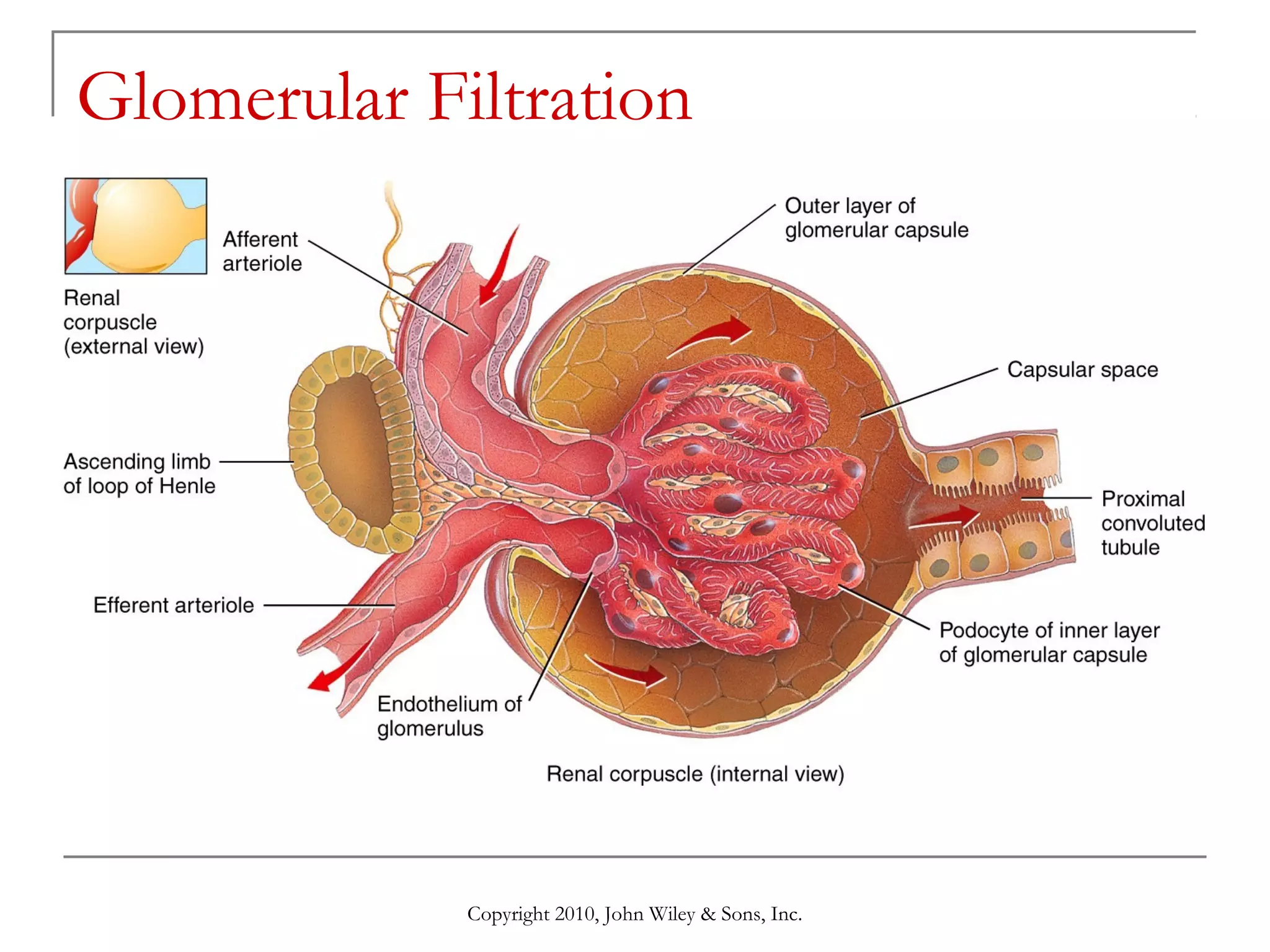
Glomerular Filtration







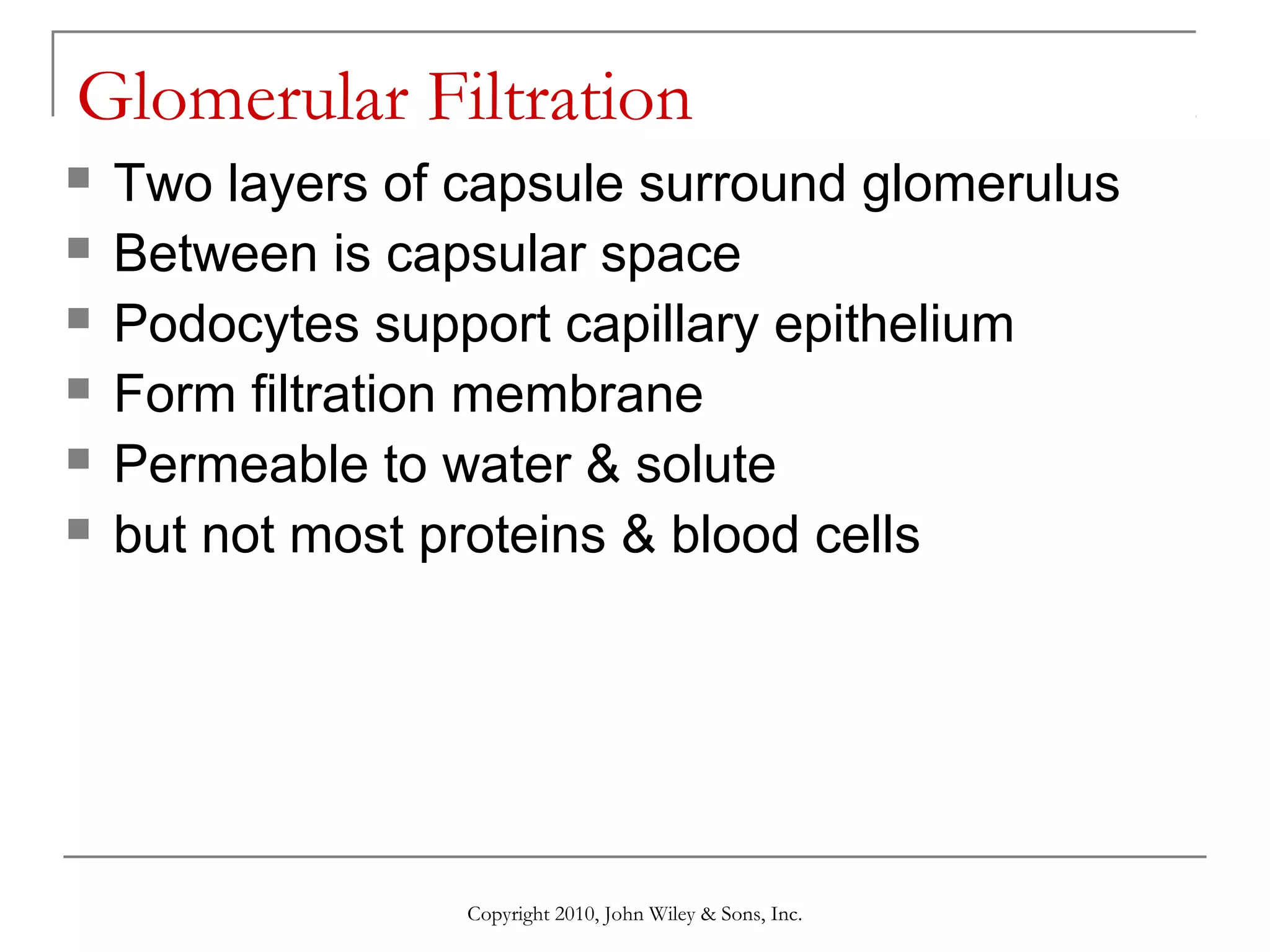
Two layers of capsule surround glomerulus
Between is capsular space
Podocytes support capillary epithelium
Form filtration membrane
Permeable to water & solute
but not most proteins & blood cells

Copyright 2010, John Wiley & Sons, Inc.
Filtration Pressure





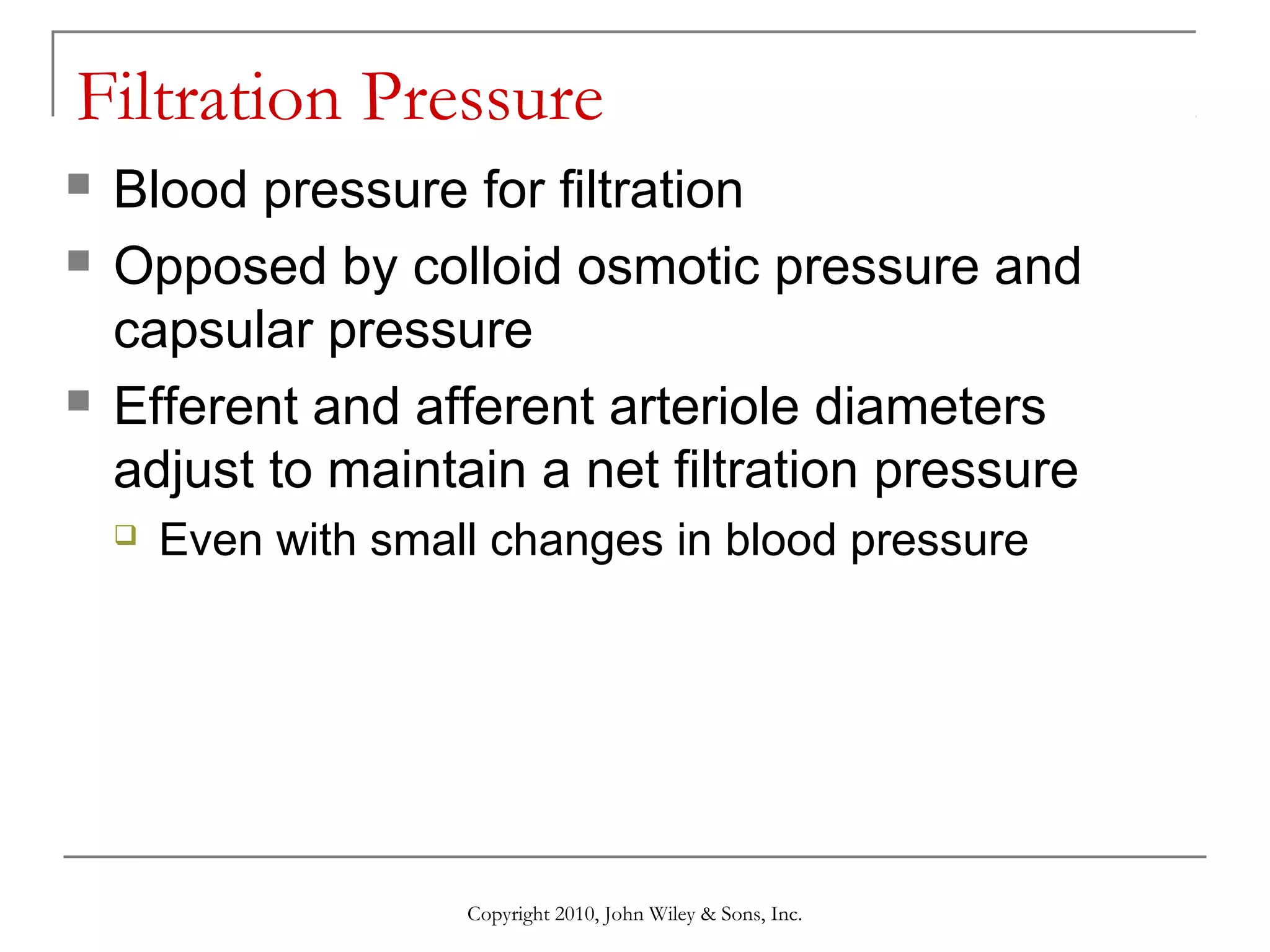
Blood pressure for filtration
Opposed by colloid osmotic pressure and
capsular pressure
Efferent and afferent arteriole diameters
adjust to maintain a net filtration pressure


Even with small changes in blood pressure

Copyright 2010, John Wiley & Sons, Inc.
Glomerular Filtration Rate





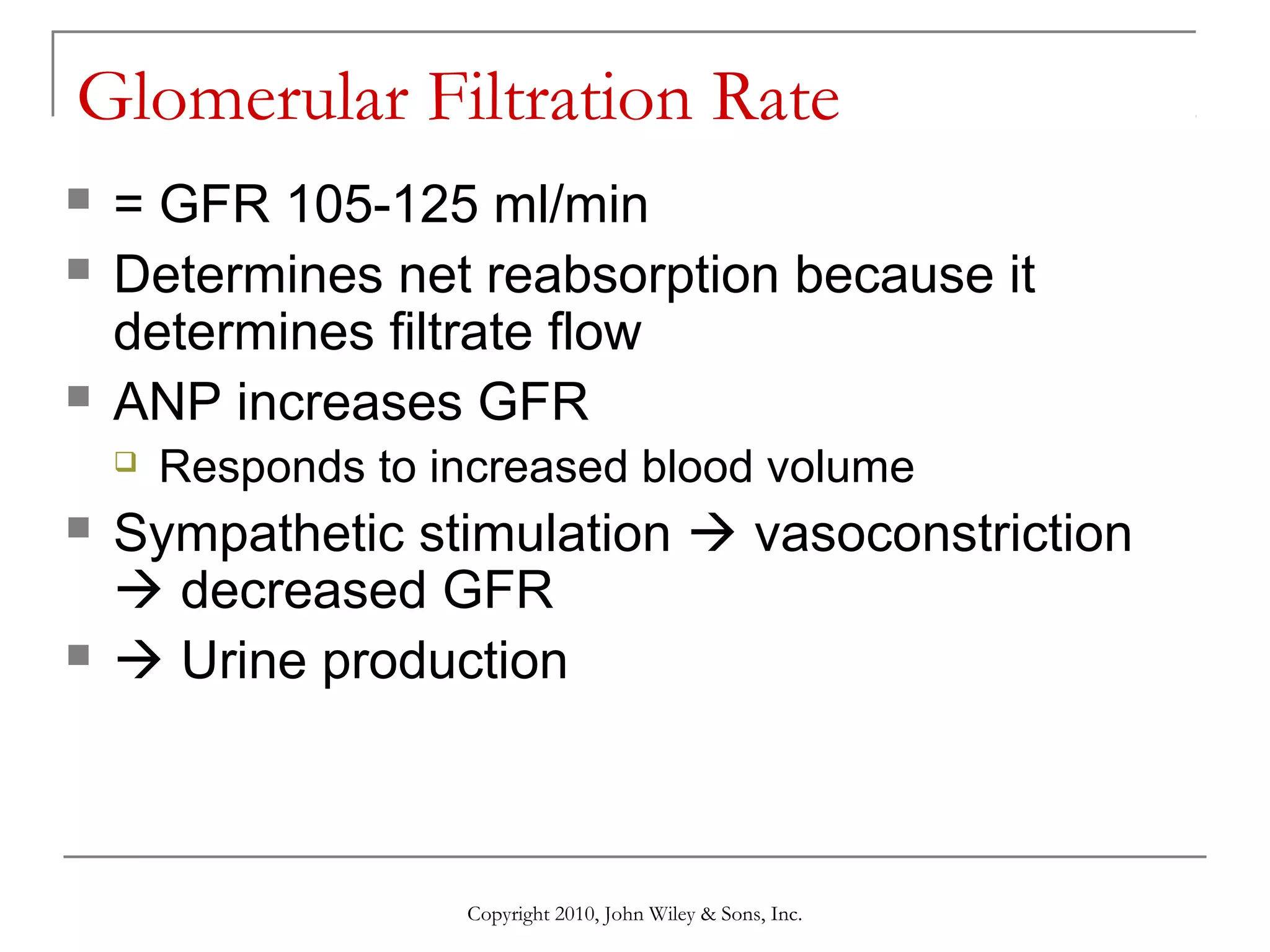
= GFR 105-125 ml/min
Determines net reabsorption because it
determines filtrate flow
ANP increases GFR






Responds to increased blood volume

Sympathetic stimulation  vasoconstriction
 decreased GFR
 Urine production

Copyright 2010, John Wiley & Sons, Inc.
Glomerular Filtration

Copyright 2010, John Wiley & Sons, Inc.
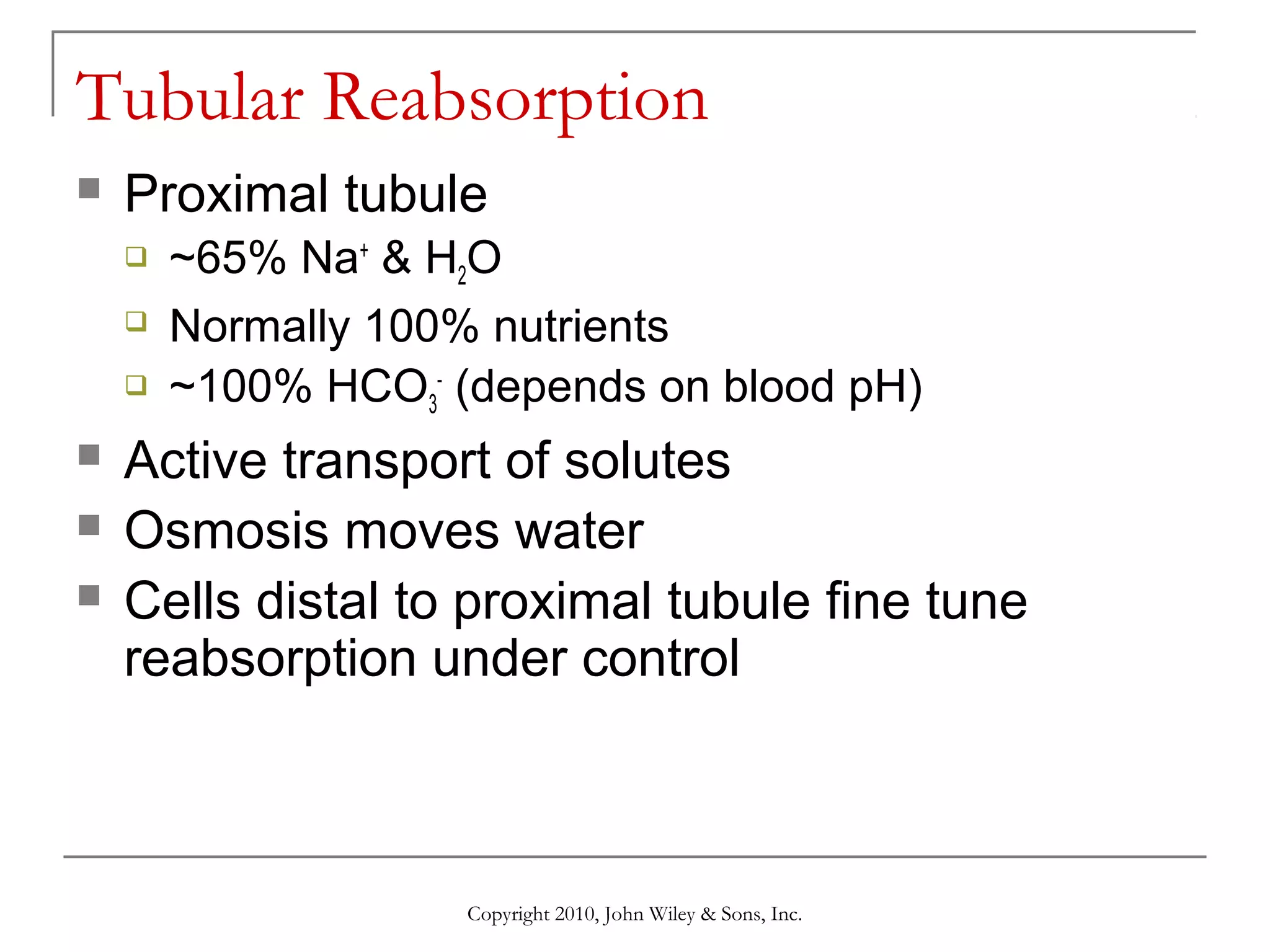
Tubular Reabsorption


Proximal tubule








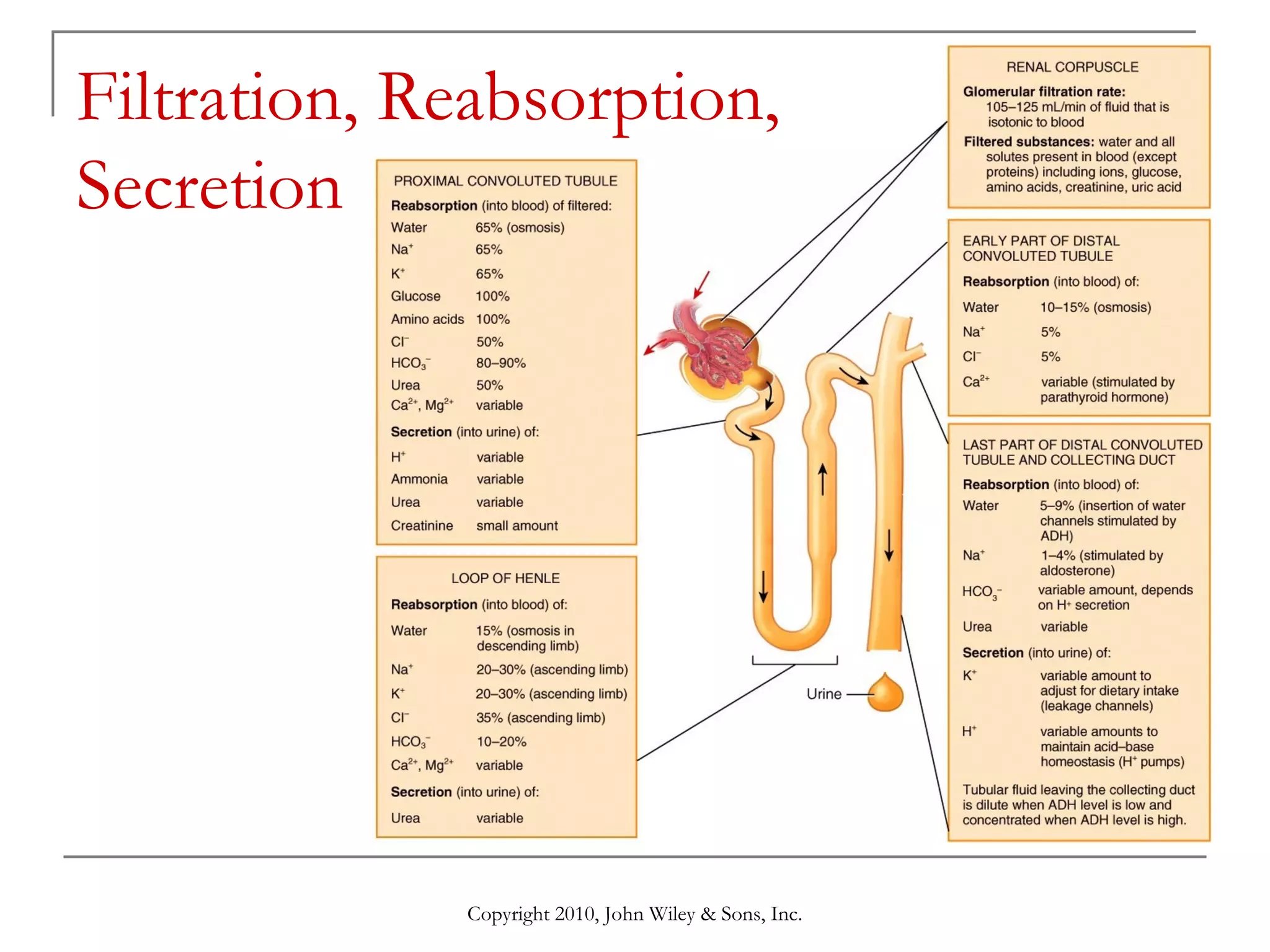
~65% Na+ & H2O
Normally 100% nutrients
~100% HCO3- (depends on blood pH)

Active transport of solutes
Osmosis moves water
Cells distal to proximal tubule fine tune
reabsorption under control

Copyright 2010, John Wiley & Sons, Inc.
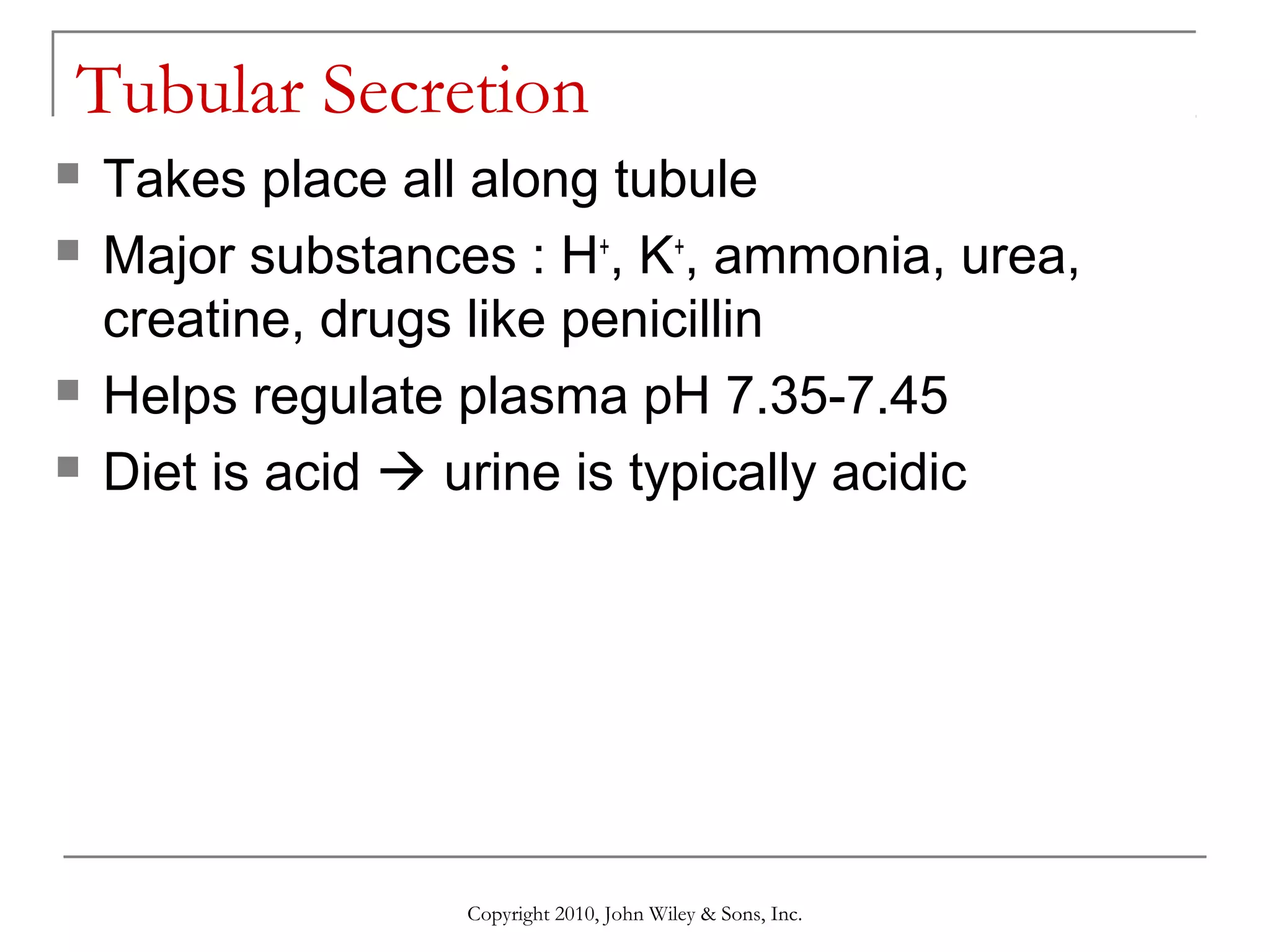
Tubular Secretion






Takes place all along tubule
Major substances : H+, K+, ammonia, urea,
creatine, drugs like penicillin
Helps regulate plasma pH 7.35-7.45
Diet is acid  urine is typically acidic

Copyright 2010, John Wiley & Sons, Inc.
Urine Route





Collecting ducts to calyces
Calyces to ureter
Ureter to bladder
Bladder to urethra

Copyright 2010, John Wiley & Sons, Inc.
Filtration, Reabsorption,
Secretion

Copyright 2010, John Wiley & Sons, Inc.
Hormonal Regulation


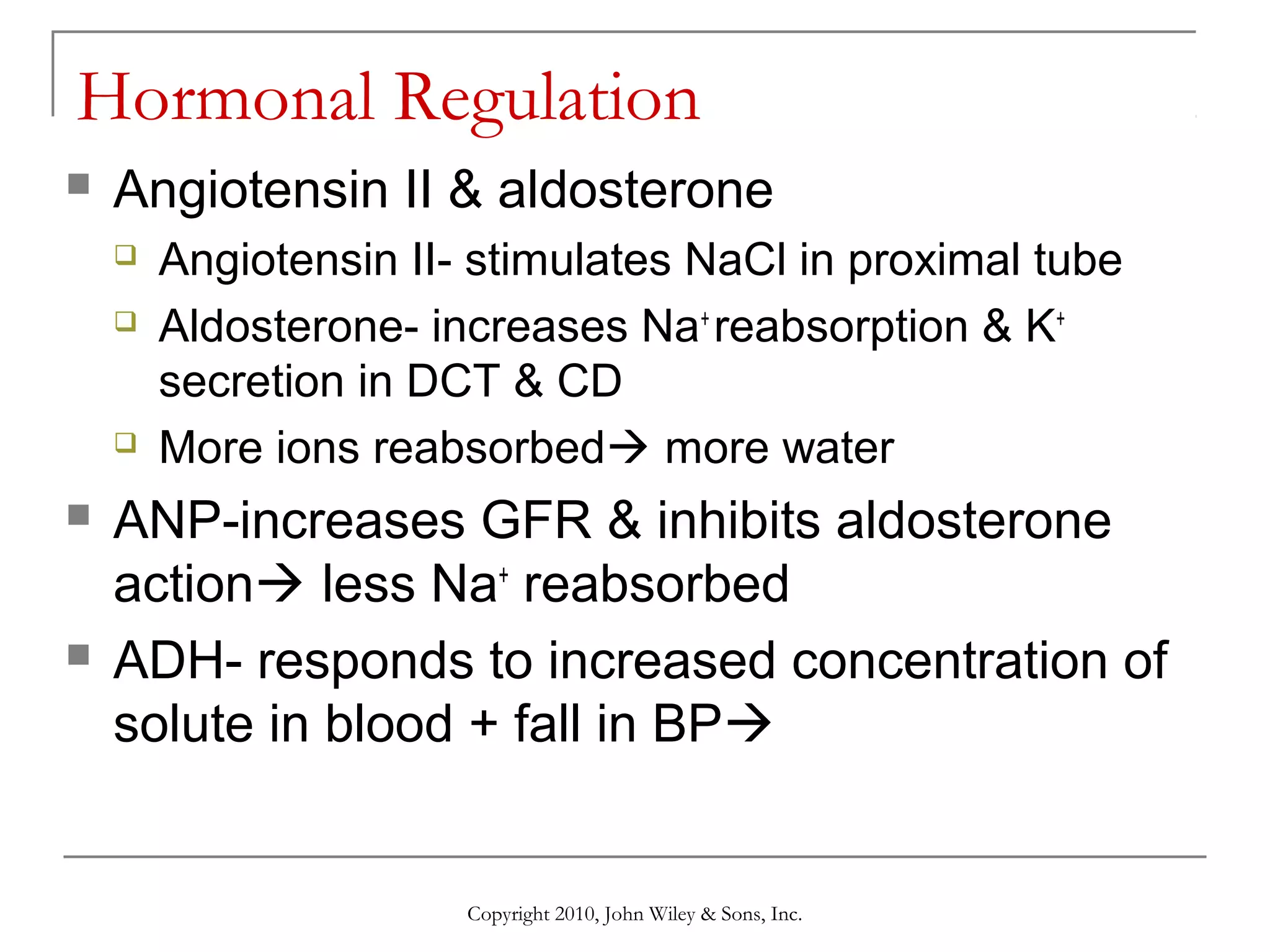
Angiotensin II & aldosterone









Angiotensin II- stimulates NaCl in proximal tube
Aldosterone- increases Na+ reabsorption & K+
secretion in DCT & CD
More ions reabsorbed more water

ANP-increases GFR & inhibits aldosterone
action less Na+ reabsorbed
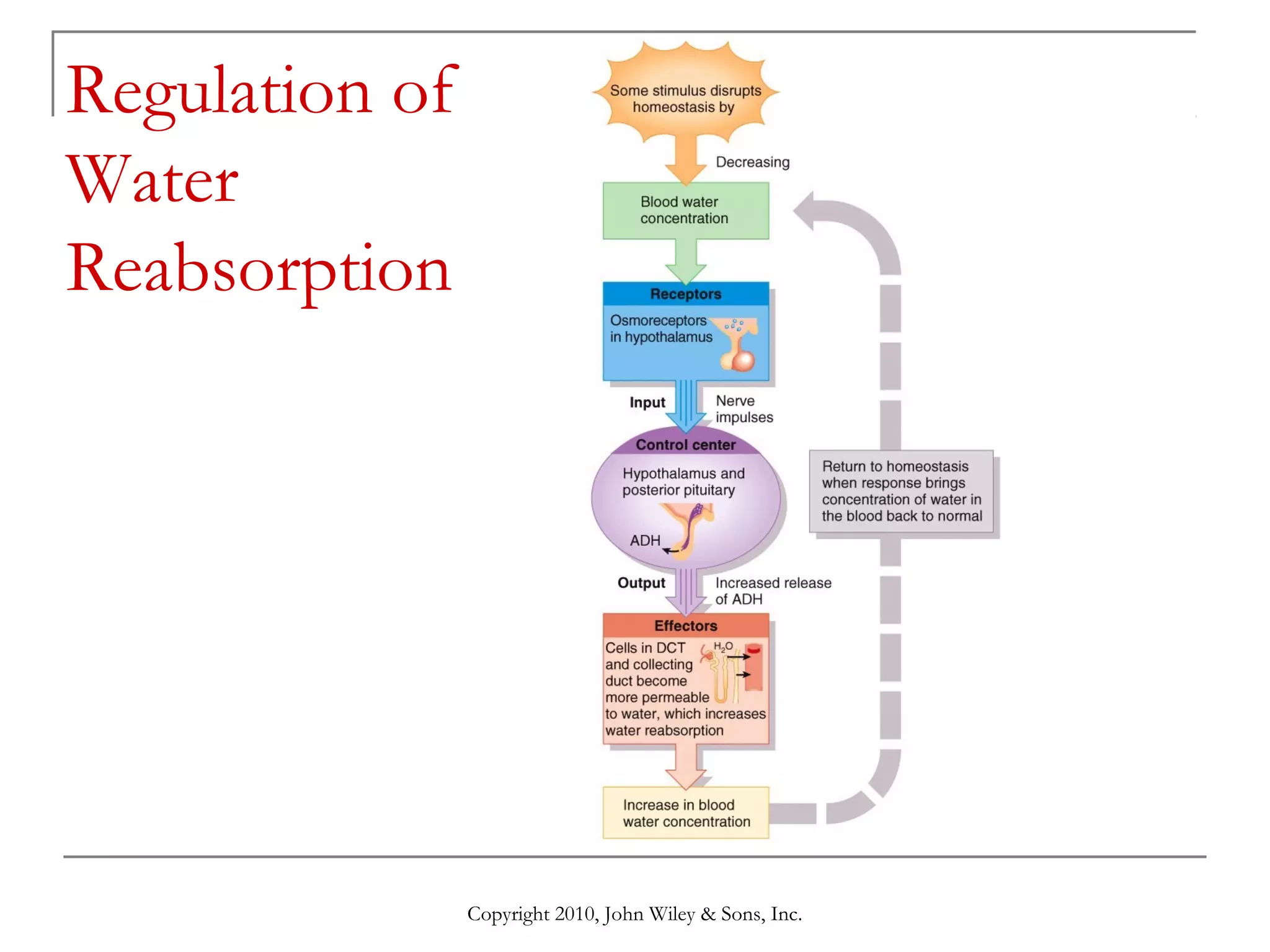
ADH- responds to increased concentration of
solute in blood + fall in BP

Copyright 2010, John Wiley & Sons, Inc.
Hormonal Regulation







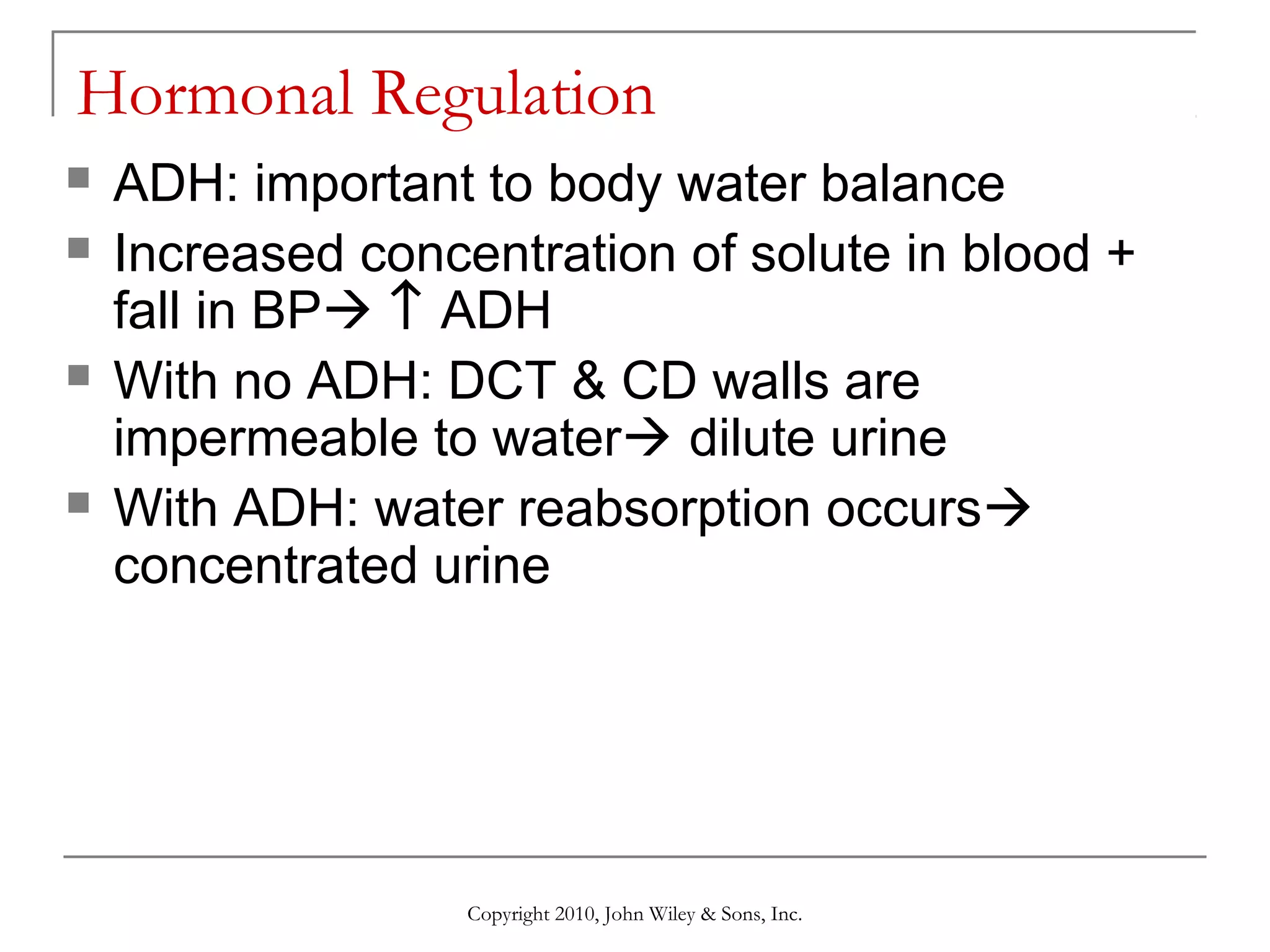
ADH: important to body water balance
Increased concentration of solute in blood +
fall in BP ↑ ADH
With no ADH: DCT & CD walls are
impermeable to water dilute urine
With ADH: water reabsorption occurs
concentrated urine

Copyright 2010, John Wiley & Sons, Inc.
Components of Urine






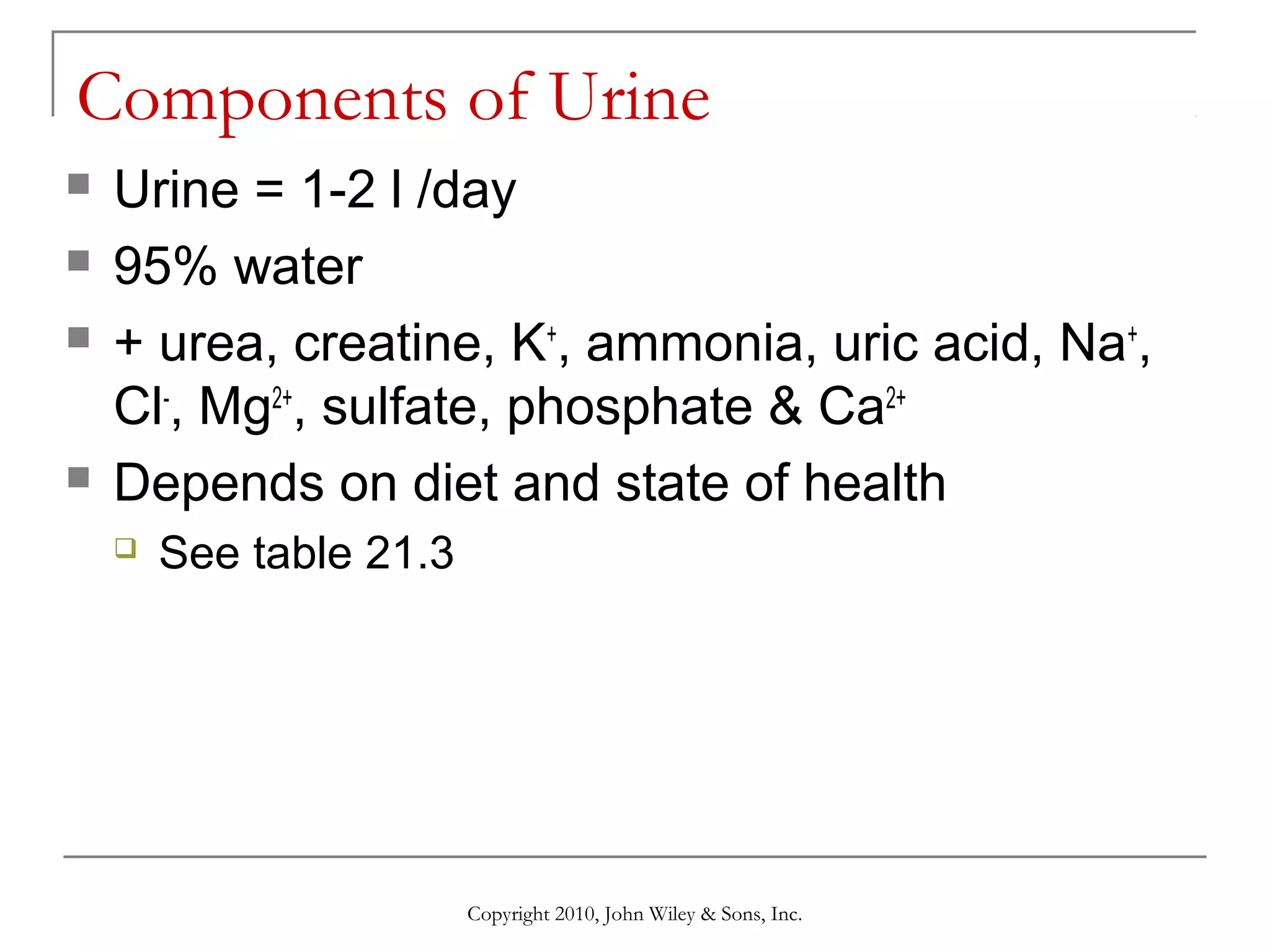
Urine = 1-2 l /day
95% water
+ urea, creatine, K+, ammonia, uric acid, Na+,
Cl-, Mg2+, sulfate, phosphate & Ca2+
Depends on diet and state of health


See table 21.3

Copyright 2010, John Wiley & Sons, Inc.
Regulation of
Water
Reabsorption

Copyright 2010, John Wiley & Sons, Inc.
Urine Route



Collecting ducts calyces
Ureter






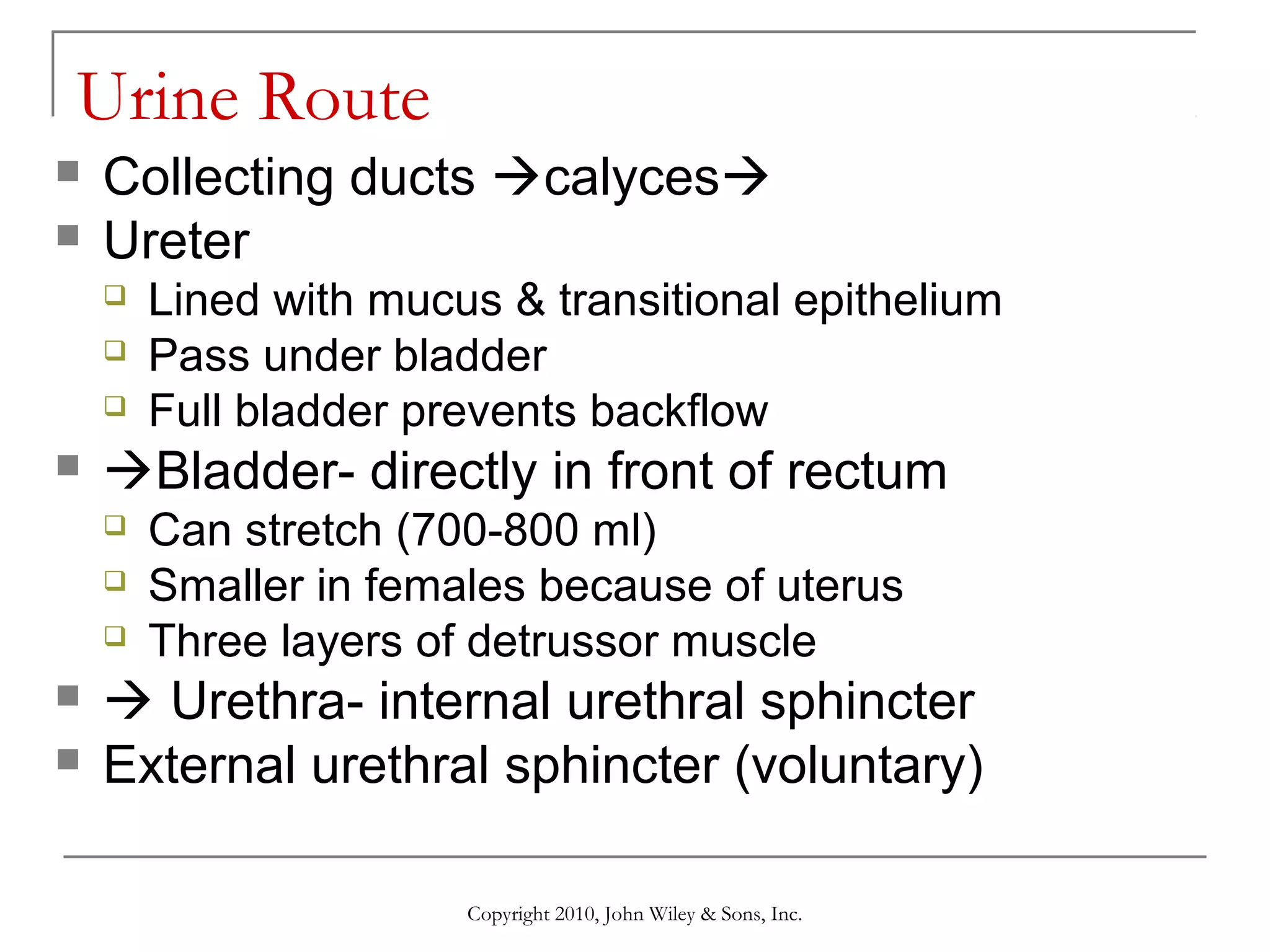
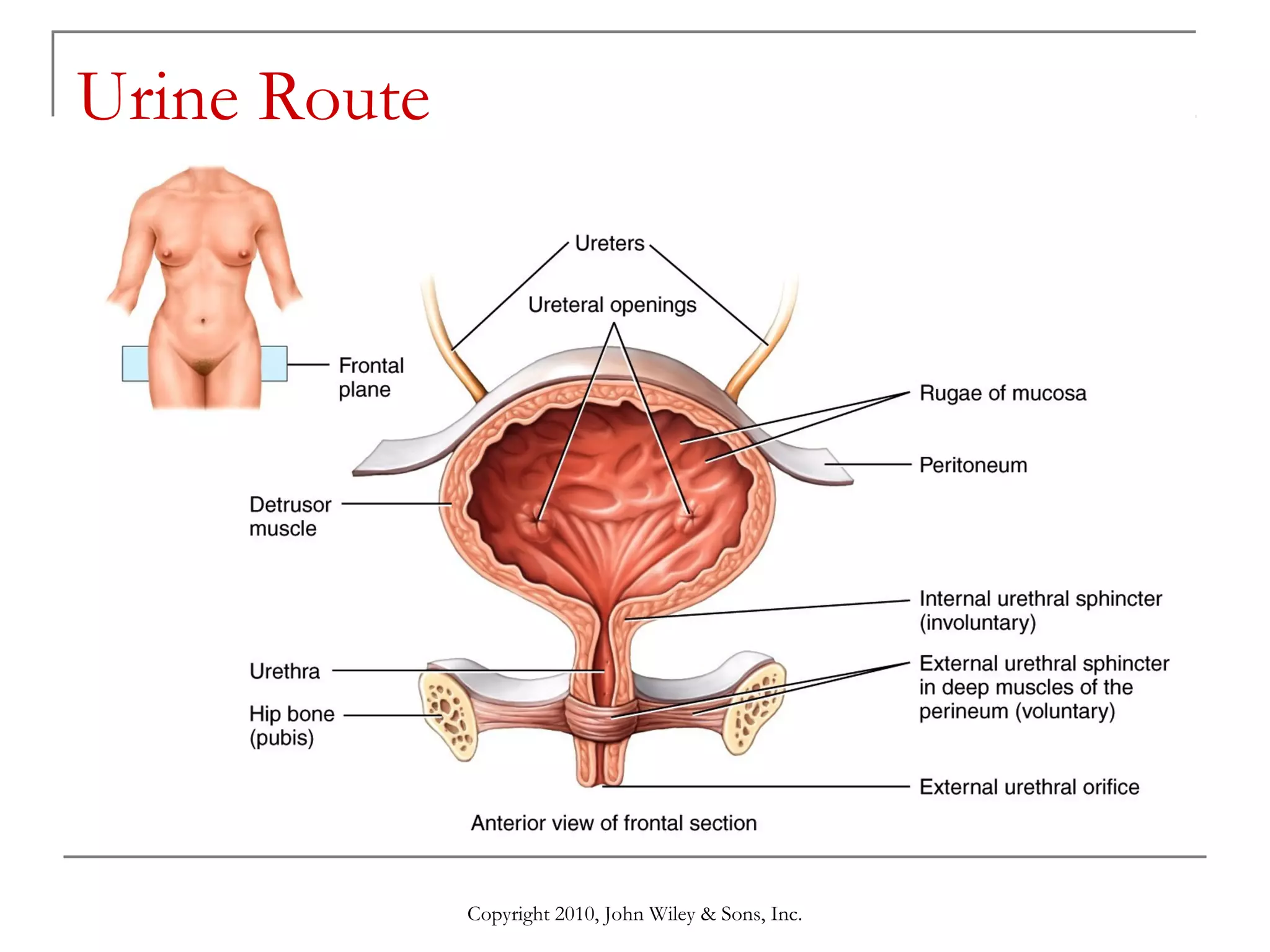
Bladder- directly in front of rectum







Lined with mucus & transitional epithelium
Pass under bladder
Full bladder prevents backflow
Can stretch (700-800 ml)
Smaller in females because of uterus
Three layers of detrussor muscle

 Urethra- internal urethral sphincter
External urethral sphincter (voluntary)
Copyright 2010, John Wiley & Sons, Inc.
Urine Route

Copyright 2010, John Wiley & Sons, Inc.
Micturition = Urination


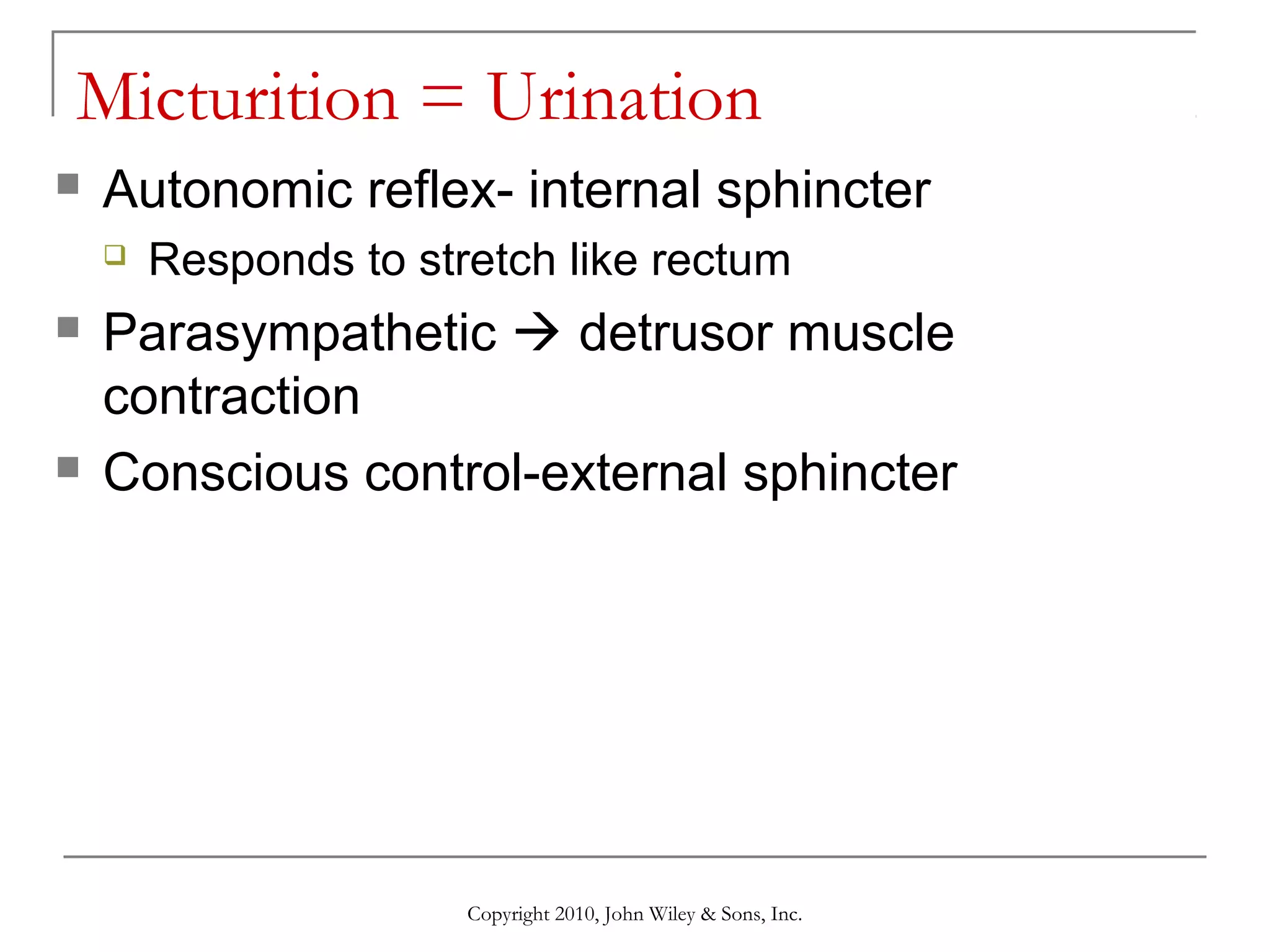
Autonomic reflex- internal sphincter






Responds to stretch like rectum

Parasympathetic  detrusor muscle
contraction
Conscious control-external sphincter

Copyright 2010, John Wiley & Sons, Inc.
Aging









Kidneys shrink- decrease in capacity
Thirst decreases  dehydration
 urinary tract infections
Males: prostate enlargement frequent
urination & slow flow
Females: more prone to leakage of external
sphincter (incontinence)
Both: nocturia

Copyright 2010, John Wiley & Sons, Inc.

Lecture 2 the urinary system

  • 1.
    Chapter 21 The UrinarySystem Copyright 2010, John Wiley & Sons, Inc.
  • 2.
    End of Chapter21  Copyright 2010 John Wiley & Sons, Inc. All rights reserved. Reproduction or translation of this work beyond that permitted in section 117 of the 1976 United States Copyright Act without express permission of the copyright owner is unlawful. Request for further information should be addressed to the Permission Department, John Wiley & Sons, Inc. The purchaser may make back-up copies for his/her own use only and not for distribution or resale. The Publishers assumes no responsibility for errors, omissions, or damages caused by the use of theses programs or from the use of the information herein. Copyright 2010, John Wiley & Sons, Inc.
  • 3.
    Urinary System    Two kidneysand two ureters Urinary bladder & urethra Effector organ for 1. 2. 3. 4. 5. Regulation of Plasma ion composition Regulation of Body water Volume (BP) Regulation of blood pH (with lung) Production of Hormones Excretion of waste Copyright 2010, John Wiley & Sons, Inc.
  • 4.
    Urinary System Copyright 2010,John Wiley & Sons, Inc.
  • 5.
    Kidney   Divided into cortex–outer portion Medulla- inner portion   Urine goes into renal pelvis   Contain renal pyramids & renal columns Edges are made of major & minor calyces Then out ureter Copyright 2010, John Wiley & Sons, Inc.
  • 6.
    Kidney Copyright 2010, JohnWiley & Sons, Inc.
  • 7.
    Renal Blood Supply   20-25%resting CO goes through kidneys  L. & R. renal arteries then        Segmental  interlobar  arcuate  interlobular  afferent arterioles  glomerulus (capillary network)  efferent arterioles  peritubular capillaries  veins    renal vein Capillaris Units –nephrons grouped at pyramids Copyright 2010, John Wiley & Sons, Inc.
  • 8.
  • 9.
    Renal Blood Supply Copyright2010, John Wiley & Sons, Inc.
  • 10.
    Nephron         Unit of renalfunction: corpuscle & tubule Corpuscle: forms filtrate Glomerulus & Glomerular capsule (cortex) Proximal convoluted tubule (cortex)  Descending Loop of Henle (into medulla) ascending Loop of Henle (into medulla)  Distal convoluted tubule (cortex)  Collecting duct minor calyx Copyright 2010, John Wiley & Sons, Inc.
  • 11.
    Nephron Copyright 2010, JohnWiley & Sons, Inc.
  • 12.
    Basic Operation   Glomerular filtration-filterplasma Tubular reabsorption   Tubular Secretion   Reabsorb needed compounds & water from filtrate Secrete some materials into filtrate Let rest go out as a solution called urine–see Table 21.1 Copyright 2010, John Wiley & Sons, Inc.
  • 13.
    Basic Operation Copyright 2010,John Wiley & Sons, Inc.
  • 14.
    Glomerular Filtration       Two layersof capsule surround glomerulus Between is capsular space Podocytes support capillary epithelium Form filtration membrane Permeable to water & solute but not most proteins & blood cells Copyright 2010, John Wiley & Sons, Inc.
  • 15.
    Filtration Pressure    Blood pressurefor filtration Opposed by colloid osmotic pressure and capsular pressure Efferent and afferent arteriole diameters adjust to maintain a net filtration pressure  Even with small changes in blood pressure Copyright 2010, John Wiley & Sons, Inc.
  • 16.
    Glomerular Filtration Rate    =GFR 105-125 ml/min Determines net reabsorption because it determines filtrate flow ANP increases GFR    Responds to increased blood volume Sympathetic stimulation  vasoconstriction  decreased GFR  Urine production Copyright 2010, John Wiley & Sons, Inc.
  • 17.
  • 18.
    Tubular Reabsorption  Proximal tubule       ~65%Na+ & H2O Normally 100% nutrients ~100% HCO3- (depends on blood pH) Active transport of solutes Osmosis moves water Cells distal to proximal tubule fine tune reabsorption under control Copyright 2010, John Wiley & Sons, Inc.
  • 19.
    Tubular Secretion     Takes placeall along tubule Major substances : H+, K+, ammonia, urea, creatine, drugs like penicillin Helps regulate plasma pH 7.35-7.45 Diet is acid  urine is typically acidic Copyright 2010, John Wiley & Sons, Inc.
  • 20.
    Urine Route     Collecting ductsto calyces Calyces to ureter Ureter to bladder Bladder to urethra Copyright 2010, John Wiley & Sons, Inc.
  • 21.
  • 22.
    Hormonal Regulation  Angiotensin II& aldosterone      Angiotensin II- stimulates NaCl in proximal tube Aldosterone- increases Na+ reabsorption & K+ secretion in DCT & CD More ions reabsorbed more water ANP-increases GFR & inhibits aldosterone action less Na+ reabsorbed ADH- responds to increased concentration of solute in blood + fall in BP Copyright 2010, John Wiley & Sons, Inc.
  • 23.
    Hormonal Regulation     ADH: importantto body water balance Increased concentration of solute in blood + fall in BP ↑ ADH With no ADH: DCT & CD walls are impermeable to water dilute urine With ADH: water reabsorption occurs concentrated urine Copyright 2010, John Wiley & Sons, Inc.
  • 24.
    Components of Urine     Urine= 1-2 l /day 95% water + urea, creatine, K+, ammonia, uric acid, Na+, Cl-, Mg2+, sulfate, phosphate & Ca2+ Depends on diet and state of health  See table 21.3 Copyright 2010, John Wiley & Sons, Inc.
  • 25.
  • 26.
    Urine Route   Collecting ductscalyces Ureter     Bladder- directly in front of rectum      Lined with mucus & transitional epithelium Pass under bladder Full bladder prevents backflow Can stretch (700-800 ml) Smaller in females because of uterus Three layers of detrussor muscle  Urethra- internal urethral sphincter External urethral sphincter (voluntary) Copyright 2010, John Wiley & Sons, Inc.
  • 27.
    Urine Route Copyright 2010,John Wiley & Sons, Inc.
  • 28.
    Micturition = Urination  Autonomicreflex- internal sphincter    Responds to stretch like rectum Parasympathetic  detrusor muscle contraction Conscious control-external sphincter Copyright 2010, John Wiley & Sons, Inc.
  • 29.
    Aging       Kidneys shrink- decreasein capacity Thirst decreases  dehydration  urinary tract infections Males: prostate enlargement frequent urination & slow flow Females: more prone to leakage of external sphincter (incontinence) Both: nocturia Copyright 2010, John Wiley & Sons, Inc.