CHAPTER 15
The Autonomic Nervous System
Copyright © 2014 John Wiley & Sons, Inc. All rights reserved.
Principles of
Anatomy and
Physiology
14th Edition
 The somatic nervous system includes both
sensory and motor neurons. Sensory neurons are
related to touch, pain, temperature, and
proprioception (sense of self position), sight,
hearing, taste, smell and equilibrium. Motor
neurons innervate skeletal muscles.
 The autonomic nervous system receives input
from sensory receptors located in organs, blood
vessels, muscles and the nervous system.
Comparison of Somatic and
Autonomic Nervous Systems
Copyright © 2014 John Wiley & Sons, Inc. All rights reserved.
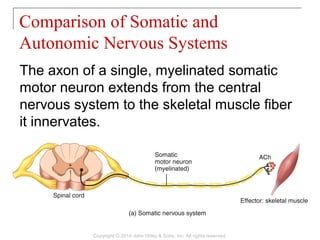
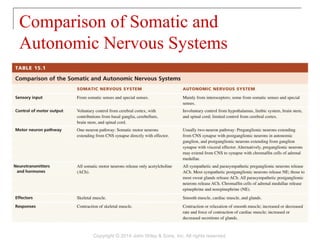
The axon of a single, myelinated somatic
motor neuron extends from the central
nervous system to the skeletal muscle fiber
it innervates.
Comparison of Somatic and
Autonomic Nervous Systems
Copyright © 2014 John Wiley & Sons, Inc. All rights reserved.
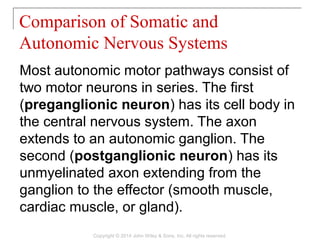
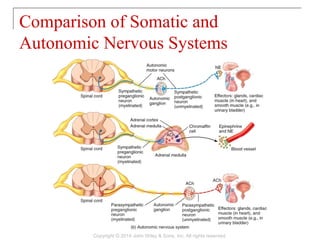
Most autonomic motor pathways consist of
two motor neurons in series. The first
(preganglionic neuron) has its cell body in
the central nervous system. The axon
extends to an autonomic ganglion. The
second (postganglionic neuron) has its
unmyelinated axon extending from the
ganglion to the effector (smooth muscle,
cardiac muscle, or gland).
Comparison of Somatic and
Autonomic Nervous Systems
Copyright © 2014 John Wiley & Sons, Inc. All rights reserved.
Comparison of Somatic and
Autonomic Nervous Systems
Copyright © 2014 John Wiley & Sons, Inc. All rights reserved.
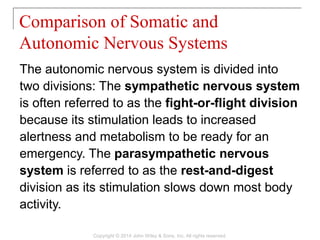
The autonomic nervous system is divided into
two divisions: The sympathetic nervous system
is often referred to as the fight-or-flight division
because its stimulation leads to increased
alertness and metabolism to be ready for an
emergency. The parasympathetic nervous
system is referred to as the rest-and-digest
division as its stimulation slows down most body
activity.
Comparison of Somatic and
Autonomic Nervous Systems
Copyright © 2014 John Wiley & Sons, Inc. All rights reserved.
Comparison of Somatic and
Autonomic Nervous Systems
Copyright © 2014 John Wiley & Sons, Inc. All rights reserved.
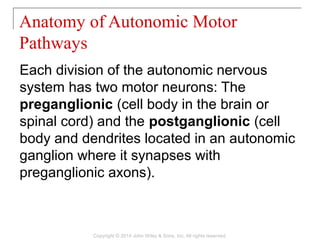
Each division of the autonomic nervous
system has two motor neurons: The
preganglionic (cell body in the brain or
spinal cord) and the postganglionic (cell
body and dendrites located in an autonomic
ganglion where it synapses with
preganglionic axons).
Anatomy of Autonomic Motor
Pathways
Copyright © 2014 John Wiley & Sons, Inc. All rights reserved.
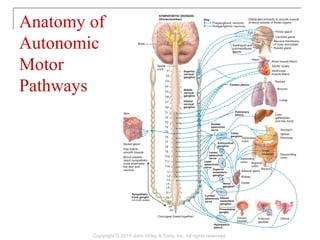
In the sympathetic division, the cell bodies
of preganglionic neurons are in the lateral
horns of the gray matter in the 12 thoracic
and first 2 or 3 lumbar segments.
Anatomy of Autonomic Motor
Pathways
Copyright © 2014 John Wiley & Sons, Inc. All rights reserved.
Anatomy of
Autonomic
Motor
Pathways
Copyright © 2014 John Wiley & Sons, Inc. All rights reserved.
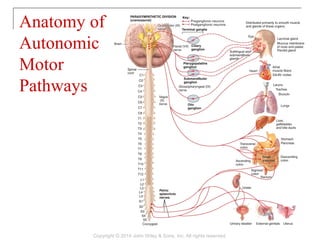
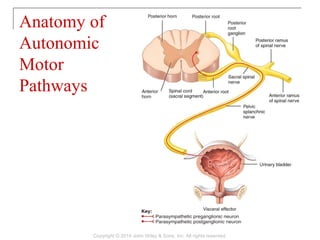
In the parasympathetic division, cell
bodies of the preganglionic neurons are in
the nuclei of four cranial nerves (III, VII, IX
and X) in the brain stem and in the lateral
gray matter of sacral segments 2–4 of the
spinal cord.
Anatomy of Autonomic Motor
Pathways
Copyright © 2014 John Wiley & Sons, Inc. All rights reserved.
Anatomy of
Autonomic
Motor
Pathways
Copyright © 2014 John Wiley & Sons, Inc. All rights reserved.
 There are two types of autonomic ganglia: sympathetic and
parasympathetic. Sympathetic ganglia are sites of synapses between
sympathetic preganglionic and postganglionic neurons.
 There are 2 major types of sympathetic ganglia: Sympathetic trunk
ganglia (lie in a vertical row on either side of the vertebral column) and
prevertebral ganglia (lie anterior to the vertebral column and close to the
large abdominal arteries).
Anatomy of Autonomic
Motor Pathways
Copyright © 2014 John Wiley & Sons, Inc. All rights reserved.
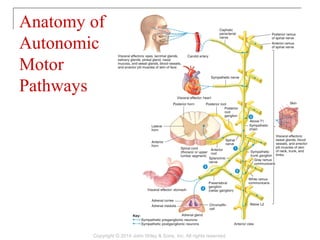
After axons of sympathetic preganglionic neurons enter sympathetic trunk ganglia, they
may connect with postganglionic neurons in one of 4 ways.
1. An axon may synapse with postganglionic neurons in the first ganglion it reaches.
2. An axon may ascend or descend to a higher or lower ganglion before synapsing with
postganglionic neurons.
3. An axon may continue, without synapsing, through the sympathetic trunk ganglion to
end at a prevertebral ganglion and synapse with postganglionic neurons.
4. An axon may also pass, without synapsing, through the sympathetic trunk ganglion
and a prevertebral ganglion and then extend to the adrenal medullae.
Anatomy of Autonomic Motor
Pathways
Copyright © 2014 John Wiley & Sons, Inc. All rights reserved.
Anatomy of
Autonomic
Motor
Pathways
Copyright © 2014 John Wiley & Sons, Inc. All rights reserved.
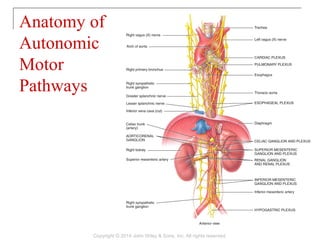
The abdomen and pelvis also contain major
autonomic plexuses which are often named
after the artery along which they are
distributed. These include the celiac (solar)
plexus, the superior mesenteric plexus,
the inferior mesenteric plexus, the renal
plexus and the hypogastric plexus.
Anatomy of Autonomic Motor
Pathways
Copyright © 2014 John Wiley & Sons, Inc. All rights reserved.
Anatomy of
Autonomic
Motor
Pathways
Copyright © 2014 John Wiley & Sons, Inc. All rights reserved.
 Cell bodies of the sympathetic preganglionic
neurons are part of the lateral gray horns of all
thoracic segments and of the first two lumbar
segments of the spinal cord.
 The paired sympathetic trunk ganglia are anterior
and lateral to the vertebral column. Usually, there are 2
cervical, 11 or 12 thoracic, 4 or 5 lumbar, 4 or 5 sacral
sympathetic trunk ganglia and 1 coccygeal ganglion.
Anatomy of Autonomic Motor
Pathways
Copyright © 2014 John Wiley & Sons, Inc. All rights reserved.
Cell bodies of the parasympathetic
preganglionic neurons are located in nuclei in
the brain stem and in the lateral gray matter of the
2nd through 4th sacral segments of the spinal
cord. There is a cranial parasympathetic
outflow that extends from the brain stem in 4
cranial nerves. The sacral parasympathetic
outflow extends from the 2nd through 4th sacral
spinal nerves.
Anatomy of Autonomic Motor
Pathways
Copyright © 2014 John Wiley & Sons, Inc. All rights reserved.
Anatomy of
Autonomic
Motor
Pathways
Copyright © 2014 John Wiley & Sons, Inc. All rights reserved.
Nervous System: Organization of the ANS
Anatomy of Atonomic Motor
Pathways
Copyright © 2014 John Wiley & Sons, Inc. All rights reserved.
Anatomy Overview:
You must be connected to the Internet and in
Slideshow Mode to run this animation.
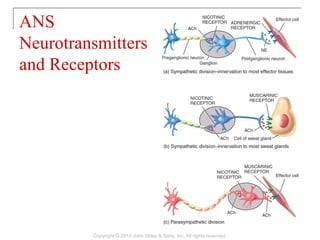
Based on the neurotransmitter they produce
and release, autonomic neurons are
considered as either cholinergic or
adrenergic. Cholinergic neurons release
the neurotransmitter acetylcholine, while
adrenergic neurons release norepinephrine
(noradrenalin). Cholinergic receptors
include nicotinic receptors and
muscarinic receptors.
ANS Neurotransmitters and Receptors
Copyright © 2014 John Wiley & Sons, Inc. All rights reserved.
ANS
Neurotransmitters
and Receptors
Copyright © 2014 John Wiley & Sons, Inc. All rights reserved.
Physiology of the ANS
Copyright © 2014 John Wiley & Sons, Inc. All rights reserved.
Physiology of the ANS
Copyright © 2014 John Wiley & Sons, Inc. All rights reserved.
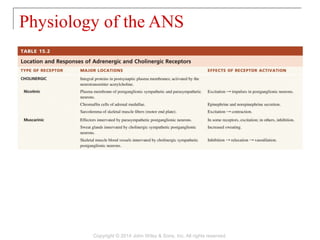
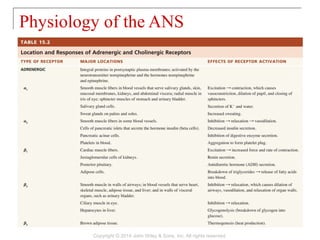
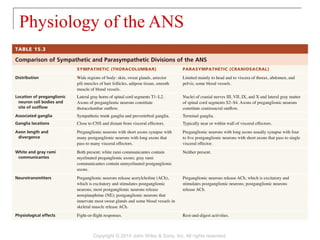
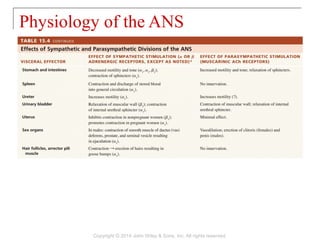
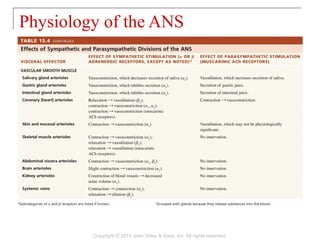
In general, the sympathetic and
parasympathetic divisions of the autonomic
nervous system are antagonistic to each
other.
Physiology of the ANS
Copyright © 2014 John Wiley & Sons, Inc. All rights reserved.
Physiology of the ANS
Copyright © 2014 John Wiley & Sons, Inc. All rights reserved.
Physiology of the ANS
Copyright © 2014 John Wiley & Sons, Inc. All rights reserved.
Physiology of the ANS
Copyright © 2014 John Wiley & Sons, Inc. All rights reserved.
Physiology of the ANS
Copyright © 2014 John Wiley & Sons, Inc. All rights reserved.
 Functions such as heart rate and force of
ventricular contraction, blood pressure
and blood vessel diameter are controlled
by autonomic reflexes that occur when
nerve impulses pass through an
autonomic reflex arc.
 The reflex arc is composed of a receptor,
a sensory neuron, an integrating
center, motor neurons and an effector.
Integration and Control of Autonomic
Functions
Copyright © 2014 John Wiley & Sons, Inc. All rights reserved.
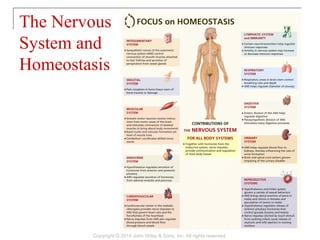
The nervous system is associated with
virtually all functions of the body. It is
intimately involved in maintaining
homeostasis throughout the body.
The Nervous System and Homeostasis
Copyright © 2014 John Wiley & Sons, Inc. All rights reserved.
The Nervous
System and
Homeostasis
Copyright © 2014 John Wiley & Sons, Inc. All rights reserved.
Copyright 2014 John Wiley & Sons, Inc.
All rights reserved. Reproduction or translation of this work beyond that permitted
in section 117 of the 1976 United States Copyright Act without express permission
of the copyright owner is unlawful. Request for further information should be
addressed to the Permission Department, John Wiley & Sons, Inc. The purchaser
may make back-up copies for his/her own use only and not for distribution or
resale. The Publisher assumes no responsibility for errors, omissions, or damages
caused by the use of these programs or from the use of the information herein.
End of Chapter 15
Copyright © 2014 John Wiley & Sons, Inc. All rights reserved.

15 [chapter 15 the autonomic nervous system]

  • 1.
    CHAPTER 15 The AutonomicNervous System Copyright © 2014 John Wiley & Sons, Inc. All rights reserved. Principles of Anatomy and Physiology 14th Edition
  • 2.
     The somaticnervous system includes both sensory and motor neurons. Sensory neurons are related to touch, pain, temperature, and proprioception (sense of self position), sight, hearing, taste, smell and equilibrium. Motor neurons innervate skeletal muscles.  The autonomic nervous system receives input from sensory receptors located in organs, blood vessels, muscles and the nervous system. Comparison of Somatic and Autonomic Nervous Systems Copyright © 2014 John Wiley & Sons, Inc. All rights reserved.
  • 3.
    The axon ofa single, myelinated somatic motor neuron extends from the central nervous system to the skeletal muscle fiber it innervates. Comparison of Somatic and Autonomic Nervous Systems Copyright © 2014 John Wiley & Sons, Inc. All rights reserved.
  • 4.
    Most autonomic motorpathways consist of two motor neurons in series. The first (preganglionic neuron) has its cell body in the central nervous system. The axon extends to an autonomic ganglion. The second (postganglionic neuron) has its unmyelinated axon extending from the ganglion to the effector (smooth muscle, cardiac muscle, or gland). Comparison of Somatic and Autonomic Nervous Systems Copyright © 2014 John Wiley & Sons, Inc. All rights reserved.
  • 5.
    Comparison of Somaticand Autonomic Nervous Systems Copyright © 2014 John Wiley & Sons, Inc. All rights reserved.
  • 6.
    The autonomic nervoussystem is divided into two divisions: The sympathetic nervous system is often referred to as the fight-or-flight division because its stimulation leads to increased alertness and metabolism to be ready for an emergency. The parasympathetic nervous system is referred to as the rest-and-digest division as its stimulation slows down most body activity. Comparison of Somatic and Autonomic Nervous Systems Copyright © 2014 John Wiley & Sons, Inc. All rights reserved.
  • 7.
    Comparison of Somaticand Autonomic Nervous Systems Copyright © 2014 John Wiley & Sons, Inc. All rights reserved.
  • 8.
    Each division ofthe autonomic nervous system has two motor neurons: The preganglionic (cell body in the brain or spinal cord) and the postganglionic (cell body and dendrites located in an autonomic ganglion where it synapses with preganglionic axons). Anatomy of Autonomic Motor Pathways Copyright © 2014 John Wiley & Sons, Inc. All rights reserved.
  • 9.
    In the sympatheticdivision, the cell bodies of preganglionic neurons are in the lateral horns of the gray matter in the 12 thoracic and first 2 or 3 lumbar segments. Anatomy of Autonomic Motor Pathways Copyright © 2014 John Wiley & Sons, Inc. All rights reserved.
  • 10.
    Anatomy of Autonomic Motor Pathways Copyright ©2014 John Wiley & Sons, Inc. All rights reserved.
  • 11.
    In the parasympatheticdivision, cell bodies of the preganglionic neurons are in the nuclei of four cranial nerves (III, VII, IX and X) in the brain stem and in the lateral gray matter of sacral segments 2–4 of the spinal cord. Anatomy of Autonomic Motor Pathways Copyright © 2014 John Wiley & Sons, Inc. All rights reserved.
  • 12.
    Anatomy of Autonomic Motor Pathways Copyright ©2014 John Wiley & Sons, Inc. All rights reserved.
  • 13.
     There aretwo types of autonomic ganglia: sympathetic and parasympathetic. Sympathetic ganglia are sites of synapses between sympathetic preganglionic and postganglionic neurons.  There are 2 major types of sympathetic ganglia: Sympathetic trunk ganglia (lie in a vertical row on either side of the vertebral column) and prevertebral ganglia (lie anterior to the vertebral column and close to the large abdominal arteries). Anatomy of Autonomic Motor Pathways Copyright © 2014 John Wiley & Sons, Inc. All rights reserved.
  • 14.
    After axons ofsympathetic preganglionic neurons enter sympathetic trunk ganglia, they may connect with postganglionic neurons in one of 4 ways. 1. An axon may synapse with postganglionic neurons in the first ganglion it reaches. 2. An axon may ascend or descend to a higher or lower ganglion before synapsing with postganglionic neurons. 3. An axon may continue, without synapsing, through the sympathetic trunk ganglion to end at a prevertebral ganglion and synapse with postganglionic neurons. 4. An axon may also pass, without synapsing, through the sympathetic trunk ganglion and a prevertebral ganglion and then extend to the adrenal medullae. Anatomy of Autonomic Motor Pathways Copyright © 2014 John Wiley & Sons, Inc. All rights reserved.
  • 15.
    Anatomy of Autonomic Motor Pathways Copyright ©2014 John Wiley & Sons, Inc. All rights reserved.
  • 16.
    The abdomen andpelvis also contain major autonomic plexuses which are often named after the artery along which they are distributed. These include the celiac (solar) plexus, the superior mesenteric plexus, the inferior mesenteric plexus, the renal plexus and the hypogastric plexus. Anatomy of Autonomic Motor Pathways Copyright © 2014 John Wiley & Sons, Inc. All rights reserved.
  • 17.
    Anatomy of Autonomic Motor Pathways Copyright ©2014 John Wiley & Sons, Inc. All rights reserved.
  • 18.
     Cell bodiesof the sympathetic preganglionic neurons are part of the lateral gray horns of all thoracic segments and of the first two lumbar segments of the spinal cord.  The paired sympathetic trunk ganglia are anterior and lateral to the vertebral column. Usually, there are 2 cervical, 11 or 12 thoracic, 4 or 5 lumbar, 4 or 5 sacral sympathetic trunk ganglia and 1 coccygeal ganglion. Anatomy of Autonomic Motor Pathways Copyright © 2014 John Wiley & Sons, Inc. All rights reserved.
  • 19.
    Cell bodies ofthe parasympathetic preganglionic neurons are located in nuclei in the brain stem and in the lateral gray matter of the 2nd through 4th sacral segments of the spinal cord. There is a cranial parasympathetic outflow that extends from the brain stem in 4 cranial nerves. The sacral parasympathetic outflow extends from the 2nd through 4th sacral spinal nerves. Anatomy of Autonomic Motor Pathways Copyright © 2014 John Wiley & Sons, Inc. All rights reserved.
  • 20.
    Anatomy of Autonomic Motor Pathways Copyright ©2014 John Wiley & Sons, Inc. All rights reserved.
  • 21.
    Nervous System: Organizationof the ANS Anatomy of Atonomic Motor Pathways Copyright © 2014 John Wiley & Sons, Inc. All rights reserved. Anatomy Overview: You must be connected to the Internet and in Slideshow Mode to run this animation.
  • 22.
    Based on theneurotransmitter they produce and release, autonomic neurons are considered as either cholinergic or adrenergic. Cholinergic neurons release the neurotransmitter acetylcholine, while adrenergic neurons release norepinephrine (noradrenalin). Cholinergic receptors include nicotinic receptors and muscarinic receptors. ANS Neurotransmitters and Receptors Copyright © 2014 John Wiley & Sons, Inc. All rights reserved.
  • 23.
    ANS Neurotransmitters and Receptors Copyright ©2014 John Wiley & Sons, Inc. All rights reserved.
  • 24.
    Physiology of theANS Copyright © 2014 John Wiley & Sons, Inc. All rights reserved.
  • 25.
    Physiology of theANS Copyright © 2014 John Wiley & Sons, Inc. All rights reserved.
  • 26.
    In general, thesympathetic and parasympathetic divisions of the autonomic nervous system are antagonistic to each other. Physiology of the ANS Copyright © 2014 John Wiley & Sons, Inc. All rights reserved.
  • 27.
    Physiology of theANS Copyright © 2014 John Wiley & Sons, Inc. All rights reserved.
  • 28.
    Physiology of theANS Copyright © 2014 John Wiley & Sons, Inc. All rights reserved.
  • 29.
    Physiology of theANS Copyright © 2014 John Wiley & Sons, Inc. All rights reserved.
  • 30.
    Physiology of theANS Copyright © 2014 John Wiley & Sons, Inc. All rights reserved.
  • 31.
     Functions suchas heart rate and force of ventricular contraction, blood pressure and blood vessel diameter are controlled by autonomic reflexes that occur when nerve impulses pass through an autonomic reflex arc.  The reflex arc is composed of a receptor, a sensory neuron, an integrating center, motor neurons and an effector. Integration and Control of Autonomic Functions Copyright © 2014 John Wiley & Sons, Inc. All rights reserved.
  • 32.
    The nervous systemis associated with virtually all functions of the body. It is intimately involved in maintaining homeostasis throughout the body. The Nervous System and Homeostasis Copyright © 2014 John Wiley & Sons, Inc. All rights reserved.
  • 33.
    The Nervous System and Homeostasis Copyright© 2014 John Wiley & Sons, Inc. All rights reserved.
  • 34.
    Copyright 2014 JohnWiley & Sons, Inc. All rights reserved. Reproduction or translation of this work beyond that permitted in section 117 of the 1976 United States Copyright Act without express permission of the copyright owner is unlawful. Request for further information should be addressed to the Permission Department, John Wiley & Sons, Inc. The purchaser may make back-up copies for his/her own use only and not for distribution or resale. The Publisher assumes no responsibility for errors, omissions, or damages caused by the use of these programs or from the use of the information herein. End of Chapter 15 Copyright © 2014 John Wiley & Sons, Inc. All rights reserved.

Editor's Notes

  • #2 <number>
  • #22 <number>