The Urinary System
Overview of kidney functions
 Regulation of blood ionic composition
 Regulation of blood pH
 Regulation of blood volume
 Regulation of blood pressure
 Maintenance of blood osmolarity
 Production of hormones (calcitrol and erythropoitin)
 Regulation of blood glucose level
 Excretion of wastes from metabolic reactions and
foreign substances (drugs or toxins)
Copyright 2009, John Wiley & Sons, Inc.
Anatomy and histology of the kidneys
 External anatomy
 Renal hilium – indent where ureter emerges along
with blood vessels, lymphatic vessels and nerves
 3 layers of tissue
 Renal capsule – deep layer – continuous with outer coat
of ureter, barrier against trauma, maintains kidney shape
 Adipose capsule – mass of fatty tissue that protects
kidney from trauma and holds it in place
 Renal fascia – superficial layer – thin layer of connective
tissue that anchors kidney to surrounding structures and
abdominal wall
Copyright 2009, John Wiley & Sons, Inc.
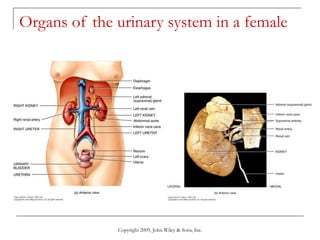
Organs of the urinary system in a female
Copyright 2009, John Wiley & Sons, Inc.
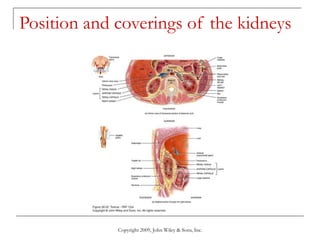
Position and coverings of the kidneys
Copyright 2009, John Wiley & Sons, Inc.
Internal anatomy
 Renal cortex – superficial
 Outer cortical zone
 Inner juxtamedullary zone
 Renal columns – portions of cortex that extend between
renal pyramids
 Renal medulla – inner region
 Several cone shaped renal pyramids – base faces cortex
and renal papilla points toward hilium
 Renal lobe – renal pyramid, overlying cortex area,
and ½ of each adjacent renal column
Copyright 2009, John Wiley & Sons, Inc.
Anatomy of the kidneys
 Parenchyma (functional portion) of kidney
 Renal cortex and renal pyramids of medulla
 Nephron – microscopic functional units of kidney
 Urine formed by nephron drains into
 Papillary ducts
 Minor and major calyces
 Renal pelvis
 Ureter
 Urinary bladder
Copyright 2009, John Wiley & Sons, Inc.
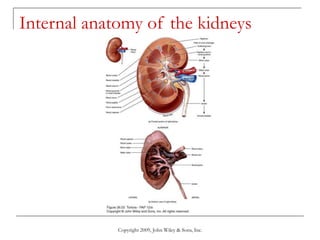
Internal anatomy of the kidneys
Copyright 2009, John Wiley & Sons, Inc.
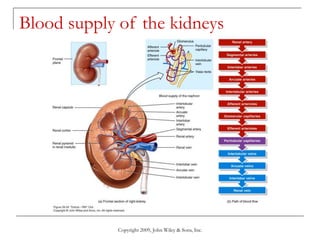
Blood and nerve supply of the kidneys
 Blood supply
 Although kidneys constitute less than 0.5% of total body mass,
they receive 20-25% of resting cardiac output
 Left and right renal artery enters kidney
 Branches into segmental, interlobar, arcuate, interlobular arteries
 Each nephron receives one afferent arteriole
 Divides into glomerulus – capillary ball
 Reunite to form efferent arteriole (unique)
 Divide to form peritubular capillaries or some have vasa recta
 Peritubular venule, interlobar vein and renal vein exits kidney
 Renal nerves are part of the sympathetic autonomic nervous
system
 Most are vasomotor nerves regulating blood flow
Copyright 2009, John Wiley & Sons, Inc.
Blood supply of the kidneys
Copyright 2009, John Wiley & Sons, Inc.
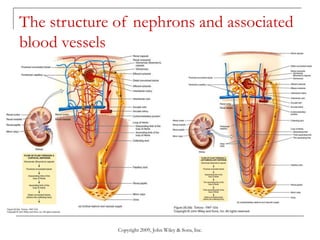
The nephron – functional units of
kidney
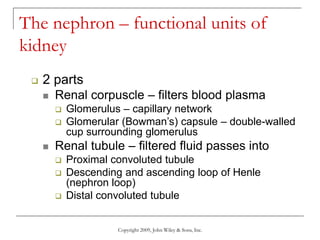
 2 parts
 Renal corpuscle – filters blood plasma
 Glomerulus – capillary network
 Glomerular (Bowman’s) capsule – double-walled
cup surrounding glomerulus
 Renal tubule – filtered fluid passes into
 Proximal convoluted tubule
 Descending and ascending loop of Henle
(nephron loop)
 Distal convoluted tubule
Copyright 2009, John Wiley & Sons, Inc.
Nephrons
 Renal corpuscle and both convoluted tubules in
cortex, loop of Henle extend into medulla
 Distal convoluted tubule of several nephrons
empty into single collecting duct
 Cortical nephrons – 80-85% of nephrons
 Renal corpuscle in outer portion of cortex and short loops of
Henle extend only into outer region of medulla
 Juxtamedullary nephrons – other 25-20%
 Renal corpuscle deep in cortex and long loops of Henle
extend deep into medulla
 Receive blood from peritubular capillaries and vasa recta
 Ascending limb has thick and thin regions
 Enable kidney to secrete very dilute or very concentrated urine
Copyright 2009, John Wiley & Sons, Inc.
The structure of nephrons and associated
blood vessels
Copyright 2009, John Wiley & Sons, Inc.
Histology of nephron and collecting duct
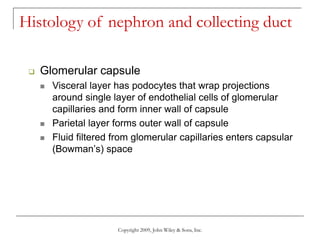
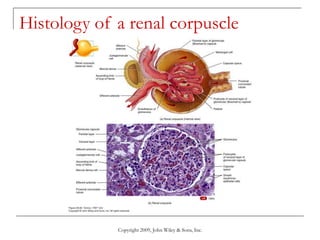
 Glomerular capsule
 Visceral layer has podocytes that wrap projections
around single layer of endothelial cells of glomerular
capillaries and form inner wall of capsule
 Parietal layer forms outer wall of capsule
 Fluid filtered from glomerular capillaries enters capsular
(Bowman’s) space
Copyright 2009, John Wiley & Sons, Inc.
Histology of a renal corpuscle
Copyright 2009, John Wiley & Sons, Inc.
Renal tubule and collecting duct
 Proximal convoluted tubule cells have microvilli with
brush border – increases surface area
 Juxtaglomerular appraratus helps regulate blood
pressure in kidney
 Macula densa – cells in final part of ascending loop of Henle
 Juxtaglomerular cells – cells of afferent and efferent
arterioles contain modified smooth muscle fibers
 Last part of distal convoluted tubule and collecting duct
 Principal cells – receptors for antidiuretic hormone (ADH)
and aldosterone
 Intercalated cells – role in blood pH homeostasis
Copyright 2009, John Wiley & Sons, Inc.
Overview of renal physiology
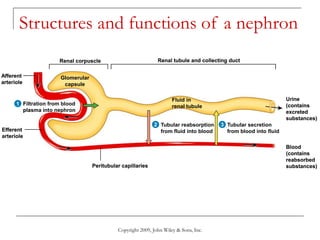
1. Glomerular filtration
 Water and most solutes in blood plasma move across the wall of
the glomerular capillaries into glomerular capsule and then renal
tubule
2. Tubular reabsorption
 As filtered fluid moves along tubule and through collecting duct,
about 99% of water and many useful solutes reabsorbed –
returned to blood
3. Tubular secretion
 As filtered fluid moves along tubule and through collecting duct,
other material secreted into fluid such as wastes, drugs, and
excess ions – removes substances from blood
 Solutes in the fluid that drains into the renal pelvis remain in the
fluid and are excreted
 Excretion of any solute = glomerular filtration + secretion - reabsorption
Copyright 2009, John Wiley & Sons, Inc.
Structures and functions of a nephron
Renal corpuscle Renal tubule and collecting duct
Peritubular capillaries
Urine
(contains
excreted
substances)
Blood
(contains
reabsorbed
substances)
Fluid in
renal tubule
Afferent
arteriole
Filtration from blood
plasma into nephron
Efferent
arteriole
Glomerular
capsule
1
Renal corpuscle Renal tubule and collecting duct
Peritubular capillaries
Urine
(contains
excreted
substances)
Blood
(contains
reabsorbed
substances)
Tubular reabsorption
from fluid into blood
Fluid in
renal tubule
Afferent
arteriole
Filtration from blood
plasma into nephron
Efferent
arteriole
Glomerular
capsule
1
2
Renal corpuscle Renal tubule and collecting duct
Peritubular capillaries
Urine
(contains
excreted
substances)
Blood
(contains
reabsorbed
substances)
Tubular secretion
from blood into fluid
Tubular reabsorption
from fluid into blood
Fluid in
renal tubule
Afferent
arteriole
Filtration from blood
plasma into nephron
Efferent
arteriole
Glomerular
capsule
1
2 3
Copyright 2009, John Wiley & Sons, Inc.
Glomerular filtration
 Glomerular filtrate – fluid that enters capsular space
 Daily volume 150-180 liters – more than 99% returned to
blood plasma via tubular reabsorption
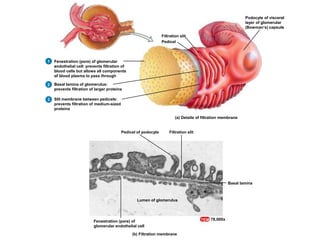
 Filtration membrane – endothelial cells of glomerular
capillaries and podocytes encircling capillaries
 Permits filtration of water and small solutes
 Prevents filtration of most plasma proteins, blood cells and
platelets
 3 barriers to cross – glomerular endothelial cells
fenestrations, basal lamina between endothelium and
podocytes and pedicels of podocytes create filtration slits
 Volume of fluid filtered is large because of large surface
area, thin and porous membrane, and high glomerular
capillary blood pressure
Copyright 2009, John Wiley & Sons, Inc.
The filtration membrane
Filtration slit
Pedicel of podocyte
Fenestration (pore) of
glomerular endothelial cell
Basal lamina
Lumen of glomerulus
(b) Filtration membrane
TEM 78,000x
(a) Details of filtration membrane
Filtration slit
Pedicel
Fenestration (pore) of glomerular
endothelial cell: prevents filtration of
blood cells but allows all components
of blood plasma to pass through
Podocyte of visceral
layer of glomerular
(Bowman’s) capsule
1
Filtration slit
Pedicel of podocyte
Fenestration (pore) of
glomerular endothelial cell
Basal lamina
Lumen of glomerulus
(b) Filtration membrane
TEM 78,000x
(a) Details of filtration membrane
Filtration slit
Pedicel
Fenestration (pore) of glomerular
endothelial cell: prevents filtration of
blood cells but allows all components
of blood plasma to pass through
Basal lamina of glomerulus:
prevents filtration of larger proteins
Podocyte of visceral
layer of glomerular
(Bowman’s) capsule
1
2
Filtration slit
Pedicel of podocyte
Fenestration (pore) of
glomerular endothelial cell
Basal lamina
Lumen of glomerulus
(b) Filtration membrane
TEM 78,000x
(a) Details of filtration membrane
Filtration slit
Pedicel
Fenestration (pore) of glomerular
endothelial cell: prevents filtration of
blood cells but allows all components
of blood plasma to pass through
Basal lamina of glomerulus:
prevents filtration of larger proteins
Slit membrane between pedicels:
prevents filtration of medium-sized
proteins
Podocyte of visceral
layer of glomerular
(Bowman’s) capsule
1
2
3
Copyright 2009, John Wiley & Sons, Inc.
Net filtration pressure
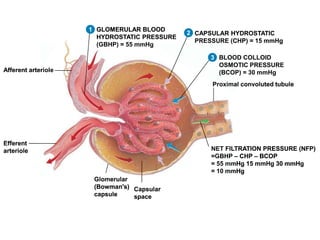
 Net filtration pressure (NFP) is the total pressure
that promotes filtration
 NFP = GBHP – CHP – BCOP
 Glomerular blood hydrostatic pressure is the blood
pressure of the glomerular capillaries forcing water and
solutes through filtration slits
 Capsular hydrostatic pressure is the hydrostatic pressure
exerted against the filtration membrane by fluid already in
the capsular space and represents “back pressure”
 Blood colloid osmotic pressure due to presence of proteins
in blood plasma and also opposes filtration
Copyright 2009, John Wiley & Sons, Inc.
The pressures that drive glomerular
filtration
NET FILTRATION PRESSURE (NFP)
=GBHP – CHP – BCOP
= 55 mmHg 15 mmHg 30 mmHg
= 10 mmHg
GLOMERULAR BLOOD
HYDROSTATIC PRESSURE
(GBHP) = 55 mmHg
Capsular
space
Glomerular
(Bowman's)
capsule
Efferent
arteriole
Afferent arteriole
1
Proximal convoluted tubule
NET FILTRATION PRESSURE (NFP)
=GBHP – CHP – BCOP
= 55 mmHg 15 mmHg 30 mmHg
= 10 mmHg
CAPSULAR HYDROSTATIC
PRESSURE (CHP) = 15 mmHg
GLOMERULAR BLOOD
HYDROSTATIC PRESSURE
(GBHP) = 55 mmHg
Capsular
space
Glomerular
(Bowman's)
capsule
Efferent
arteriole
Afferent arteriole
1
2
Proximal convoluted tubule
NET FILTRATION PRESSURE (NFP)
=GBHP – CHP – BCOP
= 55 mmHg 15 mmHg 30 mmHg
= 10 mmHg
BLOOD COLLOID
OSMOTIC PRESSURE
(BCOP) = 30 mmHg
CAPSULAR HYDROSTATIC
PRESSURE (CHP) = 15 mmHg
GLOMERULAR BLOOD
HYDROSTATIC PRESSURE
(GBHP) = 55 mmHg
Capsular
space
Glomerular
(Bowman's)
capsule
Efferent
arteriole
Afferent arteriole
1
2
3
Proximal convoluted tubule
Copyright 2009, John Wiley & Sons, Inc.
Glomerular filtration
 Glomerular filtration rate – amount of filtrate
formed in all the renal corpuscles of both
kidneys each minute
 Homeostasis requires kidneys maintain a
relatively constant GFR
 Too high – substances pass too quickly and are not
reabsorbed
 Too low – nearly all reabsorbed and some waste
products not adequately excreted
 GFR directly related to pressures that determine
net filtration pressure
Copyright 2009, John Wiley & Sons, Inc.
3 Mechanisms regulating GFR
1. Renal autoregulation
 Kidneys themselves maintain constant renal blood flow
and GFR using
 Myogenic mechanism – occurs when stretching triggers
contraction of smooth muscle cells in afferent arterioles –
reduces GFR
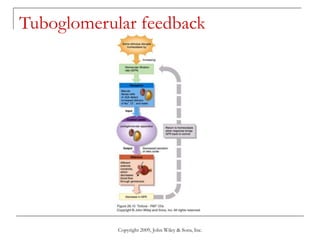
 Tubuloglomerular mechanism – macula densa provides
feedback to glomerulus, inhibits release of NO causing
afferent arterioles to constrict and decreasing GFR
Copyright 2009, John Wiley & Sons, Inc.
Tuboglomerular feedback
Copyright 2009, John Wiley & Sons, Inc.
Mechanisms regulating GFR
2. Neural regulation
 Kidney blood vessels supplied by sympathetic ANS fibers that
release norepinephrine causing vasoconstriction
 Moderate stimulation – both afferent and efferent arterioles
constrict to same degree and GFR decreases
 Greater stimulation constricts afferent arterioles more and
GFR drops
3. Hormonal regulation
 Angiotensin II reduces GFR – potent vasoconstrictor of both
afferent and efferent arterioles
 Atrial natriuretic peptide increases GFR – stretching of atria
causes release, increases capillary surface area for filtration
Copyright 2009, John Wiley & Sons, Inc.
Tubular reabsorption and tubular secretion
 Reabsorption – return of most of the filtered
water and many solutes to the bloodstream
 About 99% of filtered water reabsorbed
 Proximal convoluted tubule cells make largest
contribution
 Both active and passive processes
 Secretion – transfer of material from blood
into tubular fluid
 Helps control blood pH
 Helps eliminate substances from the body
Copyright 2009, John Wiley & Sons, Inc.
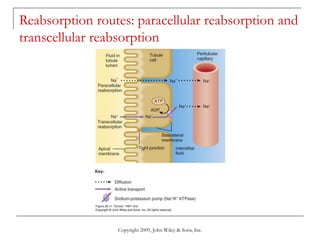
Reabsorption routes and transport mechanisms
 Reabsorption routes
 Paracellular reabsorption
 Between adjacent tubule cells
 Tight junction do not completely seal off interstitial fluid from
tubule fluid
 Passive
 Transcellular reabsorption – through an individual cell
 Transport mechanisms
 Reabsorption of Na+ especially important
 Primary active transport
 Sodium-potassium pumps in basolateral membrane only
 Secondary active transport
 Symporters, antiporters
 Transport maximum (Tm)
 Upper limit to how fast it can work
 Obligatory vs. facultative water reabsorption
Copyright 2009, John Wiley & Sons, Inc.
Reabsorption routes: paracellular reabsorption and
transcellular reabsorption
Copyright 2009, John Wiley & Sons, Inc.
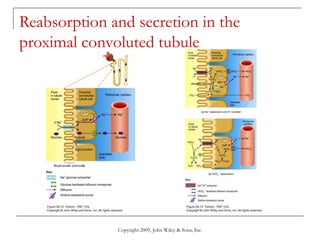
Reabsorption and secretion in proximal
convoluted tubule (PCT)
 Largest amount of solute and water reabsorption
 Secretes variable amounts of H+, NH4
+ and urea
 Most solute reabsorption involves Na+
 Symporters for glucose, amino acids, lactic acid, water-soluble
vitamins, phosphate and sulfate
 Na+ / H+ antiporter causes Na+ to be reabsorbed and H+ to be secreted
 Solute reabsorption promotes osmosis – creates osmotic gradient
 Aquaporin-1 in cells lining PCT and descending limb of loop of Henle
 As water leaves tubular fluid, solute concentration increases
 Urea and ammonia in blood are filtered at glomerulus and secreted
by proximal convoluted tubule cells
Copyright 2009, John Wiley & Sons, Inc.
Reabsorption and secretion in the
proximal convoluted tubule
Copyright 2009, John Wiley & Sons, Inc.
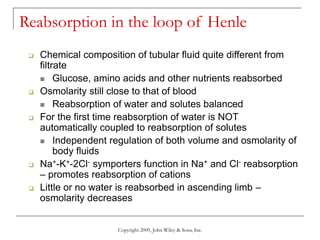
Reabsorption in the loop of Henle
 Chemical composition of tubular fluid quite different from
filtrate
 Glucose, amino acids and other nutrients reabsorbed
 Osmolarity still close to that of blood
 Reabsorption of water and solutes balanced
 For the first time reabsorption of water is NOT
automatically coupled to reabsorption of solutes
 Independent regulation of both volume and osmolarity of
body fluids
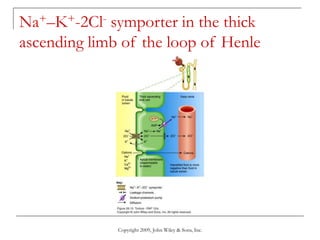
 Na+-K+-2Cl- symporters function in Na+ and Cl- reabsorption
– promotes reabsorption of cations
 Little or no water is reabsorbed in ascending limb –
osmolarity decreases
Copyright 2009, John Wiley & Sons, Inc.
Na+–K+-2Cl- symporter in the thick
ascending limb of the loop of Henle
Copyright 2009, John Wiley & Sons, Inc.
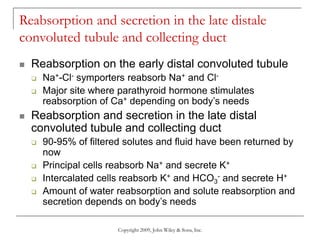
Reabsorption and secretion in the late distale
convoluted tubule and collecting duct
 Reabsorption on the early distal convoluted tubule
 Na+-Cl- symporters reabsorb Na+ and Cl-
 Major site where parathyroid hormone stimulates
reabsorption of Ca+ depending on body’s needs
 Reabsorption and secretion in the late distal
convoluted tubule and collecting duct
 90-95% of filtered solutes and fluid have been returned by
now
 Principal cells reabsorb Na+ and secrete K+
 Intercalated cells reabsorb K+ and HCO3
- and secrete H+
 Amount of water reabsorption and solute reabsorption and
secretion depends on body’s needs
Copyright 2009, John Wiley & Sons, Inc.
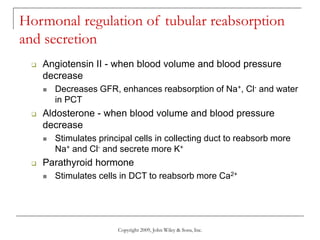
Hormonal regulation of tubular reabsorption
and secretion
 Angiotensin II - when blood volume and blood pressure
decrease
 Decreases GFR, enhances reabsorption of Na+, Cl- and water
in PCT
 Aldosterone - when blood volume and blood pressure
decrease
 Stimulates principal cells in collecting duct to reabsorb more
Na+ and Cl- and secrete more K+
 Parathyroid hormone
 Stimulates cells in DCT to reabsorb more Ca2+
Copyright 2009, John Wiley & Sons, Inc.
Regulation of facultative water reabsorption
by ADH
 Antidiuretic hormone (ADH
or vasopressin)
 Increases water
permeability of cells by
inserting aquaporin-2 in last
part of DCT and collecting
duct
 Atrial natriuretic peptide
(ANP)
 Large increase in blood
volume promotes release of
ANP
 Decreases blood volume
and pressure by inhibiting
reabsorption of Na+ and
water in PCT and collecting
duct, suppress secretion of
ADH and aldosterone
Copyright 2009, John Wiley & Sons, Inc.
Production of dilute and concentrated
urine
 Even though your fluid intake can be highly
variable, total fluid volume in your body
remains stable
 Depends in large part on the kidneys to
regulate the rate of water loss in urine
 ADH controls whether dilute or concentrated
urine is formed
 Absent or low ADH = dilute urine
 Higher levels = more concentrated urine through
increased water reabsorption
Copyright 2009, John Wiley & Sons, Inc.
Formation of dilute urine
 Glomerular filtrate has same osmolarity as blood
300 mOsm/liter
 Fluid leaving PCT is isotonic to plasma
 When dilute urine is being formed, the osmolarity
of fluid increases as it goes down the descending
loop of Henle, decreases as it goes up the
ascending limb, and decreases still more as it
flows through the rest of the nephron and
collecting duct
Copyright 2009, John Wiley & Sons, Inc.
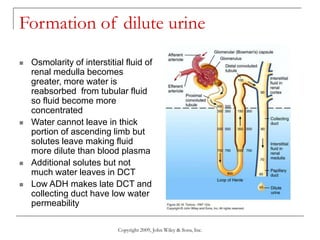
Formation of dilute urine
 Osmolarity of interstitial fluid of
renal medulla becomes
greater, more water is
reabsorbed from tubular fluid
so fluid become more
concentrated
 Water cannot leave in thick
portion of ascending limb but
solutes leave making fluid
more dilute than blood plasma
 Additional solutes but not
much water leaves in DCT
 Low ADH makes late DCT and
collecting duct have low water
permeability
Copyright 2009, John Wiley & Sons, Inc.
Formation of concentrated urine
 Urine can be up to 4 times more concentrated than
blood plasma
 Ability of ADH depends on presence of osmotic
gradient in interstitial fluid of renal medulla
 3 major solutes contribute – Na+, Cl-, and urea
 2 main factors build and maintain gradient
 Differences in solute and water permeability in
different sections of loop of Henle and collecting
ducts
 Countercurrent flow of fluid though descending and
ascending loop of Henle and blood through
ascending and descending limbs of vasa recta
Copyright 2009, John Wiley & Sons, Inc.
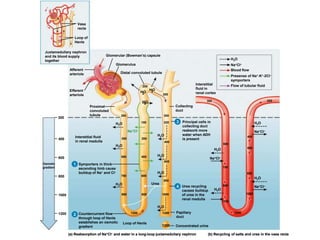
Countercurrent multiplication
 Process by which a progressively increasing osmotic gradient is
formed as a result of countercurrent flow
 Long loops of Henle of juxtamedullary nephrons function as
countercurrent multiplier
 Symporters in thick ascending limb of loop of Henle cause buildup
of Na+ and Cl- in renal medulla, cells impermeable to water
 Countercurrent flow establishes gradient as reabsorbed Na+ and
Cl- become increasingly concentrated
 Cells in collecting duct reabsorb more water and urea
 Urea recycling causes a buildup of urea in the renal medulla
 Long loop of Henle establishes gradient by countercurrent
multiplication
Copyright 2009, John Wiley & Sons, Inc.
Countercurrent exchange
 Process by which solutes and water are passively
exchanged between blood of the vasa recta and
interstitial fluid of the renal medulla as a result of
countercurrent flow
 Vasa recta is a countercurrent exchanger
 Osmolarity of blood leaving vasa recta is only
slightly higher than blood entering
 Provides oxygen and nutrients to medulla without
washing out or diminishing gradient
 Vasa recta maintains gradient by countercurrent
exchange
Copyright 2009, John Wiley & Sons, Inc.
Mechanism of urine concentration in
long-loop juxtamedullary nephrons
(b) Recycling of salts and urea in the vasa recta
(a) Reabsorption of Na+CI– and water in a long-loop juxtamedullary nephron
Glomerular (Bowman’s) capsule
Afferent
arteriole
Efferent
arteriole
Glomerulus
Distal convoluted tubule
Proximal
convoluted
tubule
Symporters in thick
ascending limb cause
buildup of Na+ and Cl–
Interstitial fluid
in renal medulla
300
1200
1000
800
Osmotic
gradient
600
400
H2
O
H2
O
H2
O
200
1200
980
600
780
400
580
200
380
300
100
Loop of Henle
1200 Concentrated urine
300
300
320
400
600
800
1000
1200
800
H2O
Urea
Papillary
duct
Collecting
duct
300
500
700
900
1100
1200
400
800
1000
600
Na+CI–
Blood flow
Flow of tubular fluid
Presense of Na+-K+-2CI–
symporters
Interstitial
fluid in
renal cortex
320
Juxtamedullary nephron
and its blood supply
together
Vasa
recta
Loop of
Henle
H2O
H2O
H2O
H2O
H2O
H2O
H2O
1
H2O
H2O
Na+CI–
Na+CI–
H2O
Na+CI–
H2O
Na+CI–
(b) Recycling of salts and urea in the vasa recta
(a) Reabsorption of Na+CI– and water in a long-loop juxtamedullary nephron
Glomerular (Bowman’s) capsule
Afferent
arteriole
Efferent
arteriole
Glomerulus
Distal convoluted tubule
Proximal
convoluted
tubule
Symporters in thick
ascending limb cause
buildup of Na+ and Cl–
Interstitial fluid
in renal medulla
300
1200
1000
800
Osmotic
gradient
600
400
H2
O
H2
O
H2
O
200
1200
980
600
780
400
580
200
380
300
100
Loop of Henle
1200 Concentrated urine
300
300
320
400
600
800
1000
1200
800
H2O
Urea
Papillary
duct
Collecting
duct
Countercurrent flow
through loop of Henle
establishes an osmotic
gradient
300
500
700
900
1100
1200
400
800
1000
600
Na+CI–
Blood flow
Flow of tubular fluid
Presense of Na+-K+-2CI–
symporters
Interstitial
fluid in
renal cortex
320
Juxtamedullary nephron
and its blood supply
together
Vasa
recta
Loop of
Henle
H2O
H2O
H2O
H2O
H2O
H2O
H2O
1
2
H2O
H2O
Na+CI–
Na+CI–
H2O
Na+CI–
H2O
Na+CI–
(b) Recycling of salts and urea in the vasa recta
(a) Reabsorption of Na+CI– and water in a long-loop juxtamedullary nephron
Glomerular (Bowman’s) capsule
Afferent
arteriole
Efferent
arteriole
Glomerulus
Distal convoluted tubule
Proximal
convoluted
tubule
Symporters in thick
ascending limb cause
buildup of Na+ and Cl–
Interstitial fluid
in renal medulla
300
1200
1000
800
Osmotic
gradient
600
400
H2
O
H2
O
H2
O
200
1200
980
600
780
400
580
200
380
300
100
Loop of Henle
1200 Concentrated urine
300
300
320
400
600
800
1000
1200
800
H2O
Urea
Papillary
duct
Collecting
duct
Countercurrent flow
through loop of Henle
establishes an osmotic
gradient
Principal cells in
collecting duct
reabsorb more
water when ADH
is present
300
500
700
900
1100
1200
400
800
1000
600
Na+CI–
Blood flow
Flow of tubular fluid
Presense of Na+-K+-2CI–
symporters
Interstitial
fluid in
renal cortex
320
Juxtamedullary nephron
and its blood supply
together
Vasa
recta
Loop of
Henle
H2O
H2O
H2O
H2O
H2O
H2O
H2O
1
2
3
H2O
H2O
Na+CI–
Na+CI–
H2O
Na+CI–
H2O
Na+CI–
(b) Recycling of salts and urea in the vasa recta
(a) Reabsorption of Na+CI– and water in a long-loop juxtamedullary nephron
Glomerular (Bowman’s) capsule
Afferent
arteriole
Efferent
arteriole
Glomerulus
Distal convoluted tubule
Proximal
convoluted
tubule
Symporters in thick
ascending limb cause
buildup of Na+ and Cl–
Interstitial fluid
in renal medulla
300
1200
1000
800
Osmotic
gradient
600
400
H2
O
H2
O
H2
O
200
1200
980
600
780
400
580
200
380
300
100
Loop of Henle
1200 Concentrated urine
300
300
320
400
600
800
1000
1200
800
H2O
Urea
Papillary
duct
Urea recycling
causes buildup
of urea in the
renal medulla
Collecting
duct
Countercurrent flow
through loop of Henle
establishes an osmotic
gradient
Principal cells in
collecting duct
reabsorb more
water when ADH
is present
300
500
700
900
1100
1200
400
800
1000
600
Na+CI–
Blood flow
Flow of tubular fluid
Presense of Na+-K+-2CI–
symporters
Interstitial
fluid in
renal cortex
320
Juxtamedullary nephron
and its blood supply
together
Vasa
recta
Loop of
Henle
H2O
H2O
H2O
H2O
H2O
H2O
H2O
1
2
3
4
H2O
H2O
Na+CI–
Na+CI–
H2O
Na+CI–
H2O
Na+CI–
Copyright 2009, John Wiley & Sons, Inc.
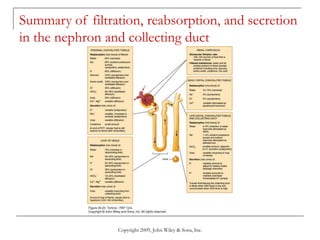
Summary of filtration, reabsorption, and secretion
in the nephron and collecting duct
Copyright 2009, John Wiley & Sons, Inc.
Evaluation of kidney function
 Urinalysis
 Analysis of the volume and physical, chemical and
microscopic properties of urine
 Water accounts for 95% of total urine volume
 Typical solutes are filtered and secreted
substances that are not reabsorbed
 If disease alters metabolism or kidney function,
traces if substances normally not present or
normal constituents in abnormal amounts may
appear
Copyright 2009, John Wiley & Sons, Inc.
Evaluation of kidney function
 Blood tests
 Blood urea nitrogen (BUN) – measures blood nitrogen that
is part of the urea resulting from catabolism and
deamination of amino acids
 Plasma creatinine results from catabolism of creatine
phosphate in skeletal muscle – measure of renal function
 Renal plasma clearance
 More useful in diagnosis of kidney problems than above
 Volume of blood cleared of a substance per unit time
 High renal plasma clearance indicates efficient excretion of
a substance into urine
 PAH administered to measure renal plasma flow
Copyright 2009, John Wiley & Sons, Inc.
Urine transportation, storage, and
elimination
 Ureters
 Each of 2 ureters transports urine from renal
pelvis of one kidney to the bladder
 Peristaltic waves, hydrostatic pressure and gravity
move urine
 No anatomical valve at the opening of the ureter
into bladder – when bladder fills it compresses the
opening and prevents backflow
Copyright 2009, John Wiley & Sons, Inc.
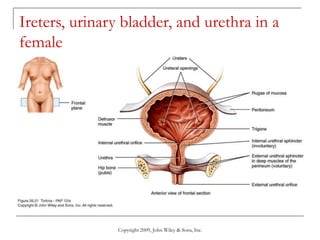
Ireters, urinary bladder, and urethra in a
female
Copyright 2009, John Wiley & Sons, Inc.
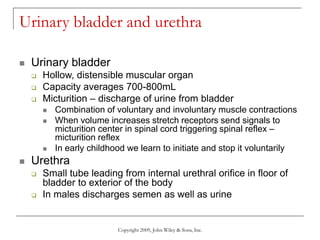
Urinary bladder and urethra
 Urinary bladder
 Hollow, distensible muscular organ
 Capacity averages 700-800mL
 Micturition – discharge of urine from bladder
 Combination of voluntary and involuntary muscle contractions
 When volume increases stretch receptors send signals to
micturition center in spinal cord triggering spinal reflex –
micturition reflex
 In early childhood we learn to initiate and stop it voluntarily
 Urethra
 Small tube leading from internal urethral orifice in floor of
bladder to exterior of the body
 In males discharges semen as well as urine
Copyright 2009, John Wiley & Sons, Inc.
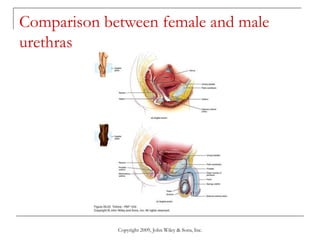
Comparison between female and male
urethras

Excretory system.ppt

  • 1.
  • 2.
    Overview of kidneyfunctions  Regulation of blood ionic composition  Regulation of blood pH  Regulation of blood volume  Regulation of blood pressure  Maintenance of blood osmolarity  Production of hormones (calcitrol and erythropoitin)  Regulation of blood glucose level  Excretion of wastes from metabolic reactions and foreign substances (drugs or toxins)
  • 3.
    Copyright 2009, JohnWiley & Sons, Inc. Anatomy and histology of the kidneys  External anatomy  Renal hilium – indent where ureter emerges along with blood vessels, lymphatic vessels and nerves  3 layers of tissue  Renal capsule – deep layer – continuous with outer coat of ureter, barrier against trauma, maintains kidney shape  Adipose capsule – mass of fatty tissue that protects kidney from trauma and holds it in place  Renal fascia – superficial layer – thin layer of connective tissue that anchors kidney to surrounding structures and abdominal wall
  • 4.
    Copyright 2009, JohnWiley & Sons, Inc. Organs of the urinary system in a female
  • 5.
    Copyright 2009, JohnWiley & Sons, Inc. Position and coverings of the kidneys
  • 6.
    Copyright 2009, JohnWiley & Sons, Inc. Internal anatomy  Renal cortex – superficial  Outer cortical zone  Inner juxtamedullary zone  Renal columns – portions of cortex that extend between renal pyramids  Renal medulla – inner region  Several cone shaped renal pyramids – base faces cortex and renal papilla points toward hilium  Renal lobe – renal pyramid, overlying cortex area, and ½ of each adjacent renal column
  • 7.
    Copyright 2009, JohnWiley & Sons, Inc. Anatomy of the kidneys  Parenchyma (functional portion) of kidney  Renal cortex and renal pyramids of medulla  Nephron – microscopic functional units of kidney  Urine formed by nephron drains into  Papillary ducts  Minor and major calyces  Renal pelvis  Ureter  Urinary bladder
  • 8.
    Copyright 2009, JohnWiley & Sons, Inc. Internal anatomy of the kidneys
  • 9.
    Copyright 2009, JohnWiley & Sons, Inc. Blood and nerve supply of the kidneys  Blood supply  Although kidneys constitute less than 0.5% of total body mass, they receive 20-25% of resting cardiac output  Left and right renal artery enters kidney  Branches into segmental, interlobar, arcuate, interlobular arteries  Each nephron receives one afferent arteriole  Divides into glomerulus – capillary ball  Reunite to form efferent arteriole (unique)  Divide to form peritubular capillaries or some have vasa recta  Peritubular venule, interlobar vein and renal vein exits kidney  Renal nerves are part of the sympathetic autonomic nervous system  Most are vasomotor nerves regulating blood flow
  • 10.
    Copyright 2009, JohnWiley & Sons, Inc. Blood supply of the kidneys
  • 11.
    Copyright 2009, JohnWiley & Sons, Inc. The nephron – functional units of kidney  2 parts  Renal corpuscle – filters blood plasma  Glomerulus – capillary network  Glomerular (Bowman’s) capsule – double-walled cup surrounding glomerulus  Renal tubule – filtered fluid passes into  Proximal convoluted tubule  Descending and ascending loop of Henle (nephron loop)  Distal convoluted tubule
  • 12.
    Copyright 2009, JohnWiley & Sons, Inc. Nephrons  Renal corpuscle and both convoluted tubules in cortex, loop of Henle extend into medulla  Distal convoluted tubule of several nephrons empty into single collecting duct  Cortical nephrons – 80-85% of nephrons  Renal corpuscle in outer portion of cortex and short loops of Henle extend only into outer region of medulla  Juxtamedullary nephrons – other 25-20%  Renal corpuscle deep in cortex and long loops of Henle extend deep into medulla  Receive blood from peritubular capillaries and vasa recta  Ascending limb has thick and thin regions  Enable kidney to secrete very dilute or very concentrated urine
  • 13.
    Copyright 2009, JohnWiley & Sons, Inc. The structure of nephrons and associated blood vessels
  • 14.
    Copyright 2009, JohnWiley & Sons, Inc. Histology of nephron and collecting duct  Glomerular capsule  Visceral layer has podocytes that wrap projections around single layer of endothelial cells of glomerular capillaries and form inner wall of capsule  Parietal layer forms outer wall of capsule  Fluid filtered from glomerular capillaries enters capsular (Bowman’s) space
  • 15.
    Copyright 2009, JohnWiley & Sons, Inc. Histology of a renal corpuscle
  • 16.
    Copyright 2009, JohnWiley & Sons, Inc. Renal tubule and collecting duct  Proximal convoluted tubule cells have microvilli with brush border – increases surface area  Juxtaglomerular appraratus helps regulate blood pressure in kidney  Macula densa – cells in final part of ascending loop of Henle  Juxtaglomerular cells – cells of afferent and efferent arterioles contain modified smooth muscle fibers  Last part of distal convoluted tubule and collecting duct  Principal cells – receptors for antidiuretic hormone (ADH) and aldosterone  Intercalated cells – role in blood pH homeostasis
  • 17.
    Copyright 2009, JohnWiley & Sons, Inc. Overview of renal physiology 1. Glomerular filtration  Water and most solutes in blood plasma move across the wall of the glomerular capillaries into glomerular capsule and then renal tubule 2. Tubular reabsorption  As filtered fluid moves along tubule and through collecting duct, about 99% of water and many useful solutes reabsorbed – returned to blood 3. Tubular secretion  As filtered fluid moves along tubule and through collecting duct, other material secreted into fluid such as wastes, drugs, and excess ions – removes substances from blood  Solutes in the fluid that drains into the renal pelvis remain in the fluid and are excreted  Excretion of any solute = glomerular filtration + secretion - reabsorption
  • 18.
    Copyright 2009, JohnWiley & Sons, Inc. Structures and functions of a nephron Renal corpuscle Renal tubule and collecting duct Peritubular capillaries Urine (contains excreted substances) Blood (contains reabsorbed substances) Fluid in renal tubule Afferent arteriole Filtration from blood plasma into nephron Efferent arteriole Glomerular capsule 1 Renal corpuscle Renal tubule and collecting duct Peritubular capillaries Urine (contains excreted substances) Blood (contains reabsorbed substances) Tubular reabsorption from fluid into blood Fluid in renal tubule Afferent arteriole Filtration from blood plasma into nephron Efferent arteriole Glomerular capsule 1 2 Renal corpuscle Renal tubule and collecting duct Peritubular capillaries Urine (contains excreted substances) Blood (contains reabsorbed substances) Tubular secretion from blood into fluid Tubular reabsorption from fluid into blood Fluid in renal tubule Afferent arteriole Filtration from blood plasma into nephron Efferent arteriole Glomerular capsule 1 2 3
  • 19.
    Copyright 2009, JohnWiley & Sons, Inc. Glomerular filtration  Glomerular filtrate – fluid that enters capsular space  Daily volume 150-180 liters – more than 99% returned to blood plasma via tubular reabsorption  Filtration membrane – endothelial cells of glomerular capillaries and podocytes encircling capillaries  Permits filtration of water and small solutes  Prevents filtration of most plasma proteins, blood cells and platelets  3 barriers to cross – glomerular endothelial cells fenestrations, basal lamina between endothelium and podocytes and pedicels of podocytes create filtration slits  Volume of fluid filtered is large because of large surface area, thin and porous membrane, and high glomerular capillary blood pressure
  • 20.
    Copyright 2009, JohnWiley & Sons, Inc. The filtration membrane
  • 21.
    Filtration slit Pedicel ofpodocyte Fenestration (pore) of glomerular endothelial cell Basal lamina Lumen of glomerulus (b) Filtration membrane TEM 78,000x (a) Details of filtration membrane Filtration slit Pedicel Fenestration (pore) of glomerular endothelial cell: prevents filtration of blood cells but allows all components of blood plasma to pass through Podocyte of visceral layer of glomerular (Bowman’s) capsule 1 Filtration slit Pedicel of podocyte Fenestration (pore) of glomerular endothelial cell Basal lamina Lumen of glomerulus (b) Filtration membrane TEM 78,000x (a) Details of filtration membrane Filtration slit Pedicel Fenestration (pore) of glomerular endothelial cell: prevents filtration of blood cells but allows all components of blood plasma to pass through Basal lamina of glomerulus: prevents filtration of larger proteins Podocyte of visceral layer of glomerular (Bowman’s) capsule 1 2 Filtration slit Pedicel of podocyte Fenestration (pore) of glomerular endothelial cell Basal lamina Lumen of glomerulus (b) Filtration membrane TEM 78,000x (a) Details of filtration membrane Filtration slit Pedicel Fenestration (pore) of glomerular endothelial cell: prevents filtration of blood cells but allows all components of blood plasma to pass through Basal lamina of glomerulus: prevents filtration of larger proteins Slit membrane between pedicels: prevents filtration of medium-sized proteins Podocyte of visceral layer of glomerular (Bowman’s) capsule 1 2 3
  • 22.
    Copyright 2009, JohnWiley & Sons, Inc. Net filtration pressure  Net filtration pressure (NFP) is the total pressure that promotes filtration  NFP = GBHP – CHP – BCOP  Glomerular blood hydrostatic pressure is the blood pressure of the glomerular capillaries forcing water and solutes through filtration slits  Capsular hydrostatic pressure is the hydrostatic pressure exerted against the filtration membrane by fluid already in the capsular space and represents “back pressure”  Blood colloid osmotic pressure due to presence of proteins in blood plasma and also opposes filtration
  • 23.
    Copyright 2009, JohnWiley & Sons, Inc. The pressures that drive glomerular filtration
  • 24.
    NET FILTRATION PRESSURE(NFP) =GBHP – CHP – BCOP = 55 mmHg 15 mmHg 30 mmHg = 10 mmHg GLOMERULAR BLOOD HYDROSTATIC PRESSURE (GBHP) = 55 mmHg Capsular space Glomerular (Bowman's) capsule Efferent arteriole Afferent arteriole 1 Proximal convoluted tubule NET FILTRATION PRESSURE (NFP) =GBHP – CHP – BCOP = 55 mmHg 15 mmHg 30 mmHg = 10 mmHg CAPSULAR HYDROSTATIC PRESSURE (CHP) = 15 mmHg GLOMERULAR BLOOD HYDROSTATIC PRESSURE (GBHP) = 55 mmHg Capsular space Glomerular (Bowman's) capsule Efferent arteriole Afferent arteriole 1 2 Proximal convoluted tubule NET FILTRATION PRESSURE (NFP) =GBHP – CHP – BCOP = 55 mmHg 15 mmHg 30 mmHg = 10 mmHg BLOOD COLLOID OSMOTIC PRESSURE (BCOP) = 30 mmHg CAPSULAR HYDROSTATIC PRESSURE (CHP) = 15 mmHg GLOMERULAR BLOOD HYDROSTATIC PRESSURE (GBHP) = 55 mmHg Capsular space Glomerular (Bowman's) capsule Efferent arteriole Afferent arteriole 1 2 3 Proximal convoluted tubule
  • 25.
    Copyright 2009, JohnWiley & Sons, Inc. Glomerular filtration  Glomerular filtration rate – amount of filtrate formed in all the renal corpuscles of both kidneys each minute  Homeostasis requires kidneys maintain a relatively constant GFR  Too high – substances pass too quickly and are not reabsorbed  Too low – nearly all reabsorbed and some waste products not adequately excreted  GFR directly related to pressures that determine net filtration pressure
  • 26.
    Copyright 2009, JohnWiley & Sons, Inc. 3 Mechanisms regulating GFR 1. Renal autoregulation  Kidneys themselves maintain constant renal blood flow and GFR using  Myogenic mechanism – occurs when stretching triggers contraction of smooth muscle cells in afferent arterioles – reduces GFR  Tubuloglomerular mechanism – macula densa provides feedback to glomerulus, inhibits release of NO causing afferent arterioles to constrict and decreasing GFR
  • 27.
    Copyright 2009, JohnWiley & Sons, Inc. Tuboglomerular feedback
  • 28.
    Copyright 2009, JohnWiley & Sons, Inc. Mechanisms regulating GFR 2. Neural regulation  Kidney blood vessels supplied by sympathetic ANS fibers that release norepinephrine causing vasoconstriction  Moderate stimulation – both afferent and efferent arterioles constrict to same degree and GFR decreases  Greater stimulation constricts afferent arterioles more and GFR drops 3. Hormonal regulation  Angiotensin II reduces GFR – potent vasoconstrictor of both afferent and efferent arterioles  Atrial natriuretic peptide increases GFR – stretching of atria causes release, increases capillary surface area for filtration
  • 29.
    Copyright 2009, JohnWiley & Sons, Inc. Tubular reabsorption and tubular secretion  Reabsorption – return of most of the filtered water and many solutes to the bloodstream  About 99% of filtered water reabsorbed  Proximal convoluted tubule cells make largest contribution  Both active and passive processes  Secretion – transfer of material from blood into tubular fluid  Helps control blood pH  Helps eliminate substances from the body
  • 30.
    Copyright 2009, JohnWiley & Sons, Inc. Reabsorption routes and transport mechanisms  Reabsorption routes  Paracellular reabsorption  Between adjacent tubule cells  Tight junction do not completely seal off interstitial fluid from tubule fluid  Passive  Transcellular reabsorption – through an individual cell  Transport mechanisms  Reabsorption of Na+ especially important  Primary active transport  Sodium-potassium pumps in basolateral membrane only  Secondary active transport  Symporters, antiporters  Transport maximum (Tm)  Upper limit to how fast it can work  Obligatory vs. facultative water reabsorption
  • 31.
    Copyright 2009, JohnWiley & Sons, Inc. Reabsorption routes: paracellular reabsorption and transcellular reabsorption
  • 32.
    Copyright 2009, JohnWiley & Sons, Inc. Reabsorption and secretion in proximal convoluted tubule (PCT)  Largest amount of solute and water reabsorption  Secretes variable amounts of H+, NH4 + and urea  Most solute reabsorption involves Na+  Symporters for glucose, amino acids, lactic acid, water-soluble vitamins, phosphate and sulfate  Na+ / H+ antiporter causes Na+ to be reabsorbed and H+ to be secreted  Solute reabsorption promotes osmosis – creates osmotic gradient  Aquaporin-1 in cells lining PCT and descending limb of loop of Henle  As water leaves tubular fluid, solute concentration increases  Urea and ammonia in blood are filtered at glomerulus and secreted by proximal convoluted tubule cells
  • 33.
    Copyright 2009, JohnWiley & Sons, Inc. Reabsorption and secretion in the proximal convoluted tubule
  • 34.
    Copyright 2009, JohnWiley & Sons, Inc. Reabsorption in the loop of Henle  Chemical composition of tubular fluid quite different from filtrate  Glucose, amino acids and other nutrients reabsorbed  Osmolarity still close to that of blood  Reabsorption of water and solutes balanced  For the first time reabsorption of water is NOT automatically coupled to reabsorption of solutes  Independent regulation of both volume and osmolarity of body fluids  Na+-K+-2Cl- symporters function in Na+ and Cl- reabsorption – promotes reabsorption of cations  Little or no water is reabsorbed in ascending limb – osmolarity decreases
  • 35.
    Copyright 2009, JohnWiley & Sons, Inc. Na+–K+-2Cl- symporter in the thick ascending limb of the loop of Henle
  • 36.
    Copyright 2009, JohnWiley & Sons, Inc. Reabsorption and secretion in the late distale convoluted tubule and collecting duct  Reabsorption on the early distal convoluted tubule  Na+-Cl- symporters reabsorb Na+ and Cl-  Major site where parathyroid hormone stimulates reabsorption of Ca+ depending on body’s needs  Reabsorption and secretion in the late distal convoluted tubule and collecting duct  90-95% of filtered solutes and fluid have been returned by now  Principal cells reabsorb Na+ and secrete K+  Intercalated cells reabsorb K+ and HCO3 - and secrete H+  Amount of water reabsorption and solute reabsorption and secretion depends on body’s needs
  • 37.
    Copyright 2009, JohnWiley & Sons, Inc. Hormonal regulation of tubular reabsorption and secretion  Angiotensin II - when blood volume and blood pressure decrease  Decreases GFR, enhances reabsorption of Na+, Cl- and water in PCT  Aldosterone - when blood volume and blood pressure decrease  Stimulates principal cells in collecting duct to reabsorb more Na+ and Cl- and secrete more K+  Parathyroid hormone  Stimulates cells in DCT to reabsorb more Ca2+
  • 38.
    Copyright 2009, JohnWiley & Sons, Inc. Regulation of facultative water reabsorption by ADH  Antidiuretic hormone (ADH or vasopressin)  Increases water permeability of cells by inserting aquaporin-2 in last part of DCT and collecting duct  Atrial natriuretic peptide (ANP)  Large increase in blood volume promotes release of ANP  Decreases blood volume and pressure by inhibiting reabsorption of Na+ and water in PCT and collecting duct, suppress secretion of ADH and aldosterone
  • 39.
    Copyright 2009, JohnWiley & Sons, Inc. Production of dilute and concentrated urine  Even though your fluid intake can be highly variable, total fluid volume in your body remains stable  Depends in large part on the kidneys to regulate the rate of water loss in urine  ADH controls whether dilute or concentrated urine is formed  Absent or low ADH = dilute urine  Higher levels = more concentrated urine through increased water reabsorption
  • 40.
    Copyright 2009, JohnWiley & Sons, Inc. Formation of dilute urine  Glomerular filtrate has same osmolarity as blood 300 mOsm/liter  Fluid leaving PCT is isotonic to plasma  When dilute urine is being formed, the osmolarity of fluid increases as it goes down the descending loop of Henle, decreases as it goes up the ascending limb, and decreases still more as it flows through the rest of the nephron and collecting duct
  • 41.
    Copyright 2009, JohnWiley & Sons, Inc. Formation of dilute urine  Osmolarity of interstitial fluid of renal medulla becomes greater, more water is reabsorbed from tubular fluid so fluid become more concentrated  Water cannot leave in thick portion of ascending limb but solutes leave making fluid more dilute than blood plasma  Additional solutes but not much water leaves in DCT  Low ADH makes late DCT and collecting duct have low water permeability
  • 42.
    Copyright 2009, JohnWiley & Sons, Inc. Formation of concentrated urine  Urine can be up to 4 times more concentrated than blood plasma  Ability of ADH depends on presence of osmotic gradient in interstitial fluid of renal medulla  3 major solutes contribute – Na+, Cl-, and urea  2 main factors build and maintain gradient  Differences in solute and water permeability in different sections of loop of Henle and collecting ducts  Countercurrent flow of fluid though descending and ascending loop of Henle and blood through ascending and descending limbs of vasa recta
  • 43.
    Copyright 2009, JohnWiley & Sons, Inc. Countercurrent multiplication  Process by which a progressively increasing osmotic gradient is formed as a result of countercurrent flow  Long loops of Henle of juxtamedullary nephrons function as countercurrent multiplier  Symporters in thick ascending limb of loop of Henle cause buildup of Na+ and Cl- in renal medulla, cells impermeable to water  Countercurrent flow establishes gradient as reabsorbed Na+ and Cl- become increasingly concentrated  Cells in collecting duct reabsorb more water and urea  Urea recycling causes a buildup of urea in the renal medulla  Long loop of Henle establishes gradient by countercurrent multiplication
  • 44.
    Copyright 2009, JohnWiley & Sons, Inc. Countercurrent exchange  Process by which solutes and water are passively exchanged between blood of the vasa recta and interstitial fluid of the renal medulla as a result of countercurrent flow  Vasa recta is a countercurrent exchanger  Osmolarity of blood leaving vasa recta is only slightly higher than blood entering  Provides oxygen and nutrients to medulla without washing out or diminishing gradient  Vasa recta maintains gradient by countercurrent exchange
  • 45.
    Copyright 2009, JohnWiley & Sons, Inc. Mechanism of urine concentration in long-loop juxtamedullary nephrons
  • 46.
    (b) Recycling ofsalts and urea in the vasa recta (a) Reabsorption of Na+CI– and water in a long-loop juxtamedullary nephron Glomerular (Bowman’s) capsule Afferent arteriole Efferent arteriole Glomerulus Distal convoluted tubule Proximal convoluted tubule Symporters in thick ascending limb cause buildup of Na+ and Cl– Interstitial fluid in renal medulla 300 1200 1000 800 Osmotic gradient 600 400 H2 O H2 O H2 O 200 1200 980 600 780 400 580 200 380 300 100 Loop of Henle 1200 Concentrated urine 300 300 320 400 600 800 1000 1200 800 H2O Urea Papillary duct Collecting duct 300 500 700 900 1100 1200 400 800 1000 600 Na+CI– Blood flow Flow of tubular fluid Presense of Na+-K+-2CI– symporters Interstitial fluid in renal cortex 320 Juxtamedullary nephron and its blood supply together Vasa recta Loop of Henle H2O H2O H2O H2O H2O H2O H2O 1 H2O H2O Na+CI– Na+CI– H2O Na+CI– H2O Na+CI– (b) Recycling of salts and urea in the vasa recta (a) Reabsorption of Na+CI– and water in a long-loop juxtamedullary nephron Glomerular (Bowman’s) capsule Afferent arteriole Efferent arteriole Glomerulus Distal convoluted tubule Proximal convoluted tubule Symporters in thick ascending limb cause buildup of Na+ and Cl– Interstitial fluid in renal medulla 300 1200 1000 800 Osmotic gradient 600 400 H2 O H2 O H2 O 200 1200 980 600 780 400 580 200 380 300 100 Loop of Henle 1200 Concentrated urine 300 300 320 400 600 800 1000 1200 800 H2O Urea Papillary duct Collecting duct Countercurrent flow through loop of Henle establishes an osmotic gradient 300 500 700 900 1100 1200 400 800 1000 600 Na+CI– Blood flow Flow of tubular fluid Presense of Na+-K+-2CI– symporters Interstitial fluid in renal cortex 320 Juxtamedullary nephron and its blood supply together Vasa recta Loop of Henle H2O H2O H2O H2O H2O H2O H2O 1 2 H2O H2O Na+CI– Na+CI– H2O Na+CI– H2O Na+CI– (b) Recycling of salts and urea in the vasa recta (a) Reabsorption of Na+CI– and water in a long-loop juxtamedullary nephron Glomerular (Bowman’s) capsule Afferent arteriole Efferent arteriole Glomerulus Distal convoluted tubule Proximal convoluted tubule Symporters in thick ascending limb cause buildup of Na+ and Cl– Interstitial fluid in renal medulla 300 1200 1000 800 Osmotic gradient 600 400 H2 O H2 O H2 O 200 1200 980 600 780 400 580 200 380 300 100 Loop of Henle 1200 Concentrated urine 300 300 320 400 600 800 1000 1200 800 H2O Urea Papillary duct Collecting duct Countercurrent flow through loop of Henle establishes an osmotic gradient Principal cells in collecting duct reabsorb more water when ADH is present 300 500 700 900 1100 1200 400 800 1000 600 Na+CI– Blood flow Flow of tubular fluid Presense of Na+-K+-2CI– symporters Interstitial fluid in renal cortex 320 Juxtamedullary nephron and its blood supply together Vasa recta Loop of Henle H2O H2O H2O H2O H2O H2O H2O 1 2 3 H2O H2O Na+CI– Na+CI– H2O Na+CI– H2O Na+CI– (b) Recycling of salts and urea in the vasa recta (a) Reabsorption of Na+CI– and water in a long-loop juxtamedullary nephron Glomerular (Bowman’s) capsule Afferent arteriole Efferent arteriole Glomerulus Distal convoluted tubule Proximal convoluted tubule Symporters in thick ascending limb cause buildup of Na+ and Cl– Interstitial fluid in renal medulla 300 1200 1000 800 Osmotic gradient 600 400 H2 O H2 O H2 O 200 1200 980 600 780 400 580 200 380 300 100 Loop of Henle 1200 Concentrated urine 300 300 320 400 600 800 1000 1200 800 H2O Urea Papillary duct Urea recycling causes buildup of urea in the renal medulla Collecting duct Countercurrent flow through loop of Henle establishes an osmotic gradient Principal cells in collecting duct reabsorb more water when ADH is present 300 500 700 900 1100 1200 400 800 1000 600 Na+CI– Blood flow Flow of tubular fluid Presense of Na+-K+-2CI– symporters Interstitial fluid in renal cortex 320 Juxtamedullary nephron and its blood supply together Vasa recta Loop of Henle H2O H2O H2O H2O H2O H2O H2O 1 2 3 4 H2O H2O Na+CI– Na+CI– H2O Na+CI– H2O Na+CI–
  • 47.
    Copyright 2009, JohnWiley & Sons, Inc. Summary of filtration, reabsorption, and secretion in the nephron and collecting duct
  • 48.
    Copyright 2009, JohnWiley & Sons, Inc. Evaluation of kidney function  Urinalysis  Analysis of the volume and physical, chemical and microscopic properties of urine  Water accounts for 95% of total urine volume  Typical solutes are filtered and secreted substances that are not reabsorbed  If disease alters metabolism or kidney function, traces if substances normally not present or normal constituents in abnormal amounts may appear
  • 49.
    Copyright 2009, JohnWiley & Sons, Inc. Evaluation of kidney function  Blood tests  Blood urea nitrogen (BUN) – measures blood nitrogen that is part of the urea resulting from catabolism and deamination of amino acids  Plasma creatinine results from catabolism of creatine phosphate in skeletal muscle – measure of renal function  Renal plasma clearance  More useful in diagnosis of kidney problems than above  Volume of blood cleared of a substance per unit time  High renal plasma clearance indicates efficient excretion of a substance into urine  PAH administered to measure renal plasma flow
  • 50.
    Copyright 2009, JohnWiley & Sons, Inc. Urine transportation, storage, and elimination  Ureters  Each of 2 ureters transports urine from renal pelvis of one kidney to the bladder  Peristaltic waves, hydrostatic pressure and gravity move urine  No anatomical valve at the opening of the ureter into bladder – when bladder fills it compresses the opening and prevents backflow
  • 51.
    Copyright 2009, JohnWiley & Sons, Inc. Ireters, urinary bladder, and urethra in a female
  • 52.
    Copyright 2009, JohnWiley & Sons, Inc. Urinary bladder and urethra  Urinary bladder  Hollow, distensible muscular organ  Capacity averages 700-800mL  Micturition – discharge of urine from bladder  Combination of voluntary and involuntary muscle contractions  When volume increases stretch receptors send signals to micturition center in spinal cord triggering spinal reflex – micturition reflex  In early childhood we learn to initiate and stop it voluntarily  Urethra  Small tube leading from internal urethral orifice in floor of bladder to exterior of the body  In males discharges semen as well as urine
  • 53.
    Copyright 2009, JohnWiley & Sons, Inc. Comparison between female and male urethras