Unit-4
Bandwidth Utilization
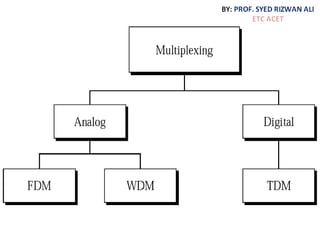
MULTIPLEXING AND SPREADING
Efficiency can be achieved by
Multiplexing
Privacy and Antijamming can be
achieved by Spreading
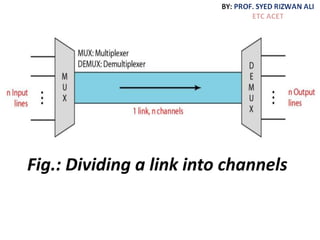
MULTIPLEXING
Fig.: Dividing a link into channels
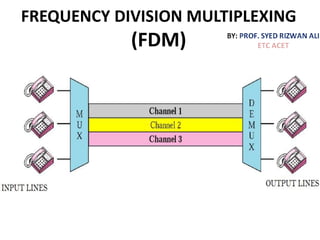
FREQUENCY DIVISION MULTIPLEXING
(FDM)
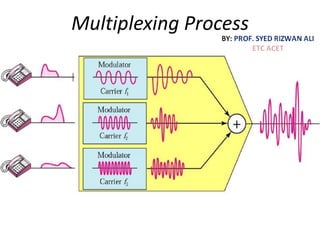
Multiplexing Process
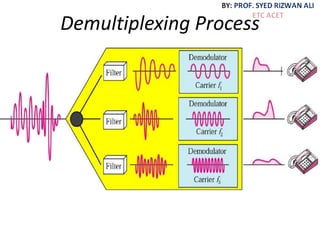
Demultiplexing Process
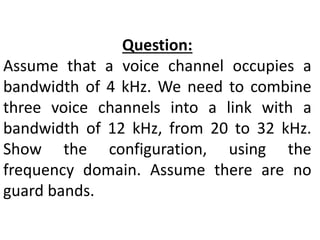
Question:
Assume that a voice channel occupies a
bandwidth of 4 kHz. We need to combine
three voice channels into a link with a
bandwidth of 12 kHz, from 20 to 32 kHz.
Show the configuration, using the
frequency domain. Assume there are no
guard bands.
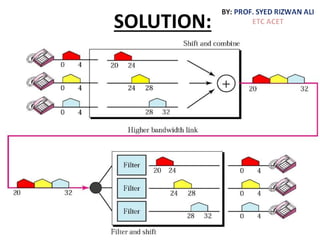
SOLUTION:
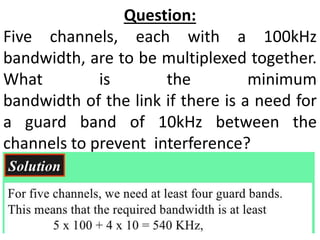
Question:
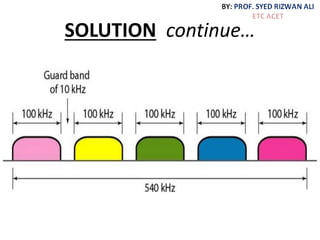
Five channels, each with a 100kHz
bandwidth, are to be multiplexed together.
What is the minimum
bandwidth of the link if there is a need for
a guard band of 10kHz between the
channels to prevent interference?
SOLUTION continue…
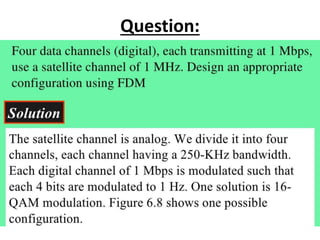
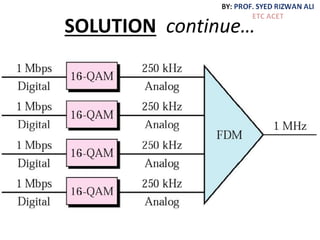
Question:
SOLUTION continue…
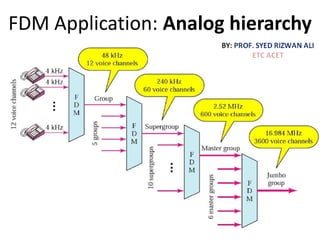
FDM Application: Analog hierarchy
Other Application of FDM
A special band from 530 to 1700 kHz is assigned to AM radio. each AM station needs
10kHz of bandwidth. Each station uses a different carrier frequency, which means it is
shifting its signal and multiplexing. The signal that goes to the air is a combination of
signals. A receiver receives all these signals, but filters (by tuning) only the one which
is desired. Without multiplexing, only one AM station could broadcast to the common
link, the air. However, we need to know that there is physical multiplexer or
demultiplexer here.
The situation is similar in FM broadcasting. However, FM has a wider band of 88 to
108 MHz because each station needs a bandwidth of 200 kHz.
Another common use of FDM is in television broadcasting. Each TV channel has its
own bandwidth of 6 MHz.
The first generation of cellular telephones (still in operation) also uses FDM. Each
user is assigned two 30-kHz channels, one for sending voice and the other for
receiving. The voice signal, which has a bandwidth of 3 kHz (from 300 to 3300 Hz), is
modulated by using FM.
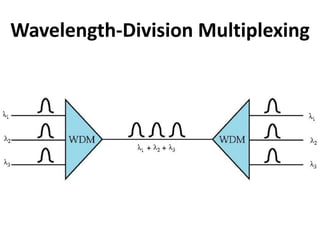
Wavelength-Division Multiplexing
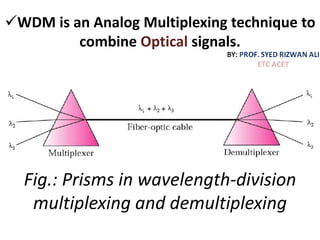
Fig.: Prisms in wavelength-division
multiplexing and demultiplexing
WDM is an Analog Multiplexing technique to
combine Optical signals.
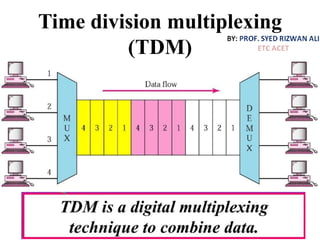
Time division multiplexing
(TDM)
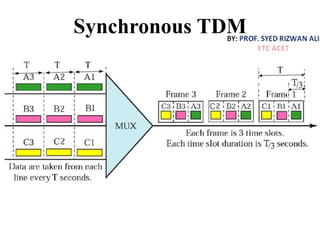
Synchronous TDM
Question:
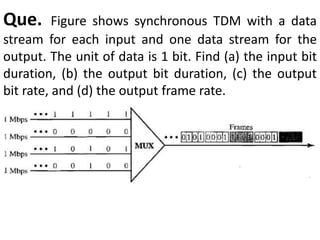
Que. Figure shows synchronous TDM with a data
stream for each input and one data stream for the
output. The unit of data is 1 bit. Find (a) the input bit
duration, (b) the output bit duration, (c) the output
bit rate, and (d) the output frame rate.
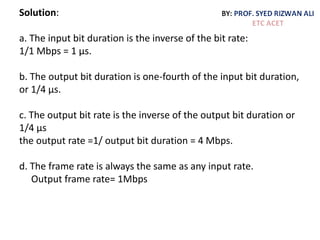
Solution:
a. The input bit duration is the inverse of the bit rate:
1/1 Mbps = 1 µs.
b. The output bit duration is one-fourth of the input bit duration,
or 1/4 µs.
c. The output bit rate is the inverse of the output bit duration or
1/4 µs
the output rate =1/ output bit duration = 4 Mbps.
d. The frame rate is always the same as any input rate.
Output frame rate= 1Mbps
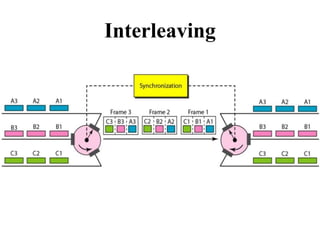
Interleaving
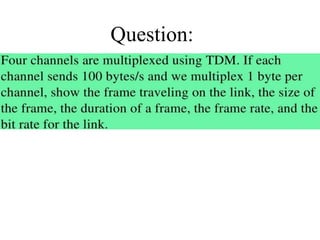
Question:
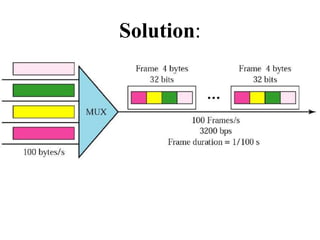
Solution:
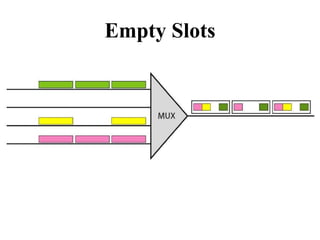
Empty Slots
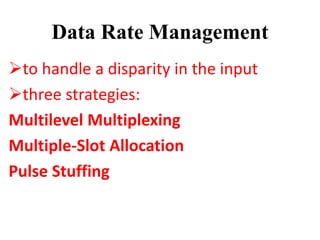
Data Rate Management
to handle a disparity in the input
three strategies:
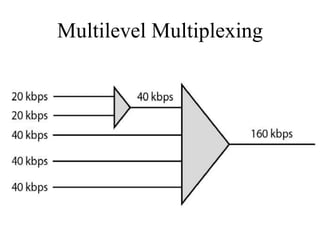
Multilevel Multiplexing
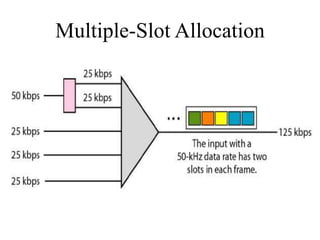
Multiple-Slot Allocation
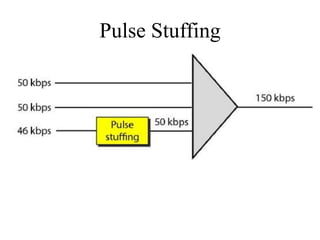
Pulse Stuffing
Multilevel Multiplexing
Multiple-Slot Allocation
Pulse Stuffing
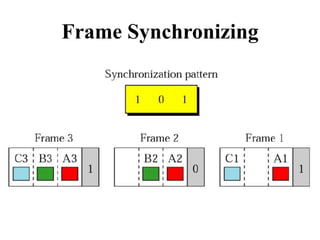
Frame Synchronizing
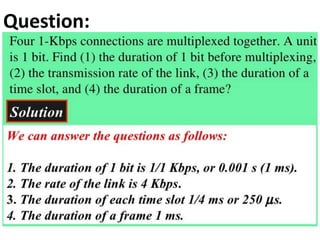
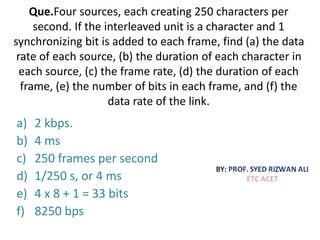
Que.Four sources, each creating 250 characters per
second. If the interleaved unit is a character and 1
synchronizing bit is added to each frame, find (a) the data
rate of each source, (b) the duration of each character in
each source, (c) the frame rate, (d) the duration of each
frame, (e) the number of bits in each frame, and (f) the
data rate of the link.
a) 2 kbps.
b) 4 ms
c) 250 frames per second
d) 1/250 s, or 4 ms
e) 4 x 8 + 1 = 33 bits
f) 8250 bps
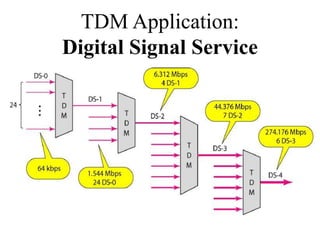
TDM Application:
Digital Signal Service
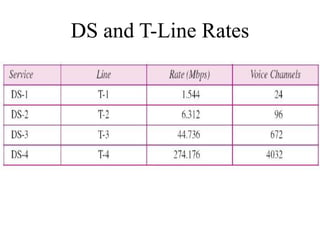
DS and T-Line Rates
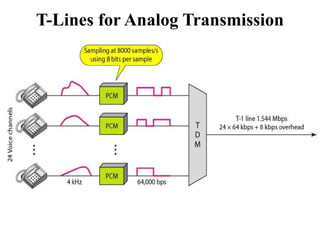
T-Lines for Analog Transmission
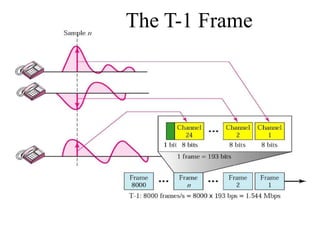
The T-1 Frame
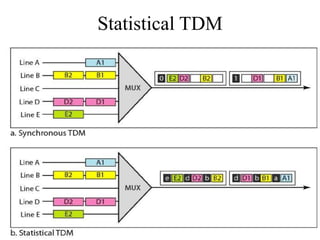
Statistical TDM
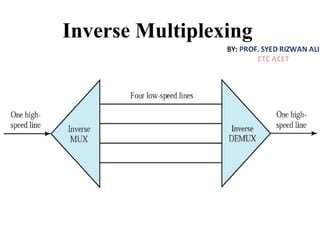
Inverse Multiplexing
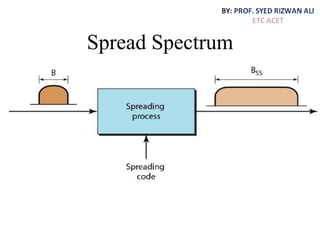
Spread Spectrum
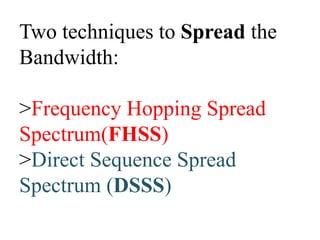
Two techniques to Spread the
Bandwidth:
>Frequency Hopping Spread
Spectrum(FHSS)
>Direct Sequence Spread
Spectrum (DSSS)
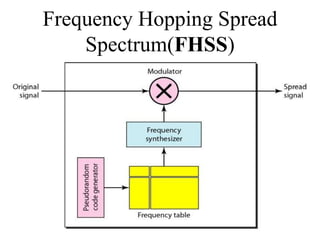
Frequency Hopping Spread
Spectrum(FHSS)
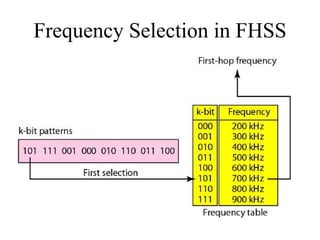
Frequency Selection in FHSS
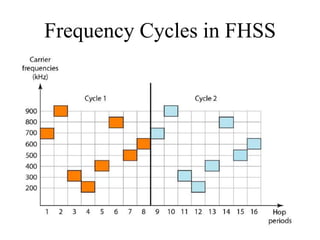
Frequency Cycles in FHSS
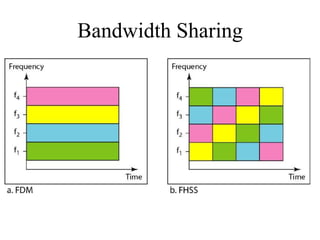
Bandwidth Sharing
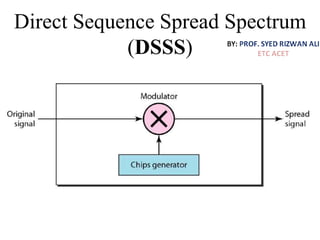
Direct Sequence Spread Spectrum
(DSSS)
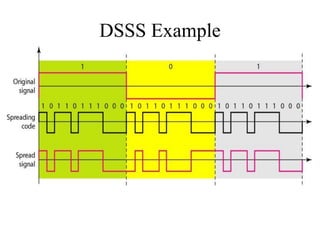
DSSS Example
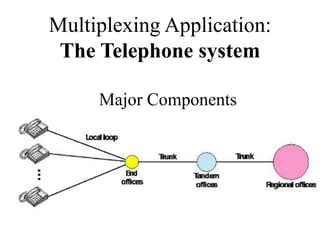
Major Components
Multiplexing Application:
The Telephone system
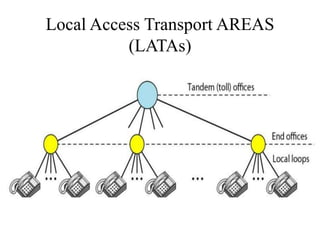
Local Access Transport AREAS
(LATAs)
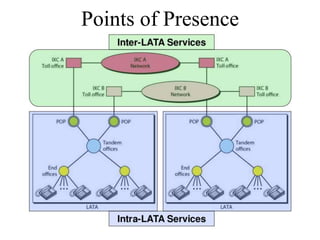
Points of Presence
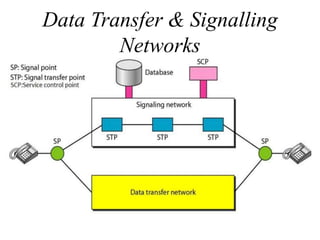
Data Transfer & Signalling
Networks
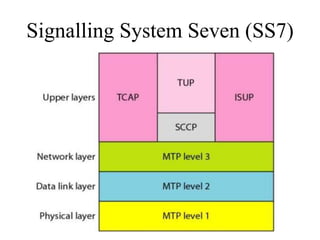
Signalling System Seven (SS7)
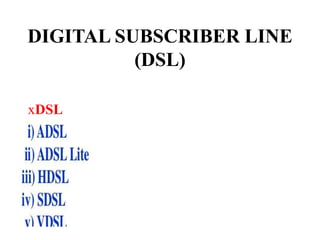
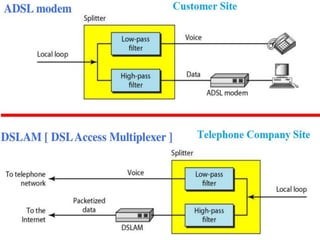
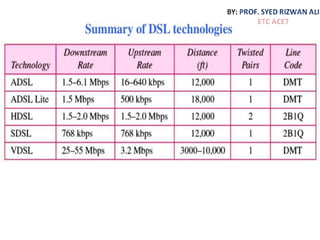
DIGITAL SUBSCRIBER LINE
(DSL)
xDSL
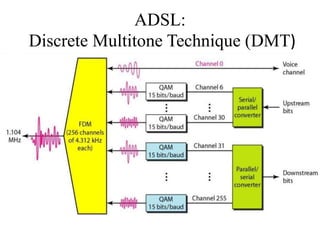
ADSL:
Discrete Multitone Technique (DMT)
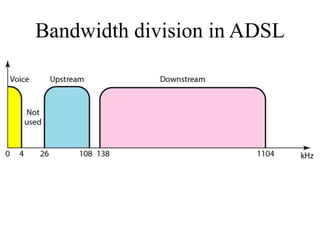
Bandwidth division in ADSL
Unit 4 bandwidth utilization

Unit 4 bandwidth utilization