
Submitted by
MURTADHA ALI NSAIF SHUKUR
(M.Tech (ECE))
Second semester (1ST year)
WDM(Wavelength-Division Multiplexing)
 WDM is based on a well-known concept called frequency

division multiplexing or FDM. With this technology, the
bandwidth of a channel (its frequency domain) is divided
into multiple channels, and each channel occupies a part
of the larger frequency spectrum. In WDM networks, each
channel is called a wavelength. This name is used because
each channel operates at a different frequency and at a
different optical wavelength (and the higher the
frequency, the shorter the signal's wavelength)
Con.WDM
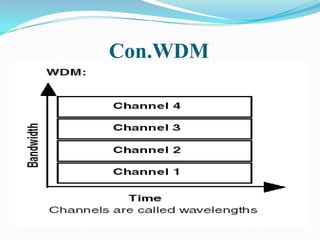
 The wavelengths on the fiber are separated by unused

spectrum. This practice keeps the wavelengths separated
from each other and helps prevent their interfering with
each other. This idea is called channel spacing, or simply
spacing. It is similar to the idea of guardbands used in
electrical systems. In Figure below, the small gaps
between each channel represent the spacing. The relation
between frequency and wavelength is ( c = ƛ*f)
Mean
ƛ c f when increasing (ƛ) performance
decreasing (f) and vice versa .
Con.WDM
(TDMA) Time Division Multiple Access
 Time division multiplexing (TDM) provides a user the

full channel capacity but divides the channel usage
into time slots. Each user is given a slot and the slots
are rotated among the users. A pure TDM system
cyclically scans the input signals (incoming traffic)
from the multiple incoming data sources
(communications links, for example). Bits, bytes, or
blocks of data are separated and interleaved together
into slots on a single high-speed communications line.
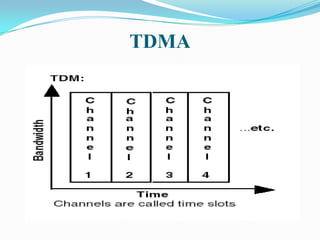
TDMA
Combining WDM and TDM
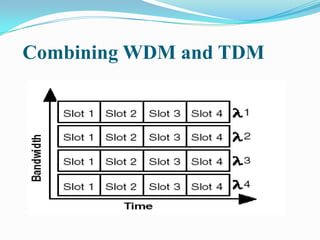
 Most optical networks (or, for that matter, most

networks in general) use a combination of WDM and
TDM by time-division multiplexing fixed slots onto a
specific wavelength, as shown in Figure below. This
concept is quite valuable because it allows multiple
users to share one WDM wavelength's capacity. With
some exceptions, the capacity of one wavelength
exceeds an individual user's traffic capacity needs.
Combining WDM and TDM
THANK YOU

Introduction to WDM and TDM

  • 1.
    Submitted by MURTADHA ALINSAIF SHUKUR (M.Tech (ECE)) Second semester (1ST year)
  • 2.
    WDM(Wavelength-Division Multiplexing)  WDMis based on a well-known concept called frequency division multiplexing or FDM. With this technology, the bandwidth of a channel (its frequency domain) is divided into multiple channels, and each channel occupies a part of the larger frequency spectrum. In WDM networks, each channel is called a wavelength. This name is used because each channel operates at a different frequency and at a different optical wavelength (and the higher the frequency, the shorter the signal's wavelength)
  • 3.
    Con.WDM  The wavelengthson the fiber are separated by unused spectrum. This practice keeps the wavelengths separated from each other and helps prevent their interfering with each other. This idea is called channel spacing, or simply spacing. It is similar to the idea of guardbands used in electrical systems. In Figure below, the small gaps between each channel represent the spacing. The relation between frequency and wavelength is ( c = ƛ*f) Mean ƛ c f when increasing (ƛ) performance decreasing (f) and vice versa .
  • 4.
  • 5.
    (TDMA) Time DivisionMultiple Access  Time division multiplexing (TDM) provides a user the full channel capacity but divides the channel usage into time slots. Each user is given a slot and the slots are rotated among the users. A pure TDM system cyclically scans the input signals (incoming traffic) from the multiple incoming data sources (communications links, for example). Bits, bytes, or blocks of data are separated and interleaved together into slots on a single high-speed communications line.
  • 6.
  • 7.
    Combining WDM andTDM  Most optical networks (or, for that matter, most networks in general) use a combination of WDM and TDM by time-division multiplexing fixed slots onto a specific wavelength, as shown in Figure below. This concept is quite valuable because it allows multiple users to share one WDM wavelength's capacity. With some exceptions, the capacity of one wavelength exceeds an individual user's traffic capacity needs.
  • 8.
  • 9.