Presented by:
Ali Ahmad Farooq
INTRODUCTION
 Under the simplest conditions, a medium can carry
only one signal at any moment in time
 If we try to pass multiple signals through a common
medium , they will possibly interfere with each other.
 When two or more signals with same frequency pass at
the same time through a common medium the
interference phenomena occurs
INTRODUCTION
 This means we have to devise a way to avoid the
interference of the signals
 Which means that multiple signals
i. Should have different frequency
ii. Must not travel at same time
iii. Must not travel through same medium
 For multiple signals to share a medium , the medium must
somehow be divided , so that each signal receives a portion
of the total bandwidth.
Need for MULTIPLEXING
 Transmission services are very expensive (leased lines ,
packet switched networks)
 Multiplexing and compression techniques save the
business money
 As the data capacity of line increases , it will become
more cost effective for a company
 Most data services require modest data rate support
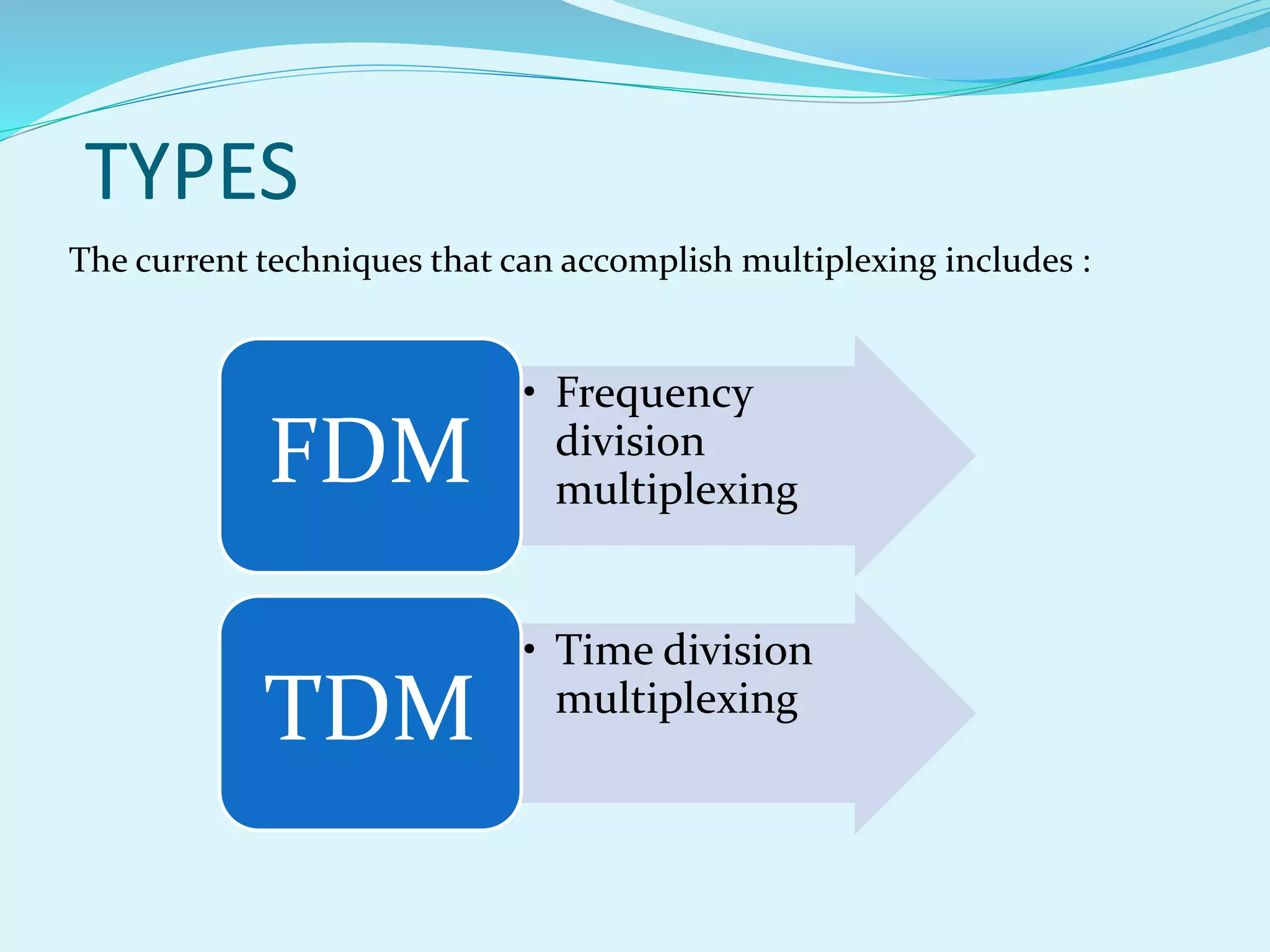
TYPES
The current techniques that can accomplish multiplexing includes :
• Frequency
division
multiplexingFDM
• Time division
multiplexing
TDM
MULTIPLEXING
 Multiplexing is nothing but sharing of medium
Multiplexor (MUX)
De-multiplexor(DEMUX)
Sometimes just called a MUX
Simple block diagram of Mux-Demux pair
Frequency Division Multiplexing
 Frequency spectrum is divided among multiple
logical channels
 Each user can have access to its own assigned
frequencies or logical channels at all the time that the
individual user is active
Frequency division multiplexing
Logic diagram
f1= Lowest frequency
of the band
f6= Highest frequency
of the band
fn= subcarrier frequency
Frequency division multiplexing
 Sends the signal in several distinct frequency ranges
 Each signal is modulated on the different carrier
frequency which are separated by guard bands
 The bandwidth of the transmission medium must
exceed the required bandwidth of all signals
Frequency division multiplexing
 Used in cable TV to carry multiple video channels on a
single cable network
 Broadcast radio and TV and the AMPS cellular phone
systems use FDM
 Since it involves analog signaling , it is more
susceptible to noise
 This is the oldest technique of multiplexing
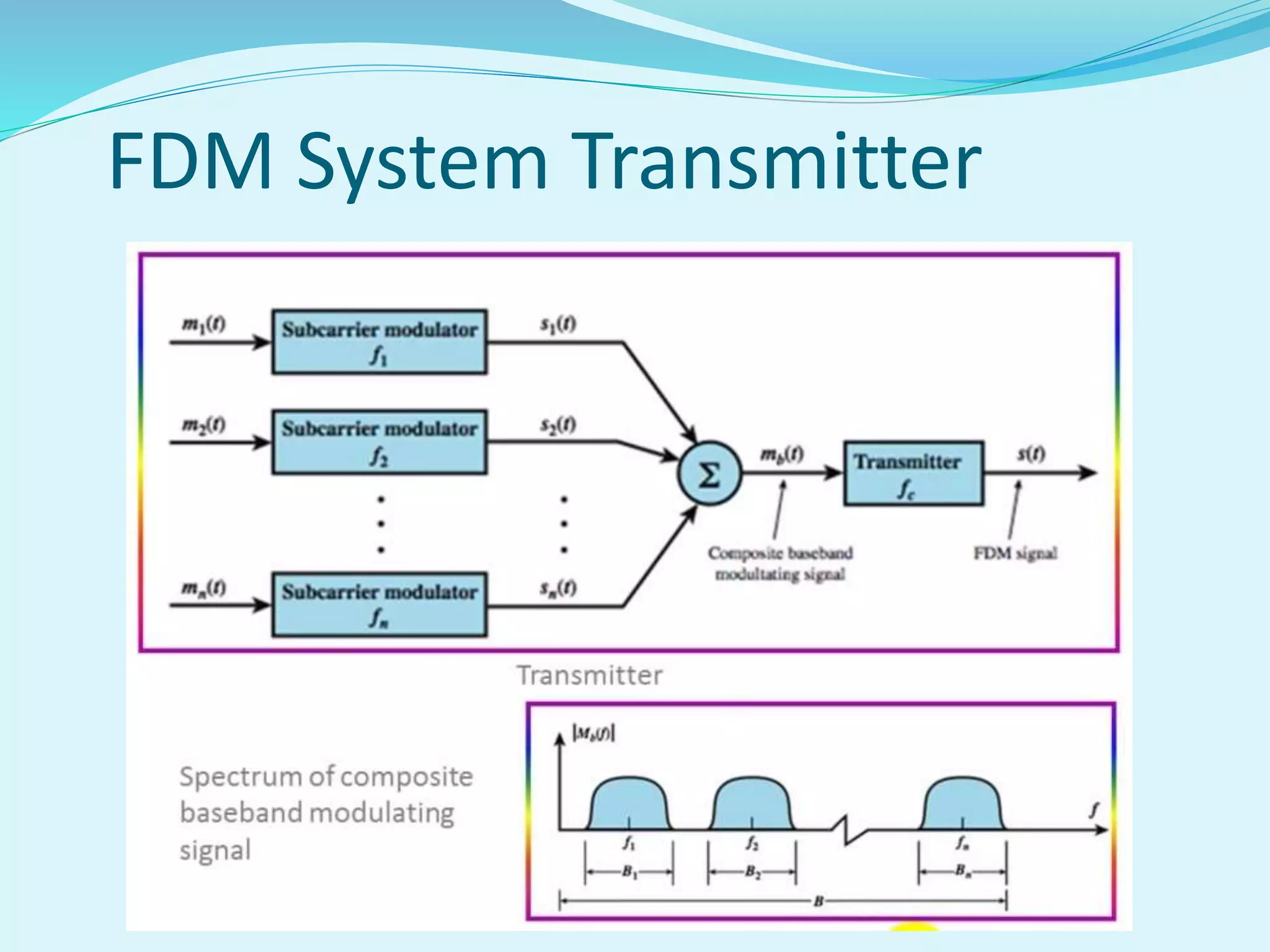
FDM System Transmitter
 In FDM each user is assigned non-overlapping
frequency ranges so that multiple signals can be
transmitted at the same time
 Multiple message signals {m1(t), m2(t)…mn(t)} from
multiple sources are modulated over different
subcarrier frequencies (f1,f2…fn) and send them to an
adder
 Now this composite signal (Adder output) is
modulated over carrier frequency (fc) and transmitted
over channel
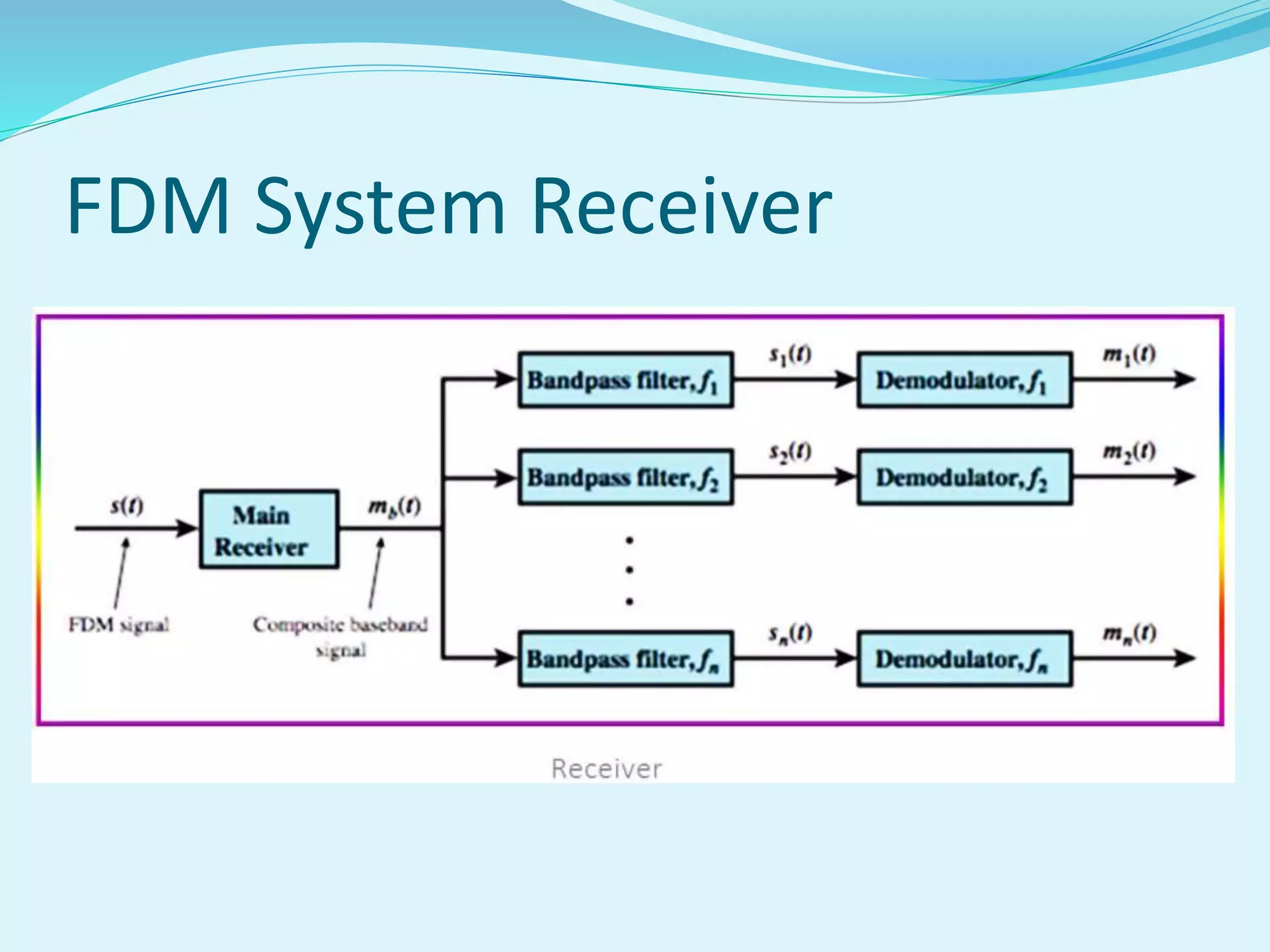
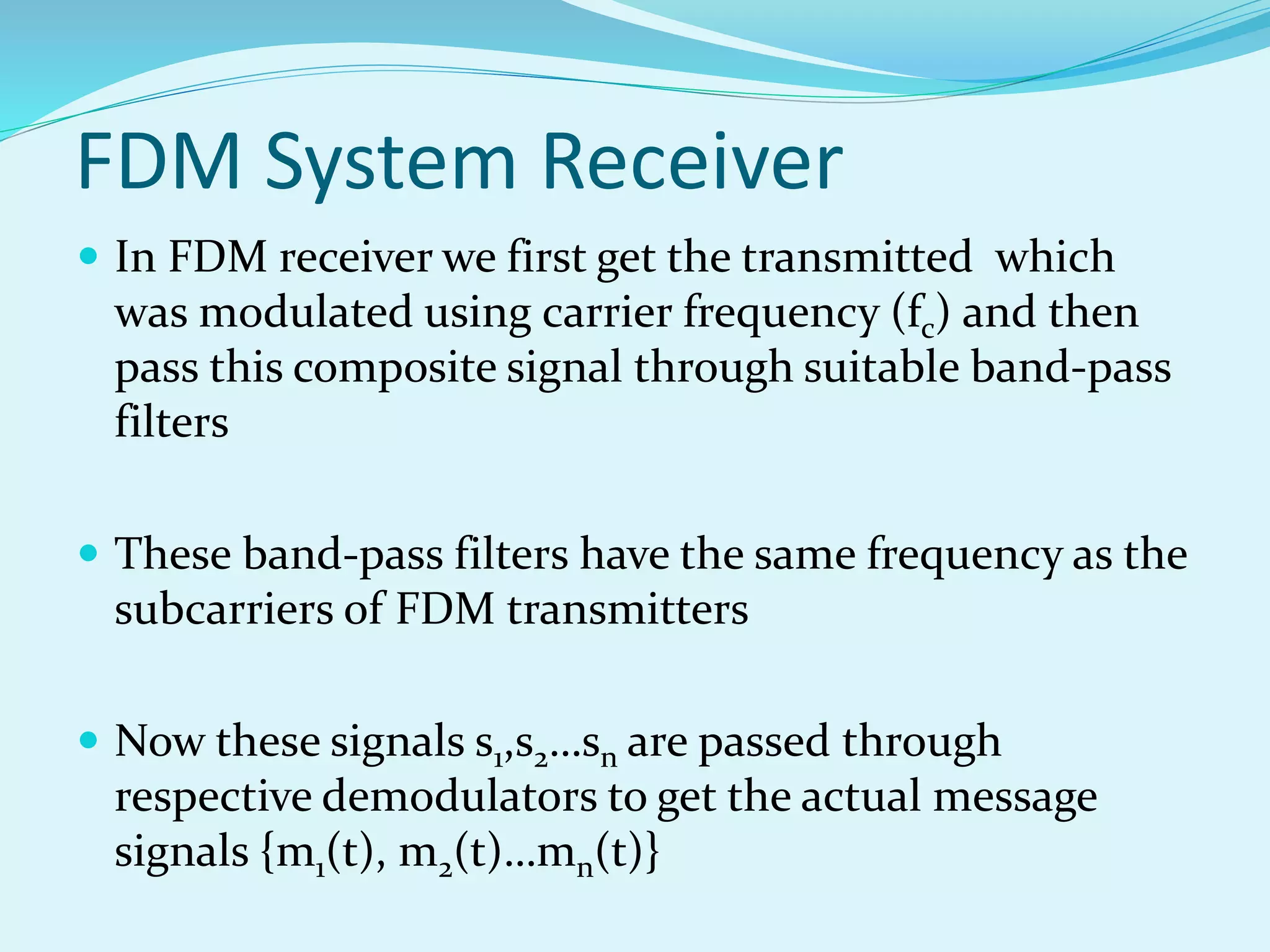
FDM System Receiver
FDM System Receiver
 In FDM receiver we first get the transmitted which
was modulated using carrier frequency (fc) and then
pass this composite signal through suitable band-pass
filters
 These band-pass filters have the same frequency as the
subcarriers of FDM transmitters
 Now these signals s1,s2…sn are passed through
respective demodulators to get the actual message
signals {m1(t), m2(t)…mn(t)}
Disadvantages of FDM
 The problem with FDM is that it cannot utilize the full
capacity of the system
 We need to ensure that the adjacent bands do not
overlap each other , otherwise the signal in one band
may interfere the signal in other band
 Although system has the capacity still in some cases
the channel cannot pass the actual signal
TIME DIVISION MULTIPLEXING
 In Time division multiplexing the time is divided into
multiple smaller units called slots and each user is
given a slot to transmit the signal
 Each user has the entire bandwidth of the channel for
a short interval of time
TIME DIVISION MULTIPLEXING
Logic diagram
TIME DIVISION MULTIPLEXING
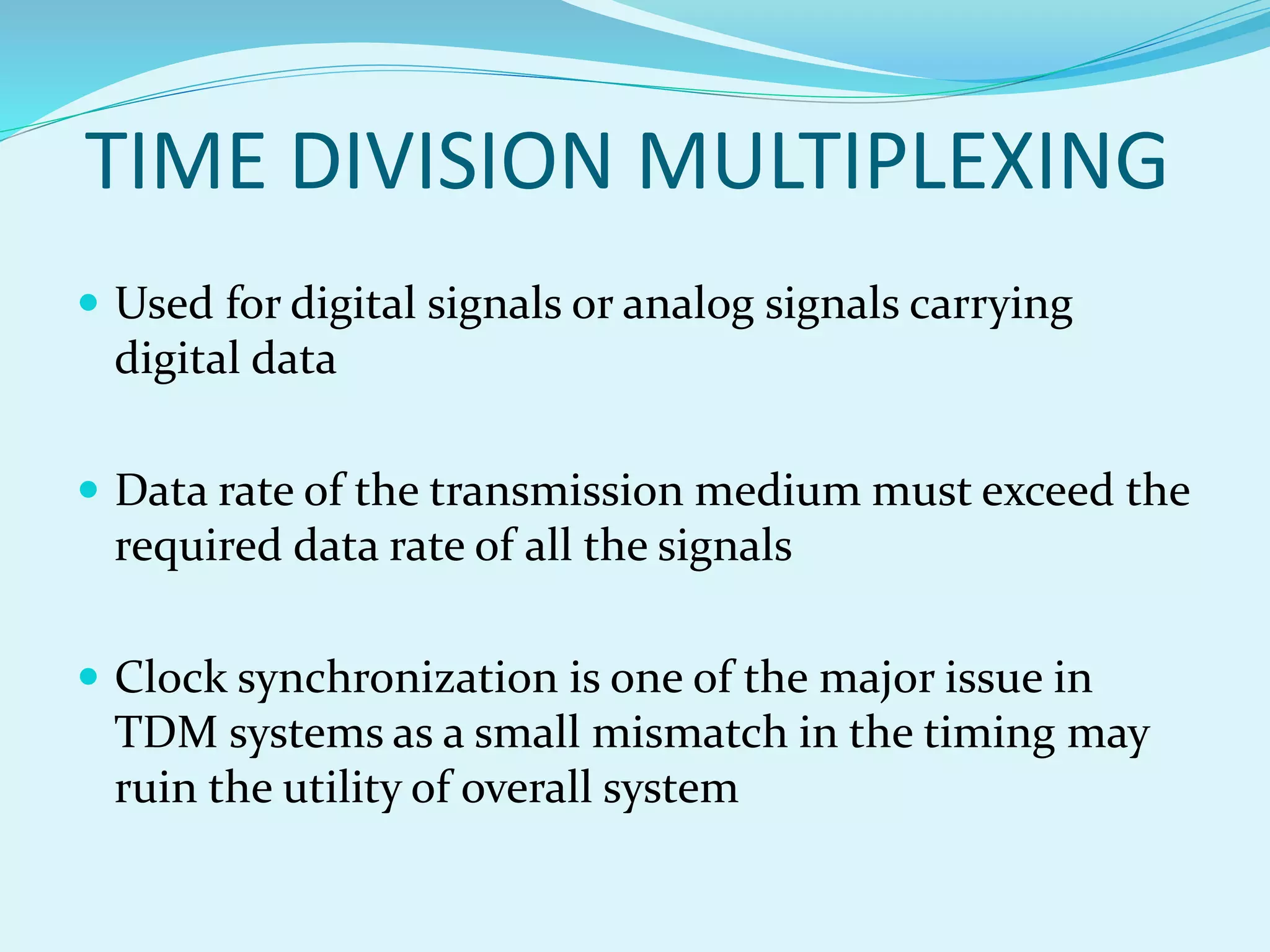
 Used for digital signals or analog signals carrying
digital data
 Data rate of the transmission medium must exceed the
required data rate of all the signals
 Clock synchronization is one of the major issue in
TDM systems as a small mismatch in the timing may
ruin the utility of overall system
Synchronous TDM
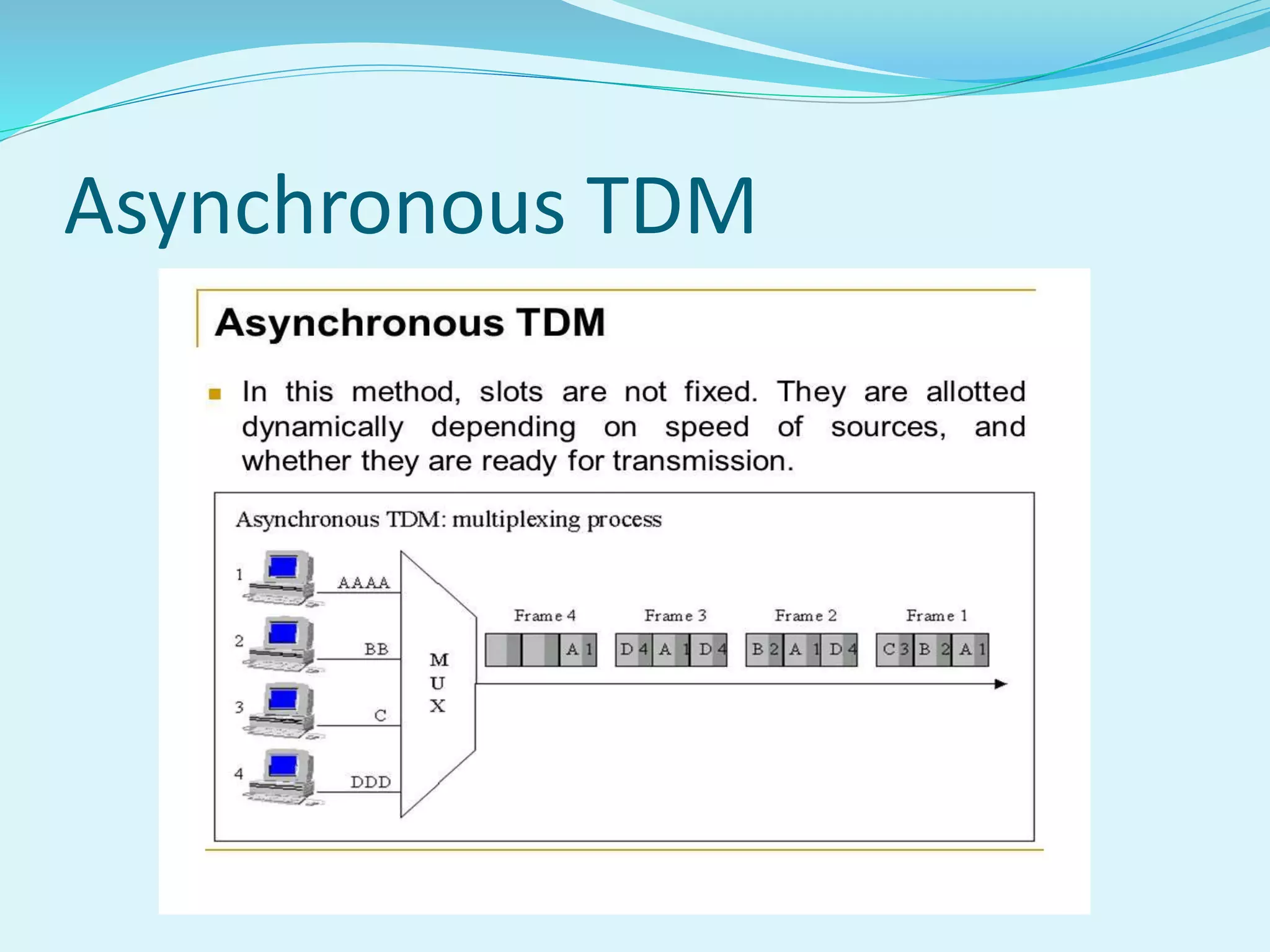
Asynchronous TDM

Multiplexing FDM and TDM

  • 1.
  • 2.
    INTRODUCTION  Under thesimplest conditions, a medium can carry only one signal at any moment in time  If we try to pass multiple signals through a common medium , they will possibly interfere with each other.  When two or more signals with same frequency pass at the same time through a common medium the interference phenomena occurs
  • 3.
    INTRODUCTION  This meanswe have to devise a way to avoid the interference of the signals  Which means that multiple signals i. Should have different frequency ii. Must not travel at same time iii. Must not travel through same medium  For multiple signals to share a medium , the medium must somehow be divided , so that each signal receives a portion of the total bandwidth.
  • 4.
    Need for MULTIPLEXING Transmission services are very expensive (leased lines , packet switched networks)  Multiplexing and compression techniques save the business money  As the data capacity of line increases , it will become more cost effective for a company  Most data services require modest data rate support
  • 5.
    TYPES The current techniquesthat can accomplish multiplexing includes : • Frequency division multiplexingFDM • Time division multiplexing TDM
  • 6.
    MULTIPLEXING  Multiplexing isnothing but sharing of medium Multiplexor (MUX) De-multiplexor(DEMUX) Sometimes just called a MUX Simple block diagram of Mux-Demux pair
  • 7.
    Frequency Division Multiplexing Frequency spectrum is divided among multiple logical channels  Each user can have access to its own assigned frequencies or logical channels at all the time that the individual user is active
  • 8.
    Frequency division multiplexing Logicdiagram f1= Lowest frequency of the band f6= Highest frequency of the band fn= subcarrier frequency
  • 9.
    Frequency division multiplexing Sends the signal in several distinct frequency ranges  Each signal is modulated on the different carrier frequency which are separated by guard bands  The bandwidth of the transmission medium must exceed the required bandwidth of all signals
  • 10.
    Frequency division multiplexing Used in cable TV to carry multiple video channels on a single cable network  Broadcast radio and TV and the AMPS cellular phone systems use FDM  Since it involves analog signaling , it is more susceptible to noise  This is the oldest technique of multiplexing
  • 11.
  • 12.
    FDM System Transmitter In FDM each user is assigned non-overlapping frequency ranges so that multiple signals can be transmitted at the same time  Multiple message signals {m1(t), m2(t)…mn(t)} from multiple sources are modulated over different subcarrier frequencies (f1,f2…fn) and send them to an adder  Now this composite signal (Adder output) is modulated over carrier frequency (fc) and transmitted over channel
  • 13.
  • 14.
    FDM System Receiver In FDM receiver we first get the transmitted which was modulated using carrier frequency (fc) and then pass this composite signal through suitable band-pass filters  These band-pass filters have the same frequency as the subcarriers of FDM transmitters  Now these signals s1,s2…sn are passed through respective demodulators to get the actual message signals {m1(t), m2(t)…mn(t)}
  • 15.
    Disadvantages of FDM The problem with FDM is that it cannot utilize the full capacity of the system  We need to ensure that the adjacent bands do not overlap each other , otherwise the signal in one band may interfere the signal in other band  Although system has the capacity still in some cases the channel cannot pass the actual signal
  • 16.
    TIME DIVISION MULTIPLEXING In Time division multiplexing the time is divided into multiple smaller units called slots and each user is given a slot to transmit the signal  Each user has the entire bandwidth of the channel for a short interval of time
  • 17.
  • 18.
    TIME DIVISION MULTIPLEXING Used for digital signals or analog signals carrying digital data  Data rate of the transmission medium must exceed the required data rate of all the signals  Clock synchronization is one of the major issue in TDM systems as a small mismatch in the timing may ruin the utility of overall system
  • 19.
  • 20.