Lecture 12 Enzyme regulation
What Factors Influence Enzymatic 
Activity? 
• Two of the more obvious ways to regulate 
the amount of activity are 
1. To increase or decrease the number of 
enzyme molecule (enzyme level) 
2. To increase or decrease the activity of each 
enzyme molecule (enzyme activity)
• A general overview of factors influencing 
enzyme activity includes the following 
considerations 
1. Rate depends on substrate availability 
2. Rate slows as product accumulates 
3. Allosteric effectors may be important 
4. Enzymes can be modified covalently 
5. Genetic controls (transcription regulation) - 
induction and repression (enzyme level) 
6. Zymogens, isozymes and modulator proteins 
may play a role
• A general overview of factors influencing 
enzyme activity includes the following 
considerations 
1. Rate depends on substrate availability 
2. Rate slows as product accumulates 
3. Allosteric effectors may be important 
4. Enzymes can be modified covalently 
5. Genetic controls (transcription regulation) - 
induction and repression (enzyme level) 
6. Zymogens, isozymes and modulator proteins 
may play a role
Non-covalent Interactions 
Substrate availability 
• Non-regulatory enzymes generally exhibit 
hyperbolic kinetics (Michaelis-Menton) 
• At low substrate concentration, reaction rate 
proportional to substrate concentration 
• Regulatory enzymes generally exhibit 
sigmoidal kinetics (positive cooperativity) 
• Changes of substrate concentrations at normal 
physiological levels greatly alter reaction rate
• Regulatory enzymes are usually the 
enzymes that are the rate-limiting step, in 
a pathway, meaning that after this step a 
particular reaction pathway will go to 
completion
• A general overview of factors influencing 
enzyme activity includes the following 
considerations 
1. Rate depends on substrate availability 
2. Rate slows as product accumulates 
3. Allosteric effectors may be important 
4. Enzymes can be modified covalently 
5. Genetic controls (transcription regulation) - 
induction and repression (enzyme level) 
6. Zymogens, isozymes and modulator proteins 
may play a role
Non-covalent Interactions 
Allosteric Regulation 
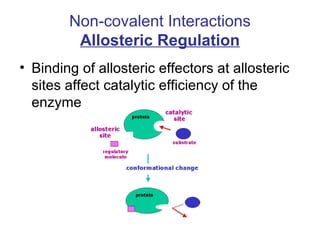
• Binding of allosteric effectors at allosteric 
sites affect catalytic efficiency of the 
enzyme
Non-covalent Interactions 
Allosteric Regulation 
• Allosteric Activators 
– Decrease Km (increases the enzyme 
binding affinity) 
– Increases Vmax (increases the enzyme 
catalytic efficiency)
Non-covalent Interactions 
Allosteric Regulation 
• Allosteric Inhibitors 
– Increases Km (decreases enzyme binding 
affinity) 
– Decreases Vmax (decreases enzyme catalytic 
efficiency)
Molecules that act as allosteric effectors 
• End products of pathways 
– Feedback inhibition 
• Substrates of pathways 
– Feed-forward activators 
• Indicators of Energy Status 
– ATP/ADP/AMP 
– NAD/NADH 
– Citrate & acetyl CoA
Allosteric Example 
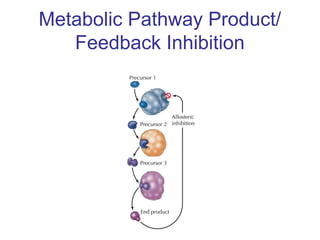
• Feedback Inhibition - This occurs 
when an end-product of a pathway 
accumulates as the metabolic demand 
for it declines. 
• This end-product in turn binds to the 
regulatory enzyme at the start of the 
pathway and decreases its activity - the 
greater the end-product levels the 
greater the inhibition of enzyme activity.
Metabolic Pathway Product/ 
Feedback Inhibition
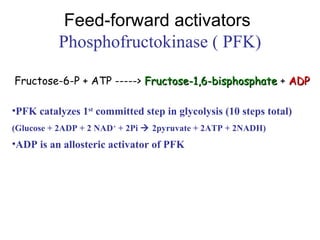
Feed-forward activators 
Phosphofructokinase ( PFK) 
Fructose-6-P + ATP -----> FFrruuccttoossee--11,,66--bbiisspphhoosspphhaattee + AADDPP 
•PFK catalyzes 1st committed step in glycolysis (10 steps total) 
(Glucose + 2ADP + 2 NAD+ + 2Pi  2pyruvate + 2ATP + 2NADH) 
•ADP is an allosteric activator of PFK
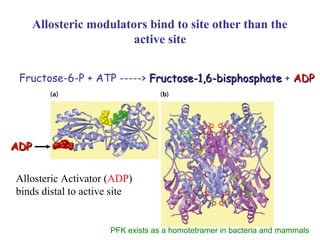
Allosteric modulators bind to site other than the 
active site 
Fructose-6-P + ATP -----> FFrruuccttoossee--11,,66--bbiisspphhoosspphhaattee + AADDPP 
AADDPP 
Allosteric Activator (ADP) 
binds distal to active site 
PFK exists as a homotetramer in bacteria and mammals
Vo vs [S] plots give sigmoidal curve 
for at least one substrate 
Activator can shift hyperbolic (as if there were no T state) 
Binding of this allosteric inhibitor or this activator does not 
effect Vmax, but does alter Km 
Allosteric enzyme do not follow M-M kinetics
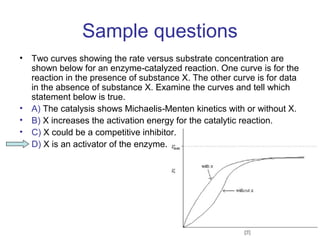
Sample questions 
• Two curves showing the rate versus substrate concentration are 
shown below for an enzyme catalyzed reaction. One ‐ curve is for the 
reaction in the presence of substance X. The other curve is for data 
in the absence of substance X. Examine the curves and tell which 
statement below is true. 
• A) The catalysis shows Michaelis‐Menten kinetics with or without X. 
• B) X increases the activation energy for the catalytic reaction. 
• C) X could be a competitive inhibitor. 
• D) X is an activator of the enzyme.
Sample questions 
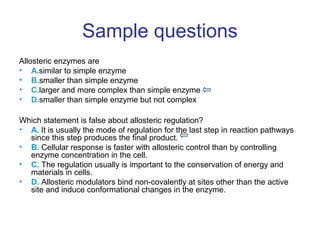
Allosteric enzymes are 
• A.similar to simple enzyme 
• B.smaller than simple enzyme 
• C.larger and more complex than simple enzyme 
• D.smaller than simple enzyme but not complex 
Which statement is false about allosteric regulation? 
• A. It is usually the mode of regulation for the last step in reaction pathways 
since this step produces the final product. 
• B. Cellular response is faster with allosteric control than by controlling 
enzyme concentration in the cell. 
• C. The regulation usually is important to the conservation of energy and 
materials in cells. 
• D. Allosteric modulators bind non-covalently at sites other than the active 
site and induce conformational changes in the enzyme.
Sample questions 
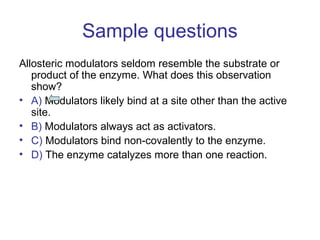
Allosteric modulators seldom resemble the substrate or 
product of the enzyme. What does this observation 
show? 
• A) Modulators likely bind at a site other than the active 
site. 
• B) Modulators always act as activators. 
• C) Modulators bind non-covalently to the enzyme. 
• D) The enzyme catalyzes more than one reaction.
Sample questions 
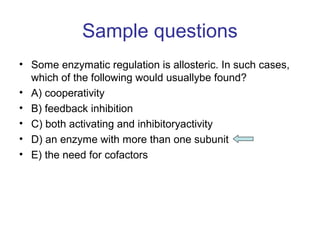
• Some enzymatic regulation is allosteric. In such cases, 
which of the following would usuallybe found? 
• A) cooperativity 
• B) feedback inhibition 
• C) both activating and inhibitoryactivity 
• D) an enzyme with more than one subunit 
• E) the need for cofactors
Sample questions 
• Describe allosteric regulation of 
enzyme activity? 
An allosteric enzyme is one in which the activity of the enzyme can be 
controlled by the binding of a molecule to the “allosteric site”, somewhere 
other than the active site. Thus allosteric control of an enzyme can be 
classed in two ways. A positive allosteric regulation is the binding of a 
molecule to the enzyme which increase the rate of reaction. The opposite is 
a negative allosteric regulation. An example for this is phosphofructokinase, 
which is promoted by a high AMP concentration, and inhibited by a high ATP 
concentration.
Non-covalent Interactions 
Protein-Protein Interactions 
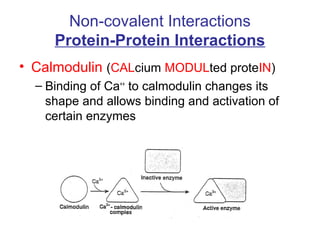
• Calmodulin (CALcium MODULted proteIN) 
– Binding of Ca++ to calmodulin changes its 
shape and allows binding and activation of 
certain enzymes
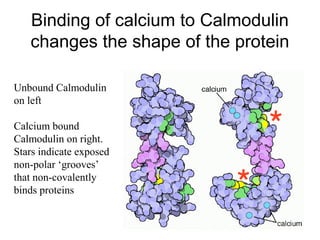
Binding of calcium to Calmodulin 
changes the shape of the protein 
Unbound Calmodulin 
on left 
Calcium bound 
Calmodulin on right. 
Stars indicate exposed 
non-polar ‘grooves’ 
that non-covalently 
binds proteins
Calmodulin 
• Extracellular [Ca] = 5 mM 
• Intracellular [Ca] = 10-4 mM 
– Bound Ca can be released by hormonal 
action, nerve innervation, light, …. 
– Released Ca binds to Calmodulin which 
activates a large number of proteins
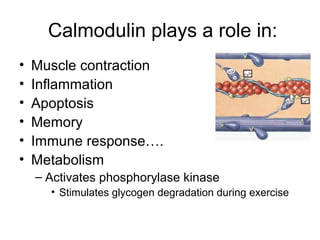
Calmodulin plays a role in: 
• Muscle contraction 
• Inflammation 
• Apoptosis 
• Memory 
• Immune response…. 
• Metabolism 
– Activates phosphorylase kinase 
• Stimulates glycogen degradation during exercise
• A general overview of factors influencing 
enzyme activity includes the following 
considerations 
1. Rate depends on substrate availability 
2. Rate slows as product accumulates 
3. Allosteric effectors may be important 
4. Enzymes can be modified covalently 
5. Genetic controls (transcription regulation) - 
induction and repression (enzyme level) 
6. Zymogens, isozymes and modulator proteins 
may play a role
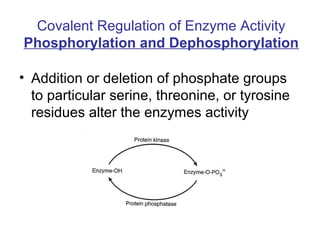
Covalent Regulation of Enzyme Activity 
Phosphorylation and Dephosphorylation 
• Addition or deletion of phosphate groups 
to particular serine, threonine, or tyrosine 
residues alter the enzymes activity
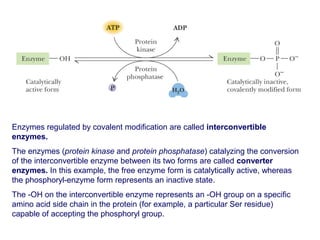
Enzymes regulated by covalent modification are called interconvertible 
enzymes. 
The enzymes (protein kinase and protein phosphatase) catalyzing the conversion 
of the interconvertible enzyme between its two forms are called converter 
enzymes. In this example, the free enzyme form is catalytically active, whereas 
the phosphoryl-enzyme form represents an inactive state. 
The -OH on the interconvertible enzyme represents an -OH group on a specific 
amino acid side chain in the protein (for example, a particular Ser residue) 
capable of accepting the phosphoryl group.
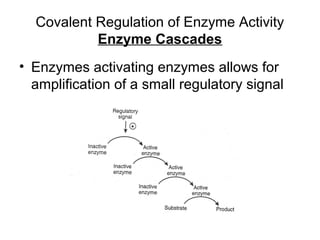
Covalent Regulation of Enzyme Activity 
Enzyme Cascades 
• Enzymes activating enzymes allows for 
amplification of a small regulatory signal
Sample questions 
• Which statement is false about covalent modification? 
• A) It is reversible. 
• B) It is slower than allosteric regulation. 
• C) It is irreversible. 
• D) Phosphorylation is a common covalent modification.
Sample questions 
Protein kinases are enzymes that act on other enzymes by 
adding phosphates groups. When the enzyme is 
phosphorylated, it changes its activity (it becomes more 
or less active, depending on the enzyme). This 
regulatory mechanism of enzymatic activity is called: 
• A) Allosteric Control 
• B) Competitive inhibition 
• C) Covalent Modification 
• D) Isozymes Modification 
• E) Zymogen activation
• A general overview of factors influencing 
enzyme activity includes the following 
considerations 
1. Rate depends on substrate availability 
2. Rate slows as product accumulates 
3. Allosteric effectors may be important 
4. Enzymes can be modified covalently 
5. Genetic controls (transcription regulation) - 
induction and repression (enzyme level) 
6. Zymogens, isozymes and modulator proteins 
may play a role
Changes in Enzyme Abundance 
• Inducible vs Constitutive Enzymes 
• Induction is caused by increases in rate of 
gene transcription. 
– Hormones activate transcriptional factors 
• Increase synthesis of specific mRNA 
• Increase synthesis of specific enzymes
Regulation of Enzyme 
Concentrations: Induction 
• Induction (an increase caused by an effecter 
molecule) of enzyme synthesis is a common 
mechanism - this can manifest itself at the level of 
gene expression, RNA translation, and post-translational 
modifications. The actions of many 
hormones and/or growth factors on cells will ultimately 
lead to an increase in the expression and translation 
of "new" enzymes not present prior to the signal.
Regulation of Enzyme 
Concentrations: Degradation 
• The degradation of proteins is constantly 
occurring in the cell. 
• Proteolytic degradation is an irreversible 
mechanism.
Regulation of Enzyme 
Concentrations: Degradation (cont) 
• Protein degradation by proteases is 
compartmentalized in the cell in the lysosome (which 
is generally non-specific), or in macromolecular 
complexes termed proteasomes. 
• Degradation by proteasomes is regulated by a 
complex pathway involving transfer of a 76 aa 
polypeptide, ubiquitin, to targeted proteins. 
Ubiquination of protein targets it for degradation by 
the proteasome. This pathway is highly conserved in 
eukaryotes, but still poorly understood
• A general overview of factors influencing 
enzyme activity includes the following 
considerations 
1. Rate depends on substrate availability 
2. Rate slows as product accumulates 
3. Allosteric effectors may be important 
4. Enzymes can be modified covalently 
5. Genetic controls (transcription regulation) - 
induction and repression (enzyme level) 
6. Zymogens, isozymes and modulator proteins 
may play a role
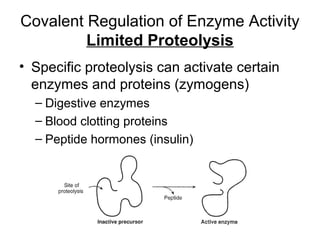
Covalent Regulation of Enzyme Activity 
Limited Proteolysis 
• Specific proteolysis can activate certain 
enzymes and proteins (zymogens) 
– Digestive enzymes 
– Blood clotting proteins 
– Peptide hormones (insulin)
Regulation signaling: 
Hormones, Receptors, and 
Communication Between Cells
• Hormones 
– chemical signals that coordinate metabolism 
• Hormone Receptors 
– Target tissues 
– Specific binding 
– Types 
• Intracellular receptors 
• Cell-surface receptors
Hormones, Receptors, and 
Communication Between Cells 
• Intracellular receptors 
• lipid soluble hormones 
• Steroid hormones, vitamin D, retinoids, 
thyroxine 
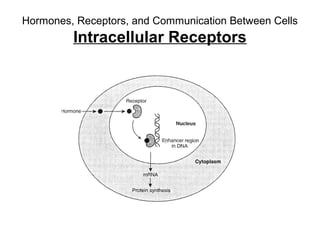
• Bind to intracellular protein receptors 
– This binds to regulatory elements by a gene 
– Alters the rate of gene transcription 
• Induces or represses gene transcription
Hormones, Receptors, and Communication Between Cells 
Intracellular Receptors
Hormones, Receptors, and 
Communication Between Cells 
• Cell-surface receptors 
– Water soluble hormones 
• Peptide hormones (insulin), catecholamines, 
neurotransmitters 
• Three class of cell-surface receptors 
– Ligand-Gated Receptors 
– Catalytic Receptors 
– G Protein-linked Receptors
Cell Surface Receptors 
Ligand-Gated Receptors 
• Binding of a ligand (often a neurotransmitter) 
affects flow of ions in/out of cell 
• Gamma-amino butyric acid (GABA) binds and 
opens chloride channels in the brain 
– Valium (anti-anxiety drug) reduces the amount of GABA 
required to open the chloride channels
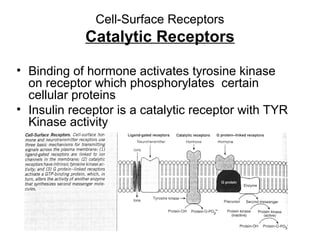
Cell-Surface Receptors 
Catalytic Receptors 
• Binding of hormone activates tyrosine kinase 
on receptor which phosphorylates certain 
cellular proteins 
• Insulin receptor is a catalytic receptor with TYR 
Kinase activity
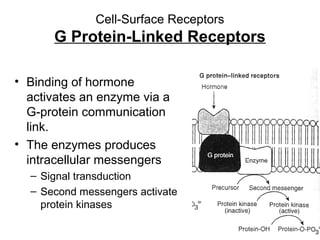
Cell-Surface Receptors 
G Protein-Linked Receptors 
• Binding of hormone 
activates an enzyme via a 
G-protein communication 
link. 
• The enzymes produces 
intracellular messengers 
– Signal transduction 
– Second messengers activate 
protein kinases
Intracellular Messengers: 
Signal Transduction Pathways 
• Cyclic AMP (cAMP) 
• Diacylglycerol (DAG) & Inositol 
Triphosphate (IP3) 
• Cyclic GMP (cGMP)
cAMP is a Second Messenger 
• Cyclic AMP is the intracellular agent of 
extracellular hormones - thus a ‘second 
messenger’ 
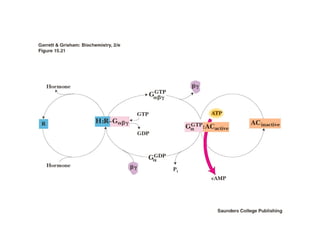
• Hormone binding stimulates a GTP-binding 
protein (G protein), releasing 
Ga(GTP) 
• Binding of Ga(GTP) stimulates adenylyl 
cyclase to make cAMP
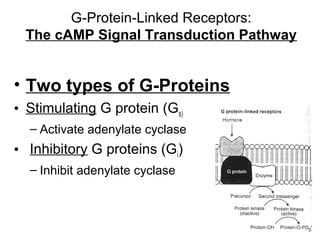
G-Protein-Linked Receptors: 
The cAMP Signal Transduction Pathway 
• Two types of G-Proteins 
• Stimulating G protein (Gs) 
– Activate adenylate cyclase 
• Inhibitory G proteins (Gi) 
– Inhibit adenylate cyclase
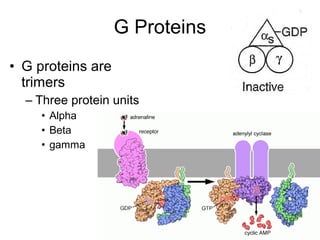
G Proteins 
• G proteins are 
trimers 
– Three protein units 
• Alpha 
• Beta 
• gamma
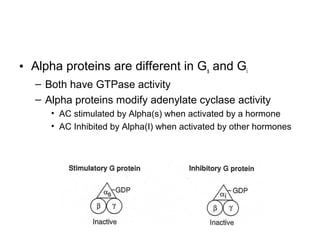
• Alpha proteins are different in Gs and Gi 
– Both have GTPase activity 
– Alpha proteins modify adenylate cyclase activity 
• AC stimulated by Alpha(s) when activated by a hormone 
• AC Inhibited by Alpha(I) when activated by other hormones
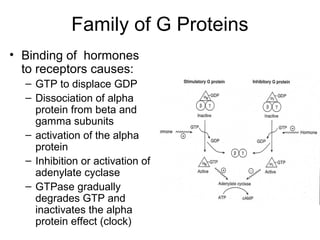
Family of G Proteins 
• Binding of hormones 
to receptors causes: 
– GTP to displace GDP 
– Dissociation of alpha 
protein from beta and 
gamma subunits 
– activation of the alpha 
protein 
– Inhibition or activation of 
adenylate cyclase 
– GTPase gradually 
degrades GTP and 
inactivates the alpha 
protein effect (clock)
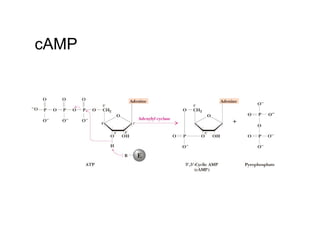
cAMP
The cAMP Signal Transduction 
Pathway 
• cAMP – intracellular messenger 
– Elevated cAMP can either activate or inhibit 
regulatory enzymes 
• cAMP activates glycogen degradation 
• cAMP inhibits glycogen synthesis 
• [cAMP] affected by rates of synthesis and 
degradation 
– Synthesis by adenylate cyclase 
– Degradation by phosphodiesterase 
• Stimulated by insulin 
• Inhibited by caffeine
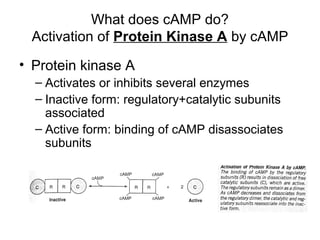
What does cAMP do? 
Activation of Protein Kinase A by cAMP 
• Protein kinase A 
– Activates or inhibits several enzymes 
– Inactive form: regulatory+catalytic subunits 
associated 
– Active form: binding of cAMP disassociates 
subunits
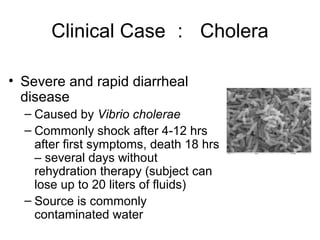
Clinical Case: Cholera 
• Severe and rapid diarrheal 
disease 
– Caused by Vibrio cholerae 
– Commonly shock after 4-12 hrs 
after first symptoms, death 18 hrs 
– several days without 
rehydration therapy (subject can 
lose up to 20 liters of fluids) 
– Source is commonly 
contaminated water
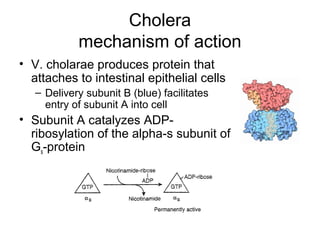
Cholera 
mechanism of action 
• V. cholarae produces protein that 
attaches to intestinal epithelial cells 
– Delivery subunit B (blue) facilitates 
entry of subunit A into cell 
• Subunit A catalyzes ADP-ribosylation 
of the alpha-s subunit of 
Gs-protein
Clinical Case 
• V. cholerae toxin affects alpha-S 
subunit 
– Inactivates GTPase 
– Alpha-S subunit permanently active 
• Stimulates adenylate cyclase 
– Overproduces cAMP 
– stimulates protein kinase 
– Phosphorylation of membrane ion 
transport proteins – massive losses of Na, 
Cl, K, HCO3
Hypothetical link to cystic fibrosis 
• Cystic fibrosis characterized by 
– Salty sweat 
– Very thick mucous 
• Homozygous genetic defect to chloride transport 
to mucous 
– Decreased chloride results in less water following due 
to osmosis, leading to thicker mucous 
• Heterozygous mutation (normal mucous) has 
transport protein resistant to effects of cholera 
toxin ?
Intracellular Messengers: 
Signal Transduction Pathways 
• Cyclic AMP (cAMP) 
• Diacylglycerol (DAG) & 
Inositol Triphosphate (IP3) 
• Cyclic GMP (cGMP)
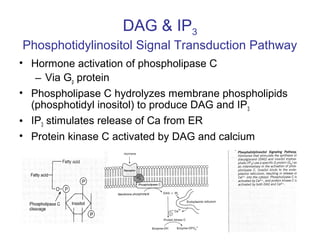
DAG & IP3 
Phosphotidylinositol Signal Transduction Pathway 
• Hormone activation of phospholipase C 
– Via Gp protein 
• Phospholipase C hydrolyzes membrane phospholipids 
(phosphotidyl inositol) to produce DAG and IP3 
• IP3 stimulates release of Ca from ER 
• Protein kinase C activated by DAG and calcium
Intracellular Messengers: 
Signal Transduction Pathways 
• Cyclic AMP (cAMP) 
• Diacylglycerol (DAG) & Inositol 
Triphosphate (IP3) 
• Cyclic GMP (cGMP)
cGMP 
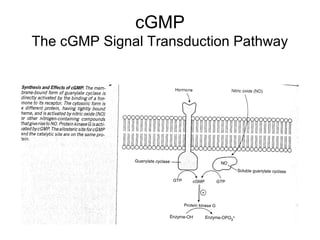
The cGMP Signal Transduction Pathway 
• cGMP effects: 
• lowering of blood pressure & decreasing CHD 
risk 
– Relaxation of cardiac muscle 
– Vasodilation of vascular smooth muscle 
– Increased excretion of sodium and water by kidney 
– Decreased aggregation by platelet cells
cGMP 
The cGMP Signal Transduction Pathway 
• Two forms of guanylate cyclase 
• Membrane-bound 
• Activated by ANF (atrial natriuretic factor) 
– ANF released when BP elevated 
• Cytosolic 
• Activated by nitric oxide 
• NO produced from arginine by NO synthase (activated by 
Ca) 
– Nitroglycerine slowly produces NO, relaxes cardiac and 
vascular smooth muscle, reduces angina 
• cGMP activates Protein Kinase G 
– Phosphorylates smooth muscle proteins
cGMP 
The cGMP Signal Transduction Pathway

Lecture 12

  • 1.
  • 2.
    What Factors InfluenceEnzymatic Activity? • Two of the more obvious ways to regulate the amount of activity are 1. To increase or decrease the number of enzyme molecule (enzyme level) 2. To increase or decrease the activity of each enzyme molecule (enzyme activity)
  • 3.
    • A generaloverview of factors influencing enzyme activity includes the following considerations 1. Rate depends on substrate availability 2. Rate slows as product accumulates 3. Allosteric effectors may be important 4. Enzymes can be modified covalently 5. Genetic controls (transcription regulation) - induction and repression (enzyme level) 6. Zymogens, isozymes and modulator proteins may play a role
  • 4.
    • A generaloverview of factors influencing enzyme activity includes the following considerations 1. Rate depends on substrate availability 2. Rate slows as product accumulates 3. Allosteric effectors may be important 4. Enzymes can be modified covalently 5. Genetic controls (transcription regulation) - induction and repression (enzyme level) 6. Zymogens, isozymes and modulator proteins may play a role
  • 5.
    Non-covalent Interactions Substrateavailability • Non-regulatory enzymes generally exhibit hyperbolic kinetics (Michaelis-Menton) • At low substrate concentration, reaction rate proportional to substrate concentration • Regulatory enzymes generally exhibit sigmoidal kinetics (positive cooperativity) • Changes of substrate concentrations at normal physiological levels greatly alter reaction rate
  • 6.
    • Regulatory enzymesare usually the enzymes that are the rate-limiting step, in a pathway, meaning that after this step a particular reaction pathway will go to completion
  • 7.
    • A generaloverview of factors influencing enzyme activity includes the following considerations 1. Rate depends on substrate availability 2. Rate slows as product accumulates 3. Allosteric effectors may be important 4. Enzymes can be modified covalently 5. Genetic controls (transcription regulation) - induction and repression (enzyme level) 6. Zymogens, isozymes and modulator proteins may play a role
  • 8.
    Non-covalent Interactions AllostericRegulation • Binding of allosteric effectors at allosteric sites affect catalytic efficiency of the enzyme
  • 9.
    Non-covalent Interactions AllostericRegulation • Allosteric Activators – Decrease Km (increases the enzyme binding affinity) – Increases Vmax (increases the enzyme catalytic efficiency)
  • 10.
    Non-covalent Interactions AllostericRegulation • Allosteric Inhibitors – Increases Km (decreases enzyme binding affinity) – Decreases Vmax (decreases enzyme catalytic efficiency)
  • 11.
    Molecules that actas allosteric effectors • End products of pathways – Feedback inhibition • Substrates of pathways – Feed-forward activators • Indicators of Energy Status – ATP/ADP/AMP – NAD/NADH – Citrate & acetyl CoA
  • 12.
    Allosteric Example •Feedback Inhibition - This occurs when an end-product of a pathway accumulates as the metabolic demand for it declines. • This end-product in turn binds to the regulatory enzyme at the start of the pathway and decreases its activity - the greater the end-product levels the greater the inhibition of enzyme activity.
  • 13.
    Metabolic Pathway Product/ Feedback Inhibition
  • 14.
    Feed-forward activators Phosphofructokinase( PFK) Fructose-6-P + ATP -----> FFrruuccttoossee--11,,66--bbiisspphhoosspphhaattee + AADDPP •PFK catalyzes 1st committed step in glycolysis (10 steps total) (Glucose + 2ADP + 2 NAD+ + 2Pi  2pyruvate + 2ATP + 2NADH) •ADP is an allosteric activator of PFK
  • 15.
    Allosteric modulators bindto site other than the active site Fructose-6-P + ATP -----> FFrruuccttoossee--11,,66--bbiisspphhoosspphhaattee + AADDPP AADDPP Allosteric Activator (ADP) binds distal to active site PFK exists as a homotetramer in bacteria and mammals
  • 16.
    Vo vs [S]plots give sigmoidal curve for at least one substrate Activator can shift hyperbolic (as if there were no T state) Binding of this allosteric inhibitor or this activator does not effect Vmax, but does alter Km Allosteric enzyme do not follow M-M kinetics
  • 17.
    Sample questions •Two curves showing the rate versus substrate concentration are shown below for an enzyme catalyzed reaction. One ‐ curve is for the reaction in the presence of substance X. The other curve is for data in the absence of substance X. Examine the curves and tell which statement below is true. • A) The catalysis shows Michaelis‐Menten kinetics with or without X. • B) X increases the activation energy for the catalytic reaction. • C) X could be a competitive inhibitor. • D) X is an activator of the enzyme.
  • 18.
    Sample questions Allostericenzymes are • A.similar to simple enzyme • B.smaller than simple enzyme • C.larger and more complex than simple enzyme • D.smaller than simple enzyme but not complex Which statement is false about allosteric regulation? • A. It is usually the mode of regulation for the last step in reaction pathways since this step produces the final product. • B. Cellular response is faster with allosteric control than by controlling enzyme concentration in the cell. • C. The regulation usually is important to the conservation of energy and materials in cells. • D. Allosteric modulators bind non-covalently at sites other than the active site and induce conformational changes in the enzyme.
  • 19.
    Sample questions Allostericmodulators seldom resemble the substrate or product of the enzyme. What does this observation show? • A) Modulators likely bind at a site other than the active site. • B) Modulators always act as activators. • C) Modulators bind non-covalently to the enzyme. • D) The enzyme catalyzes more than one reaction.
  • 20.
    Sample questions •Some enzymatic regulation is allosteric. In such cases, which of the following would usuallybe found? • A) cooperativity • B) feedback inhibition • C) both activating and inhibitoryactivity • D) an enzyme with more than one subunit • E) the need for cofactors
  • 21.
    Sample questions •Describe allosteric regulation of enzyme activity? An allosteric enzyme is one in which the activity of the enzyme can be controlled by the binding of a molecule to the “allosteric site”, somewhere other than the active site. Thus allosteric control of an enzyme can be classed in two ways. A positive allosteric regulation is the binding of a molecule to the enzyme which increase the rate of reaction. The opposite is a negative allosteric regulation. An example for this is phosphofructokinase, which is promoted by a high AMP concentration, and inhibited by a high ATP concentration.
  • 22.
    Non-covalent Interactions Protein-ProteinInteractions • Calmodulin (CALcium MODULted proteIN) – Binding of Ca++ to calmodulin changes its shape and allows binding and activation of certain enzymes
  • 23.
    Binding of calciumto Calmodulin changes the shape of the protein Unbound Calmodulin on left Calcium bound Calmodulin on right. Stars indicate exposed non-polar ‘grooves’ that non-covalently binds proteins
  • 24.
    Calmodulin • Extracellular[Ca] = 5 mM • Intracellular [Ca] = 10-4 mM – Bound Ca can be released by hormonal action, nerve innervation, light, …. – Released Ca binds to Calmodulin which activates a large number of proteins
  • 25.
    Calmodulin plays arole in: • Muscle contraction • Inflammation • Apoptosis • Memory • Immune response…. • Metabolism – Activates phosphorylase kinase • Stimulates glycogen degradation during exercise
  • 26.
    • A generaloverview of factors influencing enzyme activity includes the following considerations 1. Rate depends on substrate availability 2. Rate slows as product accumulates 3. Allosteric effectors may be important 4. Enzymes can be modified covalently 5. Genetic controls (transcription regulation) - induction and repression (enzyme level) 6. Zymogens, isozymes and modulator proteins may play a role
  • 27.
    Covalent Regulation ofEnzyme Activity Phosphorylation and Dephosphorylation • Addition or deletion of phosphate groups to particular serine, threonine, or tyrosine residues alter the enzymes activity
  • 28.
    Enzymes regulated bycovalent modification are called interconvertible enzymes. The enzymes (protein kinase and protein phosphatase) catalyzing the conversion of the interconvertible enzyme between its two forms are called converter enzymes. In this example, the free enzyme form is catalytically active, whereas the phosphoryl-enzyme form represents an inactive state. The -OH on the interconvertible enzyme represents an -OH group on a specific amino acid side chain in the protein (for example, a particular Ser residue) capable of accepting the phosphoryl group.
  • 29.
    Covalent Regulation ofEnzyme Activity Enzyme Cascades • Enzymes activating enzymes allows for amplification of a small regulatory signal
  • 30.
    Sample questions •Which statement is false about covalent modification? • A) It is reversible. • B) It is slower than allosteric regulation. • C) It is irreversible. • D) Phosphorylation is a common covalent modification.
  • 31.
    Sample questions Proteinkinases are enzymes that act on other enzymes by adding phosphates groups. When the enzyme is phosphorylated, it changes its activity (it becomes more or less active, depending on the enzyme). This regulatory mechanism of enzymatic activity is called: • A) Allosteric Control • B) Competitive inhibition • C) Covalent Modification • D) Isozymes Modification • E) Zymogen activation
  • 32.
    • A generaloverview of factors influencing enzyme activity includes the following considerations 1. Rate depends on substrate availability 2. Rate slows as product accumulates 3. Allosteric effectors may be important 4. Enzymes can be modified covalently 5. Genetic controls (transcription regulation) - induction and repression (enzyme level) 6. Zymogens, isozymes and modulator proteins may play a role
  • 33.
    Changes in EnzymeAbundance • Inducible vs Constitutive Enzymes • Induction is caused by increases in rate of gene transcription. – Hormones activate transcriptional factors • Increase synthesis of specific mRNA • Increase synthesis of specific enzymes
  • 34.
    Regulation of Enzyme Concentrations: Induction • Induction (an increase caused by an effecter molecule) of enzyme synthesis is a common mechanism - this can manifest itself at the level of gene expression, RNA translation, and post-translational modifications. The actions of many hormones and/or growth factors on cells will ultimately lead to an increase in the expression and translation of "new" enzymes not present prior to the signal.
  • 35.
    Regulation of Enzyme Concentrations: Degradation • The degradation of proteins is constantly occurring in the cell. • Proteolytic degradation is an irreversible mechanism.
  • 36.
    Regulation of Enzyme Concentrations: Degradation (cont) • Protein degradation by proteases is compartmentalized in the cell in the lysosome (which is generally non-specific), or in macromolecular complexes termed proteasomes. • Degradation by proteasomes is regulated by a complex pathway involving transfer of a 76 aa polypeptide, ubiquitin, to targeted proteins. Ubiquination of protein targets it for degradation by the proteasome. This pathway is highly conserved in eukaryotes, but still poorly understood
  • 37.
    • A generaloverview of factors influencing enzyme activity includes the following considerations 1. Rate depends on substrate availability 2. Rate slows as product accumulates 3. Allosteric effectors may be important 4. Enzymes can be modified covalently 5. Genetic controls (transcription regulation) - induction and repression (enzyme level) 6. Zymogens, isozymes and modulator proteins may play a role
  • 38.
    Covalent Regulation ofEnzyme Activity Limited Proteolysis • Specific proteolysis can activate certain enzymes and proteins (zymogens) – Digestive enzymes – Blood clotting proteins – Peptide hormones (insulin)
  • 39.
    Regulation signaling: Hormones,Receptors, and Communication Between Cells
  • 40.
    • Hormones –chemical signals that coordinate metabolism • Hormone Receptors – Target tissues – Specific binding – Types • Intracellular receptors • Cell-surface receptors
  • 41.
    Hormones, Receptors, and Communication Between Cells • Intracellular receptors • lipid soluble hormones • Steroid hormones, vitamin D, retinoids, thyroxine • Bind to intracellular protein receptors – This binds to regulatory elements by a gene – Alters the rate of gene transcription • Induces or represses gene transcription
  • 42.
    Hormones, Receptors, andCommunication Between Cells Intracellular Receptors
  • 43.
    Hormones, Receptors, and Communication Between Cells • Cell-surface receptors – Water soluble hormones • Peptide hormones (insulin), catecholamines, neurotransmitters • Three class of cell-surface receptors – Ligand-Gated Receptors – Catalytic Receptors – G Protein-linked Receptors
  • 44.
    Cell Surface Receptors Ligand-Gated Receptors • Binding of a ligand (often a neurotransmitter) affects flow of ions in/out of cell • Gamma-amino butyric acid (GABA) binds and opens chloride channels in the brain – Valium (anti-anxiety drug) reduces the amount of GABA required to open the chloride channels
  • 45.
    Cell-Surface Receptors CatalyticReceptors • Binding of hormone activates tyrosine kinase on receptor which phosphorylates certain cellular proteins • Insulin receptor is a catalytic receptor with TYR Kinase activity
  • 46.
    Cell-Surface Receptors GProtein-Linked Receptors • Binding of hormone activates an enzyme via a G-protein communication link. • The enzymes produces intracellular messengers – Signal transduction – Second messengers activate protein kinases
  • 47.
    Intracellular Messengers: SignalTransduction Pathways • Cyclic AMP (cAMP) • Diacylglycerol (DAG) & Inositol Triphosphate (IP3) • Cyclic GMP (cGMP)
  • 48.
    cAMP is aSecond Messenger • Cyclic AMP is the intracellular agent of extracellular hormones - thus a ‘second messenger’ • Hormone binding stimulates a GTP-binding protein (G protein), releasing Ga(GTP) • Binding of Ga(GTP) stimulates adenylyl cyclase to make cAMP
  • 49.
    G-Protein-Linked Receptors: ThecAMP Signal Transduction Pathway • Two types of G-Proteins • Stimulating G protein (Gs) – Activate adenylate cyclase • Inhibitory G proteins (Gi) – Inhibit adenylate cyclase
  • 50.
    G Proteins •G proteins are trimers – Three protein units • Alpha • Beta • gamma
  • 51.
    • Alpha proteinsare different in Gs and Gi – Both have GTPase activity – Alpha proteins modify adenylate cyclase activity • AC stimulated by Alpha(s) when activated by a hormone • AC Inhibited by Alpha(I) when activated by other hormones
  • 52.
    Family of GProteins • Binding of hormones to receptors causes: – GTP to displace GDP – Dissociation of alpha protein from beta and gamma subunits – activation of the alpha protein – Inhibition or activation of adenylate cyclase – GTPase gradually degrades GTP and inactivates the alpha protein effect (clock)
  • 53.
  • 54.
    The cAMP SignalTransduction Pathway • cAMP – intracellular messenger – Elevated cAMP can either activate or inhibit regulatory enzymes • cAMP activates glycogen degradation • cAMP inhibits glycogen synthesis • [cAMP] affected by rates of synthesis and degradation – Synthesis by adenylate cyclase – Degradation by phosphodiesterase • Stimulated by insulin • Inhibited by caffeine
  • 56.
    What does cAMPdo? Activation of Protein Kinase A by cAMP • Protein kinase A – Activates or inhibits several enzymes – Inactive form: regulatory+catalytic subunits associated – Active form: binding of cAMP disassociates subunits
  • 57.
    Clinical Case: Cholera • Severe and rapid diarrheal disease – Caused by Vibrio cholerae – Commonly shock after 4-12 hrs after first symptoms, death 18 hrs – several days without rehydration therapy (subject can lose up to 20 liters of fluids) – Source is commonly contaminated water
  • 58.
    Cholera mechanism ofaction • V. cholarae produces protein that attaches to intestinal epithelial cells – Delivery subunit B (blue) facilitates entry of subunit A into cell • Subunit A catalyzes ADP-ribosylation of the alpha-s subunit of Gs-protein
  • 59.
    Clinical Case •V. cholerae toxin affects alpha-S subunit – Inactivates GTPase – Alpha-S subunit permanently active • Stimulates adenylate cyclase – Overproduces cAMP – stimulates protein kinase – Phosphorylation of membrane ion transport proteins – massive losses of Na, Cl, K, HCO3
  • 60.
    Hypothetical link tocystic fibrosis • Cystic fibrosis characterized by – Salty sweat – Very thick mucous • Homozygous genetic defect to chloride transport to mucous – Decreased chloride results in less water following due to osmosis, leading to thicker mucous • Heterozygous mutation (normal mucous) has transport protein resistant to effects of cholera toxin ?
  • 61.
    Intracellular Messengers: SignalTransduction Pathways • Cyclic AMP (cAMP) • Diacylglycerol (DAG) & Inositol Triphosphate (IP3) • Cyclic GMP (cGMP)
  • 62.
    DAG & IP3 Phosphotidylinositol Signal Transduction Pathway • Hormone activation of phospholipase C – Via Gp protein • Phospholipase C hydrolyzes membrane phospholipids (phosphotidyl inositol) to produce DAG and IP3 • IP3 stimulates release of Ca from ER • Protein kinase C activated by DAG and calcium
  • 63.
    Intracellular Messengers: SignalTransduction Pathways • Cyclic AMP (cAMP) • Diacylglycerol (DAG) & Inositol Triphosphate (IP3) • Cyclic GMP (cGMP)
  • 64.
    cGMP The cGMPSignal Transduction Pathway • cGMP effects: • lowering of blood pressure & decreasing CHD risk – Relaxation of cardiac muscle – Vasodilation of vascular smooth muscle – Increased excretion of sodium and water by kidney – Decreased aggregation by platelet cells
  • 65.
    cGMP The cGMPSignal Transduction Pathway • Two forms of guanylate cyclase • Membrane-bound • Activated by ANF (atrial natriuretic factor) – ANF released when BP elevated • Cytosolic • Activated by nitric oxide • NO produced from arginine by NO synthase (activated by Ca) – Nitroglycerine slowly produces NO, relaxes cardiac and vascular smooth muscle, reduces angina • cGMP activates Protein Kinase G – Phosphorylates smooth muscle proteins
  • 66.
    cGMP The cGMPSignal Transduction Pathway