Enzyme
Regulation
Adarsh P P
M.Sc. Bioinformatics
Union Christian College, Aluva
Modes of Regulation
• Allosteric Control
• Covalent modification
• Protein Processing
Levels of Enzyme Regulation
1. Enzyme level: The enzyme may be activated or inhibited by either
noncovalent or covalent interactions. This is the most rapid control
system. Eg. Allosteric control, covalent modification, proteolytic
cleavage, Isoezymes, Product inhibition (feedback inhibition)
2. Hormonal level: A hormone is secreted and carries a message to the
cell and in turn an enzyme is activated or inhibited. The speed of
this control system is intermediate.
3. Gene level: A message is sent to the nucleus either express or
repress a gene. This determines the amount of enzyme produced
and is the slowest control measure
Allosteric mode of regulation
The enzyme has two binding sites, one for the substrate (the active site) and the other
for the allosteric modulator (the regulatory site). When the allosteric activator is not
bound to the regulatory site, the active site of the enzyme is not able to bind substrate
and catalyze the production of product. However, when the allosteric activator binds to
the enzyme at the regulatory site, the shape of the active site changes so that it can bind
its substrate and catalyze the production of products
Homotropic
A homotropic allosteric modulator is a molecule which binds to the
regulatory as well as active site of an enzyme, which is the substrate
for the enzyme. It is typically an activator of the enzyme. For example,
O2 is a homotropic allosteric modulator of hemoglobin.
Heterotropic
A heterotropic allosteric modulator is a molecule which binds to the
regulatory site. It may be either an activator or an inhibitor of the
enzyme. For example, H+, CO2, and 2,3-bisphosphoglycerate are
heterotropic allosteric modulators of hemoglobin.
Some allosteric proteins can be regulated by both their substrates and
other molecules. Such proteins are capable of both homotropic and
heterotropic interaction
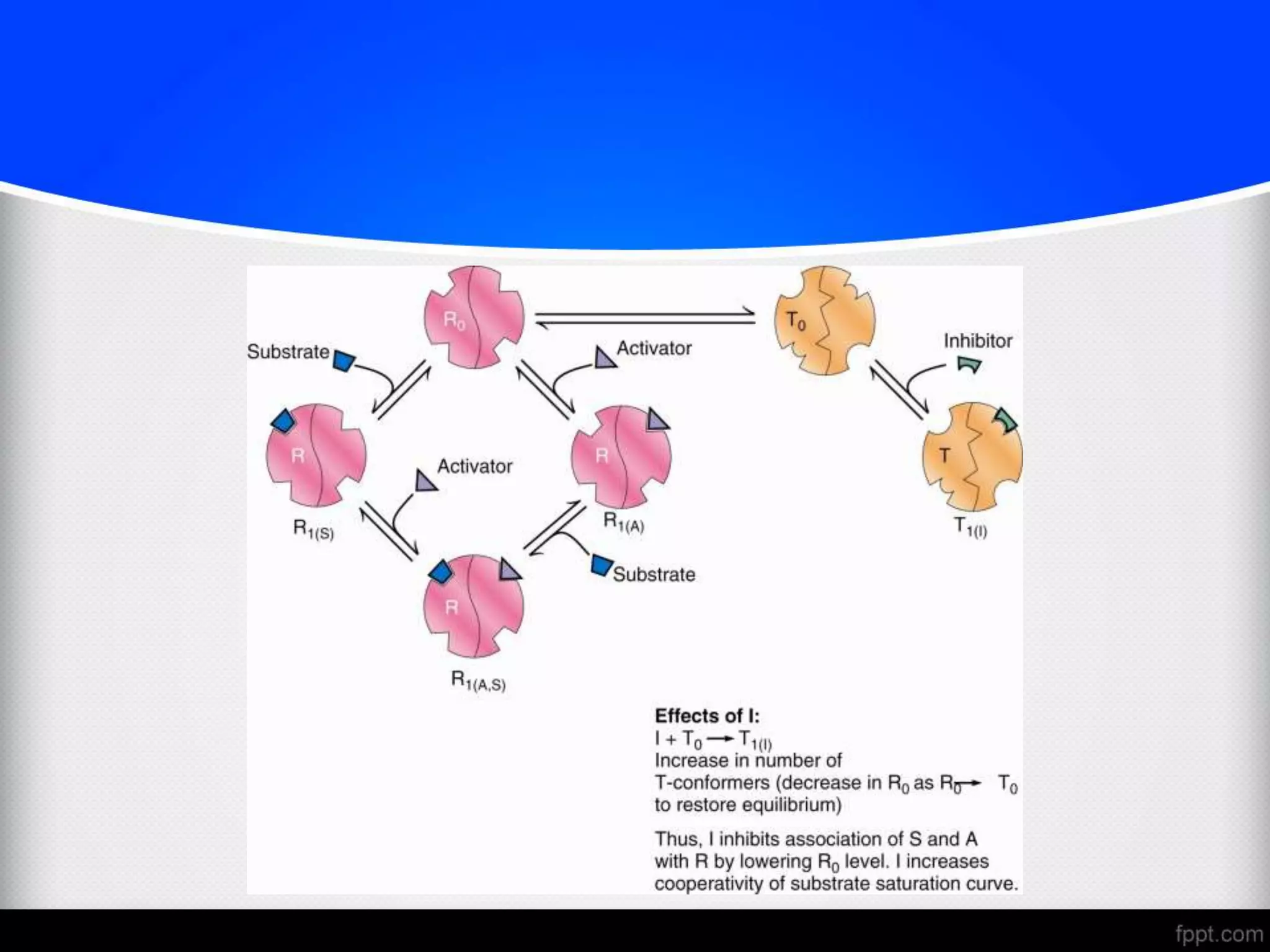
 A positive modulator activates the enzyme
(an activator).
 A negative modulator inhibits the enzyme
(an inhibitor
Feedback Inhibition
Negative modulators (inhibitors)- Inhibits the
enzymatic reaction.
Eg. PFK (phospho fructo kinase)
PFK
Allosteric Regulation and
Conformational Changes in
Subunits.
• Monod, Wyman, Changeux (MWC) Model: allosteric
proteins can exist in two states: R (relaxed) and T (taut
or tight).
• In this two-state model, all the subunits of an oligomer
must be in the same state (they all change together) and
is therefore termed the concerted model.
• T state predominates in the absence of substrate S.
• S binds much tighter to R than to T.
• Cooperativity is achieved because S binding increases
the population of R, which increases the sites available
to S
The Sequential Model for Allosteric
Regulation (KNF)
• An alternative model – proposed by Koshland, Nemethy,
and Filmer (the KNF model) relies on the idea that
ligand binding triggers a conformation change in a
protein.
• In this one-state model, ligand-induced conformation
changes in one subunit may lead to conformation
changes in adjacent subunits.
• This model explains positive and negative
cooperativity
• The KNF model is termed the sequential model.
S S S S S
S
S
S
S
S
S
S
S
S
S S
S
S
SS
MWC: Two state concerted
KNF: One state sequential
Covalent Modification
• Enzymes can be regulated by transfer of a
molecule or atom from a donor to an amino acid
side chain that serves as the acceptor of the
transferred molecule.
• Another way of regulating an enzyme is by
altering the amino acid sequence itself by
proteolytic cleavage.
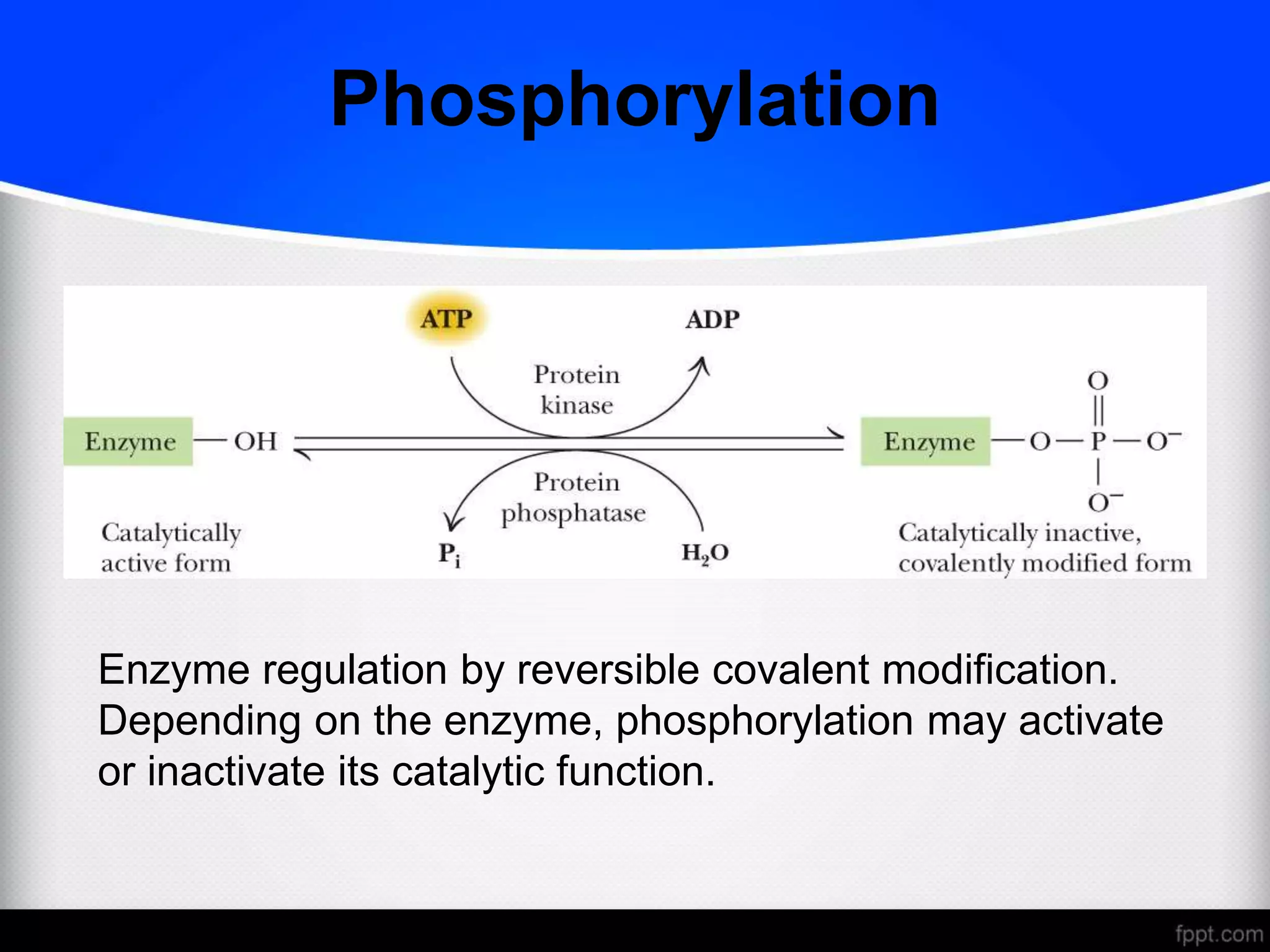
Phosphorylation
Enzyme regulation by reversible covalent modification.
Depending on the enzyme, phosphorylation may activate
or inactivate its catalytic function.
Phosphorylation-
dephosphorylation of glycogen
Phosphorylase
•Cyclic AMP is the intracellular agent of
extracellular hormones - thus a ‘second
messenger’
• Hormone binding stimulates a GTP-
binding protein (G protein), releasing
G(GTP)
• Binding of G(GTP) stimulates adenylyl
cyclase to make cAMP
Proteolytic cleavage
Regulating an enzyme is by altering the amino acid
sequence itself by proteolytic cleavage.
Chymotrypsin
bond fission(Hydrolysis)
Removal of two peptide
fragments
The final form of the enzyme contains 3 polypeptides
linked by disulfide linkages
Trypsin-
Genetic level control of
enzyme regulation
• Constitutive Enzymes
• Inducible enzymes/Adaptive Enzymes
• Constitutive enzymes are produced in constant amounts without regard to
the physiological demand or the concentration of the substrate.
• They are continuously synthesized because their role in maintaining cell
processes or structure is indispensable.eg. Enzymes of glycolytic pathway.
• The genes that code for constitutive enzymes are always on (always
expressed, the gene product is constantly synthesized.
• Constitutive enzyme activity is regulated by feed back mechanisms or
second messenger systems.
• An adaptive enzyme or inducible enzyme is an
enzyme that is expressed only under conditions in which
it is clear of adaptive value
• Inducible enzyme is used for the breaking-down of
things in the cell.
• It is also a part of the Operon Model, which illustrates a
way for genes to turn "on" and "off“
• Eg COX-2 which is synthesized in macrophages to
produce Prostaglandin E2
Protein Processing
• Post translation modification and folding
Trancription and Translation
(cell)
Folding (ER /golgi or
cytosol)
chaperones
Active enzyme (send to the
targets)
Degradation
by
proteasome
s
THANK YOU

Enzyme regulation

  • 1.
    Enzyme Regulation Adarsh P P M.Sc.Bioinformatics Union Christian College, Aluva
  • 2.
    Modes of Regulation •Allosteric Control • Covalent modification • Protein Processing
  • 3.
    Levels of EnzymeRegulation 1. Enzyme level: The enzyme may be activated or inhibited by either noncovalent or covalent interactions. This is the most rapid control system. Eg. Allosteric control, covalent modification, proteolytic cleavage, Isoezymes, Product inhibition (feedback inhibition) 2. Hormonal level: A hormone is secreted and carries a message to the cell and in turn an enzyme is activated or inhibited. The speed of this control system is intermediate. 3. Gene level: A message is sent to the nucleus either express or repress a gene. This determines the amount of enzyme produced and is the slowest control measure
  • 4.
    Allosteric mode ofregulation The enzyme has two binding sites, one for the substrate (the active site) and the other for the allosteric modulator (the regulatory site). When the allosteric activator is not bound to the regulatory site, the active site of the enzyme is not able to bind substrate and catalyze the production of product. However, when the allosteric activator binds to the enzyme at the regulatory site, the shape of the active site changes so that it can bind its substrate and catalyze the production of products
  • 5.
    Homotropic A homotropic allostericmodulator is a molecule which binds to the regulatory as well as active site of an enzyme, which is the substrate for the enzyme. It is typically an activator of the enzyme. For example, O2 is a homotropic allosteric modulator of hemoglobin. Heterotropic A heterotropic allosteric modulator is a molecule which binds to the regulatory site. It may be either an activator or an inhibitor of the enzyme. For example, H+, CO2, and 2,3-bisphosphoglycerate are heterotropic allosteric modulators of hemoglobin. Some allosteric proteins can be regulated by both their substrates and other molecules. Such proteins are capable of both homotropic and heterotropic interaction
  • 6.
     A positivemodulator activates the enzyme (an activator).  A negative modulator inhibits the enzyme (an inhibitor
  • 7.
    Feedback Inhibition Negative modulators(inhibitors)- Inhibits the enzymatic reaction. Eg. PFK (phospho fructo kinase) PFK
  • 8.
    Allosteric Regulation and ConformationalChanges in Subunits. • Monod, Wyman, Changeux (MWC) Model: allosteric proteins can exist in two states: R (relaxed) and T (taut or tight). • In this two-state model, all the subunits of an oligomer must be in the same state (they all change together) and is therefore termed the concerted model. • T state predominates in the absence of substrate S. • S binds much tighter to R than to T. • Cooperativity is achieved because S binding increases the population of R, which increases the sites available to S
  • 10.
    The Sequential Modelfor Allosteric Regulation (KNF) • An alternative model – proposed by Koshland, Nemethy, and Filmer (the KNF model) relies on the idea that ligand binding triggers a conformation change in a protein. • In this one-state model, ligand-induced conformation changes in one subunit may lead to conformation changes in adjacent subunits. • This model explains positive and negative cooperativity • The KNF model is termed the sequential model.
  • 11.
    S S SS S S S S S S S S S S S S S S SS MWC: Two state concerted KNF: One state sequential
  • 12.
    Covalent Modification • Enzymescan be regulated by transfer of a molecule or atom from a donor to an amino acid side chain that serves as the acceptor of the transferred molecule. • Another way of regulating an enzyme is by altering the amino acid sequence itself by proteolytic cleavage.
  • 13.
    Phosphorylation Enzyme regulation byreversible covalent modification. Depending on the enzyme, phosphorylation may activate or inactivate its catalytic function.
  • 14.
  • 15.
    •Cyclic AMP isthe intracellular agent of extracellular hormones - thus a ‘second messenger’ • Hormone binding stimulates a GTP- binding protein (G protein), releasing G(GTP) • Binding of G(GTP) stimulates adenylyl cyclase to make cAMP
  • 16.
    Proteolytic cleavage Regulating anenzyme is by altering the amino acid sequence itself by proteolytic cleavage.
  • 17.
    Chymotrypsin bond fission(Hydrolysis) Removal oftwo peptide fragments The final form of the enzyme contains 3 polypeptides linked by disulfide linkages
  • 18.
  • 19.
    Genetic level controlof enzyme regulation • Constitutive Enzymes • Inducible enzymes/Adaptive Enzymes
  • 20.
    • Constitutive enzymesare produced in constant amounts without regard to the physiological demand or the concentration of the substrate. • They are continuously synthesized because their role in maintaining cell processes or structure is indispensable.eg. Enzymes of glycolytic pathway. • The genes that code for constitutive enzymes are always on (always expressed, the gene product is constantly synthesized. • Constitutive enzyme activity is regulated by feed back mechanisms or second messenger systems.
  • 21.
    • An adaptiveenzyme or inducible enzyme is an enzyme that is expressed only under conditions in which it is clear of adaptive value • Inducible enzyme is used for the breaking-down of things in the cell. • It is also a part of the Operon Model, which illustrates a way for genes to turn "on" and "off“ • Eg COX-2 which is synthesized in macrophages to produce Prostaglandin E2
  • 22.
    Protein Processing • Posttranslation modification and folding Trancription and Translation (cell) Folding (ER /golgi or cytosol) chaperones Active enzyme (send to the targets) Degradation by proteasome s
  • 24.