CELL EVOLUTION
Fossil evidence indicates that prokaryotic
cells existed before eukaryotic cells
Prokaryotic cells are simpler and have less
structural organization when compared to
eukaryotic cells
It appears that the first organism on Earth
were simple prokaryotes that existed
around 3.5 – 3.9 billion years ago =
stromatolites
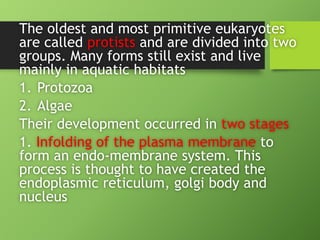
Stromatolites are primitive
photosynthetic prokaryotes
They were primitive bacteria which formed
along the coastline and preserved as
fossils.
These were autotrophic organisms , able to
make their own food and produce oxygen.
As they became more widespread they
were able to change the composition of the
atmosphere.
An increase in the amount of oxygen
enabled the development of heterotrophic
organisms
The oldest eukaryotic organisms seem to
have evolved around 2.1 billion years ago.
The oldest and most primitive eukaryotes
are called protists and are divided into two
groups. Many forms still exist and live
mainly in aquatic habitats
1. Protozoa
2. Algae
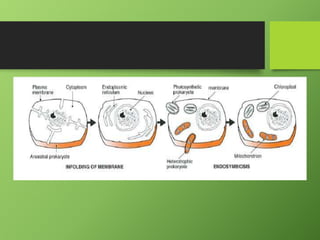
Their development occurred in two stages
1. Infolding of the plasma membrane to
form an endo-membrane system. This
process is thought to have created the
endoplasmic reticulum, golgi body and
nucleus
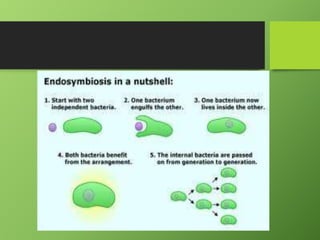
2. The second process is called
endosymbiosis. Chloroplasts and
mitochondria appear to have evolved from
smaller prokaryotes which became
incorporated, possibly after being “eaten”
by a larger cell.
Mitochondria are thought to have been
originally heterotrophic cells, able to use
oxygen in the process of aerobic respiration
to release energy.
Chloroplasts are thought to have evolved
from autotrophic cells, able to use light
energy to produce food and release oxygen
Evidence supporting the
endosymbiotic theory
Mitochondria and chloroplasts have inner
membranes that are similar to the plasma
membrane of living prokaryotes
Both replicate by splitting in a similar
fashion to prokaryotic cells
Both have circular DNA like prokaryotes
Both have their own protein manufacturing
system including ribosomes
Cell evolution

Cell evolution

  • 2.
  • 3.
    Fossil evidence indicatesthat prokaryotic cells existed before eukaryotic cells Prokaryotic cells are simpler and have less structural organization when compared to eukaryotic cells It appears that the first organism on Earth were simple prokaryotes that existed around 3.5 – 3.9 billion years ago = stromatolites Stromatolites are primitive photosynthetic prokaryotes
  • 4.
    They were primitivebacteria which formed along the coastline and preserved as fossils. These were autotrophic organisms , able to make their own food and produce oxygen. As they became more widespread they were able to change the composition of the atmosphere. An increase in the amount of oxygen enabled the development of heterotrophic organisms The oldest eukaryotic organisms seem to have evolved around 2.1 billion years ago.
  • 5.
    The oldest andmost primitive eukaryotes are called protists and are divided into two groups. Many forms still exist and live mainly in aquatic habitats 1. Protozoa 2. Algae Their development occurred in two stages 1. Infolding of the plasma membrane to form an endo-membrane system. This process is thought to have created the endoplasmic reticulum, golgi body and nucleus
  • 6.
    2. The secondprocess is called endosymbiosis. Chloroplasts and mitochondria appear to have evolved from smaller prokaryotes which became incorporated, possibly after being “eaten” by a larger cell. Mitochondria are thought to have been originally heterotrophic cells, able to use oxygen in the process of aerobic respiration to release energy. Chloroplasts are thought to have evolved from autotrophic cells, able to use light energy to produce food and release oxygen
  • 8.
    Evidence supporting the endosymbiotictheory Mitochondria and chloroplasts have inner membranes that are similar to the plasma membrane of living prokaryotes Both replicate by splitting in a similar fashion to prokaryotic cells Both have circular DNA like prokaryotes Both have their own protein manufacturing system including ribosomes