PRESENTED BY
SUSHMA P.R
1ST M.Sc BIOTECH,
BRINDAVAN COLLEGE
PRESENTED TO
Mrs. DILSHAD BEGUM
BIOCHEMISTRY,
BRINDAVAN COLLEGE
 Also known as Energy Rich Compounds
 Compounds in biological system which on
hydrolysis yield free energy equal to or greater
than that of ATP, i.e. ∆ G = -7.3 kcal / mol
 Compounds that yield energy less than -7.3
kcal / mol are called Low Energy Compounds.
 Most of the high energy compounds contain phosphate
group [except acetyl CoA] hence they are also called high
energy phosphates.
 The bonds in the high energy compounds which yields
energy upon hydrolysis are called high energy bonds.
 These bonds are notated by the symbol '~‘ [squiggle].
 Fritz Albert Lipmann invented this notation.
 The energy that is actually available
[ utilizable ] to do the work is called Free
Energy.
 Change in free energy is denoted by ∆G.
Also known as Gibb’s Free Energy.
 For endergonic reactions ∆G will be +ve
 For exergonic reactions ∆G will be -ve
 High energy compounds are mainly classified into 5
groups:
1. Pyrophosphates
2. Enol phosphates
3. Acyl phosphates
4. Thiol phosphates
5. Guanido phosphates or phophagens
 The energy bonds in pyrophosphates are acid anhydride
bonds.
 These bonds are formed by the condensation of acid
groups [mainly phosphoric acid] or its derivatives.
 An example for pyrophosphates is ATP. It has two high
energy diphosphate bonds – phosphoanhydride bonds.
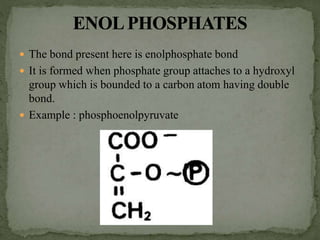
 The bond present here is enolphosphate bond
 It is formed when phosphate group attaches to a hydroxyl
group which is bounded to a carbon atom having double
bond.
 Example : phosphoenolpyruvate
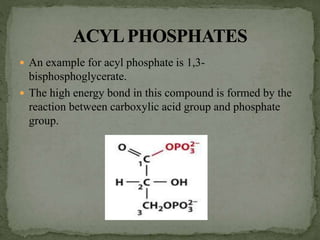
 An example for acyl phosphate is 1,3-
bisphosphoglycerate.
 The high energy bond in this compound is formed by the
reaction between carboxylic acid group and phosphate
group.
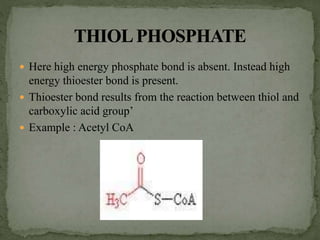
 Here high energy phosphate bond is absent. Instead high
energy thioester bond is present.
 Thioester bond results from the reaction between thiol and
carboxylic acid group’
 Example : Acetyl CoA
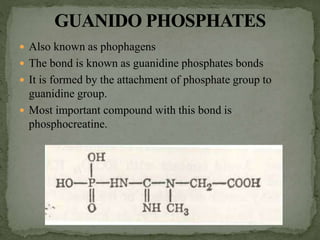
 Also known as phophagens
 The bond is known as guanidine phosphates bonds
 It is formed by the attachment of phosphate group to
guanidine group.
 Most important compound with this bond is
phosphocreatine.
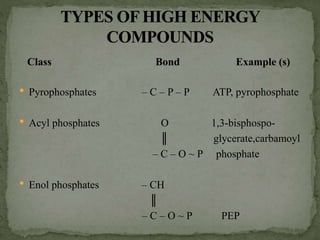
Class Bond Example (s)
 Pyrophosphates – C – P – P ATP, pyrophosphate
 Acyl phosphates O 1,3-bisphospo-
║ glycerate,carbamoyl
– C – O ~ P phosphate
 Enol phosphates – CH
║
– C – O ~ P PEP
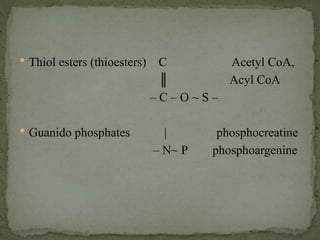
 Thiol esters (thioesters) C Acetyl CoA,
║ Acyl CoA
– C – O ~ S –
 Guanido phosphates | phosphocreatine
– N~ P phosphoargenine
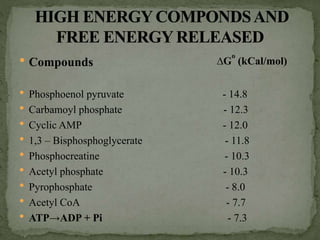
 Compounds ∆G
o
(kCal/mol)
 Phosphoenol pyruvate - 14.8
 Carbamoyl phosphate - 12.3
 Cyclic AMP - 12.0
 1,3 – Bisphosphoglycerate - 11.8
 Phosphocreatine - 10.3
 Acetyl phosphate - 10.3
 Pyrophosphate - 8.0
 Acetyl CoA - 7.7
 ATP→ADP + Pi - 7.3
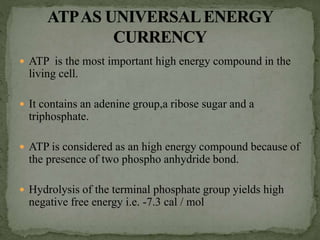
 ATP is the most important high energy compound in the
living cell.
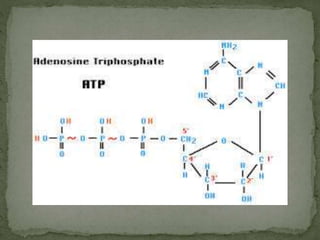
 It contains an adenine group,a ribose sugar and a
triphosphate.
 ATP is considered as an high energy compound because of
the presence of two phospho anhydride bond.
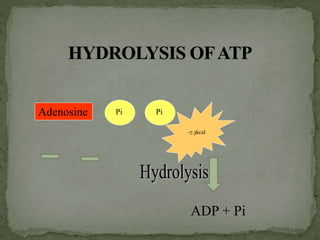
 Hydrolysis of the terminal phosphate group yields high
negative free energy i.e. -7.3 cal / mol
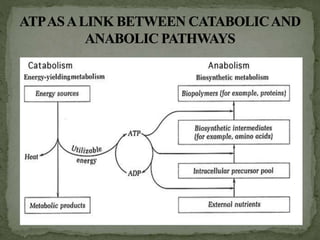
 ATP acts as an link between catabolism [exergonic
reaction] and anabolism [endergonic reaction].
 Catabolic reactions can give energy in the form of ATP.
 Anabolic reactions can utilize energy through hydrolysis
of ATP.
 It transfers phophoryl groups from high energy
compounds to less energetic compounds
Adenosine Pi Pi
-7.3kcal
ADP + Pi
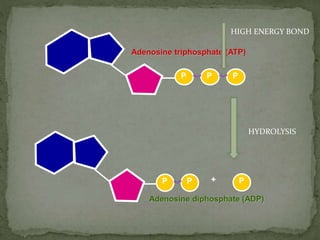
P P P
Adenosine triphosphate (ATP)
P P P+
Adenosine diphosphate (ADP)
HYDROLYSIS
HIGH ENERGY BOND
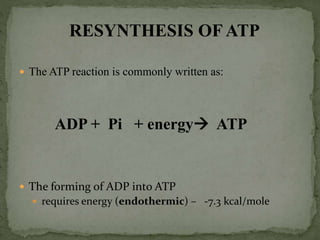
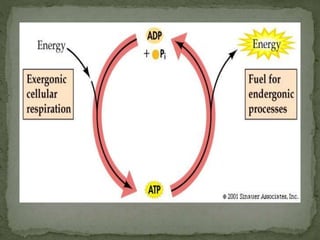
 The ATP reaction is commonly written as:
ADP + Pi + energy ATP
 The forming of ADP into ATP
 requires energy (endothermic) – -7.3 kcal/mole
RESYNTHESIS OF ATP
P P P+
Adenosine diphosphate (ADP)
P P P
Adenosine triphosphate (ATP)
Dehydration
[Remove H2O]
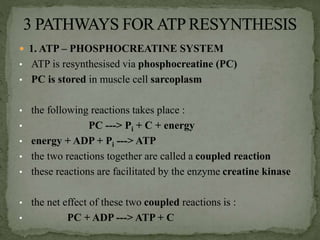
 1. ATP – PHOSPHOCREATINE SYSTEM
• ATP is resynthesised via phosphocreatine (PC)
• PC is stored in muscle cell sarcoplasm
• the following reactions takes place :
• PC ---> Pi + C + energy
• energy + ADP + Pi ---> ATP
• the two reactions together are called a coupled reaction
• these reactions are facilitated by the enzyme creatine kinase
• the net effect of these two coupled reactions is :
• PC + ADP ---> ATP + C
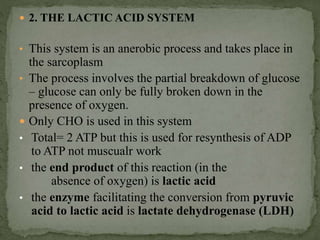
 2. THE LACTIC ACID SYSTEM
• This system is an anerobic process and takes place in
the sarcoplasm
• The process involves the partial breakdown of glucose
– glucose can only be fully broken down in the
presence of oxygen.
 Only CHO is used in this system
• Total= 2 ATP but this is used for resynthesis of ADP
to ATP not muscualr work
• the end product of this reaction (in the
absence of oxygen) is lactic acid
• the enzyme facilitating the conversion from pyruvic
acid to lactic acid is lactate dehydrogenase (LDH)
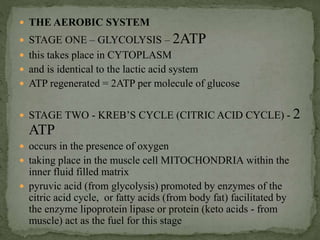
 THE AEROBIC SYSTEM
 STAGE ONE – GLYCOLYSIS – 2ATP
 this takes place in CYTOPLASM
 and is identical to the lactic acid system
 ATP regenerated = 2ATP per molecule of glucose
 STAGE TWO - KREB’S CYCLE (CITRIC ACID CYCLE) - 2
ATP
 occurs in the presence of oxygen
 taking place in the muscle cell MITOCHONDRIA within the
inner fluid filled matrix
 pyruvic acid (from glycolysis) promoted by enzymes of the
citric acid cycle, or fatty acids (from body fat) facilitated by
the enzyme lipoprotein lipase or protein (keto acids - from
muscle) act as the fuel for this stage
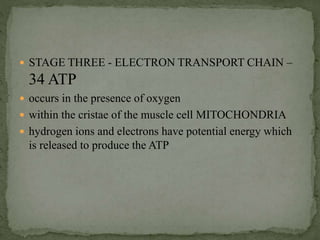
 STAGE THREE - ELECTRON TRANSPORT CHAIN –
34 ATP
 occurs in the presence of oxygen
 within the cristae of the muscle cell MITOCHONDRIA
 hydrogen ions and electrons have potential energy which
is released to produce the ATP
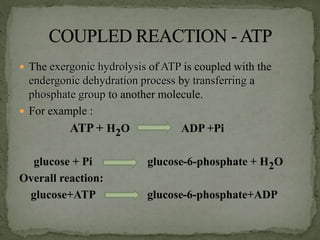
 The exergonic hydrolysis of ATP is coupled with the
endergonic dehydration process by transferring a
phosphate group to another molecule.
 For example :
ATP + H2O ADP +Pi
glucose + Pi glucose-6-phosphate + H2O
Overall reaction:
glucose+ATP glucose-6-phosphate+ADP
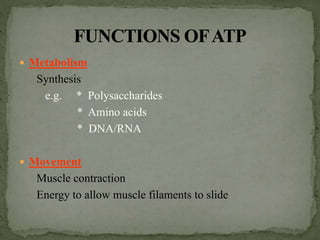
 Metabolism
Synthesis
e.g. * Polysaccharides
* Amino acids
* DNA/RNA
 Movement
Muscle contraction
Energy to allow muscle filaments to slide
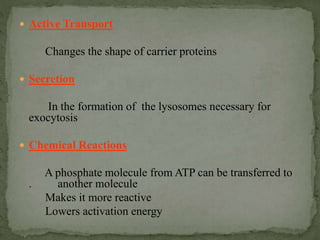
 Active Transport
Changes the shape of carrier proteins
 Secretion
In the formation of the lysosomes necessary for
exocytosis
 Chemical Reactions
A phosphate molecule from ATP can be transferred to
. another molecule
Makes it more reactive
Lowers activation energy
WHY ATP IS CONSIDERED AS UNIVERSAL
ENERGY CURRENCY?
 Common intermediate in many reactions
 Links energy requiring and energy producing
reactions
• It is universal with all living things
 Easily participates in many reactions
 Drives most biological processes
 One molecule can be synthesised and perform
a large number of jobs
High energy compounds

High energy compounds

  • 1.
    PRESENTED BY SUSHMA P.R 1STM.Sc BIOTECH, BRINDAVAN COLLEGE PRESENTED TO Mrs. DILSHAD BEGUM BIOCHEMISTRY, BRINDAVAN COLLEGE
  • 2.
     Also knownas Energy Rich Compounds  Compounds in biological system which on hydrolysis yield free energy equal to or greater than that of ATP, i.e. ∆ G = -7.3 kcal / mol  Compounds that yield energy less than -7.3 kcal / mol are called Low Energy Compounds.
  • 3.
     Most ofthe high energy compounds contain phosphate group [except acetyl CoA] hence they are also called high energy phosphates.  The bonds in the high energy compounds which yields energy upon hydrolysis are called high energy bonds.  These bonds are notated by the symbol '~‘ [squiggle].  Fritz Albert Lipmann invented this notation.
  • 4.
     The energythat is actually available [ utilizable ] to do the work is called Free Energy.  Change in free energy is denoted by ∆G. Also known as Gibb’s Free Energy.  For endergonic reactions ∆G will be +ve  For exergonic reactions ∆G will be -ve
  • 5.
     High energycompounds are mainly classified into 5 groups: 1. Pyrophosphates 2. Enol phosphates 3. Acyl phosphates 4. Thiol phosphates 5. Guanido phosphates or phophagens
  • 6.
     The energybonds in pyrophosphates are acid anhydride bonds.  These bonds are formed by the condensation of acid groups [mainly phosphoric acid] or its derivatives.  An example for pyrophosphates is ATP. It has two high energy diphosphate bonds – phosphoanhydride bonds.
  • 7.
     The bondpresent here is enolphosphate bond  It is formed when phosphate group attaches to a hydroxyl group which is bounded to a carbon atom having double bond.  Example : phosphoenolpyruvate
  • 8.
     An examplefor acyl phosphate is 1,3- bisphosphoglycerate.  The high energy bond in this compound is formed by the reaction between carboxylic acid group and phosphate group.
  • 9.
     Here highenergy phosphate bond is absent. Instead high energy thioester bond is present.  Thioester bond results from the reaction between thiol and carboxylic acid group’  Example : Acetyl CoA
  • 10.
     Also knownas phophagens  The bond is known as guanidine phosphates bonds  It is formed by the attachment of phosphate group to guanidine group.  Most important compound with this bond is phosphocreatine.
  • 11.
    Class Bond Example(s)  Pyrophosphates – C – P – P ATP, pyrophosphate  Acyl phosphates O 1,3-bisphospo- ║ glycerate,carbamoyl – C – O ~ P phosphate  Enol phosphates – CH ║ – C – O ~ P PEP
  • 12.
     Thiol esters(thioesters) C Acetyl CoA, ║ Acyl CoA – C – O ~ S –  Guanido phosphates | phosphocreatine – N~ P phosphoargenine
  • 13.
     Compounds ∆G o (kCal/mol) Phosphoenol pyruvate - 14.8  Carbamoyl phosphate - 12.3  Cyclic AMP - 12.0  1,3 – Bisphosphoglycerate - 11.8  Phosphocreatine - 10.3  Acetyl phosphate - 10.3  Pyrophosphate - 8.0  Acetyl CoA - 7.7  ATP→ADP + Pi - 7.3
  • 14.
     ATP isthe most important high energy compound in the living cell.  It contains an adenine group,a ribose sugar and a triphosphate.  ATP is considered as an high energy compound because of the presence of two phospho anhydride bond.  Hydrolysis of the terminal phosphate group yields high negative free energy i.e. -7.3 cal / mol
  • 15.
     ATP actsas an link between catabolism [exergonic reaction] and anabolism [endergonic reaction].  Catabolic reactions can give energy in the form of ATP.  Anabolic reactions can utilize energy through hydrolysis of ATP.  It transfers phophoryl groups from high energy compounds to less energetic compounds
  • 17.
  • 18.
    P P P Adenosinetriphosphate (ATP) P P P+ Adenosine diphosphate (ADP) HYDROLYSIS HIGH ENERGY BOND
  • 19.
     The ATPreaction is commonly written as: ADP + Pi + energy ATP  The forming of ADP into ATP  requires energy (endothermic) – -7.3 kcal/mole RESYNTHESIS OF ATP
  • 20.
    P P P+ Adenosinediphosphate (ADP) P P P Adenosine triphosphate (ATP) Dehydration [Remove H2O]
  • 21.
     1. ATP– PHOSPHOCREATINE SYSTEM • ATP is resynthesised via phosphocreatine (PC) • PC is stored in muscle cell sarcoplasm • the following reactions takes place : • PC ---> Pi + C + energy • energy + ADP + Pi ---> ATP • the two reactions together are called a coupled reaction • these reactions are facilitated by the enzyme creatine kinase • the net effect of these two coupled reactions is : • PC + ADP ---> ATP + C
  • 22.
     2. THELACTIC ACID SYSTEM • This system is an anerobic process and takes place in the sarcoplasm • The process involves the partial breakdown of glucose – glucose can only be fully broken down in the presence of oxygen.  Only CHO is used in this system • Total= 2 ATP but this is used for resynthesis of ADP to ATP not muscualr work • the end product of this reaction (in the absence of oxygen) is lactic acid • the enzyme facilitating the conversion from pyruvic acid to lactic acid is lactate dehydrogenase (LDH)
  • 23.
     THE AEROBICSYSTEM  STAGE ONE – GLYCOLYSIS – 2ATP  this takes place in CYTOPLASM  and is identical to the lactic acid system  ATP regenerated = 2ATP per molecule of glucose  STAGE TWO - KREB’S CYCLE (CITRIC ACID CYCLE) - 2 ATP  occurs in the presence of oxygen  taking place in the muscle cell MITOCHONDRIA within the inner fluid filled matrix  pyruvic acid (from glycolysis) promoted by enzymes of the citric acid cycle, or fatty acids (from body fat) facilitated by the enzyme lipoprotein lipase or protein (keto acids - from muscle) act as the fuel for this stage
  • 24.
     STAGE THREE- ELECTRON TRANSPORT CHAIN – 34 ATP  occurs in the presence of oxygen  within the cristae of the muscle cell MITOCHONDRIA  hydrogen ions and electrons have potential energy which is released to produce the ATP
  • 25.
     The exergonichydrolysis of ATP is coupled with the endergonic dehydration process by transferring a phosphate group to another molecule.  For example : ATP + H2O ADP +Pi glucose + Pi glucose-6-phosphate + H2O Overall reaction: glucose+ATP glucose-6-phosphate+ADP
  • 28.
     Metabolism Synthesis e.g. *Polysaccharides * Amino acids * DNA/RNA  Movement Muscle contraction Energy to allow muscle filaments to slide
  • 29.
     Active Transport Changesthe shape of carrier proteins  Secretion In the formation of the lysosomes necessary for exocytosis  Chemical Reactions A phosphate molecule from ATP can be transferred to . another molecule Makes it more reactive Lowers activation energy
  • 30.
    WHY ATP ISCONSIDERED AS UNIVERSAL ENERGY CURRENCY?  Common intermediate in many reactions  Links energy requiring and energy producing reactions • It is universal with all living things
  • 31.
     Easily participatesin many reactions  Drives most biological processes  One molecule can be synthesised and perform a large number of jobs