
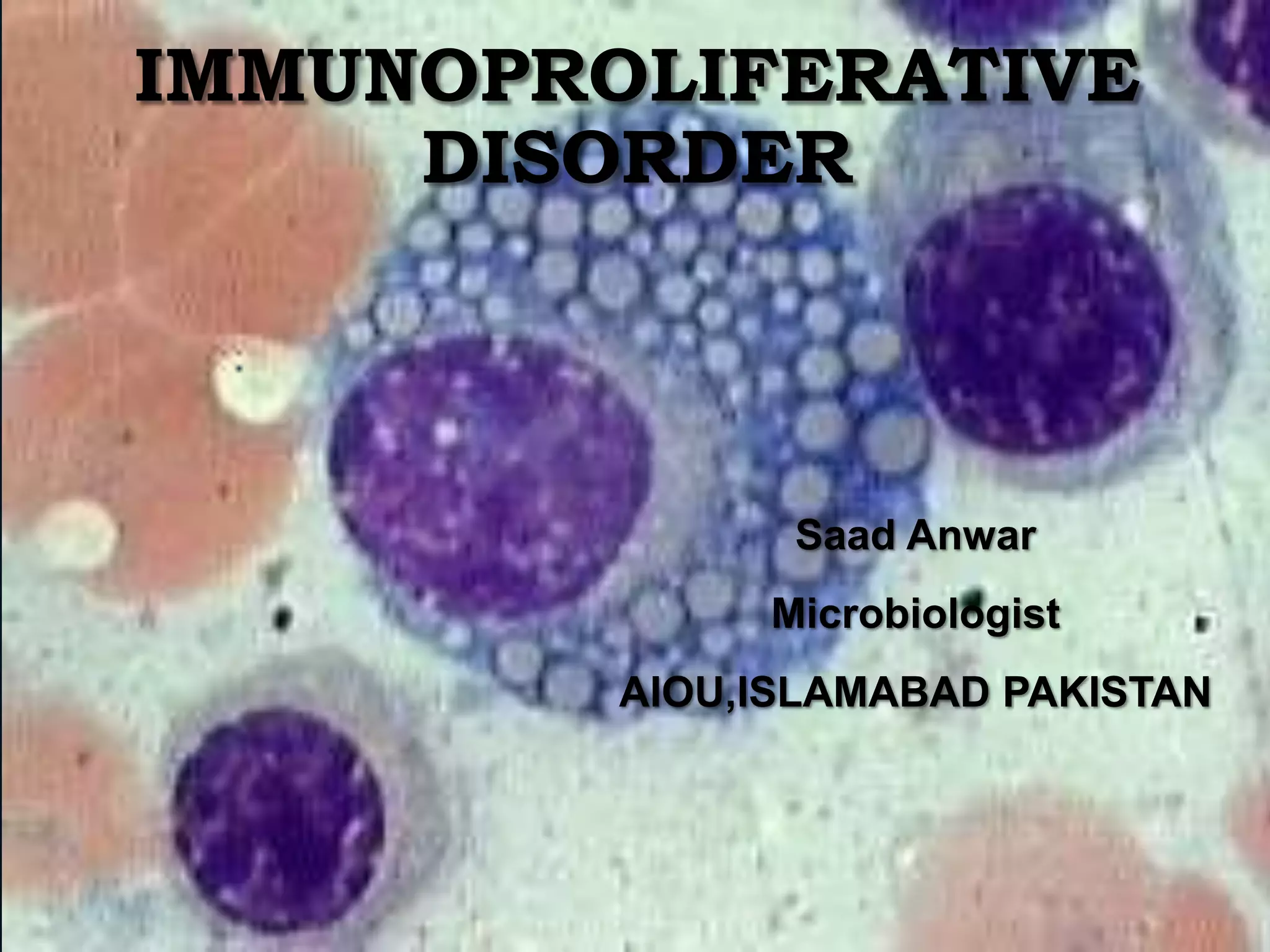
IMMUNOPROLIFERATIVE
DISORDER
Saad Anwar
Microbiologist
AIOU,ISLAMABAD PAKISTAN
INTRODUCTION
• Immunoproliferative disorders,also known as immunoproliferative
diseases or immunoproliferative neoplasms, are disorders of the
immune system that are characterized by the abnormal
proliferation of the primary cells of the immune system, which
includes B cells, T cells and Natural killer (NK) cells, or by the
excessive production of immunoglobulins.
CLASSES
Immunoproliferative
disorder
lymphoproliferative
disorders
(cellular)
Hypergammaglobuline
mia
(Humoral)
Paraproteinemia
(Humoral)
SIGNS & SYMPTOMS
1.The symptoms of these conditions can vary from patient to
patient and condition to condition, but the most common
symptoms include:
2.Diarrhea
3.Abdominal pain
4.Unexplained weight loss
5.Anorexia
6.Mass in the abdomen
LYMPHOPROLIFERATIVE
DISORDERS
• Lymphoproliferative disorders (LPDs) refer to several conditions
in which lymphocytes are produced in excessive quantities.
• They typically occur in people who have a compromised immune
system.
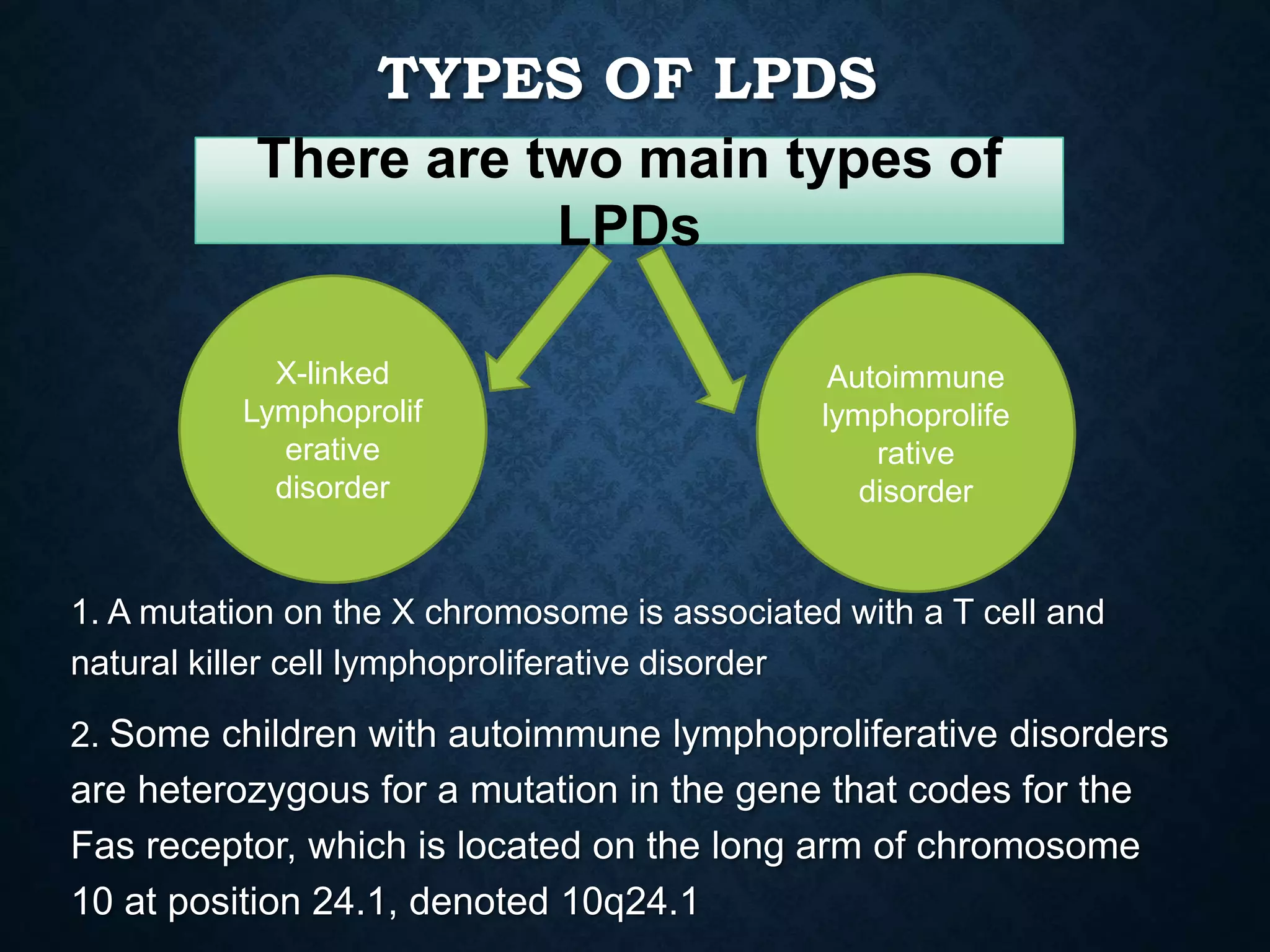
TYPES OF LPDS
1. A mutation on the X chromosome is associated with a T cell and
natural killer cell lymphoproliferative disorder
2. Some children with autoimmune lymphoproliferative disorders
are heterozygous for a mutation in the gene that codes for the
Fas receptor, which is located on the long arm of chromosome
10 at position 24.1, denoted 10q24.1
There are two main types of
LPDs
X-linked
Lymphoprolif
erative
disorder
Autoimmune
lymphoprolife
rative
disorder
CAUSES
• Acquired causes
• Iatrogenic causes
• Other inherited causes
HYPERGAMMAGLOBULINEMIA
• Hypergammaglobulinemia is a medical condition with elevated
levels of gamma globulin.
TYPES
Hypergammaglobulinemia
Type 1
X-linked
immunodeficiency
with hyper–
immunoglobulin M,
which is also called
type 1 hyper IgM
TYPE 2
Immunodeficiency
with hyper IgM type 2
is caused by a
mutation in the
Activation-Induced
Cytidine Deaminase
(AICDA) gene
Type3
Immunodeficiency
with hyper IgM type
3 is caused by a
mutation in the gene
that codes for CD40
Type 4
Immunodeficiency with
hyper IgM type 4 is
poorly characterized.
Type 5
Immunodeficiency
with hyper IgM type 5
is caused by a
mutation in the Uracil-
DNA glycosylase
(UNG) gene
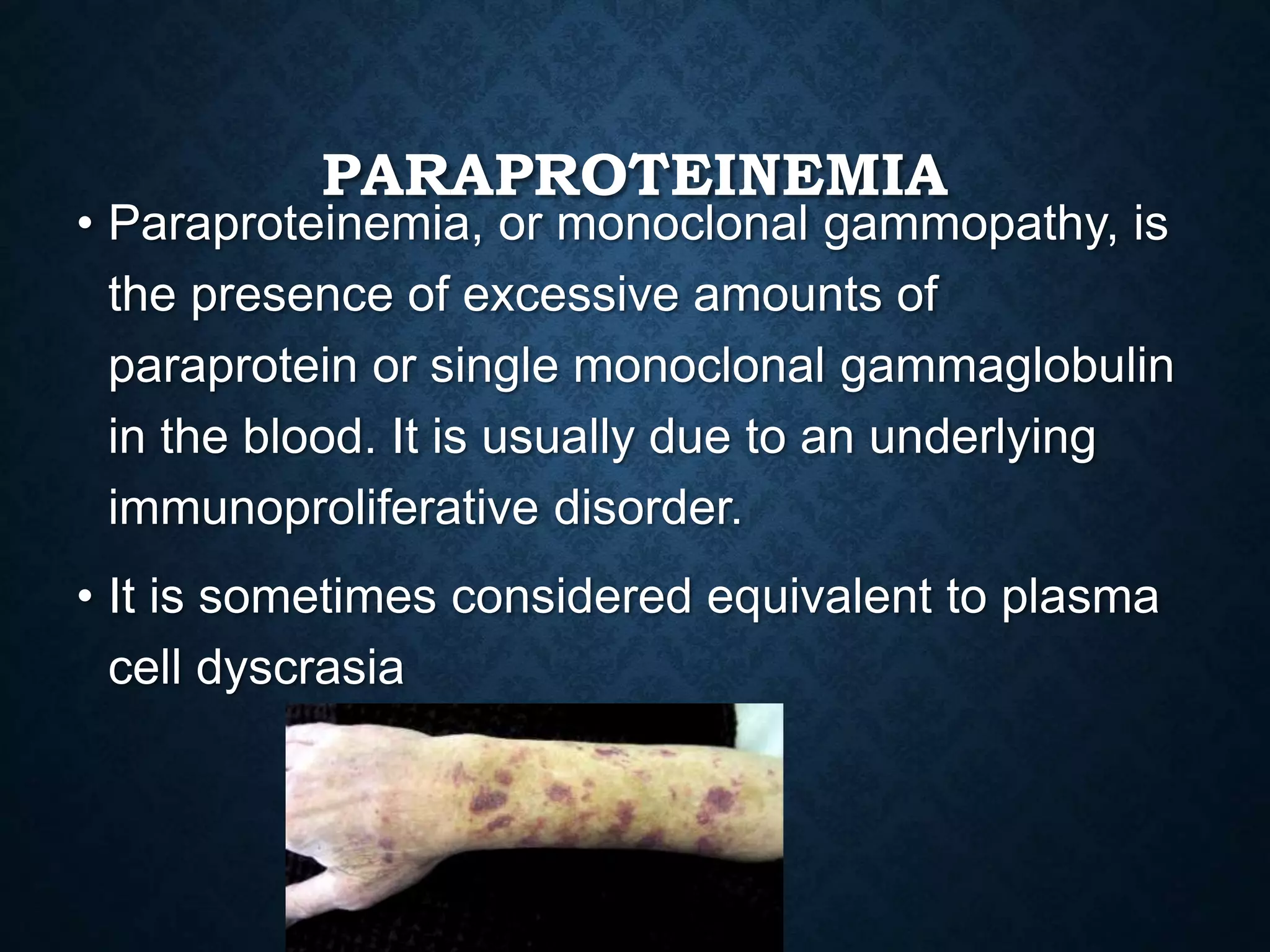
PARAPROTEINEMIA
• Paraproteinemia, or monoclonal gammopathy, is
the presence of excessive amounts of
paraprotein or single monoclonal gammaglobulin
in the blood. It is usually due to an underlying
immunoproliferative disorder.
• It is sometimes considered equivalent to plasma
cell dyscrasia
TYPES
Paraproteinemia
Light chains Heavy chains
Whole
immunoglobuli
ns
The three types of paraproteins may occur alone or in
combination in a given individual. Note that while most heavy
chains or whole immunoglobulins remain within blood vessels,
light chains frequently escape and are excreted by the kidneys
into urine, where they take the name of Bence Jones protein.
DIAGNOSIS & TREATMENT
Immunoproliferative disease can be tested with a number of scans
• MRI,
• X-ray,
• CT/CAT scan
• Blood scans
Treatment can include
• Chemotherapy
• radiation,
• surgery or
• any combination of the three.
• Patients with later-stage leukemia must often undergo a bone marrow transplant
in order to replace the cancer-stricken cells.
REFERENCES
1. Health Communication Network. Immunoproliferative disorders - Topic
Tree.
2. http://www.use.hcn.com.au/subject.%60Immunoproliferative%20Disorde
rs%60/home.html. Accessed March 2007
3. "Idiopathic Interstitial Pneumonias: Interstitial Lung Diseases: Merck
Manual Professional". Retrieved 2008-12-09
4. http://www.emedicine.com/ped/topic1345.htm. Accessed March 2007
5. http://www.ncbi.nlm.nih.gov/entrez/query.fcgi?cmd=Retrieve&db=gene&
dopt=full_report&list_uids=355.

Immunoproliferative disorders[1]

  • 2.
  • 3.
    INTRODUCTION • Immunoproliferative disorders,alsoknown as immunoproliferative diseases or immunoproliferative neoplasms, are disorders of the immune system that are characterized by the abnormal proliferation of the primary cells of the immune system, which includes B cells, T cells and Natural killer (NK) cells, or by the excessive production of immunoglobulins.
  • 4.
  • 5.
    SIGNS & SYMPTOMS 1.Thesymptoms of these conditions can vary from patient to patient and condition to condition, but the most common symptoms include: 2.Diarrhea 3.Abdominal pain 4.Unexplained weight loss 5.Anorexia 6.Mass in the abdomen
  • 6.
    LYMPHOPROLIFERATIVE DISORDERS • Lymphoproliferative disorders(LPDs) refer to several conditions in which lymphocytes are produced in excessive quantities. • They typically occur in people who have a compromised immune system.
  • 7.
    TYPES OF LPDS 1.A mutation on the X chromosome is associated with a T cell and natural killer cell lymphoproliferative disorder 2. Some children with autoimmune lymphoproliferative disorders are heterozygous for a mutation in the gene that codes for the Fas receptor, which is located on the long arm of chromosome 10 at position 24.1, denoted 10q24.1 There are two main types of LPDs X-linked Lymphoprolif erative disorder Autoimmune lymphoprolife rative disorder
  • 8.
    CAUSES • Acquired causes •Iatrogenic causes • Other inherited causes
  • 9.
    HYPERGAMMAGLOBULINEMIA • Hypergammaglobulinemia isa medical condition with elevated levels of gamma globulin.
  • 10.
    TYPES Hypergammaglobulinemia Type 1 X-linked immunodeficiency with hyper– immunoglobulinM, which is also called type 1 hyper IgM TYPE 2 Immunodeficiency with hyper IgM type 2 is caused by a mutation in the Activation-Induced Cytidine Deaminase (AICDA) gene Type3 Immunodeficiency with hyper IgM type 3 is caused by a mutation in the gene that codes for CD40 Type 4 Immunodeficiency with hyper IgM type 4 is poorly characterized. Type 5 Immunodeficiency with hyper IgM type 5 is caused by a mutation in the Uracil- DNA glycosylase (UNG) gene
  • 11.
    PARAPROTEINEMIA • Paraproteinemia, ormonoclonal gammopathy, is the presence of excessive amounts of paraprotein or single monoclonal gammaglobulin in the blood. It is usually due to an underlying immunoproliferative disorder. • It is sometimes considered equivalent to plasma cell dyscrasia
  • 12.
    TYPES Paraproteinemia Light chains Heavychains Whole immunoglobuli ns The three types of paraproteins may occur alone or in combination in a given individual. Note that while most heavy chains or whole immunoglobulins remain within blood vessels, light chains frequently escape and are excreted by the kidneys into urine, where they take the name of Bence Jones protein.
  • 13.
    DIAGNOSIS & TREATMENT Immunoproliferativedisease can be tested with a number of scans • MRI, • X-ray, • CT/CAT scan • Blood scans Treatment can include • Chemotherapy • radiation, • surgery or • any combination of the three. • Patients with later-stage leukemia must often undergo a bone marrow transplant in order to replace the cancer-stricken cells.
  • 14.
    REFERENCES 1. Health CommunicationNetwork. Immunoproliferative disorders - Topic Tree. 2. http://www.use.hcn.com.au/subject.%60Immunoproliferative%20Disorde rs%60/home.html. Accessed March 2007 3. "Idiopathic Interstitial Pneumonias: Interstitial Lung Diseases: Merck Manual Professional". Retrieved 2008-12-09 4. http://www.emedicine.com/ped/topic1345.htm. Accessed March 2007 5. http://www.ncbi.nlm.nih.gov/entrez/query.fcgi?cmd=Retrieve&db=gene& dopt=full_report&list_uids=355.