DISTANCE MEASUREMENT
Dr. Mahmood Arshad
Assistant Professor,
Dept. of Mining Engineering,
Faculty of Earth Sciences and
Engineering,
University of Engineering & Technology,
Lahore.
smarshad@uet.edu.pk
Min-E-240 Surveying
Lecture 5 – Week 3
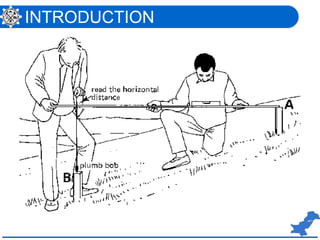
INTRODUCTION
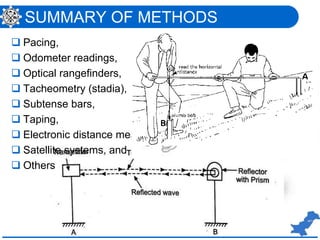
SUMMARY OF METHODS
 Pacing,
 Odometer readings,
 Optical rangefinders,
 Tacheometry (stadia),
 Subtense bars,
 Taping,
 Electronic distance measurement (EDM),
 Satellite systems, and
 Others
TAPING EQUIPMENT AND ACCESSORIES
 Surveyor’s and engineer’s tapes
 Made of steel
 1/4 to 3/8 in. wide and
 Weigh 2 to 3 lbs/100 ft.
 Invar tapes
 Made of a special nickel-steel alloy (35% nickel and 65%
steel)
 Thermal coefficient of expansion and contraction of this
material is only about 1/30 to 1/60 that of an ordinary steel
tape.
 Suitable only for precise geodetic work and as a standard for
comparison with working tapes.
 Lovar tape,
 Has properties and a cost between those of steel and Invar
tapes.
TAPING EQUIPMENT AND ACCESSORIES – Cont’d
 Cloth (or metallic) tapes are actually
 Made of high-grade linen, with fine copper wires running
lengthwise
 5/8 in. wide
 Fiberglass tapes
 A variety of sizes and lengths and are usually wound on a
reel.
 Employed for the same types of work as metallic tapes.
 Chaining pins or taping pins
 Used to mark tape lengths
 Made of number 12 steel wire, sharply pointed at one end,
have a round loop at the other end, and are painted with
alternate red and white bands
 Sets of 11 pins carried on a steel ring are standard.
TAPING EQUIPMENT AND ACCESSORIES – Cont’d
 The hand level
 Used to keep the tape ends at equal elevations
 Tension handles
 Facilitate the application of a desired standard or known
tension
 A complete unit consists of:
 A wire handle,
 A clip to fit the ring end of the tape, and
 A spring balance reading up to 30 lb in 1/2-lb graduations
 Clamp handles
 Used to apply tension by a positive, quick grip using a
scissors-type action on any part of a steel tape
 Do not damage the tape and prevent injury to hands and the
tape
TAPING EQUIPMENT AND ACCESSORIES – Cont’d
 A pocket thermometer
 Permits reading data for making temperature corrections.
 About 5 in. long, graduated from perhaps to in 1° or 2°
divisions, and kept in a protective metal case
 Range poles (lining rods)
 Made of wood, steel, or aluminum
 About 1 in. thick and 6 to 10 ft long
 Round or hexagonal in cross section and
 Marked with alternate 1-ft long red and white bands
 Used to mark the line being measured
 Plumb bobs for taping
 Should weigh a minimum of 8 oz and have a fine point
 At least 6 ft of good-quality string or cord, free of knots, is
necessary
CARE OF TAPING EQUIPMENT
 Consider it your homework. Read, understand and
handwrite article 6.10
Taping on level ground
 Quick Revision
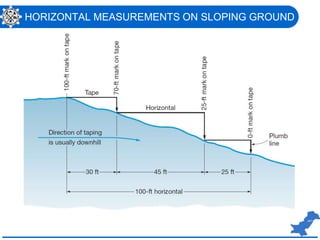
HORIZONTAL MEASUREMENTS ON SLOPING GROUND
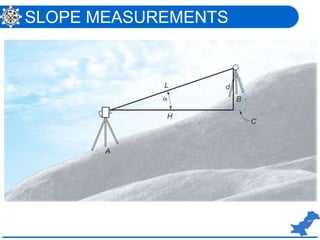
SLOPE MEASUREMENTS
SOURCES OF ERROR IN TAPING
 Incorrect length of tape
 Temperature other than standard
 Inconsistent pull
 Sag
 Tape not horizontal and tape off-line
 Improper plumbing
 Faulty marking
 Incorrect reading or interpolation
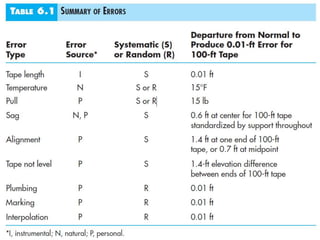
 Summary of effects of taping errors
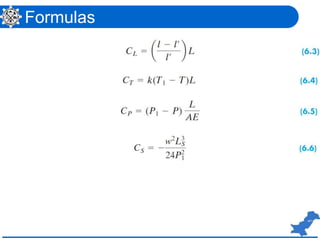
Formulas
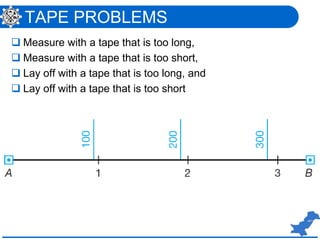
TAPE PROBLEMS
 Measure with a tape that is too long,
 Measure with a tape that is too short,
 Lay off with a tape that is too long, and
 Lay off with a tape that is too short
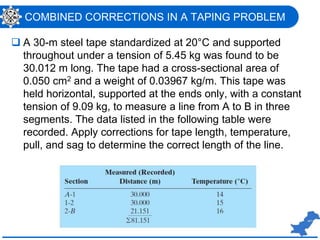
COMBINED CORRECTIONS IN A TAPING PROBLEM
 A 30-m steel tape standardized at 20°C and supported
throughout under a tension of 5.45 kg was found to be
30.012 m long. The tape had a cross-sectional area of
0.050 cm2 and a weight of 0.03967 kg/m. This tape was
held horizontal, supported at the ends only, with a constant
tension of 9.09 kg, to measure a line from A to B in three
segments. The data listed in the following table were
recorded. Apply corrections for tape length, temperature,
pull, and sag to determine the correct length of the line.
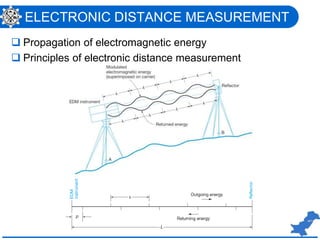
ELECTRONIC DISTANCE MEASUREMENT
 Propagation of electromagnetic energy
 Principles of electronic distance measurement
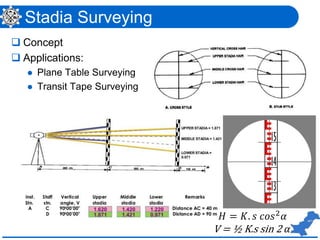
Stadia Surveying
 Concept
 Applications:
 Plane Table Surveying
 Transit Tape Surveying
𝐻 = 𝐾. 𝑠 𝑐𝑜𝑠2
𝛼
V = ½ K.s sin 2 𝛼
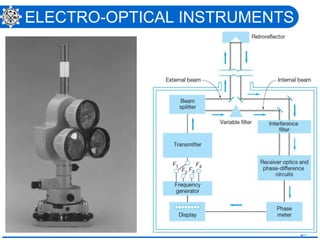
ELECTRO-OPTICAL INSTRUMENTS
TOTAL STATION INSTRUMENTS
EDM INSTRUMENTS WITHOUT REFLECTORS
ERRORS IN ELECTRONIC DISTANCE MEASUREMENT

Lecture 05 distance measurement

  • 1.
    DISTANCE MEASUREMENT Dr. MahmoodArshad Assistant Professor, Dept. of Mining Engineering, Faculty of Earth Sciences and Engineering, University of Engineering & Technology, Lahore. smarshad@uet.edu.pk Min-E-240 Surveying Lecture 5 – Week 3
  • 2.
  • 3.
    SUMMARY OF METHODS Pacing,  Odometer readings,  Optical rangefinders,  Tacheometry (stadia),  Subtense bars,  Taping,  Electronic distance measurement (EDM),  Satellite systems, and  Others
  • 4.
    TAPING EQUIPMENT ANDACCESSORIES  Surveyor’s and engineer’s tapes  Made of steel  1/4 to 3/8 in. wide and  Weigh 2 to 3 lbs/100 ft.  Invar tapes  Made of a special nickel-steel alloy (35% nickel and 65% steel)  Thermal coefficient of expansion and contraction of this material is only about 1/30 to 1/60 that of an ordinary steel tape.  Suitable only for precise geodetic work and as a standard for comparison with working tapes.  Lovar tape,  Has properties and a cost between those of steel and Invar tapes.
  • 5.
    TAPING EQUIPMENT ANDACCESSORIES – Cont’d  Cloth (or metallic) tapes are actually  Made of high-grade linen, with fine copper wires running lengthwise  5/8 in. wide  Fiberglass tapes  A variety of sizes and lengths and are usually wound on a reel.  Employed for the same types of work as metallic tapes.  Chaining pins or taping pins  Used to mark tape lengths  Made of number 12 steel wire, sharply pointed at one end, have a round loop at the other end, and are painted with alternate red and white bands  Sets of 11 pins carried on a steel ring are standard.
  • 6.
    TAPING EQUIPMENT ANDACCESSORIES – Cont’d  The hand level  Used to keep the tape ends at equal elevations  Tension handles  Facilitate the application of a desired standard or known tension  A complete unit consists of:  A wire handle,  A clip to fit the ring end of the tape, and  A spring balance reading up to 30 lb in 1/2-lb graduations  Clamp handles  Used to apply tension by a positive, quick grip using a scissors-type action on any part of a steel tape  Do not damage the tape and prevent injury to hands and the tape
  • 7.
    TAPING EQUIPMENT ANDACCESSORIES – Cont’d  A pocket thermometer  Permits reading data for making temperature corrections.  About 5 in. long, graduated from perhaps to in 1° or 2° divisions, and kept in a protective metal case  Range poles (lining rods)  Made of wood, steel, or aluminum  About 1 in. thick and 6 to 10 ft long  Round or hexagonal in cross section and  Marked with alternate 1-ft long red and white bands  Used to mark the line being measured  Plumb bobs for taping  Should weigh a minimum of 8 oz and have a fine point  At least 6 ft of good-quality string or cord, free of knots, is necessary
  • 8.
    CARE OF TAPINGEQUIPMENT  Consider it your homework. Read, understand and handwrite article 6.10
  • 9.
    Taping on levelground  Quick Revision
  • 10.
  • 11.
  • 12.
    SOURCES OF ERRORIN TAPING  Incorrect length of tape  Temperature other than standard  Inconsistent pull  Sag  Tape not horizontal and tape off-line  Improper plumbing  Faulty marking  Incorrect reading or interpolation  Summary of effects of taping errors
  • 14.
  • 15.
    TAPE PROBLEMS  Measurewith a tape that is too long,  Measure with a tape that is too short,  Lay off with a tape that is too long, and  Lay off with a tape that is too short
  • 16.
    COMBINED CORRECTIONS INA TAPING PROBLEM  A 30-m steel tape standardized at 20°C and supported throughout under a tension of 5.45 kg was found to be 30.012 m long. The tape had a cross-sectional area of 0.050 cm2 and a weight of 0.03967 kg/m. This tape was held horizontal, supported at the ends only, with a constant tension of 9.09 kg, to measure a line from A to B in three segments. The data listed in the following table were recorded. Apply corrections for tape length, temperature, pull, and sag to determine the correct length of the line.
  • 17.
    ELECTRONIC DISTANCE MEASUREMENT Propagation of electromagnetic energy  Principles of electronic distance measurement
  • 18.
    Stadia Surveying  Concept Applications:  Plane Table Surveying  Transit Tape Surveying 𝐻 = 𝐾. 𝑠 𝑐𝑜𝑠2 𝛼 V = ½ K.s sin 2 𝛼
  • 19.
  • 20.
  • 21.
  • 22.
    ERRORS IN ELECTRONICDISTANCE MEASUREMENT