CIV 205
Introduction to Geomatics
Course Instructor
Dr. Saidi Siuhi
Chapter 6-Distance Measurement
2
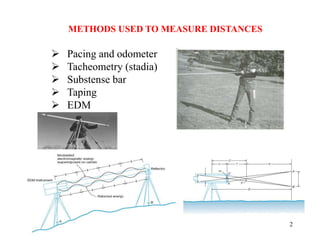
METHODS USED TO MEASURE DISTANCES
 Pacing and odometer
 Tacheometry (stadia)
 Substense bar
 Taping
 EDM
3
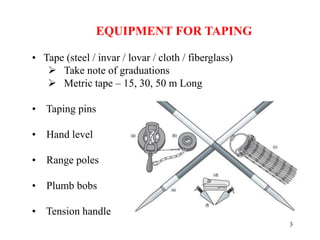
EQUIPMENT FOR TAPING
• Tape (steel / invar / lovar / cloth / fiberglass)
 Take note of graduations
 Metric tape – 15, 30, 50 m Long
• Taping pins
• Hand level
• Range poles
• Plumb bobs
• Tension handle
4
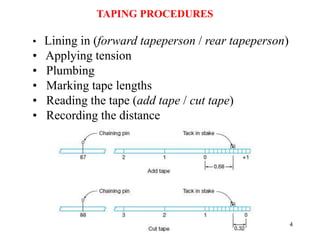
TAPING PROCEDURES
• Lining in (forward tapeperson / rear tapeperson)
• Applying tension
• Plumbing
• Marking tape lengths
• Reading the tape (add tape / cut tape)
• Recording the distance
5
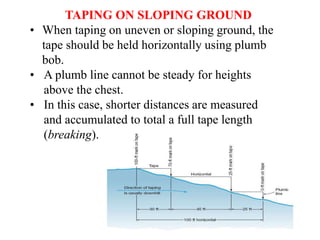
TAPING ON SLOPING GROUND
• When taping on uneven or sloping ground, the
tape should be held horizontally using plumb
bob.
• A plumb line cannot be steady for heights
above the chest.
• In this case, shorter distances are measured
and accumulated to total a full tape length
(breaking).
6
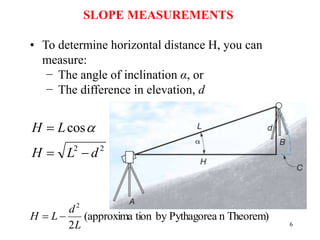
SLOPE MEASUREMENTS
• To determine horizontal distance H, you can
measure:
− The angle of inclination α, or
− The difference in elevation, d
2
2
cos
d
L
H
L
H


 
Theorem)
n
Pythagorea
by
tion
(approxima
2
2
L
d
L
H 

• Improper plumbing.
• Faulty marking.
• Incorrect reading or interpolation.
7
RANDOM ERRORS IN TAPING
[Should corrections be added or subtracted?]
8
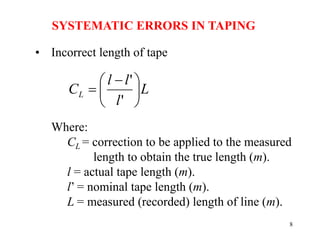
• Incorrect length of tape
Where:
CL = correction to be applied to the measured
length to obtain the true length (m).
l = actual tape length (m).
l’ = nominal tape length (m).
L = measured (recorded) length of line (m).
SYSTEMATIC ERRORS IN TAPING
L
l
l
l
CL 




 

'
'
9
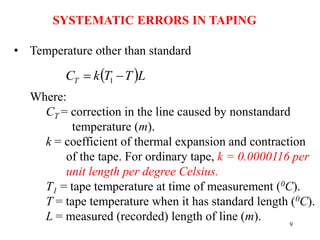
• Temperature other than standard
Where:
CT = correction in the line caused by nonstandard
temperature (m).
k = coefficient of thermal expansion and contraction
of the tape. For ordinary tape, k = 0.0000116 per
unit length per degree Celsius.
T1 = tape temperature at time of measurement (0C).
T = tape temperature when it has standard length (0C).
L = measured (recorded) length of line (m).
SYSTEMATIC ERRORS IN TAPING
 L
T
T
k
CT 
 1
10
• Inconsistent pull
Where:
Cp = elongation in tape length due to pull (m)
P1 = pull applied to the tape at the time of
observation (kg).
P = standard pull for the tape (kg).
A = area in square centimeters (cm2)
E = kilogram per square centimeter (kg/cm2)
(E = 2,000,000 kg/cm2)
L = measured (recorded) length of line (m).
SYSTEMATIC ERRORS IN TAPING
 
AE
L
P
P
CP 
 1
11
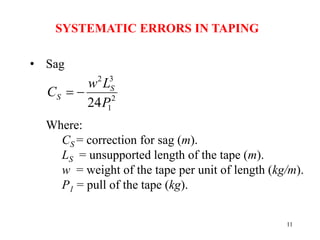
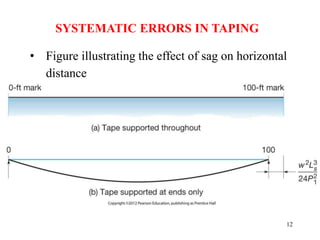
• Sag
Where:
CS = correction for sag (m).
LS = unsupported length of the tape (m).
w = weight of the tape per unit of length (kg/m).
P1 = pull of the tape (kg).
SYSTEMATIC ERRORS IN TAPING
2
1
3
2
24P
L
w
C S
S 

12
SYSTEMATIC ERRORS IN TAPING
• Figure illustrating the effect of sag on horizontal
distance
13
TAPE PROBLEMS
• All tape problems develop due tape either longer or
shorter than its graduated “nominal” length of
manufacture:
− temperature changes,
− tension applied,
− etc.
• Two types of taping tasks
− An unknown distance between two fixed points
can be measured.
− A required distance can be laid off from one fixed
point.
14
TAPE PROBLEMS
• Four possible versions of taping problems:
− Measure with a tape that is too long
− Measure with a tape that is too short
− Lay off with a tape that is too long
− Lay off with a tape that is too short
• The following examples illustrates procedures for
computing and applying corrections for the two basic
types of problems
− Measurement
− Lay off
EXAMPLE 6.1
A 30-m steel tape (k = 0.0000116; E = 2,000,000 kg/cm2) was standardized at
20 C° and supported throughout under a tension of 5.45 kg and it was found to
be 30.012 m long. The tape had a cross-sectional area of 0.05 cm2 and a weight
of 0.03967 kg/m. That tape was held horizontal, supported at the ends only,
with a constant tension of 9.09 kg, to measure a line from A to B in three
segments as per the recorded data shown below. Apply corrections for tape
length, temperature, pull, and sag and determine the correct length of the line
(answer: 81.131 m).
Section Measured Distance Temperature (C°)
A-1 30.000 14
1-2 30.000 15
2-B 21.151 16
[Solution next page]
15
COMBINED CORRECTIONS IN TAPING
FUNDAMENTALS OF SURVEYING
16
Example 6.1 Solution
Example 6.2
A 100 ft tape standardized at 68oF and supported throughout
under a tension of 20 lb was found to be 100.012 ft long. The
tape had a cross-sectional area of 0.0078 in.2 and a weight of
0.0266 lb/ft. This tape is used to lay off a horizontal distance CD
of exactly 175.00 ft. The ground is on a smooth 3% grade, thus
the tape will be used fully supported. Determine the correct slope
distance to layoff if a pull of 15 lb is used and temperature is
87oF.
[Solution next page]
17
COMBINED CORRECTIONS IN TAPING
18
Example 6.2
• Transmission and reflection of modulated light
Wave length: λ = V / f
where V = velocity and f = modulation frequency
• The velocity of electromagnetic energy is slowed in the
atmosphere according to the following equation:
V = c / n
Where c is the velocity in vacuum
and n is the atmospheric index of
refraction (1.0001 – 1.0005).
19
PROPAGATION OF ELECTROMAGNETIC ENERGY
ELECTRONIC DISTANCE MEASUREMENT (EDM)
20
PRINCIPLES OF ELECTRONIC DISTANCE MEASUREMENT
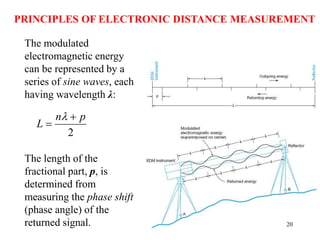
The modulated
electromagnetic energy
can be represented by a
series of sine waves, each
having wavelength λ:
The length of the
fractional part, p, is
determined from
measuring the phase shift
(phase angle) of the
returned signal.
2
p
n
L



21
PRINCIPLES OF ELECTRONIC DISTANCE MEASUREMENT
Example
If the number of cycles is 9, wavelength is 20 m and the
phase angle of the returned signal is 115.7°, calculate the
length of the fractional part and the overall measured
length (answer: 93.214 m).
[See Whiteboard]
22
Generalized block diagram illustrating
operation of electro-optical EDM instrument
23
DETERMINING THE NUMBER OF FULL WAVELENGTHS
• EDM instruments can precisely determine the fractional
part of a wavelength (by measuring the received phase
shift). To determine the number of full wavelengths,
different modulation frequencies (with different
effective wavelengths) should be used.
• When using four different modulation frequencies that
produce effective wavelengths of 10.000 m, 100.00 m,
1000.0 m and 10000 m, those four wavelengths can
precisely measure distances up to 10 km.
• How to use the above wavelengths to measure a
distance of 3867.142 m?
24
TOTAL STATION INSTRUMENTS
• Most of the modern EDM instruments are now combined with an
electronic digital theodolite and a computer processor.
• Those devices are called total station instruments.
• They can measure distances as well as horizontal and vertical (or
zenith) angles.
• The results are transmitted to the built-in computer for recording
and further analysis.
25
USES OF TOTAL STATION INSTRUMENTS
• Total station instruments are very valuable in all types of
surveying. Some examples are:
− They can compute the horizontal and vertical components
of any slope distance.
− They can also compute the coordinates of any sighted
point (by knowing the coordinates of the occupied
station).
− They can also operate in tracking mode where a required
distance (horizontal, vertical or slope) is input to the
instrument, and as the reflector is moved forward or
backward, the instrument displays the difference between
the desired distance and that to the reflector.
• Total station instruments usually have a range of approximately
3-km (with single-prism reflector) or 100-m (in the
reflectorless mode).
• Usually they have an accuracy of (2 mm + 2 ppm) and they
read angles to the nearest 1”.
26
USING TOTAL STATIONS TO COMPUTE HORIZONTAL
LENGTHS FROM SLOPE DISTANCES
)
(
)
( r
B
e
A h
elev
h
elev
d 



Example
A slope distance of 165.360 m was measured from A to B, whose
elevations were 447.401 and 445.389 m above datum, respectively.
Find the horizontal length of line AB if the height of the total
station and the reflector were 1.417 and 1.615 m above their
respective stations (answer: 165.350 m).
[See whiteboard]
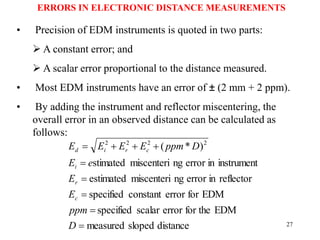
• Precision of EDM instruments is quoted in two parts:
 A constant error; and
 A scalar error proportional to the distance measured.
• Most EDM instruments have an error of ± (2 mm + 2 ppm).
• By adding the instrument and reflector miscentering, the
overall error in an observed distance can be calculated as
follows:
27
ERRORS IN ELECTRONIC DISTANCE MEASUREMENTS
distance
sloped
measured
EDM
for the
error
scalar
specified
EDM
for
error
constant
specified
reflector
in
error
ng
miscenteri
estimated
instrument
in
error
ng
miscenteri
stimated
)
*
( 2
2
2
2









D
ppm
E
E
e
E
D
ppm
E
E
E
E
c
r
i
c
r
i
d
28
ERRORS IN ELECTRONIC DISTANCE MEASUREMENTS
Example
A slope distance of 827.329 m was measured between two stations
with an EDM instrument that has an error of ± (2 mm + 2 ppm). the
instrument was centered with an estimated error of ± 3 mm, and the
reflector was centered with an estimated error of ± 5 mm. Calculate
the overall estimated error in the measured distance and its
precision (answer: ± 6.4 mm, 1:129,000).
[See whiteboard]
29
REFLECTOR CONSTANT
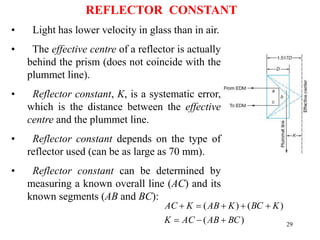
• Light has lower velocity in glass than in air.
• The effective centre of a reflector is actually
behind the prism (does not coincide with the
plummet line).
• Reflector constant, K, is a systematic error,
which is the distance between the effective
centre and the plummet line.
• Reflector constant depends on the type of
reflector used (can be as large as 70 mm).
• Reflector constant can be determined by
measuring a known overall line (AC) and its
known segments (AB and BC):
)
(
)
(
)
(
BC
AB
AC
K
K
BC
K
AB
K
AC








30
Example
• To calibrate an EDM instrument, distances AC, AB, and BC
along a straight line were observed as 116.633 m, 80.320 m,
and 36.281 m, respectively. What is the system measurement
constant for this equipment? Compute the length of each
segment corrected for constant (answer: 0.032 m, 116.665 m,
80.352 m, 36.313 m).
31
NATURAL ERRORS IN EDM INSTRUMENTS
• Variations in temperature,
pressure and humidity affect the
index of refraction and therefore
modify the wavelength of the
electromagnetic energy.
• Atmospheric pressure should be
measured using a barometer.
• Atmospheric variables should be
input to total stations equipped
with EDM.
• A temperature error of 10° C or a
pressure difference of 25 mm Hg
will each produce a distance error
of 10 ppm.

BASIC SURVEYING--Measuring_Distance.pptx

  • 1.
    CIV 205 Introduction toGeomatics Course Instructor Dr. Saidi Siuhi Chapter 6-Distance Measurement
  • 2.
    2 METHODS USED TOMEASURE DISTANCES  Pacing and odometer  Tacheometry (stadia)  Substense bar  Taping  EDM
  • 3.
    3 EQUIPMENT FOR TAPING •Tape (steel / invar / lovar / cloth / fiberglass)  Take note of graduations  Metric tape – 15, 30, 50 m Long • Taping pins • Hand level • Range poles • Plumb bobs • Tension handle
  • 4.
    4 TAPING PROCEDURES • Liningin (forward tapeperson / rear tapeperson) • Applying tension • Plumbing • Marking tape lengths • Reading the tape (add tape / cut tape) • Recording the distance
  • 5.
    5 TAPING ON SLOPINGGROUND • When taping on uneven or sloping ground, the tape should be held horizontally using plumb bob. • A plumb line cannot be steady for heights above the chest. • In this case, shorter distances are measured and accumulated to total a full tape length (breaking).
  • 6.
    6 SLOPE MEASUREMENTS • Todetermine horizontal distance H, you can measure: − The angle of inclination α, or − The difference in elevation, d 2 2 cos d L H L H     Theorem) n Pythagorea by tion (approxima 2 2 L d L H  
  • 7.
    • Improper plumbing. •Faulty marking. • Incorrect reading or interpolation. 7 RANDOM ERRORS IN TAPING [Should corrections be added or subtracted?]
  • 8.
    8 • Incorrect lengthof tape Where: CL = correction to be applied to the measured length to obtain the true length (m). l = actual tape length (m). l’ = nominal tape length (m). L = measured (recorded) length of line (m). SYSTEMATIC ERRORS IN TAPING L l l l CL         ' '
  • 9.
    9 • Temperature otherthan standard Where: CT = correction in the line caused by nonstandard temperature (m). k = coefficient of thermal expansion and contraction of the tape. For ordinary tape, k = 0.0000116 per unit length per degree Celsius. T1 = tape temperature at time of measurement (0C). T = tape temperature when it has standard length (0C). L = measured (recorded) length of line (m). SYSTEMATIC ERRORS IN TAPING  L T T k CT   1
  • 10.
    10 • Inconsistent pull Where: Cp= elongation in tape length due to pull (m) P1 = pull applied to the tape at the time of observation (kg). P = standard pull for the tape (kg). A = area in square centimeters (cm2) E = kilogram per square centimeter (kg/cm2) (E = 2,000,000 kg/cm2) L = measured (recorded) length of line (m). SYSTEMATIC ERRORS IN TAPING   AE L P P CP   1
  • 11.
    11 • Sag Where: CS =correction for sag (m). LS = unsupported length of the tape (m). w = weight of the tape per unit of length (kg/m). P1 = pull of the tape (kg). SYSTEMATIC ERRORS IN TAPING 2 1 3 2 24P L w C S S  
  • 12.
    12 SYSTEMATIC ERRORS INTAPING • Figure illustrating the effect of sag on horizontal distance
  • 13.
    13 TAPE PROBLEMS • Alltape problems develop due tape either longer or shorter than its graduated “nominal” length of manufacture: − temperature changes, − tension applied, − etc. • Two types of taping tasks − An unknown distance between two fixed points can be measured. − A required distance can be laid off from one fixed point.
  • 14.
    14 TAPE PROBLEMS • Fourpossible versions of taping problems: − Measure with a tape that is too long − Measure with a tape that is too short − Lay off with a tape that is too long − Lay off with a tape that is too short • The following examples illustrates procedures for computing and applying corrections for the two basic types of problems − Measurement − Lay off
  • 15.
    EXAMPLE 6.1 A 30-msteel tape (k = 0.0000116; E = 2,000,000 kg/cm2) was standardized at 20 C° and supported throughout under a tension of 5.45 kg and it was found to be 30.012 m long. The tape had a cross-sectional area of 0.05 cm2 and a weight of 0.03967 kg/m. That tape was held horizontal, supported at the ends only, with a constant tension of 9.09 kg, to measure a line from A to B in three segments as per the recorded data shown below. Apply corrections for tape length, temperature, pull, and sag and determine the correct length of the line (answer: 81.131 m). Section Measured Distance Temperature (C°) A-1 30.000 14 1-2 30.000 15 2-B 21.151 16 [Solution next page] 15 COMBINED CORRECTIONS IN TAPING
  • 16.
  • 17.
    Example 6.2 A 100ft tape standardized at 68oF and supported throughout under a tension of 20 lb was found to be 100.012 ft long. The tape had a cross-sectional area of 0.0078 in.2 and a weight of 0.0266 lb/ft. This tape is used to lay off a horizontal distance CD of exactly 175.00 ft. The ground is on a smooth 3% grade, thus the tape will be used fully supported. Determine the correct slope distance to layoff if a pull of 15 lb is used and temperature is 87oF. [Solution next page] 17 COMBINED CORRECTIONS IN TAPING
  • 18.
  • 19.
    • Transmission andreflection of modulated light Wave length: λ = V / f where V = velocity and f = modulation frequency • The velocity of electromagnetic energy is slowed in the atmosphere according to the following equation: V = c / n Where c is the velocity in vacuum and n is the atmospheric index of refraction (1.0001 – 1.0005). 19 PROPAGATION OF ELECTROMAGNETIC ENERGY ELECTRONIC DISTANCE MEASUREMENT (EDM)
  • 20.
    20 PRINCIPLES OF ELECTRONICDISTANCE MEASUREMENT The modulated electromagnetic energy can be represented by a series of sine waves, each having wavelength λ: The length of the fractional part, p, is determined from measuring the phase shift (phase angle) of the returned signal. 2 p n L   
  • 21.
    21 PRINCIPLES OF ELECTRONICDISTANCE MEASUREMENT Example If the number of cycles is 9, wavelength is 20 m and the phase angle of the returned signal is 115.7°, calculate the length of the fractional part and the overall measured length (answer: 93.214 m). [See Whiteboard]
  • 22.
    22 Generalized block diagramillustrating operation of electro-optical EDM instrument
  • 23.
    23 DETERMINING THE NUMBEROF FULL WAVELENGTHS • EDM instruments can precisely determine the fractional part of a wavelength (by measuring the received phase shift). To determine the number of full wavelengths, different modulation frequencies (with different effective wavelengths) should be used. • When using four different modulation frequencies that produce effective wavelengths of 10.000 m, 100.00 m, 1000.0 m and 10000 m, those four wavelengths can precisely measure distances up to 10 km. • How to use the above wavelengths to measure a distance of 3867.142 m?
  • 24.
    24 TOTAL STATION INSTRUMENTS •Most of the modern EDM instruments are now combined with an electronic digital theodolite and a computer processor. • Those devices are called total station instruments. • They can measure distances as well as horizontal and vertical (or zenith) angles. • The results are transmitted to the built-in computer for recording and further analysis.
  • 25.
    25 USES OF TOTALSTATION INSTRUMENTS • Total station instruments are very valuable in all types of surveying. Some examples are: − They can compute the horizontal and vertical components of any slope distance. − They can also compute the coordinates of any sighted point (by knowing the coordinates of the occupied station). − They can also operate in tracking mode where a required distance (horizontal, vertical or slope) is input to the instrument, and as the reflector is moved forward or backward, the instrument displays the difference between the desired distance and that to the reflector. • Total station instruments usually have a range of approximately 3-km (with single-prism reflector) or 100-m (in the reflectorless mode). • Usually they have an accuracy of (2 mm + 2 ppm) and they read angles to the nearest 1”.
  • 26.
    26 USING TOTAL STATIONSTO COMPUTE HORIZONTAL LENGTHS FROM SLOPE DISTANCES ) ( ) ( r B e A h elev h elev d     Example A slope distance of 165.360 m was measured from A to B, whose elevations were 447.401 and 445.389 m above datum, respectively. Find the horizontal length of line AB if the height of the total station and the reflector were 1.417 and 1.615 m above their respective stations (answer: 165.350 m). [See whiteboard]
  • 27.
    • Precision ofEDM instruments is quoted in two parts:  A constant error; and  A scalar error proportional to the distance measured. • Most EDM instruments have an error of ± (2 mm + 2 ppm). • By adding the instrument and reflector miscentering, the overall error in an observed distance can be calculated as follows: 27 ERRORS IN ELECTRONIC DISTANCE MEASUREMENTS distance sloped measured EDM for the error scalar specified EDM for error constant specified reflector in error ng miscenteri estimated instrument in error ng miscenteri stimated ) * ( 2 2 2 2          D ppm E E e E D ppm E E E E c r i c r i d
  • 28.
    28 ERRORS IN ELECTRONICDISTANCE MEASUREMENTS Example A slope distance of 827.329 m was measured between two stations with an EDM instrument that has an error of ± (2 mm + 2 ppm). the instrument was centered with an estimated error of ± 3 mm, and the reflector was centered with an estimated error of ± 5 mm. Calculate the overall estimated error in the measured distance and its precision (answer: ± 6.4 mm, 1:129,000). [See whiteboard]
  • 29.
    29 REFLECTOR CONSTANT • Lighthas lower velocity in glass than in air. • The effective centre of a reflector is actually behind the prism (does not coincide with the plummet line). • Reflector constant, K, is a systematic error, which is the distance between the effective centre and the plummet line. • Reflector constant depends on the type of reflector used (can be as large as 70 mm). • Reflector constant can be determined by measuring a known overall line (AC) and its known segments (AB and BC): ) ( ) ( ) ( BC AB AC K K BC K AB K AC        
  • 30.
    30 Example • To calibratean EDM instrument, distances AC, AB, and BC along a straight line were observed as 116.633 m, 80.320 m, and 36.281 m, respectively. What is the system measurement constant for this equipment? Compute the length of each segment corrected for constant (answer: 0.032 m, 116.665 m, 80.352 m, 36.313 m).
  • 31.
    31 NATURAL ERRORS INEDM INSTRUMENTS • Variations in temperature, pressure and humidity affect the index of refraction and therefore modify the wavelength of the electromagnetic energy. • Atmospheric pressure should be measured using a barometer. • Atmospheric variables should be input to total stations equipped with EDM. • A temperature error of 10° C or a pressure difference of 25 mm Hg will each produce a distance error of 10 ppm.