Total Station Instruments, Angle
Observations
Dr. Mahmood Arshad
Assistant Professor,
Dept. of Mining Engineering,
Faculty of Earth Sciences and
Engineering,
University of Engineering & Technology,
Lahore.
smarshad@uet.edu.pk
Min-E-240 Surveying
Lecture 9 – Week 5
INTRODUCTION
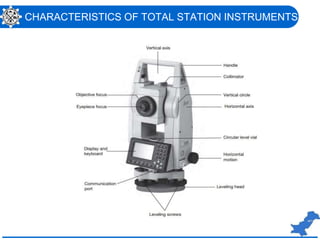
CHARACTERISTICS OF TOTAL STATION INSTRUMENTS
FUNCTIONS PERFORMED BY TOTAL STATION INSTRUMENTS
 Averaging of multiple angle and distance observations,
 Correcting electronically observed distances for prism
constants, atmospheric pressure, and temperature,
 Making curvature and refraction corrections to elevations
determined by trigonometric leveling,
 Reducing slope distances to their horizontal and vertical
components,
 Calculating point elevations from the vertical distance
components (supplemented with keyboard input of
instrument and reflector heights), and
 Computing coordinates of surveyed points from horizontal
angle and horizontal distance components (supplemented
with keyboard input of coordinates for the occupied station,
and a reference azimuth.
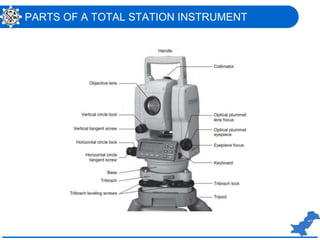
PARTS OF A TOTAL STATION INSTRUMENT
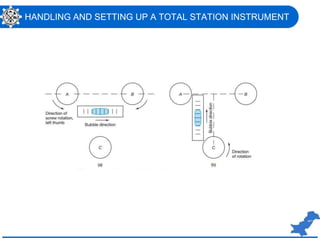
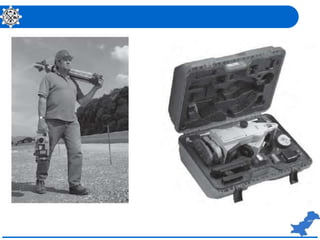
HANDLING AND SETTING UP A TOTAL STATION INSTRUMENT
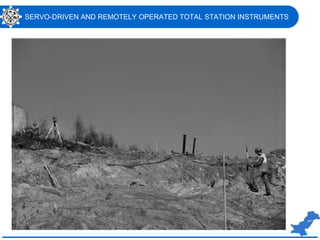
SERVO-DRIVEN AND REMOTELY OPERATED TOTAL STATION INSTRUMENTS
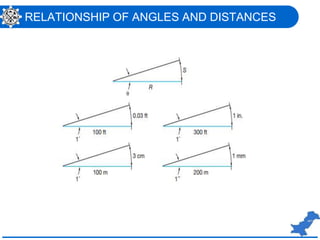
RELATIONSHIP OF ANGLES AND DISTANCES
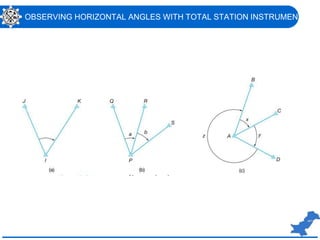
OBSERVING HORIZONTAL ANGLES WITH TOTAL STATION INSTRUMENTS
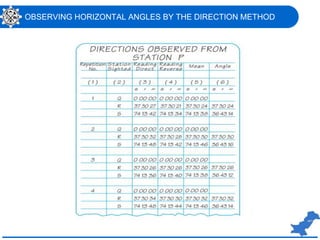
OBSERVING HORIZONTAL ANGLES BY THE DIRECTION METHOD
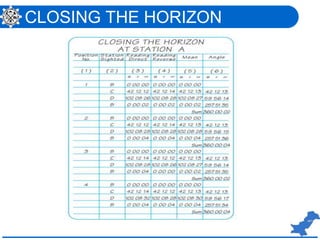
CLOSING THE HORIZON
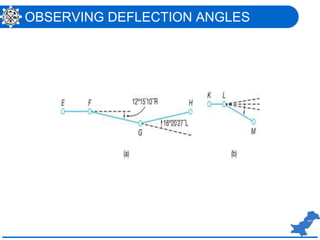
OBSERVING DEFLECTION ANGLES
OBSERVING AZIMUTHS
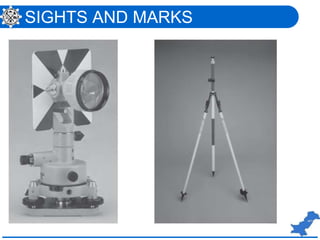
SIGHTS AND MARKS
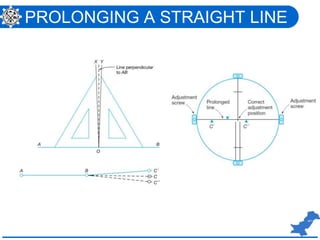
PROLONGING A STRAIGHT LINE
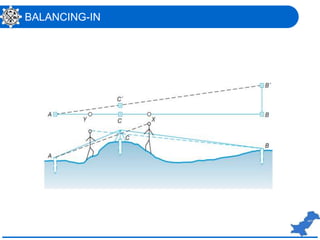
BALANCING-IN
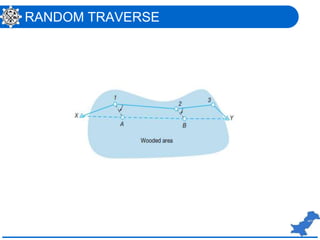
RANDOM TRAVERSE
DETERMINING ELEVATION DIFFERENCES
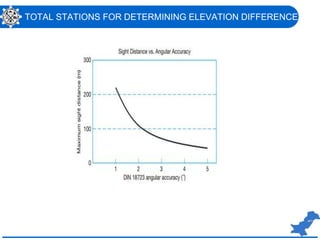
 Place the instrument between two prisms so that sight
distances are appropriate for the angular accuracy of the
instrument;
 Use target panels with the prisms;
 Keep rod heights equal so that their measurement is
unnecessary;
 Observe the vertical distances between the prisms using
two complete sets4 of observations at a minimum;
 Keep sight distances approximately equal; and
 Apply all necessary atmospheric corrections and reflector
constants
ADJUSTMENT OF TOTAL STATION INSTRUMENTS AND THEIR ACCESSORIES
 Adjustment of Plate-Level Vials
 Adjustment of Tripods
 Adjustment of Tribrachs
 Adjustment of Plummets
 Adjustment of Circular Level Bubbles
TOTAL STATIONS FOR DETERMINING ELEVATION DIFFERENCES
ADJUSTMENT OF TOTAL STATION INSTRUMENTS AND THEIR ACCESSORIES
 Adjustment of Plate-Level Vials
 Adjustment of Tripods
 Adjustment of Tribrachs
 Adjustment of Plummets
 Adjustment of Circular Level Bubbles
SOURCES OF ERROR IN TOTAL STATION WORK
 Here comes the homework. 8.20 SOURCES OF ERROR IN
TOTAL STATION WORK
Today’s Quote
 Either find a way, or make one.

Lecture 09 total station instruments and angle observations

  • 1.
    Total Station Instruments,Angle Observations Dr. Mahmood Arshad Assistant Professor, Dept. of Mining Engineering, Faculty of Earth Sciences and Engineering, University of Engineering & Technology, Lahore. smarshad@uet.edu.pk Min-E-240 Surveying Lecture 9 – Week 5
  • 2.
  • 3.
    CHARACTERISTICS OF TOTALSTATION INSTRUMENTS
  • 4.
    FUNCTIONS PERFORMED BYTOTAL STATION INSTRUMENTS  Averaging of multiple angle and distance observations,  Correcting electronically observed distances for prism constants, atmospheric pressure, and temperature,  Making curvature and refraction corrections to elevations determined by trigonometric leveling,  Reducing slope distances to their horizontal and vertical components,  Calculating point elevations from the vertical distance components (supplemented with keyboard input of instrument and reflector heights), and  Computing coordinates of surveyed points from horizontal angle and horizontal distance components (supplemented with keyboard input of coordinates for the occupied station, and a reference azimuth.
  • 5.
    PARTS OF ATOTAL STATION INSTRUMENT
  • 6.
    HANDLING AND SETTINGUP A TOTAL STATION INSTRUMENT
  • 9.
    SERVO-DRIVEN AND REMOTELYOPERATED TOTAL STATION INSTRUMENTS
  • 10.
  • 11.
    OBSERVING HORIZONTAL ANGLESWITH TOTAL STATION INSTRUMENTS
  • 12.
    OBSERVING HORIZONTAL ANGLESBY THE DIRECTION METHOD
  • 13.
  • 14.
  • 15.
  • 16.
  • 17.
  • 18.
  • 19.
  • 20.
    DETERMINING ELEVATION DIFFERENCES Place the instrument between two prisms so that sight distances are appropriate for the angular accuracy of the instrument;  Use target panels with the prisms;  Keep rod heights equal so that their measurement is unnecessary;  Observe the vertical distances between the prisms using two complete sets4 of observations at a minimum;  Keep sight distances approximately equal; and  Apply all necessary atmospheric corrections and reflector constants
  • 21.
    ADJUSTMENT OF TOTALSTATION INSTRUMENTS AND THEIR ACCESSORIES  Adjustment of Plate-Level Vials  Adjustment of Tripods  Adjustment of Tribrachs  Adjustment of Plummets  Adjustment of Circular Level Bubbles
  • 22.
    TOTAL STATIONS FORDETERMINING ELEVATION DIFFERENCES
  • 23.
    ADJUSTMENT OF TOTALSTATION INSTRUMENTS AND THEIR ACCESSORIES  Adjustment of Plate-Level Vials  Adjustment of Tripods  Adjustment of Tribrachs  Adjustment of Plummets  Adjustment of Circular Level Bubbles
  • 24.
    SOURCES OF ERRORIN TOTAL STATION WORK  Here comes the homework. 8.20 SOURCES OF ERROR IN TOTAL STATION WORK
  • 25.
    Today’s Quote  Eitherfind a way, or make one.