5-1
Dr. D. J. Jackson Lecture 5-1Electrical & Computer Engineering
Programmable Logic
Controllers
PLC Timer Functions
Dr. D. J. Jackson Lecture 5-2Electrical & Computer Engineering
Outline
• Introduction
• PLC Timer Functions
• Examples of Timer Function Applications
5-2
Dr. D. J. Jackson Lecture 5-3Electrical & Computer Engineering
Objectives
• Describe PLC retentive and delay timer
functions.
• List and describe major timing functions that
are commonly used in circuits and processes.
• Apply PLC functions and PLC circuitry to
process control for timing functions.
• Apply PLC timers in multiple timing problems
that combine two or more of the basic timing
functions.
• Apply PLC timers for the control of processes.
Dr. D. J. Jackson Lecture 5-4Electrical & Computer Engineering
Introduction
• The most commonly used process control
device after coils and contacts is the timer.
• The most common timing function is TIME
DELAY-ON, which is the basic function.
• There are also many other timing
configurations, all of which can be derived
from one or more of the basic TIME DELAY-
ON functions.
• PLCs have the one basic function timer
capability in multiples.
5-3
Dr. D. J. Jackson Lecture 5-5Electrical & Computer Engineering
Timer Uses
• The timing block functions are used with
various contact arrangements and in
multiples to accomplish various timing tasks.
• Typical industrial timing tasks include timing
of the intervals for welding, painting, and
heat treating.
• Timers can also predetermine the interval
between two operations.
• With a PLC you can utilize as many timer
blocks as you need, within the PLC memory
limitations.
Dr. D. J. Jackson Lecture 5-6Electrical & Computer Engineering
Basic Timing and Derived
Functions
• Here we illustrate the basic PLC TIME DELAY-
ON function and some other derived timing
functions.
• Typical of the derived functions are
– TIME DELAY-OFF,
– interval pulse timing,
– and multiple pulse timing of more than one
process operation.
5-4
Dr. D. J. Jackson Lecture 5-7Electrical & Computer Engineering
Timer Variables
• One major advantage of the PLC timer is that
its time may be a programmable variable
time as well as a fixed time.
• The variable time interval may be in
accordance with a changing register value.
• Another advantage of the PLC timer is that
its timer accuracy, repeatability, and
reliability are extremely high because it is
based on solid-state technology.
Dr. D. J. Jackson Lecture 5-8Electrical & Computer Engineering
Non-retentive Timers
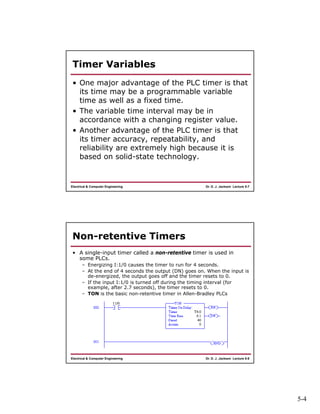
• A single-input timer called a non-retentive timer is used in
some PLCs.
– Energizing I:1/0 causes the timer to run for 4 seconds.
– At the end of 4 seconds the output (DN) goes on. When the input is
de-energized, the output goes off and the timer resets to 0.
– If the input I:1/0 is turned off during the timing interval (for
example, after 2.7 seconds), the timer resets to 0.
– TON is the basic non-retentive timer in Allen-Bradley PLCs
5-5
Dr. D. J. Jackson Lecture 5-9Electrical & Computer Engineering
Timer Information
• The timer table contains all information for that timer
– /EN: Timer is enabled (i.e. the input rung is energized)
– /TT: Timer is timing
– /DN: Timer is done
– .PRE: Timer preset value (point at which the timer stops timing)
– .ACC: Timer accumulator (accumulated time value)
Dr. D. J. Jackson Lecture 5-10Electrical & Computer Engineering
Timer Delay Off (TOF)
• The TOF timer functions the opposite of the TON timer.
– De-Energizing I:1/0 causes the timer to run for 4.5 seconds. The
DN bit is initially set.
– At the end of 4.5 seconds the output (DN) goes off. When the input
is energized the timer resets to 0.
– If the input I:1/0 is turned on during the timing interval (for
example, after 2.7 seconds), the timer resets to 0.
5-6
Dr. D. J. Jackson Lecture 5-11Electrical & Computer Engineering
Retentive Timers (RTO)
• Functions exactly like TON except the accumulated
time value is retained even if the input rung is de-
energized.
Dr. D. J. Jackson Lecture 5-12Electrical & Computer Engineering
Timer Reset Coils (RES)
• A reset coil (RES) can be associated with a timer to
provide a means of resetting the accumulated time
value (and status bits) at any given time
5-7
Dr. D. J. Jackson Lecture 5-13Electrical & Computer Engineering
Examples Of Timer
Function Applications
• On delay
– Output B comes on at a specific set time after output A is
turned on. When A is turned off, B also goes off.
• Limited on time
– A and B go on at the same time. B goes off after specific set
time period, but A remains on.
• One-shot operation
– Output B goes on for a specified time after output A is
turned on. Output B will run for its specified time interval
even if A is turned off during the B timing interval.
• Interval time within a cycle
– We may require that an output come on 7.5 seconds after
system startup, remain on for 4.5 seconds, and then go off
and stay off. The interval would repeat only after the system
is shut off and then turned back on.
Dr. D. J. Jackson Lecture 5-14Electrical & Computer Engineering
On Delay Timer Function
• The first example is the simplest form of time delay.
– When the circuit is turned on, one action takes place.
– A specified time later, another action occurs.
– O:2/1 energizes exactly 8 seconds after O:2/0 energizes,
provided I:1/0 remains energized
5-8
Dr. D. J. Jackson Lecture 5-15Electrical & Computer Engineering
Limited On-Time Timer Function
• This example illustrates a situation in which two outputs go on
at the same time.
• Then, one of them is to go off after a preset period of time.
• One output, O:2/0, stays on; the other output, O:2/1, turns off
at the end of the timing interval.
• Resetting is accomplished by turning I:1/0 off.
Dr. D. J. Jackson Lecture 5-16Electrical & Computer Engineering
One-shot Operation Timer
Function
• The next example is a one-shot system.
– The output comes on after its specified time period even if
the input is turned off during the timing period.
5-9
Dr. D. J. Jackson Lecture 5-17Electrical & Computer Engineering
Interval Time Within a Cycle
• This example is for a timed interval of a
number of seconds after the start of a
process operation.
– This time interval is sometimes called an
embedded time interval.
– A fan is to come on 8.7 seconds after a system is
turned on.
– It is then to run until 16 seconds after the system
is turned on, which is a net time of 7.3 seconds.
Dr. D. J. Jackson Lecture 5-18Electrical & Computer Engineering
Interval Time Example

Lect05

  • 1.
    5-1 Dr. D. J.Jackson Lecture 5-1Electrical & Computer Engineering Programmable Logic Controllers PLC Timer Functions Dr. D. J. Jackson Lecture 5-2Electrical & Computer Engineering Outline • Introduction • PLC Timer Functions • Examples of Timer Function Applications
  • 2.
    5-2 Dr. D. J.Jackson Lecture 5-3Electrical & Computer Engineering Objectives • Describe PLC retentive and delay timer functions. • List and describe major timing functions that are commonly used in circuits and processes. • Apply PLC functions and PLC circuitry to process control for timing functions. • Apply PLC timers in multiple timing problems that combine two or more of the basic timing functions. • Apply PLC timers for the control of processes. Dr. D. J. Jackson Lecture 5-4Electrical & Computer Engineering Introduction • The most commonly used process control device after coils and contacts is the timer. • The most common timing function is TIME DELAY-ON, which is the basic function. • There are also many other timing configurations, all of which can be derived from one or more of the basic TIME DELAY- ON functions. • PLCs have the one basic function timer capability in multiples.
  • 3.
    5-3 Dr. D. J.Jackson Lecture 5-5Electrical & Computer Engineering Timer Uses • The timing block functions are used with various contact arrangements and in multiples to accomplish various timing tasks. • Typical industrial timing tasks include timing of the intervals for welding, painting, and heat treating. • Timers can also predetermine the interval between two operations. • With a PLC you can utilize as many timer blocks as you need, within the PLC memory limitations. Dr. D. J. Jackson Lecture 5-6Electrical & Computer Engineering Basic Timing and Derived Functions • Here we illustrate the basic PLC TIME DELAY- ON function and some other derived timing functions. • Typical of the derived functions are – TIME DELAY-OFF, – interval pulse timing, – and multiple pulse timing of more than one process operation.
  • 4.
    5-4 Dr. D. J.Jackson Lecture 5-7Electrical & Computer Engineering Timer Variables • One major advantage of the PLC timer is that its time may be a programmable variable time as well as a fixed time. • The variable time interval may be in accordance with a changing register value. • Another advantage of the PLC timer is that its timer accuracy, repeatability, and reliability are extremely high because it is based on solid-state technology. Dr. D. J. Jackson Lecture 5-8Electrical & Computer Engineering Non-retentive Timers • A single-input timer called a non-retentive timer is used in some PLCs. – Energizing I:1/0 causes the timer to run for 4 seconds. – At the end of 4 seconds the output (DN) goes on. When the input is de-energized, the output goes off and the timer resets to 0. – If the input I:1/0 is turned off during the timing interval (for example, after 2.7 seconds), the timer resets to 0. – TON is the basic non-retentive timer in Allen-Bradley PLCs
  • 5.
    5-5 Dr. D. J.Jackson Lecture 5-9Electrical & Computer Engineering Timer Information • The timer table contains all information for that timer – /EN: Timer is enabled (i.e. the input rung is energized) – /TT: Timer is timing – /DN: Timer is done – .PRE: Timer preset value (point at which the timer stops timing) – .ACC: Timer accumulator (accumulated time value) Dr. D. J. Jackson Lecture 5-10Electrical & Computer Engineering Timer Delay Off (TOF) • The TOF timer functions the opposite of the TON timer. – De-Energizing I:1/0 causes the timer to run for 4.5 seconds. The DN bit is initially set. – At the end of 4.5 seconds the output (DN) goes off. When the input is energized the timer resets to 0. – If the input I:1/0 is turned on during the timing interval (for example, after 2.7 seconds), the timer resets to 0.
  • 6.
    5-6 Dr. D. J.Jackson Lecture 5-11Electrical & Computer Engineering Retentive Timers (RTO) • Functions exactly like TON except the accumulated time value is retained even if the input rung is de- energized. Dr. D. J. Jackson Lecture 5-12Electrical & Computer Engineering Timer Reset Coils (RES) • A reset coil (RES) can be associated with a timer to provide a means of resetting the accumulated time value (and status bits) at any given time
  • 7.
    5-7 Dr. D. J.Jackson Lecture 5-13Electrical & Computer Engineering Examples Of Timer Function Applications • On delay – Output B comes on at a specific set time after output A is turned on. When A is turned off, B also goes off. • Limited on time – A and B go on at the same time. B goes off after specific set time period, but A remains on. • One-shot operation – Output B goes on for a specified time after output A is turned on. Output B will run for its specified time interval even if A is turned off during the B timing interval. • Interval time within a cycle – We may require that an output come on 7.5 seconds after system startup, remain on for 4.5 seconds, and then go off and stay off. The interval would repeat only after the system is shut off and then turned back on. Dr. D. J. Jackson Lecture 5-14Electrical & Computer Engineering On Delay Timer Function • The first example is the simplest form of time delay. – When the circuit is turned on, one action takes place. – A specified time later, another action occurs. – O:2/1 energizes exactly 8 seconds after O:2/0 energizes, provided I:1/0 remains energized
  • 8.
    5-8 Dr. D. J.Jackson Lecture 5-15Electrical & Computer Engineering Limited On-Time Timer Function • This example illustrates a situation in which two outputs go on at the same time. • Then, one of them is to go off after a preset period of time. • One output, O:2/0, stays on; the other output, O:2/1, turns off at the end of the timing interval. • Resetting is accomplished by turning I:1/0 off. Dr. D. J. Jackson Lecture 5-16Electrical & Computer Engineering One-shot Operation Timer Function • The next example is a one-shot system. – The output comes on after its specified time period even if the input is turned off during the timing period.
  • 9.
    5-9 Dr. D. J.Jackson Lecture 5-17Electrical & Computer Engineering Interval Time Within a Cycle • This example is for a timed interval of a number of seconds after the start of a process operation. – This time interval is sometimes called an embedded time interval. – A fan is to come on 8.7 seconds after a system is turned on. – It is then to run until 16 seconds after the system is turned on, which is a net time of 7.3 seconds. Dr. D. J. Jackson Lecture 5-18Electrical & Computer Engineering Interval Time Example