INDUSTRIAL AUTOMATION
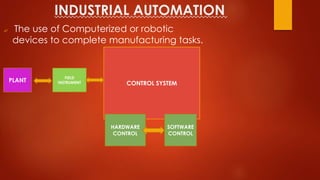
 The use of Computerized or robotic
devices to complete manufacturing tasks.
PLANT
FIELD
INSTRUMENT CONTROL SYSTEM
HARDWARE
CONTROL
SOFTWARE
CONTROL
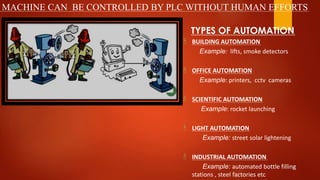
MACHINE CAN BE CONTROLLED BY PLC WITHOUT HUMAN EFFORTS
TYPES OF AUTOMATION
 BUILDING AUTOMATION
Example: lifts, smoke detectors
 OFFICE AUTOMATION
Example: printers, cctv cameras
 SCIENTIFIC AUTOMATION
Example: rocket launching
 LIGHT AUTOMATION
Example: street solar lightening
 INDUSTRIAL AUTOMATION
Example: automated bottle filling
stations , steel factories etc
INTRODUCTION
• A timer can provide a delay in time operation.
• Usually the duration of delay can be adjusted by
changing the dial setting.
• The most commonly used timer are the on delay timer
and off delay timer
• An on delay timer’s contact would not operate until a preset
delay time has elapsed after it is energized,
• An off delay timer’s contacts will immediately operate and stay
in this active state once it is energized
• But its’ contacts will only deactivate after a preset time has
elapsed once it is de-energized.
There are very few industrial control systems that do not need at
least one or two timed functions. They are used to
activate or de-activate a device after a preset interval of
time.
TIMERS
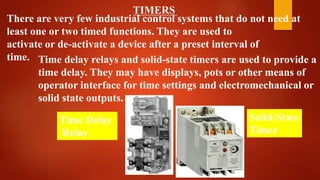
Time delay relays and solid-state timers are used to provide a
time delay. They may have displays, pots or other means of
operator interface for time settings and electromechanical or
solid state outputs.
Time Delay
Relay
Solid-State
Timer
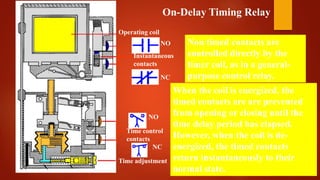
On-Delay Timing Relay
Operating coil
Instantaneous
contacts
NO
NC
Non timed contacts are
controlled directly by the
timer coil, as in a general-
purpose control relay.
Time control
contacts
NO
NC
Time adjustment
When the coil is energized, the
timed contacts are are prevented
from opening or closing until the
time delay period has elapsed.
However, when the coil is de-
energized, the timed contacts
return instantaneously to their
normal state.
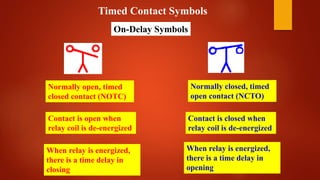
Normally open, timed
closed contact (NOTC)
Contact is open when
relay coil is de-energized
When relay is energized,
there is a time delay in
closing
Timed Contact Symbols
On-Delay Symbols
Normally closed, timed
open contact (NCTO)
Contact is closed when
relay coil is de-energized
When relay is energized,
there is a time delay in
opening
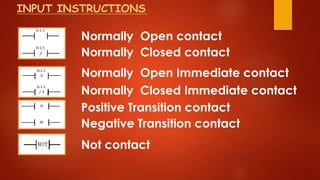
Normally Open contact
Normally Open Immediate contact
Normally Closed contact
Not contact
Normally Closed Immediate contact
Positive Transition contact
Negative Transition contact
INPUT INSTRUCTIONS
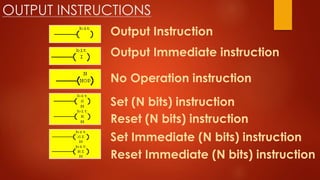
OUTPUT INSTRUCTIONS
Output Instruction
No Operation instruction
Output Immediate instruction
Set (N bits) instruction
Reset (N bits) instruction
Set Immediate (N bits) instruction
Reset Immediate (N bits) instruction
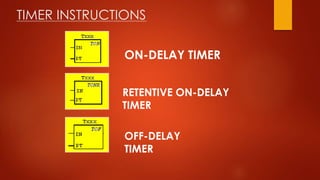
TIMER INSTRUCTIONS
ON-DELAY TIMER
RETENTIVE ON-DELAY
TIMER
OFF-DELAY
TIMER
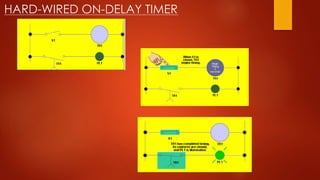
HARD-WIRED ON-DELAY TIMER
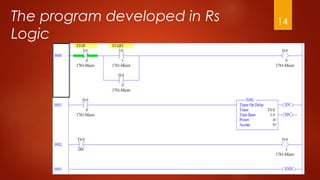
The program developed in Rs
Logic
14
APPLICATION OF TIMER:
 The timer used in many places.
 1) It is used in school, college, mills
etc.. To operate the bell’s.
 2) It is used in time Bomb’s.
 3) Alarm’s in watch.
15
Thank You!
Thank You!

On delay timer

  • 4.
    INDUSTRIAL AUTOMATION  Theuse of Computerized or robotic devices to complete manufacturing tasks. PLANT FIELD INSTRUMENT CONTROL SYSTEM HARDWARE CONTROL SOFTWARE CONTROL
  • 5.
    MACHINE CAN BECONTROLLED BY PLC WITHOUT HUMAN EFFORTS TYPES OF AUTOMATION  BUILDING AUTOMATION Example: lifts, smoke detectors  OFFICE AUTOMATION Example: printers, cctv cameras  SCIENTIFIC AUTOMATION Example: rocket launching  LIGHT AUTOMATION Example: street solar lightening  INDUSTRIAL AUTOMATION Example: automated bottle filling stations , steel factories etc
  • 6.
    INTRODUCTION • A timercan provide a delay in time operation. • Usually the duration of delay can be adjusted by changing the dial setting. • The most commonly used timer are the on delay timer and off delay timer • An on delay timer’s contact would not operate until a preset delay time has elapsed after it is energized, • An off delay timer’s contacts will immediately operate and stay in this active state once it is energized • But its’ contacts will only deactivate after a preset time has elapsed once it is de-energized.
  • 7.
    There are veryfew industrial control systems that do not need at least one or two timed functions. They are used to activate or de-activate a device after a preset interval of time. TIMERS Time delay relays and solid-state timers are used to provide a time delay. They may have displays, pots or other means of operator interface for time settings and electromechanical or solid state outputs. Time Delay Relay Solid-State Timer
  • 8.
    On-Delay Timing Relay Operatingcoil Instantaneous contacts NO NC Non timed contacts are controlled directly by the timer coil, as in a general- purpose control relay. Time control contacts NO NC Time adjustment When the coil is energized, the timed contacts are are prevented from opening or closing until the time delay period has elapsed. However, when the coil is de- energized, the timed contacts return instantaneously to their normal state.
  • 9.
    Normally open, timed closedcontact (NOTC) Contact is open when relay coil is de-energized When relay is energized, there is a time delay in closing Timed Contact Symbols On-Delay Symbols Normally closed, timed open contact (NCTO) Contact is closed when relay coil is de-energized When relay is energized, there is a time delay in opening
  • 10.
    Normally Open contact NormallyOpen Immediate contact Normally Closed contact Not contact Normally Closed Immediate contact Positive Transition contact Negative Transition contact INPUT INSTRUCTIONS
  • 11.
    OUTPUT INSTRUCTIONS Output Instruction NoOperation instruction Output Immediate instruction Set (N bits) instruction Reset (N bits) instruction Set Immediate (N bits) instruction Reset Immediate (N bits) instruction
  • 12.
    TIMER INSTRUCTIONS ON-DELAY TIMER RETENTIVEON-DELAY TIMER OFF-DELAY TIMER
  • 13.
  • 14.
    The program developedin Rs Logic 14
  • 15.
    APPLICATION OF TIMER: The timer used in many places.  1) It is used in school, college, mills etc.. To operate the bell’s.  2) It is used in time Bomb’s.  3) Alarm’s in watch. 15
  • 16.