DIGITAL LOGIC DESIGN (DLD)

Lecture # 1

Prepared By
Muhammad Shoaib Saleem
COURSE OBJECTIVES

Understand the digital logic design
 Understand the number systems, codes , Boolean
algebra
 Understand the combinational logic, circuits,
latches/flip flops and counters

WHAT IS DLD?

 Digital

logic design is a system in electrical
and computer engineering that uses simple
number values to produce input and output
operations.
WHAT IS DLD? CONT….
Digital logic design is the basis of electronic
systems, such as computers and cell phones.
 Digital logic is rooted in binary code, which make
information through zeroes and ones, giving each
number in the binary code an opposite value.
 This system facilitates the design of electronic
circuits that convey information, including logic
gates with functions that include AND, OR and NOT
commands.

WHAT IS DIGITAL
A single character in a numbering system. In
decimal, digits are 0 through 9.
 In binary, digits are 0 and 1. Describes any system
based on discontinuous data or events.
 Computers are digital machines because at their
most basic level they can distinguish between just
two values, 0 and 1, or off and on.
 There is no simple way to represent all the values
in between, such as 0.25. All data that a computer
processes must be encoded digitally, as a series of
zeroes and ones.

EXAMPLES OF DIGITAL DEVICES


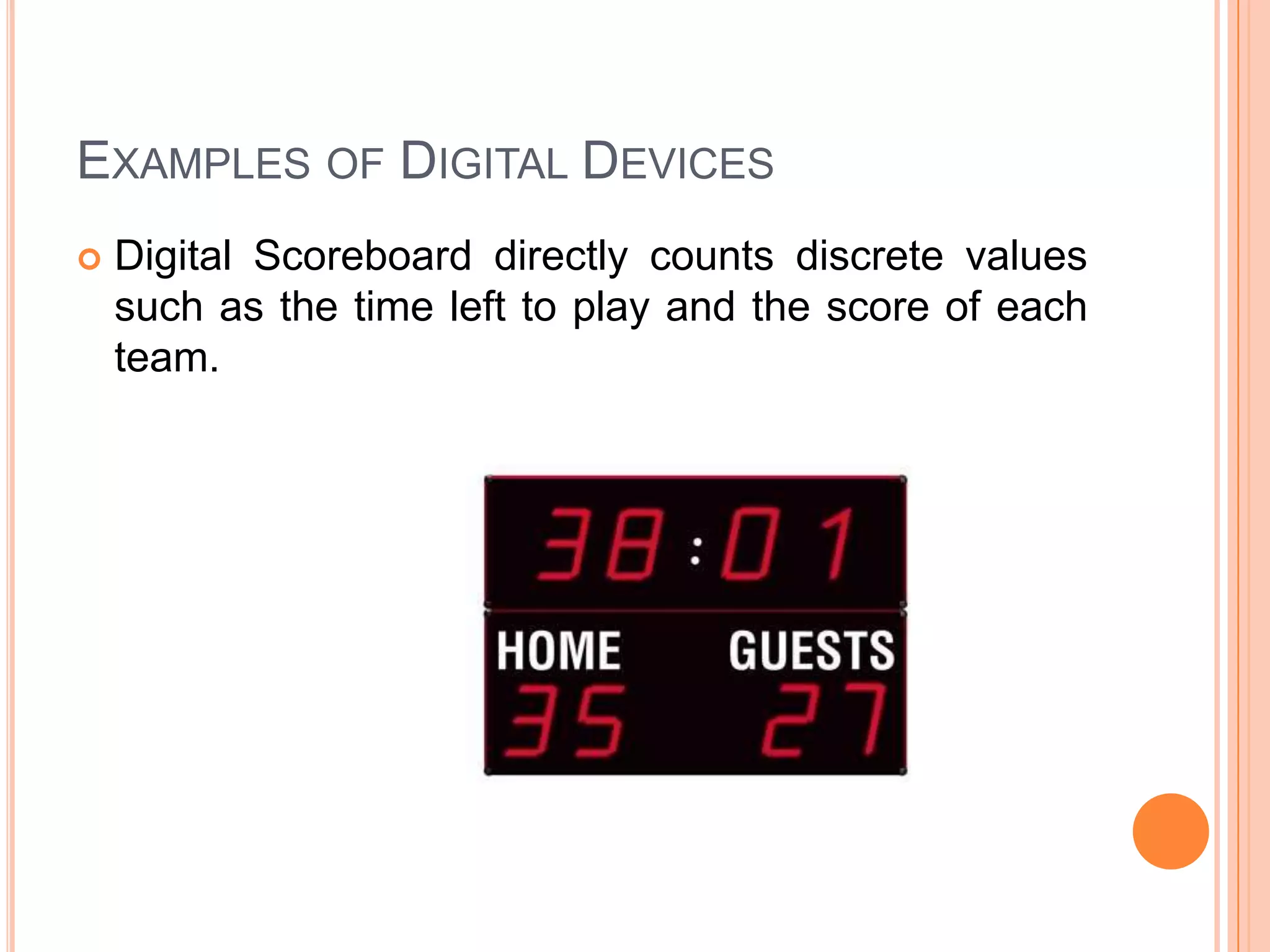
Digital watch displays the time that does not vary
continuously but changes from one discrete value
to the other.
EXAMPLES OF DIGITAL DEVICES


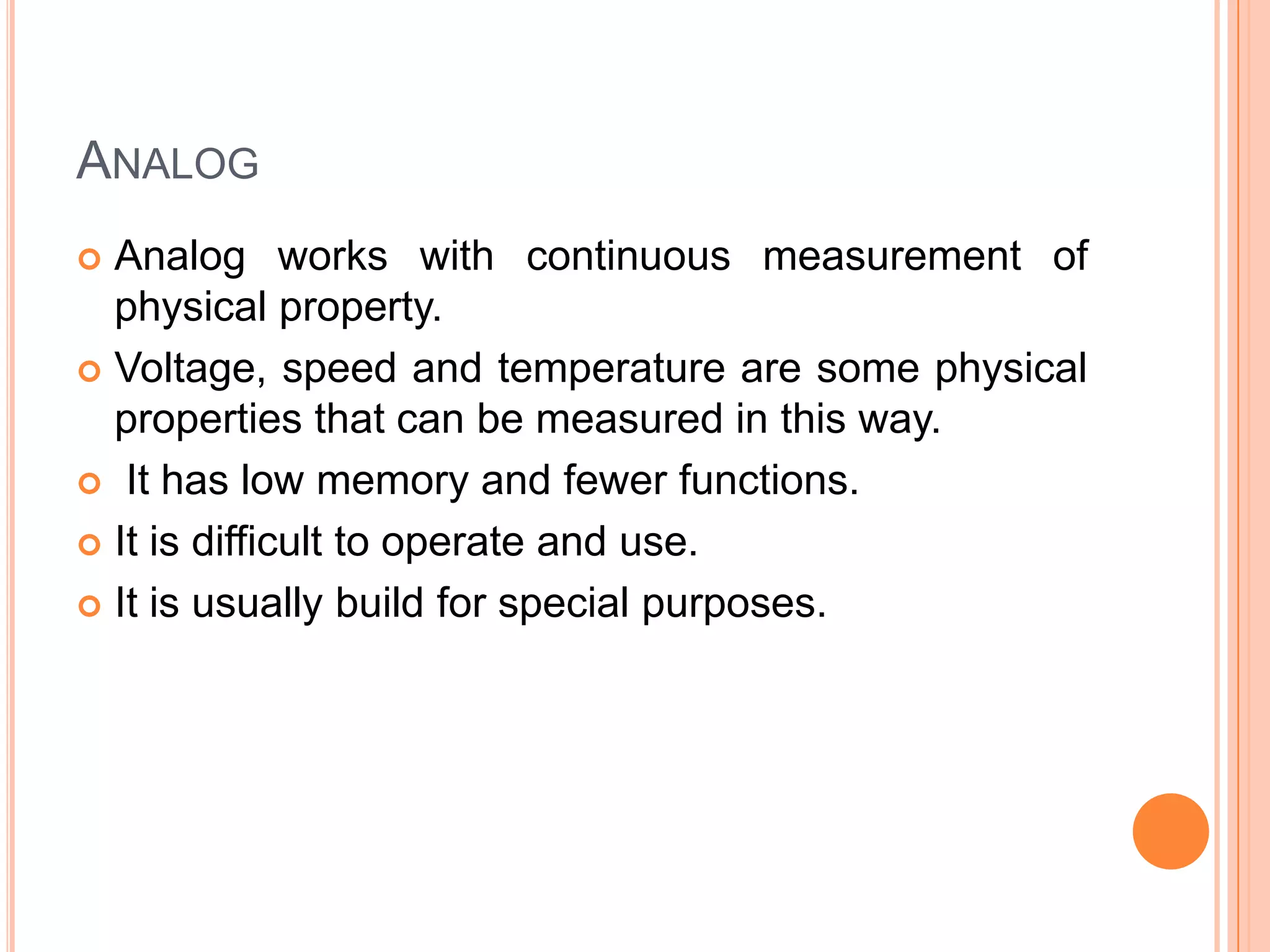
Digital Scoreboard directly counts discrete values
such as the time left to play and the score of each
team.
ANALOG
Analog works with continuous measurement of
physical property.
 Voltage, speed and temperature are some physical
properties that can be measured in this way.
 It has low memory and fewer functions.
 It is difficult to operate and use.
 It is usually build for special purposes.

EXAMPLES OF ANALOG DEVICES
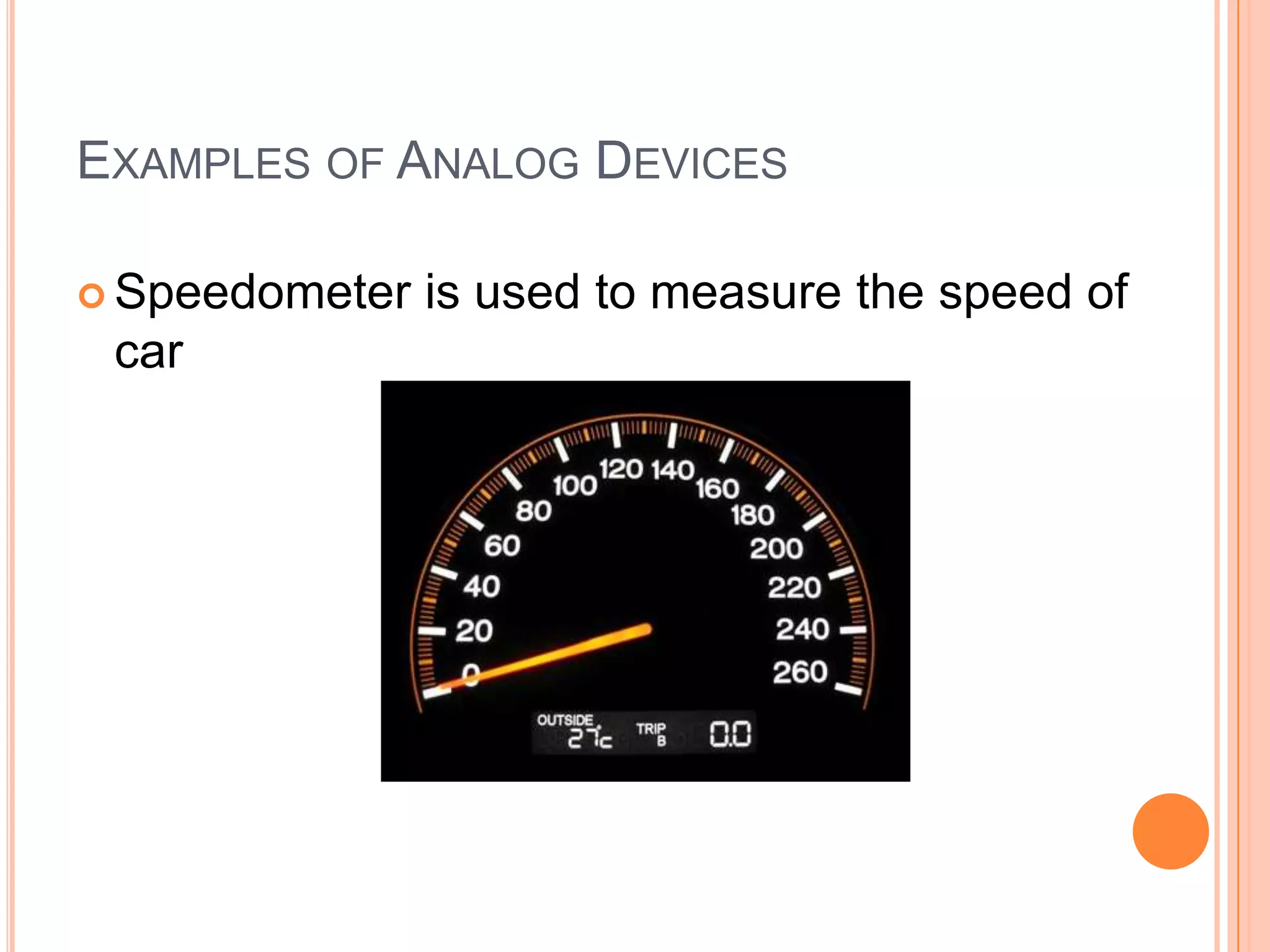
 Speedometer

car

is used to measure the speed of
EXAMPLES OF ANALOG DEVICES
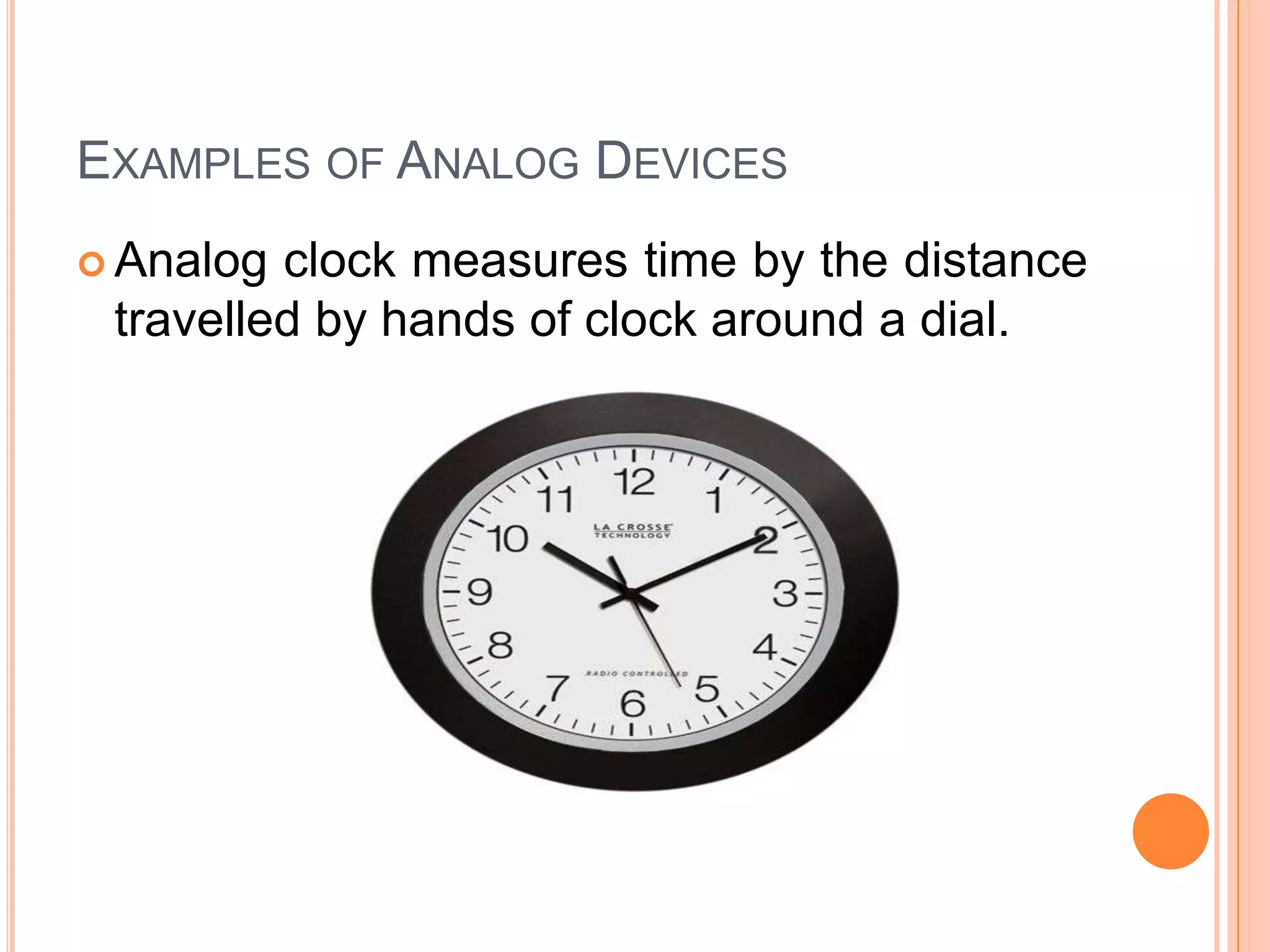
 Analog

clock measures time by the distance
travelled by hands of clock around a dial.
EXAMPLES OF ANALOG DEVICES


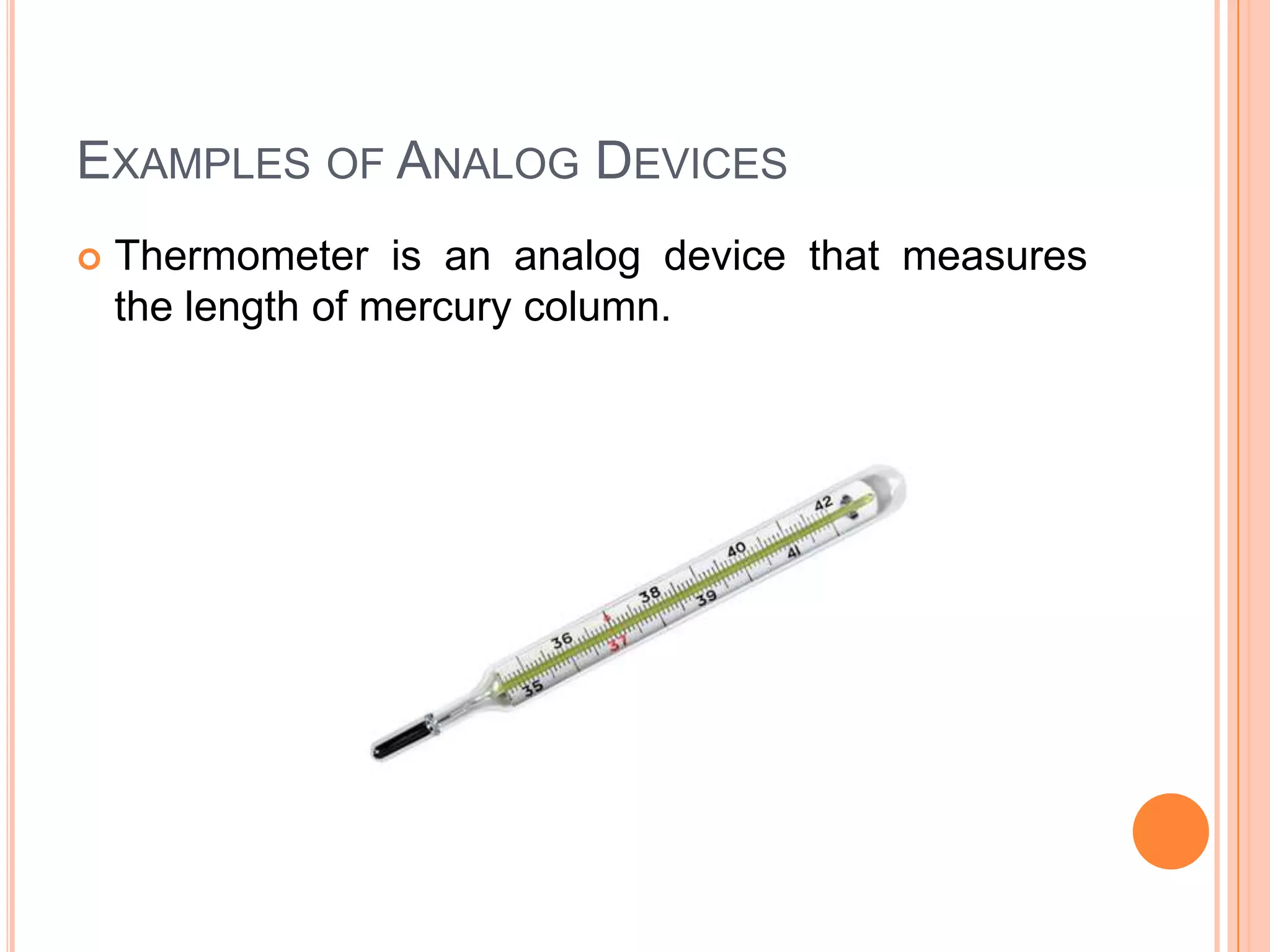
Thermometer is an analog device that measures
the length of mercury column.
NUMBER SYSTEM
A set of values used to represent different quantities
is know as Number System.


For Example, a number system used to represent
the number of students in a class.
NUMBER SYSTEM
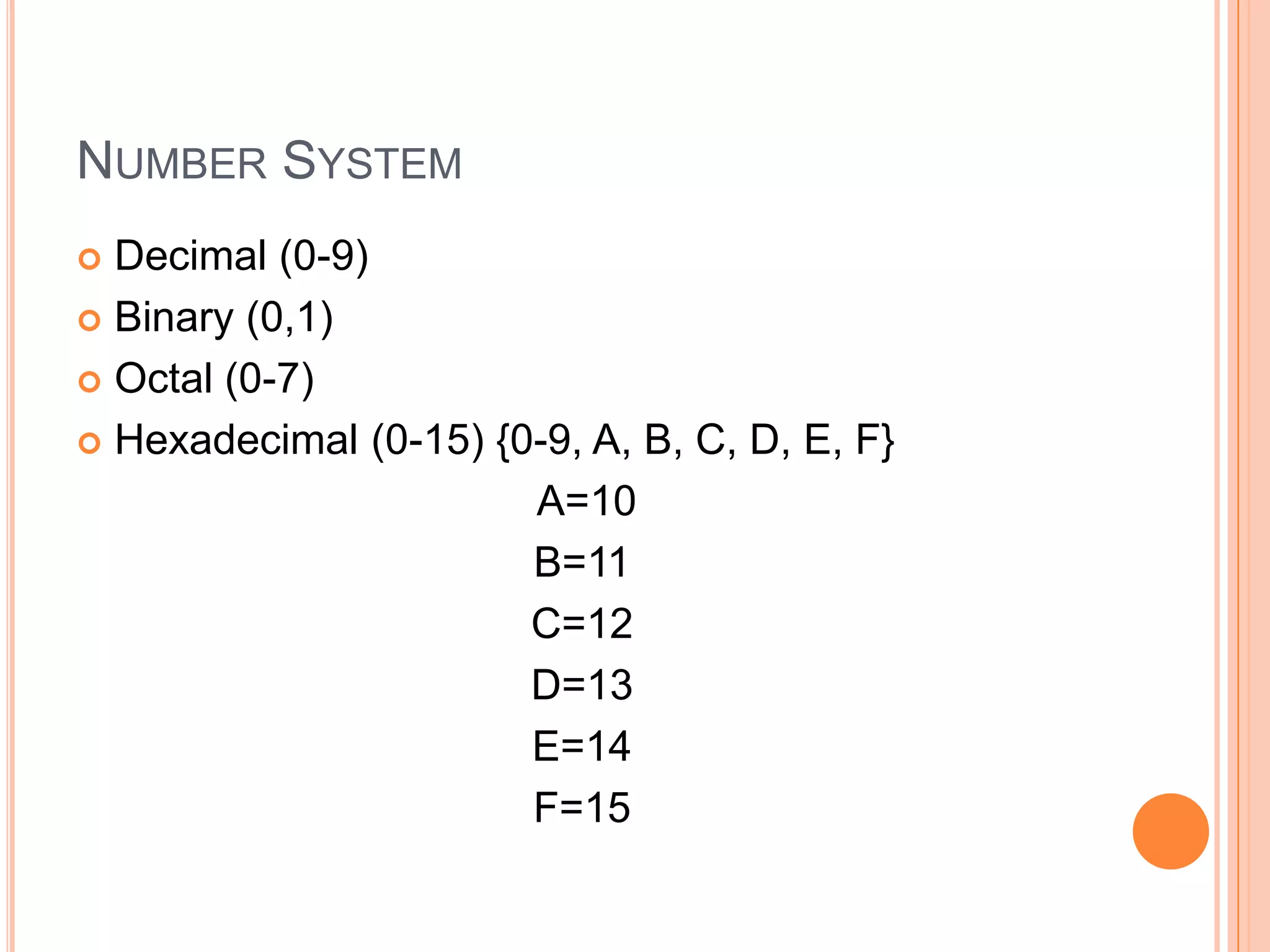
Decimal (0-9)
 Binary (0,1)
 Octal (0-7)
 Hexadecimal (0-15) {0-9, A, B, C, D, E, F}
A=10
B=11
C=12
D=13
E=14
F=15

BASE OF NUMBER SYSTEMS
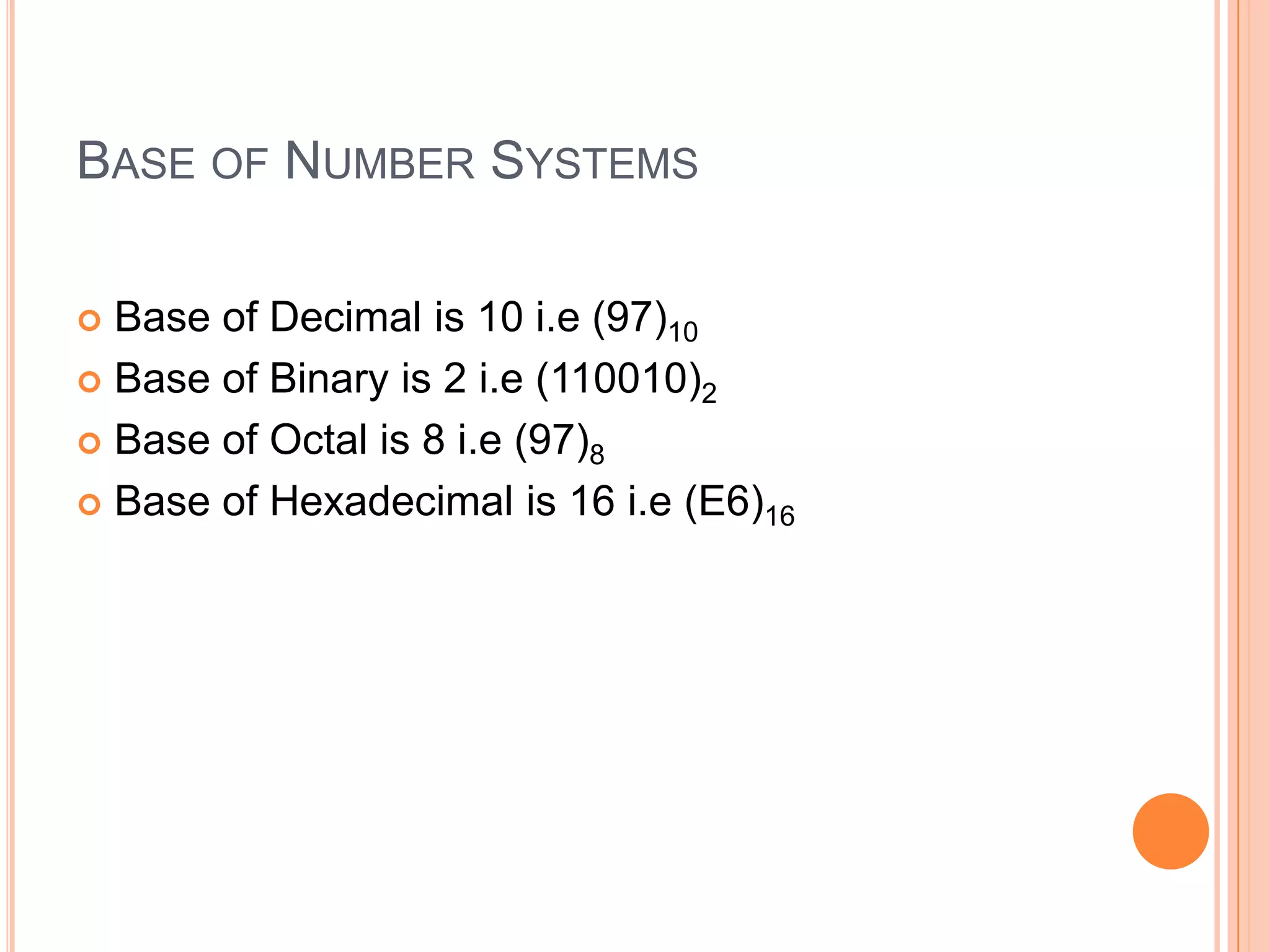
Base of Decimal is 10 i.e (97)10
 Base of Binary is 2 i.e (110010)2
 Base of Octal is 8 i.e (97)8
 Base of Hexadecimal is 16 i.e (E6)16

ASSIGNMENT#1

Analog VS Digital
Submitted on Next Lecture

Lect 1

  • 1.
    DIGITAL LOGIC DESIGN(DLD) Lecture # 1 Prepared By Muhammad Shoaib Saleem
  • 2.
    COURSE OBJECTIVES Understand thedigital logic design  Understand the number systems, codes , Boolean algebra  Understand the combinational logic, circuits, latches/flip flops and counters 
  • 3.
    WHAT IS DLD? Digital logic design is a system in electrical and computer engineering that uses simple number values to produce input and output operations.
  • 4.
    WHAT IS DLD?CONT…. Digital logic design is the basis of electronic systems, such as computers and cell phones.  Digital logic is rooted in binary code, which make information through zeroes and ones, giving each number in the binary code an opposite value.  This system facilitates the design of electronic circuits that convey information, including logic gates with functions that include AND, OR and NOT commands. 
  • 5.
    WHAT IS DIGITAL Asingle character in a numbering system. In decimal, digits are 0 through 9.  In binary, digits are 0 and 1. Describes any system based on discontinuous data or events.  Computers are digital machines because at their most basic level they can distinguish between just two values, 0 and 1, or off and on.  There is no simple way to represent all the values in between, such as 0.25. All data that a computer processes must be encoded digitally, as a series of zeroes and ones. 
  • 6.
    EXAMPLES OF DIGITALDEVICES  Digital watch displays the time that does not vary continuously but changes from one discrete value to the other.
  • 7.
    EXAMPLES OF DIGITALDEVICES  Digital Scoreboard directly counts discrete values such as the time left to play and the score of each team.
  • 8.
    ANALOG Analog works withcontinuous measurement of physical property.  Voltage, speed and temperature are some physical properties that can be measured in this way.  It has low memory and fewer functions.  It is difficult to operate and use.  It is usually build for special purposes. 
  • 9.
    EXAMPLES OF ANALOGDEVICES  Speedometer car is used to measure the speed of
  • 10.
    EXAMPLES OF ANALOGDEVICES  Analog clock measures time by the distance travelled by hands of clock around a dial.
  • 11.
    EXAMPLES OF ANALOGDEVICES  Thermometer is an analog device that measures the length of mercury column.
  • 12.
    NUMBER SYSTEM A setof values used to represent different quantities is know as Number System.  For Example, a number system used to represent the number of students in a class.
  • 13.
    NUMBER SYSTEM Decimal (0-9) Binary (0,1)  Octal (0-7)  Hexadecimal (0-15) {0-9, A, B, C, D, E, F} A=10 B=11 C=12 D=13 E=14 F=15 
  • 14.
    BASE OF NUMBERSYSTEMS Base of Decimal is 10 i.e (97)10  Base of Binary is 2 i.e (110010)2  Base of Octal is 8 i.e (97)8  Base of Hexadecimal is 16 i.e (E6)16 
  • 15.