




ICON BASED VISUALIZATION
      TECHNIQUES


     PRESENTED BY:

   WAFA QAISER KHAN
ICON BASED VISUALIZATION TECHNIQUES

    Uses small icons to represent multidimensional
     data values.

TWO POPULAR ICON-BASED TECHNIQUES

1.   Chernoff faces

2.   Stick figures
General Techniques:

   Shape coding: Use shape to represent
    certain information encoding.
   Color icons: Use color icons to encode
    more information.

   Tile bars: Use small icons to represent
    the relevant feature vectors in document.
CHERNOFF FACES


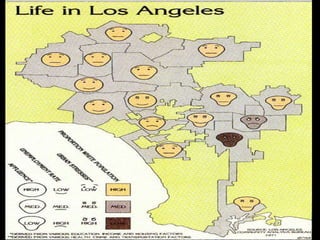
•   Introduced in 1973 by statistician Herman
    Chernoff.

•   They display multidimensional data
    of up to 18 variables (or dimensions) as a
    cartoon human face.

•   Chernoff faces help reveal trends in the data.
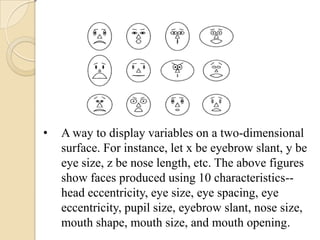
•   A way to display variables on a two-dimensional
    surface. For instance, let x be eyebrow slant, y be
    eye size, z be nose length, etc. The above figures
    show faces produced using 10 characteristics--
    head eccentricity, eye size, eye spacing, eye
    eccentricity, pupil size, eyebrow slant, nose size,
    mouth shape, mouth size, and mouth opening.
   Viewing large data can be tedious.


   Chernoff faces make the data easier for users to
    digest.
STICK FIGURE

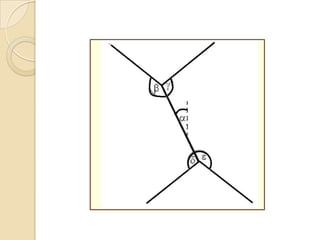
   This technique maps multidimensional data to
    five-piece stick figure.

   Each figure has four limbs and a body.

   Two dimensions are mapped to the display (x
    and y) axes and the remaining dimensions are
    mapped to the angle or length of the limbs.
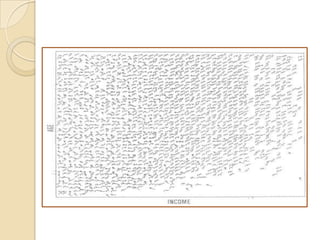
   Figure shows census:

   Age and income are mapped to the display axes.

   Remaining dimensions gender, education and so on are
    mapped to stick figures.

   Stick figures having a similar shape, means that they
    are similar with respect to the dimensions that are
    assigned to the limbs of the stick figure icon.

   The resulting visualization shows texture
    patterns, reflecting data trends.
CONCLUSION

   Chernoff faces help reveal trends
    in the data and are easy to understand.

   Stick figures maps multidimensional data to
    five-piece stick figure.
THANKYOU

Icon based visualization techniques

  • 1.
    ICON BASED VISUALIZATION TECHNIQUES PRESENTED BY: WAFA QAISER KHAN
  • 2.
    ICON BASED VISUALIZATIONTECHNIQUES  Uses small icons to represent multidimensional data values. TWO POPULAR ICON-BASED TECHNIQUES 1. Chernoff faces 2. Stick figures
  • 3.
    General Techniques:  Shape coding: Use shape to represent certain information encoding.
  • 4.
    Color icons: Use color icons to encode more information.  Tile bars: Use small icons to represent the relevant feature vectors in document.
  • 5.
    CHERNOFF FACES • Introduced in 1973 by statistician Herman Chernoff. • They display multidimensional data of up to 18 variables (or dimensions) as a cartoon human face. • Chernoff faces help reveal trends in the data.
  • 6.
    A way to display variables on a two-dimensional surface. For instance, let x be eyebrow slant, y be eye size, z be nose length, etc. The above figures show faces produced using 10 characteristics-- head eccentricity, eye size, eye spacing, eye eccentricity, pupil size, eyebrow slant, nose size, mouth shape, mouth size, and mouth opening.
  • 7.
    Viewing large data can be tedious.  Chernoff faces make the data easier for users to digest.
  • 9.
    STICK FIGURE  This technique maps multidimensional data to five-piece stick figure.  Each figure has four limbs and a body.  Two dimensions are mapped to the display (x and y) axes and the remaining dimensions are mapped to the angle or length of the limbs.
  • 12.
    Figure shows census:  Age and income are mapped to the display axes.  Remaining dimensions gender, education and so on are mapped to stick figures.  Stick figures having a similar shape, means that they are similar with respect to the dimensions that are assigned to the limbs of the stick figure icon.  The resulting visualization shows texture patterns, reflecting data trends.
  • 13.
    CONCLUSION  Chernoff faces help reveal trends in the data and are easy to understand.  Stick figures maps multidimensional data to five-piece stick figure.
  • 14.