Face Recognition
Using Principal Components Analysis (PCA)
Outline
•What is face Recognition ?
•Principal Components Analysis (PCA)
•Shortest Euclidean Distance Classifier
•Dataset
•Matlab
What is face recognition ?
face recognition is a type of biometric software
application that can identify a specific individual in a
digital image by analyzing and comparing patterns.
What are biometrics ?
A biometric is a unique, measurable characteristic of a human being that can be
used to automatically recognize an individual or verify an individual identity.
Biometrics can measure both physiological and behavioral characteristics.
Physiological biometrics (based on measurements and data derived from direct
the human body) include:
• Finger-scan
• Facial Recognition
• Iris-scan
• Retina-scan
• Hand-scan.
Applications
• Security/Counterterrorism. Access control, comparing
surveillance images to Know terrorist.
• Day Care:Verify identity of individuals picking up the
children Residential Security: Alert homeowners of
approaching personnel .
• Banking using ATM:The software is able to quickly verify a
customer’s face.
Implementation
The implementation of face recognition technology
includes the following four stages:
• Image acquisition
• Image processing
• Distinctive characteristic location
• Template creation
• Template matching
Image Acquisition
•Facial-scan technology can acquire faces from almost any
static camera or video system that generates images of
sufficient quality and resolution.
•High-quality enrollment is essential to eventual
verification and identification enrollment images define
the facial characteristics to be used in all future
authentication events.
Image Processing
• Images are cropped such that the ovoid facial
image remains, and color images are normally
converted to black and white in order to
facilitate initial comparisons based on grayscale
characteristics.
• First the presence of faces or face in a scene must
be detected. Once the face is detected, it must
be localized and Normalization process may be
required to bring the dimensions of the live facial
sample in alignment with the one on the
template.
Distinctive characteristic location
• All facial-scan systems attempt to match visible
facial features in a fashion similar to the way
people recognize one another.
• The features most often utilized in facial-scan
systems are those least likely to change
significantly over time: upper ridges of the eye
sockets, areas around the cheekbones, sides of
the mouth, nose shape, and the position of
major features relative to each other.
Behavioral changes such as alteration of hairstyle,
changes in makeup, growing or shaving facial hair,
adding or removing eyeglasses are behaviours that
impact the ability of facial-scan systems to locate
distinctive features, facial-scan systems are not yet
developed to the point where they can overcome
such variables.
Template Creation
Template Matching
• It compares match templates against enrollment
templates.
• A series of images is acquired and scored against the
enrollment, so that a user attempting 1:1 verification
within a facial-scan system may have 10 to 20 match
attempts take place within 1 to 2 seconds.
• facial-scan is not as effective as finger-scan or iris-sscan
in identifying a single individual from a large database, a
number of potential matches are generally returned after
large-scale facial-scan identification searches.
PCA
Principal Components Analysis ( PCA)
An exploratory technique used to reduce the
dimensionality of the data set to 2D or 3D
Can be used to:
• Reduce number of dimensions in data
• Find patterns in high-dimensional data
• Visualize data of high dimensionality
Example :
• Face recognition
• Image compression
• Gene expression analysis
How is PCA used in Recognition?
A training set is used for learning phase
• Applying PCA to training data to form a new
coordinate system defined by significant
Eigen vectors
• Representing each data in PCA coordinate
system (weights of Eigen vectors)
A test set is used for testing phase
• Same PCA coordinate system is used
• Each new data is represented in PCA
coordinates
• New data is recognized as the closest training
data (Euclidean distance)
Steps of PCA
1.Let be the mean vector
(taking the mean of all rows)
2.taking the mean of all rows)
X’ = X –
X
X
3. Compute the covariance matrix C
of adjusted X .
4. Find the eigenvectors and
eigenvalues of C.
5.For matrix C, vectors e
(=column vector) having same
direction as Ce :
eigenvectors of C is e such that
Ce=e
 is called an eigenvalue of C.
Ce=e  (C-I)e=0
6.Calculate eigenvalues  and
eigenvectors x for covariance
matrix
PCA Applications
•DataVisualization
•Data Compression
•Noise Reduction
•Data Classification
•Trend Analysis
•Factor Analysis
Shortest Euclidean Distance
Classifier
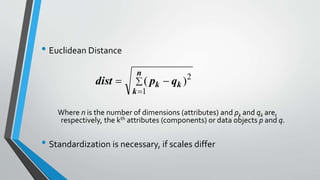
• Euclidean Distance
Where n is the number of dimensions (attributes) and pk and qk are,
respectively, the kth attributes (components) or data objects p and q.
• Standardization is necessary, if scales differ



n
k
kk qpdist
1
2
)(
Euclidean Distance
0
1
2
3
0 1 2 3 4 5 6
p1
p2
p3 p4 point x y
p1 0 2
p2 2 0
p3 3 1
p4 5 1
p1 p2 p3 p4
p1 0 2.828 3.162 5.099
p2 2.828 0 1.414 3.162
p3 3.162 1.414 0 2
p4 5.099 3.162 2 0
Distance Matrix
Dataset
Training Image
Testing Image
Image details
Make Dataset
• https://image.online-convert.com/convert-to-jpg
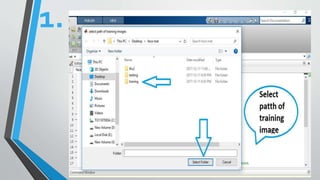
MATLAB
1.
2.
3.
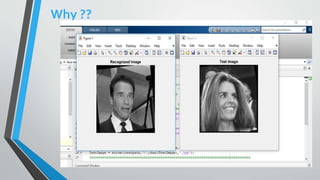
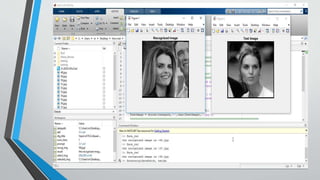
Some Examples
Why ??
Why ??
Why ??
Thanks

Face recognition

  • 1.
    Face Recognition Using PrincipalComponents Analysis (PCA)
  • 2.
    Outline •What is faceRecognition ? •Principal Components Analysis (PCA) •Shortest Euclidean Distance Classifier •Dataset •Matlab
  • 3.
    What is facerecognition ? face recognition is a type of biometric software application that can identify a specific individual in a digital image by analyzing and comparing patterns.
  • 4.
    What are biometrics? A biometric is a unique, measurable characteristic of a human being that can be used to automatically recognize an individual or verify an individual identity. Biometrics can measure both physiological and behavioral characteristics. Physiological biometrics (based on measurements and data derived from direct the human body) include: • Finger-scan • Facial Recognition • Iris-scan • Retina-scan • Hand-scan.
  • 5.
    Applications • Security/Counterterrorism. Accesscontrol, comparing surveillance images to Know terrorist. • Day Care:Verify identity of individuals picking up the children Residential Security: Alert homeowners of approaching personnel . • Banking using ATM:The software is able to quickly verify a customer’s face.
  • 6.
    Implementation The implementation offace recognition technology includes the following four stages: • Image acquisition • Image processing • Distinctive characteristic location • Template creation • Template matching
  • 7.
    Image Acquisition •Facial-scan technologycan acquire faces from almost any static camera or video system that generates images of sufficient quality and resolution. •High-quality enrollment is essential to eventual verification and identification enrollment images define the facial characteristics to be used in all future authentication events.
  • 9.
    Image Processing • Imagesare cropped such that the ovoid facial image remains, and color images are normally converted to black and white in order to facilitate initial comparisons based on grayscale characteristics. • First the presence of faces or face in a scene must be detected. Once the face is detected, it must be localized and Normalization process may be required to bring the dimensions of the live facial sample in alignment with the one on the template.
  • 10.
    Distinctive characteristic location •All facial-scan systems attempt to match visible facial features in a fashion similar to the way people recognize one another. • The features most often utilized in facial-scan systems are those least likely to change significantly over time: upper ridges of the eye sockets, areas around the cheekbones, sides of the mouth, nose shape, and the position of major features relative to each other.
  • 11.
    Behavioral changes suchas alteration of hairstyle, changes in makeup, growing or shaving facial hair, adding or removing eyeglasses are behaviours that impact the ability of facial-scan systems to locate distinctive features, facial-scan systems are not yet developed to the point where they can overcome such variables.
  • 12.
  • 13.
    Template Matching • Itcompares match templates against enrollment templates. • A series of images is acquired and scored against the enrollment, so that a user attempting 1:1 verification within a facial-scan system may have 10 to 20 match attempts take place within 1 to 2 seconds. • facial-scan is not as effective as finger-scan or iris-sscan in identifying a single individual from a large database, a number of potential matches are generally returned after large-scale facial-scan identification searches.
  • 14.
  • 15.
    Principal Components Analysis( PCA) An exploratory technique used to reduce the dimensionality of the data set to 2D or 3D Can be used to: • Reduce number of dimensions in data • Find patterns in high-dimensional data • Visualize data of high dimensionality Example : • Face recognition • Image compression • Gene expression analysis
  • 16.
    How is PCAused in Recognition? A training set is used for learning phase • Applying PCA to training data to form a new coordinate system defined by significant Eigen vectors • Representing each data in PCA coordinate system (weights of Eigen vectors)
  • 17.
    A test setis used for testing phase • Same PCA coordinate system is used • Each new data is represented in PCA coordinates • New data is recognized as the closest training data (Euclidean distance)
  • 18.
  • 19.
    1.Let be themean vector (taking the mean of all rows) 2.taking the mean of all rows) X’ = X – X X
  • 20.
    3. Compute thecovariance matrix C of adjusted X . 4. Find the eigenvectors and eigenvalues of C.
  • 21.
    5.For matrix C,vectors e (=column vector) having same direction as Ce : eigenvectors of C is e such that Ce=e  is called an eigenvalue of C.
  • 22.
    Ce=e  (C-I)e=0 6.Calculateeigenvalues  and eigenvectors x for covariance matrix
  • 23.
    PCA Applications •DataVisualization •Data Compression •NoiseReduction •Data Classification •Trend Analysis •Factor Analysis
  • 24.
  • 25.
    • Euclidean Distance Wheren is the number of dimensions (attributes) and pk and qk are, respectively, the kth attributes (components) or data objects p and q. • Standardization is necessary, if scales differ    n k kk qpdist 1 2 )(
  • 26.
    Euclidean Distance 0 1 2 3 0 12 3 4 5 6 p1 p2 p3 p4 point x y p1 0 2 p2 2 0 p3 3 1 p4 5 1 p1 p2 p3 p4 p1 0 2.828 3.162 5.099 p2 2.828 0 1.414 3.162 p3 3.162 1.414 0 2 p4 5.099 3.162 2 0 Distance Matrix
  • 27.
  • 28.
  • 29.
  • 30.
  • 31.
  • 32.
  • 33.
  • 34.
  • 35.
  • 36.
  • 37.
  • 38.
  • 39.
  • 41.