EC8392 – DIGITAL ELECTRONICS
Unit1
Digital ElectronicsGeneral View
Subject Name : EC 8392 – Digital Electronics
Department : Electronics and Communication
Engineering
Class : III year ECE
Dr.M.A.Raja
Professor
ECE Department
NEHRU INSTITUTE OF ENGINEERING AND TECHNOLOGY
T. M. Palayam, Coimbatore-641 105
(Approved by AICTE, New Delhi and Affiliated to Anna UniversityChennai)
Accredited by NAAC, Recognized by UGC under Section 2(f) and 12, (B)
EC8392 – DIGITAL ELECTRONICS
SYLLABUS
EC8392 DIGITAL ELECTRONICS L T P C 3 0 0 3 TOTAL:45 PERIODS
OBJECTIVES:
To present the Digital fundamentals, Boolean algebra and its applications in digital systems
To familiarize with the design of various combinational digital circuits using logic gates
To introduce the analysis and design procedures for synchronous and asynchronous sequential circuits
To explain the various semiconductor memories and related technology
To introduce the electronic circuits involved in the making of logic gates
UNIT I DIGITAL FUNDAMENTALS 9
Number Systems – Decimal, Binary, Octal, Hexadecimal, 1‘s and 2‘s complements, Codes – Binary, BCD, Excess 3, Gray, Alphanumeric codes, Boolean theorems, Logic
gates, Universal gates, Sum of products and product of sums, Minterms and Maxterms, Karnaugh map Minimization and Quine-McCluskey method of minimization.
UNIT II COMBINATIONAL CIRCUIT DESIGN 9
Design of Half and Full Adders, Half and Full Subtractors, Binary Parallel Adder – Carry look ahead Adder,
BCD Adder, Multiplexer, Demultiplexer, Magnitude Comparator, Decoder, Encoder, Priority Encoder.
UNIT III SYNCHRONOUS SEQUENTIAL CIRCUITS 9
Flip flops – SR, JK, T, D, Master/Slave FF – operation and excitation tables, Triggering of FF, Analysis and
design of clocked sequential circuits – Design – Moore/Mealy models, state minimization, state assignment, circuit implementation – Design of Counters- Ripple Counters,
Ring Counters, Shift registers, Universal Shift Register.
UNIT IV ASYNCHRONOUS SEQUENTIAL CIRCUITS 9
Stable and Unstable states, output specifications, cycles and races, state reduction, race free assignments, Hazards, Essential Hazards, Pulse mode sequential circuits,
Design of Hazard free circuits.
UNIT V MEMORY DEVICES AND DIGITAL INTEGRATED CIRCUITS 9
Basic memory structure – ROM -PROM – EPROM – EEPROM –EAPROM, RAM – Static and dynamic RAM – Programmable Logic Devices – Programmable Logic Array
(PLA) – Programmable Array Logic (PAL) – Field Programmable Gate Arrays (FPGA) – Implementation of combinational logic circuits using PLA, PAL.
Digital integrated circuits: Logic levels, propagation delay, power dissipation, fan-out and fan-in, noise
margin, logic families and their characteristics-RTL, TTL, ECL, CMOS
OUTCOMES:
At the end of the course:
Use digital electronics in the present contemporary world
Design various combinational digital circuits using logic gates
Do the analysis and design procedures for synchronous and asynchronous sequential circuits
Use the semiconductor memories and related technology
Use electronic circuits involved in the design of logic gates
1. DIGITAL ELECTRONICS GENERAL
VIEW
Introductionto DigitalElectronics
Digitalelectronicsisabranchof electronicswhichdealswith digitalformat of dataandcodes.
Digitalstandfor digit,digital electronicsbasicallyhastwo conditionswhicharepossible, 0
(low logic)and1(highlogic).
Digital electronic systemsuseadigital signalthat arecomposedofmathematical features to
work.
"1" astrue and"0" asfalsearecalledbit andthe groupof bitsarenamedbyte.
Digitalelectronic circuitsareusuallymadefrom largeassembliesof logicgates.
Digitaldescribeselectronic technology that generates,stores, andprocessesdata in termsof two
states:1andnumber0.
Amodemisusedto convertthe digitalinformation in yourcomputerto analogsignalsfor
your deviceandto convertanalog signalsto digital information for yourcomputer.
and
(ICs)
ited on
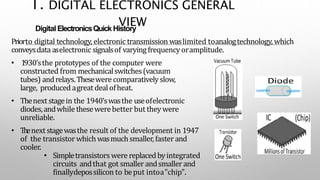
Digital ElectronicsQuick History
Priorto digital technology, electronic transmission waslimited toanalogtechnology, which
conveysdata aselectronic signalsof varyingfrequencyoramplitude.
• 1930'sthe prototypes of the computer were
constructed from mechanicalswitches(vacuum
tubes) andrelays.Thesewere comparativelyslow,
large, produced agreat dealofheat.
• Thenext stagein the 1940'swasthe useofelectronic
diodes,andwhile thesewerebetter but theywere
unreliable.
• Thenext stagewasthe result of the development in 1947
of the transistor which wasmuchsmaller,faster and
cooler.
• Simpletransistors were replacedbyintegrated
circuits andthat got smaller andsmallerand
finallydepossilicon to beput intoa"chip".
1. DIGITAL ELECTRONICS GENERAL
VIEW
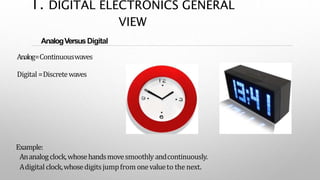
AnalogVersusDigital
Analog=Continuouswaves
Digital =Discretewaves
Example:
Ananalogclock,whosehandsmovesmoothly andcontinuously.
Adigital clock,whosedigitsjumpfrom onevalueto the next.
1. DIGITAL ELECTRONICS GENERAL
VIEW
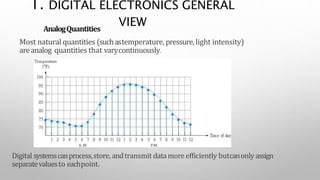
Digital systemscanprocess,store, andtransmit datamore efficiently butcanonly assign
separatevaluesto eachpoint.
1. DIGITAL ELECTRONICS GENERAL
VIEW
AnalogQuantities
Most natural quantities (suchastemperature, pressure,light intensity)
areanalog quantities that varycontinuously.
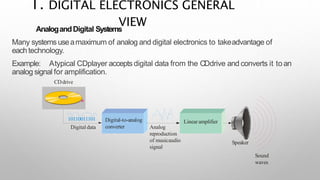
AnalogandDigital Systems
Many systems useamaximum of analog and digital electronics to takeadvantage of
eachtechnology.
Example: Atypical CDplayer accepts digital data from the CDdrive and converts it to an
analog signal for amplification.
CDdrive
Digital data
10110011101
Analog
reproduction
of musicaudio
signal
Speaker
Sound
waves
Digital-to-analog
converter
Linearamplifier
1. DIGITAL ELECTRONICS GENERAL
VIEW
1. DIGITAL ELECTRONICS GENERAL
VIEW
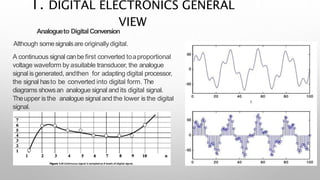
Analogueto DigitalConversion
Although somesignalsare originallydigital.
A continuous signal canbe first converted toaproportional
voltage waveform by asuitable transducer, the analogue
signal is generated, andthen for adapting digital processor,
the signal hasto be converted into digital form. The
diagrams showsan analogue signal and its digital signal.
Theupper is the analogue signal and the lower is the digital
signal.
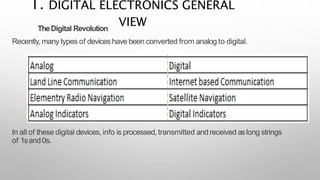
TheDigital Revolution
Recently, many types of devices have been converted from analog to digital.
In all of these digital devices, info is processed, transmitted and received aslong strings
of 1sand0s.
1. DIGITAL ELECTRONICS GENERAL
VIEW
Advantagesof Digital Electronics
• Computer-controlled digital systems canbe controlled by software, allowing
new functions to be added withoutchanging hardware.
• Information storage can be easier in digital systems than in analog ones.
• The noise-immunity of digital systems permits data to be stored and retrieved
without noise.
• In adigital system are easier to design and more precise representation of asignalcan
be obtained by using more binary digits torepresent it.
• More digital circuitry canbe fabricated onICchips.
• Error management method can be inserted into the signal path. Todetect errors,
and then either correct the errors, or at least askfor anew copy of the data.
1. DIGITAL ELECTRONICS GENERAL
VIEW
Disadvantagesof DigitalElectronics
Conversion to digital format and re-conversion to analog format is needed, which always
include the lost ofinformation.
In somecases,digital circuits usemore energy than analog circuits and producemore
heat and need heatsinks.
Digital circuits are sometimes moreexpensive,
especially in smallquantities.
1. DIGITAL ELECTRONICS GENERAL
VIEW
Unit1
NumberingSystem
EC8392 – DIGITAL
ELECTRONICS
Types of NumberingSystems
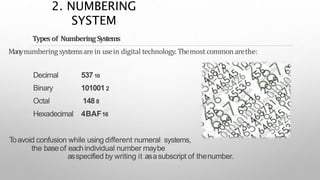
Manynumberingsystemsarein usein digital technology. Themost commonarethe:
Decimal 537 10
Binary 1010012
Octal 148 8
Hexadecimal 4BAF16
Toavoid confusion while using different numeral systems,
the baseof eachindividual number maybe
asspecified by writing it asasubscript of thenumber.
2. NUMBERING
SYSTEM
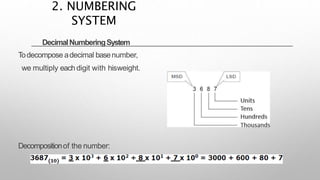
DecimalNumberingSystem
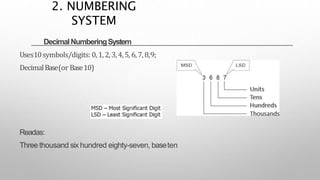
Uses10symbols/digits: 0,1,2,3,4,5,6,7,8,9;
DecimalBase(or Base10)
Readas:
Three thousand six hundred eighty-seven, baseten
2. NUMBERING
SYSTEM
DecimalNumberingSystem
Todecompose adecimal basenumber,
we multiply eachdigit with hisweight.
Decompositionof the number:
2. NUMBERING
SYSTEM
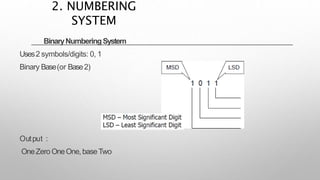
BinaryNumberingSystem
Uses2 symbols/digits: 0, 1
Binary Base(or Base2)
Output :
OneZero OneOne,baseTwo
2. NUMBERING
SYSTEM
BinaryNumberingSystem
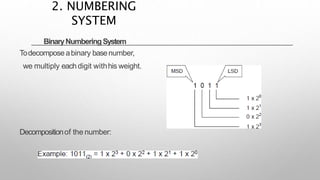
Todecomposeabinary basenumber,
we multiply eachdigit withhis weight.
Decompositionof the number:
2. NUMBERING
SYSTEM
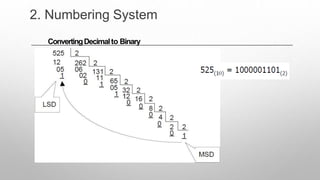
ConvertingDecimalto Binary
• To convert from adecimal integer numeral to binary, the number is divided by
two and the remainder is the least-significant bit(LSD).
• The result is again divided by two, and its remainder is the next least significant
bit.
• The processis repeated until theresult cannot be divided anymore and the last
result is the most-significant bit(MSD).
2. NUMBERING
SYSTEM
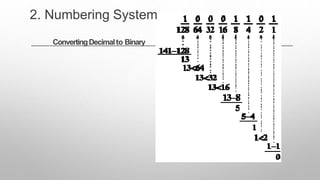
ConvertingDecimalto Binary
2. Numbering System
ConvertingDecimalto Binary
2. Numbering System
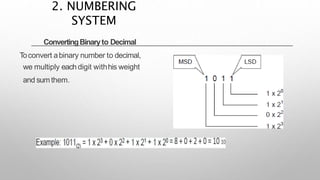
ConvertingBinaryto Decimal
Toconvert abinary number to decimal,
we multiply eachdigit withhis weight
and sumthem.
2. NUMBERING
SYSTEM
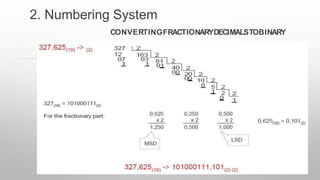
CONVERTING FRACTIONARY DECIMALS TO BINARY
• If it is afactionary decimal number the integer is converted using the previous
method and the factionary part is multipliedby 2;
• Theinteger part of that product is the MSDof the factionary part of the number;
• If the fractionary part is not zero, it is once more multiplied by 2 and the integer part
of that product is the next significant digit and soon until we reach zero for the
fractionary part.
2. NUMBERING
SYSTEM
CONVERTINGFRACTIONARYDECIMALSTOBINARY
2. Numbering System
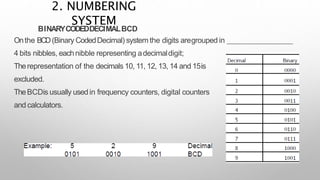
BINARYCODEDDECIMALBCD
Onthe BCD(Binary CodedDecimal) system the digits aregrouped in
4 bits nibbles, eachnibble representing adecimaldigit;
Therepresentation of the decimals 10, 11, 12, 13, 14 and 15is
excluded.
TheBCDis usually usedin frequency counters, digital counters
and calculators.
2. NUMBERING
SYSTEM
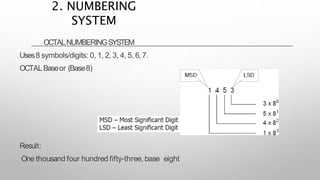
OCTALNUMBERINGSYSTEM
Uses8 symbols/digits: 0, 1, 2, 3, 4, 5, 6,7.
OCTALBaseor (Base8)
Result:
One thousand four hundred fifty-three, base eight
2. NUMBERING
SYSTEM
OCTALNumberingSystem
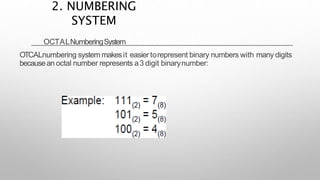
OTCALnumbering system makesit easier torepresent binary numbers with many digits
becausean octal number represents a3 digit binarynumber:
2. NUMBERING
SYSTEM
OCTALNumberingSystem
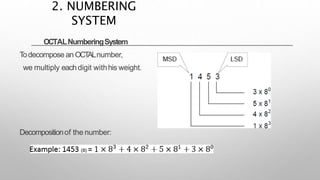
Todecompose an OCT
ALnumber,
we multiply eachdigit withhis weight.
Decompositionof the number:
2. NUMBERING
SYSTEM
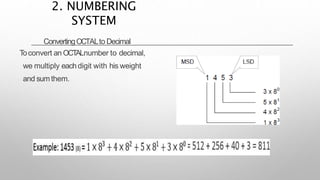
ConvertingOCTALto Decimal
Toconvert an OCT
ALnumber to decimal,
we multiply eachdigit with his weight
and sumthem.
2. NUMBERING
SYSTEM
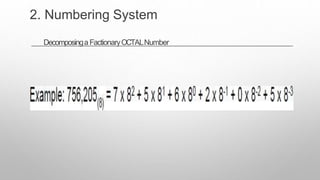
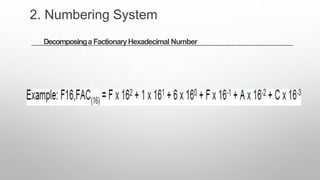
DecomposingaFactionaryOCTALNumber
2. Numbering System
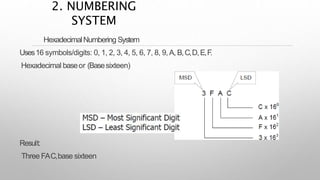
HexadecimalNumbering System
Uses16 symbols/digits: 0, 1, 2, 3, 4, 5, 6, 7, 8, 9,A, B,C,D,E,F
.
Hexadecimal baseor (Basesixteen)
Result:
Three FAC,base sixteen
2. NUMBERING
SYSTEM
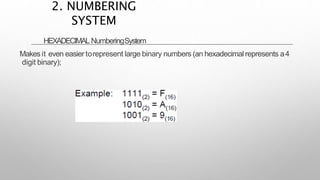
HEXADECIMAL NumberingSystem
Makes it even easier torepresent large binary numbers (an hexadecimal represents a4
digit binary);
2. NUMBERING
SYSTEM
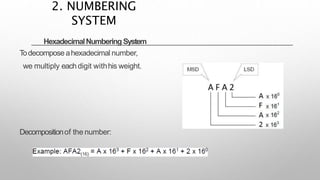
HexadecimalNumbering System
Todecomposeahexadecimal number,
we multiply eachdigit withhis weight.
Decompositionof the number:
2. NUMBERING
SYSTEM
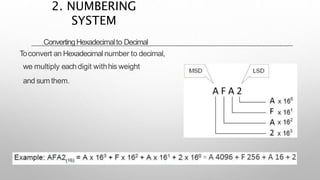
ConvertingHexadecimalto Decimal
Toconvert an Hexadecimal number to decimal,
we multiply eachdigit withhis weight
and sumthem.
2. NUMBERING
SYSTEM
DecomposingaFactionaryHexadecimal Number
2. Numbering System
Unit1
BinarySystem Operations
EC8392 – DIGITAL
ELECTRONICS
• Sum
• Multiplication
• Subtraction
• Division
3. BINARY SYSTEM
OPERATIONS
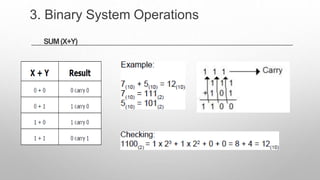
SUM(X+Y)
3. Binary System Operations
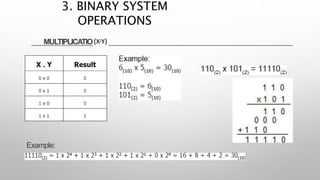
MULTIPLICATION
Example:
3. BINARY SYSTEM
OPERATIONS
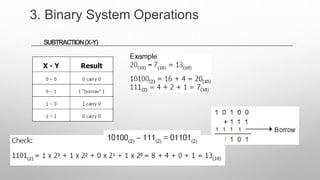
SUBTRACTION(X-Y)
3. Binary System Operations
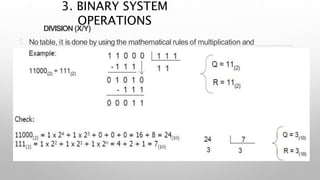
DIVISION (X/Y)
No table, it is done by using the mathematical rules of multiplication and
subtraction.
3. BINARY SYSTEM
OPERATIONS
DIGITAL ELECTRONICS
Unit1
BooleanAlgebra
Introduction to BooleanAlgebra
• Much of what we will be discussing wasformalized by George Boole (1815–1864) inhis
paper An Investigation of the LawsofThought.
• Thebranch of mathematics involving digital logic is aptly named BooleanAlgebra.
• Developedto investigate the fundamental laws of the human mind ´s operations relating
to reasoning.
• Its purpose is to define symbols to represent phenomenon's that will originate more
complex mathematical expressions– Boolean Functions or BooleanExpressions;
• But unlike traditional Algebra, instead of dealing with quantities, BooleanAlgebra deals
with Logic.
• Symbolslike (+) or (x) represent logic relations between signals and pules, instead of sum
and multiplication algorithms.
• Thesymbols 0 and 1 represent LogicStates and not quantities (0 is Low or Falseand 1 is
High or True).
4. BOOLEAN
ALGEBR
A
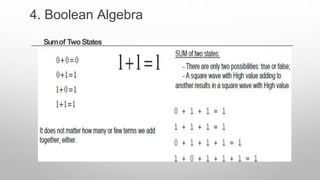
Sumof TwoStates
4. Boolean Algebra
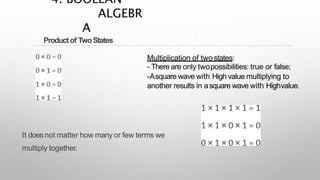
Productof TwoStates
Multiplication of twostates:
- There are only twopossibilities: true or false;
-Asquare wave with High value multiplying to
another results in asquare wave with Highvalue.
It doesnot matter how many or few terms we
multiply together.
4. BOOLEAN
ALGEBR
A
DIGITAL ELECTRONICS
Unit1
BasicLogic Operation
What isLogicGate?
Digital gate is aDigital Deviceusedto perform thelogic operation
Logicgates (or simply gates) are the fundamental building blocks of digital circuitry
Electronic gates require apower supply.
GateINPUTSare driven by voltages having two nominalvalues,
e.g. 0Vand 5Vrepresenting logic 0 and logic 1respectively.
TheOUTPUTof agate provides two nominal values of voltageonly,
e.g. 0Vand 5V representing logic 0 and logic 1respectively.
In general, there is only one output to alogic gate except in some special cases.
5. BASIC LOGIC
OPERATION
5. BASIC LOGIC
OPERATION
TruthTable
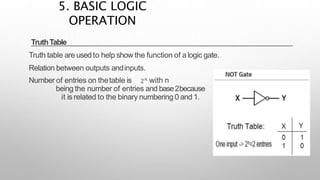
Truth table are usedto help show the function of alogic gate.
Relation between outputs andinputs.
Number of entries on thetable is with n
being the number of entries and base2because
it is related to the binary numbering 0 and 1.
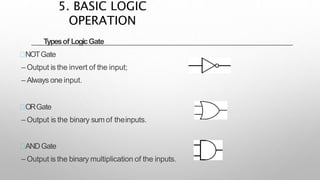
Typesof LogicGate
NOTGate
– Output is the invert of the input;
– Always one input.
ORGate
– Output is the binary sum of theinputs.
ANDGate
– Output is the binary multiplication of the inputs.
5. BASIC LOGIC
OPERATION
NOTGate
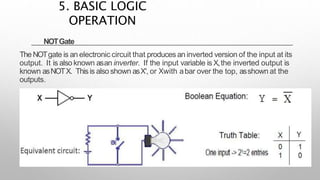
The NOTgate is an electronic circuit that produces an inverted version of the input at its
output. It is also known asan inverter. If the input variable is X,the inverted output is
known asNOTX. Thisis also shown asX', or Xwith abar over the top, asshown at the
outputs.
5. BASIC LOGIC
OPERATION
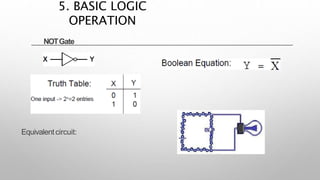
NOTGate
Equivalentcircuit:
5. BASIC LOGIC
OPERATION
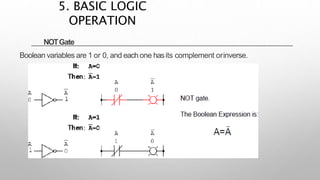
NOTGate
Boolean variables are 1 or 0, and eachone hasits complement orinverse.
5. BASIC LOGIC
OPERATION
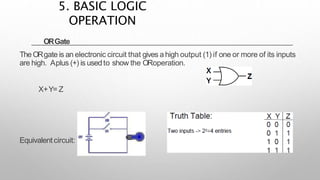
ORGate
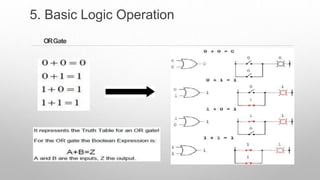
The ORgate is an electronic circuit that gives ahigh output (1) if one or more of its inputs
are high. Aplus (+) is usedto show the ORoperation.
X+Y= Z
Equivalent circuit:
5. BASIC LOGIC
OPERATION
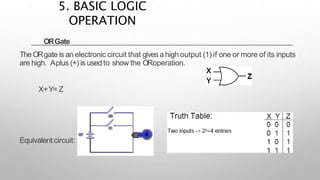
ORGate
The ORgate is an electronic circuit that gives ahigh output (1) if one or more of its inputs
are high. Aplus (+) is usedto show the ORoperation.
X+Y= Z
Equivalent circuit:
5. BASIC LOGIC
OPERATION
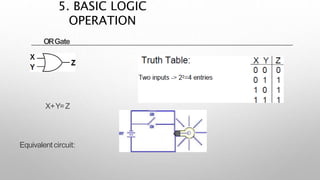
ORGate
X+Y=Z
Equivalent circuit:
5. BASIC LOGIC
OPERATION
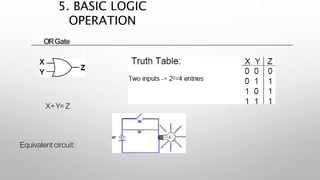
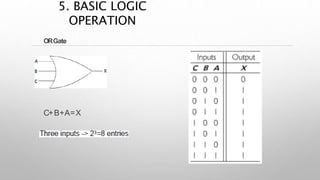
ORGate
X+Y=Z
Equivalent circuit:
5. BASIC LOGIC
OPERATION
ORGate
5. Basic Logic Operation
ORGate
C+B+A=X
5. BASIC LOGIC
OPERATION
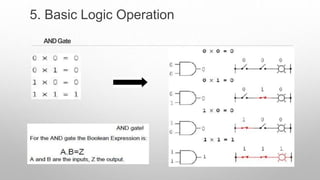
ANDGate
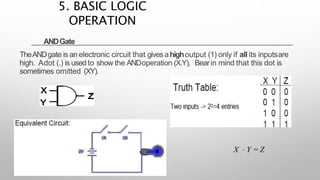
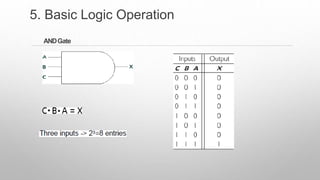
TheANDgate is an electronic circuit that gives ahighoutput (1) only if all its inputsare
high. Adot (.) is usedto show the ANDoperation (X.Y), Bearin mind that this dot is
sometimes omitted (XY).
X  Y = Z
5. BASIC LOGIC
OPERATION
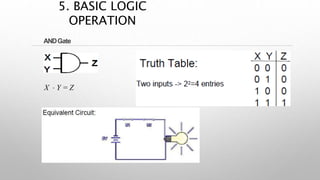
ANDGate
X  Y = Z
5. BASIC LOGIC
OPERATION
ANDGate
5. Basic Logic Operation
ANDGate
5. Basic Logic Operation
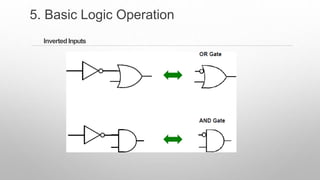
Inverted Inputs
5. Basic Logic Operation
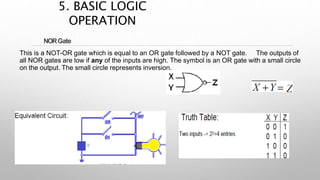
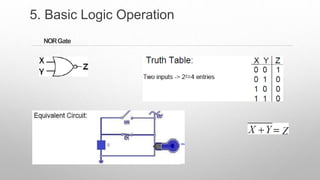
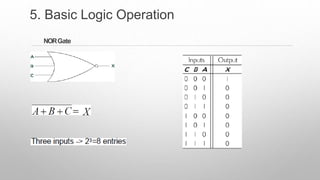
NORGate
This is a NOT-OR gate which is equal to an OR gate followed by a NOT gate. The outputs of
all NOR gates are low if any of the inputs are high. The symbol is an OR gate with a small circle
on the output. The small circle represents inversion.
5. BASIC LOGIC
OPERATION
NORGate
5. Basic Logic Operation
NORGate
5. Basic Logic Operation
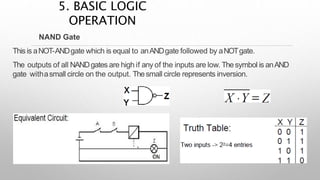
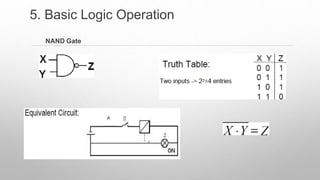
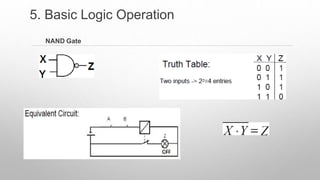
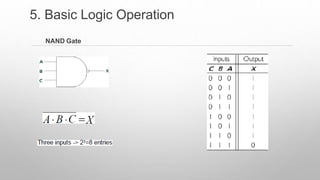
NAND Gate
Thisis aNOT-ANDgate which is equal to anANDgate followed by aNOTgate.
The outputs of all NANDgates are high if any of the inputs are low. Thesymbol is anAND
gate withasmall circle on the output. Thesmall circle represents inversion.
5. BASIC LOGIC
OPERATION
NAND Gate
5. Basic Logic Operation
NAND Gate
5. Basic Logic Operation
NAND Gate
5. Basic Logic Operation
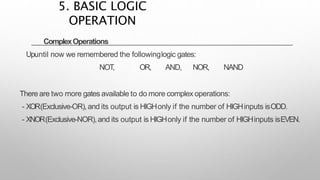
ComplexOperations
Upuntil now we remembered the followinglogic gates:
NOT
, OR, AND, NOR, NAND
There are two more gates available to do more complex operations:
- XOR(Exclusive-OR),and its output is HIGHonly if the number of HIGHinputs isODD.
- XNOR(Exclusive-NOR),and its output is HIGHonly if the number of HIGHinputs isEVEN.
5. BASIC LOGIC
OPERATION
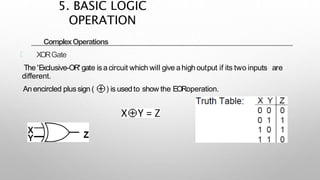
ComplexOperations
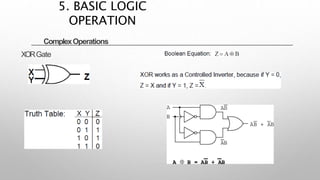
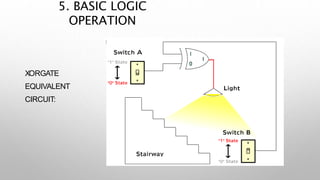
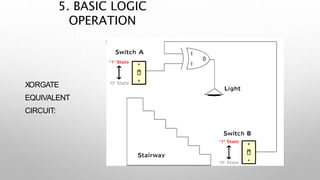
XORGate
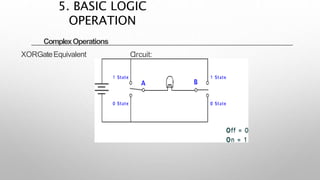
The 'Exclusive-OR' gate isacircuit which will give ahigh output if its two inputs are
different.
An encircled plus sign ( ) is usedto show the EORoperation.
5. BASIC LOGIC
OPERATION
ComplexOperations
XORGate
5. BASIC LOGIC
OPERATION
ComplexOperations
XORGateEquivalent Circuit:
5. BASIC LOGIC
OPERATION
ComplexOperations
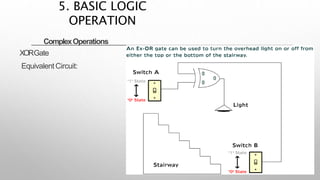
XORGate
EquivalentCircuit:
5. BASIC LOGIC
OPERATION
5. BASIC LOGIC
OPERATION
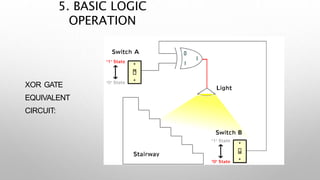
XOR GATE
EQUIVALENT
CIRCUIT:
s
5. BASIC LOGIC
OPERATION
XORGATE
EQUIVALENT
CIRCUIT:
s
5. BASIC LOGIC
OPERATION
XORGATE
EQUIVALENT
CIRCUIT:
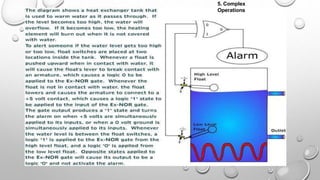
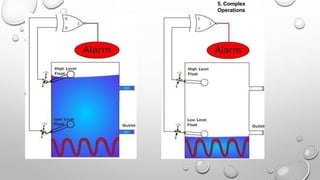
ComplexOperations
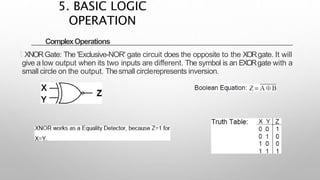
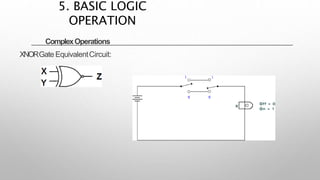
XNORGate: The 'Exclusive-NOR' gate circuit does the opposite to the XORgate. It will
give a low output when its two inputs are different. The symbol is an EXORgate with a
small circle on the output. Thesmall circlerepresents inversion.
5. BASIC LOGIC
OPERATION
ComplexOperations
XNORGate EquivalentCircuit:
5. BASIC LOGIC
OPERATION
5. Complex
Operations
5. Complex
Operations
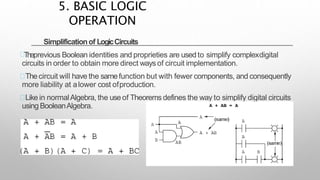
Simplificationof LogicCircuits
Theprevious Boolean identities and proprieties are usedto simplify complexdigital
circuits in order to obtain more direct ways of circuit implementation.
The circuit will have the samefunction but with fewer components, and consequently
more liability at alower cost ofproduction.
Like in normalAlgebra, the useof Theorems defines the way to simplify digital circuits
using BooleanAlgebra.
5. BASIC LOGIC
OPERATION
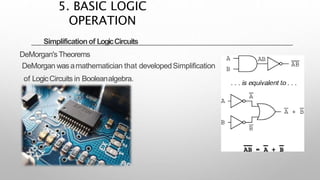
Simplificationof LogicCircuits
DeMorgan'sTheorems
DeMorgan wasamathematician that developedSimplification
of LogicCircuits in Booleanalgebra.
5. BASIC LOGIC
OPERATION
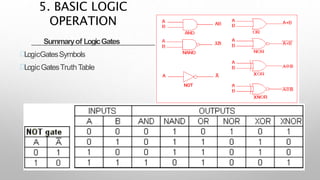
Summaryof LogicGates
LogicGatesSymbols
LogicGatesTruthTable
5. BASIC LOGIC
OPERATION
DE UNIT1.pptx

DE UNIT1.pptx

  • 1.
    EC8392 – DIGITALELECTRONICS Unit1 Digital ElectronicsGeneral View Subject Name : EC 8392 – Digital Electronics Department : Electronics and Communication Engineering Class : III year ECE Dr.M.A.Raja Professor ECE Department NEHRU INSTITUTE OF ENGINEERING AND TECHNOLOGY T. M. Palayam, Coimbatore-641 105 (Approved by AICTE, New Delhi and Affiliated to Anna UniversityChennai) Accredited by NAAC, Recognized by UGC under Section 2(f) and 12, (B)
  • 2.
    EC8392 – DIGITALELECTRONICS SYLLABUS EC8392 DIGITAL ELECTRONICS L T P C 3 0 0 3 TOTAL:45 PERIODS OBJECTIVES: To present the Digital fundamentals, Boolean algebra and its applications in digital systems To familiarize with the design of various combinational digital circuits using logic gates To introduce the analysis and design procedures for synchronous and asynchronous sequential circuits To explain the various semiconductor memories and related technology To introduce the electronic circuits involved in the making of logic gates UNIT I DIGITAL FUNDAMENTALS 9 Number Systems – Decimal, Binary, Octal, Hexadecimal, 1‘s and 2‘s complements, Codes – Binary, BCD, Excess 3, Gray, Alphanumeric codes, Boolean theorems, Logic gates, Universal gates, Sum of products and product of sums, Minterms and Maxterms, Karnaugh map Minimization and Quine-McCluskey method of minimization. UNIT II COMBINATIONAL CIRCUIT DESIGN 9 Design of Half and Full Adders, Half and Full Subtractors, Binary Parallel Adder – Carry look ahead Adder, BCD Adder, Multiplexer, Demultiplexer, Magnitude Comparator, Decoder, Encoder, Priority Encoder. UNIT III SYNCHRONOUS SEQUENTIAL CIRCUITS 9 Flip flops – SR, JK, T, D, Master/Slave FF – operation and excitation tables, Triggering of FF, Analysis and design of clocked sequential circuits – Design – Moore/Mealy models, state minimization, state assignment, circuit implementation – Design of Counters- Ripple Counters, Ring Counters, Shift registers, Universal Shift Register. UNIT IV ASYNCHRONOUS SEQUENTIAL CIRCUITS 9 Stable and Unstable states, output specifications, cycles and races, state reduction, race free assignments, Hazards, Essential Hazards, Pulse mode sequential circuits, Design of Hazard free circuits. UNIT V MEMORY DEVICES AND DIGITAL INTEGRATED CIRCUITS 9 Basic memory structure – ROM -PROM – EPROM – EEPROM –EAPROM, RAM – Static and dynamic RAM – Programmable Logic Devices – Programmable Logic Array (PLA) – Programmable Array Logic (PAL) – Field Programmable Gate Arrays (FPGA) – Implementation of combinational logic circuits using PLA, PAL. Digital integrated circuits: Logic levels, propagation delay, power dissipation, fan-out and fan-in, noise margin, logic families and their characteristics-RTL, TTL, ECL, CMOS OUTCOMES: At the end of the course: Use digital electronics in the present contemporary world Design various combinational digital circuits using logic gates Do the analysis and design procedures for synchronous and asynchronous sequential circuits Use the semiconductor memories and related technology Use electronic circuits involved in the design of logic gates
  • 3.
    1. DIGITAL ELECTRONICSGENERAL VIEW Introductionto DigitalElectronics Digitalelectronicsisabranchof electronicswhichdealswith digitalformat of dataandcodes. Digitalstandfor digit,digital electronicsbasicallyhastwo conditionswhicharepossible, 0 (low logic)and1(highlogic). Digital electronic systemsuseadigital signalthat arecomposedofmathematical features to work. "1" astrue and"0" asfalsearecalledbit andthe groupof bitsarenamedbyte. Digitalelectronic circuitsareusuallymadefrom largeassembliesof logicgates. Digitaldescribeselectronic technology that generates,stores, andprocessesdata in termsof two states:1andnumber0. Amodemisusedto convertthe digitalinformation in yourcomputerto analogsignalsfor your deviceandto convertanalog signalsto digital information for yourcomputer.
  • 4.
    and (ICs) ited on Digital ElectronicsQuickHistory Priorto digital technology, electronic transmission waslimited toanalogtechnology, which conveysdata aselectronic signalsof varyingfrequencyoramplitude. • 1930'sthe prototypes of the computer were constructed from mechanicalswitches(vacuum tubes) andrelays.Thesewere comparativelyslow, large, produced agreat dealofheat. • Thenext stagein the 1940'swasthe useofelectronic diodes,andwhile thesewerebetter but theywere unreliable. • Thenext stagewasthe result of the development in 1947 of the transistor which wasmuchsmaller,faster and cooler. • Simpletransistors were replacedbyintegrated circuits andthat got smaller andsmallerand finallydepossilicon to beput intoa"chip". 1. DIGITAL ELECTRONICS GENERAL VIEW
  • 5.
  • 6.
    Digital systemscanprocess,store, andtransmitdatamore efficiently butcanonly assign separatevaluesto eachpoint. 1. DIGITAL ELECTRONICS GENERAL VIEW AnalogQuantities Most natural quantities (suchastemperature, pressure,light intensity) areanalog quantities that varycontinuously.
  • 7.
    AnalogandDigital Systems Many systemsuseamaximum of analog and digital electronics to takeadvantage of eachtechnology. Example: Atypical CDplayer accepts digital data from the CDdrive and converts it to an analog signal for amplification. CDdrive Digital data 10110011101 Analog reproduction of musicaudio signal Speaker Sound waves Digital-to-analog converter Linearamplifier 1. DIGITAL ELECTRONICS GENERAL VIEW
  • 8.
    1. DIGITAL ELECTRONICSGENERAL VIEW Analogueto DigitalConversion Although somesignalsare originallydigital. A continuous signal canbe first converted toaproportional voltage waveform by asuitable transducer, the analogue signal is generated, andthen for adapting digital processor, the signal hasto be converted into digital form. The diagrams showsan analogue signal and its digital signal. Theupper is the analogue signal and the lower is the digital signal.
  • 9.
    TheDigital Revolution Recently, manytypes of devices have been converted from analog to digital. In all of these digital devices, info is processed, transmitted and received aslong strings of 1sand0s. 1. DIGITAL ELECTRONICS GENERAL VIEW
  • 10.
    Advantagesof Digital Electronics •Computer-controlled digital systems canbe controlled by software, allowing new functions to be added withoutchanging hardware. • Information storage can be easier in digital systems than in analog ones. • The noise-immunity of digital systems permits data to be stored and retrieved without noise. • In adigital system are easier to design and more precise representation of asignalcan be obtained by using more binary digits torepresent it. • More digital circuitry canbe fabricated onICchips. • Error management method can be inserted into the signal path. Todetect errors, and then either correct the errors, or at least askfor anew copy of the data. 1. DIGITAL ELECTRONICS GENERAL VIEW
  • 11.
    Disadvantagesof DigitalElectronics Conversion todigital format and re-conversion to analog format is needed, which always include the lost ofinformation. In somecases,digital circuits usemore energy than analog circuits and producemore heat and need heatsinks. Digital circuits are sometimes moreexpensive, especially in smallquantities. 1. DIGITAL ELECTRONICS GENERAL VIEW
  • 12.
  • 13.
    Types of NumberingSystems Manynumberingsystemsareinusein digital technology. Themost commonarethe: Decimal 537 10 Binary 1010012 Octal 148 8 Hexadecimal 4BAF16 Toavoid confusion while using different numeral systems, the baseof eachindividual number maybe asspecified by writing it asasubscript of thenumber. 2. NUMBERING SYSTEM
  • 14.
  • 15.
    DecimalNumberingSystem Todecompose adecimal basenumber, wemultiply eachdigit with hisweight. Decompositionof the number: 2. NUMBERING SYSTEM
  • 16.
    BinaryNumberingSystem Uses2 symbols/digits: 0,1 Binary Base(or Base2) Output : OneZero OneOne,baseTwo 2. NUMBERING SYSTEM
  • 17.
    BinaryNumberingSystem Todecomposeabinary basenumber, we multiplyeachdigit withhis weight. Decompositionof the number: 2. NUMBERING SYSTEM
  • 18.
    ConvertingDecimalto Binary • Toconvert from adecimal integer numeral to binary, the number is divided by two and the remainder is the least-significant bit(LSD). • The result is again divided by two, and its remainder is the next least significant bit. • The processis repeated until theresult cannot be divided anymore and the last result is the most-significant bit(MSD). 2. NUMBERING SYSTEM
  • 19.
  • 20.
  • 21.
    ConvertingBinaryto Decimal Toconvert abinarynumber to decimal, we multiply eachdigit withhis weight and sumthem. 2. NUMBERING SYSTEM
  • 22.
    CONVERTING FRACTIONARY DECIMALSTO BINARY • If it is afactionary decimal number the integer is converted using the previous method and the factionary part is multipliedby 2; • Theinteger part of that product is the MSDof the factionary part of the number; • If the fractionary part is not zero, it is once more multiplied by 2 and the integer part of that product is the next significant digit and soon until we reach zero for the fractionary part. 2. NUMBERING SYSTEM
  • 23.
  • 24.
    BINARYCODEDDECIMALBCD Onthe BCD(Binary CodedDecimal)system the digits aregrouped in 4 bits nibbles, eachnibble representing adecimaldigit; Therepresentation of the decimals 10, 11, 12, 13, 14 and 15is excluded. TheBCDis usually usedin frequency counters, digital counters and calculators. 2. NUMBERING SYSTEM
  • 25.
    OCTALNUMBERINGSYSTEM Uses8 symbols/digits: 0,1, 2, 3, 4, 5, 6,7. OCTALBaseor (Base8) Result: One thousand four hundred fifty-three, base eight 2. NUMBERING SYSTEM
  • 26.
    OCTALNumberingSystem OTCALnumbering system makesiteasier torepresent binary numbers with many digits becausean octal number represents a3 digit binarynumber: 2. NUMBERING SYSTEM
  • 27.
    OCTALNumberingSystem Todecompose an OCT ALnumber, wemultiply eachdigit withhis weight. Decompositionof the number: 2. NUMBERING SYSTEM
  • 28.
    ConvertingOCTALto Decimal Toconvert anOCT ALnumber to decimal, we multiply eachdigit with his weight and sumthem. 2. NUMBERING SYSTEM
  • 29.
  • 30.
    HexadecimalNumbering System Uses16 symbols/digits:0, 1, 2, 3, 4, 5, 6, 7, 8, 9,A, B,C,D,E,F . Hexadecimal baseor (Basesixteen) Result: Three FAC,base sixteen 2. NUMBERING SYSTEM
  • 31.
    HEXADECIMAL NumberingSystem Makes iteven easier torepresent large binary numbers (an hexadecimal represents a4 digit binary); 2. NUMBERING SYSTEM
  • 32.
    HexadecimalNumbering System Todecomposeahexadecimal number, wemultiply eachdigit withhis weight. Decompositionof the number: 2. NUMBERING SYSTEM
  • 33.
    ConvertingHexadecimalto Decimal Toconvert anHexadecimal number to decimal, we multiply eachdigit withhis weight and sumthem. 2. NUMBERING SYSTEM
  • 34.
  • 35.
  • 36.
    • Sum • Multiplication •Subtraction • Division 3. BINARY SYSTEM OPERATIONS
  • 37.
  • 38.
  • 39.
  • 40.
    DIVISION (X/Y) No table,it is done by using the mathematical rules of multiplication and subtraction. 3. BINARY SYSTEM OPERATIONS
  • 41.
  • 42.
    Introduction to BooleanAlgebra •Much of what we will be discussing wasformalized by George Boole (1815–1864) inhis paper An Investigation of the LawsofThought. • Thebranch of mathematics involving digital logic is aptly named BooleanAlgebra. • Developedto investigate the fundamental laws of the human mind ´s operations relating to reasoning. • Its purpose is to define symbols to represent phenomenon's that will originate more complex mathematical expressions– Boolean Functions or BooleanExpressions; • But unlike traditional Algebra, instead of dealing with quantities, BooleanAlgebra deals with Logic. • Symbolslike (+) or (x) represent logic relations between signals and pules, instead of sum and multiplication algorithms. • Thesymbols 0 and 1 represent LogicStates and not quantities (0 is Low or Falseand 1 is High or True). 4. BOOLEAN ALGEBR A
  • 43.
  • 44.
    Productof TwoStates Multiplication oftwostates: - There are only twopossibilities: true or false; -Asquare wave with High value multiplying to another results in asquare wave with Highvalue. It doesnot matter how many or few terms we multiply together. 4. BOOLEAN ALGEBR A
  • 45.
  • 46.
    What isLogicGate? Digital gateis aDigital Deviceusedto perform thelogic operation Logicgates (or simply gates) are the fundamental building blocks of digital circuitry Electronic gates require apower supply. GateINPUTSare driven by voltages having two nominalvalues, e.g. 0Vand 5Vrepresenting logic 0 and logic 1respectively. TheOUTPUTof agate provides two nominal values of voltageonly, e.g. 0Vand 5V representing logic 0 and logic 1respectively. In general, there is only one output to alogic gate except in some special cases. 5. BASIC LOGIC OPERATION
  • 47.
    5. BASIC LOGIC OPERATION TruthTable Truthtable are usedto help show the function of alogic gate. Relation between outputs andinputs. Number of entries on thetable is with n being the number of entries and base2because it is related to the binary numbering 0 and 1.
  • 48.
    Typesof LogicGate NOTGate – Outputis the invert of the input; – Always one input. ORGate – Output is the binary sum of theinputs. ANDGate – Output is the binary multiplication of the inputs. 5. BASIC LOGIC OPERATION
  • 49.
    NOTGate The NOTgate isan electronic circuit that produces an inverted version of the input at its output. It is also known asan inverter. If the input variable is X,the inverted output is known asNOTX. Thisis also shown asX', or Xwith abar over the top, asshown at the outputs. 5. BASIC LOGIC OPERATION
  • 50.
  • 51.
    NOTGate Boolean variables are1 or 0, and eachone hasits complement orinverse. 5. BASIC LOGIC OPERATION
  • 52.
    ORGate The ORgate isan electronic circuit that gives ahigh output (1) if one or more of its inputs are high. Aplus (+) is usedto show the ORoperation. X+Y= Z Equivalent circuit: 5. BASIC LOGIC OPERATION
  • 53.
    ORGate The ORgate isan electronic circuit that gives ahigh output (1) if one or more of its inputs are high. Aplus (+) is usedto show the ORoperation. X+Y= Z Equivalent circuit: 5. BASIC LOGIC OPERATION
  • 54.
  • 55.
  • 56.
  • 57.
  • 58.
    ANDGate TheANDgate is anelectronic circuit that gives ahighoutput (1) only if all its inputsare high. Adot (.) is usedto show the ANDoperation (X.Y), Bearin mind that this dot is sometimes omitted (XY). X  Y = Z 5. BASIC LOGIC OPERATION
  • 59.
    ANDGate X  Y= Z 5. BASIC LOGIC OPERATION
  • 60.
  • 61.
  • 62.
    Inverted Inputs 5. BasicLogic Operation
  • 63.
    NORGate This is aNOT-OR gate which is equal to an OR gate followed by a NOT gate. The outputs of all NOR gates are low if any of the inputs are high. The symbol is an OR gate with a small circle on the output. The small circle represents inversion. 5. BASIC LOGIC OPERATION
  • 64.
  • 65.
  • 66.
    NAND Gate Thisis aNOT-ANDgatewhich is equal to anANDgate followed by aNOTgate. The outputs of all NANDgates are high if any of the inputs are low. Thesymbol is anAND gate withasmall circle on the output. Thesmall circle represents inversion. 5. BASIC LOGIC OPERATION
  • 67.
    NAND Gate 5. BasicLogic Operation
  • 68.
    NAND Gate 5. BasicLogic Operation
  • 69.
    NAND Gate 5. BasicLogic Operation
  • 70.
    ComplexOperations Upuntil now weremembered the followinglogic gates: NOT , OR, AND, NOR, NAND There are two more gates available to do more complex operations: - XOR(Exclusive-OR),and its output is HIGHonly if the number of HIGHinputs isODD. - XNOR(Exclusive-NOR),and its output is HIGHonly if the number of HIGHinputs isEVEN. 5. BASIC LOGIC OPERATION
  • 71.
    ComplexOperations XORGate The 'Exclusive-OR' gateisacircuit which will give ahigh output if its two inputs are different. An encircled plus sign ( ) is usedto show the EORoperation. 5. BASIC LOGIC OPERATION
  • 72.
  • 73.
  • 74.
  • 75.
    5. BASIC LOGIC OPERATION XORGATE EQUIVALENT CIRCUIT:
  • 76.
  • 77.
  • 78.
    ComplexOperations XNORGate: The 'Exclusive-NOR'gate circuit does the opposite to the XORgate. It will give a low output when its two inputs are different. The symbol is an EXORgate with a small circle on the output. Thesmall circlerepresents inversion. 5. BASIC LOGIC OPERATION
  • 79.
  • 80.
  • 81.
  • 82.
    Simplificationof LogicCircuits Theprevious Booleanidentities and proprieties are usedto simplify complexdigital circuits in order to obtain more direct ways of circuit implementation. The circuit will have the samefunction but with fewer components, and consequently more liability at alower cost ofproduction. Like in normalAlgebra, the useof Theorems defines the way to simplify digital circuits using BooleanAlgebra. 5. BASIC LOGIC OPERATION
  • 83.
    Simplificationof LogicCircuits DeMorgan'sTheorems DeMorgan wasamathematicianthat developedSimplification of LogicCircuits in Booleanalgebra. 5. BASIC LOGIC OPERATION
  • 84.