DIGITAL LOGIC DESIGN
Lecture # 01
After studying this course , students will be able to:
 Introduce the basics digital systems
 Understand and design digital systems
 Solve complex logical problems and design digital systems
Reference Books
 Digital Logic and Computer Design by Morris Mano
 Fundamentals of logic design by Charles H Roth ; Larry L
Kinney
Course Objectives
 Number systems
 Boolean algebra
 Switching algebra
 Logic Gates
 Types of Logic
 Simplification of Boolean Function
 Karnaugh Map/K-MAP
 Combinational logic
 Building blocks: de/mux, De/encoder, shifters, Adder/ subtractor,
multiplier
 Logic minimization
 Mixed logic
 Sequential logic
 Latches or Flip-flops
Objective: Digital Logic
design Overview
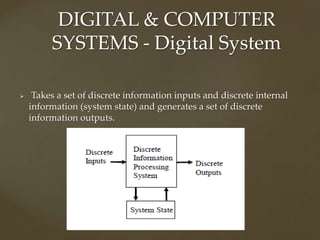
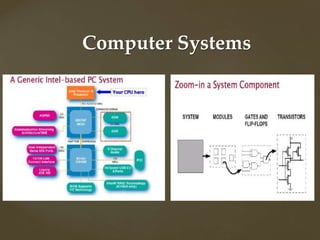
 Takes a set of discrete information inputs and discrete internal
information (system state) and generates a set of discrete
information outputs.
DIGITAL & COMPUTER
SYSTEMS - Digital System
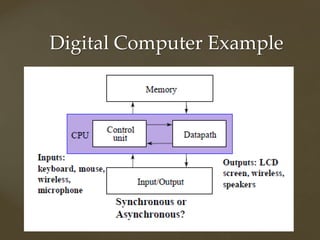
Digital Computer Example
And Beyond – Embedded
Systems
Computers as integral parts of other
products
 Examples of embedded computers
 •Microcomputers
 •Microcontrollers
 •Digital signal processors
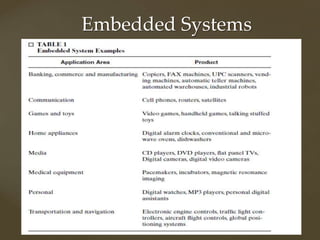
Embedded Systems
Examples of Embedded Systems
Applications
•Cell phones
•Automobiles
•Video games
•Copiers
•Flat Panel TVs
•ETC.
Embedded Systems
INFORMATION
REPRESENTATION - Signals
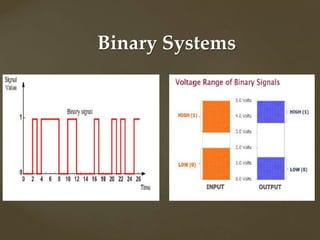
 Information variables represented by physical quantities.
 For digital systems, the variables take on discrete values.
 Two level, or binary values are the most prevalent values
in digital systems.
 Binary values are represented abstractly by:
•digits 0 and 1
•words (symbols) False (F) and True (T)
•words (symbols) Low (L) and High (H)
•and words On and Off.
 Binary values are represented by values or ranges of
values of physical quantities
Signal Examples Over Time
Digital Signal Example –
Physical Quantity: Voltage
Binary Values: Other
Physical Quantities
 What are other physical quantities represent 0
and 1?
•CPU Voltage
•Disk
•CD
•Dynamic RAM
 Binary Values: Other Physical Quantities
Magnetic Field Direction
 Surface Pits/Light
 Electrical Charge
Digital Wolrd
Digital World
 Digital systems spatially computers are driving the world
economy.
• The Internet changing the way to communicate ,shop,
learn, Invest and entertain ourselves.
 This is an amazingly fast moving business.
• Processors double in speed after few months
• The Internet doubles in speed in size and speed every year
 Computers are the most amazing and complex things ever
built by mankind
• The Intel Pentium 4 has millions transistors
• It runs 3 billions cycles per second
Analog VS Digital Systems
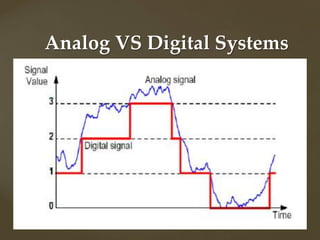
 Analog devices process signal that can assume any value across a
continuous range and produce results that are also in continuous
form.
 Digital devices process signal that take only two discrete values such
as 0 and 1 as input and produce output results that can be
represented by 0 and 1 form.
 Examples:
Analog Devices: Solid state devices TV(except for digital TV), Audio
Amplifier etc.
Digital Devices: Computer, CD Players, Digital TV, Smart Phones,
Electronic calculator and Digital Camera etc.
Analog VS Digital Systems
 Analog Systems:
• Limited precision, errors accumulate, drift
• Interface circuits (i.e. sensors and accumulators) often analog
 Digital Systems:
• More accurate and reliable
• More Precise and less
Binary Systems
Computer Systems

Digital Logic Design Lecture 01

  • 1.
  • 2.
    After studying thiscourse , students will be able to:  Introduce the basics digital systems  Understand and design digital systems  Solve complex logical problems and design digital systems Reference Books  Digital Logic and Computer Design by Morris Mano  Fundamentals of logic design by Charles H Roth ; Larry L Kinney Course Objectives
  • 3.
     Number systems Boolean algebra  Switching algebra  Logic Gates  Types of Logic  Simplification of Boolean Function  Karnaugh Map/K-MAP  Combinational logic  Building blocks: de/mux, De/encoder, shifters, Adder/ subtractor, multiplier  Logic minimization  Mixed logic  Sequential logic  Latches or Flip-flops Objective: Digital Logic design Overview
  • 4.
     Takes aset of discrete information inputs and discrete internal information (system state) and generates a set of discrete information outputs. DIGITAL & COMPUTER SYSTEMS - Digital System
  • 5.
  • 6.
    And Beyond –Embedded Systems Computers as integral parts of other products  Examples of embedded computers  •Microcomputers  •Microcontrollers  •Digital signal processors
  • 7.
    Embedded Systems Examples ofEmbedded Systems Applications •Cell phones •Automobiles •Video games •Copiers •Flat Panel TVs •ETC.
  • 8.
  • 9.
    INFORMATION REPRESENTATION - Signals Information variables represented by physical quantities.  For digital systems, the variables take on discrete values.  Two level, or binary values are the most prevalent values in digital systems.  Binary values are represented abstractly by: •digits 0 and 1 •words (symbols) False (F) and True (T) •words (symbols) Low (L) and High (H) •and words On and Off.  Binary values are represented by values or ranges of values of physical quantities
  • 10.
  • 11.
    Digital Signal Example– Physical Quantity: Voltage
  • 12.
    Binary Values: Other PhysicalQuantities  What are other physical quantities represent 0 and 1? •CPU Voltage •Disk •CD •Dynamic RAM  Binary Values: Other Physical Quantities Magnetic Field Direction  Surface Pits/Light  Electrical Charge
  • 13.
  • 14.
    Digital World  Digitalsystems spatially computers are driving the world economy. • The Internet changing the way to communicate ,shop, learn, Invest and entertain ourselves.  This is an amazingly fast moving business. • Processors double in speed after few months • The Internet doubles in speed in size and speed every year  Computers are the most amazing and complex things ever built by mankind • The Intel Pentium 4 has millions transistors • It runs 3 billions cycles per second
  • 15.
  • 16.
  • 17.
    Analog VS DigitalSystems  Analog devices process signal that can assume any value across a continuous range and produce results that are also in continuous form.  Digital devices process signal that take only two discrete values such as 0 and 1 as input and produce output results that can be represented by 0 and 1 form.  Examples: Analog Devices: Solid state devices TV(except for digital TV), Audio Amplifier etc. Digital Devices: Computer, CD Players, Digital TV, Smart Phones, Electronic calculator and Digital Camera etc.
  • 18.
    Analog VS DigitalSystems  Analog Systems: • Limited precision, errors accumulate, drift • Interface circuits (i.e. sensors and accumulators) often analog  Digital Systems: • More accurate and reliable • More Precise and less
  • 19.
  • 20.

Editor's Notes

  • #4 CMOS:complementary metal oxide semiconductor.  CMOS is a widely used type of semiconductor. Personal computers also contain a small amount of battery-powered CMOS memory to hold the date, time, and system setup parameters. Sequential logic is a form of binary circuit design that employs one or more inputs and one or more outputs, whose states are related by defined rules that depend, in part, on previous states. ... A common example of a circuit employing sequential logic is the flip-flop, also called a bistable gate. In electronics, a flip-flop or latch is a circuit that has two stable states and can be used to store state information.