Analysis & Design of
Reinforced Concrete Structures (1) Lecture.3 Working Stress Design Method
23
Dr. Muthanna Adil Najm
1- Working Stress Design Method or elastic method or alternative design method
or allowable stress design method : This method was the principal one used since
1900s to 1960s.
The working stress design method maybe expressed by the following:
Load = service (unfactored) load
aff 
Where:
f = an elastically computed stress, such as by using flexural stress =
I
cM.
for
beams.
fa = a limiting allowable stress prescribed by ACI code , as a percentage of cf  for
concrete and as a percentage of fy for steel.
2- Ultimate Strength Design Method:
In this method, service loads are increased by factors to obtain the load at which
the failure is considered to be " imminent". Also, the section strengths are reduced
by a safety reduction factors.
The ultimate strength design method maybe expressed by the following:
Strength provided ≥ Strength required to carry factored loads
Types of Beams:
1- Types of beams according to section reinforcement:
a- Singly Reinforced concrete beams : main steel reinforcement used at tension
zone only.
b- Doubly reinforced concrete beams: main steel reinforcement used at tension
zone and compression zone.
2- Types of beams according to section Shape:
a- Beams of rectangular section.
b- Beams of ( T, L & I ) section.
Design Methods
b
d
sA'
sA
b
d
sA
h
Singly Reinforced Beam Doubly Reinforced Beam
Analysis & Design of
Reinforced Concrete Structures (1) Lecture.3 Working Stress Design Method
24
Dr. Muthanna Adil Najm
c- Beams of irregular sections.
Assumptions:
1- Plain section before bending remains plain after bending.
2- Both concrete and steel obey to Hook's law.


E
3- Strain and stress are proportional to the distance from neutral axis.
4- Concrete strength in tension is negligible.
5- Perfect bond must be maintained between steel and concrete.
6- Allowable stress:
For concrete: cca ff  45.0
For steel : 140saf for fy = 300 and 350 MPa.
170saf for fy = 420 MPa
Structural Behavior of R.C. Beams:
Working Stress Design Methods
b
d
sA
cε
sε
cf
sf
tε tf
cracks
crushing
Analysis & Design of
Reinforced Concrete Structures (1) Lecture.3 Working Stress Design Method
25
Dr. Muthanna Adil Najm
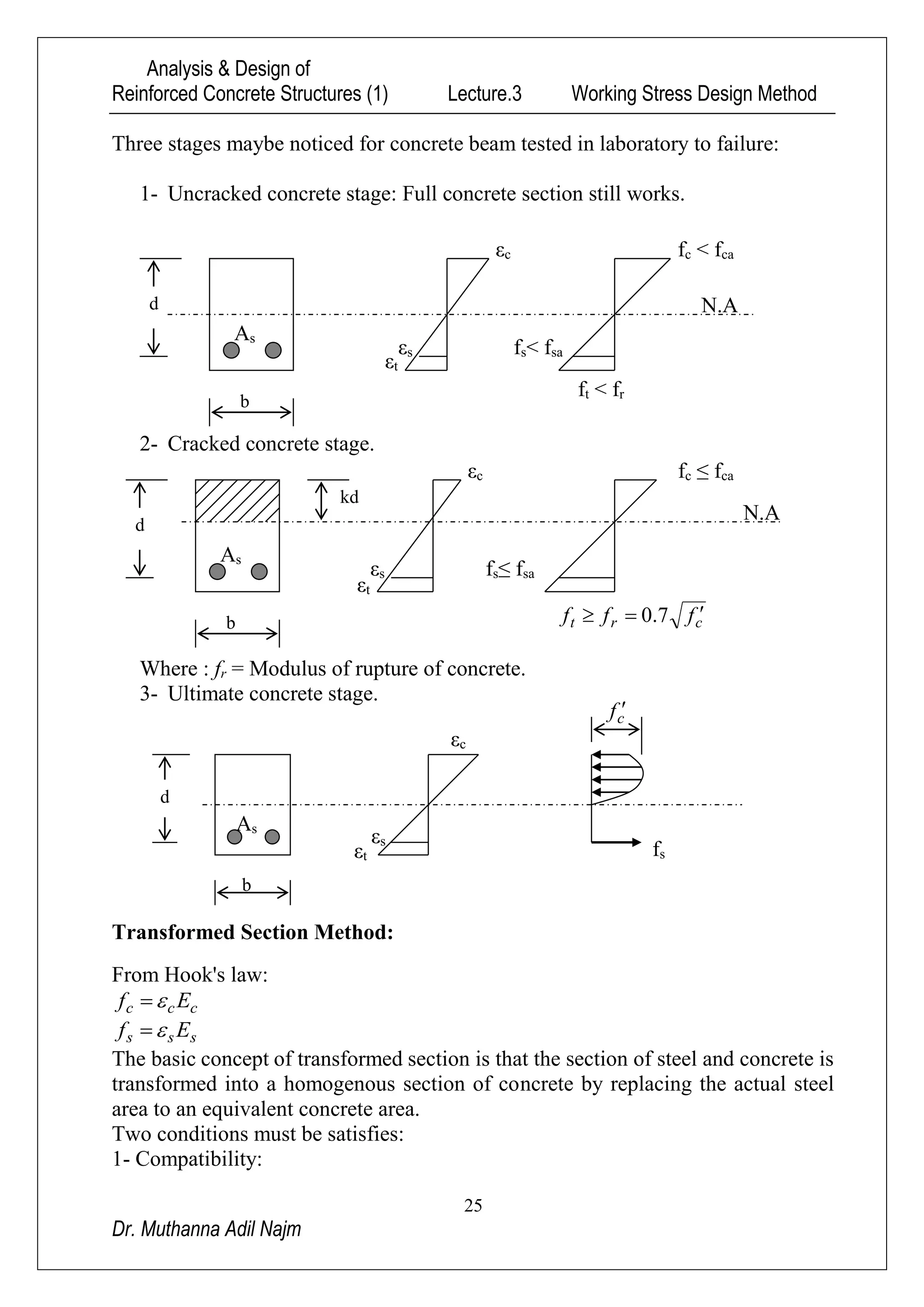
Three stages maybe noticed for concrete beam tested in laboratory to failure:
1- Uncracked concrete stage: Full concrete section still works.
2- Cracked concrete stage.
Where : fr = Modulus of rupture of concrete.
3- Ultimate concrete stage.
Transformed Section Method:
From Hook's law:
ccc Ef 
sss Ef 
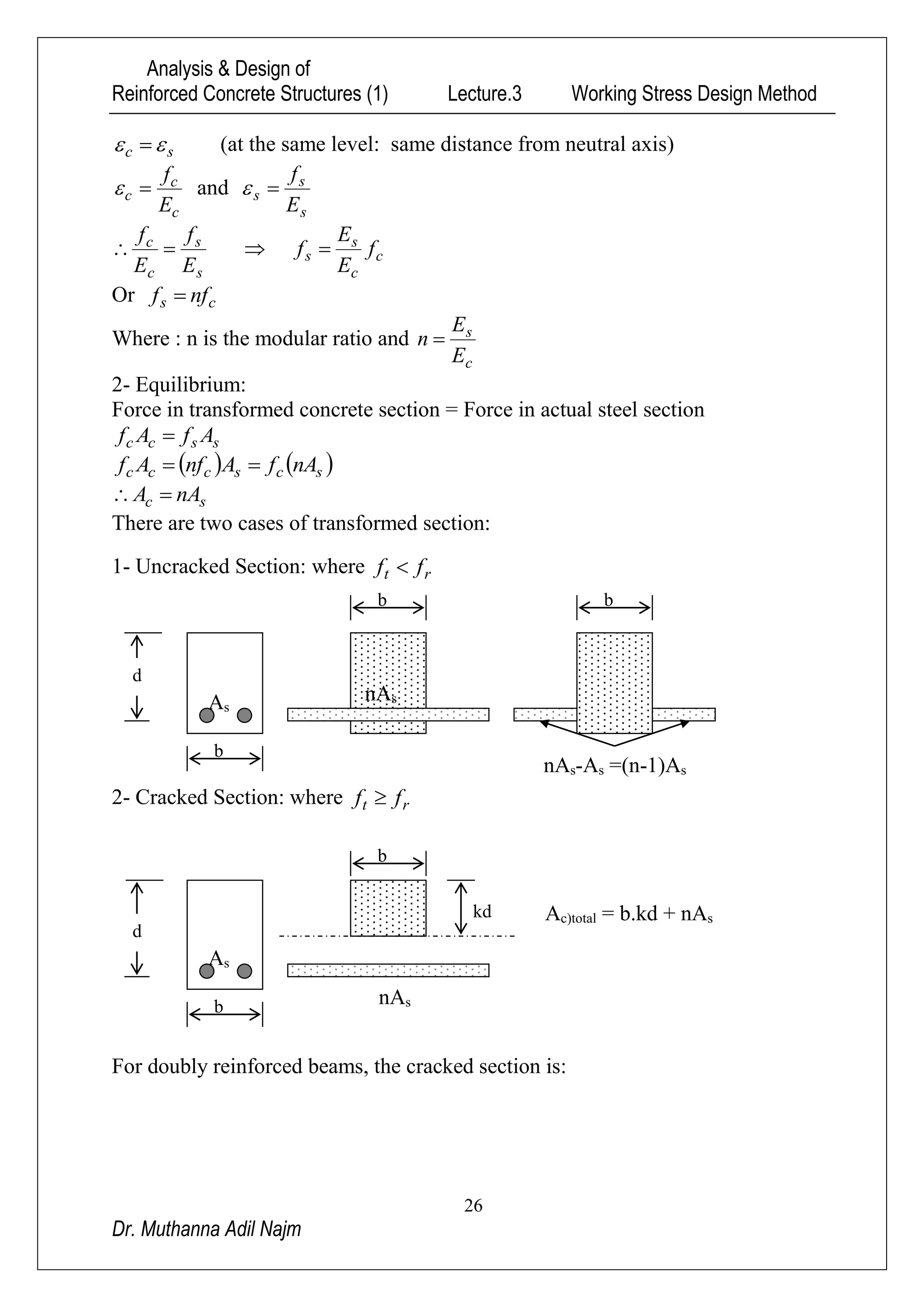
The basic concept of transformed section is that the section of steel and concrete is
transformed into a homogenous section of concrete by replacing the actual steel
area to an equivalent concrete area.
Two conditions must be satisfies:
1- Compatibility:
b
d
sA
sε
tε
cε
sf
cf 
b
d
sA
cε
sε
ac≤ fcf
as≤ fsf
tε
crt fff  7.0
N.A
kd
cε
tε
ac< fcf
as< fsf
r< ftf
sε
b
d
sA
N.A
Analysis & Design of
Reinforced Concrete Structures (1) Lecture.3 Working Stress Design Method
26
Dr. Muthanna Adil Najm
sc   (at the same level: same distance from neutral axis)
c
c
c
E
f
 and
s
s
s
E
f

s
s
c
c
E
f
E
f
  c
c
s
s f
E
E
f 
Or cs nff 
Where : n is the modular ratio and
c
s
E
E
n 
2- Equilibrium:
Force in transformed concrete section = Force in actual steel section
sscc AfAf 
   scsccc nAfAnfAf 
sc nAA 
There are two cases of transformed section:
1- Uncracked Section: where rt ff 
2- Cracked Section: where rt ff 
For doubly reinforced beams, the cracked section is:
b
d
sA
snA
b
kd s= b.kd + nAc)totalA
b
d
sA snA
s1)A-=(nsA-snA
b b
Analysis & Design of
Reinforced Concrete Structures (1) Lecture.3 Working Stress Design Method
27
Dr. Muthanna Adil Najm
Ex.1)
For the beam section shown below, if the applied moment is 35 kN.m , fr = 3.1
MPa and n = 9.
1- Calculate the maximum flexural stresses in concrete at top fiber and bottom
fiber and in steel reinforcement.
2- Calculate the cracking moment of the section.
Sol.)
  2
2
1847
4
28
3 mmAs 










    2
1647761847195003001 mmAnbhA s 
Find N.A. location by taking moment of areas about top fiber.
      mmy 265
164776
420184719250500300



        492
33
10513.3265420184719
3
235300
3
265300
mmxI 
1- Flexural stresses:
a- Tension stress at bottom fiber of concrete:
  22
9
6
/1.3/34.2
10513.3
2351035
mmNfmmN
I
Mc
f rt 



Since tension stress at bottom fiber of concrete < modulus of rupture ( rct ff  ),
then section is not crack and hence assumption is true.
b- Compression stress at top fiber of concrete:
s1)A-=(nsA-snA
300 mm
420
mm
3Ø28
500
mm
265 mm
N.A
b
d
s'A
snA
b
kd s1)A'-(2n= b.kd +c)totalA
snA+
sA
s1)A'-(2n
Analysis & Design of
Reinforced Concrete Structures (1) Lecture.3 Working Stress Design Method
28
Dr. Muthanna Adil Najm
  2
9
6
/64.2
10513.3
2651035
mmN
I
Mc
fc 



c- Stress in steel:
  2
9
6
/9.13
10513.3
1551035
mmN
I
Mc
nfs 



2- Cracking moment ( Mcr ):
  mkNmmN
c
If
M r
cr .34.46.1034.46
235
10513.31.3 6
9



Ex.2)
Calculate the maximum flexural stresses for the beam section shown below, if the
applied moment is 95 kN.m , and n = 9. Compare with allowable stresses if fy =
420 MPa and f 'c = 25 MPa.
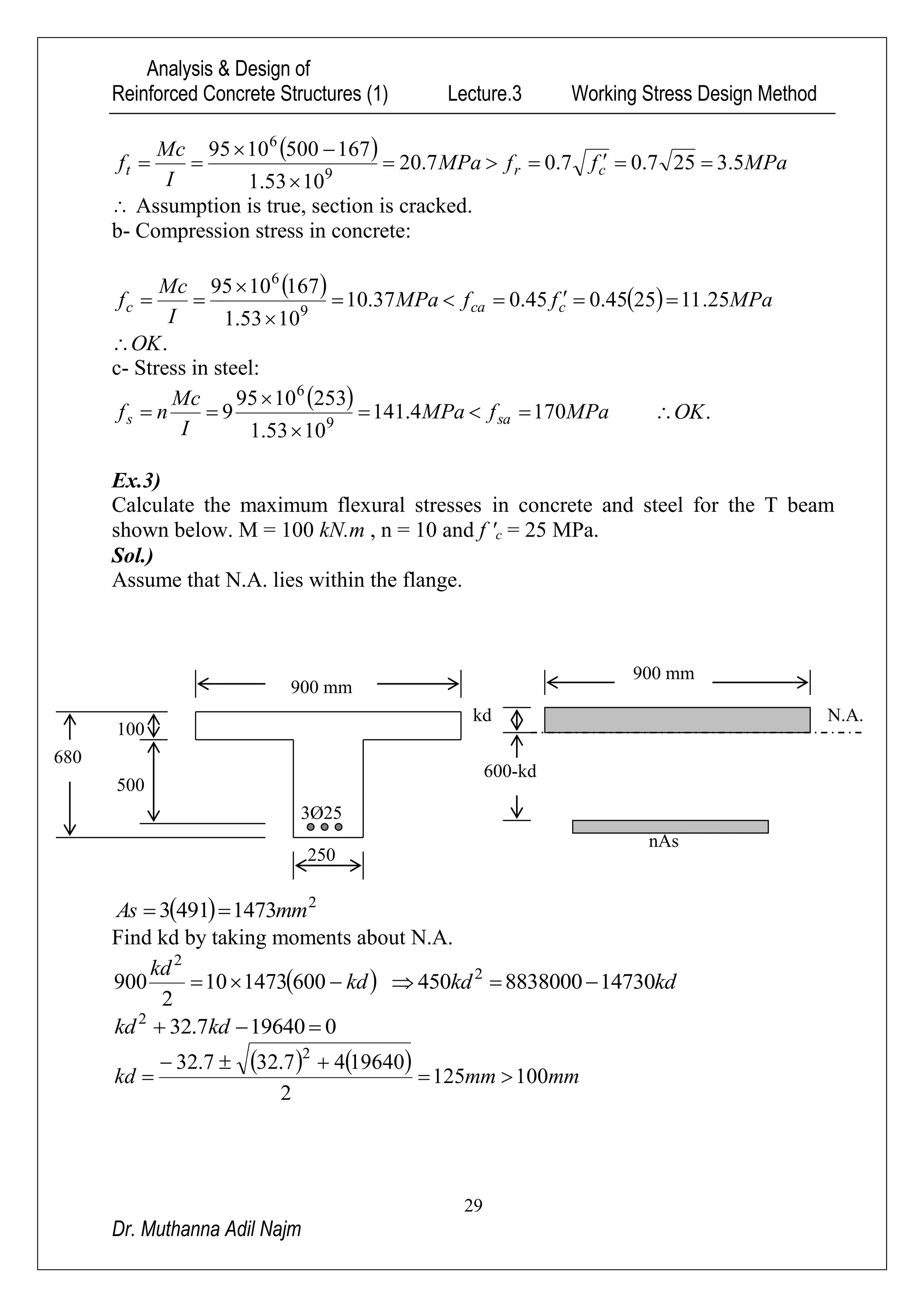
Sol.)
Assume cracked section. Find kd by taking moments about the N.A.
 kddnA
kd
kd s 
2
300   kd
kd
kd  42018479
2
300
kdkd 166236981660150 2

0465441112
 kdkd
   
mmkd 167
2
445111
2
465444111111 2





    492
3
1053.116742018479
3
167300
mmI 
a- Tension stress in concrete:
300 mm
420
mm
3Ø28
500
mm
2
= 9(1847) = 16623mmsnA
kd = 167 mm
N.A
300 mm
420 - kd =
253 mm
Analysis & Design of
Reinforced Concrete Structures (1) Lecture.3 Working Stress Design Method
29
Dr. Muthanna Adil Najm
  MPaffMPa
I
Mc
f crt 5.3257.07.07.20
1053.1
1675001095
9
6




 Assumption is true, section is cracked.
b- Compression stress in concrete:
    MPaffMPa
I
Mc
f ccac 25.112545.045.037.10
1053.1
1671095
9
6




.OK
c- Stress in steel:
  MPafMPa
I
Mc
nf sas 1704.141
1053.1
2531095
9 9
6



 .OK
Ex.3)
Calculate the maximum flexural stresses in concrete and steel for the T beam
shown below. M = 100 kN.m , n = 10 and f 'c = 25 MPa.
Sol.)
Assume that N.A. lies within the flange.
  2
14734913 mmAs 
Find kd by taking moments about N.A.
 kd
kd
 600147310
2
900
2
kdkd 147308838000450 2

0196407.322
 kdkd
   
mmmmkd 100125
2
1964047.327.32 2



kd
600-kd
900 mm
nAs
N.A.
100
500
900 mm
3Ø25
250
680
Analysis & Design of
Reinforced Concrete Structures (1) Lecture.3 Working Stress Design Method
30
Dr. Muthanna Adil Najm
 Assumption is false and N.A. lies at the web.
Find kd by taking moments about N.A.
     


2
100
10025050100900
kd
kdkd
 kd 600147310
0967046382
 kdkd
   
mmmmkd 100126
2
967044638638 2



       492
33
10906.3126600147310
3
26250900
3
126900
mmI 


a- Tension stress in concrete:
  MPaffMPa
I
Mc
f crt 5.3257.07.02.14
10906.3
12668010100
9
6




 Assumption is true, section is cracked.
b- Compression stress in concrete:
  MPa
I
Mc
fc 23.3
10906.3
12610100
9
6




c- Stress in steel:
  MPa
I
Mc
nfs 35.121
10906.3
12660010100
10 9
6




Ex.4)
Calculate the maximum stresses in concrete and steel for the beam section shown
below. M = 160 kN.m , n = 10 and f 'c = 25 MPa.
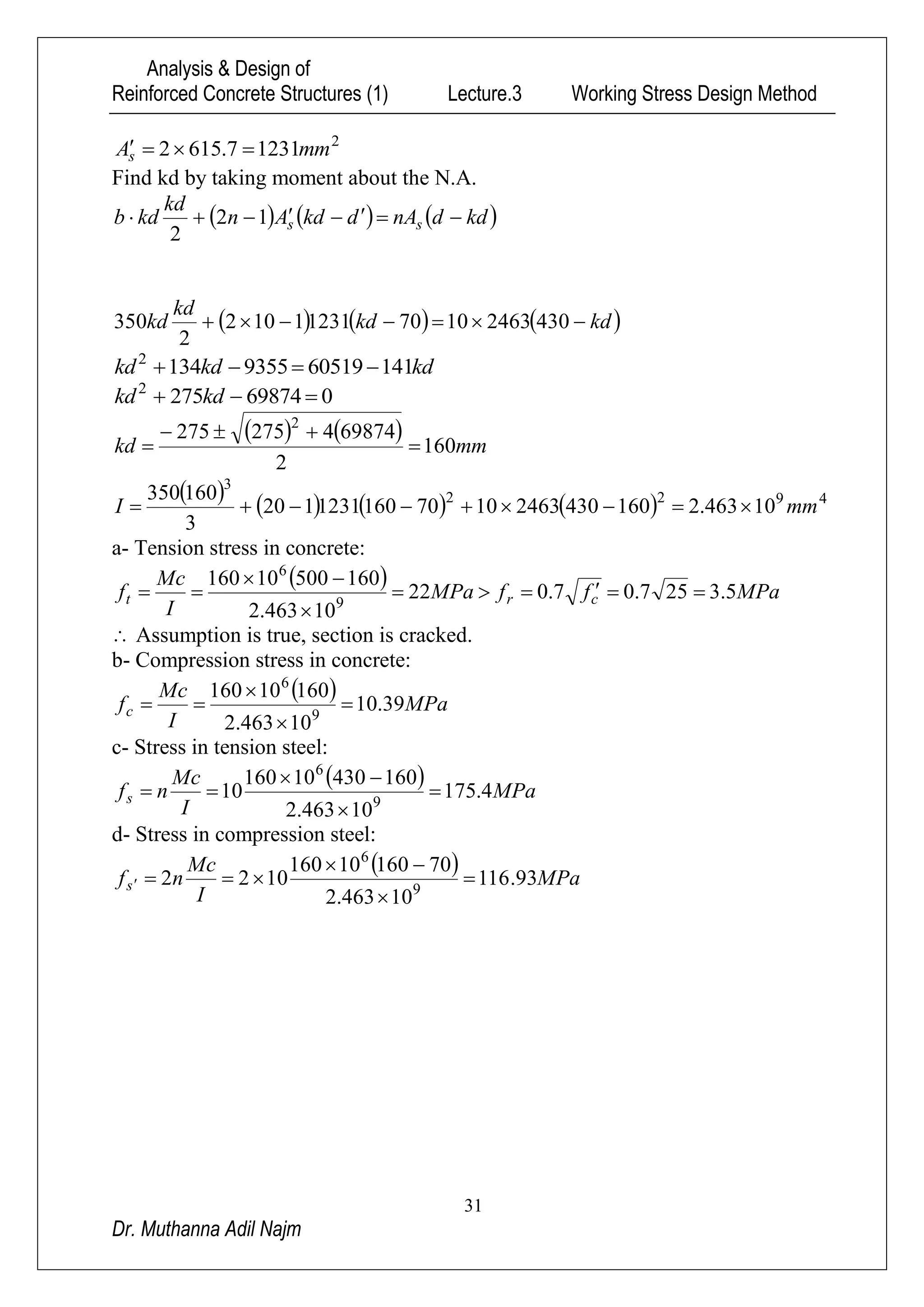
Sol.)
2
24637.6154 mmAs 
kd
600-kd
900 mm
nAs
N.A.
250 mm
350 mm
360
70
70
500mm
2Ø28
4Ø28 430-kd
snA
350
kd
s1)A'-(2n
N.A.
Analysis & Design of
Reinforced Concrete Structures (1) Lecture.3 Working Stress Design Method
31
Dr. Muthanna Adil Najm
2
12317.6152 mmAs 
Find kd by taking moment about the N.A.
     kddnAdkdAn
kd
kdb ss  12
2
     kdkd
kd
kd  4302463107012311102
2
350
kdkdkd 1416051993551342

0698742752
 kdkd
   
mmkd 160
2
698744275275 2



        4922
3
10463.2160430246310701601231120
3
160350
mmI 
a- Tension stress in concrete:
  MPaffMPa
I
Mc
f crt 5.3257.07.022
10463.2
16050010160
9
6




 Assumption is true, section is cracked.
b- Compression stress in concrete:
  MPa
I
Mc
fc 39.10
10463.2
16010160
9
6




c- Stress in tension steel:
  MPa
I
Mc
nfs 4.175
10463.2
16043010160
10 9
6




d- Stress in compression steel:
  MPa
I
Mc
nfs 93.116
10463.2
7016010160
1022 9
6





Lec.3 working stress 1

  • 1.
    Analysis & Designof Reinforced Concrete Structures (1) Lecture.3 Working Stress Design Method 23 Dr. Muthanna Adil Najm 1- Working Stress Design Method or elastic method or alternative design method or allowable stress design method : This method was the principal one used since 1900s to 1960s. The working stress design method maybe expressed by the following: Load = service (unfactored) load aff  Where: f = an elastically computed stress, such as by using flexural stress = I cM. for beams. fa = a limiting allowable stress prescribed by ACI code , as a percentage of cf  for concrete and as a percentage of fy for steel. 2- Ultimate Strength Design Method: In this method, service loads are increased by factors to obtain the load at which the failure is considered to be " imminent". Also, the section strengths are reduced by a safety reduction factors. The ultimate strength design method maybe expressed by the following: Strength provided ≥ Strength required to carry factored loads Types of Beams: 1- Types of beams according to section reinforcement: a- Singly Reinforced concrete beams : main steel reinforcement used at tension zone only. b- Doubly reinforced concrete beams: main steel reinforcement used at tension zone and compression zone. 2- Types of beams according to section Shape: a- Beams of rectangular section. b- Beams of ( T, L & I ) section. Design Methods b d sA' sA b d sA h Singly Reinforced Beam Doubly Reinforced Beam
  • 2.
    Analysis & Designof Reinforced Concrete Structures (1) Lecture.3 Working Stress Design Method 24 Dr. Muthanna Adil Najm c- Beams of irregular sections. Assumptions: 1- Plain section before bending remains plain after bending. 2- Both concrete and steel obey to Hook's law.   E 3- Strain and stress are proportional to the distance from neutral axis. 4- Concrete strength in tension is negligible. 5- Perfect bond must be maintained between steel and concrete. 6- Allowable stress: For concrete: cca ff  45.0 For steel : 140saf for fy = 300 and 350 MPa. 170saf for fy = 420 MPa Structural Behavior of R.C. Beams: Working Stress Design Methods b d sA cε sε cf sf tε tf cracks crushing
  • 3.
    Analysis & Designof Reinforced Concrete Structures (1) Lecture.3 Working Stress Design Method 25 Dr. Muthanna Adil Najm Three stages maybe noticed for concrete beam tested in laboratory to failure: 1- Uncracked concrete stage: Full concrete section still works. 2- Cracked concrete stage. Where : fr = Modulus of rupture of concrete. 3- Ultimate concrete stage. Transformed Section Method: From Hook's law: ccc Ef  sss Ef  The basic concept of transformed section is that the section of steel and concrete is transformed into a homogenous section of concrete by replacing the actual steel area to an equivalent concrete area. Two conditions must be satisfies: 1- Compatibility: b d sA sε tε cε sf cf  b d sA cε sε ac≤ fcf as≤ fsf tε crt fff  7.0 N.A kd cε tε ac< fcf as< fsf r< ftf sε b d sA N.A
  • 4.
    Analysis & Designof Reinforced Concrete Structures (1) Lecture.3 Working Stress Design Method 26 Dr. Muthanna Adil Najm sc   (at the same level: same distance from neutral axis) c c c E f  and s s s E f  s s c c E f E f   c c s s f E E f  Or cs nff  Where : n is the modular ratio and c s E E n  2- Equilibrium: Force in transformed concrete section = Force in actual steel section sscc AfAf     scsccc nAfAnfAf  sc nAA  There are two cases of transformed section: 1- Uncracked Section: where rt ff  2- Cracked Section: where rt ff  For doubly reinforced beams, the cracked section is: b d sA snA b kd s= b.kd + nAc)totalA b d sA snA s1)A-=(nsA-snA b b
  • 5.
    Analysis & Designof Reinforced Concrete Structures (1) Lecture.3 Working Stress Design Method 27 Dr. Muthanna Adil Najm Ex.1) For the beam section shown below, if the applied moment is 35 kN.m , fr = 3.1 MPa and n = 9. 1- Calculate the maximum flexural stresses in concrete at top fiber and bottom fiber and in steel reinforcement. 2- Calculate the cracking moment of the section. Sol.)   2 2 1847 4 28 3 mmAs                2 1647761847195003001 mmAnbhA s  Find N.A. location by taking moment of areas about top fiber.       mmy 265 164776 420184719250500300            492 33 10513.3265420184719 3 235300 3 265300 mmxI  1- Flexural stresses: a- Tension stress at bottom fiber of concrete:   22 9 6 /1.3/34.2 10513.3 2351035 mmNfmmN I Mc f rt     Since tension stress at bottom fiber of concrete < modulus of rupture ( rct ff  ), then section is not crack and hence assumption is true. b- Compression stress at top fiber of concrete: s1)A-=(nsA-snA 300 mm 420 mm 3Ø28 500 mm 265 mm N.A b d s'A snA b kd s1)A'-(2n= b.kd +c)totalA snA+ sA s1)A'-(2n
  • 6.
    Analysis & Designof Reinforced Concrete Structures (1) Lecture.3 Working Stress Design Method 28 Dr. Muthanna Adil Najm   2 9 6 /64.2 10513.3 2651035 mmN I Mc fc     c- Stress in steel:   2 9 6 /9.13 10513.3 1551035 mmN I Mc nfs     2- Cracking moment ( Mcr ):   mkNmmN c If M r cr .34.46.1034.46 235 10513.31.3 6 9    Ex.2) Calculate the maximum flexural stresses for the beam section shown below, if the applied moment is 95 kN.m , and n = 9. Compare with allowable stresses if fy = 420 MPa and f 'c = 25 MPa. Sol.) Assume cracked section. Find kd by taking moments about the N.A.  kddnA kd kd s  2 300   kd kd kd  42018479 2 300 kdkd 166236981660150 2  0465441112  kdkd     mmkd 167 2 445111 2 465444111111 2          492 3 1053.116742018479 3 167300 mmI  a- Tension stress in concrete: 300 mm 420 mm 3Ø28 500 mm 2 = 9(1847) = 16623mmsnA kd = 167 mm N.A 300 mm 420 - kd = 253 mm
  • 7.
    Analysis & Designof Reinforced Concrete Structures (1) Lecture.3 Working Stress Design Method 29 Dr. Muthanna Adil Najm   MPaffMPa I Mc f crt 5.3257.07.07.20 1053.1 1675001095 9 6      Assumption is true, section is cracked. b- Compression stress in concrete:     MPaffMPa I Mc f ccac 25.112545.045.037.10 1053.1 1671095 9 6     .OK c- Stress in steel:   MPafMPa I Mc nf sas 1704.141 1053.1 2531095 9 9 6     .OK Ex.3) Calculate the maximum flexural stresses in concrete and steel for the T beam shown below. M = 100 kN.m , n = 10 and f 'c = 25 MPa. Sol.) Assume that N.A. lies within the flange.   2 14734913 mmAs  Find kd by taking moments about N.A.  kd kd  600147310 2 900 2 kdkd 147308838000450 2  0196407.322  kdkd     mmmmkd 100125 2 1964047.327.32 2    kd 600-kd 900 mm nAs N.A. 100 500 900 mm 3Ø25 250 680
  • 8.
    Analysis & Designof Reinforced Concrete Structures (1) Lecture.3 Working Stress Design Method 30 Dr. Muthanna Adil Najm  Assumption is false and N.A. lies at the web. Find kd by taking moments about N.A.         2 100 10025050100900 kd kdkd  kd 600147310 0967046382  kdkd     mmmmkd 100126 2 967044638638 2           492 33 10906.3126600147310 3 26250900 3 126900 mmI    a- Tension stress in concrete:   MPaffMPa I Mc f crt 5.3257.07.02.14 10906.3 12668010100 9 6      Assumption is true, section is cracked. b- Compression stress in concrete:   MPa I Mc fc 23.3 10906.3 12610100 9 6     c- Stress in steel:   MPa I Mc nfs 35.121 10906.3 12660010100 10 9 6     Ex.4) Calculate the maximum stresses in concrete and steel for the beam section shown below. M = 160 kN.m , n = 10 and f 'c = 25 MPa. Sol.) 2 24637.6154 mmAs  kd 600-kd 900 mm nAs N.A. 250 mm 350 mm 360 70 70 500mm 2Ø28 4Ø28 430-kd snA 350 kd s1)A'-(2n N.A.
  • 9.
    Analysis & Designof Reinforced Concrete Structures (1) Lecture.3 Working Stress Design Method 31 Dr. Muthanna Adil Najm 2 12317.6152 mmAs  Find kd by taking moment about the N.A.      kddnAdkdAn kd kdb ss  12 2      kdkd kd kd  4302463107012311102 2 350 kdkdkd 1416051993551342  0698742752  kdkd     mmkd 160 2 698744275275 2            4922 3 10463.2160430246310701601231120 3 160350 mmI  a- Tension stress in concrete:   MPaffMPa I Mc f crt 5.3257.07.022 10463.2 16050010160 9 6      Assumption is true, section is cracked. b- Compression stress in concrete:   MPa I Mc fc 39.10 10463.2 16010160 9 6     c- Stress in tension steel:   MPa I Mc nfs 4.175 10463.2 16043010160 10 9 6     d- Stress in compression steel:   MPa I Mc nfs 93.116 10463.2 7016010160 1022 9 6    