Chapter 5The 1st chapter in 2nd term
Introduction :In this chapter we care for the analysis and the design of beams ,structural members supporting loads applied at different points ,In most cases ,the loads are perpendicular to the axis of the beam ,when loads aren’t at right angles they also produce axial forces .
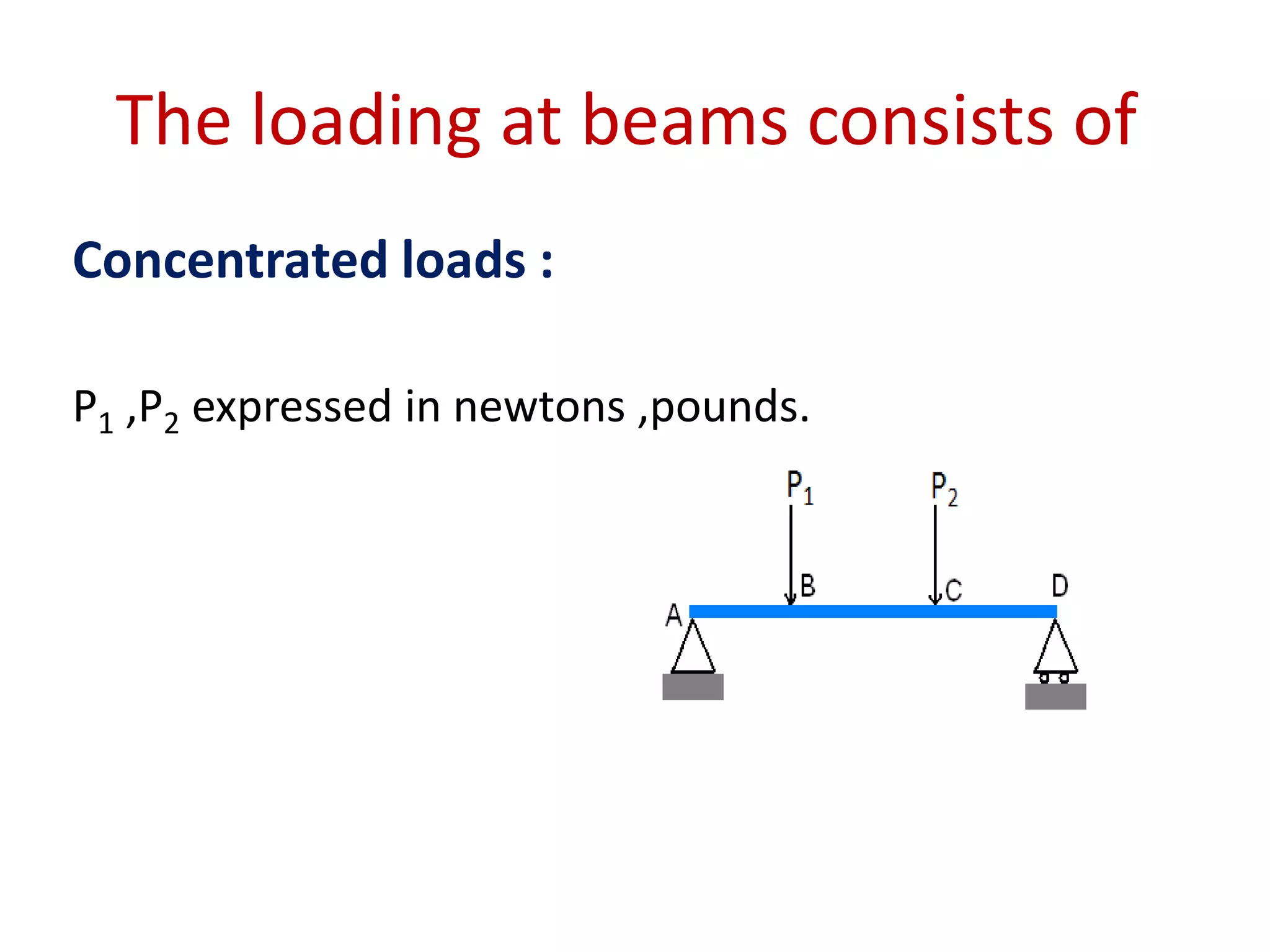
The loading at beams consists of Concentrated loads :P1,P2 expressed in newtons ,pounds.
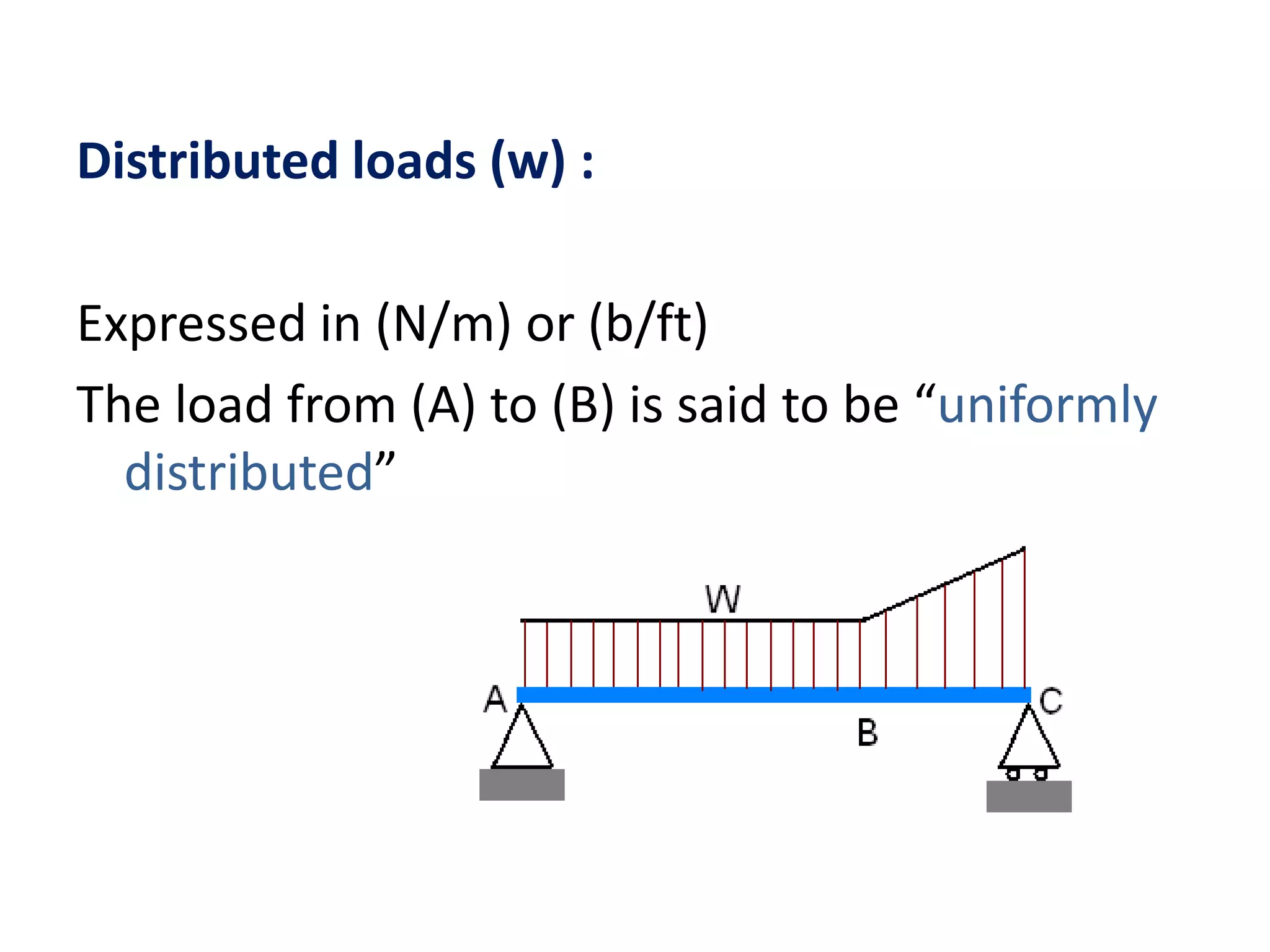
Distributedloads(w) :Expressed in (N/m) or (b/ft)The load from (A) to (B) is said to be “uniformly distributed”
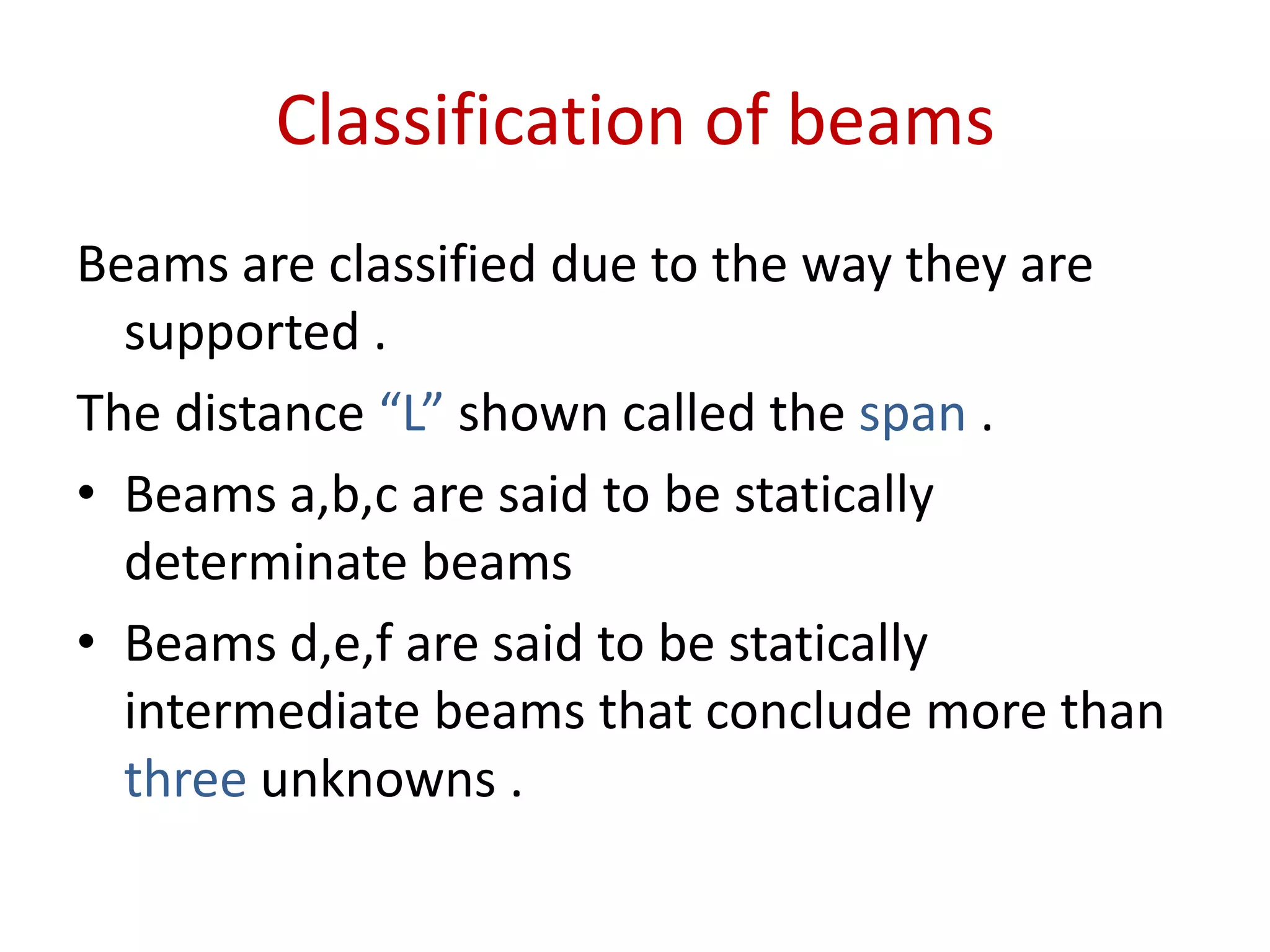
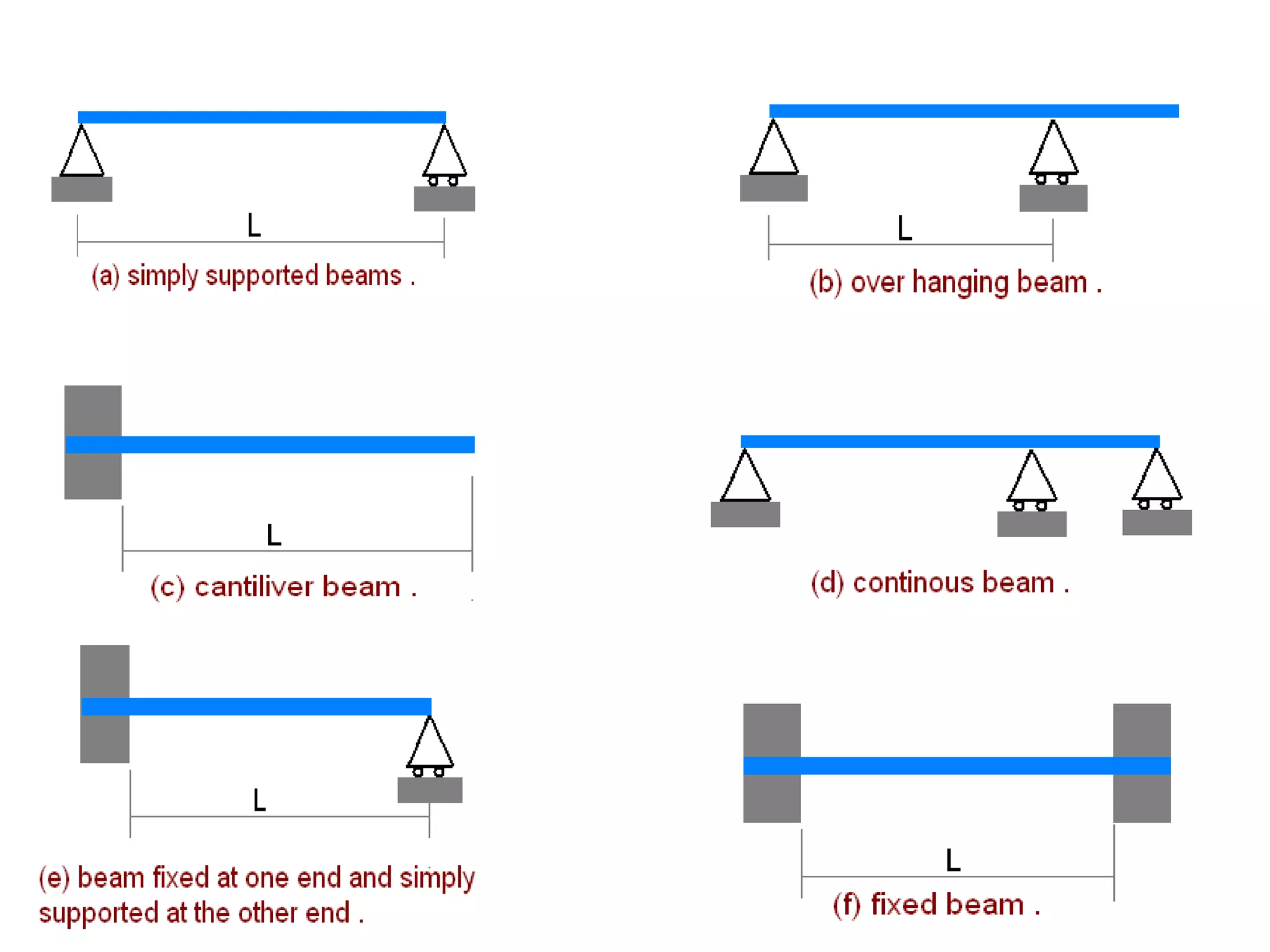
Classification of beamsBeams are classified due to the way they are supported .The distance “L” shown called the span .Beams a,b,c are said to be statically determinate beamsBeams d,e,f are said to be statically intermediate beams that conclude more than three unknowns .
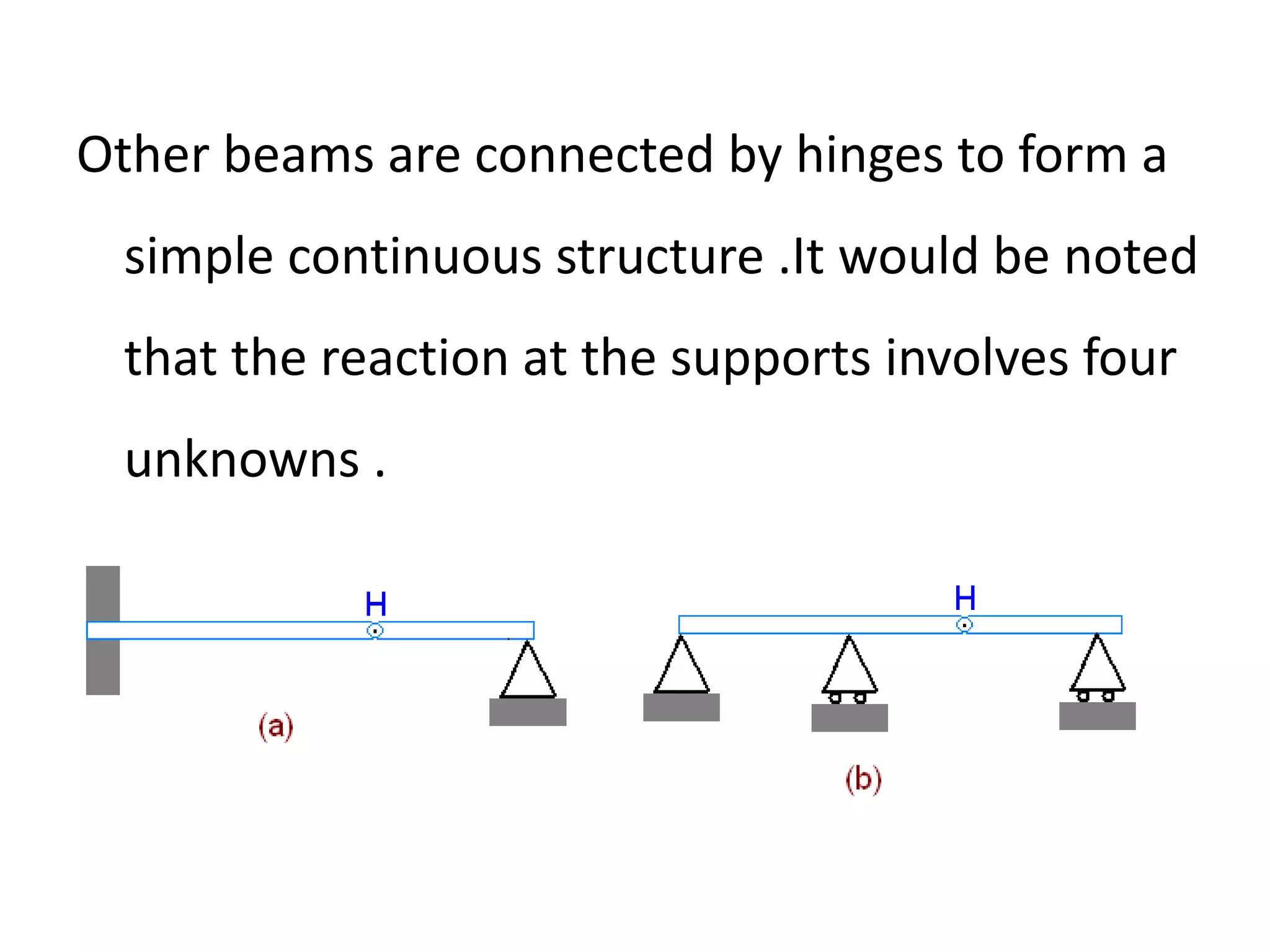
Other beams are connected by hinges to form a simple continuous structure .It would be noted that the reaction at the supports involves four unknowns .
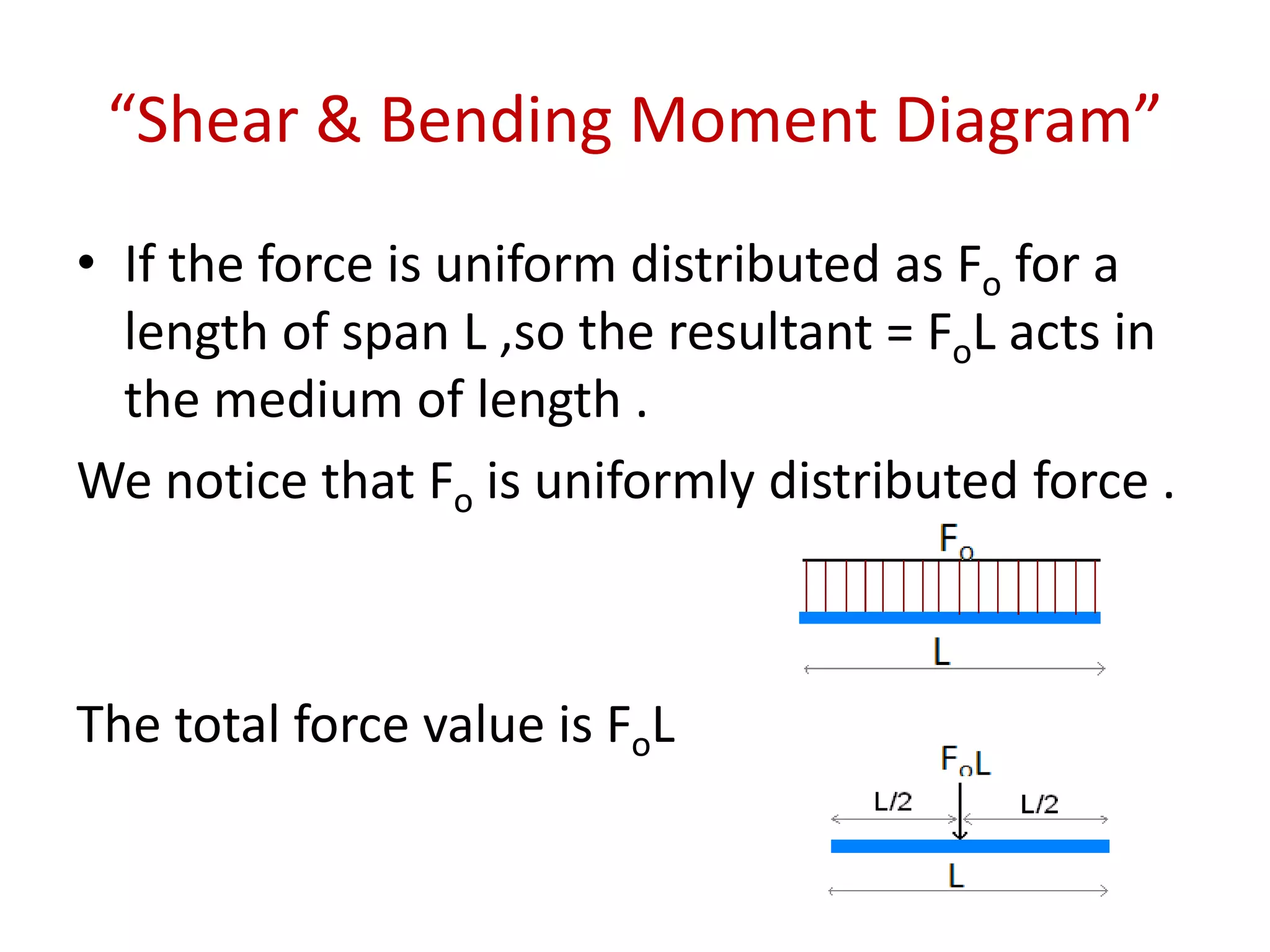
“Shear & Bending Moment Diagram”If the force is uniform distributed as Fo for a length of span L ,so the resultant = FoL acts in the medium of length .We notice that Fo is uniformly distributed force .The total force value is FoL
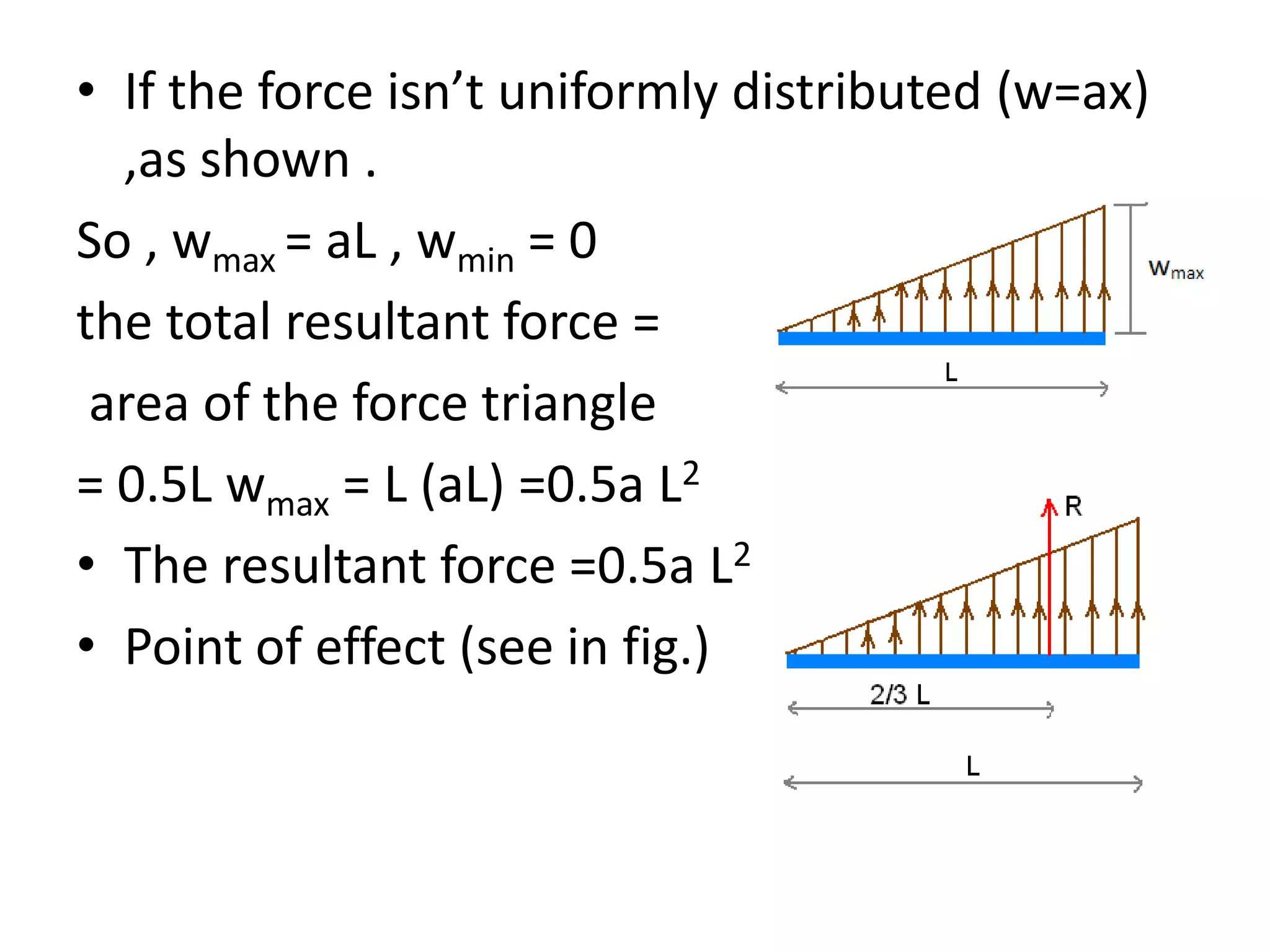
If the force isn’t uniformly distributed (w=ax) ,as shown .So ,wmax= aL , wmin = 0the total resultant force =area of the force triangle = 0.5L wmax = L (aL) =0.5a L2The resultant force =0.5a L2Point of effect (see in fig.)
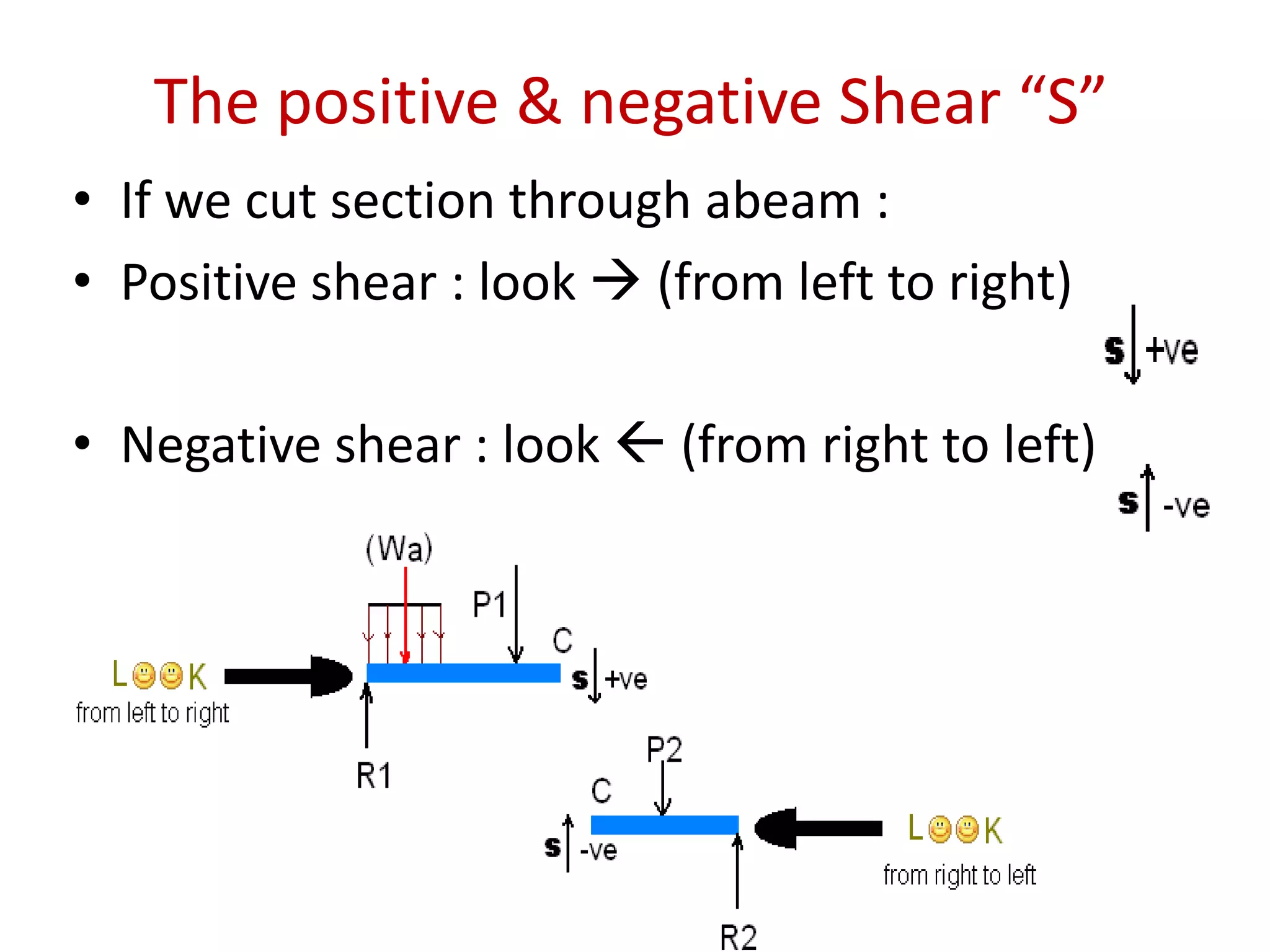
The positive & negative Shear “S”If we cut section through abeam :Positive shear : look  (from left to right) Negative shear : look  (from right to left)
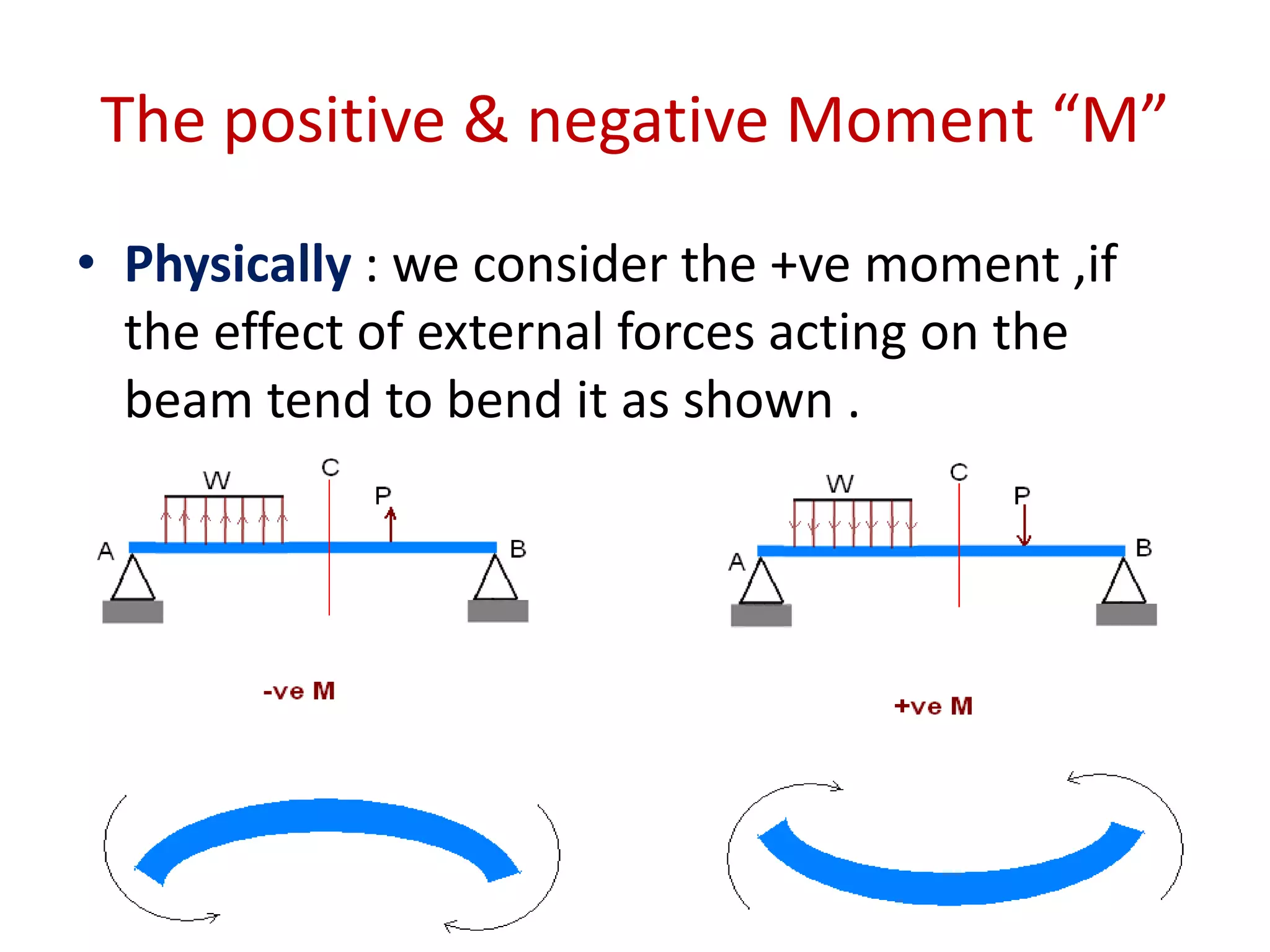
The positive & negative Moment “M”Physically : we consider the +ve moment ,if the effect of external forces acting on the beam tend to bend it as shown .
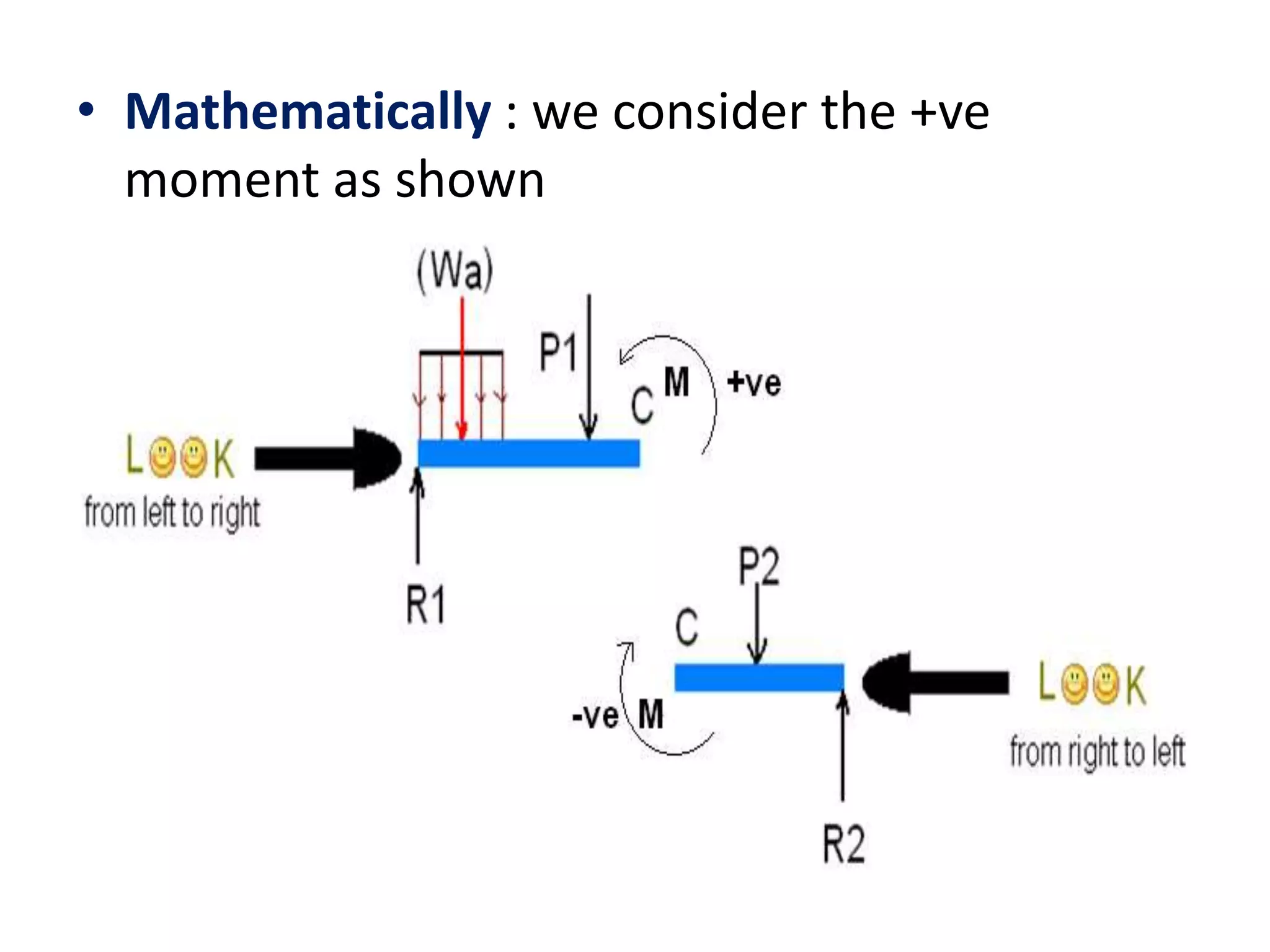
Mathematically : we consider the +ve moment as shown
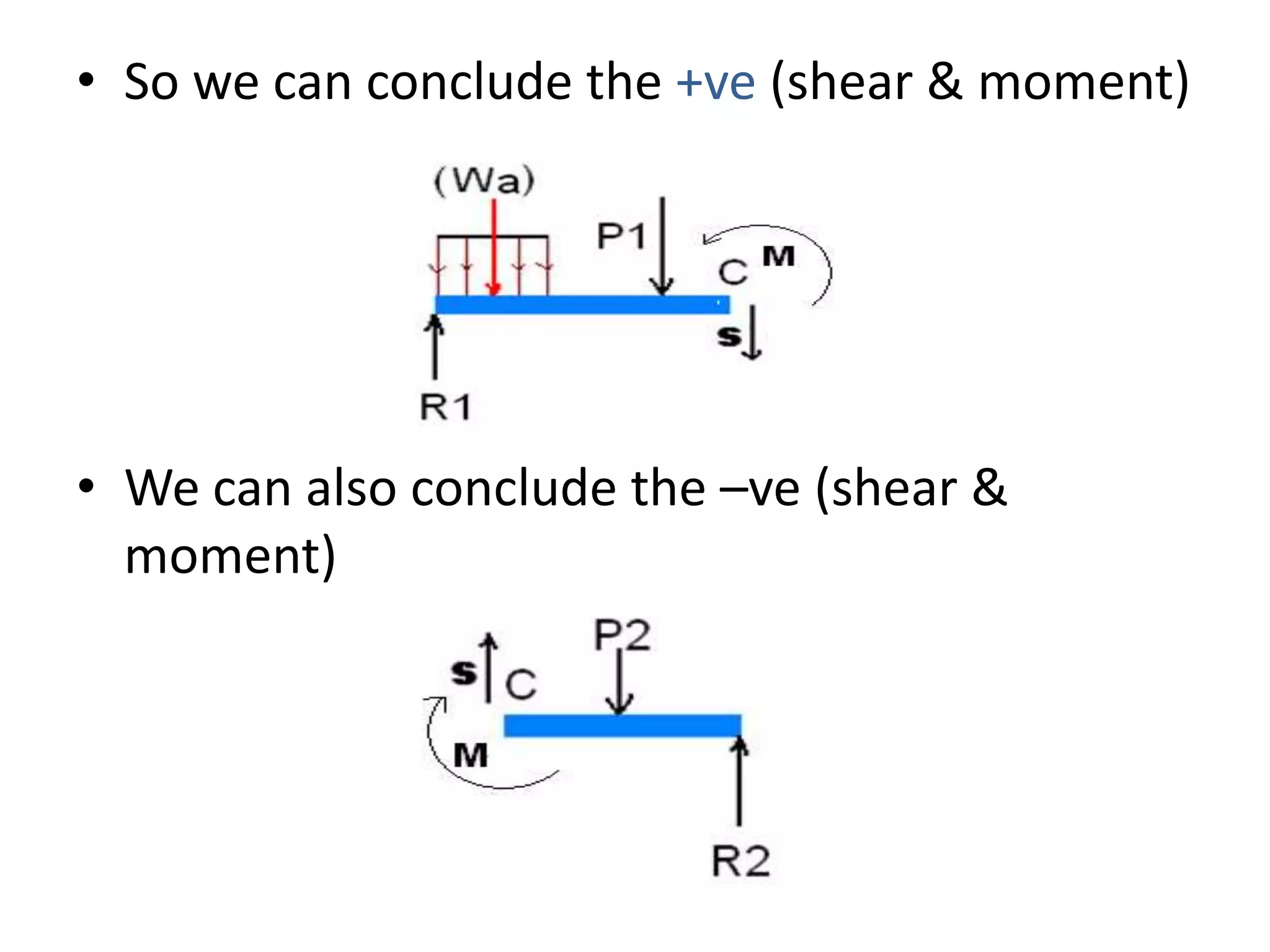
So we can conclude the +ve (shear & moment) We can also conclude the –ve (shear & moment)

Shear & Bending Moment Diagram

  • 1.
    Chapter 5The 1stchapter in 2nd term
  • 2.
    Introduction :In thischapter we care for the analysis and the design of beams ,structural members supporting loads applied at different points ,In most cases ,the loads are perpendicular to the axis of the beam ,when loads aren’t at right angles they also produce axial forces .
  • 3.
    The loading atbeams consists of Concentrated loads :P1,P2 expressed in newtons ,pounds.
  • 4.
    Distributedloads(w) :Expressed in(N/m) or (b/ft)The load from (A) to (B) is said to be “uniformly distributed”
  • 5.
    Classification of beamsBeamsare classified due to the way they are supported .The distance “L” shown called the span .Beams a,b,c are said to be statically determinate beamsBeams d,e,f are said to be statically intermediate beams that conclude more than three unknowns .
  • 7.
    Other beams areconnected by hinges to form a simple continuous structure .It would be noted that the reaction at the supports involves four unknowns .
  • 8.
    “Shear & BendingMoment Diagram”If the force is uniform distributed as Fo for a length of span L ,so the resultant = FoL acts in the medium of length .We notice that Fo is uniformly distributed force .The total force value is FoL
  • 9.
    If the forceisn’t uniformly distributed (w=ax) ,as shown .So ,wmax= aL , wmin = 0the total resultant force =area of the force triangle = 0.5L wmax = L (aL) =0.5a L2The resultant force =0.5a L2Point of effect (see in fig.)
  • 10.
    The positive &negative Shear “S”If we cut section through abeam :Positive shear : look  (from left to right) Negative shear : look  (from right to left)
  • 11.
    The positive &negative Moment “M”Physically : we consider the +ve moment ,if the effect of external forces acting on the beam tend to bend it as shown .
  • 12.
    Mathematically : weconsider the +ve moment as shown
  • 13.
    So we canconclude the +ve (shear & moment) We can also conclude the –ve (shear & moment)